Jan and Leo Lucassen deserve tremendous credit for their effort to quantify mobility in historic societies that did not maintain public migration statistics and, moreover, for a long time period and for the whole of Europe.Footnote 1 Their article goes far beyond a critique of the ‘mobility transition hypothesis’. The Lucassens not only demonstrate the high degree and the rich diversity of geographical mobility in early modern Europe; they also refute any idea of linear trends in the history of mobility. One of the most exciting of their results is, in my view, the evidence for varying rhythms of levels of mobility throughout early modern times, both in respect to migration types and to immigration/emigration regions. Their approach to quantifying early modern migration reveals previously unknown structures of mobility in pre-industrial Europe. This will intensively stimulate research and discussions in migration history in Europe and beyond.
My commentary concentrates on three themes. First, I will discuss some basic methodological decisions made by the Lucassens. Second, I will look at types of migration and migratory groups that are not treated in sufficient depth by the Lucassens, or that need additional discussion: rural-to-rural migration, migration to cities, and tramping artisans. Finally, I would like to discuss a point of accord between the Lucassens and modernization scholars, including proponents of the ‘mobility transition hypothesis’ – namely the assumption that ‘there was indeed a sharp jump in the level of migration after 1850’ and that the ‘period 1850–1900 was indeed spectacular’.Footnote 2 Even if most migration historians would subscribe to this hypothesis, the topic is much more complicated and the evidence is not as clear as it might seem upon initial inspection.
Conceptual framework
My first argument concerns the conceptual framework and definitions used by Jan and Leo Lucassen for making calculations. Definitions that are as precise as possible are certainly indispensable for quantitative historical analysis. Furthermore, quantification requires the choice of particular concepts, methods, and clear-cut variables at the expense of others. Therefore, the authors make two basic choices. First, they concentrate on a particular type of migration only, namely on ‘cross-community migration’ as understood by Patrick Manning. Second, they decided to count the number of migrants and not of migratory acts or moves, as many historical migration studies have done and as most recent migration statistics do. Any such decision implies benefits and risks. The benefits of the Lucassens’ decisions are clear and remarkable. First and foremost, they proved to be practicable. They allowed the construction of a comprehensive quantitative picture of migration in the whole of Europe over a time period of 300 to 400 years, and they also made it possible to differentiate between different types of migrants. Therefore, the choices made by the authors have been remarkably successful and are legitimized by their results.
Both decisions also give rise to concern, however. To start with, the limitation of the analysis to ‘cross-community migration’ is only partially valid with respect to the ‘mobility transition hypothesis’. The idea that, before the Industrial Revolution, there was almost no geographical mobility, or only strictly limited mobility, excludes all forms of migration, micro-moves as well as meso- and macro- ones. This view was not only held by social scientists such as the geographer Wilbur Zelinsky but also by innovative social historians of the 1970s, and it is still present in historiography (aside from migration history). In Germany, Harmut Kaelble wrote in 1979 that there prevailed ‘broad unanimity that industrialization, at least in Europe, led to an extraordinary spatial and occupational mobilization of the members of those societies and thus to a decisive break with less mobile pre-industrial society’.Footnote 3 Moreover, German perceptions of nineteenth-century mass migration strongly emphasized transatlantic emigration at the expense of other forms of migration. Wolfgang Koellmann, another very influential German social historian of the 1960s and 1970s, was convinced that, even in the first half of the nineteenth century, transcontinental emigration was the crucial form of geographical mobility in Germany, while migratory moves within the country (Binnenmigration) did not gain significance before the period of complete industrialization (Zeitalter der Hochindustrialisierung) between 1860 and 1914.Footnote 4 A comprehensive critique of the ‘mobility transition hypothesis’ should therefore include all forms of mobility. Being aware of all methodological risks, I would nevertheless advocate a broad concept of migration.
Second, I wonder whether Patrick Manning’s concept of ‘cross-community migration’ is the best analytical tool for the understanding of migratory moves in early modern Europe. I also have the impression that the Lucassens do not apply this concept strictly. Manning developed his migration typology for the analysis of ‘world history’ in a twofold sense: first, in respect to the whole globe, and second, in respect to the ‘long term interpretation of human migratory processes’ from the very beginnings of mankind ‘since the African Eve’.Footnote 5 In this extremely broad perspective, his intention is to make use of historical linguistics for the study of human migration. Accordingly, he defines ‘community’ as a ‘language community’ that, in turn, is linked to ‘customs’ and a ‘habitat’.Footnote 6 Manning’s approach looks quite convincing at the most general level – both spatial and temporal – of ‘world history’. But is it also the best tool for the analysis of the migration history of early modern Europe – that is, of a rather small, densely populated, complexly structured, and dynamically changing continent such as Europe over a rather brief period of 300 to 400 years? Early modern Europe consisted of a wide variety of languages and dialects, as well as of local and regional customs coexisting in dynamic relations with unifying and centralizing trends. Moreover, many people – not only members of the elites – seem to have been able to communicate in more than one language and dialect. Particularly in larger towns, one would find many diasporas: that is, communities speaking a migrant’s native tongue. The identification of linguistic and cultural boundaries seems not to be that easy in such particular historical circumstances, and, even where they existed, they were crossed by migration systems, networks, return migrations, and the like.Footnote 7
In addition, the analytical separation of micro- from macro-moves very often contradicts the experiences of early modern migrants. The migrants with whom I am most familiar in my own research are servants in husbandry, domestic servants, peddlers, seasonal labourers, artisans of all kinds, and particularly tramping journeymen and the like, mainly in the German-speaking world. These people had, and used, the option to move over short or long distances, over few or many years of their life, to settle down finally in their birthplace or somewhere else. My impression is that it is rather the combination of micro-, meso- and macro-moves that was typical of most forms of early modern European mobility. Excluding short-distance moves is conceptually problematic, and excludes the most frequent forms of pre-modern (and modern) mobility.Footnote 8
My next point concerns the risks and rewards of counting migrants instead of migratory moves. The Lucassens decided to quantify ‘migrants’ – that is, persons with at least one ‘important migration experience’ during their life.Footnote 9 This decision differs from usual statistical practices. From the beginnings of the bureaucratic registration of migrants (by civil authorities, as well as by more ‘traditional’ bodies such as craft guilds) until the present, the structure of registration has been based on the act of arrival in, or departure from, a community (defined in administrative or legal terms as a village, a town, a province, or a state). It has not focused on the individual migrant, even if he or she is usually registered by name and other characteristics. Accordingly, constructions of migration rates usually rely on migratory moves, not on migrants. A long-term quantitative history of migration, particularly when it includes the nineteenth and twentieth centuries, might try to follow this practice in order to reconstruct long-term trends based on the same kind of data.Footnote 10
Neither of the two methods is better or worse per se. One’s choice depends both on research questions and on available sources. In any case, one should be aware of the consequences. The choice made by the Lucassens to count migrants certainly provides a clear picture of the proportion of migrants in a particular society, which can be compared to the proportion of non-migrants. However, it does not take into account frequent moves or permanent mobility, and therefore risks underestimating overall migration. Counting migratory moves provides good access to short- and long-term cycles and variations in the structures and levels of mobility.
The importance of rural-to-rural migrations
Perhaps the greatest problem in quantifying early modern mobility concerns rural migrations. The Lucassens were pioneers in putting early modern rural migrations on the research agenda.Footnote 11 In their article, however, rural migration plays a minor role, partly owing to the self-imposed concept of ‘cross-community migration’, partly enforced by the lack of sufficient quantitative sources. The Lucassens include ‘migratory labour of seasonal nature’ in their calculation, defining seasonal labour as ‘large numbers of peasants (who) left their small farms to work for higher wages in areas where labour was in great demand’. In respect to other forms of labour migration, they limit themselves to seamen and soldiers, as the only groups for whom they found sufficient statistical data. Servants and tramping journeymen were excluded from the Lucassens’ project of quantifying migration, but they assume that both occupational groups fell into the category ‘migration to cities’.Footnote 12
Even if the lack of overall statistical sources on rural migrations is indeed a serious problem, one should be aware of the many migratory groups and migration types that are missing because of these limitations. I would like to mention a few of them and give at least some regional figures. Transhumance is an ancient practice in all Mediterranean regions, but its importance rose dramatically in the early modern period, owing to increasing demand for wool.Footnote 13 In numerous states, the number of transhumant sheep was recorded by government authorities. The ratio of animals to individuals caring for them (sheep farmers and their family members, shepherds, etc.) is estimated to have been about 100 : 1.Footnote 14 Approximately three to four million sheep were involved in the annual long-distance transhumance in sixteenth-century Spain, which led ‘to treks of 800 kilometers’.Footnote 15 This then corresponds to about 30,000–40,000 shepherds migrating over such long distances twice a year. In Apulia, about three million sheep from adjacent regions of the Abruzzi spent every winter in the coastal area during the sixteenth and seventeenth centuries. Accordingly, at least 30,000 individuals were on the move along with them, and that in only one of the many regions of the Italian peninsula in which transhumance played an important role in agriculture.Footnote 16 These migratory movements often entailed crossing linguistic borders, as was the case in southern France, where French was spoken in the Alps and Provençal on the coast.Footnote 17 Another important type of long-distance agricultural labour migration, about which we have even less quantitative data, was cattle droving from east-central and northern Europe towards the densely populated regions and cities of central and western Europe.
Another category of mobile agricultural workers included farm servants, or servants in husbandry. The Lucassens seem to define ‘servant’ as ‘domestic servant’, which would indeed subsume servant migration to a very large extent under ‘migration to cities’. In large parts of early modern western and central Europe, however, agriculture was based on a labour force made up of life-cycle farm servants. Servants in husbandry regularly changed their employer, and crossed at least village and district borders in search of employment. How many of them were there, and how often did they move? Studies on rural Austria in the seventeenth to nineteenth centuries show that, in many villages, servants made up one-third of the whole population, sometimes even more than 40%. In the village of Pulst, Carinthia, in 1803, almost half of the population consisted of male and female farm servants. Nearly 90% of them were immigrants not born in the village; some of them came from nearby areas, but others from more distant regions, for instance Carniola (modern Slovenia). Most of them changed their employer after one year, and very few of them stayed for several years. In many rural regions of the eastern Alps, particularly where animal husbandry dominated, agricultural production depended on the temporary immigration of farm servants.Footnote 18 Thus they constituted a quantitatively important migratory group in early modern Europe. All these forms of short- or middle-distance rural labour migration were an integral part of early modern social and economic structures.
Rural-to-rural migration remained important in later periods, too. For the nineteenth century, there is some research based on quantitative evidence. Paul-André Rosental, whose work is well known to the Lucassens, produced a study of France that documents the great importance of migration for the rural populace.Footnote 19 At the beginning of the nineteenth century, most migration in France was among villages, the sedentariness of inhabitants of rural communities being lower than among those living in cities. It was not until the end of the nineteenth century that Rosental was able to identify concentrated migration to metropoles, and especially Paris. His interpretation was that the urbanization process was not the result of increased mobility but rather a change of direction. As Rosental shows, the impression of a ‘rural exodus’ arises only when immigrants surveyed at their urban destinations are listed according to their place of origin. If, on the other hand, such a study focuses on the destinations of emigrants from villages, then a different picture materializes.
Steve Hochstadt’s study of the German district of Düsseldorf illustrates that, in about 1820, there were no differences between immigration rates displayed by large and small villages and towns, or by industrial and agricultural communities.Footnote 20 Only in places with a great deal of domestic industry was there evidence of lower geographical mobility. Migration increased in communities of all types in the following decades also, though to varying extents. Between 1830 and 1860, immigration to industrial cities tripled while immigration to rural villages still doubled.Footnote 21 Pooley and Turnbull demonstrated the importance of in-migration into villages for Britain, too.Footnote 22 Such research results highlight the fact that there is still a shortage of village studies in historical migration research, while simultaneously showing how problematic it is to neglect rural migrations, and the same is the case for in- and out-migration to and from small cities.
Migration to cities
‘Migration to cities’ is one of the six forms of migration constructed by the Lucassens. This form is particularly significant because it, along with emigration from Europe and colonization migration mainly in Russia, was primarily responsible for the ‘spectacular’ increase of migration rates in the second half of the nineteenth century. The Lucassens apply a sophisticated method, which combines population data with data on natural increase/decrease, and they deserve credit for the collection of so many studies on urban demography.
Nevertheless, computing migration rates on the basis of net migration also risks underestimating mobility, defined in a wide sense. German studies show very low ‘net immigration rates’. In Berlin in the 1880s, almost 60% of male immigrants had moved on within two years of their arrival; after five years, the figure was about 75%; after 8 years it was approximately 80%. In smaller cities, mobility was even higher.Footnote 23 According to Hochstadt’s calculations, in half of all German metropolises, less than 5% of all immigrants became long-term residents, and in some cities the figure was as low as 1–2%.Footnote 24 Thus, if one derives migration rates from the increase of the urban population in major German cities, one runs the risk of failing to take 95–99% of all migrants into account.
The close relation between in- and out-migration seems to be the main feature of urban mobility patterns. In nineteenth-century central Europe, the large cities were not only hotspots of immigration but also hotspots of emigration. This was mainly due to migratory moves of young people – domestics, journeymen, casual or skilled workers – who were more or less permanently mobile in a certain stage of their life cycle. At the same time, however, in large urban centres and industrial cities, there was considerable return migration to smaller cities and to the countryside, including middle-aged and elderly persons.Footnote 25 German occupational statistics from the late nineteenth century show a clear life-cycle pattern of employment in industrial occupations at younger ages and a return to self-employment in crafts, trades, and agricultural jobs later on in life.Footnote 26 Pooley and Turnbull show a comparable result for Britain: after 1880 there was almost a balance between in- and out-migration in large cities, and a net loss through out-migration in some large cities, even in London.Footnote 27
Furthermore, the role played by immigration as compared to ‘natural’ population increase as a factor contributing to urban growth has been the subject of intense debate. Particularly with respect to the second half of the nineteenth century, some German historians ascribe rather low significance to immigration and greater importance to the natural increase in population. These two factors are, of course, related: since most immigrants were young people, cities displayed a ‘youthful’ age structure with high fertility rates. Nevertheless, calculating migration rates from population figures risks revealing only one dimension of the multifaceted mobility processes.
Overall migration rates and artisanal migration
As the Lucassens put it, ‘tramping artisans’ were among the ‘numerically important’ occupational sub-groups in the category of labour migration.Footnote 28 I agree that there is a ‘lack of good figures’ for the whole of Europe. However, there are some very good data at the local and regional level in the German-speaking world, which show that the number and mobility of tramping journeymen were even higher than usually thought. At the same time, I would like to discuss the reliability of nineteenth-century quantitative sources on migration. There is some evidence that particularly mobile groups such as journeymen are insufficiently represented in official statistics, with the serious effect of underestimating overall mobility.Footnote 29
All migration historians who try to construct long time series complain about the poor extent and quality of quantitative sources before the second half of the nineteenth century, compared with later periods. Such differences do exist, and can have considerable effects. The second half of the nineteenth century is the first period of advanced population statistics, and some European states then began producing reliable data on migration. All quantitative evidence before that period is much less complete, despite the Lucassens’ admirable efforts and great success. In Germany in the first half of the nineteenth century, I compare two types of sources. The first consists of public registrations, used by Steve Hochstadt in his seminal book on German migrations from 1820 to 1989.Footnote 30 The second consists of the registration of tramping journeymen in guild archives, and stems from my own research.Footnote 31
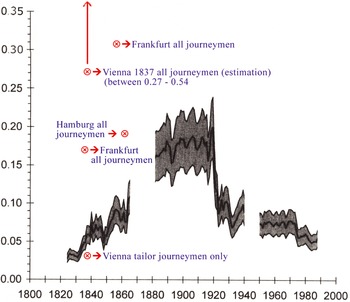
As a statistical measure, Hochstadt uses migration rates based on an administrative definition. He decided to use the number of immigrations only and not to add in-migration and out-migration in order to create a kind of total mobility rate, as some migration historians do. The reason for this was that he correctly assumed that most of the out-migrants were previous in-migrants, and vice versa. Aggregating in- and out-migration over multiple communities would therefore result in double counting. The migration rate is simply the number of immigrations into a certain administrative unit (village, town, or city) within one year, divided by the average population of that place in that year.Footnote 32 For example, 1,000 immigrations into a city of 10,000 inhabitants would result in a migration rate of 0.10.Footnote 33 Overall data on in-migration already exist for some German communities and districts for the first half of the nineteenth century. Furthermore, from the second half of the nineteenth century until the present, Hochstadt’s definition corresponds to the practice of the administrative statistical agencies. Data based on in-migration into local communities therefore make it possible to study changes in migration behaviour throughout the nineteenth and twentieth centuries in quantitative terms. This means that Steve Hochstadt’s concepts and measures differ from those of the Lucassens. Their starting point, however, is the same – questioning the idea of mobility transition – and their results can be compared. The result of Hochstadt’s research on migration rates in nineteenth- and twentieth-century Germany is encapsulated in Figure 1, which is taken from his book (with the exception of journeymen’s migration rates, which I calculated and inserted).Footnote 34 Hochstadt depicts the mean migration rate with a black line; the grey field shows deviations from the mean of +/– 20%. His graph shows remarkable but nevertheless comparatively low rates at the beginning of the nineteenth century (1821: 0.026); rising rates from about 1830 onwards (0.03–0.10); a climax of migration between about 1880 and 1920 (0.15–0.20); a sharp decline of mobility in the early 1920s and comparatively low levels from the interwar period to the 1960s (0.07–0.08); and finally still lower levels in the 1970s and 1980s (0.06). These results quite clearly contradict the mobility transition theory.
Migration rates in Germany, 1824–1988. Taken from Hochstadt, Mobility and modernity, p. 277, fig. 24, with addition of figures for tramping artisans. Values for artisans calculated from number of arriving journeymen within one year divided by the population of the town.

Hochstadt’s data seem nevertheless to confirm the notion of a ‘sharp jump in the level of migration after 1850’.Footnote 35 My question is whether his data for the first half of the nineteenth century are reliable, and this question is directly related to the Lucassens’ finding of a ‘spectacular increase’ of mobility in the second half of the nineteenth century. As noted above, my argument is based on tramping journeymen in German-speaking parts of Europe. For the eighteenth century, we can only very roughly estimate the numbers of artisans, but some historians think that tramping journeymen made up about 1% of the population.Footnote 36 For the early nineteenth century, we have better data, particularly for Prussia (which in 1816 accounted for more than 40% of the ‘German’ population) and for some other states and regions.Footnote 37 I would guess that tramping artisans in the territory of the later German empire made up at least 2% of the population, which, in numerical terms, was about 500,000 in 1816 and about 700,000 in 1850. An even greater problem is calculating the frequency with which they changed locations in the course of their tour. Most of them were more or less permanently on the move for a couple of years, but it is impossible to say what that means with respect to migration rates. If tramping journeymen made up 2% of the population, and if they changed their place of residence four times a year, which is a very conservative estimate, the result would be a migration rate, according to Hochstadt’s concept, of 0.08 – hardly less than his results for the whole population of the Düsseldorf district in 1861. If we estimate that tramping artisans on average changed their place of residence eight times a year, which is a less conservative estimate, the result would be a migration rate – of journeymen only – of 0.16, about the same as for the population as a whole in the late nineteenth century at the climax of mobility. This means, in my view, that the moves of tramping artisans are not – or at least not properly – recorded in early nineteenth-century local migration registration.
When local officials in some German towns started to register in-migrants in the early nineteenth century, the huge number of permanently circulating persons obviously overstrained the capacities of bureaucratic administration. Therefore it was only by ‘pure chance’ that mobile workers, journeymen, apprentices, or domestic servants made their way into migration registration.Footnote 38 In the case of journeymen this was not regarded as a problem, since registration of journeymen was seen as the task of guilds. Indeed, in many guild archives one finds ‘Books of in- and out-migrating journeymen’ in which each individual is recorded, usually with name and place of origin, and often with an additional remark on whether the journeyman took a job in this town, or whether he moved on after a few days. There was some division of labour between local administrations and guilds, with the effect that tramping journeymen hardly show up in public registration. Accordingly, their numbers have been strongly underrepresented in official migration statistics, and calculations from guild records are much more realistic.
The best evidence we have is still not for larger territories but for single communities. Let me present a few examples, which I have also inserted in Hochstadt’s graph (see Figure 1). In Frankfurt in 1840 there were about 10,000 tramping journeymen arriving, compared to a population of about 56,000; in 1857, 21,600 arriving journeymen and 68,000 inhabitants were counted. Therefore, the journeymen arrivals alone would result in migration rates of 0.17 (1840) and 0.31 (1857). In Hamburg in 1861, the ratio of 45,000 tramping journeymen to about 230,000 inhabitants would result in an immigration rate of 0.19. For Vienna, which I know best, it is impossible to calculate exact overall figures, since only a few guild registration books have survived. In the tailors’ guild, for instance, we have books of that very kind for the years 1837–50. From 10 October 1837 to 8 May 1850 they register altogether 131,933 journeymen tailors arriving in Vienna, on average between 10,000 and 12,000 each year.Footnote 39 Therefore, journeymen tailors alone accounted for a migration rate of about 0.03. If one tries to extrapolate these statistics to come up with a figure for all Viennese guilds, one might estimate for 1837 a number somewhere between 90,000 to 180,000 incoming journeymen as compared to a population of 350,000 (suburbs included), or an estimated migration rate between 0.27 and 0.54. Even if such rates are hypothetical, they constitute evidence that the magnitude of migration in the first half of the nineteenth century attributable to journeymen alone is perhaps higher than overall migration rates at their assumed climax in the late nineteenth century. That said, it is not clear whether or not such results can be generalized for the whole of Germany.
Conclusion
My previous considerations were based on concepts that differ from those of the Lucassens: on a broad definition of migration and on migratory moves instead of migrants as basis of quantification. The focus of my arguments was on the risk of underestimating the extent of mobility by a narrow definition of migration, as well as by the exclusion of rural and many forms of permanent and cyclical mobility. This risk particularly concerns both the early modern period and the first half of the nineteenth century. So, what implications does this have for the hypothesis of a ‘spectacular’ increase in the level of migration in the second half of the nineteenth century? I would like to discuss this hypothesis on both a statistical and a phenomenological level. In my opinion, and on the basis of the current state of research, it is by no means out of the question that the level of migration in the second half of the nineteenth century was actually higher than in previous centuries. However, I would most definitely not seek an explanation of this in the modernization paradigm but rather in the persistence of traditional early modern migration patterns and in their combination with new forms of migration in industrial society. Traditional forms of migration – seasonal and other forms of rural labour migration, tramping artisans, the mobility of farm servants and of domestic servants, and so forth – certainly coexisted with new forms such as transatlantic mass migration, migration to industrializing regions, accelerating urbanization, and the like. Not simply modernization but the mixture and superimposition of old and new migration patterns would then be responsible for high levels of mobility in the nineteenth century.
Nevertheless – and despite the conclusions at which the Lucassens arrived – I am not yet convinced that the level of mobility in the second half of the nineteenth century differs so strongly from previous periods. The high migration rates of tramping artisans refer to the first half of the nineteenth century, and individual examples give rise to the supposition that they were high in the eighteenth century as well. A broad concept of migration might show a higher extent of mobility in the early modern period and not so strong an increase but rather some continuity of high mobility until the end of the nineteenth century. To this can be added the fact that we know very little about how traditional types of migration developed over the nineteenth century. In some regions with traditionally high mobility, such as Ticino in Switzerland and Vorarlberg in Austria, traditional inner-European seasonal migration segued into transatlantic migration. The migration of artisans probably grew until the mid nineteenth century but then slowly declined towards the end of the century. Transhumance and cattle driving gradually declined with the advent of new forms of transportation and the emergence of global markets for wool and meat. The nineteenth century experienced not only rising but also declining types of migration. It is thus extremely difficult to draw a clear conclusion from all these different processes.
Therefore, we should be grateful to the Lucassens for stimulating such discussions, even if I am still not absolutely convinced by some aspects of their conceptual framework and their results. Their attempt to quantify early modern and early industrial migration is a major step forward in European and global comparative migration history. Earlier approaches towards a quantitative history of migration were usually embedded in a mechanistic theoretical framework of ‘push- and pull-factors’ or of streams from high to low ‘population pressure’.Footnote 40 The reaction was an extremely fruitful methodological turn in migration history towards the agency and experiences of individual men and women.Footnote 41 The Lucassens’ article now shows that theoretically reflexive quantitative research is still of significance and that it has gained new weight for global comparison. Moreover, the Lucassens’ work constitutes a challenge to consider how to collect data on rural migration, return migration, and various forms of circular or permanent mobility and integrate it into their model. My expectation and my hope is, therefore, that their seminal article will not be the last word on this topic but rather will impart a strong impulse to initiate a new form of quantification in migration history and serious discussions of its methodological framework and consequences.