Introduction
The world's population aged 60 years and older is expected to more than triple from 600 million to 2 billion between 2000 and 2050 (Department of Economic and Social Affairs: Population Division, 2002). As the population ages, the number of older people needing healthcare is increasing and more older people are using health services. In Victoria, Australia, people older than 65 years were reported to be using more than 49% of all inpatient hospital days in 2007–08 (Australian Institute of Health and Welfare, 2009) and in the United Kingdom in 2000, two-thirds of acute hospital beds were occupied by patients aged 65 years and older (Department of Health, 2000, as cited in Bridges et al., Reference Bridges, Flatley and Meyer2009). In a systematic review of qualitative research focused on older people's and their relatives’ views on and experiences of acute care, Bridges and colleagues (Reference Bridges, Flatley and Meyer2009) concluded that older people and their relatives value approaches to care that are relational in nature, where they have a reciprocal relationship with staff, where staff get to know them as individuals and understand what is important to them, where they can participate in decision-making and have information presented to them in ways that respond to their individual needs (for example, taking into account cognitive impairment or communication difficulties). For this reason, health services need to ensure that they have an environment that is appropriate for the older person and their specific care needs and have a culture that places the older person at the center of their own care.
To improve the experience of older people in hospitals in Victoria, the then Victorian Government Department of Human Services (DHS) launched the Improving Care for Older People (ICOP) policy in 2003 (Victorian Government Department of Human Services, 2003). The aim of this policy was to improve health services for older people and their carers and for people with complex care needs. The policy encouraged health services to
1. adopt a strong person-centered approach to the provision of care and services,
2. better understand the complexity of older people's healthcare needs, and
3. improve integration of care.
The National Ageing Research Institute (NARI) was commissioned by DHS (now Department of Health (DH)) to find or develop a tool that could be used to measure staff attitudes and practices in relation to person-centered care, and to develop educational resources to support person-centered care, such as best practice case examples and a website with links to international initiatives. This paper reports on the development and testing of the measurement tool.
DHS defined person-centered care as “treatment and care . . . that puts the person at the center of their own care and considers the needs of the older person's carers” (Victorian Government Department of Human Services, 2003). The NARI team conducted a literature review that aimed to further define person-centered healthcare, to document any evidence of its effectiveness, and to locate an appropriate measure of person-centered healthcare for use in the ICOP initiative. The literature search included the following key words: person-centered practice, person-centered care, client-centered practice, client-centered care, consumer-focused practice, consumer-focused care, patient-centered care, and client goal setting. The Cochrane Library and the Pubmed and Ovid databases (including Cinahl, Psychlit, and Medline) were searched. Literature published prior to 1995, literature on pediatric clients, and literature that considered adults younger than 70 (unless they had complex care needs such as adults with post-traumatic brain injury or stroke) were excluded. In addition, reports that included direct feedback from clients and/or carers about their experience of healthcare were also included. All four levels of evidence determined by the National Health and Medical Research Council (1999) and qualitative research reports were included in this review.
The literature review identified numerous definitions of person-centered care, including one from the United States Agency for International Development (USAID 1999, as cited in Harkness, Reference Harkness2005, p. 9), and one from Canadian occupational therapists (Law et al., Reference Law, Baptiste and Mills1995). All of the definitions, including the one by DHS, place the patient, client, or person at the center of healthcare and identify the consideration of their needs and wishes as paramount.
Five principles of person-centered care were identified in the literature:
1. Getting to know the patient or client as a person (holistic approach as well as individual approach),
2. Sharing of power and responsibility (patient or client as expert in their own health, sharing of decision-making, information, the idea of common ground),
3. Accessibility and flexibility (of service provider as a person and of the services provided),
4. Coordination and integration (consideration of the whole experience from the point of view of the service user), and
5. Having an environment that is conducive to person-centered care (supportive of staff working in a person-centered way and easy for service users to navigate).
The literature also described three main approaches to evaluating person-centered care:
1. Evaluate the person-centeredness of a single clinical intervention or the work of a single clinician from the point of view of a trained observer or assessor, or through a self-report instrument, usually completed by the patient,
2. Assess client satisfaction with the service as a whole, including its person-centeredness, and
3. Evaluate the extent of person-centered practice within a health setting using a benchmarking tool or observation (Dow et al., Reference Dow, Haralambous, Bremner and Fearn2006).
The third approach was selected as the most appropriate to evaluate person-centered care within Victorian health services as the purpose of the tool was to assist staff to reflect on their own practice, either as individuals or as part of a team, educate them about person-centered practice, and give direction for areas that they could work to improve.
The literature review revealed that there were no previously published measures of person-centered care in health settings at the time, so the NARI team developed the “benchmarking person-centred care” survey.
Aims
The aims of this project were to
1. conduct a psychometric evaluation of the properties of the initial “benchmarking person-centred care” survey,
2. investigate the “benchmarking person-centred care” survey as a psychometrically valid and reliable measure of current practice and attitudes or beliefs in relation to person-centered care from the point of view of healthcare staff, and
3. increase the ease of use of the “benchmarking person-centred care” survey by reducing the number of items.
Methods
Ethics
Ethics approval was obtained from all the participating health service human research ethics committees.
Survey development
The original survey developed by the NARI team was based on key elements identified in the literature (Dow et al., Reference Dow, Haralambous, Bremner and Fearn2006), and on advice from older people themselves (via consultative focus groups) as to what they viewed as important aspects of person-centered care.
The five key principles in person-centered care identified in the literature were used as the starting point for the survey. Questions addressing each of these key principles in person-centered care were developed by the NARI team, which included research staff with clinical expertise. The draft survey was then reviewed by the project Expert Advisory Group, which consisted of experts in the healthcare field (including geriatricians, nurses, policy makers, and allied health personnel with both academic and clinical knowledge of care of older people in hospital), healthcare staff (including nurses, medical practitioners, and allied health staff currently working with older people in assessment and treatment wards), and representatives of carer and consumer advocacy groups. They suggested that the survey needed to include questions about items that are important to older people, and that greater consumer input on the survey development was required. As there was very little published literature on older people's views on person-centered healthcare, two focus groups were conducted with older people to confirm that what was included in the survey was relevant to them and to add anything that they thought was missing. Consulting with older people, advocacy groups, healthcare staff, and academics with expertise in the area was considered to be the best way of validating the items derived from the literature by the research team, as it enabled triangulation of views (Docherty, Reference Docherty2000). Furthermore, it was considered important that the survey development involved a partnership between researchers and older people, as this was the main concept to emerge from our literature review and we felt that the research process should be consistent with a person-centered approach.
The 20 focus group participants (four male) were all older (over 65 years of age) NARI volunteers (that is, people who have expressed an interest in participating in research and placed their contact details on a register of volunteers), who had experienced a hospital admission themselves or were caring for someone who had been in hospital on one or more occasions in the past two years. They were asked about their experiences of hospital and what they thought constituted good care. They were then asked to review a draft of the survey and to identify anything they thought was missing, and whether they thought the questions represented what was important to them. Results of the focus groups confirmed that the questions already developed were important to older people. Another section was added that contained questions about aspects of person-centered care considered important to the focus group participants but not in the initial survey, including questions about privacy, parking and access, and hot food being served hot.
The initial benchmarking survey based on the literature and focus group findings was a 48-item survey divided into six sections.
1. getting to know the older service user (seven items),
2. sharing power and responsibility (eight items),
3. service flexibility and accessibility (eight items),
4. making sense of services for the older service user (seven items),
5. the working environment facilitates person-centered practice (nine items),
6. concerns expressed by older people (nine items).
The survey questions explored respondents’ attitudes and beliefs and current practice in relation to person-centered care. Person-centered care practice is likely to be influenced by staff attitudes and beliefs and we felt it important to identify where future educational and practice change interventions should be directed. For example, staff may need education that challenges negative attitudes and beliefs about older people or they may require specific training in goal setting with older people. As one of the aims of the survey was to benchmark current practice and identify areas where health services could improve their person-centered practice, both attitudes and beliefs and practices were included in the survey. The response format for each question was a 5-point Likert scale, ranging from 1 (strongly disagree) to 5 (strongly agree) for the attitude and belief questions or 1 (never) to 5 (always) for the practice questions.
Survey dissemination and completion
The survey was disseminated to approximately 4,018 staff in 17 Victorian health services in 2005. Respondents were provided with two options of completing the survey, either online through a secure website or paper based. Each health service employed a key implementation contact (KIC) person who assisted with the dissemination and collection of the survey to all staff working within the acute general medical wards, geriatric evaluation and management or aged care wards, rehabilitation wards, community rehabilitation centers, and continence clinics. They either provided paper-based copies of the survey to respondents or emailed the secure website address to them. The researchers’ preferred means of completion were web-based as they were seen to be more time and cost efficient. However, advice obtained from the KICs at each health service was that not all health service staff had ready access to computers and completion rates would be increased if a mixture of both web-based and paper-based surveys was used. By using two different modes of survey completion, the project team reduced coverage error and improved the response rate (Dillman et al., Reference Dillman, Smyth and Chritian2009), ensuring that as many people as possible in the target population were able to complete the survey through a mode that was preferable to them. Following this, the KICs assisted with posting back all paper-based completed surveys to the researchers in a prepaid envelope. All surveys were completed anonymously. Whilst the researchers acknowledge that there could be differences between the responses from the two different data collection modes, they are unable to differentiate between those that were completed via the Internet and those that were completed as paper based.
Data analysis
The survey results were analyzed using SPSS version 17.0. Psychometric evaluations of the internal consistency reliability and construct validity of the survey were conducted. These were also used to aid in the item reduction of the survey. The objective was to develop a reduced-item survey with a stable and interpretable factor structure and with acceptable internal consistency across the survey as well as within the factors.
The construct validity of the survey was determined using exploratory factor analysis. The criteria to indicate the suitability of the data for the factor analysis were Bartlett's test of sphericity of significance and the Kaiser–Meyer–Olkin measure of sampling adequacy of ≥0.7. The extraction of factors was determined by the number of factors with eigenvalues greater than 1. Factors were subjected to direct oblimin rotation (assuming the inter-relatedness of the items and therefore the factors) and interpreted. Cross-loading items in the rotated factor structure were eliminated to increase the stability of the factor structure.
Internal consistency reliability was examined through item–total correlations and Cronbach's α coefficient. Items with item–total correlation (α) coefficients less than 0.3 were considered inappropriate and were deleted from the data prior to factor analysis. Following the factor analysis, Cronbach's α coefficients were found for each factor and for the total of currently remaining items.
Expert and older people consultation
After the revised tool had been developed, based on the above data analysis, the revised survey, along with a questionnaire about the revised survey, was distributed to six clinical experts and three older people who had been involved in the development and use of the original tool. The revised tool was sent to these nine people for consultation to ensure that it was still an accurate measure of person-centered care. This group of people was asked the following questions:
1. Do you think the revised survey addresses the main aspects of person-centered care?
2. Do you think the revised survey is user-friendly and easy for staff to complete?
3. Do you think the revised survey is easy to understand?
4. Do you think the section titles in the revised survey are suitable?
5. Do you think any of the items that were removed (as a result of the data analyses) should be included in the revised survey? If so, which items and why?
Results
Participants
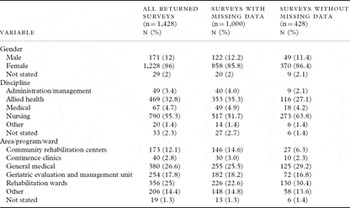
A total of 1,428 surveys were returned, giving an approximate overall response rate of 35.5%. Table 1 shows the demographics of the survey respondents.
Demographics of the sample

One thousand of the questionnaires contained missing data on at least one of the 48 items. This included items for which a participant had responded “don't know,” which was not a measurable response and was therefore treated as missing data. For each of the data analyses used, cases with missing items on the relevant items were excluded. However, sampling adequacy was established for this original sample of 428 participants. There were no significant differences between the 428 respondents who answered all questions and the 1,000 respondents who had missing data in relation to the location of their health service (rural or metro), the area they worked in (acute or sub-acute), or their gender. However, there was a difference between the two samples in relation to the disciplines of the respondents (χ2(5, n = 1,428) = 19.68, p < 0.01). Table 1 shows the demographics of the two groups.
The number of cases available for data analysis increased as items were removed throughout the procedure, resulting in a sample ranging from 428 to 471 participants for the factor analyses and 471 to 1,389 for reliability analyses.
Item analysis and reduction
The sample was tested for suitability for factor analysis. Bartlett's test of sphericity was significant (7,841.8, p < 0.001) and Kaiser–Meyer–Olkin was satisfactory (0.926), which indicated that the sample was suitable for factor analysis.
Initial examination of the item–total correlation matrix identified ten items with α correlation coefficients less than 0.3 and these were removed. This reduced the 48-item survey to 38 items.
Principal components analysis on the remaining 38 items suggested an eight-factor solution based on the criterion of eigenvalues exceeding 1, which explained 60.2% of the variance. Following this, three cross-loading items were removed as they had a moderate loading (>0.3) on more than one factor and were close in size on each of the factors they loaded on (within 0.15 of each other). A further four items were removed due to low factor loadings (<0.4).
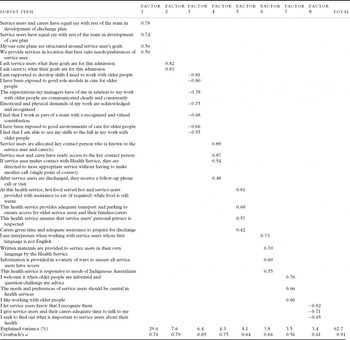
Another principal components analysis with direct oblimin rotation was conducted on the remaining 31 items. The original factor structure was confirmed and the eight-factor solution explained 62.7% of the variance, indicating satisfactory content validity. Factor 1 (accounting for 29.6% of the variance) contained four items looking at “involvement in care planning.” Factor 2 accounted for 7.6% of the variance and contained two items (both with factor loadings exceeding 0.8) focusing on “finding out goals.” Factor 3, which contributes 6.4% of the total variance, contained seven items about the “supportive working environment.” Factor 4 had four items, explaining 4.3% of the variance. These items addressed the area of “co-ordinated contact.” Factor 5 (accounting for 4.1% of the variance) also had four items which looked at “meeting practical needs” of the service user. Factor 6 explained 3.8% of the variance with four items focusing on “meeting communication needs.” Factor 7 had three items (all with factor loadings >0.6) looking at issues around “getting to know the individual,” and it contributed 3.5% of the variance. Finally, factor 8 accounted for 3.4% of the variance and contained three items related to “attitudes toward person-centered care.” All of the eight identified factors had good internal consistency, with Cronbach's α coefficients for each factor ranging between 0.56 and 0.85, given a range of between 0.5 and 0.6 is considered acceptable for preliminary research (Nunally, Reference Nunally1978). Factor loading of each survey item, explained variance, and Cronbach's α coefficients for each factor can be seen in Table 2.
Scale content, factor loadings, total variance explained, and Cronbach's α for the final Person-Centred Health Care for Older Adults Survey

Item correlations with factors of <0.4 have been suppressed to facilitate interpretation.
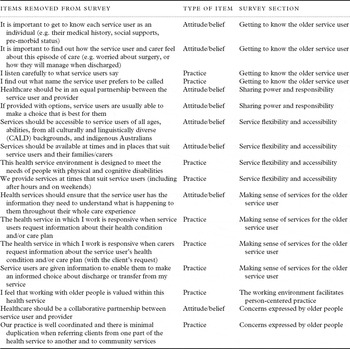
Of the 17 items that were removed from the original survey, eight items were about attitudes and beliefs rather than practices in person-centered care. Only one of the attitudes and beliefs questions from the original survey remained in the revised survey. The items that were removed were across all aspects of person-centered care. Table 3 lists the survey items that were removed.
Survey items that were removed in the development of the Person-Centred Health Care for Older Adults Survey

Finally, internal consistency of the 31-item survey was assessed, yielding a Cronbach's α coefficient of 0.91, which indicated good internal consistency.
All of the 31 items in the revised survey except for one were related to practice, and therefore used the response format ranging from never to always. This response format was appropriate to use for the one attitude or belief item that remained in the revised survey; therefore, the response format of a 5-point Likert scale, ranging from 1 (never) to 5 (always), was used for all questions in the revised survey.
The revised survey, with 31 items distributed into eight sub-scales, was titled the “Person-Centred Health Care for Older Adults (PCHCOA) Survey” (see Appendix A1 published as supplementary material online attached to the electronic version of this paper at http://journals.cambridge.org/jpg).
Consultation on survey content
Those who provided feedback (three clinical experts and three older people) felt that the revised survey was easy to understand, user-friendly, and easy for staff to complete, and addressed the main aspects of person-centered care. This indicated that the revised survey had content validity. One respondent suggested that the items that were excluded from the original survey following the factor analysis could still be used in staff training as, even though they are not necessary to have in the revised survey, they are still important aspects of person-centered healthcare.
Discussion
The “Person-Centred Health Care for Older Adults Survey” appears to be a valid and reliable measure of current practice in person-centered care in the inpatient hospital setting from the point of view of healthcare staff. The original survey was based on the literature and advice from older people, but it had no psychometric evaluation and was considered too lengthy. The revised survey is shorter in length but still appears to measure the same aspects of person-centered care as identified in the literature. The literature review undertaken by NARI identified five principles of person-centered care (Dow et al., Reference Dow, Haralambous, Bremner and Fearn2006). The first principle of getting to know the patient or client as a person is encompassed in the eighth factor of the revised survey, “getting to know the individual.” “Finding out goals” and “involvement in care planning” capture the second principle identified in the literature of sharing of power and responsibility. The sixth sub-scale in the revised survey, “meeting communication needs” addresses the principle of accessibility and flexibility. The principle of coordination and integration is covered in the sub-scale “co-ordinated contact.” The final principle, having an environment that is conducive to person-centered care, is captured by “supportive working environment,” “meeting communication needs,” and “attitudes toward person-centered practice.” However, as well as measuring the aspects of person-centered care identified in the literature, the PCHCOA survey is unique and measures aspects of person-centered care that are important to older people themselves. This is addressed in the sub-scale “meeting practical needs” and captures the items in the original “benchmarking person-centred care” survey that addressed concerns expressed by older people. Furthermore, items within each factor seemed to be conceptually consistent allowing for clear interpretations of the factors.
Since the original review, there has been considerable international development in the concept of person-centered care including in the hospital setting (Huby et al., Reference Huby, Brook, Thompson and Tierney2007; Olsson et al., Reference Olsson, Hansson, Ekman and Karlsson2009; Redfern et al., Reference Redfern, Briffa, Ellis and Freedman2009; Bamm et al., Reference Bamm, Rosenbaum and Stratford2010; Flynn et al., Reference Flynn2010; Poochikian-Sarkissian et al., Reference Poochikian-Sarkissian, Sidani, Ferguson-Pare and Doran2010; Doig et al., Reference Doig, Fleming, Kuipers, Cornwell and Khan2011; McMurray et al., Reference McMurray, Chaboyer, Wallis, Johnson and Gehrke2011). In the main, this more recent research supported the findings of the original review and the survey items derived from that review, suggesting that the PCHCOA is in line with current international research into person-centered healthcare. Studies of integrated care have found that individualized goal setting and well-coordinated care are effective in improving outcomes for patients (Olsson et al., Reference Olsson, Hansson, Ekman and Karlsson2009; Redfern et al., Reference Redfern, Briffa, Ellis and Freedman2009). Other aspects of person-centered care identified as important were exposure to good role models (Flynn et al., Reference Flynn2010; PCHCOA, item 3.2), a partnership approach in the management of Chronic Obstructive Pulmonary Disease (COPD; PCHCOA Sections 1, 2, 3, and 6; Ingadottir and Jonsdottir, Reference Ingadottir and Jonsdottir2010), and the organizational context supporting person-centered care (PCHCOA, Section 3; Huby et al., Reference Huby, Brook, Thompson and Tierney2007), all of which are included in the PCHCOA survey. The one area identified in the more recent research that was not specifically identified in the survey was the importance of patient education (Poochikian-Sarkissian et al., Reference Poochikian-Sarkissian, Sidani, Ferguson-Pare and Doran2010). However, if all other aspects of care identified in the survey were being practiced, patient education would be addressed as part of care planning, goal setting, meeting communication needs, and getting to know the individual (PCHCOA, sections 1,2,6, and 8).
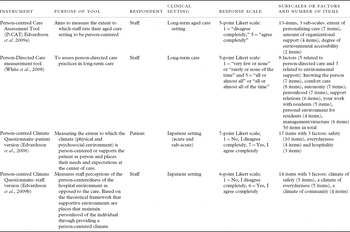
Since the development of the “benchmarking person-centred care” survey, there have also been other tools developed that measure person-centered care in Australia, Europe, and the United States, including, but not limited to, the Person-Centred Care Assessment Tool (P-CAT; Edvardsson et al., Reference Edvardsson, Sandman and Rasmussen2009b), the Person-Directed Care measurement tool (White et al., Reference White, Newton-Curtis and Lyons2008), the Person-Centred Climate Questionnaire–patient version (Edvardsson et al., Reference Edvardsson, Sandman and Rasmussen2008), and the Person-Centred Climate Questionnaire–staff version (Edvardsson et al., Reference Edvardsson, Sandman and Rasmussen2009b). More information about these tools is given in Table 4. However, these have been developed for different settings, for use with different audiences, or measure different aspects of person-centered care from the current tool. The Person-Centred Climate Questionnaire–patient version (Edvardsson et al., Reference Edvardsson, Sandman and Rasmussen2008) measures person-centered care from the point of view of the patient. The P-CAT (Edvardsson et al., Reference Edvardsson, Fetherstonhaugh, Nay, Gibson, Sandman and Rasmussen2009a) and the Person-Directed Care measurement tool (White et al., Reference White, Newton-Curtis and Lyons2008) measure staff perceptions of person-centered care in long-term care, which is a qualitatively different environment to a hospital setting, requiring different person-centered care practices. Unlike care homes, where the older person is a permanent resident, hospital staff–patient relationships are generally short term and focused on management of acute or chronic illness and discharge planning. Although there are some areas of overlap, the PCHCOA survey focuses specifically on healthcare and includes practices that are specific to a health environment, such as development of a discharge plan (PCHCOA, item 1.2), location of healthcare (item 1.4), goals for this admission (items 2.1 and 2.2), and follow-up after admission (item 4.4). The most similar tool was the Person-Centred Climate Questionnaire–staff version. However, this tool measured staff perceptions of the person-centeredness of the hospital environment as opposed to the attitudes and care practices of staff. Although we acknowledge that this is an important component of person-centered care (included in Section 3 of PCHCOA), we wanted a measure that would give staff direction about aspects of care that they had direct control over as well as organizational factors.
Other person-centered care surveys

Eight of the 17 items that were removed from the original survey were attitudes and beliefs questions. Only one of the attitudes and beliefs questions from the original survey remains in the revised PCHCOA survey. The attitudes and beliefs questions in the original survey generally received a very high response rate of usually or always. They indicated that healthcare staff believed that person-centered care was important; however, they did not provide a true indication of whether person-centered practices were actually occurring within a health service. The removal of these items suggests the PCHCOA is now a more accurate measure of person-centered care practices. The other nine items removed from the original survey were spread across all aspects of person-centered care identified in the literature. This indicates that all aspects of person-centered care identified in this literature which formed the basis of this survey are important; however, it was not necessary to have as many items for each factor as was in the original survey.
There were limitations to this study. Although the survey asks questions about person-centered practice, it may have a social desirability bias because it only looks at what staff perceive. Future studies could combine this survey with an approach similar to that used by Wellard et al. (Reference Wellard, Lillibridge, Beanland and Lewis2003), where they compared the findings of focus group discussions with staff with observations made on a ward by a trained researcher, looking at whether there were any discrepancies between participants’ beliefs about practice and their actual practice.
Furthermore, this survey does not measure service user perceptions about the care they receive. It has items about aspects of person-centered healthcare that older people themselves believe are important, but it only measures staff perceptions of whether this is happening, not whether the service user perceives it to be happening. An accompanying survey that measures the service users’ perceptions about the level of person-centered care in relation to staff practice would be a useful tool to develop, similar to those developed by Edvardsson and colleagues (Reference Edvardsson, Sandman and Rasmussen2008; Reference Edvardsson, Sandman and Rasmussen2009b) in Sweden that measure the person-centered care environment.
Future research on use of this survey could include its use as a measure of person-centered healthcare within the hospital setting overall, as well as exploring different aspects of person-centered healthcare if the tool is broken down into sub-scales. Health services potentially could use it to benchmark themselves against other health services, as well as identify areas of person-centered healthcare where they are performing well. Used in this way, the survey could assist in identifying areas of person-centered healthcare that require improvement in the service as a whole and, as a result, may assist in identifying areas of need for staff training and improving care for older people.
In addition, future studies could examine the test–retest reliability of the PCHCOA survey and its ability to be used as a pre–post measure of person-centered care in the hospital setting. Whilst the data in this study were collected in 2005, the updated literature review suggests that the survey items are consistent with current conceptual development in this area. Finally, the large number of missing data resulting in a loss of sample size may have impacted on the results. Even though there were 1,428 survey respondents, some items had a sample as small as 428. However, there was only one significant difference between the groups who completed all items and those who did not, with nurses being more likely to complete all items than allied health professionals.
Conclusion
The results indicate that the PCHCOA survey is a psychometrically valid and reliable measure of staff perceptions of person-centered healthcare for use in hospital settings. The PCHCOA survey is a shorter, more user-friendly survey than the original that can be used by health services to benchmark their person-centered practice within the hospital setting and identify areas of person-centered healthcare for improvement.
Conflict of interest
None.
Description of authors’ roles
B. Dow designed the study, supervised the data collection, assisted with data analysis, and wrote the paper. M. Fearn collected data, assisted with data analysis, and wrote the paper. B. Haralambous, J. Tinney and K. Hill assisted with data collection and writing of the paper. S. Gibson assisted with data analysis and writing of the paper.
Acknowledgments
This work was supported by the Ambulatory and Continuing Care Division, Victorian Government Department of Health, Victoria, Australia.
The project team wish to thank the Key Implementation Contacts for their assistance with dissemination and collection of the surveys; the staff at the 17 participating Victorian Health Services who completed the survey; the Project Advisory Committee and the Consumer Reference Group for their input in the development of the original survey; and Ms Esther Cramer and Ms Maggie Yu who assisted with data analysis during their psychology placement.