Case definitions for influenza-like illness (ILI) and severe acute respiratory illness (SARI) are important for surveillance. They are not intended to capture every case of influenza but rather to aid in describing trends and burden of disease; however, they are also often used by clinicians for management decisions. It is important to understand whether such case definitions’ performance characteristics differ across patient groups because such bias may lead to inaccurate estimates of the burden of influenza. This bias is especially problematic if populations missed by these surveillance case definitions are particularly vulnerable to influenza and its complications.
The World Health Organization (WHO) case definition of ILI is an acute respiratory illness with measured fever of ≥38°C AND cough AND onset within the prior 10 days. The SARI definition is an acute respiratory illness with a slightly more relaxed fever criterion (either history of fever or measured fever of ≥38°C) AND cough AND onset within the prior 10 days AND requiring hospitalization. 1,Reference Fitzner, Qasmieh and Mounts2 Older adults, especially those who are frail, may not present with the symptoms usually associated with acute illness. Rather than presenting with fever and cough, they may present with exacerbations of chronic conditions, acute confusion (delirium), falls or declines in mobility, or functional decline. Despite being called “atypical” presentation of disease, these nonstandard presentations are in fact the norm rather than the exception when frail older adults become acutely ill. Reference Jarrett, Rockwood, Carver, Stolee and Cosway3,Reference Rockwood4
With this in mind, we aimed to determine how well ILI and SARI case definitions perform in identifying older adults who are hospitalized and who experience severe outcomes with laboratory-confirmed influenza in the context of active surveillance in the Serious Outcomes Surveillance (SOS) Network of the Canadian Immunization Research Network (CIRN).
Methods
The SOS Network conducts active surveillance for serious outcomes of influenza in acute-care hospitals at several academic and community hospital sites in Canada. Depending on the season, the network has included 10–45 acute-care hospitals representing 6,000–18,000 hospital beds. Reference Andrew, Shinde and Hatchette5-Reference Nichols, Andrew and Hatchette9 This study is an analysis of pooled data from this prospective cohort study conducted over three consecutive influenza seasons: 2011/12, 2012/13, and 2013/14. Reference Nichols, Andrew and Hatchette9
The 2 core features of the SOS Network are active surveillance with laboratory confirmation of respiratory viral illness and a focus on health measures and outcomes relevant to older adults. Reference Andrew, Shinde and Ye6 Together, these provide an opportunity to address the sensitivity of ILI and SARI case definitions in the identification of older adults admitted to hospital with influenza. Because of the SOS Network’s mandate to conduct active surveillance for influenza that is severe enough to require hospitalization, only hospitalized influenza cases that arise in the community are enrolled; nosocomial infections are excluded.
The enrollment criteria of the SOS Network were standardized across sites and age groups. Active surveillance was conducted during the influenza season starting on November 15 of each year and continuing through April 30 of the following year, unless influenza activity was identified in the community outside these dates, in which case active surveillance was initiated earlier or continued longer, as appropriate. SOS Network monitors reviewed all admissions on a daily basis to identify eligible patients. Patients with any acute respiratory illness (with or without fever or cough) or unexplained fever (with or without cough) were considered eligible and had a nasopharyngeal swab with polymerase chain reaction testing (PCR) for influenza. Samples are tested at the local laboratory using standardized procedures and used in the course of usual clinical care, and they are also sent to the SOS central laboratory for confirmatory testing including subtyping and B lineage determination. Reference Andrew, Shinde and Hatchette5,Reference Andrew, Shinde and Ye6,Reference Nichols, Andrew and Hatchette9 Clinical data collection for this study included influenza vaccination status, documentation of fever (subjective or objective), cough as a symptom, and time of onset of symptoms, allowing for the determination of which patients met WHO ILI or SARI case definitions. 1
We were able to identify measured fever (≥38°C), feverishness, and cough precisely in our data. Although the timeline in the ILI and SARI criteria specifies onset within the prior 10 days, the SOS inclusion criteria specified 7 days to avoid false-negative PCR results and incorrect classification of influenza cases. Patients with influenza who met the case definition were considered a surveillance match for either ILI or SARI, and those with confirmed influenza illness who did not meet the case definition represented the informative “surveillance gap.”
To determine how often older adults (aged ≥65 years) met ILI or SARI criteria compared to younger adults, both older and younger adult age groups were considered. Beyond simply considering chronological age, frailty is an important concept when it comes to assessing vulnerability to adverse health outcomes. Accumulation of health deficits is a robust and well-studied approach to measuring frailty. Accordingly, for older adults enrolled in the SOS Network, frailty was measured using a previously validated frailty index (FI). Reference Andrew, Shinde and Ye6 The FI was categorized as nonfrail (FI, 0.0–0.1), prefrail (FI, >0.1–0.21), frail (FI, 0.21–0.45), and most frail (FI, >0.45). Reference Andrew, Shinde and Ye6,Reference Hoover, Rotermann, Sanmartin and Bernier10
For all age and frailty categories, sensitivity, specificity, and positive and negative predictive values for WHO ILI and SARI were calculated, taking PCR-confirmed influenza A or B as the gold standard. Sensitivity and specificity of ILI and SARI case definitions were also determined stratified by age and experience of a composite of severe outcomes (ICU admission or death) for patients ≥65 versus <65 year of age. To explore whether vaccinations status influenced clinical presentation, an analysis stratified by age and vaccination status was conducted. For all results, 95% confidence intervals (CIs) are presented. Differences were compared across age and frailty categories using χ2 testing. Analyses were conducted using intercooled Stata version 8.1 software (StataCorp, College Station, TX).
SOS surveillance was approved by the research ethics boards of all participating hospitals, and analyses were approved by the Nova Scotia Health Authority Research Ethics Board.
Results
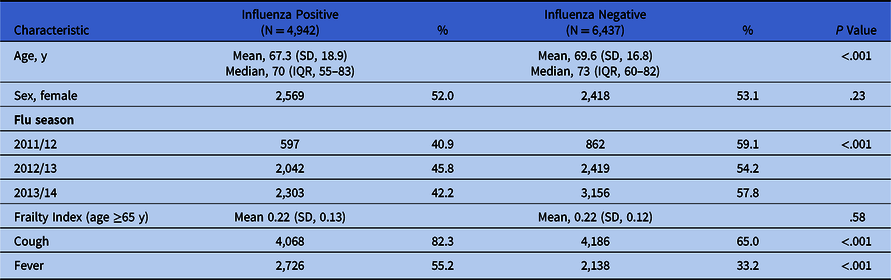
During the 3 consecutive influenza seasons, the SOS Network enrolled 11,379 hospitalized adults age 16 years and older, of whom 7,254 were aged ≥65 years. Among them, 4,942 had laboratory-confirmed influenza, 2,948 of whom were older adults (Table 1). Percent positivity was 43.4% overall and was higher for younger versus older adults (48.3% vs 40.6%; P < .001). The median age was 72 years (IQR, 58–82) and 52.6% were women. Among the older adults, 2,252 (31.0%) were aged 65–74 years; 2,745 (37.8%) were aged 75–84 years; and 2,257 (31.1%) were aged ≥85 years. As expected in a hospitalized population, the ≥65-year-old cohort was relatively frail (mean FI, 0.22; SD, 0.12): 360 (5.8%) were most frail, 2,520 (40.9%) were frail, and 2,398 (39.0%) were prefrail. Only 879 (14.3%) were nonfrail. Also, 1,646 (14.9%) patients were admitted to an intensive care unit (ICU) and 734 (6.4%) died.
Patient Characteristics by Laboratory-Confirmed Influenza Status

Note. SD, standard deviation; IQR, interquartile range.
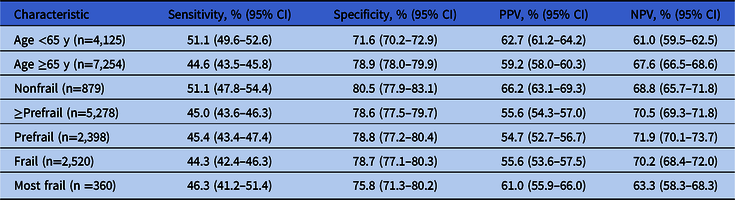
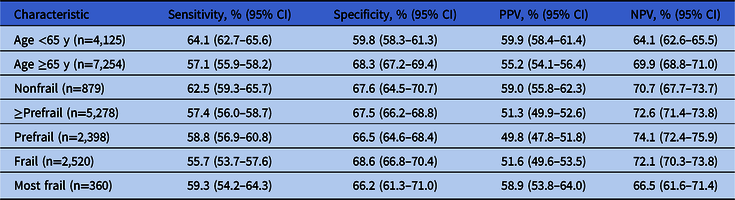
Among those with laboratory-confirmed influenza, 55.2% had a measured fever ≥38°C (59.2% of younger adults and 52.4% of older adults; P < .001) (Table 1). Most patients (82.3%) had cough, with no age difference (P = .39). Overall, 2,334 patients (47.2%) with laboratory-confirmed influenza met ILI criteria: 1,019 (51.1%) younger adults and 1,315 (44.6%) older adults (P < .001). The SARI criteria were met by 1,279 younger adults (64.1%) and 1,682 older adults (57.1%). Sensitivity, specificity, and positive and negative predictive values for ILI and SARI criteria by patient group, along with 95% CIs, are shown in Table 2 for ILI and Table 3 for SARI.
Performance of Influenza-like Illness (ILI) Criteria in Relation to Laboratory-Confirmed Influenza by Age Group and Frailty Categorya

Note. CI, confidence interval; PPV, positive predictive value; NPV, negative predictive value.
a Frailty analyses were performed only for patients aged ≥65 y.
Performance of Severe Acute Respiratory Illness (SARI) Criteria in Relation to Laboratory-Confirmed Influenza by Age Group and Frailty Categorya

Note. CI, confidence interval.
a Frailty analyses were performed only for patients aged ≥65 y.
For the older adult group, sensitivity of ILI criteria was higher among patients who were nonfrail (sensitivity, 51.1%) versus all others (sensitivity, 45.0%; P = .03), although we detected no dose response as frailty increased (Table 2). The trend was similar but not statistically significant for the SARI criteria, though with higher sensitivities, with sensitivity of 62.5% for nonfrail patients versus 57.4% for prefrail, frail, or most frail patients (P = .06) (Table 3).
Specificity was generally higher using ILI criteria, most notably in older versus younger adults (78.9% for age ≥65 years vs 71.6% for younger adults) (Table 2). The same pattern held for SARI, for which specificity was 68.3% in older adults versus 59.8% in younger adults (Table 3).
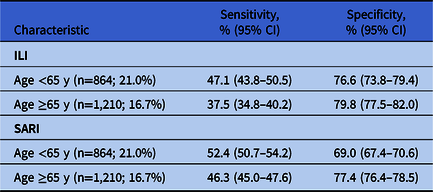
Among patients with severe outcomes (ICU admission and/or death), ILI and SARI criteria had lower sensitivity, particularly for patients aged ≥65 years: ILI sensitivity was 47.1% for patients aged <65 years and 37.5% for those aged ≥65 years, and SARI sensitivity was 52.4% for those aged <65 years and 46.3% for those aged ≥65 years. None of the confidence intervals were overlapping (Table 4).
Performance of Influenza-like Illness (ILI) and Severe Acute Respiratory Illness (SARI) Criteria for Severe Outcomes (ICU and/or Death), Stratified by Age

Note. ICU, intensive care unit; CI, confidence interval.
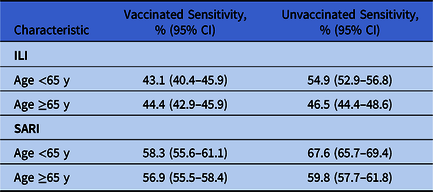
Overall, 1,871 patients with influenza (33.7%) had been vaccinated in the current season. In analyses stratified by age and vaccination status, sensitivity of both ILI and SARI criteria was lower in vaccinated patients but only in adults aged <65 years (Table 5).
Sensitivity of Influenza-like Illness (ILI) and Severe Acute Respiratory Illness (SARI) Criteria Stratified by Vaccination Status and Age

Note. CI, confidence interval.
Discussion
We found that a substantial proportion of hospitalized older adults with laboratory-confirmed influenza (55.4%) was missed by the ILI case definition, representing an important “surveillance gap.” These surveillance gaps were larger for older adults, especially those who were at least prefrail and for those with the most severe outcomes. The surveillance gap in older adults narrowed to 42.9% when SARI criteria (with a less stringent fever definition) were applied. Both ILI and SARI criteria performed better in younger adults. As anticipated due to more stringent fever definitions in the ILI criteria, specificity was generally higher using ILI criteria compared to SARI criteria. Specificity was statistically significantly higher in older adults, suggesting that once older adults meet the criteria, they are more likely to have influenza than other illnesses. However, these results must be balanced with the understanding that they are less likely to meet the criteria in the first place.
These findings have important implications for influenza surveillance. Additionally, although these criteria are designed to be surveillance tools, clinicians do use them when assessing individual patients. For example, a US study found that provider-ordered influenza testing was less likely to be performed on older adults who did indeed have laboratory-confirmed influenza when investigated, and that this disparity was partially due to older patients being less likely to meet ILI criteria. Reference Hartman, Zhu, Edwards, Griffin and Talbot11 Adhering to these definitions in selecting which patients get antiviral treatment or influenza testing will miss a substantial proportion of patients (especially frail older adults) who have influenza, resulting in missed opportunities for treatment and for application of droplet precautions to prevent nosocomial transmission. Case definitions may also impact estimates of vaccine effectiveness in observational studies. If a case definition is too narrow, frail older adults are more likely to not meet inclusion thresholds even when they do have influenza. Given that older and frailer patients are more likely to have received vaccine than younger and fitter patients, Reference Andrew, Shinde and Ye6 this could lead to overestimation of vaccine effectiveness.
The performance of ILI criteria has been considered in prior studies, though most have not included many older adults. Sensitivity estimates have varied widely depending on setting, population, criteria used, and influenza strain. Reference Jiang, Lee and Lim12-Reference Rumoro, Bayram and Silva16 To our knowledge, none have compared the performance of case definitions across age groups with a focus on older adults. The French Influenza Surveillance Network published a comparison of several influenza case definitions, including WHO, European Centre for Disease Prevention and Control (ECDC), and US Centers for Disease Control and Prevention (CDC) definitions for ILI, and they found a sensitivity of 89.8% for the WHO ILI definition, though their study differed from ours in being community-based and in that only 3.7% of the sample were adults aged ≥65 years. Reference Casalegno, Eibach and Valette17 Another French study in primary care found no differences across age groups in the positive and negative predictive values of different influenza case definitions, though only 12 of 158 patients were aged ≥65 years. Reference Carrat, Tachet, Rouzioux, Housset and Valleron18 A US study identified cough, fever, rhinorrhea, and myalgias as the symptoms most predictive of laboratory-confirmed influenza in patients presenting to emergency departments. Age-group comparisons were not reported, though most included patients (86%) were <50 years of age. Reference Shah, Rumoro and Hallock19 A Canadian study of emergency department presentations in adults aged ≥60 years found that while cough and feverishness were the two symptoms most predictive of influenza, only 31% of influenza positive older patients were identified using the US CDC ILI case definition (ie, fever ≥37.8°C and cough and/or sore throat); no younger adults were included for comparison. Reference Lam, Coleman and Green20 Their finding that cough is an important symptom is consistent with our finding that >80% of both older and younger adults presented with cough. A Korean study compared symptoms in an ILI cohort, all of whom had fever, finding that there were differences in symptoms across age groups, with older adults being less likely to have cough and myalgias. Reference Yang, Cheong and Song21
Circulating strains may impact case presentations and performance of case definitions. We reported data pooled across 3 influenza seasons in Canada. During this period, 72.4% of identified viruses in our network were influenza A and 27.6% influenza B. During the 2011/12 flu season, influenza A/H3N2 and A/H1N1 cocirculated, along with both B/Yamagata and B/Victoria lineages. In 2012/13, A/H3N2 dominated, and in 2013/14, A/H1N1 and B/Yamagata were the predominant circulating strains. Our results thus reflect pooling across all of these strains, subtypes, and lineages.
In this study, influenza vaccination was associated with lower sensitivity of ILI and SARI criteria in younger but not older adults. In comparison, a French study found that vaccination was associated with modest reductions in symptom severity (fever, headache, myalgias, and shivering) among older adults with laboratory-confirmed influenza. Reference Mosnier, Daviaud and Caini22 Vaccination may attenuate clinical illness, resulting in less fever and cough. Reference Arriola, Garg and Anderson24,Reference Thompson, Pierse and Sue Huang25 Also, these findings may be confounded by factors associated with receipt of influenza vaccine in younger age groups, in whom vaccine coverage is low in our inpatient network. Reference Nichols, Andrew and Hatchette9 For example, the presence of chronic conditions or immunosuppression, themselves specific indications for influenza vaccination, may lessen fever and/or cough presentations.
The trade-off between sensitivity and specificity is inherent in decisions on which case definitions to use for screening programs. The choice of definition should ideally consider the program’s goals. If the aim is to understand the burden of influenza in various settings, it is preferable to capture as much illness as possible with a highly sensitive measure, particularly if at least some subset of these will go on to have laboratory testing to confirm the presence of illness. If the aim is to limit the number of tests performed and maximize yield of testing, which could be particularly important in resource-limited settings, a more specific definition is preferable. High specificity would be a particularly important aim in vaccine effectiveness studies that do not use laboratory confirmation, given that misclassification of patients without influenza into the influenza group could result in artificially lower estimates of vaccine effectiveness. Reference Murray, Khagayi and Ope23
Our study has certain limitations. Some cases of influenza (ie, those not meeting our relatively broad inclusion criteria, and therefore not meeting ILI or SARI case definitions) could have been missed, which would have led to an underestimate of the surveillance gap. As the primary aims of the SOS Network are to estimate influenza vaccine effectiveness and burden of disease, only a portion of the patients who test negative for influenza are enrolled as test-negative controls, which affects estimates of positive and negative predictive values. Although the timeline in ILI and SARI criteria specifies onset within the prior 10 days, SOS inclusion criteria specified 7 days, representing a slight difference in criteria operationalization. Based on prior literature showing limited relative gains in sensitivity after day 7, we expect the impact of this difference to be minimal. Reference Murray, Khagayi and Ope23 Missing data may have impacted some of our analyses. No patients were missing data for age, sex, influenza status, cough or fever; thus, SARI and ILI criteria were operationalized for all patients, and stratification by age included the entire sample. Outcomes data were missing for 10% (30-day mortality) and 2.7% (ICU admission) of patients. Frailty data were missing for 15% of older patients. Accounts in the literature suggest that this is not uncommon and that indeed frailer patients tend to be more likely to be missing frailty data. Reference Andrew, Fillit, Rockwood and Young26 For frailty-stratified analyses, these patients were therefore excluded, which may have biased our results in a conservative direction.
Our study was conducted during influenza seasons, when the prevalence of influenza is high, improving predictive value. All patients had illness severe enough to require hospitalization, which means that the ILI and SARI criteria surveillance gap is not limited to mild illness. Studying performance of influenza cases definitions in outpatient populations where presentations may be different would be useful to help inform surveillance criteria use in other settings. The SOS Network is ideally positioned to assess the performance of ILI and SARI case definitions, given that we undertook rigorous active surveillance with laboratory confirmation for all patients and sample size is large. Additionally, our focus on older adults and frailty allows a more detailed look at the surveillance gap across age groups and grades of frailty.
Ideally, influenza surveillance case definitions should be reconsidered when applied to older adults. Analogously, SARI case definitions are different in the pediatric population, where fever is not included. Reference Murray, Khagayi and Ope23 We argue that similar consideration could be afforded the older adult population, given the high prevalence of atypical presentation. Here, we found that compared with younger adults, older adults hospitalized with laboratory-confirmed influenza were less likely to have fever but had the same high prevalence of cough. Thus, a definition which prioritized cough over fever may be more appropriate for improving detection of influenza.
Alternatively, different fever thresholds could be considered in case definitions for older adults. Falsey et al Reference Falsey, Baran and Walsh27 found that older adults with influenza were less likely than younger adults to have fever. Using receiver operating curves, they determined that the optimal temperature threshold should be 37.3°C in older adults and 37.9°C in younger adults. Similarly, Infectious Diseases Society of America clinical practice guidelines suggest alternative fever thresholds for in long-term care residents (ie, a single oral temperature >37.8°C or repeated readings >37.2°C, or an increase of >1.1°C over baseline temperature). Reference High, Bradley and Gravenstein28,Reference Stone, Ashraf and Calder29
Active surveillance efforts with broad inclusion criteria are important. In clinical contexts, our results speak to the importance of keeping an open mind to the possibility that a patient is presenting with influenza infection, even when symptoms are atypical. If we do not think of influenza, we run the risk of missing it, which has important implications for treatment (eg, with antivirals) and management (eg, isolation and droplet precautions). Given that older adults, particularly those who are frail, are especially vulnerable to adverse outcomes, better clinical diagnosis and surveillance case identification represent important goals as we strive to better understand the true burden of influenza and improve its prevention, management, and outcomes.
Acknowledgments
The authors are solely responsible for final content and interpretation.
Financial support
The Serious Outcomes Surveillance (SOS) Network of the Canadian Immunization Research Network (CIRN) is funded by the Public Health Agency of Canada and the Canadian Institutes of Health Research through the Canadian Immunization Research Network and through an investigator-initiated Collaborative Research Agreement with GlaxoSmithKline Biologicals SA.
Conflicts of interest
The authors have received no financial support or other form of compensation related to the development of the manuscript. M.K.A. reports payments from the GSK group of companies, during the conduct of the study; and reports payments from Sanofi Pasteur, GSK and Pfizer, outside the submitted work. J.E.M. reports payments to her institution from GlaxoSmithKline Group of Companies, PCIRN, and Sanofi Pasteur, Pfizer, Merck, Medicago and RestorBio outside of the submitted work. A.M. reports payments to her institution from the GSK group of companies for the conduct of this study and payments from GSK, Sequirus and Sanofi Pasteur outside the submitted work. T.F.H. reports payments from the GSK group of companies during the conduct of the study, and payments from Pfizer and GSK outside the submitted work. D.W. reports payments from AbbVie, Gilead, Merck, Pfizer, GSK, and ViiV outside the submitted work. A.P. reports grants from the PCIRN Network during the conduct of the study as well as grants from Sanofi and Actelion outside the submitted work. S.A.M. reports payments from the GSK group of companies during the conduct of the study and payments from Pfizer, Merck, Pfizer and Sanofi outside the submitted work. All other authors have nothing to disclose.