In Canada, the economic burden of diabetes in 1998 was estimated to be $1.6 billion, of which $1.2 billion (75 percent) in indirect costs (7). In addition, the economic burden of diabetes plus the costs of associated complications was estimated to be over $13 billion (Reference Dawson, Gomes, Gerstein, Blanchard and Kahler6). However, increasing treatment compliance, improved treatment effectiveness, and disease prevention measures for those at high risk of developing diabetes in the population as a whole (8) have been shown to decrease the long-term costs of diabetes (9).
The ultimate goal of diabetes management is to achieve tight glycemic control, which in turn should result in reductions in diabetic complications and the overall costs to the healthcare system and community (1). However, despite advances in the development of insulin analogs that have greatly improved the clinical effectiveness of insulin therapy, optimal glycemic control remains elusive and intensive insulin therapy has not gained widespread acceptance in clinical practice (Reference Skyler, Cefalu and Kourides23). Patients' resistance to adopt injectable insulin and adhere to more aggressive insulin regimens significantly limits the goal of achieving glycemic control and better diabetes outcomes (Reference Cefalu3). In this context, it has been suggested that patients would be more likely to initiate and adhere to insulin therapy if an alternative to the injectable route was available (Reference Cappelleri, Gerber, Kourides and Gelfand2).
Two of the most clinically viable noninjectable delivery systems being developed are oral and pulmonary (i.e., inhaled) insulin delivery. Researchers have evaluated several alternative methods to overcome gastrointestinal insulin metabolism and promote the bioavailability of oral insulin, and ongoing phase I and II clinical trials suggest that orally administered hexyl-insulin-monoconjugate-2 (HIM-2) appears to have an acceptable glucose-lowering effect. The delivery of oral HIM2 to the liver through the portal circulation, thereby mimicking the physiological route of insulin secretion, may result in improved control of glucose excursions (i.e., hypoglycemic events) and avoidance of peripheral hyperinsulinemia (Reference Clement, Still, Kosutic and McAllister5). Pulmonary insulin delivery has also been proposed as feasible given the large surface area and high permeability of the lungs where insulin can be effectively absorbed by means of the pulmonary alveoli (Reference Cefalu, Skyler and Kourides4). However, Exubera® (inhaled insulin approved for use in 2006 as the first available alternative to injectable insulin) was removed from the market less than 2 years after introduction secondary to limited uptake (Reference Keegan11). Potential reasons for limited uptake may have been the bulky delivery system, safety concerns, and cost. Regardless, research into inhaled insulin delivery continues (Reference Keegan10). Given that several new delivery systems are being evaluated, it is conceivable that alternative routes of insulin delivery will become a clinical reality in the near future (Reference Cefalu3).
Despite newer approaches to insulin administration and diabetes management on the horizon, there is paucity of information regarding how patients might “value” alternative, noninjectable insulin, and how these alternative routes may lead to better patients' outcomes. One Canadian study used contingent valuation (CV) methodology to determine that, on average, diabetic patients were willing to pay $C153.70/month for inhaled insulin versus $C50.00/month for injectable insulin (Reference Sadri, MacKeigan, Leiter and Einarson18). Although the study included differences in the dosage form and delivery in their description, neither the potential differences in effectiveness or risks were included and, therefore, it does not accurately represent the true decision that patients will be required to make. The true “value” of alternative routes of administration to patients encompasses not only their WTP to avoid having to use the injectable dosage form, but also how much additional risk they might be willing to accept and what magnitude of benefit they might be willing to forgo. Therefore, all these attributes need to be considered simultaneously when trading off.
Willingness-to-pay (WTP) is one method of eliciting patients' preferences for different treatments based on how much they are hypothetically willing to spend to experience a treatment benefit or avoid a potential risk (Reference Ryan, Bate, Eastmond and Ludbrook16). The two primary approaches used to elicit WTP are CV or conjoint analysis (CA). In a CV, WTP can be estimated using four techniques: open-ended questions, bidding game, payment card, and closed-ended questions (Reference Ryan, Scott and Reeves17;Reference Smith24). However, CV can be very cognitively challenging to many individuals. Alternatively, estimating patients' WTP using a DCE attempts to minimize the cognitive respondent burden by establishing the most important attributes and levels of the intervention in question a priori, and forcing well-defined trade-offs between these attribute levels (Reference Telser and Zweifel25). Thus, one of the advantages of DCE-derived WTP is that the value can be estimated for any possible configuration of attributes and levels, which allows WTP values to be estimated for a new treatment that is not yet available in the market (Reference Kleinman, McIntosh and Ryan12).
In this context, this study was aimed to determine the insulin-delivery system and the attributes of insulin therapy that best meet patients' preferences, and to estimate how much patients with diabetes were willing to pay for them. A DCE was used to evaluate patients' WTP. The WTP estimates were determined for the overall sample as well as for predefined subgroups such as type 1 or type 2 diabetics, and insulin users or insulin naive.
RESEARCH DESIGN AND METHODS
Study Design and Participants
Patients with type 1 or type 2 diabetes were recruited through diabetes education clinics at Vancouver General Hospital and St. Paul's Hospital in Vancouver, Canada. Participants were eligible for inclusion if they were 19 years of age or older, had physician-diagnosed type 1 or type 2 diabetes, were using oral anti-hyperglycemic agents and/or insulin, were fluent in both reading and writing English, and were able to provide informed consent. All patients were approached in the clinic, asked if they would agree to participate, were informed that it would take them approximately 15–20 minutes to complete the questionnaire, and were given the option of completing it while waiting for their appointment or completing it elsewhere and mailing it back to the study coordinator. Ethics approval was received from the research ethics boards of Vancouver General Hospital, Providence Healthcare, and the University of British Columbia.
Information regarding sociodemographic and diabetes-related characteristics of participants was collected using a self-administered questionnaire that has been designed previously for use in asthma and rheumatoid arthritis studies (Reference Lynd, Sandford and Kelly14;Reference Marra, Esdaile and Guh15). A DCE questionnaire was used to determine patients' WTP for different attributes of insulin therapy. Development of the DCE questionnaire involved the identification of the insulin-related diabetes treatment attributes most important to patients. This was achieved using a systematic review of the literature, focus groups and individual interviews, and consultation with diabetes educators. This resulted in the identification of the following attributes and associated levels: fasting blood glucose control (optimal [<4 mmol/L], suboptimal [4–7 mmol/L], and poor [>7 mmol/L]); number of hypoglycemic events per month (0, 4, and 8); weight gain in the first year (low [2 kg], moderate [6 kg], and high [10 kg]); route of administration for once daily long-acting insulin (oral and subcutaneous); route of administration for the short-acting insulin administered three times daily (oral, subcutaneous, and inhaled); and monthly out-of-pocket cost ($0, $50, $100, and $200).
After attribute selection, six fractional factorial design-based questionnaires with fifteen hypothetical choice sets of insulin treatment options in each version were designed using Sawtooth® CBC/Web version 6.4.2 (Sequim, WA) (20). In each choice set, respondents were asked to choose between two hypothetical treatments. Patients were asked to consider themselves in a situation where they would have to decide about an insulin treatment and were told that the only options available were the two offered in that specific choice set. The software designs each version of the questionnaire that ensures orthogonality (i.e., minimal correlation between attributes), level balance (i.e., each level is presented with equal or proportional frequencies with each level of each other attribute), and minimal overlap (i.e., attributes do not appear at the same level within a given scenario) (21;22).
Questionnaire comprehension was assessed based on the proportion of participants that selected the dominant treatment option (i.e., lower cost, lower side effects, more effective, and noninjectable) in two additional “fixed” choice sets. Participants who “failed” both questions were dropped from the analysis. Because these scenarios do not require respondents to make any trade-offs, they were not included in the final analysis.
Analysis
Descriptive statistics were performed on all variables using means and standard deviations for continuous variables and proportions for categorical variables. For the discrete choice data, effect-coded variables were created for each level of all attributes. However, based on the presence of a linear relationship between the levels for the cost attribute, this variable was analyzed as a continuous variable. The DCE analysis was performed using a conditional logit regression model to regress stated preferences for each scenario on cost, and all other treatment attributes identified as important, to determine the crude relative preferences for each attribute. First, an unsegmented analysis including all consistent respondents was performed to allow the determination of the overall mean WTP in the sample. Segmented models were then developed to evaluate whether patients' WTP differed between different subgroups of patients, specifically insulin naive versus insulin users, and type 1 versus type 2 diabetics.
The marginal rates of substitution (MRS) and welfare estimates were calculated based on the ratios of the regression coefficients. Specifically, the mean WTP for attribute i was determined based on the ratio of regression coefficients (i.e., βi/βj), where βi and βj are the regression coefficients for attribute i and cost, respectively. Z-tests were used to assess the differences in the mean WTP between predefined subgroups (e.g., insulin user or insulin naive, type 1 or type 2 diabetics). Statistical significance was defined as p ≤ .05. All statistic analysis were performed using SAS statistical software version 9.1 (SAS Institute, Cary, NC) (19).
RESULTS
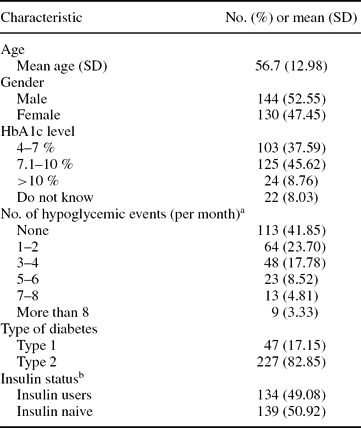
Of 378 invited participants, 291 completed and returned the survey resulting in an overall response rate of 77 percent. Among the respondents, seven questionnaires were incomplete and ten respondents answered both dominant strategy questions incorrectly and were, therefore, excluded from the final analysis, resulting in 274 respondents included in the final analysis. The mean age of participants was 56.7 (SD 12.98) years, of which 144 (52 percent) were men, 227 (83 percent) had type 2 diabetes, and 134 (49 percent) were insulin users (Table 1).
Sociodemographic and Diabetes-Related Characteristics of Participants (n = 274)

aFour missing.
bOne missing.
SD, standard deviation.
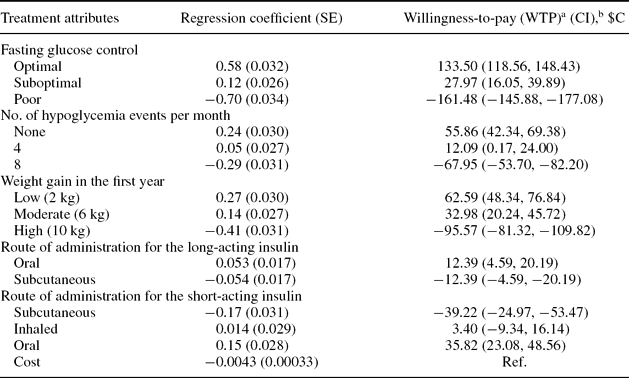
Overall, patients were willing to pay the most for better glucose control, and to avoid weight gain and hypoglycemic events, and were willing to pay the least for an alternative route of insulin delivery (Table 2). Specifically, patients were willing to pay significantly more for oral short-acting insulin ($C35.82, [95 percent CI, 23.08, 48.56]) relative to both inhaled ($C3.40, CI, [−9.34, 16.14]; p < .01) and subcutaneous insulin ($C-39.22, CI, [−24.97, −53.47]; p < .01). A negative WTP for subcutaneous insulin suggests that patients were willing to pay $C39.22 to avoid the subcutaneous route for the short-acting insulin. They were also willing to pay significantly more for inhaled versus subcutaneous insulin (p < .01). Similarly, for the long-acting insulin, patients were willing to pay $C12.39 to avoid the subcutaneous route.
Relative Preferences and Mean Willingness-to-Pay for the Aggregate Sample (n = 274)

aWTP was estimated based on the ratios of the regression coefficients: βi/βj, where βi is the coefficient for the ith attribute level, and βj is the coefficient for the cost attribute.
bConfidence interval. Variance was estimated from the Taylor series approximation to the variance of random variable: Var(WTP) = 1/bj2[var(bj) – 2WTPcov(bj, bi) + WTP2var(bj)], where bj = coefficient for the cost attribute and bi = coefficient for the ith attribute level.
SE, standard error.
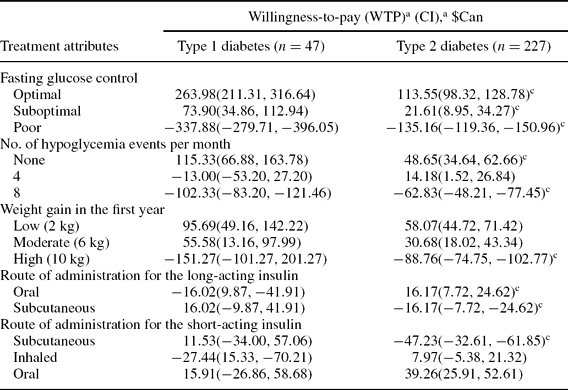
Stratification of the sample by type of diabetes revealed that patients with type 1 diabetes were willing to pay more for better control and to avoid adverse events, in particular hypoglycemia, relative to type 2 diabetics (Table 3). Conversely, whereas type 1 diabetics were willing to pay $C11.53 for subcutaneous short-acting insulin, type 2 diabetics were willing to pay $C47.23 to avoid subcutaneous short-acting insulin (p < .05). Moreover, although the difference was not statistically significant, type 2 diabetics were willing to pay more than twice as much as type 1 diabetics for oral short-acting insulin ($C39.26, CI, [25.91, 52.61] versus $C15.91, CI, [−26.86, 58.68]; p = .31), respectively. Whereas type 2 diabetics were willing to pay $C7.97 for inhaled insulin, the WTP for inhaled insulin by type 1 diabetics was negative, suggesting that they were actually willing to pay $C27.44 to avoid using inhaled relative to subcutaneous insulin; however, this difference was not statistically significant (p = .12). For long-acting insulin, type 2 diabetics were willing to pay $C16.17 to avoid the subcutaneous route, while type 1 diabetics, surprisingly, were willing to pay $C16.02 for subcutaneous relative to oral insulin (p = .02).
Willingness-to-Pay for Each Treatment Attribute, Stratified by Diabetes Type

aWTP was estimated based on the ratios of the regression coefficients: βi/βj, where βi is the coefficient for the ith attribute level, and βj is the coefficient for the cost attribute.
bConfidence interval. Variance was estimated from the Taylor series approximation to the variance of random variable: Var(WTP) = 1/bj2[var(bj) – 2WTPcov(bj, bi) + WTP2var(bj)], where bj = coefficient for the cost attribute and bi = coefficient for the ith attribute level.
cStatistically significant difference between groups at (p < 0.05).
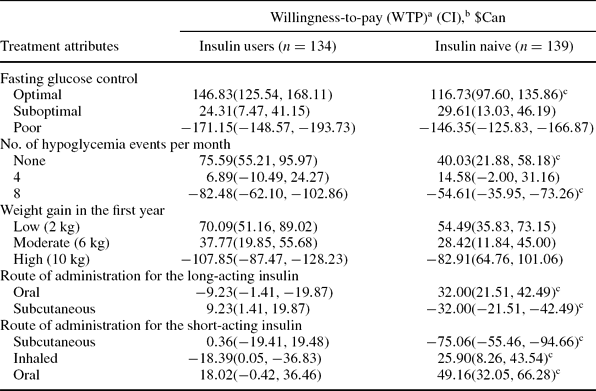
Stratification of the sample by insulin use revealed that, on average, insulin users were willing to pay more for increased control and fewer adverse events compared with insulin naive diabetics (Table 4). However, analysis of the route of delivery attribute revealed that insulin naive diabetics were willing to pay significantly more for both oral and inhaled short-acting insulin compared with insulin users ($C49.16, CI, [32.05, 66.28] versus C$ 18.02, CI, [−0.42, 36.46]; p = .01), and ($C25.90, CI, [8.26, 43.54] versus $C-18.39, CI, [0.05, −36.83]; p < .01), respectively. Insulin users were willing to pay $C18.39 to avoid using inhaled versus subcutaneous short-acting insulin. Similarly, whereas insulin naive patients were willing to pay $C32.00 for oral versus subcutaneous long-acting insulin, insulin users were actually willing to pay $C9.23 to avoid oral insulin in favor of subcutaneous administration (p < .01).
Willingness-to-Pay Estimates for Each Treatment Attribute, Stratified by Insulin Use

aWTP was estimated based on the ratios of the regression coefficients: βi/βj, where βi is the coefficient for the ith attribute level, and βj is the coefficient for the cost attribute.
bConfidence interval. Variance was estimated from the Taylor series approximation to the variance of random variable: Var(WTP) = 1/bj2[var(bj) – 2WTPcov(bj, bi) + WTP2var(bj)], where bj = coefficient for the cost attribute and bi = coefficient for the ith attribute level.
cStatistically significant difference between groups at (p < 0.05).
DISCUSSION AND CONCLUSIONS
Unsegmented analysis of patients' mean WTP revealed that, on average, patients were willing to pay the most for better glucose control, followed by avoidance of weight gain and hypoglycemic events. On average, diabetics were willing to pay the least for alternative routes of insulin delivery. Specifically, patients were willing to pay more for oral short-acting insulin relative to both inhaled and subcutaneous insulin. They were also willing to pay more for inhaled versus subcutaneous insulin. However, as hypothesized, type 1 diabetics were willing to pay less to avoid subcutaneous insulin, and were willing to pay more for other attributes of therapy such as effectiveness, and avoidance of adverse events, relative to type 2 diabetics. Insulin users were willing to pay more for increased control and fewer adverse events compared with insulin naive, who were willing to pay more for both oral and inhaled short-acting insulin compared with insulin users. Therefore, the findings of the present study suggest that diabetic patients, particularly type 1 diabetics, consider glucose control and avoidance of side effects to be significantly more important than alternative routes of insulin delivery.
The concept of asking individuals how much they would be prepared to pay for a new product as part of the market research is well-established, and WTP has become increasingly applied in healthcare programs to elicit the strength of patients' preferences (Reference Kleinman, McIntosh and Ryan12;Reference Sadri, MacKeigan, Leiter and Einarson18). A high WTP may indicate that patients are more likely to adhere to that treatment relative to another, if that treatment was offered. This information is very important within the health domain to decide if a certain treatment should be adopted or not. In addition, the WTP also indicates whether patients are willing to pay a significant portion of the costs of a treatment. In the present study, patients were aware that most treatments are covered in British Columbia, and they are not routinely required to pay out-of-pocket. Therefore, they were asked to “imagine” that they would have to pay out-of-pocket for the treatment they preferred. Thus, the WTP estimates in this study provide a measure of patient's relative preference for each attribute.
Of the 284 participants that completed the questionnaire, 274 (96 percent) answered both dominant, fixed choice sets correctly. This high correct response rate reflects that participant comprehension of the DCE questionnaire was very good and provides further evidence of the validity of results.
One explanation for the highest WTP for optimal glucose control may be patients' awareness that tight glycemic control represents the goal of therapy to prevent the development of diabetic-related complications that can significantly impact their longevity and quality of life. Of interest, although no previously published studies have evaluated patients' WTP to avoid weight gain, this adverse event was the second most valued attribute in our study. This, therefore, suggests that failing to include weight gain as one of the risk factors could reduce the validity of previous studies that neglected to include it, and that it should be incorporated into the treatment decision process.
As hypothesized, patients' WTP for different aspects of treatment differed between subgroups. Differences in patients' preferences are of interest because they provide a test of standard theoretical predictions and allow for the identification of groups with particularly strong positive or negative preferences for specific treatment attributes. Stratification of the sample by diabetes type and insulin use or nonuse revealed similar findings given the overlap between groups. Specifically, the insulin users group in this study included all 47 type 1 diabetics and 87 type 2 diabetics. Thus, we found that type 1 diabetics and insulin users were willing to pay more for increased control and fewer adverse events relative to type 2 and insulin naive diabetics, respectively. However, their WTP for insulin delivery revealed different findings. In essence, insulin naive diabetics had a stronger preference for oral and inhaled insulin compared with insulin users, and thus, demonstrated a strong desire to avoid subcutaneous administration, relative to insulin users. In addition, although it was not statistically significant, type 2 diabetics were willing to pay more than twice as much as type 1 diabetics for an oral, short-acting insulin. Moreover, both type 1 diabetics and insulin users were willing to pay out-of-pocket to avoid inhaled insulin in favor of subcutaneous administration. These findings support the hypothesis of a psychological barrier to initiating insulin therapy, but once that this barrier has been broken, they accommodate and accept injectable therapy as a treatment option. When this occurs, other aspects of therapy become more important.
No studies to date have attempted to evaluate patients' preferences for oral insulin, despite the fact that there are oral insulin analogues in the development pipeline. As predicted, oral insulin was preferred over inhaled and subcutaneous routes for the aggregate sample. However, the mean WTP for oral insulin was only $C35.82/month for short-acting, and $C12.39 for long-acting insulin. Although the difference can be explained based on the frequency of administration required, one might have expected that patients would place a higher value on a more convenient, noninvasive route of administration relative to subcutaneous insulin, and on a more convenient route relative to inhaled insulin, where patients are required to carry an inhaler.
Although we hypothesized a priori that patients would prefer a noninjectable route of insulin delivery, route of administration was actually the least important attribute overall. This was not expected because patients' resistance to initiating insulin is well established in the literature, mainly due to barriers related to the injections such as fear of needles, inconvenience of repeated daily injections, and injection-related anxiety (Reference Korytkowski13). One likely explanation for the low relative importance of route of insulin delivery is that type 1 diabetics and insulin users overcame the barrier to initiating insulin therapy and accommodated to the injections. Another explanation may be that insulin users and type 1 diabetics were more likely to have experienced at least one serious adverse event; therefore, these attributes of therapy may become more important than route of insulin delivery for these patients. Specifically, nine patients in this study reported to have experienced more than eight hypoglycemic events per month. Of these, only three had type 2 diabetes, and all nine were insulin users, which might explain the importance these patients place on hypoglycemic event avoidance.
In a previous Canadian study (Reference Sadri, MacKeigan, Leiter and Einarson18), the mean WTP for inhaled insulin derived using contingent valuation was $C157. Specifically, type 1 and type 2 diabetics were willing to pay $C154 and $C177, respectively for inhaled insulin, which is inconsistent with our findings. Our results suggest a mean WTP for inhaled insulin was $C3.40 in the entire sample, while type 2 diabetics were willing to pay $C7.97 for inhaled insulin, and type 1 diabetics were willing to pay $C27.44 to avoid this route in favor of subcutaneous administration. One possible explanation for the low WTP for inhaled insulin in the present study is that because an oral route was simultaneously investigated, and would represent a more convenient route compared with an inhaled route, patients in this study valued oral administration more than inhaled administration. A second explanation is that it was explained to patients in the background information that there could be increased risk of pulmonary adverse events with inhaled insulin which may have led to a preference for avoidance of additional potential adverse events associated with inhaled insulin that was implicit within the inhaled route attribute. Thus, the low valuation of inhaled insulin in this study may, in part, represent avoidance of potential adverse events, rather than a lack of preference for the inhaled route. A third explanation is that, as previously revealed, patients tend to accommodate to the injectable route once they start using insulin. Specifically, our findings revealed that while insulin users were only willing to pay $C0.36 for subcutaneous short-acting insulin, nonusers were willing to pay $C75.06 to avoid this route. These findings are of great importance because they may help understand the reasons for the limited adoption of Exubera®, the first inhaled insulin, which was removed from the market less than 2 years after it was approved for use in 2006 due to a lack of demand (Reference Keegan11).
In general, stated preference studies are limited to eliciting only patients' stated preferences for the initial use of a new drug product and route, which may not necessarily represent their preference over time or how they would actually choose given the choice in a real world. Furthermore, even if the alternative insulin administration routes were available, they may not be covered by medical insurance plans initially; therefore, patients may not choose this type of therapy given the cost barrier. Thus, all that can be concluded from this study is patients' stated willingness to pay for alternative routes of administration, but their actual willingness to pay cannot be determined.
Participant recruitment through diabetes education centers at two tertiary institutions could potential raise concerns over a potentially biased patient sample. However, in British Columbia, to have diabetes test strips reimbursed, patients must complete a diabetes education program. Thus, essentially all diabetics in the recruitment area must visit the clinic, and as such, it is anticipated that this sample is representative of the general population.
The WTP data from this study provides information about patients' preferences for several aspects of insulin therapy. This information can be used to guide future directions for drug development, with a focus on increasing the ability to improve glucose control and reduce adverse events. Findings also provide evidence that substantial efforts are needed by diabetes educators to overcome the psychological barrier to insulin initiation as an attempt to improve glucose control. For type 2 diabetics and insulin nonusers in particular, improved glucose control may be achieved with alternative routes of insulin delivery. Therefore, by understanding and addressing patients' preferences for insulin therapy, diabetes educators can use this information to find an optimal treatment approach for each individual patient, which may ultimately lead to improved control, through improved compliance, and better diabetes outcomes.
CONTACT INFORMATION
Camila Guimarães, MSc, (milaguimaraes2@hotmail.com), PhD, Department of Clinical, Toxicological and Bromatological Analysis, University of São Paulo— Faculty of Pharmaceutical Sciences of Ribeirão Preto, Via do Café s/n, Ribeirão Preto, São Paulo, CEP 14040–903, Brazil
Carlo A. Marra, BSc(Pharm), PharmD, PhD, FCSHP (cmarra@exchange.ubc.ca), Scientist, Centre for Health Evaluation and Outcomes Sciences, Providence Healthcare; Associate Professor, Faculty of Pharmaceutical Sciences, Lindsey Colley, BA, MSc (lcolley@interchange.ubc.ca), Statistician, Faculty of Pharmaceutical Sciences, Sabrina Gill, BSc, MD, MPH, FRCPC (sgill@providencehealth.bc.ca), Director, Diabetes Clinic, Endocrinologist, Department of Medicine, St. Paul's Hospital; Clinical Assistant Professor, Department of Medicine, University of British Columbia, 2146 East Mall, Vancouver, British Columbia V6T 1Z3, Canada
Scot H. Simpson, PharmD, MSc (ssimpson@pharmacy.ualberta.ca), Associate Professor, Pharmacy & Pharmaceutical Sciences, University of Alberta, 3126 Dentistry/Pharmacy Centre, Edmonton, Alberta T6G 2N8, Canada
Graydon S. Meneilly, MD, FRCPC (meneilly@interchange.ubc.ca), Head, Dept of Medicine, Faculty of Medicine, University of British Columbia; Professor, Geriatric Medicine, Vancouver Coastal Health, 10203—2775 Laurel Street, Vancouver, British Columbia V5Z 1M9, Canada
Regina H. C. Queiroz, MSc, PhD (rqueiroz@fcfrp.usp.br), Associate Professor, Department of Clinical, Toxicological and Bromatological Analysis, University of São Paulo—Faculty of Pharmaceutical Sciences of Ribeirão Preto, Via do Café s/n, Ribeirão Preto, São Paulo, CEP 14040–903, Brazil
Larry D. Lynd, BSP, PhD (llynd@interchange.ubc.ca), Assistant Professor, Faculty of Pharmaceutical Sciences, University of British Columbia; Scientist, Centre for Health Evaluation and Outcomes Sciences, Providence Healthcare, 1081 Burrard Street Vancouver, British Columbia V6Z 1Y6, Canada