

INTRODUCTION: JEPHSON'S BIG SECRET
We begin with a story of a man who knew too much and a nation that did not. At the beginning of the 1690s, no one knew more secrets about the government's money than William Jephson.Footnote 1 Others had more visible power, like the Lords of the Treasury, or extracted greater personal profits from their positions of financial trust, like the auditor of the Exchequer, Sir Robert Howard. But Jephson knew something it seemed no one else could. In his capacity as secretary to the Treasury since April 1689, Jephson was responsible for paying over £100,000 per year out of public revenues for “Secret Service,” money paid directly on order of the monarchs without public record.Footnote 2 Many Englishmen suspected that Jephson's account books mapped a covert network of payoffs to the public's political representatives. In the wake of the “Glorious” Revolution of 1688–89, Jephson's secret accounts reminded some that the threat of autocracy was not dead. Jephson was willing to take these secrets to his grave.
To Jephson's ultimate employers, the new monarchs William and Mary, maintaining absolute secrecy over these payments was essential for exercising their royal prerogative. Secret Service legitimately included many minor expenses related to the everyday business of government, such as rewards to royal employees under £100. Yet it also encompassed considerably larger payments (up to thousands of pounds) to royal household officials, diplomats, and the king's personal creditors. Many Englishmen feared that these sums were being used as kickbacks to royal favorites or, even worse, royal bribes to members of Parliament. The exploitation of Secret Service money had exploded under the late Stuarts, largely through the efforts of Charles II's suspicious minister the Earl of Danby to “manage” Parliament in the late 1670s.Footnote 3 The fact that large uses of public money were still kept secret from Parliament after 1688 indicated to many MPs that the Crown maintained too much autonomy even after the removal of James II. So when the new Commission of Public Accounts began to investigate the movements of public money in March 1691, Jephson was one of its prime targets.Footnote 4
But that commission quickly hit the ultimate obstacle in its Secret Service investigations. On June 7, Jephson died. Over the next six months, the commission tried desperately to recover Jephson's secret accounts by harassing his employees and pleading with his employers at the Treasury. In return, they received partial answers and appeals to executive privilege, none of which explained where Jephson's secret money had gone or even who might know where it went. In the end, the commission could only account specifically for payments to eighteen members of Parliament since November 1688, totaling just under £27,000. This was a fraction of the £243,000 in total secret money that the commissioners surmised Jephson had distributed during that time.Footnote 5 Rumors abounded about £20,000 supposedly paid to the Earl of Nottingham for the purchase of his house in Kensington.Footnote 6 The commission's audience remained incredulous that such critical information really could not be recovered.Footnote 7 MP Sir John Thompson captured the mood best when he said: “I stand amazed that, in the best times and Governments, things should be in such darkness. . . . ’Tis our misfortune, the person is dead that should give you Account.”Footnote 8
The enigma of Jephson's accounts was reflective of a broader crisis of knowledge that beset English parliamentary representatives. In the wake of 1688, many MPs realized they had long left the management of the nation's financial information to a handful of individuals, like Jephson. As a collective body, Parliament, especially the Commons, knew almost nothing. The commoners had a hard time even figuring out what they did not know or what it was possible to know. This ignorance first became apparent in 1689, when the Commons had to decide how much to pay its new monarchs for the ordinary costs of government. Parliament's subsequent investigations into the dark recesses of the public's finances offered valuable lessons about the frailty of the government's informational infrastructure and the political value of informational control.
The primary institutional apparatus for these explorations was a new parliamentary Commission of Public Accounts, formed in 1690. Designed largely to curb executive autonomy and root out administrative corruption, the commission became an unexpected project in quantitative political analysis. Steve Pincus has recently noted that “for most people in later seventeenth-century England, determining the nation's economic interest was a complex calculation.”Footnote 9 For no one was this more literally true than for the inexperienced Accounts commissioners, who found that even the most seemingly straightforward calculation—determining the government's fiscal condition—was profoundly perplexing. The process of overcoming such challenges drove a broader transformation in the place of numerical information in English government.Footnote 10 Mary Poovey and Jacob Soll have shown how important the idioms of accounting were to the development of theories of state in the early modern period.Footnote 11 In the 1690s, those connections between numerical accounts and ideas about good governance became startlingly tangible. Parliamentarians began to demand more information from the Crown's agents and to use arithmetic as a tool of critique. Numerical assaults became a potent weapon of partisan politicking, exemplified by the efforts of Accounts commissioner Robert Harley and like-minded “Country” MPs who were fearful of the abuses of ministerial power. Such critics found calculation especially useful for piecing together the spotty information they were able to extract about the public's money from official government sources.
The kinds of informational challenges that frustrated the Accounts commissioners reverberated beyond Westminster, prompting new concerns and inspiring new methods for theorists of political economy. In particular, the characteristic uncertainty that plagued the parliamentary public accountants also frustrated practitioners of “political arithmetick,” triggering a transformation of that nascent science after the death of its pioneer, the Restoration virtuoso William Petty (d. 1687).Footnote 12 This methodological reinvention of political arithmetic was laid out in the 1690s writings of Charles Davenant, a former Excise commissioner. Davenant espoused many common commitments and shared many experiences with the Public Accounts commissioners, especially Harley. These included a deep fear of ministerial corruption, intolerance for the ignorance that pervaded the nation's fiscal administration, and most critically, the frustration of trying to craft computational arguments on the basis of limited fiscal data. Davenant fashioned a new theory of political arithmetic around these shared anxieties. He articulated an embryonic Country ideology of the administrative and ethical value of information and combined the strategies of numerical interrogation pursued by the commissioners with the creative estimation techniques of Pettian political arithmetic. Davenant's most important departure came in the searching attention he gave to the question of what kind of knowledge political arithmetic really could produce. Faced with the quandary of trying to make numerical arguments based on imperfect data, in the face of opponents who claimed his evidence was never sufficient, he began to think in new ways about what made a numerical claim of knowledge good enough to believe. As Davenant became forced to worry about the epistemological dimensions of political arithmetic, he stumbled upon even bigger questions about the nature of probabilistic knowledge that simultaneously troubled some of Europe's cleverest philosophers and mathematicians.Footnote 13
This article makes two central arguments. The first is that, in the 1690s, numerical calculation found a new and vital place in political life as a tool of criticism.Footnote 14 This instrument was forged rather suddenly after 1688, as political representatives and commentators confronted how little they, or even those within the government's administrative apparatus, knew about the nation's tenuous fiscal condition. New techniques of political calculation developed largely as a way to make the most of limited information, particularly about the government itself. If, as Paul Slack has recently argued, the English state had developed little interest in gathering information about the nation by the 1690s, then at that very moment parts of the nation became extremely interested in gathering information on the state.Footnote 15 Moreover, the central problem of how to make useful fiscal knowledge despite the informational jealousy and disorder that reigned within the government was common to the day-to-day investigations of parliamentary auditors—to “public accounting”—and to Charles Davenant's systematic reflections on “political arithmetic.”Footnote 16 My second key argument is that these agonistic numerical struggles forced politicians and political economists to confront new questions about the nature of economic knowledge itself. The political chaos surrounding fiscal information was an essential site in which Englishmen at the dawn of the eighteenth century confronted the problem of creating knowledge amid uncertainty. The new kinds of calculations developed to combat that uncertainty often generated heated opposition. The more some critics called upon creative arithmetic to diagnose governmental ills, the more intensely their opponents scrutinized the validity of those numbers. As Mark Knights has put it, “[K]nowledge and truth were thus political issues.”Footnote 17 The problems of informational access, combined with the adversarial style of deliberation that characterized 1690s politics, generated new thinking about probable knowledge.
More broadly, this article reveals that developments in administration, politics, and economic (even mathematical) theory were closely linked by problems common to them all—not only about the nation's finances but also about the nature of knowledge itself.Footnote 18 In doing so, it seeks to build on the work of scholars who have explored how Britain's “Glorious” and “financial” revolutions were entangled with new anxieties about information, knowledge, and credibility.Footnote 19 Mark Knights has argued that the bitter politics of the later Stuart period forced Britons to ponder what made public claims of political knowledge valid, nowhere less than in matters of political economy.Footnote 20 Carl Wennerlind has demonstrated that the English “financial revolution” was empowered by a century of new thinking, not only about money and credit, but also about public opinion and interpersonal trust.Footnote 21 The innovative schemes for a national credit system that proliferated in the late 1600s were epistemological as much as financial, grounded in new practices of “qualitative probabilistic reasoning.”Footnote 22 In a political world racked by partisanship and distrust, making useful knowledge about politics and finance did not require demonstrative certainty but rather building trust around what was probable.
Britain's “first modern revolution” raised many pressing questions about the nation's fiscal past, present, and future.Footnote 23 In particular, finding the money—whether tracking down the recipients of William Jephson's secret service payments, determining the current state of the nation's revenues, or assessing the best future tax strategy—became a paradigmatic problem for many, from administrators to MPs to economic theorists.Footnote 24 The stories that follow are about what happened when those people went looking for certain answers—and found them lacking.
“TO ENQUIRE INTO THE REVENUE IS YOUR BEST METHOD”: THE FINANCIAL SETTLEMENT OF 1689
The Revolution of 1688 and the fall of the aspiring absolutist James II had profound consequences for the way political information was managed in England.Footnote 25 In the debates over the granting of revenue to their new monarchs, MPs confronted how little they knew about the taxes levied on the English people and how those funds were spent—and the fact that whatever information did exist was bitterly guarded by political operatives of dubious probity. It was not that finance became a brand-new concern in English legislative politics in 1688. Parliament's right to control the revenue granted to the monarchy dated back centuries, and at several moments during the tumultuous seventeenth century, MPs had expressed interest in developing the informational capacity needed to fully exploit that cherished right. Analysis of the annual needs of the government was undertaken during the Interregnum, for example, and helped shape the financial settlement that followed Charles II's Restoration.Footnote 26 Parliamentary auditing, furthermore, made a first appearance shortly thereafter thanks to opponents of Charles II's favorite, the Earl of Clarendon. In 1667–68, Clarendon's adversaries established the Brooke House Commission to look into administrative failures by the earl's allies that were believed to have caused expensive disasters in the Anglo-Dutch war.Footnote 27
Prior to 1688, though, whatever brief surges of numerical energy were built up in Parliament fizzled out, failing to activate a sustained legislative interest in fiscal information for its own sake. Parliamentary analysis of monarchical funds disappeared during the reigns of Charles II and James II, despite the heightened analysis that preceded the Restoration. Both kings were voted large revenues for life, meaning the question of the Crown's “ordinary” revenue (the funds required for standard monarchical functions, not including the irregular costs of war) only needed to be addressed comprehensively once per reign. Parliament's unfamiliarity with financial questions was exacerbated by the extreme infrequency of Parliaments, which, for example, sat only once between March 1681 and January 1689. The financial autonomy of the Crown grew in parallel, particularly in the 1680s, when booming trade swelled Customs duties. As a result, Crown ordinary revenues climbed from £1.2 million in 1670 to £1.9 million when James II took the throne in 1685.Footnote 28 The experiment in parliamentary auditing undertaken in 1668 also came to nothing, as Charles II stepped in to defend the key target, Sir George Carteret. Parliamentary audit was not seen again until the 1690s.
Parliament's fiscal awareness was further compromised by the diffuse mechanisms by which governmental finances were managed. Autonomous “undertakers” administered many of the major economic functions of government through much of the Restoration period, including tax collection, public borrowing, and military supply.Footnote 29 The private nature of English public finance prior to 1688 was mirrored in the way financial information was communicated to the legislature. Few MPs at the time were competent in the complexities of financial calculation or had reason to care. Most MPs conceded parliamentary stewardship of financial information to a select few, such as William Jephson and especially Sir Robert Howard.Footnote 30 An executive placeholder and MP since just after the Restoration, Howard had acquired the lucrative position of auditor of the Receipt in the Exchequer in 1673. In that position, he served as the primary broker of information between Parliament and the Lower Exchequer, the main clearinghouse for government funds.Footnote 31 If MPs wanted financial numbers—though certainly not a regular occurrence before 1688—they had to ask for them from individuals like Howard.
The Exchequer itself was an elaborate machine for producing financial data, but whether that information was usable by the public was an entirely different matter. The Exchequer's proud but peculiar methods of accounting, developed to safeguard the king's money, were highly opaque to outsiders.Footnote 32 That was true even when protocols were followed exactly; by the 1680s, exactitude was rare, the rigor of Exchequer procedure having deteriorated substantially under Howard's watch.Footnote 33 The processes for distilling information for use by legislators were conducted especially carelessly. For example, the position of clerk of the Pells was expected every half year to make a “General Declaration” to Parliament of all the receipts and payments to and from the Exchequer. By the early 1690s, the current clerk, William Wardour, was at least three years delinquent in this declaration.Footnote 34 Few seemed particularly concerned.
Several factors therefore converged to limit the relevance of numerical knowledge in legislative politics before 1688, particularly the monopolistic structure of financial information management and the Crown's relative fiscal autonomy. The Revolution destabilized all this. Debating numbers, relatively unfamiliar to a generation of MPs, suddenly became a regular part of parliamentary business, initiated by the problem of the Revolution's financial settlement and sustained by the problem of funding a new war with France. Parliament's numerical awakening began very shortly after the landing of William of Orange. In December 1688, a makeshift convention was tasked with establishing the constitutional terms under which William and Mary would rule. As that convention was transformed into the first post-Revolution Parliament, the monarchs’ financial settlement emerged as a pivotal question.Footnote 35 At this point, the MPs encountered a fundamental challenge: they began to realize exactly how little they knew. On the first day of debate in the Convention Parliament (26 February 1689), the discussion on monarchical supply proceeded without apparent concern for financial particulars. The next day, MPs pointed out that the simplest answer, renewing James II's ordinary revenues permanently, also put the nation in “danger of falling into the misfortune of the last two governments.” More complicated solutions required knowing what the existing revenues actually were. “I find there will be occasion of discourses, what the Revenue is?” suggested merchant MP William Love. “Therefore I move, that Howard may give you the Revenue. When all is before you, you may consent to such a Revenue as may make the king great to all the world.” Spirited calls for financial information came from Edward Seymour, a key Tory supporter of William III: “If we settle the Revenue, I would enquire into it; if you know not the value of what is given, you cannot do it effectually. To enquire into the Revenue is your best method.”Footnote 36
Seymour's cries did not go entirely unanswered. Robert Howard offered a preliminary “Computation of the several Branches of the Revenue” on 1 March 1689, with subsequent detail on expenditures and the Excise later in the month.Footnote 37 Early confusion magnified Howard's informational power, as he “delivered in such Accompts and Estimates, as he conceived were necessary for the Service of the House.”Footnote 38 The MPs remained at Howard's mercy at first, having no experience interrogating the numbers reported to them.Footnote 39 Soon, though, MPs began to make more frequent and pointed numerical demands. While some may have used such requests as a stalling tactic, the importance of better financial knowledge was increasingly apparent to many.Footnote 40 Henry Capel criticized those who were willing to allow such major decisions to be made on informational faith. “The Book of Rates, the Act for Excise, we do not yet know,” Capel cautioned, emphasizing how much uncertainty surrounded major revenue sources like the Excise. He continued with a soon-familiar refrain: “There are complaints of the ill administration of them; now is the time to correct it. . . . It is not a time to name the Revenue now.”Footnote 41
This message of caution was heeded. In mid-March 1689, the House of Commons passed a bill that continued current revenue collection until June only. In addition, 20 March featured a spirited debate in the Commons about the Crown's requisite ordinary revenue.Footnote 42 At moments, contentious arguments about what qualified as ordinary versus military expenditure drifted into more abstract territory, as MPs debated how best to assess the baseline peacetime revenue of the previous two kings. The veteran Whig William Sacheverell argued that expansions in regular military spending and pensions, fueled by the “severe way of management” introduced in the Customs in the 1670s, made it necessary to go all the way to the late 1660s for a baseline. The busy moderate William Garway suggested that it was perhaps better not even to try to project from old figures. “We cannot say the Revenue will stand to 1000, or 10,000l.,” he said, “there being several variations of the Customs in several Years.”Footnote 43 Such methodological musings, while hardly groundbreaking, show that fiscal conundrums forced MPs to think critically about making deductions from numerical data.
The House ultimately fixed upon a peacetime revenue figure of £1.2 million pounds, the amount settled upon Charles II in 1660. Over April 1689, the House turned to the question of government expenditure only after this level for ordinary revenue had been set. After discussing different governmental needs, the commoners agreed that ordinary expenses amounted to more than £1.7 million, well beyond the £1.2 million level for income. This prompted the House to undertake an even more searching look at the revenue question, through which they learned, for example, that half of all monarchical revenues were already committed to preexisting pensions, interest, and departmental backlogs.Footnote 44 From April to June, the Commons largely ignored these fiscal questions through some combination of irritation, distraction, and deliberate delay. This sluggishness frustrated King William, who voiced his anxiety before the Commons on 28 June. The king's speech prompted consideration of a new supply bill in July, which came to little. In March 1690, Parliament finally returned to the matter purposefully. By May 1690, it settled upon a reasonably stable plan that granted King William certain Excise taxes for life and Customs for four years.
The anxiety of the revenue debates in 1689–90 initiated a new era of legislative concern with financial matters. In the wartime context of the 1690s, the need for temporary funding was unending, and so money debates were constant. Parliament was not about to surrender the newfound command it was gathering over financial information. In the debates on supply during March 1690, the MP Paul Foley offered a succinct formulation of what had become a powerful mantra among many, both Whig and Tory: “I would give this King Money, but not by a Rule, because we have given other Kings. I stand upon it, to have more reason from the accounts before we give Supply.”Footnote 45 The institutional realization of this principle was the Commission of Public Accounts. Foley was one of its first members.
THE UNCERTAINTIES OF PUBLIC ACCOUNTING
Parliament's anxious handling of the supply question prompted new expectations about what Parliament ought to know, and deserved to know, about the government's finances. Some MPs began to demand that the Commons have its own infrastructure for managing fiscal data. Their goal was an autonomous parliamentary account of all public funds, built from the ground up. The vehicle chosen was the Commission of Public Accounts, a body of commoners that sat in two extended stretches from 1691 to 1697 and from 1702 to 1713. By attempting to reconcile the nation's entire financial administration in a single, external account, the commissioners created a model of the values by which they hoped government to work. Building a comprehensive public account nevertheless turned out to require more than asking the right list of people to open their books and doing simple arithmetic. Public accounting was fraught with uncertainty. The commission's anxious struggles over governmental information embodied paradigmatic problems of knowledge in the 1690s, which came to shape administrative practice, political culture, and ultimately epistemological ideas about calculation itself.
Parliament's interest in interrogating monarchical power was not new. MPs had fought over the previous century to defend a constitutional “right of inquiry” into the failings of Crown agents, and the abortive efforts in parliamentary auditing in the 1660s had instilled an earlier generation of MPs with some basic expectations about executive accountability.Footnote 46 Yet previous experiments like the failed Brooke House Commission had not left lasting institutional mechanisms for critiquing executive information. Subsequent administrative transformations meant that the task of drawing up a comprehensive public account in 1691 was a new problem with different challenges than had been encountered a quarter century earlier. In some areas of England's developing fiscal-military state, like Exchequer accounting, the intervening years had actually witnessed declining administrative care. In other areas, like public borrowing and the navy, the growth of new state capacities had generated new analytical problems of their own. A more powerful state, as it happened, was not necessarily easier to account for.Footnote 47
It was a military matter, indeed, that first renewed calls for taking public accounts. The new war with France had barely begun when some became concerned about impropriety in its management. In October 1689, MPs assailed agencies like the Victualling Office, the Admiralty Board, and the army provisioners for Ireland. Waste-conscious Tories like Edward Seymour and Christopher Musgrave found common cause with Whigs who feared the continued infection of Stuart placemen. The Commons appointed two select committees to investigate.Footnote 48 This pilot project fueled enthusiasm for a comprehensive investigation into public funds, as MPs grew frustrated with the limited account information the new king had conceded. In late May, William proactively attempted to establish a royally directed Accounts commission, though a jealous group of Whigs blocked its creation. The king promised greater access to government accounts later in October, but this failed to satiate Parliament's informational appetites.Footnote 49 The pressure for a truly parliamentary accounts board won out, and both Houses ratified a plan for a commission of nine commoners in late December.Footnote 50
The Commission of Public Accounts was foremost an organ of parliamentary inquiry, though its supporters emphasized that the greater transparency provided would make it easier to raise revenues. William III acquiesced to hasten Parliament's military funding grants.Footnote 51 From the outset, the Commons jealously guarded their new public accounting function. Despite repeated efforts, the Lords ended up with no input on the commission. The Lords made moves to add four of its own members to the commission in late December 1690, which the Commons thwarted by threatening to table a pending money bill.Footnote 52 (The commoners resorted to a similar tacking strategy in 1692, when the Lords tried to add on four nonparliamentary nominees, including Charles Davenent.)Footnote 53 Partisan tensions also threatened to trouble the new institution. Commissioner Robert Harley reported that “some hot words did pass between some” at the commission's first meeting in March 1691. But less than two weeks in, Harley explained that “business now has taken off the edge of our passions and we are fallen to it with calmness and diligence.”Footnote 54 Whigs like leading vote-getter Robert Rich quickly found common sympathies with their Tory colleagues, like Oxford clergyman Thomas Clarges.Footnote 55
The commission's first order of business was to request information. The commissioners did so through written “precepts,” many of which included dozens of subsidiary requests. The commissioners had a considerable staff of bookkeepers and messengers and a numerical system for tracking over three hundred data requests they would make by late 1691.Footnote 56 Their targets ranged from the most elevated executives to minor clerks and contractors. Among their first requests, issued 11 March, were precepts to: three top Excise officials, the Excise commissioners, the Paymaster General to the Army in both England and Ireland, and the secretary of war. On 8 May of that year, the commissioners directed precepts numbered 158–62 to: a major general in the army, a Bristol merchant, a Covent Garden linen-draper who had a military coat contract, the “Avener” of the Crown stables (responsible for feeding the king's horses), and several naval victualers.Footnote 57 The commissioners often pursued a microscopic level of detail. Sir Peter Colleton, for example, took a particular interest in the minutiae of military spending, carefully examining the efficiency of coat tailoring, the pricing of footwear, and the supply of hay for horses.Footnote 58 These were all serious logistical problems and potential areas for waste, to be sure, but Colleton's painstaking attention to such specificities shows how the commissioners had to make up rules of relevance as they went.
In their early information-gathering procedures, the commissioners displayed a distinct confidence both in their own authority and in the competence and willingness of myriad government agents. Precepts were assigned ambitious deadlines, and “accountants,” who had to swear verbally to their numbers, were called to testify on short notice. Rarely were any replies offered without incident. Some individuals were simply unwilling to deal with the commission.Footnote 59 Expert data-mongers like Robert Howard preferred subtler forms of misdirection, like sending lower officials to answer the commission so they might claim incomplete knowledge of the requested information. When the commission made a request for data on fees taken by Exchequer staff, Howard and his underlings adeptly avoided the question for weeks.Footnote 60 More disheartening problems arose when the commission found that information was not where or in the form they assumed it was or might never have been recorded at all. Some executives, like Army Paymaster the Earl of Ranelagh, simply lacked the competence or desire to keep the kind of records the commission demanded.Footnote 61 Other respondents regularly explained that they were not the right people to ask. An illustrative example of informational athletics came in early May, when the commission hosted William Jephson to inquire about back taxes in Ireland. Jephson rerouted them to the Treasury clerk William Lowndes, who informed them that he only knew of one tax backlog in Ireland and told them to consult Robert Howard for more complete documentation.Footnote 62 This kind of runaround was common. Those who controlled privileged data no doubt used such informational disorder and incommensurability at times to protect their own authority.Footnote 63
Confusion, though, was just as often a structural phenomenon. The commissioners found vague but significant sums paid out through back-channel mechanisms.Footnote 64 Particularly troublesome was a massive £20,000 payment of English money to a “Mr. Vanderesch,” muster-master of the Dutch forces, for which no authorization could be found beyond a supposed Dutch royal seal.Footnote 65 No less frustrating were the many cases where data was unavailable because the practical demands of government did not require it. The commissioners could not have been pleased to discover that the Treasury did in fact make weekly accounts for many government agencies to assist in cash distributions, but that after that immediate purpose was fulfilled the Treasury “looke upon those accts. as wast[e] papers, and keep's them not.”Footnote 66
The boundaries between intentional dissimulation and structural confusion were often hard to draw.Footnote 67 It was not always obvious what data was being withheld, what was unknown by a specific individual, and what simply did not exist. Nowhere was this more evident than in the commission's investigations into Jephson's Secret Service accounts, with which we began. On 10 June 1691, the commission sent a request to Jephson's clerk, Robert Squib, to bring in copies of answers Jephson had purportedly made to its previous inquiries, along with a catalog of records left at his death.Footnote 68 Two days later, Squib delivered an account of Secret Service payments made by Jephson, but it only showed that money paid to Members of Parliament. The commissioners were hardly satisfied by that answer or by a second report Squib later produced.Footnote 69 Squib pleaded that the king had instructed Jephson to disclose information only on payments to MPs and no other state secrets.Footnote 70
The commission took up the Secret Service issue again with vigor in early September.Footnote 71 The vexed commissioners turned to the Lords of the Treasury, with whom the commission had early developed a strained and distrustful relationship. Squib had suggested to the commission that Secret Service money was probably not paid without the knowledge of the Treasury Lords, but that body ultimately proved even less helpful than Squib had been.Footnote 72 The Lords explained that they approved the allocation of funds from the Exchequer to Jephson for general Secret Service usage. As to their particular distribution, though, the monarchs “privately entrusted him [Jephson] in that affair without our knowing or being any way privy to the particular uses to which or the particular persons to whom the same were applied.” That is, once Jephson got the money, he was the only one, save the king and queen, who knew where it went. The Lords concluded, “we doubt not but it will appear very plain to you that it is not in our power to send you such an account as you desire.”Footnote 73 The Treasury Lords’ claims of ignorance were probably somewhat exaggerated, because at least one member of that group, Chancellor of the Exchequer Richard Hampden, had periodic access to at least part of Jephson's Secret Service ledgers.Footnote 74 But whether through lack of knowledge or intentional misdirection, the Treasury Lords offered no further information. The commissioners found an unsatisfying end to their efforts on 20 November, when they received a formal letter from Squib, on the order of the Treasury Lords, admitting that “there were other payments made by Mr. Jephson to several Members of Parliament for services relating to the State . . . the secrecy of them being so absolutely necessary, his Majesty does believe that the House will not desire the Particulars.”Footnote 75
Such disappointments, however, brought a measure of education. The navy was a particular area in which the commissioners confronted the informational complexity that arose in a rapidly developing executive agency. Lord Falkland, 1st Lord of the Admiralty, explained to the commissioners early on that naval payments (excluding for victualing, which was different) might be conducted through any of three different methods (by “bill,” “book,” or “ticket”).Footnote 76 Often, such lessons were meant to justify why the commissioners could not expect the kind of information for which they hoped. Yet some excuses had real instructional value. No one did more to tutor the commissioners than Treasury clerk William Lowndes, who had rare insight into the conventions of multiple agencies. Between June and November, Lowndes explained to the commissioners the basics of Exchequer accounting, told the history of the “fictitious loan” as a fund-raising mechanism, and reconciled two major discrepancies (one of £10,000) between Treasury and Exchequer accounts relating to advances on tax revenues.Footnote 77
Nevertheless, such lessons were hardly what the commissioners, or their parliamentary audience, had envisioned when they began the project. In late November 1691, the Commons requested that the commission submit a first “State of the Income & Issues of ye Publick Revenue,” which the commission provided to both Houses shortly thereafter.Footnote 78 That report contained a lengthy table, summarizing government receipts (on the left) and expenditures (on the right).Footnote 79 This debtor-creditor structure imposed some order on the informational bedlam the commission had encountered; that numerical technology also framed the imperfections in their efforts. The commissioners explained that “this Account is as exact as we have been able to make” and provided several “reasons why it is not more perfect.”Footnote 80 Critically, the account did not quite balance; the commission found £18,018,586 in receipts but £18,020,403 in expenditures. The difference of just over £1,800 was modest, and the commissioners explained that it was an expected consequence of short-term credit procedures.Footnote 81 But any difference at all was meaningful. The precise balancing of debits and credits was a commanding rhetorical effect of mercantile accounting. When it worked, it testified to an accountant's care and honesty; when it failed, it was an immediate sign something was off.
The commission's first report was a penetrating commentary on the nation's informational administration, its imperfections notwithstanding. Each of the annoyances the commissioners encountered in their daily work was echoed in the final report. The commission spent much time explaining away sloppiness in accounting. When the Lords asked about a specific example of inaccurate accounting by the Paymaster of the Army in Ireland, the commissioners replied tersely that “as to miscasting of accounts in general, it has given the Commissioners a great deal of trouble, many of the accounts brought before them being greatly faulty.”Footnote 82 The commissioners also spoke to more systemic problems. The commission frankly admitted that the network of individuals responsible for public funds was “so voluminous, that it will require much more time to examine and state” them than was allowed.Footnote 83
The commission's report revealed that England's emergent military-fiscal state was far from an information state in any centralized sense.Footnote 84 The problems of making war and raising money had prompted many ad hoc solutions. New mechanisms of short-term financing posed some of the biggest informational challenges. The commissioners struggled to pass on to Parliament Lowndes's technical lessons about fictitious loans and tallies of anticipation.Footnote 85 Many of the state's new fiscal capabilities relied on single individuals for administration; by the commission's account, almost £120,000 of public money lay “in the hands” of individual undertakers. Thomas Fox, receiver of the Customs, held over £75,000, more than the Exchequer itself (£63,000). The commissioners explained how this complicated their ability to produce a comprehensive public account, citing the potential for “double-charging” of revenues because of loans Fox had advanced on Customs receipts.Footnote 86 Public money was hard to find when it spent so much time in private hands.
The commissioners had hoped to find a government where there was a voucher for every expense and where the accounts ultimately balanced. They did not.Footnote 87 They imagined a kind of certainty that did not exist, and their incomplete first report reflected that. That does not mean that the report was simply “a document of amazing ignorance.”Footnote 88 By attempting to reconcile England's disorderly fiscal system into a single account, the commissioners were creating a system of rules by which government was to be evaluated. They were also sharpening a set of computational tools for figuring out when their government failed to live up to those standards. The commission's first report was aspirational. It provided an incomplete image of what public finances actually were, but the model of a complete account became a numerical image of what some Englishmen wanted their government to be. It was also an implicit assertion about the need for exactly that kind of calculation—one that was far from perfect but which made the most of a profoundly uncertain situation.
“THE ACCOUNTS ARE AMAZING THINGS”: THE LEGACIES OF PUBLIC ACCOUNTING
Despite the commissioners’ ambitions, some began to question what their zeal had really achieved. The 1693 bill for renewing the commission elicited mixed sentiments. Edward Seymour, among the loudest proponents of parliamentary inquiry into the Crown's revenues in 1689, claimed of the Accounts commission that “he did not see any good was done by it answerable to what it costs you, which is almost £10,000 per annum.”Footnote 89 Historians have largely echoed Seymour's ambivalence about the commission's importance in the development of an efficient and accountable state.Footnote 90 Yet scholars have understated the connection between these public accounting exercises and enduring changes in the informational capacities of the administrative government. Two such changes are suggestive. A first example comes from late 1691 or 1692, when the Treasury began to keep a permanent series of consolidated accounts of annual revenue and expenditure.Footnote 91 P. G. M. Dickson notes that this was an exercise in numerical transparency unprecedented not only in England but anywhere at the time.Footnote 92 Both the timing and the formal similarities between these new accounts and the first report of the Accounts commission suggest that parliamentary pressure was likely critical to the Treasury's new practice.Footnote 93 A second key change was the rise of a new primary informational broker between the Commons and the Treasury after 1695, the informal position previously occupied by Robert Howard. That broker, elected an MP and promoted to secretary to the Treasury in 1695, was William Lowndes. Though often cited as a standard-bearer of rising civil-service professionalism in the era, “Ways and Means” Lowndes was no lone hero of administrative modernization.Footnote 94 His remarkable career was conditioned by the informational politics of the 1690s. When he entered the House of Commons in 1695, Lowndes had already been the Accounts commission's most important educator. From then until his death in 1724, he was both prized by the Court for his ability to get the king's business done and also trusted by Country critics for his ethical probity and clarity in conveying information.
More dramatic than such administrative effects was the impact that the efforts of the Commission of Public Accounts had on the place of numerical information in political discourse in the 1690s and beyond. The commissioners had learned that numerical accounting was a potent analytical tool. The armature of accounting organized disparate information and isolated what potentially valuable data was unavailable. Accounting calculations could be a potent argumentative instrument, even when administrative fragmentation or partisan conflict made it difficult to get all the desired information. These lessons were especially seized upon by MPs with Country sympathies, led by Accounts commissioners Robert Harley and Paul Foley. Country MPs, both Whig and Tory, sought to eliminate governmental waste and corruption, reform the nation's morals, and curb “Court” autonomy.Footnote 95 Country outsiders rarely held government places, and so they found in the arithmetic of accounting a tool for making potent conclusions despite informational asymmetries.
Changing attitudes about the political place of numbers were evident in the Commons debates over Secret Service money on 3 December 1691. Frustrated by the failure to unearth Jephson's secrets, one MP reflected on how the balance of numerical power had shifted somewhat from Court to Parliament. “The Accounts are amazing things,” John Thompson declared. “We were told in the last session, ‘Country gentlemen understood not Accounts,’ and now, it seems, the Commissioners of the Treasury do not. If they understand not Secret-Service, then they are not fit for their places.”Footnote 96 “Country gentlemen” like Thompson realized that numerical accounts were not only the province of ministerial insiders. They were open to anyone's scrutiny. For ministerial agencies like the Treasury, however, numerical competence was to be a requirement of responsible governance.
Parliamentarians mobilized their growing accounting acumen to seek greater input into governmental decision making. For example, MPs began to demand future estimates of military expenditures.Footnote 97 Previously, executive agencies had rarely projected future monetary needs, but parliamentary pressure in the early 1690s forced administrators to expand their numerical capacities.Footnote 98 Though commoners accepted the earliest military estimates with little comment, after 1691 they began to seriously interrogate the numbers put before them, growing ever more creative in their arithmetical criticisms.Footnote 99 In November 1693, for example, the Commission of Accounts was asked to investigate parliamentary grants for the navy and to analyze what funds had ultimately gone to naval use. They computed that, of just under £6.6 million granted for naval support since 1689, only £4.6 million had actually been paid.Footnote 100 The Treasury Lords were forced to provide their own computations to defend against the implication of mismanagement. At times, such computational controversies approached questions of accounting theory. In one instance, the commissioners challenged £98,000 in payments the Treasury had claimed to make in 1690–91 for naval ordnance, stating that, because such payments were earmarked for purchasing saltpeter, they “ought not to be so charged until converted into powder and issued for sea-service, except their Lordships intend a double-charge.”Footnote 101 Arcane points of accounting method, like how to quantify the movement of intermediate materials like saltpeter, gained considerable political import.
It was not uncommon for narrow disputes over account figures to initiate much more abstract reflections. The confusions that plagued the public accountants—inadequate data and obscure accounting conventions—created space for interpretive controversy. When it was unclear whether anyone could offer a definitive account, both the Court and its critics turned to arithmetical speculation. This was evident in another dispute between the Accounts commission and Robert Howard. Early in 1693, the commission offered an analysis of the monetary resources available to the government to pay for war needs over the subsequent three to four years. They found the government had roughly £1.3 million expected “to come in in time toward defraying the Charge of the Warr,” net of loans.Footnote 102 On 16 February, Robert Howard disputed the implication that the government was so flush with cash, claiming the commission had made over £1.1 million of “Errors in their Accot” and that the government only had about £172,000 at its disposal. Howard particularly argued that the commissioners had incorrectly projected the near-term receipts of various special taxes, such as Customs on sugar, by calculating on the basis of the most recent year's returns. An irregularity in the timing of voyages had meant that an especially large number of ships had come back to England from the West Indies that year. Taking instead a four-year running average, Howard estimated that expected sugar duties would be £282,000 below the commission's predictions.Footnote 103 When it came to projecting the future volume of international trade, the combatants had fully entered the realm of economic interpretation—political arithmetic, perhaps.
These 1693 battles testified to the increasing use of speculative numerical polemics in parliamentary discourse. Practitioners with a Country perspective honed the suggestive power of accounting in the early 1690s as a moralistic tool, aimed at executive agents who betrayed the public trust for personal gain.Footnote 104 Nevertheless, the analysis of accounts proved a flexible political instrument that could be applied from inside the ministerial government as well as from outside. As political battles over fiscal administration and political economy became defined by the all-encompassing conflict of “Whig” versus “Tory,” particularly in the Age of Anne, the computational pugilism shown by Howard and the commissioners would be asserted with greater intensity and analytical creativity.Footnote 105 Calculation would prove an indispensable part of the propaganda battles of the Augustan age, as the two great parties sought actively to conquer public opinion by managing information, spinning news, and “controlling the language by which the public gained financial literacy.”Footnote 106 In turn, the kinds of informational conflicts that had been fought out on a small scale between parliamentary outsider-accountants and reticent government insiders in the early 1690s would be replayed many times over, with many more viewers and many more digits in the numbers being discussed.Footnote 107 Whig-Tory partisanship was not the immediate cause of a new culture of numerical combat in England, but it certainly would take that form of political conflict to new limits—both of fiction and of fact.Footnote 108 On the one hand, the desire for competing parties to win arguments at all costs would push their spokesmen toward extreme knowledge claims that highlighted the potentially fictitious nature of political discourse. On the other hand, knowledge claims were subjected to relentless scrutiny by the opposing party, and the need to make statements that could hold up to such vicious criticism would encourage both sides toward more penetrating and rigorous analysis.
FINDING THE MONEY: FROM PUBLIC ACCOUNTING TO POLITICAL ARITHMETIC
The travails of the public accountants in the early 1690s had framed fiscal knowledge—who controlled it, how it ought to be made, and what standards should be invoked for evaluating it—as an object of political contestation. Robert Harley repeatedly contended that independent parliamentary institutions ought to be the primary stewards of governmental knowledge on matters like trade and national debt policy. In doing so, he made implicit claims about what the techniques of external analysis adopted by such representative bodies really could show about national commerce and public finance. In early 1693, for example, he wrote to his father about why the parliamentary Accounts commission ought to be given greater control over raising a new public loan. Harley suggested that the Treasury, who had “us[e]d ye Comrs. of accounts so unk[i]ndly,” ought to allow the commissioners to “shew their skil[l]s” as the proper stewards of such financial transactions. After all, it was the commission “who have found out all ye mon[e]y hither to.”Footnote 109 It is unclear exactly what Harley meant by “finding out the money” in that sparse letter. Was he crediting the commissioners with an administrative success, of having found new or lost streams of revenue? Was he applauding their ethical and constitutional achievement in having tracked down surreptitious corruption? Or was he speaking more to their analytical “skills” in assessing the nation's fiscal condition? The ambiguity, of course, spoke to more than Harley's terse epistolary style.
For Harley in the early 1690s, advocating public accounting required defending the value of parliamentary fiscal oversight and the validity of external auditing as a tool of governmental knowledge. None of these points went unchallenged, particularly amid a raging war with France. England's enemy, after all, had already established unprecedented centralized control over information under the ruthless command of Colbert.Footnote 110 The fiscal challenges England faced were complex, technical matters that many dared not leave to committees of inexperienced commoners.Footnote 111 Doubters worried that requests for greater numerical transparency were purely exercises in partisan obfuscation or sabotage and questioned whether the kind of external analysis offered by the Accounts commissioners could ever be reliable. Robert Howard offered a cogent, if petulant, critique in 1693 when he claimed of the commission's reports that “there was nothing in them but what any clerk of their office should be bound to present you with, but there are several mistakes in them.”Footnote 112 Howard's snarky point could not be dismissed lightly. How was it possible to defend such external analyses when they were bound to be flawed?
For at least one thinker, Charles Davenant, this question became a guiding intellectual occupation. In Davenant, Robert Harley's inchoate perspectives on representative government and the value of information found an ambitious theorist. In a series of treatises in the mid- to late 1690s, Davenant voiced many of Harley's ideological concerns, especially a prevailing fear of ministerial corruption and a belief in the administrative efficacy of representative institutions. (After 1700, Davenant would become one of Harley's most prized propagandists.)Footnote 113 Yet the political arithmetician Davenant shared another commonality with the Accounts commissioners, even more vital to his thinking. Both confronted the vexing problems of trying to make politically salient claims about the public's finances on the basis of imperfect data. Those shared frustrations inspired Davenant to cultivate a new approach to the science of political arithmetic. An Excise commissioner and MP before 1688, Davenant had been on the front lines of fiscal administration in the mid-1680s as a manager of major taxation reforms.Footnote 114 But he found himself out of work and out of Parliament after 1688, tarred as a Stuart placeman. It was through his writing that Davenant revived his career in the 1690s. From 1695–98, Davenant wrote prolifically on taxation, trade, the coinage, national credit, and “public virtue,” making a name for himself with his 1695 Essay upon Ways and Means. Indeed, it was Davenant who gave political arithmetic its most oft-cited definition, as “the Art of Reasoning, by Figures, upon Things relating to Government.”Footnote 115
Scholars have been collectively unsure about what to make of Charles Davenant. Historians like J. G. A. Pocock have seen Davenant as a characteristic “classical republican” critic of England's emerging military-financial complex, while others have cited him as a standard-bearer of state modernization.Footnote 116 Similarly, scholars have been mixed on what to make of political arithmetic, as first conceived in the seventeenth century by William Petty, and its impact on the political and intellectual life of the subsequent century. The historical fate of political arithmetic after Petty's death in 1687 looks different depending on how you define the term: as the ambitious science conceived by Petty, or more generically as the use of numerical data in making and debating public policy. Scholars have pointed out that Petty's transformative aspirations for political arithmetic went largely unrealized after his death, whether measured by the history of administrative practice, economic methodology, or social thought.Footnote 117 Yet other scholars have shown that political arithmetic as a practical, political activity did not die in the eighteenth century, whatever its unfulfilled potential. Julian Hoppit contends that political arithmetic “was at least as common after 1700 as before” in parliamentary and administrative affairs, regularly invoked on matters ranging from fiscal planning to colonial demography.Footnote 118 Numerical calculation was also a common tool of political argumentation out-of-doors, adapted to targets like public health, social policy, and moral reform.Footnote 119 In his fine recent biography of William Petty, Ted McCormick has attempted to reconcile the disjuncture. In McCormick's view, Petty's followers like Gregory King and especially Davenant refigured Petty's grand, ideological “programme” for social engineering to a comparatively inert political “practice.”Footnote 120 This tempering was a response to changing political circumstances; after 1688, “policy-making centred less and less on the shadowy comings and goings of a handful of courtiers and more and more on Parliamentary party politics.”Footnote 121
Placing Charles Davenant's own computational ambitions within the specific context of 1690s informational politics reveals two key features of this later history of political arithmetic. First, Davenant's ideas about fiscal administration and his reconceptualization of political arithmetic emerged from the political values and informational vexations he shared with the Country public accountants in Parliament.Footnote 122 Like Harley, Davenant in the 1690s espoused a vision of a modern English information state built on the power of parliamentary oversight, a perspective that explains Davenant's seemingly discordant historiographical personalities as both a classical republican theorist and an administrative modernizer. Methodologically, Davenant reshaped political arithmetic by combining Petty's pioneering techniques of data synthesis and estimation with the adversarial accounting strategies of Harley and the commissioners. Davenant gave political arithmetic a new analytical function and a new political ambition—it was to be a tool for making politically useful knowledge in the absence of perfect information and for combatting secrecy and administrative disorder. It was to be about finding the money. Second, as will be discussed in the following section, Davenant's new uses for political arithmetic and the new political environment in which it was deployed forced him toward new epistemological problems about when numerical calculations warranted belief as true claims of knowledge.
As he began to write on the nation's military and fiscal condition in the mid-1690s, Davenant was aghast at how little the nation's government seemed to know. As he explained in his 1696 manuscript, Essay on Publick Virtue, England's condition was dire: the public debt had grown to unimaginable heights; trading markets had been lost to Dutch competitors; and the nation's deteriorated silver currency had occasioned a rash recoinage scheme.Footnote 123 These calamities were the responsibility of “young and giddy statesmen” (the “Junto”) who lacked the farsightedness to address the nation's problems.Footnote 124 Since 1688, the nation's ministerial leaders had never adequately addressed the question of how much the nation could actually afford: “They should have duely weighted the strength, – & Wealth, of this Kingdom in order to know how long, & upon what ffoot, We were able to carry on ye Warr.”Footnote 125 The expensive mismanagement of the war with France, Davenant argued, testified to the Court's economic ignorance. “If the managers had considered at all or given themselves leasure to enquire into the annuall Income ariseing from Land Manufactures and Trade,” he wrote, “they must soon have found That 5 millions yearly was an expence we could not long continue.”Footnote 126 Davenant gave a noteworthy (and highly disputable) justification for the Country-minded view that England should focus military resources on its navy, not its army: a naval strategy was preferable because it was more numerically intelligible to MPs. “The expences of it were fully known and the accompts easily stated.” Courtly schemers, Davenant suggested, “better like infinite expences, which produce Infinite Reckonings and at last no accompt.”Footnote 127
Davenant recognized that executive ministers in a fractured, parliamentary government did not always have incentives to keep good records. But then what options existed for conquering the nation's fiscal ignorance? He admitted that one potential model was to radically consolidate the management of state information under a particular minister. Such centralization was, indeed, the enemy's model. Davenant offered qualified praise of the French system in his Ways and Means, which oddly began with a survey of French administrative history.Footnote 128 Davenant lauded ministerial greats like Cardinal Richelieu, who “first introduc'd that exact Method which appears in all their Affairs,” and Jean-Baptiste Colbert, who “brought . . . perfection in the Public Revenue.”Footnote 129 The problem was that the English nation had to know as much, if not more, about its own economic condition and that of its enemies without degenerating into the autocracy of France's “great machine of government.”Footnote 130 England needed to expand its intelligence apparatus within parliamentary constraints. In fact, it needed to capitalize on the distinctive information-processing capacities of Parliament itself.Footnote 131
Like the Accounts commissioners, Davenant knew from personal experience that the accountable government he dreamed of was not yet a reality. His own analytical exercises taught him how England's territorial administrative culture made it profoundly difficult to assess the nation's fiscal condition coherently. Davenant offered a weary disclaimer in his 1698 Discourses on the Publick Revenues, echoing the Accounts commissioners’ frustrations: “The Writer of these Papers has met with extream Difficulty and Opposition, in procuring the sight of the Accompts relating to the Revenue. . . . The Books of the Principal Offices have been in a manner shut up against any Inquiry he desir'd to make; and this has render'd his Work more imperfect.”Footnote 132 Just like the commissioners again, Davenant developed creative calculations to circumvent these informational challenges.
The close affinity between Country “public accounting” and Davenantian “political arithmetic” was evident from Davenant's first published computations. The first numerical arguments in his Ways and Means involved reorganizing government “Accompts” about tax revenues to reveal temporal trends.Footnote 133 Davenant expanded upon such accounting through creative arithmetical manipulations and by combining government data with projections of less certain quantities, like population and trade metrics. An early display of such creativity came in his critique of “poll money,” a wartime tax on individuals based on status and occupation, which Davenant suspected was underproducing. He too was trying to find the money, and he found computation a vital tool for doing so. Davenant adopted demographic estimation techniques pioneered by Petty and John Graunt in order to project what receipts from the quarterly poll tax realistically should have been. The poll legislation specified different burdens for different social groups, including nobility and gentry, merchants, and other tradesmen. Davenant used hearth tax returns to estimate the number of “Richer Families” filling one bracket—800,000 families, yielding £373,333. He then used figures for land tax commissioners (a local position reserved for men of status) to estimate the number of wealthier gentleman who would be subject to a different part of the tax—80,000 people, yielding £320,000. Adding a rough estimate of the qualified “Tradesmen, Shopkeepers, and Vintners,” Davenant concluded the poll should produce £800,000 per year. The actual returns from the poll tax in the previous year, around £597,000, missed this projection by over 25 percent, while current-year returns suggested a shortfall approaching 50 percent. Such a dramatic deficit could only come from a dramatically flawed policy. “When a Tax yields no more than half what in reason might be expected from it,” he argued, “we may plainly see it grates upon all sorts of People.”Footnote 134 Finding the money was not just a practical question, but spoke to the stability of the polity itself.Footnote 135
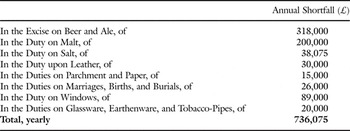
Davenant's Ways and Means made clever use of limited data to frame the difference between a political ideal—what the poll tax should produce—and the frustrating political realities of his moment. His 1698 Discourses on the Publick Revenues took computational criticism to a higher level of sophistication. In Discourse III, “On the Management of the King's Revenues,” Davenant systematically calculated the difference between the expected and the actual produce for some eight different taxes, concluding that the nation was losing £736,075 annually purely from poor management of the king's revenues (see Table 1).Footnote 136 It was an amount so large, Davenant suggested, that the nation's fiscal struggles could be solved simply “by a good Management of the Existing Duties and Revenues already granted.”Footnote 137 Davenant took advantage of this startling confusion to reflect on the powers of computation. “Political Arithmetic may peradventure be an uncertain Guide in all these Matters; and he shall desire to follow her no more, if she leads him into Error,” Davenant admitted in a bit of satisfied self-deprecation. “But if his Computations should happen to be right, Seven hundred thousand Pound Annual Income, is a Sum not to be slighted, in a Country where ’tis so very difficult to find out Ways and Means of raising Mony.”Footnote 138
Charles Davenent's Calculation of “Improvements to be Made Annually” in the Public Revenue

SOURCE: Davenant, Discourses, 1:119.
Davenant's analysis of shortfalls in the Excise, where he was formerly employed, was especially intricate. He noted that, beginning in the early 1680s (when his own service began), Excise administration was considerably improved by an increase in well-trained gaugers, upright new commissioners, and better Treasury oversight. Excise yields had subsequently risen consistently from 1683 to 1689, with annual returns rising over £150,000 by the end of that period.Footnote 139 He admitted, though, “that the Improvements made in the Six Years of the former Management, did not all arise from the Conduct of the Managers, but in part from the natural Increase of Wealth, and Numbers of People in the Kingdom.”Footnote 140 He proceeded, “Computing by Political Arithmetick,” to assess what proportion of the £150,000 annual increase resulted from these respective forces. He assigned £9,000 to the nation's increasing “Stock of Wealth,” £39,000 to the increasing “Numbers of People,” and—the critical number—£102,000 for managerial improvements.Footnote 141
Davenant was vague on how he determined the proportions of the Excise increases attributable to growth in national wealth and population, and it seems likely those figures were mostly round guesses. (He did, it should be noted, rely more heavily on Gregory King's new data on social structure and arable land in analyzing the malt tax.) But even if all of Davenant's political-arithmetical estimates were not of high empirical quality (retrospectively speaking), that should not detract from the methodological seriousness of his project. He proposed to decompose chronological trends in fiscal data into the separate influences of a range of different variables—almost a kind of regression analysis with rudimentary quantitative tools. He followed his analysis of 1683–89 Excise returns with an even more elaborate exercise concerning the seemingly deteriorated Excise returns of 1690–96. There, he attempted to break down the Excise decline from that period into eight factors (not yet including mismanagement costs): a 1690 adjustment in the metrical standards; changes in Excise assessment procedure; brewers’ producing beer and ale to higher (alcoholic) strengths to reduce their effective tax burdens; the impact of wartime “Additional Duties,” which might have driven brewers out of business; an increase of brewing in private homes; the quartering of soldiers; wartime decline in trade; and, finally, the high price of malt and hops. Deducting the estimated impact of all these forces, and making a series of other technical corrections, Davenant concluded that problems of management had still cost the public over £1.1 million.Footnote 142
Davenant's computational strategy was built to overcome informational obstacles, developing incisive political arguments from inadequate data. Like the imperfect early efforts of the Commission of Public Accounts, Davenant's computations also enacted a political ideal, modeling what the accounts of a well-informed and ethically upright government ought to look like. At the same time, Davenant's creative calculations constituted a substantial innovation in political-economic methodology, and his explorations in estimation, the use of (what might be termed) proxy variables, and controlling for multiple economic effects deserve mention in a deep history of “econometric” thinking.Footnote 143 Yet calculating with incomplete information could be a dangerous political, and epistemological, game to play. Davenant quickly found himself criticized for lack of accountability in his own calculations. A telling example emerged out of two 1696 pamphlets on the East Indian trade.Footnote 144 These writings were prompted by pending legislation to ban the importation of silk and calico textiles from India, measures strongly supported by the ascendant Whigs and staunchly opposed by the East India Company—and Davenant.Footnote 145 Davenant ambitiously claimed that the East Indian trade brought England an average net profit of £600,000 annually, even though that benefit appeared to require a net exportation of precious metals.Footnote 146 His argument hinged upon hypothetical calculations demonstrating the profitability of reexporting East Indian goods.Footnote 147 Davenant computed as follows: “By the best account I have . . England before the War for some time, one year with another, Exported for this [Indian] traffick, either in Bullion, or our Manufactures, about per annum 400,000 l. Suppose we consume at home the Returns of 200,000 l .”Footnote 148 This £200,000 in Indian goods not consumed at home, Davenant argued, could be reexported for a fourfold return (£800,000), yielding a total of £1,000,000 per year that flowed into England because of Indian imports. Deducting the original £400,000 in “prime cost,” this left £600,000 average annual profit. Though it proceeded from several generic assumptions, Davenant's calculation made a powerful point, modeling the opaque mechanics of global commerce by way of “Political Arithmetick.”Footnote 149
But such a venturesome computation proved an obvious target for advocates of the Indian textiles bill, like John Pollexfen of the freshly appointed Board of Trade.Footnote 150 Pollexfen accused Davenant of relying on mercantile hearsay rather than solid data: “Instead of offering Vouchers to prove this Accompt, it is said, That it must be clear Gains . . . because no one versed in Merchandize will deny it.”Footnote 151 Pollexfen's was the language of accounting; “vouchers” specifically connoted the written records that were necessary to verify accounts. Pollexfen contended that calculations were only as good as the records on which they were based. The fact that Davenant could not account for his own claims suggested his numbers were corrupted by special interest. Davenant's calculations, like Harley's, were of course driven by political interests, perhaps hypocritical ones.Footnote 152 Nevertheless, no one in the computational battles of the 1690s was unassailably correct or unquestionably ethical. Pollexfen's criticisms were insincere in their own way. Given the basically nonexistent administrative machinery for gathering trade statistics at that time, there was no way Davenant could have offered vouchers for such an ambitious calculation, a fact that Pollexfen, as a member of the new Board of Trade, would well have known.Footnote 153 Whether it was in an abstract work of political arithmetic like Davenant's calculation of East Indian trade or the seemingly more focused auditing work of the Public Accounts commission, such matters of political calculation were never so ideal.
THE ART OF DECYPHRING: POLITICAL ARITHMETIC AND PROBABLE KNOWLEDGE
By the time he published his Discourses on the Publick Revenues in 1698, Davenant was clear that some level of uncertainty was intrinsic to political deliberation about economic policy and that many, including those wielding considerable power, might use that uncertainty to their advantage. “The Councils of a Country are always inquisitive after Truth,” he contended, “but to hide it from ’em, and to perplex Things which have Relation to Trade, is the Interest of so many.”Footnote 154 Holding critical calculations to very high standards of certainty, as Pollexfen did, was one way such interests tilted the rules in their own favor.Footnote 155 Practitioners of political arithmetic therefore faced a fundamental political-epistemological problem. On the one hand, calculations about revenues and trade were an indispensable way to make cogent arguments about pressing public questions, especially for relative outsiders. Political arithmetic was vital not only for figuring out what was going on behind the veil of domestic ministerial power but also for national security, as a way to gain “Intelligence of the Posture of Affairs in those Countries” that were England's enemies or allies.Footnote 156 On the other hand, Davenant's clash with Pollexfen about the East Indian trade—and parallel battles between parliamentary accountants and insiders like Robert Howard—showed that rough estimations or speculative models, however illuminating, might not pass partisan muster. Davenant thus needed to salvage the investigative validity of political arithmetic, given that the conclusions it produced could almost never be demonstratively certain.
The solution lay in probability, in showing that political arithmetic's conclusions could merit very high levels of belief even if their informational foundations were shaky. One pamphlet rebuttal to Pollexfen's criticisms of the Essay on the East-India Trade, possibly by Davenant, expressed the essence of this position. Shooting back at Pollexfen's unrealistic demands on the calculations in the Essay, the author wrote in 1696: “I think it does not concern the Truth of the Proposition, That the East-India Trade is Beneficial to the Nation, (though as to the quantum it may) whether the Computation in the Essay be exact or no.” As for the Essay's specific claims about the monetary benefits of the East Indian trade, “the certainty of the Sum does not so much concern the Point in question, as the Proportion.”Footnote 157 Davenant soon offered a more systematic meditation on the question of whether political computations needed to be certain to be useful in his essay “Of the Use of Political Arithmetick, in all Considerations about the Revenues and Trade,” the first chapter of his Discourses. “In the Art of Decyphring,” Davenant wrote, “’tis said where three or four Words, perhaps Letters, can be found out, the whole Cypher may be discover'd; in a great measure, the same holds, in the Computations we are treating of: And very probable Conjectures may be form'd, where any certain Footing can be found, to fix our Reasonings upon.”Footnote 158 Fellow political arithmetician Gregory King, who provided key data for Davenant's exercises and who would become the era's most famous demographer, put matters more bluntly in 1696: “To be well apprized of the true State and Condition of a Nation, Especially in the Two main Articles of it's People and Wealth, be a Piece of Politicall Knowledge . . . the most usefull, and Necessary. . . . But since the attaining thereof (how necessary & disireable soever) is next to impossible, We must content our selves with such near approaches to it as the Grounds We have to go upon will enable us to make.”Footnote 159
Davenant was not the first to argue that useful knowledge should not be cast aside for failing to live up to the strictest standards of certainty. A turn toward probable knowledge rather than certain demonstration was a prominent feature of intellectual activity in seventeenth-century England across many spheres, from law to natural science to political economy.Footnote 160 William Petty's political arithmetic, indeed, had been grounded in the belief that numerical knowledge did not have to be perfect to be valuable; the defense of “rough, relative proportions,” rather than accurate numbers or demonstrative proofs, was a hallmark of Petty's project.Footnote 161 In the 1690s, though, the imprecise calculations Petty celebrated simply were not going to stand up under the assault of skilled opponents like Pollexfen, at least not without more robust justification.
It was Davenant, far more than his predecessor Petty, who began to ask the questions necessary to mount such a defense. To what degree could the claims of political arithmetic be justified internally by the numbers themselves? When was it possible to say that a mass of irregular numerical evidence compelled people to believe a set of conclusions derived therefrom? In one instance, for example, Davenant ventured a rudimentary standard for what qualified as a sufficiently good projection of future tax yields: “That Art is therefore to be prais'd, the Rules of which, if rightly follow'd, will show within a Seventh or an Eighth, what any Branch of Revenue shall produce.”Footnote 162 In a preliminary way, he was beginning to contemplate the question of statistical confidence. While Davenant certainly did not get very far on the mathematics of the problem, he would continue to reflect on the underlying epistemological quandary throughout his career. It is no coincidence, for example, that his 1699 treatise on commercial policy was titled An Essay upon the Probable Methods of Making a People Gainers in the Ballance of Trade. More pointedly, in a 1705 manuscript on Franco-Dutch trade, he framed his particular analytical conclusion—that the French had a profitable balance of trade with Holland—in terms of whether other observers were likely to come to the same conclusions as he did based on available evidence. “And ’tis not improbable,” Davenant wrote, “that others will have the same thoughts, when they come to examine & consider what sort of Commodities they [the Dutch] carry to and what they bring from France, and upon how an unequal foot the Traffick stands between them.”Footnote 163
In analyzing the Franco-Dutch trade balance, Davenant was interested not only in the question of whether it was probable that the French profited in trading with the Dutch but also in the further question of whether it was probable that other people would believe this to be the case on the basis of available evidence. Davenant's somewhat awkward and ambiguous invocation of the category of the “im/probable” was telling.Footnote 164 He was not a mathematician of probability in any formal sense, but he was implicitly pulling together two different concerns both essential to modern probability theory. On the one hand, he was interested in how to interpret numerical data and estimate likely outcomes—tax receipts or trade balances—on the basis of it. On the other hand, he was concerned, for practical reasons, about the question of what a given set of data compelled people to believe, about whether “others will have the same thoughts” when presented with the same numbers. In bringing these two concerns together, Davenant was stumbling upon a problem that simultaneously puzzled luminous philosophers and mathematicians.
In his Emergence of Probability, Ian Hacking explains that the modern concept of probability is “Janus-faced.” As he puts it: “Probability has two aspects. It is connected with the degree of belief warranted by evidence, and it is connected with the tendency, displayed by some chance devices, to produce stable relative frequencies.”Footnote 165 He also contends that this characteristic duality stemmed from the historical development of the concept of probability in the period roughly from 1650 to 1700. In that period, intense interest developed around each of the two facets of modern “probability,” which he calls, respectively, “epistemological” and “aleatory.” Thinkers like Antoine Arnauld, John Wilkins, and G. W. Leibniz struggled with the questions of epistemological probability as they attempted to develop systems of logic, to assess evidence of providential design, and to measure degrees of proof in questions of law. The concerns of aleatory probability, by comparison, arose in discussions about strategy in games of chance, about how to price government annuities, and about the frequency of births and deaths as measured by political arithmetic. Hacking contends that the modern version of “probability” came into being when these two different sets of questions, the aleatory and the epistemological, came to be understood as two different versions of fundamentally the same question. Hacking identifies examples of the complex interplay between the two faces of probability in John Arbuthnot's 1710 investigations into the providential nature of demographic ratios and Jacques Bernoulli's efforts at developing an “art of conjecturing.”
Another example came in Charles Davenant's “art of decyphring.” He, too, became concerned with the problem of how (aleatory) “probability”—referring to the likely outcome of uncertain events, like the collection of a new tax—related to (epistemological) “probability”—referring to the degree of confidence merited by available evidence. Hacking notes that the earlier political arithmetic of Petty and John Graunt had contributed in important ways to the study of aleatory probability, because those thinkers attempted to assess the regularity of certain chance processes, like life expectancies, on the basis of numerical figures. But Davenant's predecessors, especially Petty, did not seem to have been very interested in the problems of “epistemological” probability.Footnote 166 After all, Petty's calculations were aimed at a smaller coterie of monarchical agents and courtiers, and did not face the relentless partisan scrutiny Davenant's would. In Davenant's political arithmetic, the question of epistemological probability became a primary concern; for political reasons, it had to be. Davenant, like Harley and the Accounts commissioners, wanted to use political arithmetic as an investigative tool to diagnose internal political ills on the basis of available external evidence.Footnote 167 Making such claims hold up required assessing the quality of that evidence and the ability of resulting calculations to convince a broad, unforgiving public. In the post-1688 world, Davenant—and England—could not afford to let such epistemological questions go unnoticed.
We therefore begin and end with stories of people fighting over information they could not get. We began with angry MPs and then the commissioners of Public Accounts wrestling with the uncertainty surrounding Jephson's Secret Service payments. It proved to be an incredibly frustrating battle, as the commissioners’ efforts were thwarted by a maddening combination of deliberate misdirection and systemic disorder. Nevertheless, that challenge galvanized new ideas about political accountability, encouraged new thoughts on the place of information in governance, and prompted critics to forge new tools of numerical critique. Arguments over accounting data brought English politicians increasingly into effective, if not intended, conversations about abstract questions of method, theory, and even epistemology—like about how the uncertainties of global commerce might affect fiscal planning or about how reliable the past was as a basis for calculating the future.
In the same way, Davenant attempted to make computational criticisms about taxation and trade policy based on the incomplete public information he had. The uncertainty he faced was also partly a result of his own political status and partly a result of the state of fiscal information management on the eve of the eighteenth century. Davenant had to believe that it was possible to make meaningful computational arguments from imperfect data because imperfect data was all he could get. The frustrations he felt in dealing with inadequate data and incredulous opponents brought him to consider the same kinds of questions about probability that challenged some of Europe's most eminent minds. Davenant helped make Petty's science of “political arithmetic” more probabilistic and indeed more statistical, in the sense that he made it more concerned with evaluating evidence and assessing whether that evidence merited belief in certain conclusions. Davenant had to be worried about such questions because of everything the state would not, or could not, tell him. To put it another way, it was the state's own inadequacies that drove forward statistical thinking.