In 2050, the elderly population will become the most abundant population in the world. This is one of the most significant changes that are occurring in society, the progressive aging trend of the adult population. According to statistics from the World Health Organization (2015), the proportion of old adults is growing faster than any other age group, and this is true for almost all countries in the world. For this reason, identifying factors that may positively influence successful aging is of great interest for both individuals and the society (Bosnes et al., Reference Bosnes, Almkvist, Bosnes, Stordal, Romild and Nordahl2017).
Traditionally, the aging has been seen as a period of progressive decline in physical health, cognitive function and psychosocial functioning and, as a consequence, an increasing burden on the health system (Cho, Martin, & Poon, Reference Cho, Martin and Poon2015; Ritchie, Tucker-Drob, Starr, & Deary, Reference Ritchie, Tucker-Drob, Starr and Deary2016). Therefore, to help old people to age is important not only for their own quality of life, but also for the family and society in which they live. The key is not adding years to life per se, but rather aging well, successfully (Cheung & Lau, Reference Cheung and Lau2016). Hence, the need to analyze the relationships between psychosocial factors and physical activity with aging successfully emerges.
Academic literature on aging has shown different theoretical models to explain the phenomenon of aging successfully. For example, Rowe and Kahn (Reference Rowe and Kahn1997, p. 433) interpreted successful aging as “avoidance of disease and disability, maintenance of high physical and cognitive function, and sustained commitment to social and productive activities.” Baltes and Baltes (Reference Baltes, Baltes, Baltes and Baltes1990), from a psychosocial perspective, proposed the model of selection, optimization and compensation (SOC) that considers the aging process as a dynamic process, that is to say, a number of adjustments made by individuals throughout their life course. Another more recent model is the one by Lee, Lan and Yen (Reference Lee, Lan and Yen2011) that includes four successful aging factors: A physical factor, a psychological factor, a social factor and a factor of leisure time. On the other hand, Troutman, Nies, Small and Bates (Reference Troutman, Nies, Small and Bates2011) have measured successful aging through functional performance, intrapsychic factors, gerotranscendence and spirituality, considering the four dimensions being related to each other. Following Troutman et al. (2011, p. 223) functional performance may be defined as the use of conscious awareness and choice as an adaptive response to cumulative physiological and physical losses related to the aging process. Intrapsychic factors as enduring character features that promote adaptation to change and problem solving. Spirituality could be defined as personal views and behaviors a person has that express his/her relatedness to something greater than oneself. And finally, Gerotranscendence, following the conceptualization by Tornstam, is defined as a shift in perspective in the adult and old age from a materialistic and rationalistic perspective to a more mature and existential one (Tornstam, Reference Tornstam, Thomas and Eisenhandler1994, Reference Tornstam1997, Reference Tornstam2005). Therefore, we follow here the theoretical framework of Flood (2002, Reference Flood2005), who measures successful aging based on a theoretical definition that includes multiple dimensions of successful aging, and does not exclude individuals from being considered successful agers based on physical limitations alone.
Numerous investigations have focused on the study of psychosocial factors such as physical health, life satisfaction, social support, leisure activities and self-care, among others, in relation to successful aging (Gonzalo & Ubillos, Reference Gonzalo and Ubillos2016). In recent years, physical activity has also been stressed as an important factor in the study of successful aging. This comes from the idea that an active lifestyle can lead to a better quality of life because it may influence a better aging process. For most people, the demands of everyday life require a significant amount of effort. This physical effort, which usually starts in childhood and continues into adulthood, it is important to be maintained in order to keep healthy as you age (van Dyck, Teychenne, McNaughton, De Bourdeaudhuij, & Salmon, Reference van Dyck, Teychenne, McNaughton, De Bourdeaudhuij and Salmon2015).
Declining physical activity in all phases of daily life during the last five decades has led to an increase in morbidity and mortality (Beaglehole et al., Reference Beaglehole, Bonita, Horton, Adams, Alleyne, Asaria and Watt2011). A physically active lifestyle throughout the life cycle is more beneficial than sedentary lifestyle for both mental well-being as well as for physical well-being (Cesari et al., Reference Cesari, Vellas, Hsu, Newman, Doss, King and Pahor2015). In older people, regular physical activity is important for increasing or preserving aspects of physical function, for mental health (Bherer, Reference Bherer2015; Christensen et al., Reference Christensen, Payne, Wughalter, Van, Henehan and Jones2003; Forbes et al., Reference Forbes, Forbes, Forbes, Blake, Chong, Thiessen and Little2015), as well as for improving social relations, and consequently maintaining independent living, basic capacity of people to care for themselves and perform daily activities with higher performance levels (Howie, Troutman-Jordan, & Newman, Reference Howie, Troutman-Jordan and Newman2014).
While recent works showed improvements in the functional health of older people (Khazaee-pool, Sadeghi, Majlessi, & Foroushani, Reference Khazaee-pool, Sadeghi, Majlessi and Foroushani2015), increased levels of functional disability in older people remain a major problem (Martin et al., Reference Martin, Kelly, Kahana, Kahana, Willcox, Willcox and Poon2015). It is known that physical limitations and diseases can be reduced in all ages by modifying lifestyle, eliminating risk factors and participating in health promotion and protection of healthy behaviors (Britton, Shipley, Singh-Manoux, & Marmot, Reference Britton, Shipley, Singh-Martoux and Marmot2008). In this sense, as well as a large number of studies have focused on identifying risk factors for issues related mortality and morbidity (Hsu & Chang, Reference Hsu and Chang2015), other studies have been devoted to examine the effects of health promotion to maintain good physical health, focusing on what to do rather than what not to do. This positive and preventive approach is more effective if a change in healthy behaviors for good physical health is needed (van Dyck et al., Reference van Dyck, Teychenne, McNaughton, De Bourdeaudhuij and Salmon2015).
According to Feng, Son, and Zeng (Reference Feng, Son and Zeng2015), successful agers are those who are free from major illnesses and disabilities, have no depressive symptoms, participate in social or productive activities, and are satisfied with life. Therefore, a relevant factor to aging successfully is the level of well-being and life satisfaction. Some aspects in the life of a person, as pleasure or engagement, have a direct impact on life satisfaction in older people. Diener and Seligman (Reference Diener and Seligman2004) reviewed the importance of social relationships for the welfare of the elderly. Gow, Pattie, Whiteman, Whalley and Deary (Reference Gow, Pattie, Whiteman, Whalley and Deary2007) showed that life satisfaction was highly related to social aspects, and that these, in turn, improve the aging process.
Regarding social support, it is suggested that older people perceive social and family relationships as fundamental to successful aging. On one hand, social support can have a huge impact with positive consequences for health and mental functioning in old life. Aspects of social relations as the size and complexity of the social network or the quality of social contacts have been found to contribute to the improvement of psychological well-being of the individual. On the other hand, lack of social support and also loneliness may have negative consequences for successful aging. For example, the absence of close support is manifested through loneliness and it is associated with negative outcomes such as physical deterioration or lower satisfaction with life (Diener & Seligman, Reference Diener and Seligman2004).
Leisure activities also bring benefits to healthy aging. Leisure can be a significant tool in increasing or maintaining the social integration of older people. According to various studies, participation in 2–3 leisure activities is more beneficial than participation in a single activity (Chatterji, Byles, Cutler, Seeman, & Verdes, Reference Chatterji, Byles, Cutler, Seeman and Verdes2015). Reading, playing board games, dancing and playing instruments have also been linked to a lower risk of dementia and better aging (Verghese et al., Reference Verghese, Lipton, Katz, Hall, Derby, Kuslansky and Buschke2003). Participation in leisure activities is an important ingredient for achieving active aging, and definitely a better quality of life.
Once the literature around the Successful Aging Inventory (SAI) and related factors has been reviewed, we believe that this research can make a contribution that can be summarized in three aspects: (a) To our knowledge, the SAI has never been validated in Spanish; (b) Confirmatory Analysis of the SAI have only been published by Kim (Reference Kim2013) and he published the validation in Korean; (c) the authors in their validation of the scale only offered relations to psychological variables (life satisfaction, meaning in life, personal control and depression) while our contribution widens the number and type of components associated to the SAI factors. According to the successful aging paradigm, the aim of this study was twofold: (a) to validate a successful aging model in a Spanish older adults’ sample; (b) to predict the dimensions of successful aging by means of psychosocial factors and physical activity. In particular, it was hypothesized that: (1) the successful aging model proposed by Troutman et al. (Reference Troutman, Nies, Small and Bates2011) would be verified in Spanish older people; (2) successful aging dimensions will be positively related with physical health, satisfaction with life and social support; and (3) being physically active would lead to a better aging.
Method
Participants and procedure
Participants were 725 Spanish older people, of whom 478 were women (66%) and 247 men (34%). They were between 55 and 100 years old (M = 68.28; SD = 8.63), 501 were physically active whereas 197 of them did not practice physical activity. With respect to their educational level, 3.9% had not finish any formal education, 65.8% only had mandatory education, secondary a 10.1%, and 20.1% finished high school or university. Most of them were married (75.3%), with 5.4% being single, 4.2% divorced and the rest (15.1%) were widows or widowers. Regarding occupation, the majority were retired (52.6%) or housewives (24.4%), followed by those working, and finally 9.3% were unemployed. Most of them lived in their own house (94.3%), with only a 4.5% living with their sons and/or daughters, and the remaining 1.3% were in other situations.
The selection of participants was incidental, using collaborators. The sample was collected in three areas: Sports centers, day centers and public areas in several Spanish cities and towns. Firstly, permissions from the municipalities and the managers of the centers to conduct this investigation were asked for. Secondly, monitors of the activities in the sports centers and staff of day centers were contacted, and the survey details were agreed. Questionnaires were completed at the end of the collective classes and social activities.
Measurements
Physical practice
Level of physical activity (active, not active). The active people were recruited among usual attendants of the different activities in sports centers, whereas the non-active group was recruited in day centers and public areas, and they declared that did not practice any type of regulated physical activity.
Social support
The Spanish version of the Functional Social Support Questionnaire (Duke–UNC–11) in the Spanish adaptation by Bellón, Delgado, Luna del Castillo, and Lardelli (Reference Bellón, Delgado, Luna del Castillo and Lardelli1996) was used. It is composed of 11 items with a 5-point Likert scale ranging from (1) Much less than I would like, to (5) As much as I would like. This scale measures two factors: Confidant support and emotional support. Examples of items are: “I have the possibility to talk to someone about my personal and family problems”; “I get help when I am sick in bed”. The reliability of the questionnaire in this research was .82 for the total scale, .74 to confidence support and .71 for emotional support.
Life satisfaction
Life satisfaction was measured with the Satisfaction with Life Scale (SWLS; Diener, Emmons, Larsen, & Griffin, Reference Diener, Emmons, Larsen and Griffin1985). It is composed of five items to assess overall satisfaction with life. Examples: “In most ways, my life is close to my ideal”; “I am satisfied with my life”. The answers ranged from (1) Strongly disagree, to (5) Strongly agree. The reliability was α = .85.
Self-care/nutritional behavior
An indicator from the Professional Self-Care Scale (PSCP, Galiana, Oliver, Sansó, & Benito, Reference Galiana, Oliver, Sansó and Benito2015) was used. In particular, the question was: “Do you usually follow a balanced diet? Participants may respond on a scale with five anchors, from (1) Strongly disagree, to (5) Strongly agree.
Physical health
The SF–8 scale was used to measure perceived health (Ware, Kosinski, Dewey, & Gandek, Reference Ware, Kosinski, Dewey and Gandek2001). It has eight indicators of perceived health. The heading of the scale was “During the last month …” and examples of items are: “How much energy have you had? How much pain have you had?” The reliability in this study was .78.
Leisure and free time
An indicator extracted from the leisure time dimension in the model of successful aging by Lee et al. (Reference Lee, Lan and Yen2011) was used. This item was: “During the last twelve months, how many times have you left your city for vacation or travel?” The answers range from (1) None, up to (4) Four times or more.
Successful aging
We used the Successful Aging Inventory (SAI; Troutman et al., Reference Troutman, Nies, Small and Bates2011), composed of 20 items that assess four dimensions: Functional performance mechanisms, intrapsychic factors, gerotranscendence, and spirituality. Examples of items are, respectively: “I manage to do the things that I need to do to take care of my home and to take care of myself” (eating, bathing, and dressing); “I am good at thinking of new ways to solve problems”; “I feel interest in/concern for the next generation”; “I spend time in prayer or doing some kind of religious activity”. Participants responded in a five-point Likert scale, from (1) Strongly disagree, to (5) Strongly agree. Alpha for the whole scale was .86 with internal consistencies of: .62 for functional performance, .87 for the intrapsychic factors, .81 for gerotranscendence, and .80 for spirituality.
Statistical analyses
All analyses were performed with SPSS 22 and Mplus 6. The analyses included the study of the psychometric properties of the SAI. Factorial validity was analyzed with confirmatory factor analysis (CFA), with Weighted Least Square Mean and Variance corrected (WLSMV) estimation. Model fit was assessed with several tests and indices (Hu & Bentler, Reference Hu and Bentler1999; Tanaka, Reference Tanaka1993): (a) The chi-square statistic (Kline, Reference Kline1998; Ullman, Reference Ullman, Tabachnick and Fidell1996); (b) the comparative fit index (Comparative Fit Index, CFI; Bentler, Reference Bentler1990) with cut-off criteria of .90 (ideally greater than .95; Hu & Bentler, Reference Hu and Bentler1999) indicative of reasonable fit; and (c) the Root Mean Squared Error of Approximation (RMSEA) with .08 (ideally .05) or less indicating excellent fit. Finally, in order to relate successful aging with psychosocial factors and physical activity Pearson correlations and multiple regression analyses were performed.
Ethical approval and consent
The study was carried out following the guidelines of the ethical code of the University of Valencia, and all participants gave their informed consent.
Results
Psychometric properties of the Successful Aging Inventory
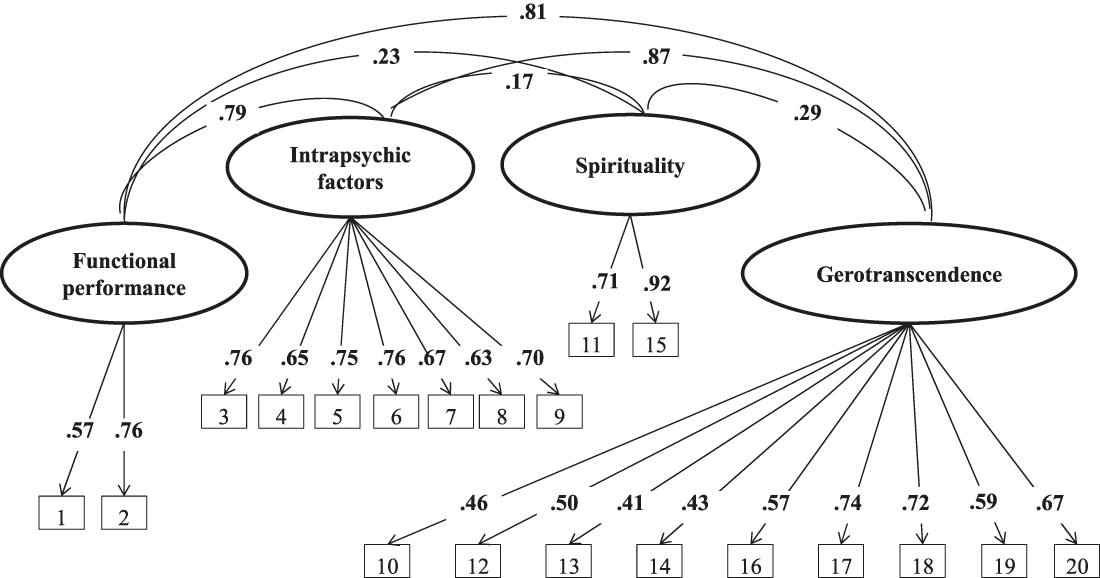
The factorial validity of the SAI was studied with the theoretical specification of four factors found by Troutman et al. (Reference Troutman, Nies, Small and Bates2011). The results showed an adequate fit: χ2(164) = 721.554, p < .001; CFI = .944; RMSEA = .068 (.063 – .074). Regarding the analytical fit, factor loadings of the four factors were statistically significant (p < .01) and large, providing support to the adequacy of the four-factor model. As shown in Figure 1, the factorial saturations ranged from the lowest value of .41 (Item 13, “I’d rather have a few real friends that many casual” in the factor gerotranscendence) to a maximum of .92 (Item 15, “It is important for me to believe in God or a higher power” in the factor spirituality). With respect to correlations between factors, there were small correlations among spirituality and the other factors, but high correlations among functional performance, intrapsychic factors and gerotranscendence (see Figure 1).
Standardized Factor Loadings and Factor Correlations for the Four-Factor Model.
All factor loadings were statistically significant (p < .05), as well as the correlations among the latent variables. For simplicity, errors are not displayed.

Relations between successful aging factors and psychosocial predictors
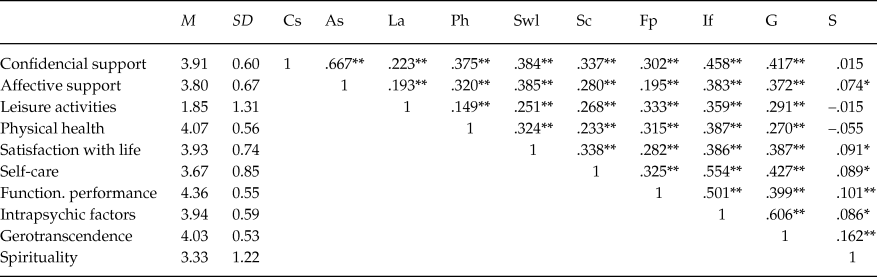
Table 1 shows that functional performance is significantly related to the other factors studied, being the largest correlations those with leisure activities (r = .333, p < .01) and self-care/nutritional behavior (r = .325, p < .01). Intrapsychic factors correlated positively and significantly with all variables, being more pronounced those relating to self-care/nutritional behavior (r = .554, p <.01) and confidential support (r = .458, p < .01). Gerotranscendence showed positive relations to all variables, with the highest values being those with self-care/nutritional behavior (r = .427, p < .01) and confidential support (r = .417, p < .01). Finally, spirituality positively and significantly correlated with some variables, but in general they are lower than the ones among the other three dimensions of successful aging and the psychosocial predictors.
Means, Standard Deviations, and Correlations between Psychosocial Predictors and Successful Aging Dimensions

Note: *p < .05; **p < .01.
Prediction of successful aging
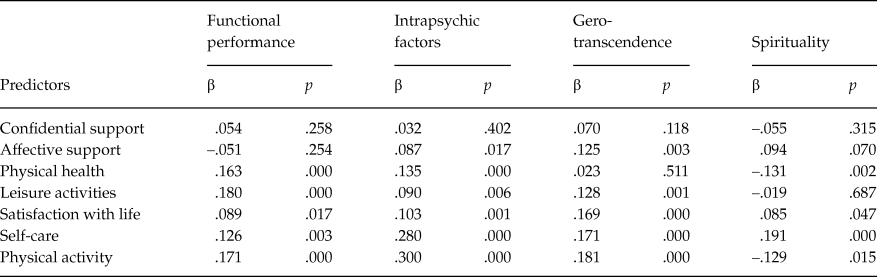
Four multiple regressions (Table 2) were estimated to predict each of the dimensions of successful aging. In the first model, to predict functional performance, an adjusted R 2 of .267 was estimated. This percentage was mainly due to the positive and significant effects of health (β = .16), leisure activities (β = .18) and physical activity (β = .17). The second regression model predicted the intrapsychic factors (adjusted R 2 = .531). The significant predictors were always positively related to this factor, and in order of importance they were: Physical activity (β = .30), self-care/nutritional behavior (β = .28), perceived health (β = .13), life satisfaction (β = .10), leisure activity (β = .09) and affective support (β = .08). The third regression model predicted gerotranscendence (R 2 = .356). Five predictors were positive and significantly related to gerotrascence: Physical activity (β = .18), self-care/nutritional behavior (β = .17), life satisfaction (β = .16), leisure activities (β = .12), and affective support (β = .12). Finally, the last model to predict spirituality showed an adjusted R 2 of .037, extremely low. Accordingly, the relationships were also low, but nevertheless some were statistically significant: Self-care/nutritional behavior (β = .19), physical health (β = –.13), physical activity (β = –.12), affective support (β = .09), and life satisfaction (β = .08).
Regression Coefficients and Significance Levels of Hierarchical Linear Regression Model for Functional Performance, Intrapsychic Factors, Gerotrascendence and Spirituality

Discussion
Within the framework of positive psychology and under the paradigm of aging successfully, the aim of this study was twofold. On the one hand, to validate the four-factor model of successful aging developed by Troutman et al. (2011) in an elderly Spanish sample. On the other hand, to predict the dimensions of successful aging using predictors of psychosocial factors and physical activity. The hypotheses were: (1) That the successful aging model by Trouman et al. (2011) would be verified in Spanish people; (2) that successful aging will be positively related with physical health, satisfaction with life and social support; and (3) that being physically active would be associated with better aging.
Regarding the first hypothesis, the CFA confirmed the four-factor structure of the Successful Aging Inventory proposed by Troutman et al. (Reference Troutman, Nies, Small and Bates2011). This is in line with previous validations of its factor structure. Accordingly, the scale may also be appropriate for application in Spanish older people studies. The same factor structure was found in a sample of Korean population (Kim, Reference Kim2013). Other studies that support these findings were estimated in noninstitutionalized USA general population (McCarthy, Reference McCarthy2010), people attending a day care center, older adults participating in a religious program in a metropolitan area of southeastern Nigeria, and in community-dwelling old people of the United States (Kozar-Westman, Troutman-Jordan, & Nies, Reference Kozar-Westman, Troutman-Jordan and Nies2013).
The second hypothesis stated that the successful aging dimensions would be related to physical health, satisfaction with life and social support. The results partially support it. While physical health and satisfaction with life were significant in predicting successful aging, social support had no predictive power on successful aging dimensions, when considered in a multivariate context. Only the affective support showed significant relationships with intrapsychic factors and gerotranscendence, although with little predictive power. These results are in agreement with those found by Christensen et al. (Reference Christensen, Payne, Wughalter, Van, Henehan and Jones2003), and Forbes et al. (Reference Forbes, Forbes, Forbes, Blake, Chong, Thiessen and Little2015) in predicting welfare and successful aging, and those of Khazaee-pool et al. (Reference Khazaee-pool, Sadeghi, Majlessi and Foroushani2015) predicting physical health and active aging. With regard to social support, the results of this study suggest that social relations are not a direct indicator of successful aging, as also proposed Prakash, Voss, Erickson, and Kramer (Reference Prakash, Voss, Erickson and Kramer2015).
Several studies suggest that the development of social relationships are part of the quality of life (Shiovitz-Ezra & Litwin, Reference Shiovitz-Ezra, Litwin, Nyqvist and Forsman2015), so for older people that practice exercise, social support may be related to well-being. Although the scientific literature is showing social support as a significant indicator for better aging, in the present study it has not been fully confirmed. The correlation matrix (Table 1) shows statistically significant relationships between two factors of social support (confidential support and affective support) and three factors of successful aging (functional performance, intrapsychic factors and gerotranscendence). However, regression coefficients (Table 2) do not show predictive power of social support factors on successful aging. One explanation may be that when social support integrates with other predictors in a complex model, it loses weight and is diluted by the presence of other variables with more power in predicting successful aging, such as physical health, self-care/nutritional behavior, physical activity and satisfaction with life. It may well be that social support affects these variables that in turn directly affect successful aging dimensions. As Bosnes et al. (Reference Bosnes, Almkvist, Bosnes, Stordal, Romild and Nordahl2017) stated, exercise and satisfaction with life are clearly related to successful aging.
Finally, the third hypothesis supposed that being physically active would lead to a better aging. This hypothesis has been partially confirmed with some statistically significant results. Older people who were active had higher levels of functional performance, intrapsychic factors and gerotranscendence, which is in line with the results from Stenholm et al. (Reference Stenholm, Westerlund, Head, Hyde, Kawachi, Pentti and Vahtera2015). Being physically active brings older people benefits for their physical health, and may improve their life satisfaction, self-care/nutritional behavior and social relations. Indeed, an adequate level of physical activity has been shown to help maintaining functional performance (Reid et al., Reference Reid, Martin, Doros, Clark, Hau, Patten and Fielding2015), well-being through intrapsychic factors (Bherer, Reference Bherer2015), and increasing social relationships (Shiovitz-Ezra & Litwin, Reference Shiovitz-Ezra, Litwin, Nyqvist and Forsman2015), which in turn improves life satisfaction and quality of life in older people (Prakash et al., Reference Prakash, Voss, Erickson and Kramer2015).
The main findings of this research are: (a) SAI scale measuring successful aging has a stable four-factor structure for the Spanish old people population; (b) while physical aspects of health and wellness are positive predictors of healthy aging, social aspects may affect rather indirectly; and (c) physically active people achieve a better aging.
A limitation of this study is the cross-sectional design, which prevents drawing causal conclusions unless they are extremely clear in the literature. In this regard, a longitudinal design would allow tapping the causal direction and amount of change more effectively, and this information, in turn could be used in the design of intervention programs aimed at favoring successful aging. Another limitation is the incidental sampling which makes generalization to the overall population difficult with precise results. Further, the data were self-reported, and accordingly bias due to the use of a single source of information may be likely. It would be desirable to use some more objective measures that could complement the self-report information about some variables such as physical activity and physical health.
The results of the present study provide additional evidence regarding the role of physical activity in achieving a better aging. These findings are important because they point out the importance of seducing those older people who perhaps are not especially motivated to exercise. The results of this study also highlighted the need for greater attention to physical activity for a better aging, because this practice enhances physical aspects of health and life satisfaction. Finally, social relations of older people are an aspect that should be better analyzed especially in people who exercise without the objective of having fun.
Appendix
The Successful Aging Inventory (Troutman, Nies, Small, & Bates, Reference Troutman, Nies, Small and Bates2011).
1. I manage to do the things that I need to do to take care of my home and to take care of myself (eating, bathing, and dressing). Functional performance mechanisms.
2. I have been able to cope with the changes that have occurred to my body as I have aged. Functional performance mechanisms, Intrapsychic factors.
3. I look forward to the future. Intrapsychic factors.
4. I feel able to deal with my own aging. Intrapsychic factors.
5. I feel able to cope with life events. Intrapsychic factors.
6. I can come up with solutions to problems. Intrapsychic factors.
7. I am good at thinking of new ways to solve problems. Intrapsychic factors.
8. I enjoy doing creative new things or making things. Intrapsychic factors.
9. I am in a positive, pleasant mood. Intrapsychic factors.
10. I think of my loved ones who have passed away and feel close to them. Gerotranscendence.
11. I spend time in prayer or doing some kind of religious activity. Spirituality.
12. As I have aged, the way I think of the world has changed. Gerotranscendence.
13. I would rather have a few close friends than many casual ones. Gerotranscendence.
14. Sometimes there can be two right answers to a problem or situation. Gerotranscendence.
15. A relationship with God or some higher power is important to me. Spirituality.
16. I feel interest in/concern for the next generation. Gerotranscendence.
17. My life is meaningful. Gerotranscendence, Purposefulness/life satisfaction.
18. I am overall satisfied with my life right now. Gerotranscendence, Purposefulness/life satisfaction.
19. I feel that I serve a purpose in this world. Gerotranscendence, Purposefulness/life satisfaction.
20. Being the age that I am now is as good as, or better than I thought it would be. Gerotranscendence.