The past 2 decades have seen several large-scale disasters, such as the September 11 terrorist attack in 2001, Hurricane Katrina in 2005, and the Great East Japan Earthquake (GEJE) in 2011. In developed countries, emergency medical services (EMS) are currently overburdened, and the emergency ambulance system is stretched beyond capacity.Reference Tang, Stein and Hsia 1 In the face of disasters whose scale overwhelms routine EMS capabilities, public health disaster preparedness and response has become paramount.Reference Savoia, Massin-Short and Rodday 2
In view of the overburdened status of EMS in developed countries, it is likely that dispatching ambulance service personnel from unaffected areas to stricken areas will have a negative impact on emergency care in the unaffected areas. However, no studies have investigated the impact of ambulance dispatches to disaster zones in case of a major disaster on emergency care in the unaffected prefectures.Reference Savoia, Massin-Short and Rodday 2 Thus, we examined ambulance dispatches to GEJE-stricken areas and out-of-hospital cardiac arrests (OHCAs) recorded between 2008 and 2011 to investigate the association between ambulance dispatches and emergency care as measured by return of spontaneous circulation (ROSC) and 1-month survival in prefectures not directly affected by the GEJE.
Methods
Design and Setting
The present study was a population-based, time-series analysis of ambulance dispatches and all OHCA cases recorded between January 1, 2008, and December 31, 2011, in Japanese prefectures not affected by the GEJE. We defined affected prefectures as those in which at least one death occurred during the GEJE on March 11, 2011, or the North Nagano earthquake on March 12, 2011. Of the 47 prefectures in Japan, 13 were stricken and 34 experienced no earthquake-related deaths. 3 The mean time from ambulance callout to hospital arrival for OHCA cases was 32.06 minutes in the unaffected prefectures between January 1, 2008, and the GEJE. We further divided the unaffected prefectures according to callout-to–hospital arrival times (high-performing, mean time <32.06 min, 16 prefectures; low-performing, mean time ≥32.06 min, 17 prefectures). Our study was approved by the ethics committee of Kyushu University Graduate School of Medical Sciences. The requirement for written informed consent was waived.
Data Collection
The data concerning ambulance dispatches following the GEJE and OHCA cases between 2008 and 2011 were obtained from the Fire and Disaster Management Agency (FDMA). The FDMA recorded the daily number of ambulance crews dispatched to GEJE disaster areas from unaffected prefectures. In 2011, Japanese EMS were delivered through 798 fire stations with dispatch centers.Reference Kitamura, Iwami and Kawamura 4 EMS personnel and the physicians in charge of patients with OHCA summarized each OHCA case according to the Utstein style.Reference Cummins, Chamberlain and Abramson 5 All OHCA cases were compiled in a prospective, nationwide, population-based database, and we accessed the OHCA cases from the 34 prefectures that reported no fatalities following the GEJE.
Intervention and Outcome Variables
Each year of this 4-year study was divided into 2-week intervals. We chose 2-week intervals to obtain a sufficient number of OHCA, ROSC, and 1-month survival cases. The intervention was the number of ambulances dispatched from each unaffected prefecture. We tallied the total number of ambulances dispatched in the 2-week periods between March 11 and December 31, 2011, in the 34 unaffected prefectures according to high- and low-performing areas. The outcome variables were ROSC and 1-month survival rates during each 2-week period.
Statistical Analysis
We used the Box−Jenkins transfer function model to assess the relationship between the 2 time series between January 1, 2008, and December 31, 2011 (n=104 two-week periods).Reference Yaffee and McGee 6 The output and input variables for the transfer function model were the rate of ROSC or 1-month survival (y t ) and the number of dispatched ambulance crews (x t ), respectively. The stationarity of the time series data was verified by checking plots of the autocorrelation functions (ACFs) and by the augmented Dickey−Fuller test.Reference Chetwynd, Coope and Brodie 7 After creating a univariate autoregressive integrated moving average model for each input (x t ) and output (y t ) series, an ACF, partial ACF, and inverse ACF were used to assess the appropriateness and stationarity of the model parameters. The model residuals were checked by autocorrelations at various lags by using the Ljung−Box chi-square statistic to confirm white noise.Reference Chetwynd, Coope and Brodie 7 The relationship between the input (x t−b ) and output (y t ) series was determined by using a cross-correlation function. The two-sided significance level was set at P<0.05 for all tests. All analyses were performed by using SAS version 8.2 (SAS Institute, Cary, NC).
Results
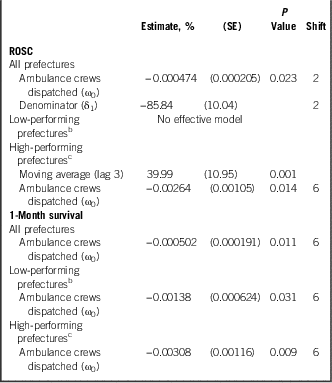
After the GEJE, 3337 ambulance crews from the 34 unaffected prefectures were dispatched to disaster areas. During the study period, 239,628 OHCA cases were recorded before and 39,278 cases were recorded after the GEJE in the prefectures not affected by the earthquake (Supplementary Materials, Table S1). The rate of advanced life support administered to patients with OHCA by a medical doctor significantly decreased after the GEJE (p<0.0001). We found no significant difference in the 1-month survival rate between before and after the GEJE (p=0.28; Supplementary Materials, Table S1). However, in a model whose output (y t ) series was the rate of ROSC, the intervention parameter (ω0) was −0.000474 (p=0.023; Table 1). This finding indicated that dispatching 1000 ambulance crews was associated with a 0.474% decrease in the rate of ROSC at 4 weeks after dispatch in the unaffected prefectures. In a model whose output (y t ) series was the rate of 1-month survival, the intervention parameter (ω0) was −0.000502 (p=0.011; Table 1). This finding indicated that dispatching 1000 ambulance crews was associated with a 0.502% decrease in the rate of 1-month survival at 12 weeks after dispatch in the unaffected prefectures.
Parameter Estimates of Impact of Ambulance Crew Dispatches on the ROSC or 1-Month Survival Rates in Patients in Unaffected Areas With OHCA After the Great East Japan EarthquakeFootnote a

a Abbreviations: OHCA, out-of-hospital cardiac arrest; ROSC, return of spontaneous circulation.
b Mean time from ambulance callout to hospital arrival ≥32.06 min.
c Mean time from ambulance callout to hospital arrival <32.06 min.
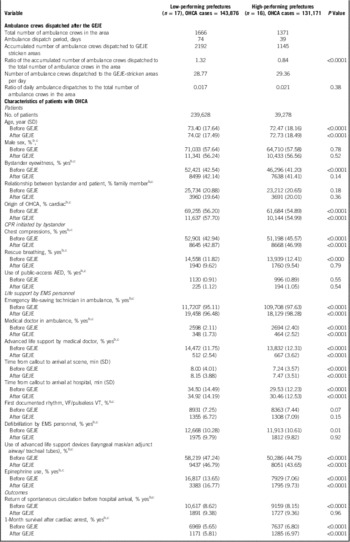
After the GEJE, 1145 ambulances from the high-performing and 2192 from the low-performing prefectures were dispatched to disaster zones (Table 2). During the study period, 131,171 and 143,876 OHCA cases were recorded in the high- and low-performing areas, respectively. During that period, the mean time from ambulance callout to hospital arrival increased significantly (Table 2). The subgroup analysis revealed a significant decrease in the rate of advanced life support administered by a medical doctor after the GEJE in the low-performing (p<0.0001) and high-performing (p<0.0001) prefectures (Table 2). The rate of ROSC in patients with OHCA increased significantly after the GEJE in both the low-performing prefectures (p<0.01) and the high-performing areas (p<0.0001; Table 2). The 1-month survival rates after the GEJE increased significantly in both the low-performing areas (p<0.05) and the high-performing prefectures (p<0.05; Table 2). However, in a model whose output (y t ) series was the rate of 1-month survival in the low-performing areas, the intervention parameter (ω0) was −0.00138 (p=0.031; Table 1). This finding indicated that dispatching 1000 ambulance crews was associated with a 1.38% decrease in the rate of 1-month survival at 12 weeks after dispatch in the unaffected area. In a model whose output (y t ) series was the rate of ROSC in the high-performing areas, the intervention parameter (ω0) was −0.00264 (p=0.014; Table 1). This finding indicated that dispatching 1000 ambulance crews was related to a 2.64% decrease in the rate of ROSC at 12 weeks after dispatch in the unaffected prefectures. In a model whose output (y t ) series was the rate of 1-month survival in the high-performing areas, the intervention parameter (ω0) was −0.00308 (p=0.009; Table 1). This finding indicated that dispatching 1000 ambulance crews was associated with a 3.08% decrease in the rate of 1-month survival at 12 weeks after dispatch in the unaffected area.
Ambulance Dispatches from Unaffected Prefectures After the Great East Japan Earthquake and Characteristics of Patients with OHCA Before and After the Earthquake in the High- and Low-Performing Unaffected PrefecturesFootnote a

a Abbreviations: AED, automatic external defibrillator; EMS, emergency medical services; OHCA, out-of-hospital cardiac arrest; ROSC, return of spontaneous circulation; VF, ventricular fibrillation; VT, ventricular tachycardia.
b Missing values ranged from 4009 to 4169 for pre-GEJE period values.
c 665 values were missing for post-GEJE period variables.
Discussion
We found that the dispatch of ambulance crews from unaffected prefectures to GEJE disaster zones was associated with a decrease in ROSC and 1-month survival rates in OHCA cases in the unaffected prefectures. The ROSC and 1-month survival rates were higher after the GEJE than before, which suggests that the effect of dispatching ambulance crews to other prefectures was limited.
The subgroup analyses revealed that the presence of an ambulance had a greater impact on resuscitation outcome in the high-performing than in the low-performing prefectures. Several factors may account for the higher resuscitation rates in the high-performing compared with the low-performing prefectures, including shorter duration between ambulance callout and arrival at the scene and hospital arrival, higher rates of emergency life-saving technicians in the ambulance, advanced life support administered by medical doctors, and not using advanced life support devices or epinephrine (Table 2). Notably, although the effectiveness of advanced life support devices and epinephrine has been questioned,Reference Hagihara, Hasegawa and Abe 8 the use of these measures was more frequent in the low-performing than in the high-performing prefectures (Table 2). We found that the low-performing prefectures used epinephrine significantly more often than did the high-performing prefectures (15.21% vs. 8.38%, respectively). The comparisons of time from ambulance callout to arrival at the scene and from callout to hospital arrival revealed an increase in time after the GEJE in all prefectures; however, the increase was greater in the high-performing than in the low-performing areas (Table 2). Thus, it is likely that the impact on resuscitation was a function of increased transportation time in the high-performing prefectures, where rapid patient transportation is a high priority.
The ratio of the daily ambulance dispatches to the total number of ambulance crews in the area indicated that relatively few ambulance crews were dispatched to the disaster zones (total, 0.01; low-performing prefectures, 0.017; high-performing prefectures, 0.021). In view of the present overburdened status of the emergency ambulance system,Reference Tang, Stein and Hsia 1 it seems reasonable to suggest that dispatching even a few ambulances to other prefectures would influence resuscitation outcomes in local OHCA cases. Although the external validity of our findings may be limited because EMS systems vary among countries, our results may be applicable to emergency systems in which the mean time from ambulance callout to the scene or hospital arrival and the ROSC before hospital arrival or the 1-month survival rates are similar to ours.
Our study has several policy implications. The GEJE resulted in 15,822 deaths, 3926 missing people, and 5942 severely injured people. 3 Large-scale earthquakes are expected in the near future in the “ring of fire” area, which includes Japan, the United States, Canada, and Mexico.Reference Kossobokov 9 Moreover, floods, hurricanes, typhoons, and terrorist attacks are expected in other areas. Our findings indicate that dispatching ambulance crews from unaffected areas to disaster zones is likely to have a negative impact on overall emergency care in the unaffected areas. Thus, disaster management plans must establish the maximum number of ambulance service personnel that can be dispatched to a disaster-affected area while maintaining the quality of emergency health services in the unaffected areas above a certain level. This information will be critical for determining the level of disaster recovery assistance that unaffected areas can offer following major disasters such as the GEJE.
Limitations
Our study had several limitations and caveats. First, after the GEJE, a large number of medical doctors from unaffected prefectures went to the disaster zone to treat victims.Reference Ishii and Nagata 10 Thus, this large-scale shift in physicians from unaffected to affected areas may have accounted for the significant decrease in advanced life support administered by medical doctors after the GEJE in the unaffected areas. ROSC, before hospital arrival, and 1-month survival rates were influenced by a decrease in the number of ambulance crews and medical doctors. However, we were unable to evaluate the impact of the decrease in physician numbers on the outcome measures in the unaffected prefectures because these data were not available. Second, our study was observational in nature and does not prove causality; however, the relationship between the dispatch of ambulance crews, increased time from callout to the scene to hospital arrival, and a decrease in ROSC and 1-month survival rates is temporally compelling and biologically plausible. Third, the external validity of our findings is limited; thus, care must be taken in extrapolating our results to other EMS systems.
Conclusion
In summary, our results indicate that dispatching ambulance crews from unaffected prefectures to GEJE disaster areas was associated with a subsequent decrease in the ROSC and 1-month survival rates in patients with OHCA in the unaffected prefectures. Our findings may provide useful information for determining the maximum number of ambulance service personnel that can be dispatched to a disaster-affected area.
Funding
This work was supported by MEXT KAKENHI grant number 24390130. The funder had no role in study design, data collection and analysis, decision to publish, or preparation of the manuscript.
Supplementary material
To view supplementary material for this article, please visit http://dx.doi.org/10.1017/dmp.2015.92