INTRODUCTION
The scaled squid Pholidoteuthis massyae (Pfeffer, 1912) is a representative of the exotic mid-water family Pholidoteuthidae that (together with Lepidoteuthidae) is characterized by the presence of dermal cushions on the mantle that resemble fish scales, and possibly play the same role in skin protection. The genus contains two species, P. adami and P. massyae. The distribution of P. adami is confined to the western Atlantic from New England to Uruguay, including the Gulf of Mexico. Pholidoteuthis massyae is known from subtropical to cold temperate waters of the northern Atlantic, where its type locality (48°N, 16°W) is situated (O'Shea et al., Reference O'Shea, Jackson and Bolstad2007; Vecchione & Young, Reference Vecchione and Young2008). In the southern hemisphere, P. massyae occurs in slope waters of the eastern Atlantic, all along African shores extending through the South Indian Ocean to New Zealand waters, and all across the tropical and subtropical Pacific to the Nazca Ridge (Nesis & Nikitina, Reference Nesis and Nikitina1990). It has never been found in the slope waters around South America.
The octopus Muusoctopus eureka (Robson, 1929) occurs in waters of the south-west Atlantic including the Falkland Islands, where it was reported from depths of 101 to 945 m (i.e. below the seasonal thermocline (our data)). Evolving in waters with virtually no light, octopods of this deep-sea genus have lost their ink sacs. However, in 1883 at Cape Horn, two specimens of M. eureka were reported as collected at 28–30 m (Gleadall et al., Reference Gleadall, Guerrero-Kommritz, Hochberg and Laptikhovsky2010). Members of the RV ‘Scotia’ expedition under W.S. Bruce also sampled two specimens onshore near Stanley, Falkland Islands, in February 1904 (presumably already dead). The expedition log (Wilton et al., Reference Wilton, Pirie and Brown1908) does not provide any details, and W.E. Hoyle tentatively misidentified one of them as Octopus techuelchus (Hoyle, Reference Hoyle1912) possibly because of its poor condition. Since then, the species has not been reported from inshore shelf waters.
RESULTS
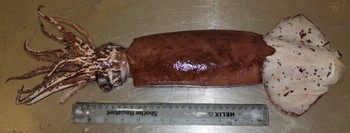
The scaled squid Pholidoteuthis massyae was captured for the first time in the south-west Atlantic on 1 April 2009 (FV ‘Beagle’ F.I. Station 559; 52°58.5–052°53.4′S 59°32.3– 060°02.2′W, depth 198–199 m) on the southern Falkland shelf edge. The specimen (Figure 1) is stored in the British Museum of Natural History (Registration no. 20090259); its mantle length measured 338 mm and it weighed 1114 g. Additional measurements were as follows: fin length 137 mm, fin width 205 mm, head length 60 mm, head width 58 mm, arm lengths from the right side were (arms I–IV) 142 mm, 175 mm, 165 mm, 153 mm, and respective sucker counts were 94, 108, 104, 104. The suckers had sharp teeth on the distal half of the inner ring. The tentacles were damaged.
Pholidoteuthis massyae defrosted in the laboratory of the Falkland Island Fisheries Department.

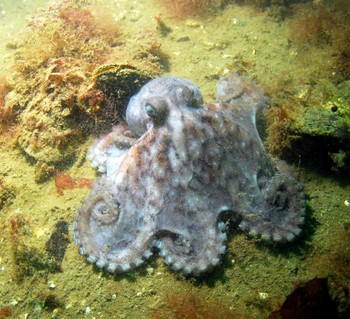
A specimen of Muusoctopus eureka (Figure 2) was found on a Shallow Marine Surveys Group research dive off Green Island, Falkland Islands (28 December 2009, 51°57.826′S 058°30.932′W, 19–20 m depth, bottom temperature 9°C). A sandy bottom with clusters of the ribbed mussel Aulacomya atra was covered with broken shells and supported low densities of the kelp Macrocystis pyrifera. The octopus was sitting on the ground and did not try to escape from the divers. Its particular, species-specific coloration (Gleadall et al., Reference Gleadall, Guerrero-Kommritz, Hochberg and Laptikhovsky2010) was accentuated, and its arms were curled, creating an illusion of largeness that, while being a typical deimatic behaviour of Octopodidae (see figure 5.11g in Hanlon & Messenger, Reference Hanlon and Messenger1998), has been observed neither in this bathyal genus nor in other inkless octopods. The octopus was not disturbed further and was left as it was found.
Muusoctopus eureka on the bottom off Green Island, Falkland Islands.

DISCUSSION
The appearance of the scaled squid in the south-west Atlantic is in line with recent records of deep-water fish and squid of North Pacific origin around the Falkland Islands, whose ranges have possibly been extended by climate-related changes to deep-sea currents (Arkhipkin et al., Reference Arkhipkin, Laptikhovsky and Brickle2010). The same current that brought these species from the North Pacific to the south-west Atlantic around Cape Horn probably ‘picked up’ other deep-sea species from the slope and seamounts of the subtropical South Pacific that were recently reported in the south-west Atlantic—Allocyttus niger (Trunov & Kukuev, Reference Trunov and Kukuev2004), Hoplostethus atlanticus (Laptikhovsky, Reference Laptikhovsky2008) and Pholidoteuthis massyae (this study). Our finding confirms a possibility of deep-sea faunal transport by a flow of Pacific Deep Water that crosses the equator off western shores of South America and then moves further south under the northbound Humboldt Current. Finally this flow mixes with Upper Circumpolar Deep Water to pass through Drake Passage into the south-west Atlantic (Reid, Reference Reid1997).
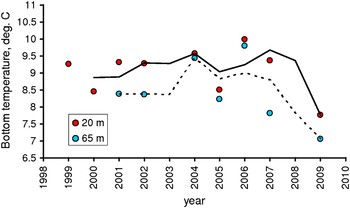
The cold-water octopus Muusoctopus eureka may have disappeared from the relatively warm shallow waters of the Falkland Islands for a century because of the increased temperatures of epi- and mesopelagic layers (0–700 m) in the southern hemisphere, which have been recorded since at least the 1930s (Gille, Reference Gille2008). Data on surface temperatures demonstrated that this warming trend actually began around 1910 (Jones et al., Reference Jones, Parker, Osborn and Briffa2010). However, since 2007, a period of steady cooling with negative temperature anomalies (generally 0.5–1.5°C lower than the annual mean from 1971–2000) has developed all over the south-west Atlantic (see interactive surface temperature anomalies maps at the NOAA website: http://nomad3.ncep.noaa.gov/cgi-bin/pdisp_sst.sh). Analysing data of standard oceanographic transects to the east and south of the Falklands showed that shelf waters between 20 and 100 m in December 2009 were the coldest since 1999 when these investigations began (Figure 3). This cooling may have allowed M. eureka to appear above the poorly resolved summer thermocline nearshore.
Interannual changes in bottom temperatures in December on the Falkland shelf (20 m—station at 51°39.6′S 057°45.4′W; 65 m—station at 52°19.0′S 058°56.4′W). Lines show the moving average with a period of two years.