Introduction
In spite of what Brightman (Reference Brightman2010:135) describes as the rather loose ways in which anthropologists have recently defined the term “property,” for the most part, anthropologists have construed the concept in terms of rights, obligations, and interests. Indeed, the idea of a “bundle of rights” has been proposed as the foundation for a general approach to comparison (von Benda-Beckmann, von Benda-Beckmann, & Wiber Reference von Benda-Beckmann, von Benda-Beckmann, Wiber, van Meijl and von Benda-Beckmann2006). The use of the terminology of “rights” as a universal metalanguage is questionable, however, for it is culturally specific, having developed in the Early Modern period in Europe during the spread of market relations and the growth of contract law (Gordon Reference Gordon, Brewer and Staves1995; Keen Reference Keen, Musharbash and Barber2011). The concept of “rights” interposes a claimed or attributed capacity or power as an imaginary object between a possessor and a possession. A right to or in something has the appearance of a kind of possession—something a person “has” (Alchian & Demsetz Reference Alchian and Demsetz1973). This mediating concept enables the things that possessors can do in relation to a possession to be differentiated and divided. Where “rights” and related concepts are used as part of a metalanguage, these implications of “rights” may be quite different from, and distort, the indigenous constructions that are constitutive of possession relations.
Not all ethnographers rely on the language of rights to translate indigenous concepts of possession, however. Rumsey & Redmond (Reference Rumsey and Redmond1999), for example, express reservations about its use in an Aboriginal context; Stasch (Reference Stasch2009:28) uses the expressions “owner,” “ownership,” and “sense of belonging” to translate Korowai possession of land; and in his analysis of Guianese Amazonian societies, Brightman (Reference Brightman2010:138) relies on the term “possession” as well as “property” and “ownership.” “Possession” is the preferred general term in this article, for it links the anthropology of “property” to linguistic concepts of possession and avoids the inappropriate connotations of “property.” This issue is related to the critique of the term “property” as ontologically inappropriate in some societies (Strathern Reference Strathern and Hirschon1984; Myers Reference Myers, Ingold, Riches and Woodburn1988:53), for it is intimately linked to the concept of rights.
One might ask, how are what anthropologists describe as “rights” and “obligations” constituted in the indigenous languages? In this article I examine the role of language in the constitution of possession relations with reference to three distinct cultures: the ownership of land and waters by Kaiadilt people of Bentinck Island (Northern Territory of Australia), possession more generally among Navajo people (southwest United States) during the first half of the twentieth century, and family/household possessions during the Southern Song dynasty of China (tenth to thirteenth century CE). I chose these cases for the quality of their records of indigenous discourses of possession and property; few ethnographies record the discourse of possession in the original language in any detail, providing little material for investigating how possession relations are linguistically constituted. The three cases also afford interesting comparisons in the cultures of possession and associated ontologies. The focus here is on linguistic aspects of the identification and differentiation of possessor and possessum, the denotation of the connection between them, and the expression of deontic norms governing possession.
The expression of a possession relation has three basic elements: a possessor (Pr), a possessum (Pm), and a connection between them. The constitution of possession requires the identification and differentiation of the Pr and the Pm in discourse, and denotation of the connection. Institutions of possession have several other aspects. Many possessors and possessions, such as corporations and an estate in fee simple (freehold title in English and Australian law), depend on discursive constructs, and constitutive and regulative rules. They have to be described and defined in order to exist. Certain transactions are essential elements of possession relations, especially those to do with the transfer of possessions—by gift, sale, inheritance, and so on. I touch on these complex topics, but because of constraints of space they cannot be explored in detail. Underlying the analysis is the idea that language not only has an instrumental role in cultural conceptualizations (Silverstein Reference Silverstein2004:621), but plays a constitutive role in the formation and reproduction of social practices and institutions (Searle Reference Searle2005). This role involves reflexive models that are “enacted representations” (Keen Reference Keen1995; Agha Reference Agha2007:1–2).
Alienable and inalienable possession
Many linguists see “possession” as a cline or continuum from the most intrinsic relation, such as part-whole relations, to the most external, such as temporary possession of an object (Chappel & McGregor Reference Chappel and McGregor1996; Riegel Reference Riegel2001). This range relates in many languages to the linguistic distinction between alienable possession on the one hand, and on the other inalienable possession, which typically includes parts of the body and kinship relations. The difference is marked in a variety of ways, and the boundary between the two occurs in different places along the continuum in different languages. In English, for example, the possessive adjective denotes a relation between the person and a part of his or her body, as in my leg, as well as kinship relations and property, as in my aunt and my car. In Yolngu languages, however, the personal pronoun is used for possession of parts of the body, as in ngarra wana ‘I arm,’ personal names, patrigroup identity, subsection identity, and occasionally, patrigroup country (De Donatis Reference De Donatis2001:150). The possessive suffix denotes other kinds of possession including kin relations, as in ngarraku bathi ‘my basket’ and ngarraku nga:ndi'mirringu ‘my mother.’ Kockelman (Reference Kockelman2007:345) shows, however, that for Q'eqchi’ at least, the notion of a cline from inalienable to alienable possession would be an oversimplification. Noun classes in Q'eqchi’ distinguish most nouns from “extended bodily substance,” “metonymic possession,” and “inalienable possession.” Anthropologically inalienable possessions are items of value protected from alienation through exchange or sale (Weiner Reference Weiner1992). The grammar of inalienable possession is not necessarily related to what anthropologists construe as inalienable possessions, although Ball (Reference Ball2011) finds some “resonance” between them in Upper Xingu society (see also Kockelman Reference Kockelman2007).
How can the field of possession be narrowed without relying on the concept of “property,” which may have inappropriate connotations? Herslund & Baron (Reference Herslund and Baron2001:11) suggest that “ownership” occupies a central point on a semantic scale stretching from inalienable possession to temporary possession. I construe “ownership” as the potentially alienable possession of objects that are normally separate from the possessor's body. What differentiates this relation from kinship or the relation between a person and a part of his or her body is its deontological entailments—,what a person can, may and ought to do in relation to his or her own and others’ possessions. Inalienable possessions (in an anthropological sense) lie within the range of potentially alienable possessions, but their alienability is blocked, for example, by doctrines attributing the creation of land to totemic ancestors (see below on Kaiadilt “country”).
The connection between possessor and possessum
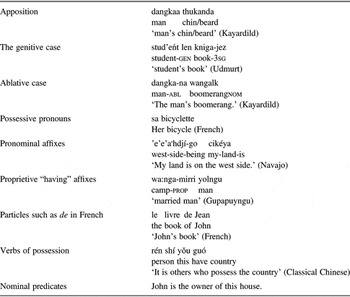
The world's languages provide a variety of means for indicating a connection between a possessor and a possessum, including apposition, the genitive case, other cases such as the ablative and dative, possessive pronouns and pronominal affixes, particles, and verbs (Table 1). Linguists distinguish attributive possession, as in John's car, from predicative constructions, as in John has a car. Among predicative constructions are “have,” “be,” and “belong to” expressions (Heine Reference Heine1997:225; Herslund & Baron Reference Baron, Herslund and Sørensen2001:4).
Expressions of connection.

Sentences link the denotation of Pr and Pm and the connection between them to the framing of norms, discussions and arguments, and transactions about possessions. NPs that include expressions of attributive possession (such as John's car), and clauses in which Pr, Pm, and the connection between them are the arguments and predicates (such as John owns a car and The car is John's) form such sentences. All of these aspects are relevant to the constitution of possession, and all vary between the case studies.
Cognitive schemas
Does the constitution of possession build on underlying cognitive schemas? Premack & Premack (Reference Premack, Premack, Hirschfeld and Gelman1994) understand possession to involve the idea of a connection between a person and an object, the movement of the person and object together, and control of the object by the possessor. Anthropologists and legal theorists have also seen control as focal (e.g. Barnard & Woodburn Reference Barnard, Woodburn, Ingold, Riches and Woodburn1991:13; Davies & Naffine Reference Davies and Naffine2001; cf. Brightman Reference Brightman2010:138). Linguists have proposed a number of foundations for possession constructions. According to the localist hypothesis, locative expressions are the source from which temporal, existential, and possessive constructions derive (Lyons Reference Lyons1967:390; Anderson Reference Anderson1971; Freeze Reference Freeze1992). Langacker (Reference Langacker2003) argues, however, that not all possessives are descended historically from locatives, and that the hypothesis ignores much of the variation in possessive constructions. Some have argued that BE verbs and copula elements are universally associated with possessive constructions (Isačenko Reference Isačenko and Heilmann1974; Clark Reference Clark and Greenberg1978, cited in Heine Reference Heine1997:228).
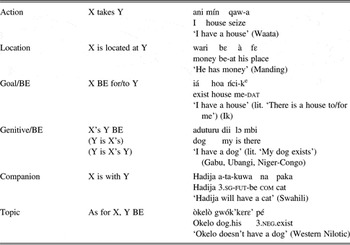
In Heine's (Reference Heine1997, Reference Heine2001) view, possession constructions are derived from a variety of cognitive schemas (Table 2), which can be paraphrased as:
Action: The Pr seizes (or “holds”) the Pm
Location: The Pm is at the Pr's place
Goal/BE: The Pm exists to/for the Pr
Genitive/BE: The Pr's Pm exists
Companion: The Pr will be with the Pm
Topic: As for the Pr, his/her Pm exists (adapted from Heine 201:316)
Heine's six schemata (Heine Reference Heine2001:318).

This range is born out in the case studies, although it does not seem to account for the proprietive case in some Aboriginal languages (see below on Kayardild). Heine's account is important because it suggests that possession can be thought about and represented linguistically in a variety of ways, and is not reducible to any one schema.
The language of possession, I suggest, builds on such cognitive underpinnings and linguistic structures to produce institutions of possession. The use of language enables:
• The framing of possession relations within a communal system of discourse and social memory;
• The constitution in discourse of imaginary and complex objects of possession;
• A rich array of nuanced varieties of possession relations including possession relations that would otherwise be nonexistent or difficult to define;
• The possession of an object in the absence of physical defense or in situ signaling;
• Negotiations over transfers of possession and arguments about the facts of possession;
• The transmission, assertion, acknowledgement, or denial of information denoting a possession relation.
Furthermore, within a community (of whatever kind) it is the knowledge or belief that a Pr possesses a Pm that is important, together with the possibility of physical protection and sanctions. These uses rest, however, on identifying a possessor and possessum, and indicating a connection between them; and it is to these that we now turn in the three case studies.
Indicators of connection
Kayardild
Kayardild, a Tangkic language spoken until recently by Kaiadilt people of Bentinck Island in the Gulf of Carpentaria in northern Australia (Evans Reference Evans1995, Reference Evans1998), has few verbs of possession and no general verb of possession akin to “have.” The verb karrngija ‘keep, keep hold of,’ frequently used in discussion of country, can mean ‘look after’, ‘guard,’ and ‘be responsible for’ something in one's possession (Evans Reference Evans1995:55). Possession is indicated by possessive pronouns and grammatical cases, which denote a variety of possession relations from inalienable to alienable possession. The simplest construction is apposition—the NOM-NOM frame (Evans Reference Evans1995, Reference Evans1998) (see (1b)).
(1) Kayardild possessive constructions
a. Apposition
dangkaa thukanda
man chin/beard
‘man's chin/beard’ (Evans Reference Evans1995:248)
b. NOMinative:NOMinative “having” frame
kulirra dingkarra thuru
catfish-eelnom long tailnom
‘The catfish-eel has a long tail.’ (Evans Reference Evans1995:711)
ngumban-da wakatha maku kiyarrng-k
2sg.poss-nom sisternom sister-in-lawnom two-nom
‘Your sister has two sisters-in-law.’ (Evans Reference Evans1995:318)
c. GENitive
dangka-karra wangalk
man-gen boomerangnom
‘The man's boomerang.’ (Evans Reference Evans1995:104)
d. ABLative
dangka-na wangalk
man-abl boomerangnom
‘The man's boomerang.’ (Evans Reference Evans1995:104)
e. PROPrietive -kuru (Evans Reference Evans1998:55)
wangalk-uru dangka-a
boomerang-prop man-nom
‘The man with/having the/a boomerang.’ (Evans Reference Evans1995:105)
f. UTILitive -marra
wumburu-marr
spear-util
‘for making spears’ (Evans Reference Evans1995:161)
g. ASSOCiative -nurru
nyingka kuru-nurru
2sg.nom egg-assoc(nom)
‘You have some eggs (with you).’ (Evans Reference Evans1995:317)
The relation of the person to parts of the body requires apposition or the NOM-NOM frame, and having something on one's person uses the associative and perhaps proprietive cases. As for potentially alienable possession, the genitive and ablative cases serve for attributive expressions such as “x's country,” and the utilative and proprietive cases are used for predicative expressions as in “country-having person” (dulkuru dangkaa, countryprop mannom). In another mode of indicating possession of country, individuals take the name of a focal site (Evans Reference Evans1998:96).
Navajo
Navajo is an agglutinating, polysynthetic head-marking language of the Athabaskan language family of the southwest United States. Pronominal affixes on noun bases are obligatory, and lexical NPs (or DPs) may be omitted (Horseherder Reference Horseherder1998:6). Possession relations in Navajo are primarily conveyed by possessive pronouns and pronominal affixes (Young & Morgan Reference Young and Morgan1980; Willie Reference Willie, Jelinek, Midgette, Rice and Saxon1996) (see (2) below). Kin terms, body parts, and dwellings (hooghan) take mandatory pronominal affixes; “meat” is always “someone's meat,” for example, and “my piece of meat” is literally “my someone's meat” (Young & Morgan Reference Young and Morgan1980:28). There are no dedicated verbs of possession in Navajo, but certain object-specific verbs imply possession, as in bee'eldǫǫh naashtin ‘I pack a gun.’ The English verb “to own” may be translated as bee hólǫ ‘exist with someone,’ a genitive/BE construction in Heine's scheme (Haile Reference Haile1954/1968:23; Young & Morgan Reference Young and Morgan1980:454, 913, 959; Heine Reference Heine2001).
(2) Navajo possessive constructions
a. Possessive pronouns
díí naal tsoos shí
‘This book is mine.’
díí naal tsoos shíí’ silįį
‘This book has come to be mine.’
t’áá bí bizaad
‘His very own language.’ (Young & Morgan Reference Young and Morgan1980:959)
b. Pronominal affixes ci-/shi- and bi-
’e'e’a.hdjí-go cikéya
west-side-being my-land-is
‘My land is on the west side.’ (Reichard Reference Reichard1951:325; original orthography)
ciyanídó. cáda'há.hdji-go citcei biyan
that-which-is-my-home-from south-side-being my-grandfather his-house
‘My grandfather's house is south of mine.’ (Reichard Reference Reichard1951:325; original orthography)
c. Part-whole relations; obligatory possessive pronominal prefixes (Young & Morgan Reference Young and Morgan1980:28)
’atsį’ ‘something's flesh, meat’
she'atsį ‘my meat’
ne'atsį ‘your meat’
d. Genitive/BE schema
shichidí hól

my car there exists
‘I have a car.’ (Young & Morgan Reference Young and Morgan1980:454)
e. Possession verb specific to object type
bee'eldǫǫh naashtin
‘I pack a gun.’ (Haile Reference Haile1954/1968:23)

The Southern Song
Literary Chinese was in use from the end of the Han dynasty until the twentieth century, when it was replaced by written vernacular Chinese. The Chinese family of languages are “analytic” languages, and do not in general possess inflectional morphologies. Possession relations in Classical and Literary Chinese are conveyed primarily by means of pronouns and particles, and there is a “have” verb (yǒu) (Rabinovich Reference Rabinovich2010; Pulleyblank Reference Pulleyblank1995:14). Possession constructions, given in (3), also include apposition (e.g. jiā chán ‘household property’). (The term “property” is appropriate to this case study, for land and other possessions were commodified in the Southern Song.)
(3) Possessive constructions in Classical and Literary Chinese
a. Possessive pronoun zhī
Wáng zhī shū
king pos book
‘The king's book.’
b. The possessive verb yǒu and possessive pronoun qí
Zǐ wèi Zǐ Chǎn yǒu jūn zǐ zhī dào sì yān:
master say Zih Chan have lord master pos principles four in him
‘The Master said Zih Chan had the [true] gentleman's four traits in him:’
qí xíng jǐ yě, gōng; ….
3sg walk (etc.) self part respectful
‘his [Zih Chan's] deportment was courteous, …’ (Rabinovich Reference Rabinovich2010)
rén jiē yǒu xiōng dì, wǒ dú wáng
person all have EB YB 1sg alone lack
‘Everyone has brothers, I alone have not.’ (Pulleyblank Reference Pulleyblank1995:109)
To sum up, these three languages have quite distinct means for expressing a possession relation: apposition, pronouns, and case marking in Kayardild; pronouns and pronominal affixes together with the genitive/BE schema and certain idioms in Navajo; apposition, pronouns, and a “have” verb in Literary Chinese. They have pronouns in common; these deictically indicate the Pr as well as the connection between Pr and Pm.
The identification of possessors
As Heine notes, “the possessor may appear as the subject, the direct or the indirect object of the verb, as an oblique case expression, as an ergative, or as a non-ergative participant” (Heine Reference Heine1997:224). Languages have a variety of means for identifying possessors, including identity categories such as age grade or occupation, personal names, proper names of groups, and possessive and demonstrative pronouns.
Kayardild possessors
Examples (4) and (5) below provide examples of possessive pronouns in Kayardild: “my country,” “his country,” “my sea,” “my spear;” and of collective possession as in “the country of my mother's mothers,” “other people's food,” “country-owning group.” There are no Kaiadilt land-owning groups akin to “clans,” for owners of the same ‘country’ (dulk) may be connected to it in a variety of ways including spirit conception, birth, and cognatic descent (Evans Reference Evans1995). Nevertheless, owners of the same country are thought of as a single ‘country-owning group’ (dulkuru jardi) rather than a mere collection of individuals (see (4); Evans Reference Evans1998:53). To fully elucidate the constitution of such groups we would need to explore categories of persons, kinship constructs, and “group,” and discourses about relations to country and totemic ancestors.
(4) Possessors of country in Kayardild
a. dulkuru dangkaa
country-prop person-nom
‘country-having person’ (Evans Reference Evans1995:678; Reference Evans1998:52)
b. dulmarra dangkaa
(country-util person-nom)
‘custodian of sacred site’ (Evans Reference Evans1995:162), ‘senior owner’ of country (1998:53)
c. dulkuru jardi
country-prop group
‘country-owning group’ (Evans Reference Evans1995:586; Reference Evans1998:52)
d. dulkuru-dulkuru
country-prop redup
‘A group of people who own the same country’ (Evans Reference Evans1998:53)
e. niida dangkaa
“same” person
person with rights/knowledge regarding a particular special site (e.g. wind-magic site)
(Evans Reference Evans1998:56)
f. dulwarngiijurungarrba
pair mutually having the one country (Evans Reference Evans1998:57)
g. mankinda dangkaa
belonging-to-somebody-else person
person from somewhere else, stranger, person who does not own country
(Evans Reference Evans1998:56)
Navajo possessors
Examples in (2) above of individual possession in Navajo discourse show the use of possessive pronouns and pronominal affixes: “my land,” “his language,” “his house,” “my meat.” There is evidently a tension in Navajo culture, however, between family and individual possession. Livestock were marked with the possessor's individual mark or brand (Haile Reference Haile1954/1968:19), but individuals did not have exclusive possession.
Young & Morgan (Reference Young and Morgan1980:885) translate t’ááłá’í hooghanígíí as ‘one household’ or ‘one family unit’ (hooghan ‘dwelling’). A family had a claim on members’ animal products (including those belonging to children) for ceremonials, for example, yet family members sought an individual's permission for the use of his or her personal animals (Kluckhohn & Leighton Reference Kluckhohn and Leighton1974:106–7). How possessions were attributed in discourse to families is less than clear, however. An expression translated as ‘family’ (Young & Morgan Reference Young and Morgan1980:885) seems to mean literally ‘those who move as a group’ (dah ‘oonétígíí, derived from ‘above’ and ‘move as a group’), whereas ‘family use area’ literally means ‘people's common area’ (diné t’áá bił nahaz’  agi, people part in-company area). I have found no examples that show how “family possessions” might be expressed in Navajo.
Southern Song possessors
The possessors in the Literary Chinese examples in (3) are identified by a possessive pronoun zhī followed by a title (“king”) or rank (“gentleman”); by a personal pronoun followed by an action or attribute (“he/she walk” = “his deportment”); or by the social category “person” followed by a demonstrative (shí) or quantifier (jiē ‘all’) and the verb yǒu ‘have.’ In “traditional” China (Shiga Reference Shiga and Buxbaum1978) tián zhǔ and yě zhǔ denoted ‘land owner’ or ‘property owner.’ I discuss the jiā family/household as a complex possessor below.
To sum up, possessors are identified in the three languages by means of categories of person, group, and organization, as well as possessive articles, pronouns, and pronominal affixes. These are general-purpose forms used for kin relations, parts of the body, and personal attributes, as well as potentially alienable objects.
The constitution of a complex possessor
Many kinds of possessors are both language-dependent and complex, involving a number of discrete but interdependent discourses in their constitution. As an example of the constitution of a complex possessor I examine in some detail the jiā family/household of the Southern Song, which is treated in Southern Song discourse as a unitary entity.
The primary meaning of jiā is ‘dwelling’ or ‘house,’ and the household was prototypically three people under one roof (Chen & Shyrock Reference Chen and Shyrock1932:660). (The hànzi character depicts a pig under a roof.) The family/household consisted of one or more individuals, prototypically with a nuclear family at the core, plus sons, wives, unmarried daughters, servants, and slaves (depending on class and wealth), sharing a common hearth and living under one roof to form a household (Shiga Reference Shiga and Buxbaum1978; Ebrey Reference Ebrey1984a, Reference Ebrey1984b; McKnight Reference McKnight2000). Government records often refer to the family/household as hù ‘door’ (Ebrey Reference Ebrey1984b: 224). The family was not necessarily confined to the household, for sons could live elsewhere with their “own stove” (Shiga Reference Shiga and Buxbaum1978; cf. Zhang Reference Zhang2005).
The jiā is treated in discourse as a dynamic as well as unitary entity, beginning with the division (fēn jiā) of the paternal parental family's property, and ending with the division of its own property among sons or other heirs with the death of the family head. Some accounts trace the identity of the jiā back to previous agnatic generations (Ebrey Reference Ebrey1984b:223). Its unity was conceptualized partly in terms of property, both in expressions such as jiā chán ‘family property’ and in expressions such as tóng jī gōng cái ‘common living, common property’ (Shiga Reference Shiga and Buxbaum1978:119).
Certain relations typified the jiā, especially those of patrilineal kin (father, sons, brothers, etc.), and it was internally differentiated by roles including family head (jiā-zhang), manager (dǒng jiā), and members (Ebrey Reference Ebrey1984a:40, 81, 105–6). The expression xiōng dì tóng ju ‘elder brother, younger brother, living together’ signified the joint household (Shiga Reference Shiga and Buxbaum1978). The patrilineal core, at least in “traditional China” of recent times, was conceptualized and expressed as having ‘the same breath’ (yì qì, tóng qì) and ‘one body’ (yì tǐ) (Shiga Reference Shiga and Buxbaum1978:122–23). The family as a group ‘possessed’ (yǒu) various kinds of resources and wealth including intangibles, holding them in common under the control of the family head (Ebrey Reference Ebrey1984b:223; Schurmann Reference Schurmann1956:509). A daughter's share in family property mainly took the form of dowry at her marriage (Birge Reference Birge2002:143), and wives often contributed to the family budget (Birge Reference Birge2002:163ff). The preservation and prosperity of the family through competent management (zhi shēng ‘well-governed life’) were common values (Ebrey Reference Ebrey1984a:40, 42, 116; Reference Ebrey1984b:223–24).
Government records describe the family head as the owner, but the head did not own family possessions as private property, and sons could not be said to “steal” from family property but only “appropriate” it (Birge Reference Birge2002:47). A wife retained possession of her own property which, not being part of the husband's patrimony, was free from division (Birge Reference Birge2002:128), and men could retain property accrued from their own enterprises, held separately from the family property (Ebrey Reference Ebrey1984b:228).
A family with more than one son was required to divide (fen) the property evenly between them before, at, or after the death of the family head. This might take place some generations later, creating an extended family household (Ebrey Reference Ebrey1984a:112). Unless adopted out or having entered the priesthood, each son succeeded as head of a new household. Complex laws governed procedures in the case of a “cut-off” household (jué hù) without a male heir, in which case a daughter, a close agnate of the head, or an adoptive son might be named heir (McKnight Reference McKnight2000).
The point of recounting these details here is that the constitution of the jiā family/household depended on a variety of discourses associated with various institutions, including kinship, hierarchical relations, ideas about shared substance, roles and activities, places and structures. These are brought together under the category jiā, which is attributed with possessions as a unitary entity.
The constitution of possessions
Three aspects of objects of possession need to be considered: the identification of possessions in sentences, the range of categories of possessions or property, and the constitution of complex possessions. There is a wide variety of morphosyntactic means for encoding the possessum, such as a subject in the nominative case, and an oblique case expression as in Kayardild (Heine Reference Heine1997:224).
Kayardild possessions
The Kayardild language has no general concept of “property” (Nicholas Evans, p.c.). Possessions in the examples in (4) are identified by nominals in NPs that are the direct objects of verbs such as “trespass” and “steal.” The focus here is on ‘countries’ (dulk)—discrete tracts of land and waters, including streams, sea, islands, and fish traps (Evans Reference Evans1998).
Each dulk consists of an area around a cluster of named sites, some regarded as mystically dangerous. Like other Aboriginal groups, Kaiadilt people believe that ancestral beings created the land as well as animal and bird life, and humans and their customs, before being transformed into features of the landscape or “story places” that “bear witness” to these original world-creating exploits (Evans Reference Evans1995:21). Thus ancestral creation underwrites the inalienable possession of dulk. Many dulk are named after single focal sites and are defined by boundaries or edges where one country “cuts off,” giving way to another, and by lists of places along the coast, paths, or creeks, given in explanations for visitors or neophytes (see (5); Evans Reference Evans1998:63–65, 72). In this way the category dulk encompasses topographical discourse, the identity of places, and totemic narratives, under a concept of a unitary object possessed by a group or an individual.
(5) Kayardild discourse about the extent of country (Evans Reference Evans1998:66)
a. dathina kunyaa katharr, dathina ngijinda dulk; niwanda dulkakalaaja dathin
that small river, that my country; his country-nomcut-nom there
‘That small estuary (‘river’), that's (the end of) my country; his country cuts off there.’
b. ngijinda dulk danmurrkid, ngijinda malaa dathinmurrkid, dathin ngijinda malaa bana
my country there-as-far-as, my sea there-as-far-as, that my sea also
‘My country goes up to here, my sea goes to there. That's my sea and land.’
Navajo possessions
The possessum in Navajo sentences (see the examples in (2)) follows a possessive pronoun, or a possessive pronominal affix is attached to a noun base denoting the possessum. As in Kayardild, there is no general, overarching concept of “property,” although there are general concepts of moveable possessions: naalyéhé ‘that which is carried about’ or ‘goods’ (Young & Morgan Reference Young and Morgan1980:583, 907) and ‘inchx  ’í ‘property,’ related etymologically to nichx ǫ’i ‘it is filthy/ugly’ (1980:472, 972). Mary Willie (p.c.) comments, “This word is used by my father, 87 yrs old … to indicate non-livestock possession[s]. It also conveys a sense of ‘pity me as this is all I have’.”
Categories of “hard” (ntł’iz) and “soft” things (yódí ‘that which is below’) were inalienable gifts for the gods (Reichard Reference Reichard1928:90–91; Haile Reference Haile1968:20–21). “Hard” items included cash, silver, precious stones, horse trappings, and so on, while “soft” things included the medicine bundle, furs, textiles, blankets, rugs, and clothing. Personal possessions included intangibles such as chants (Reichard Reference Reichard1928:90). In former times slaves were categorized as ‘goods’ (naalyéhé) and could be bartered (Haile Reference Haile1968:8).
During the first half of the twentieth century, among their personal possessions Navajo people had livestock, clothing, ornaments, weapons, saddles, ceremonial equipment, songs, and prayers; individuals could apparently dispose of them as they wished (see (2); Haile Reference Haile1968:20; Kluckhohn & Leighton Reference Kluckhohn and Leighton1974:107). Fruit trees were possessed by individuals and families (Kluckhohn & Leighton Reference Kluckhohn and Leighton1974:106–7; Reichard Reference Reichard1928:13). Mary Willie (p.c.) comments,
Usually Navajo speakers, monolinguals similar to my folks, do not express objects in the home as belonging to this individual family member. Maybe the exception is blankets … given as a gift. In fact, I find it odd when someone says, “I'm going to mop my floors.” In my view the “floor” belongs to the house.
She also comments that her relatives would say, “That cow is probably from Joe Begay's home” rather than “It is Joe Begay's cow.” (The home—hooghan ‘dwelling’—itself is treated linguistically as an inalienable possession in Navajo; Young & Morgan Reference Young and Morgan1980.) Personal possession of objects thus seems to have been downplayed.
Individuals held areas of farmland under what Kluckhohn & Leighton call “use ownership”—their use was inherited and land was inalienable (Kluckhohn & Leighton Reference Kluckhohn and Leighton1974:106). A family had use rights to a ‘family use area’ (diné t’áá bił nahaz’ agi) as long as it continued to occupy the land (Young & Morgan Reference Young and Morgan1980:542, 885). Farm plots held by families and individuals, however, were marked by stones, fences, and other markers (Haile Reference Haile1968:6, 16–18). Increasing numbers of Navajo held land according to American legal norms, a continuing trend. Navajo complex possessions include Dinétah, Navajo territory (Haile Reference Haile1968:1–2), defined by topography and by myths connecting land to Navajo gods (Matthews Reference Matthews1897).
Southern Song possessions
Unlike Kayardild and Navajo, Literary Chinese has many general terms for family property, each with a distinct focus: ‘household plot’ (chán), ‘cultivate’ or ‘cultivated field’ (tián), ‘give’ or ‘bestow’ (jī), ‘enterprise’ or ‘inheritance’ (yè), ‘resources’ or ‘capital’ (zī), ‘goods,’ ‘material wealth,’ or ‘media of exchange’ (cái) (Schurmann Reference Schurmann1956; Shiga Reference Shiga and Buxbaum1978:114–22; Ebrey Reference Ebrey1984a, Reference Ebrey1984b; Pulleyblank Reference Pulleyblank1991; Birge Reference Birge2002). All could signify property more generally. A family's property was often identified with its land, as in jiā chán ‘family/household property.’ Separate from her husband's family patrimony, a woman's dowry was categorized metonymically, as in lián zhǔ ‘cosmetic box owner,’ lián fěi ‘cosmetic box [and] basket,’ náng tuó ‘large sack, small sack,’ náng qiè ‘bag box,’ and similar expressions (Birge Reference Birge2002). The verb yǒu ‘have; hold’ also signified possession in the abstract.
Several discourses contributed to the constitution of possessions. The discursive constitution of land as property included topographical and mathematical constructs. Fields were defined by their four limits or edges (sí zhí) (Schurmann Reference Schurmann1956:509), surveyed and measured area (Martzloff Reference Martzloff and Wilson1997), and topography, and were registered in government records by number and household identity (McKnight & Liu Reference McKnight and Liu1999). Possessions were divisible, assisted by the numerical measurement of land and by monetary value. Family members drew lots for the purpose of division (fen) usually following the death of the head, the specifications of pieces of property being written on the lots to be drawn, especially in the case of land (Ebrey Reference Ebrey1984a:115).
We have glimpsed some of the discourses involved in defining complex possessions: focal places, lists of sites, “cut-off” places and edges, numerical concepts of area, totemic geography, and so on. The discursive constitution of Chinese land as property stands in sharp contrast with Kaiadilt “countries” defined by totemic geography, but less so with Navajo farmland, although Navajo land was in principle inalienable. The three cases contrast in the presence and absence of general “property” categories. Chinese is rich in these, while Kayardild and Navajo lack general property terms, although Navajo has terms for moveable possessions.
The enactment of possession
The enactment of possession relations includes both the use of possessions and transactions characteristic of particular possession regimes. Those to do with Kaiadilt country include succession or inheritance of land and waters, and negotiations over the use of other groups’ countries (Evans Reference Evans1998). Navajo of the early twentieth century engaged in extensive exchange of meat and other provisions between relatives, the trade of pots and other items with Pueblo villages, and transactions through trade stores (Kluckhohn & Leighton Reference Kluckhohn and Leighton1974:37, 78–80). Transactions also included the inheritance of moveable possessions and the use of land and dwellings (Shepardson & Hammond Reference Shepardson and Hammond1966). Transactions in the Southern Song over household property were many and varied depending on the class and occupation of the household members, and included commodity exchange such as the sale, provisional sale and rental of land, and inheritance (Shiga Reference Shiga and Buxbaum1978; Ebrey Reference Ebrey1984a; McKnight & Liu Reference McKnight and Liu1999; Birge Reference Birge2002). The role of language in the constitution of actions and transactions would require a separate study, but I discuss norms here.
Deontological entailments of possession relations
Deontic norms are rules or principles that create obligations and grant permissions and powers. Some are established by statutes and regulations, while others are informal and customary. Scholars often associate norms with modal operators such as “ought” and “must,” but they can be expressed in a variety of ways (Finnemore & Sikkink Reference Finnemore and Sikkink1998; Hechter & Opp Reference Hechter and Opp2001). Deontic norms (Beller Reference Beller2008) govern possession relations and give them their content; these are the deontological entailments of the connection between Pr and Pm. The bases of possession are recognized, and deontic norms governing possession are current and enforced, within intersecting and overlapping jural communities of varying scope and power, from the family to the state (Goodenough Reference Goodenough1965; Finnemore & Sikkink Reference Finnemore and Sikkink1998; Hechter, Opp, & Wippler Reference Hechter, Opp and Wippler1990; Sripada & Stich Reference Sripada, Stich, Carruthers, Laurence and Stich2006). Means are required within jural communities to change norms (Ensminger & Knight Reference Ensminger and Knight1997), to adjudicate disputes, and to enforce norms governing possession (e.g. Fehr Reference Fehr2004).
Norms governing possession of country in Kayardild have to do with access to and inheritance of land, waters, and their resources (Evans Reference Evans1998). Navajo norms governed: the ability to use Diné country and its resources; restrictions on using land and resources close to another family's dwelling; the ability of a family to continue to use a dwelling and the attached land; restrictions on disposing of possessions for personal gain; the obligation to supply one's family with meat from one's own livestock; the ability to give away or sell personal possessions such as ornaments, clothing and saddles, and ceremonial paraphernalia, songs, and prayers; and inheritance (Reichard Reference Reichard1928:91; Haile Reference Haile1954/1968:16–19, 21, 89; Shepardson & Hammond Reference Shepardson and Hammond1966; Kluckhohn & Leighton Reference Kluckhohn and Leighton1974:105–7). A sample of norms governing Southern Song property (see (9) below) concerns the transfer of property by division or sale, the relation of a wife's property to the patrimony, and constraints on the disposal of property by widows and young heirs (McKnight & Liu Reference McKnight and Liu1999:150, 167, 169, 171–72, 193).
Jural communities
Deontic norms are current and enforced within jural communities of various kinds. Jural communities in Australian Aboriginal societies were typically kin-based networks within which people recruited support to protect their interests and to take redressive action against perceived wrongdoers. This structure of “self-help” (Berndt Reference Berndt, Berndt and Berndt1965) lay within an overarching regional consensus as to the nature of ancestral law, whose foundation was attributed to creator ancestors (Keen Reference Keen2004). Navajo jural communities seem to have had a similar structure to those of Aboriginal Australia, but with a strong focus on the achievement of balance or harmony (hozho) in social relations rather than redressive action, under guiding concepts of harmony and k'e ‘kinship’ (Yazzie Reference Yazzie1994; Austin Reference Austin2007). Southern Song jural communities included clan, family and neighborhood, and the legal structures of the state. Property law was part of the state legal code, administered by local magistrates and other officials (McKnight & Liu Reference McKnight and Liu1999; Birge Reference Birge2002:66–67). With these structures in mind, let us turn to the expression of norms in the case studies.
The expression of norms
Verbal and nominal case are the main means for expressing deontic modality in Kayardild, especially the potential, hortative, desiderative, and oblique cases, together with the counterfactual particle maraka (Evans Reference Evans1995:264, 428). The examples in (6), which are mainly about land and waters, include:
• Strong prohibition, with the potential inflection in the negative
• Weak prohibition, with the hortative inflection
• Expressions of obligation, with the counterfactual particle maraka
• Conditional constructions, in the imperative mood
• Normative statements linking wrong action to ancestral law in declarative sentences and quoted questions
• Statements of possessive powers, with the potential inflection
• Negative powers, with the desiderative inflection in the negative
• Lexicalization of wrong action, such as the verb “steal” (Evans Reference Evans1998)
(6) Kayardild expressions of norms
a. POTential inflection
burdumbanyi waydbala raba-nangku ngijin-jinaba-wu ngarriju-naba-wu
ignorantnom white mannom tread-negpot my-abl-mprop mm-abl-mprop
jardi-naba-wu dulk-u
mob-abl-mprop country-mprop
‘The ignorant white man must not trespass on the country of [all] my mother's mothers….’ (Evans Reference Evans1995:144)
wungiinangku, bijarrba wungi-i-nangku bangaa wungi-i-nangku, dangkanaband
steal-neg-pot dugong steal-pass-neg turtle steal-pass-neg somebody else's
‘They mustn't be stolen, dugong mustn't be stolen, turtle mustn't be stolen, from someone else.’ (Evans Reference Evans1998:90)
b. HORtative
wirrka-nanginja dathin-a kunawuna ngijin-inja wumburung-inj
play-neg.hort that-nom childnom my-mobl spear-mobl
‘That child shouldn't play with my spear.’ (Evans Reference Evans1995:264)
c. DESiderative combined with the OBLique
dan-inja nga-l-da jalji-nja wirdi-d
here-mobl 1-pl-nom shade-mobl stay-des
‘We should stay here in the shade.’ (Evans Reference Evans1995:263)
d. Counterfactual particle maraca
maraka bilda ngalawanju daamiju
part they our (exclusive) ask
‘they should have asked us’ (Evans Reference Evans1998:81)
e. Conditional construction with a deontic modal
See, when you go, if you go hunting on other people's area you gotta share, give half to that person. (Evans Reference Evans1998:91)
f. Normative statements linked to the concept of ancestral law
RK yeah, that's the jungarra birrjilk [big law] you can't raaja bangaa [spear turtle] langa somebody water, you [ought to] hunting long your own area. (Evans Reference Evans1998:89)
Dangkaa bijarrba-wungind, wungija diyaj, niya bala-a-ju. Dathinanangand,
person dugong-steal-nom steal eat he/she attack-pass-pot that side
dathina birrjilk. “Nyingka ngaakawuru dangkanabanji wuran-ki
that law/custom you what for someone else's-loc food-loc
diyaj, dangkanabanji dulki?” That's the kangk.
eat-act someone else's place that's the word/story
‘And a person who steals dugong, who steals and eats, he'll be attacked/killed. It's like that, that's the law. “What have you been doing, stealing and eating other people's food?” That's what people say.’ (Evans Reference Evans1998:92)
g. Lexicalization of breaches of norms of possession
Dangkabanji dulki wungija yakuriy
someone else's country steal fish
‘They've been stealing fish from someone else's country.’ (Evans Reference Evans1995:670)
Navajo lacks modal auxiliary verbs (Willie Reference Willie, Jelinek, Midgette, Rice and Saxon1996); modality is expressed by means of other semantic features of verbs, nouns, adverbs and particles, and the optative mood. For example, obligation is expressed with the future tense together with certain particles, while the verb denoting “make a round space” expresses permission and prohibition (see (7) below; Willie Reference Willie, Jelinek, Midgette, Rice and Saxon1996:333). I have found no published examples of norms about possession in the Navajo language, however.
(7) Expression of norms in Navajo
a. Obligation T’áá’aaníí díiji ‘ashkii ‘íídoołta’
just true today boy 3.will go to school
‘The boy must go to school today.’ (Willie Reference Willie, Jelinek, Midgette, Rice and Saxon1996:345)
b. Permission Nanishgóó deeshááł = igíí bee shá haz’
Job to I.will go = comp 3.with 1.ben area.space
‘I am allowed to work.’ (Willie Reference Willie, Jelinek, Midgette, Rice and Saxon1996:333)
c. Prohibition Mą’ii jidoołheł = igíí doo bee haz’
dacoyote 3s.4s.will kill = compneg 3.with area.space neg
‘He is not allowed to kill a coyote.’ (Willie Reference Willie, Jelinek, Midgette, Rice and Saxon1996:333)
(8) Expression of norms in Classical and Literary Chinese (Pulleyblank Reference Pulleyblank1995; Fuller Reference Fuller1999)
a. Prohibitive particles bù 不, wú 毋 ‘not’
b. Verbal auxiliaries of obligation and permission
bì 必 ‘must’
dāng 當 ‘ought, should’
kě 可 ‘ought to, should, permissible’
néng 能 ‘can’
xū 須 ‘must, permitted’
yīng 應 ‘ought to, must’
yāo 要 ‘require, demand, must’
xū 須 ‘must, permitted’
xǔ 許 ‘permit, agree to, approve’
yuàn 願 ‘wish for’ or ‘desire’
(translated as a verb of permission)
c. Verbal auxiliaries of prohibition
wú 無 ‘not have, there is not, ought not, should not’
wù 勿 ‘do not, must not’ (stronger than wú)
wáng wù wǎng shòu
king not go hunt
‘The king must not go hunting’ (Rabinovich Reference Rabinovich2010)

Deontic modality is conveyed by a particle and verbal auxiliaries in Classical and Literary Chinese (see (8); Pulleyblank Reference Pulleyblank1991, Reference Pulleyblank1995; Fuller Reference Fuller1999:80; Peyraube Reference Peyraube, Tsao, Wang and Lien1999). Norms were codified, and some are cited in commentaries on legal cases (see (9); McKnight & Liu Reference McKnight and Liu1999). Their forms vary in a similar way to Kayardild norms (see (6)). The examples (see (9) below) include:
• A conditional sentence with the expression of obligation or prohibition, using the modal auxiliary yīng ‘must’
• The expression of obligation, with the modal auxiliary xū ‘must’
• A declarative sentence stating the exclusion of wife's property from the husband's patrimony
• A declarative sentence stating an entitlement and its conditions
• The expression of prohibition, using xū ‘permitted’ in the negative
• The expression of permission using the modal auxiliary yuàn (McKnight & Liu Reference McKnight and Liu1999:150, 167, 169, 172, 193)
The magistrates quoting these laws preface them with the expressions “According to law”, or “The regulations of the ministry of revenue says….”
(9) Examples of norms governing property in the Southern Song
a. Unidentified magistrate
又 准 法 應 交易 田宅 並
Yòu zhǔn fǎ: yīng jiāoyì tiánzhái bìng
Again according law: must hand over fields and buildings together
要 離 業 雖 割零 典買 亦 不 得
yāo lì yè suī gēlíng diǎnmǎi yì bù dé
must depart property even if partition conditional sale also not obtain
自 佃賃
zì diànlìn
oneself rent or lease
‘According to the law, “In all cases involving the transfer of land or buildings the former owner must vacate the land or house. If the land has been divided into parcels through conditional sale, he is not allowed to become a tenant himself.”’ (McKnight & Liu Reference McKnight and Liu1999:150)
b. The magistrate Wu Shu-zhai
在法: 諸 典賣 田宅 並 須 離 業
Zài fǎ: zhū diǎnmǎi tiánzhái bìng xū lí yè
By law: all pledged fields and buildings together must depart property
‘According to law “Those who conditionally sell their land or houses must vacate the property.”’ (McKnight & Liu Reference McKnight and Liu1999:193)
c. Weng Hao-tang
在 法 諸 僧 道 犯罪 還俗 而
Zài fǎ: zhū sēng dào fànzuì huánsú ér
By law: all Buddhist monk Taoist monk criminal laicized and yet
本 家 已 分 者 止 據 祖父
běn jiā yǐ fēn zhě zhǐ jù zǔfǔ
own family already divided nom limited occupy ancestors
財產 眾 分 見 在 者 均 分
cáichǎn zhòng fēn jiàn zài zhě jun fēn
wealth and property many divided seen to be at or in nom equal division
‘According to the law, “Buddhist and Taoist clergy who are laicized as a result of having committed infractions, if their families have already divided [the bulk of their property], are only entitled to a share of such existing undivided property as was left by the ancestors and is still kept as common property among the other family members.”’ (McKnight & Liu Reference McKnight and Liu1999:167)
d. Weng Hao-tang
在 法 妻 家 所 得 之 財 不 在
Zài fǎ: qī jiā suǒ dé zhi cai bùzai
By law: wife family that which acquired part wealth not in
分 限
fēn xiàn
division parameters
‘According to law, “Property acquired from the wife's family does not belong to the husband's family for its division.”’ (McKnight & Liu Reference McKnight and Liu1999:169)
又 法 婦女 財產 並同
Yòu fǎ: fùnú cáichǎn bìngtóng
Again law: married woman wealth and property equally in common
夫 為 主
fū wéi zhǔ
husband to be master
‘Also according to law, “A woman's property belongs jointly to her husband as the principal.”’ (McKnight & Lieu Reference McKnight and Liu1999:169)
在 法 寡婦 無 子孫 年 十六
Zàifǎ: guǎfù wú zǐsūn nián shíliu
By law: widow without sons and grandsons year of age sixteen
以下 並 不 許 典賣 田宅
yǐxia bìng bù xǔ diǎnmài tianzhai
below equally not permitted pledge fields and buildings.
‘According to the law, “A widow without an heir or whose heir is less than sixteen years of age is not permitted to sell land or houses either conditionally or outright.”’ (McKnight & Liu Reference McKnight and Liu1999:171)
戶令 曰: 諸 財產 無
Hùling yue: zhū cáichǎn wú
Household law states: all wealth and property not have
承分人 願 遺囑 與 內 外
chéngfēnrén yuàn yízhǔ yù nèi wài
inherit division person willing bequeath take part in inner outer
緦麻 以 上 親 者
sīmá yǐ shàng qīn zhě
three months mourning with above relative nom
[“mourning hemp”]
‘… the regulation of the ministry of revenue says, “Where there are no heirs to inherit property, it is permissible to bequeath it to relatives who observe at least three months of mourning.”’ (McKnight & Liu Reference McKnight and Liu1999:172)
Such norms and normative statements typically invoke possession relations, but the examples show just how varied the expression of deontic norms can be. They do not rely solely on deontic modal verbal auxiliaries, and they express subtly different kinds and degrees of obligation, prohibition, permission, and powers. A closer look reveals commonalities between the Kayardild and Song norms: both use “strong” modals of obligation and prohibition in relation to land and its resources (Kaiadilt) and family property (Southern Song), respectively. The strongest modal forms in Kayardild are reserved for obligations and prohibitions about access to other people's country and its resources: gotta and you can't in Aboriginal English, the negative potential case in raba-nangku ‘not tread,’ the lexicalization of wrong actions in wungija ‘steal,’ and the counterfactual maraka. The “weaker” hortative and desiderative are used for less weighty matters such as a child playing with a man's spear, and moving into the shade. The Southern Song norms as quoted by magistrates employ the modal particles yīng and xū ‘must,’ bù xǔ ‘not permitted,’ the permissive yuàn, and declarative sentences given obligatory force by means of expressions such as “according to law.”
While this article has not examined the matter directly, it is evident that discourses of disputes, negotiation, and dispute resolution over possession also varied between the case studies. Aboriginal disputes were pursued through “self-help,” violence, and mediation. The main aim in Navajo dispute resolution was the achievement of a harmonious resolution through mediation. The Southern Song examples of normative language are taken from summaries of court cases decided by magistrates and other officials whose findings were enforced by the state.
Conclusions
This article has traced the role of language in a number of aspects of the constitution of possession relations (specifically potentially inalienable possession), and touched on others. It has considered the identification of the Pr and Pm, and the expression of the connection between them both in general and with reference to the three case studies. It highlights the many kinds of discourse involved in complex possessors and possessions. After a brief glance at transactions, this article examined at greater length deontic norms governing possession, with a focus on the linguistic means for conveying normative force, against a sketch of the institutional background. The constitution of possession relations involves all of these aspects. Using the linguistic means to hand, it is necessary to identify the Pr and Pm and denote a connection between them. Sentences (or sentence fragments) that include expressions of possession form the bases of a wide variety of discourses, including the expression of deontic norms.
The elementary semantic structure of possession relations, which incorporates a Pr, a Pm, and a connection between them, appears to be universal, but we have seen that the linguistic means for expressing and constituting possession relations vary greatly, as do the linguistic means for expressing deontic norms that govern possession and give it its content, the discourse of transactions, negotiation and disputes, the types of jural community within which norms are current, and the means of enforcement.
The linguistic means for denoting a connection between Pr and Pm vary greatly among the languages. Kayardild lacks a general verb of possession and relies on a wide variety of grammatical cases to express subtle distinctions in varieties of possession relations, as well as possessive pronouns and apposition. Navajo employs possessive pronominal affixes, a genitive/BE construction, and certain idioms. In the examples, the possession of personal items such as a car uses the genitive/BE construction and verbs specific to object type. The expression of possession in literary Chinese of the Southern Song includes a “have” verb and possessive pronouns and particles for kin relations, personal attributes, and possessions.
The three languages of this study use possessive articles, pronouns and pronominal affixes to identify possessors, as well as categories of person, group, and organization. Like the verb “have,” these are general purpose forms whose use is not restricted to the possession of potentially alienable objects, but that extend to kinship relations, parts of the body, and personal attributes. A sketch of a complex possessor of the Southern Song—the jiā family/household—revealed the diversity of constitutive discourses and practices, including kinship, hierarchical relations, and occupation, woven together to form a complex that is conceptualized as a unitary, if dynamic, entity.
Importantly, Kayardild and Navajo have no categories of possessions that can be translated as “property” in general, while Literary Chinese has a rich variety of property concepts, concomitant with the role of the market in Southern Song society. The article touched on the constitution of complex, language-dependent possessions, such as land owned by the jiā household of the Southern Song, and Kaiadilt “countries” (dulk). Like complex possessors, such entities are composed of a variety of discrete but interwoven discourses and practices including place, topography, and numerical measurement, invoked and deployed in ongoing institutional discourse and practice. To unpack these would require looking in detail at the constitution of each kind of discourse, such as totemic ancestral worlds and narratives, number, and concepts of area, and at their interaction.
Some of the above differences seem to reflect variation in economic relations. For example, the proliferation of property categories in Literary Chinese reflects the widespread commodification of property including land. It is clearly unsafe, however, to generalize from three cases. “Have” verbs, for example, exist in a wide variety of languages, including some Australian Aboriginal ones (McGregor Reference McGregor2001), which were not associated with market economies before British colonization of Australia.
Norms give possession relations their content and create the differences between varieties of possession—they act both as regulative and constitutive rules (Searle Reference Searle2005). Subtleties in the expression of possession convey these differences, as in the range of case markers used in Kayardild. The linguistic means for expressing norms governing possessions also vary between the three case studies. Kayardild expresses deontic modality primarily by means of grammatical case. Like Kayardild, Navajo lacks modal auxiliary verbs, and uses tense and various verbal idioms to express obligation, permission, and prohibition. Literary Chinese expresses deontic modality by means of verbal auxiliaries and a particle. Both Kayardild and Song norms employ “strong” modals of obligation and prohibition. In a similar way, key modals in statutes in the legal systems of English-speaking countries are shall and must, which indicate obligation, and may which is permissive (Garner Reference Garner2009:172).
The ontological correlates of possession also varied. The “consubstantial” relations between people and country typical of Aboriginal cosmologies (Bagshaw Reference Bagshaw, Peterson and Rigsby1998; Magowan Reference Magowan2001) contrast with the commodification of land in the Southern Song. The former render land and waters inalienable, as the relation between Pr and Pm becomes akin to the relation of a person to a part of the body and/or to a kin relationship. This kind of ontology also pertained in Navajo culture in relation at least to Diné traditional territory as a whole, reflected in the use-ownership of Navajo land. These differences in ontology do not affect the expression of possession relations in the examples, although Yolngu sometimes use the inalienable form for possession of country. Where the ontologies do make a difference lies in constraints imposed on the modes of transfer of possession, most commonly in Australia through patrifiliation and place of birth (Keen Reference Keen2004), in contrast with the role of the market in the Southern Song. Kaiadilt country and Navajo territory are cast as inalienable possessions, and although there is no necessary connection between inalienable possessions and the use of inalienable possessive linguistic constructions, it is significant that the Navaho word hooghan ‘dwelling; home’ takes the mandatory pronominal prefix as an inalienable possession.
Returning to the conceptual bases of possession, linguists subsume the expression of potentially alienable possession relations, part-whole relations, kin relations, and the attributes of an object or person (e.g. “the color of x”) under “possession” in general. Not only do their deontological entailments distinguish these kinds of relations, however, but the modes of connection differ conceptually.
• The Pm is part of the Pr (part-whole relations)
• The Pr came out of the body of the Pm, or the Pm came out of the body of the Pr (the primary kin terms “mother” and “child”)
• The Pm is a quality of the Pr (attributes)
What is the equivalent connection to do with potentially alienable possession? We have seen that linguists have discussed whether location is fundamental to possession, and anthropologists and legal theorists have suggested that property has to do with control of the Pm by the Pr. The cognitive/linguistic schemas adduced by Heine (Reference Heine2001), however, suggest a wider range of actions and relations represented in a diversity of cultures and languages. These schemas (which pertain to potentially alienable possession) cluster around the Pr as the agent in an action of possessing (“I hold x”) or as the patient as a beneficiary (“x is for me”), the co-location of the Pr and Pm (“x is at/by/with me”), and the existence or presence of a Pm (“my x exists”). Possession and “property,” therefore, comprise a broad and varied family of relations, irreducible to a single concept such as location or control.
To return briefly to the issue of rights: although the language of rights purports to be able to accommodate variation in “property” relations cross-culturally, expressed as diverse “bundles of right” (von Benda-Beckman et al., ), an implication of this article is that the approach misses the diversity of conceptualizations and expressions of possession relations. The language of rights and obligations tries to capture what people can, cannot, must, and must not do in relation to things possessed, according to shared norms and laws. No word or expression that can be translated as “right” in the legal sense has emerged in the case studies, however. To express Kaiadilt, Navajo, and Southern Song deontic norms governing possession in terms of rights and obligations would require processes of inference and reconstruction. Used as a metalanguage, the language of rights obscures much of the language and culture of possession relations, and by imposing the alien concept of abstract rights as mediating possessions, it may well distort what it describes.