INTRODUCTION
The goal of predicting psychosocial outcome after head trauma has been described as elusive (Novack et al., 2001). This description probably reflects the range in severity of injuries suffered by outcome cohorts, the time after injury when outcome is measured, plus the number and variety of factors or dimensions that comprise psychosocial outcome. At earlier stages in recovery, injury severity has been associated with poor outcome (Jennett et al., 1981; Levin et al., 1990; Ruff et al., 1993). However, injury severity has less influence on outcome as time from injury increases (Thomsen, 1984; Wood & Rutterford, 2006). For example, by 8 years after injury, injury severity combines with age at the time of injury to predict occupational and social outcome (Groswasser et al., 1999; Lewin et al., 1979). Demographic and cognitive factors have also been used to predict quality of life (QoL) after brain injury. For example, Seibert et al. (2002) found that gender differences influenced perceptions of QoL at 1 year after injury, with significantly more females (69%) reporting a worse overall QoL than males (21%). Dijkers (1997) also reported gender to be influential when reviewing literature concerning community integration. However, time since injury continues to be a factor, because some studies that include gender as a predictor of outcome at later stages after injury, fail to find any association with life satisfaction or depression (Corrigan et al., 1998; Deb et al., 1999).
Length of full-time education has also been used to predict outcome after brain injury. At 1 year after injury, low premorbid educational levels seem to determine post-injury employment, or successful return to productive activity (Deb et al., 1999; Wagner et al., 2002). This observation was supported by data from the TBI Model Systems database (Sherer et al., 2002a), which found that only 10% of those with no school leaving certificate at time of injury were in work 2 years later, compared to twice the number who had gone on to further education. Evidence also appears to support the view that the greater the degree of post-injury cognitive impairment, the lower the level of post-accident productivity (Boake et al., 2001). Sherer et al. (2002b) reviewed the literature and concluded that there was “strong support for the relationship of neuropsychological test results to employment outcome after TBI” (p 176). However, the majority of studies rely on a small number of neuropsychological tests and the choice of tests often differs between studies, making it difficult to directly compare results. For example, Klonoff et al. (1986) found that tests of motor functioning, memory, and constructional ability were related most strongly to participant's QoL at 2–4 years after injury, whereas Ross et al. (1997) suggested that tests which measure speed of information processing, in combination with age, significantly predicted psychosocial outcome 1 year after severe injury. Discrepancies between studies, therefore, may be partly explained by variation in the tests and the time at which they were administered.
Only a few studies that investigate predictors of long-term outcome after traumatic brain injury have reported follow-up data beyond 7 years after injury (Colantonio et al., 2004; Hoofien et al., 2001). The aim of this research, therefore, was to investigate how well cognitive and demographic variables explain outcome at later stages (more than 10 years) after injury to see if people are capable of making gradual adjustments and adaptations that improve functional abilities and lead to a better quality of life. The research was conducted within the theoretical framework provided by Kendall and Terry (1996) who propose a model that identifies antecedents specific to head injury, capable of influencing the impact of demographic and cognitive factors on psychosocial outcome. One antecedent is pre-injury psychosocial functioning, which includes employment status before injury. Kendall and Terry (1996) suggest that employment will act directly on psychosocial adjustment. Injury severity and locus of lesion are considered to make up the component representing neurological factors, which they depict as directly predicting outcome. The influence of cognitive impairment on outcome is represented in the model by direct and indirect pathways. Cognitive impairment can directly influence outcome, independently of appraisal and coping variables, whereas the indirect pathway represents the impact of cognitive impairment on the accurate appraisal or selection of appropriate coping methods that, in turn, influence outcome. The hypotheses of this study, based on Kendall and Terry's framework, predict that neurological variables, pre-injury functioning, and cognitive impairment would directly influence multidimensional, long-term outcome. Furthermore, cognitive impairment would also indirectly influence multidimensional, long-term outcome, by means of the mediation of coping and appraisal variables.
METHODS
Participants
The cohort was drawn from the clinical archives of a regional neurotrauma center plus cases seen at a rehabilitation neuropsychology assessment service (N = 1123). To be included in the study, participants had to (1) speak English, (2) have suffered only one traumatic brain injury, (3) be able and willing to give informed consent, (4) and be at least 10 years after injury (to ensure the focus was on very late stages of adjustment and recovery). A total of 601 participants who fit these criteria were approached using the most recent contact addresses contained in their clinical files. Two hundred eleven (35%) replies were received. Of these, 131 (62%) were positive and formed the cohort, 69 (33%) were negative, and 11 (5%) replies indicated that the person had died since baseline assessment. There were no significant differences in age (t(562) = −.077; p = .235), injury severity (t(562) = −1.032; p = .119), or gender (χ2 = .692; df = 1, p = .405) between those included or not included in the study.
Of 131 participants included in the study, 85 (65%) were male and 46 (35%) were female. A total of 101 (77%) suffered their injury in a road traffic accident, 18 (13%) as a result of a fall, 6 (5%) were assaulted, and 6 (5%) suffered static concussion when hit on the head by a falling object. Injury severity was determined by the length (in days) of Post-Traumatic Amnesia (PTA) because Glasgow Coma Scale (GCS) scores were only available in 57 (51.14%) of cases. PTA was measured as recommended by McMillan et al. (1996). The cohort had a median PTA of 7 days (N = 131; mean = 12.43; range = 0–150, SD = 20.33). A total of 19 (14.5%) of the cohort had suffered a mild injury (PTA < 1 hour), 27 (20.6%) a moderate injury (PTA 1 hour < 24 hr), 13 (9.9%) a severe injury (PTA 24 hr < 1 wk), and 72 (55%) a very severe injury (PTA > 1 wk). The mean GCS on admission to hospital, based on 51% of cases, was 9.97 (4.18). The mean time since injury was 15.31 years (SD = 4.87; range, 10.00–30.73 yr), the mean age of the cohort at injury was 32.83 (SD = 13.08; range, 16–61), and at follow-up was 47.66 years (SD = 12.69; range, 27–75). The mean length of education of the cohort was 12.07 years (SD = 2.47; range, 9–19). Only one participant required paid care support because of major physical disabilities. There were 15 (11%) participants who reported a history of post-traumatic epilepsy, but in all cases, seizures were controlled by medication and were not judged to interfere with everyday life. Fifty-five of the participants were originally seen for a medicolegal assessment. None of these cases were on-going at the time of follow-up, litigation having concluded between 7 and 10 years previously. There was no difference in injury or outcome characteristics between those participants seen for medicolegal purpose and the rest of the cohort (see Wood & Rutterford, in press a).
Procedure
Participants who fulfilled criteria and provided signed consent (N = 131, 100%) were interviewed at home in the company of a close relative to obtain information on pre- and post-accident employment and relationship status. Injury details were obtained from clinical records. Each participant completed a neuropsychological assessment. To address both this study and another tandem project (Rutterford & Wood, 2006, this issue) participants and their relatives were then shown a set of questionnaires and given an explanation of how they should be completed. Because the time to complete both interview and neuropsychological examination was at least 3 hours, the questionnaires were left with the family to be completed and returned within the next few days. If the questionnaires had not been received by the researcher after a period of 3–4 weeks, the participant was contacted by telephone as a reminder. This process was repeated once more after a further period of 3–4 weeks, after which no further reminders were given and unreturned questionnaires were treated as missing. Ethical approval was obtained from the Department of Psychology, University of Wales, Swansea, and the Local Research Ethics Committee of Swansea NHS Trust.
Outcome Measures
Each of the following outcome measures acted as dependent variables in the regression analyses.
Employment status
Employment status at both PI and T2 was categorized as follows: full-time employed, part-time employed, unemployed, student, and retired. The outcome variable at T2 was converted to a dichotomy by assessing whether participants had managed to return to their PI employment status as categorized above. If the participant was retired at T2, their employment status just before retirement was considered. This strategy accounted for the expected change in employment status, that is, taking retirement, with increased age over time. Furthermore, those that were classified as students at PI or T1 (who would, therefore, be expected to obtain full-time employment on completion of their studies), but were in full-time employment at T2 were judged to have returned to their PI employment status. Assessing employment in this way accounts for the PI level of employment achieved by participants and, therefore, does not penalize participants if they were not able to obtain full-time employment before injury.
Community integration
The total score of the Community Integration Questionnaire (CIQ; Willer et al., 1993a) was used. Internal consistency of the scale has been reported by various authors (Corrigan & Deming, 1995; Heinemann & Whiteneck, 1995; Willer et al., 1994, 1993b). Three of the four studies report Cronbach's α values for the CIQ total score of above .80.
Quality of life
Each participant's perceived QoL was measured by asking respondents to describe their overall QoL as poor, fair, good, very good, or excellent. This measure has been used after traumatic brain injury by Dawson et al. (2000) and shown to have a high correlation with another QoL measure, the Reintegration to Normal Living Index (Wood-Dauphinee et al., 1988). Ratings were recoded into a dichotomous variable for the purpose of analysis, distinguishing participants who rated their QoL as poor or fair from those who gave a rating of good or better.
Predictor Measures
The predictor variables were grouped to distinguish neurological, demographic and cognitive measures.
Neurological variables
The only variable classified by Kendall and Terry (1996) as a “Neurological Factor” was injury severity. The measure of injury severity included in the analyses was length of PTA.
Demographic variables
Demographic variables included in the analysis were gender, years of education, age at injury, relationship status, and work status. Relationship status and work status were categorized as dichotomous variables, distinguishing between participants who were and were not in a relationship and those who were and were not in paid work, respectively. Therefore, five predictors were included as independent variables in the demographic regression analyses.
Cognitive measures
A neuropsychological assessment was performed using the following tests: Vocabulary, Similarities, Digit Symbol, Block Design, Matrix Reasoning, and Digit Span subtests of the Wechsler Adult Intelligence Scale-III (WAIS-III; Wechsler, 1997a); all subtests of the Wechsler Memory Scale-III (WMS-III; Wechsler, 1997b); SCOLP (Baddeley et al., 1992); Hayling and Brixton Tests (Burgess & Shallice, 1997); and Trail Making Test (Reitan & Wolfson, 1985). The selection of these particular tests was determined in a separate outcome study (see Wood & Rutterford, in press b) and reflected tests administered to participants at an earlier time after injury. Cognitive tests were grouped into domains to increase the ease with which analyses could be interpreted. Each domain score was computed by calculating the mean Z score of tests within the domain (see Johnstone et al., 1995). The domains consisted of the following tests, all of which were included as independent variables in the cognitive regression analyses:
- Verbal Ability—Vocabulary, Similarities subtests from the WAIS-III.
- Information Processing Speed—Digit Symbol (WAIS-III), Trail Making Test Parts A and B, Speed of Comprehension Test.
- Visuospatial Reasoning—Block Design, Matrix Reasoning (WAIS-III).
- Executive Function—Hayling Sentence Completion Test, Brixton Spatial Anticipation Test.
- Visual Memory—Family Pictures I and II, Faces I and II subtests from the WMS-III.
- Auditory Memory—Logical Memory I and II, Verbal Paired Associates I and II, and Delayed Auditory Recognition (WMS-III).
- Working Memory—Digit Span, Spatial Span, Letter-Number Sequencing (WMS-III).
Appraisal and Coping Measures
Causal beliefs that might determine or sustain perceptions of symptoms associated with head injury were assessed using the Revised Causal Dimension Scale (CDSII; McAuley et al., 1992), comprising four subscales relating to Locus of Causality, Stability, Personal Control, and External Control. Cronbach's α values were obtained for each subscale: Locus of Causality = .67, Stability = .67, Personal Control = .79, and External Control = .82 (McAuley et al., 1992).
The Generalized Self-Efficacy Scale (GSES; Schwarzer, 1993) was used to provide information on participant's generalized beliefs that influence how they respond to, or perceive, environmental challenges and controls. Schwarzer (1993) reported Cronbach's α values of between .82 and .93 across five “normal” samples.
The Brief COPE (Carver, 1997) was used to measure coping styles of participants in response to stress. Carver reported Cronbach's α values across all strategies between .50 and .90.
Data Analysis and Screening
Principal components analysis
Subscales of the Brief COPE were subjected to principal components analysis (PCA). PCA was selected instead of factor analysis because the aim was to identify those components that were empirically associated, rather than confirming a hypothetical factor structure (Tabachnick & Fidell, 2001). The Brief COPE has 14 subscales. It was necessary to reduce the number of subscales to decrease the variable to case ratio of the regressions analyses when testing for mediation effects. Before performing PCA, suitability of the data for analysis was assessed. Inspection of the correlation matrix revealed several coefficients of .3 and above. The Kaiser-Meyer-Oklin value was .658, exceeding the recommended value of .6 (Kaiser, 1970, 1974). Also, Bartlett's Test of Sphericity (Bartlett, 1954) reached statistical significance, supporting the factorability of the correlation matrix.
Principal component analysis revealed the presence of five components with eigenvalues exceeding 1, explaining 24.14%, 19.72%, 9.29%, 8.55%, and 8.17% of the variance, respectively. An inspection of the screeplot revealed a clear break after the fifth component. It was decided to retain five components for further investigation. To aid interpretation of these five components, varimax rotation was performed. The first component, labeled Avoidance – coping, was associated with positive scores regarding denial, substance use, behavioral disengagement, venting, and self-blame. These reflect an approach to coping that involves denying the reality of an event; reducing effort spent on dealing with the stressor; expressing feelings that are a result of the stressor; blaming themselves; and using substances to deal with feelings that result from the stressor. A factor labeled problem-focused cognitions – coping, consisted of positive scores in planning and acceptance, reflecting an approach to coping that involves accepting the reality of the situation and thinking about strategies to accommodate the stressor. Component 3 was labeled problem-focused behavior – coping, reflecting a coping approach of actively seeking support from others. The fourth component, labeled positive interpretation, comprised positive reframing and humor, which required stressful transactions to be construed in positive terms. The final component, labeled religion – coping, referred to a single subscale of religious beliefs to cope with a stressor.
Predictive associations
Associations between predictor variables and continuous outcome variables were investigated using multiple regression analyses. Logistic regression analyses were performed for the dichotomous outcome variables of employment status and QoL. The enter regression method was used. When reporting the findings of the logistic regression analyses, the Nagelkerke R2 value is presented as this accounts for sample size and is also adjusted to achieve a maximum value of 1 (Tabachnick & Fidell, 2001). So, a total of 18 regressions were conducted, 1 for each of 6 outcome variables (dependent variables) for neurological, demographic, and cognitive predictors (independent variables). Therefore, to allow for the possibility of family-wise error, the Bonferroni correction was applied to all α values. Only those predictor variables that significantly contribute to the predictive models are presented in the tables that show results of regression analyses.
A maximum number of seven predictors were entered into the regression analyses. According to the formula given by Tabachnick and Fidell (2001): N > 50 + 8m (where m = number of independent variables), the sample size, in the case of seven predictor variables, would need to be 106. Our cohort of 131 exceeds this number and, therefore, suggests that the results can be reliably generalized.
Testing for mediation effects
The process described by Baron and Kenny (1986) was used to assess the hypotheses that appraisal and coping will mediate the influence of predictor variables on outcome. First, the relationship between the predictor variables and the mediators needed to be identified. A regression was conducted using predictor variables as independent variables, with each of the mediators acting as a dependent variable. Only those mediators that were significantly predicted were carried forward for further analyses. Second, a regression was conducted with predictor variables as independent variables and each outcome variable as a dependent variable. Only those predictor variables that significantly contributed to the models were carried forward for further analyses. Third, each outcome variable was regressed on those mediators that had significant relationships with predictor variables, identified from the first step. Fourth, predictor variables that significantly contributed to each outcome variable in the second step were added to the regression of the third step, and if they no longer had a significant effect, the mediators were judged to have mediated the association between the predictor variables and outcomes (Baron & Kenny, 1986).
RESULTS
Neurological Variable Regressions
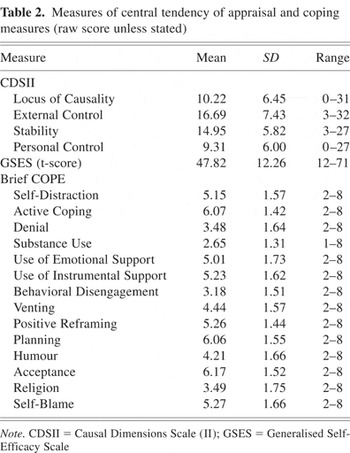
The measures of central tendency for all continuous variables included in this study are presented in Tables 1 and 2. The ability of injury severity to predict each outcome variable was investigated. Table 3 shows that injury severity only significantly predicted satisfaction with life, with 7.8% of the variance explained.
Measures of central tendency of outcome measures and cognitive predictor measures (scaled score unless stated)

Measures of central tendency of appraisal and coping measures (raw score unless stated)

Summary of multiple regression analyses testing the prediction of each outcome dimension by injury severity

Demographic Variable Regressions
The degree to which demographic variables predicted each of the outcome variables was assessed. Results presented in Table 4 are of the overall models. Demographic variables significantly predicted community integration and employment status, with 23.9% and 14.5% of the variance explained, respectively. Years in education, relationship status, and gender made significant contributions to the prediction of community integration, whereas there was no independent significant contributor to the prediction of employment status.
Summary of multiple regression analyses testing the prediction of each outcome dimension by demographic variables

Cognitive Domain Regressions
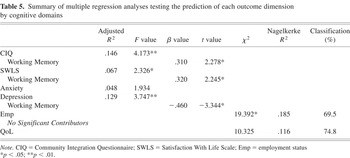
The possibility that cognitive domains directly predicted outcome variables was considered. Results presented in Table 5 are of the overall models. Community integration, satisfaction with life, depression, and employment status were significantly predicted by cognitive domains, with 14.6%, 6.7%, 12.9%, and 18.5% of the variability explained, respectively. Working memory was the sole significant contributor to the predictive models of the first three of these outcomes. However, no individual cognitive domain made a significant contribution to employment status.
Summary of multiple regression analyses testing the prediction of each outcome dimension by cognitive domains

Potential indirect relationships between cognitive domains and outcome variables, by means of the mediation of appraisal and coping variables, were investigated using the procedure described by Baron and Kenny (1986; see Methods section). Predictive associations between cognitive domains and mediating factors were investigated. Only three of the appraisal and coping mediators were significantly predicted by independent variables. None of the causal attribution scales were related to cognitive domains and only avoidance – coping [F(7,123) = 2.784; p < .05] and positive interpretation – coping [F(7,123) = 3.203; p < .01] were related to independent variables, accounting for 9% and 11% of the variance, respectively. The set of cognitive domains explained the largest amount of variance (18%) in self-efficacy [F(7,123) = 5.140; p < .01]; however, no single cognitive domain made a significant contribution to the model.
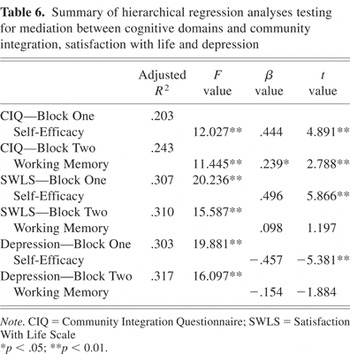
Mediators that were predicted by cognitive domains (avoidance – coping, positive interpretation – coping, self-efficacy) and those cognitive domains that were previously found to predict each outcome variable (see Table 5) were entered into a hierarchical regression. Results presented in Table 6 are of each model. The predictive models of the first block of regressions regarding community integration, satisfaction with life, and depression, were all significantly contributed to by self-efficacy, accounting for 20.3%, 30.7%, and 30.3% of the variance, respectively. When the working memory cognitive domain was added in the second block of each regression, it remained a significant predictor of community integration; however, it was no longer significant in predicting satisfaction with life and depression. Therefore, the association between working memory and these two outcomes were found to be mediated by self-efficacy.
Summary of hierarchical regression analyses testing for mediation between cognitive domains and community integration, satisfaction with life and depression

Tests of mediation could not be performed when anxiety and QoL were dependent variables because cognitive domains were not significantly associated with them (see Table 5). Cognitive domains did significantly predict employment status. However, a test of mediation could not be performed because no individual cognitive domain was found to contribute significantly to the prediction of the outcome.
DISCUSSION
The results of this study show that demographic and cognitive variables can only predict some outcome criteria at very late stages after head trauma, but provide more reliable predictions than injury severity, which was only associated with life satisfaction; those with less-severe injuries being more satisfied with their lives. This finding confirms earlier impressions that the importance of injury severity as an outcome predictor reduces as time from injury progresses (Brooks et al., 1986; Groswasser et al., 1999). Although it should be noted that the injury severity variable included in the analyses was only measured by PTA because of the limited amount of GCS data available for the sample. Demographic variables predicted satisfaction with life, community integration, and employment status, but not anxiety, depression, or QoL. We were surprised to find that being in a relationship was a significant predictor of poor community integration. This may be explained on the basis that being in a relationship before injury, potentially reduces an individual's level of independent community involvement, if a partner carried out social and domestic tasks that otherwise would need to be performed by the person with brain injury. The influence of gender on community integration has been reported by other users of the CIQ (Dijkers, 1997). This finding possibly reflects the subscale of home integration, which is biased toward a stereotypical role of the housewife or those not in paid employment.
Cognitive variables had a limited capacity to predict very late outcome. The only cognitive domain to make a significant contribution was working memory, which predicted community integration, satisfaction with life, and depression. Those who continue to experience problems of working memory appear to have a low perception of their ability to deal with situations effectively, which in turn might lead to low mood and dissatisfaction with life. This view is supported by the finding that self-efficacy acts as a mediator between impairment of working memory, depression, and satisfaction with life. However, a causal relationship between low mood and working memory cannot be inferred from the results. Therefore, consideration must also be given to the possibility that participants with low mood performed poorly on working memory tests (see Rapoport et al., 2005).
Our findings only partially support the existence of direct relationships between demographic and cognitive variables with psychosocial adjustment as depicted by the model of Kendall and Terry (1996). The particular variables contributing to predictive models, and the strength of prediction, varied between specific outcome variables. Differences appear to exist between the types of predictors that influence each outcome dimension. There was little evidence of cognitive impairment indirectly affecting long-term outcomes through the mediation of appraisal and coping variables. Therefore, it would appear that the ability of neurological variables, demographic variables, and cognitive functioning to predict very long-term outcome is limited. It also seems that the variables significantly influencing outcome vary according to the type of outcome dimensions selected. The design and methodological limitations of this study, along with the implications of the findings, are discussed in a tandem study (Rutterford & Wood, 2006, this issue) that used identical procedures and participants
ACKNOWLEDGMENTS
The authors thank Dr. Christina Liossi, for her advice regarding the statistical analyses included in this article.