Introduction
Not much analysis has yet been conducted on the global patterns and global interactions of family life. Anthropologists and sociologists have tended to analyse families as local, ethnically based organisations, whose rules and structures have been inherited from the ancestors and reproduced without much regard for the outside world. While the ethnic particularities of families are unmistakable, it would be strange if families were uniquely resistant to global influences in a world where economic, political and ideological trends are now thought to have circulated and interacted widely.
Migration opens an obvious avenue for thinking of family in transregional terms. One need only think of merchant families, stretched across the lengths of their trade routes, to recognise the significance of migration as a non-local factor influencing family life. Working from this insight, the present study considers migration and its influence on family structure. I argue that there exists a social nexus linking migration to family structure—that migration, though highly variable, is typical in family history. This interpretation focuses on modelling the dynamics of family structure, the dynamics of migration and the familial mixing resulting from their interaction. I present my interpretation of change and interaction in families by deploying and documenting several simplified models of family, migration and their interaction. If family structure can be shown through this analysis to have been influenced significantly by migration, the door is then opened to further studies of the influence of migration on the governance and ideology of family life.
The analysis centres on the Atlantic and Indian Ocean zones in the sixteenth and seventeenth centuries: an era recent enough for us to have substantial documentation on families and migration in those regions, and long enough ago that the phenomena of migration and social interaction were not as pervasive as they would later become.Footnote 1 In the sixteenth century, maritime contacts linked almost all regions of the world, and brought long-distance, sea-borne migration especially by Iberian voyagers, West African captives, and those who followed the sea lanes linking the South China Sea and the Indian Ocean. The seventeenth century brought a period of further migratory expansion, usually along the same paths: from Europe and Africa to the Americas, from Europe to Asia and among Asian regions distant from each other. Intermediate-distance migrations, mostly within continental zones and less fully documented, were likely of larger scale than oceanic migrations and surely interacted with them. As I will argue, the expanded terrestrial and maritime communication of the early-modern world led to the creation of new families and also brought the expansion, displacement, division and destruction of previously existing families. In not a few cases, the rules of family life underwent transformation.
These changes in family life, studied characteristically at familial and local levels, are susceptible to study at transregional and even global levels. I argue that migration created new families dominated by young people in areas of settlement; it transformed families and weakened some powers of family heads in regions of moderate in- or out-migration; and it made families smaller everywhere. Migration brought somewhat different changes to the Atlantic than to the Indian Ocean—the undermining of multigenerational families progressed more rapidly in the Atlantic, while the familial mixing of existing families was more prominent in the Indian Ocean.
The interplay of family and migration constituted a ‘frontier’ of families—a series of liminal zones where patterns of family life responded to the arrival and departure of migrants. This type of frontier could be thought of as a space, but was a space defined by changing family relationships. In these frontier spaces, people lived in close contact with—and shared family ties with—others whom they classified as different from themselves according to several criteria. These family-frontier zones were not just at the margin of conventional, ethnically homogeneous families, they were zones of additional complexity in family life.
For purposes of this overview, I offer definitions of family, migration and familial mixing that are intended to be appropriate to a world-historical level of analysis. Families, groups of related people, are defined everywhere by three overlapping criteria. Formal families are groups of people whose membership is defined through the legal limits of marriage, adoption and inheritance; this is usually the narrowest definition of family. Biological families, including all biological relationships, often extend well beyond the formally recognised membership—for instance, patrilineal families recognise descent only through the male line, and give no formal recognition to descent through the female line. Informal families can extend beyond formal limits to include fictive kin and co-resident persons.Footnote 2 Families thus defined, may be classified with qualitative variables (identifying family structures and the boundaries of familial and sub-familial groups) and with quantitative variables (identifying sex ratios, age ratios and total size of family groups). Of particular emphasis in the discussion below will be relative family size.
I define migration as the movement from one habitat to another, where a human habitat is taken to be a geographical zone in which ecology, language and culture exhibit commonality.Footnote 3 Thus, while there is a great deal of mobility from one household or one village to another, notably for purposes of marriage, this is labelled as local mobility within the habitat and not as migration, in that there are only minimal boundaries to cross.Footnote 4 I then divide migration into intermediate-distance migration and long-distance migration, where the difference between the two is as much a matter of familiarity as proximity. Long-distance migrants are seen, in the lands of their settlement, as culturally or physically different and also as unfamiliar. Intermediate-distance migrants are also seen as culturally or physically different, but they are familiar in that there is a history of interaction with them. For instance, along the Coromandel Coast, immigrants from the Deccan were different in language and culture, but had been known for centuries; immigrants from Europe were new and unfamiliar. The description of migration includes qualitative variables (social identity of migrants—e.g. slave, free and noble—and the character of their migration) and quantitative variables (on numbers of migrants, their age and sex distribution). In practice, for early-modern times, the difference between long-distance and intermediate-distance migration overlaps significantly with that between transoceanic and terrestrial migration. Long-distance migration of Europeans and those they transported (e.g. Africans) stands out because of the cultural distinctiveness of the migrants—in language, physical type, religion, social categorisation, dress—and the accessible documentation we have of their movement and their lives. Intermediate-distance migration from one part to another of Africa, India or South America was almost certainly of greater volume than transoceanic migration. Further, intermediate-distance migration might have involved crossing social boundaries that were just as significant as those of transoceanic migration, although these movements are not marked so clearly in the historical record.
I define familial mixing as the formation of families by people from different backgrounds—the nature of sexual reproduction makes it necessary that all families are mixed according to numerous criteria. Post-migratory mixing is the formation of families by people from differing habitats or by the descendants of such people. Post-migratory mixing takes place through formal marriage and through informal unions. In practice, the mixing and its results are described through such terms as the race, ethnicity, colour, religion or occupation of the parents and the offspring of such unions. The mixing resulting from long-distance migration results in the creation of new identities in subsequent generations that are more obviously distinctive than the mixing resulting from intermediate-distance migration, because of the greater initial social distances.
Having defined terms, we now move on to characterise the data. Early-modern data are arguably sufficient to sustain an analysis of family and migration that reaches some specificity. Descriptions of family size, while scattered through the travel literature, are numerous, though they are commonly vague about whether they refer to the formal, informal or biological definitions of family. Descriptions of family structure are also dispersed through the travel literature—this is the variable emphasised, for instance, in the common generalisations that European families are small, nuclear families, while families elsewhere have been large and extended. Parish registers are for the Christian world only, and not all of it.Footnote 5 Yet other data on families include various types of censuses, genealogies for elite families, court records of family groupings and traveller reports on family structures and practices. Descriptions of decision-making in marriage and inheritance give insights into the governance of families. All in all, data of one form or another should permit cross-regional comparison of family structures. For quantities and composition of migratory movements, estimates of European and African migration have been the subject of substantial research; research on Indian Ocean migration is less developed but significant.Footnote 6 Overall, while the interpretation to follow relies as much on hypothesis as on documented reconstruction, I argue that four key variables—family size, family structure as seen through sex ratio, migration volumes and familial mixing as seen through ethnic and racial labels—are relatively well documented in the historical record of the sixteenth and seventeenth centuries.
Dynamics of Family Structure, Migration and Family Mixing
To simplify the logic of family dynamics, one can begin by thinking of localised families, reproducing themselves over time within their own habitat. Steady familial reproduction creates multigenerational lineages, with widespread social ties and regulations for their behaviour. It is a situation of stable population in demographic terms and complexity in social terms. Various sorts of social systems develop among such multigenerational families: patrilineal descent systems tend to circulate women from family to family, while matrilineal systems tend to circulate both men and women; social systems for agricultural and pastoral peoples have developed further distinctions. Overall, however, populations with minimal migration elevate senior people, usually males, to family leadership, and these leaders set decisions on allocation of land or herds as well as residence and marriage of the younger generations. Such a system is often treated as the ideal type of family structure.
But families are always modified by migration, both in and out. Migration in human society is irregular, yet its irregularities conform to a few dependable dynamics.Footnote 7 Historically contingent mixtures of misfortune and opportunity lead to streams of migration, and these streams of migration rarely last for more than a generation without declining, though in some cases, migration rebounds after a time. Small streams of migration generally precede large ones, in effect establishing the most propitious paths for movement. Networks of migrants and non-migrants serve to facilitate the passage and settlement of migrants. Both in-migrants and out-migrants are generally young, often unattached, less constrained and less supported by family networks than those who stay at home.
Linking the dynamics of family and migration leads to further distinctions. In zones of settlement, migration usually brings mixing of immigrants with each other and with local families. An extreme case is that of migration to under-populated zones, where young people arrive with no parents and no rules, so that anything can happen in the families they form. Few regions experience long-term stability in the level of migration, and for that reason, few regions experience long-term stability in their family structure. Rules for classification of families, which have generally been treated as stable descriptions and regulations, may better be seen as current statements of ideals that are periodically adjusted in response to migration and other factors. There are various other possibilities, including the end of immigration: when immigration declines for two or three generations, age and sex distributions become more like those of a stable population.Footnote 8
To phrase the interaction in terms of population pyramids, the pyramid for a non-migrating population tends to have equal numbers of male and female populations of each age group, with smaller populations for cohorts of increasing age. Migration changes the size and shape of the pyramid.Footnote 9 In-migration usually brings additional young adults, especially males; out-migration reduces numbers of young adults, especially males. The rise and fall of adult female populations brings equivalent changes in the number of young children.
When migrants form relationships (marital or non-marital) with persons in their zone of settlement, demographic imbalance is likely to characterise the resulting families. For a male merchant marrying into an elite local family, the new family is very small on the husband's side and can be very large on the wife's side. For an immigrant female who becomes a concubine, her family is small on her side and can be very large on her master's side. For immigrant men and women forming relationships on island colonies, the families are small on both sides; imbalance would come where one was free and the other was enslaved.
In addition to demographic imbalance, familial mixing takes place as a result of migration. Mixing is a deceptive term, appearing simple when it is not. Biological mixing is inherent in the sexual reproduction of our species. Familial mixing is the labelling of family ties, such as the mixes of lineages required by rules of exogamy; it also includes mixes by ethnicity, physical type, religion, social stratum (caste, class, free or slave). In the first generation of familial mixes, the migrant family members tend to be treated as exceptions whose fate is governed within established rules. In the second generation of migration, the beginnings of new rules emerge with the labelling of categories of social mixes. In the third generation, a more complex set of mixes emerges, along with a revised set of rules setting identities in a hierarchy. That is, in the frontier zones of family life, the offsprings of ‘mixed’ relationships come to be labelled through complex terminologies identifying generation, status, ancestry, birthplace and colour. Some of the mixed relationships are formalised by marriage, especially when property is held on both sides of the family. Others—as with the coupling of master and slave or across religious lines—tend to be left as informal liaisons, so that the boundaries of the biological family and the formal social family can be quite different.
Regional Variants
In this section, five types of regions are described empirically and analytically with regard to the character of their migration experience and the resulting changes in their family size and structure, including the character of their social mix. Exemplary regions of the Indian Ocean and the Atlantic Ocean—all coastal or within a week's walk from the coast—are paired, to demonstrate that each phenomenon showed up in both regions, though to different degrees.
Zones of Moderate In-migration: South India and Brazil
The Coromandel Coast of India, especially Tamil Nadu, received settlers from the Deccan to its north, notably in the fifteenth and sixteenth centuries. These intermediate-distance migrants found sparsely populated lands in the upper valleys of the region.Footnote 10 While sources do not give a breakdown, the usual pattern of migration suggests that the immigrants were mostly male, and that these men married local women as well as women who accompanied them. The result was not so much a strict colonisation, but formation of new societies relying significantly on pre-existing local traditions that were conveyed by local women. Somewhat later, the Malabar Coast towns of Goa and Calicut, as major commercial centres, attracted long-distance migrants, especially merchants, from all over the Indian Ocean and beyond.Footnote 11 By the seventeenth century, Portuguese, Dutch, and English merchants and officials had settled in these and nearby towns. Some immigrant men of high status were able to marry into well-established local families. As a result the coastal Indian regions, now with sizeable minorities of in-migrants, developed new structures for linking multigenerational, local families to unaffiliated individuals from abroad. It was to the advantage of immigrant men to reside with their in-laws, to qualify for inheritance of family lands and goods; such families were large on wife's side and small on husband's side. Immigrant women, unless brought as spouses by immigrant men, came as women without power and entered into established families as subordinates, whether willingly or not, and had children in non-marital relationships.Footnote 12 These families were small on wife's side and larger on husband's side. In response to the expansion of these varying sorts of social mixes, local terms developed for the status, colour and occupation for these couples and their children.
On the northeast and southeast coasts of Brazil in the middle and late sixteenth century, Portuguese (and French) migrants similarly settled. The immigrant populations, dominantly male, initially married into local families (mostly of Tupi ethnicity), linking local to immigrant economic power.Footnote 13 By the seventeenth century, the Portuguese were able to establish political if not demographic dominance, gradually bringing enslaved Africans with them. Portuguese men became heads of family, displacing the men of the local families into which they had married. Thus, the new families of Brazil appeared at first to be like those formed on the Malabar Coast, with the local ethnicity dominating, but with time, the Brazilian families became more like those of the interior of Tamil Nadu, with the immigrant ethnicity dominating.
Zones with Little Migration: Mozambique and Bight of Biafra
Regions with little migration are easy to imagine, but difficult to document. Mozambique in the sixteenth and seventeenth century was a region of little migration. Localised families, with matrilineal organisation, were able to maintain a multigenerational structure, and senior men were able to control the marriage and land use of their sisters’ sons and those under their command. Some long-distance and intermediate-distance migration is known to have taken place. For the latter, the rise of the kingdom of Mwenemutapa and the later rise of the Malawi kingdom each led to out-migration from the new states and into the Zambezi Valley. Small numbers of Portuguese settlers came to the region as well.Footnote 14 In each of these cases, the immigrants were mainly male, and they formed families with local women. Aside from these movements, however, populations of the Zambezi Valley and the Mozambique coast were left with little migration.
The Bight of Biafra, including the eastern coast of modern Nigeria and the coast of Cameroon, was a region known to European voyagers, but rarely visited. The volcanic Mt. Cameroon, over four thousand meters at its peak, provided a well known and sometimes snowcapped landmark. Yet in the sixteenth and seventeenth centuries, there was little migration on this area of the continent, and even less overseas migration.Footnote 15 As a result, families remained multigenerational and linked to a given territory, and tended to be large on both male and female sides. In them, senior generations were able to control land, other resources and access of their offspring to marriage. Young people married with parental approval and married others from the same locality. They accepted and carried on the rules of their patrilineage and household. Mixing in this case consisted of normal biological mixing and perhaps, also the local familial mixing of noble and commoner lineages or the occasional absorption of small families. Later on, as the slave trade peaked in the eighteenth century, the degree of migration became so high that the neighbouring Ijo peoples of the Niger Delta developed artificial lineages known as ‘canoe houses’, in which slave and free became combined into fictive kinship networks.Footnote 16
Zones of Moderate Out-migration: Ethiopia and Bight of Benin
As early as the twelfth century, periodic warfare in the Horn of Africa, notably between Christians and Muslims, led to enslavement of captives and their dispatch to Arabia, Persia and India. This phenomenon expanded sharply in the sixteenth century with the rise of the sultanate of Ahmed Ibrahim al-Ghazi, who nearly destroyed the Ethiopian kingdom. A substantial stream of mostly male captives became long-distance migrants to the Deccan where, known as Habshis, they became the core of a slave army.Footnote 17 The result for Ethiopian regions was a relative shortage of young men. Young women in Ethiopia, whether of free or slave status, were as a result more likely to be drawn into polygynous relationships.
Later in the seventeenth century, warfare and slave trade erupted along the Bight of Benin (West Africa's Atlantic coast to the west of the Niger River). This became the largest slave-exporting region of Africa from the 1670s through the 1720s.Footnote 18 Since most out-migrants were male, the regional population became predominantly female in the young-adult years. The sexual imbalance enabled those men who remained to take additional wives or concubines. Enslaved women were thus required to enter into non-marital, residential, polygynous relationships: these families were small on the female side and large on the male side. Formal marriage remained under the control of established families. Large families were able to build their size by incorporating additional females, but the average regional family size declined because of the families that were broken up by enslavement. The familial mixes brought by slave exports included the circulation of enslaved women among ethnic groups and the rise of reproductive relations between free or noble men and slave women. One result was that the traditional pattern of marriage tended to be undermined by the increasing proportion of enslaved women.
An important contrast of these two cases was that the export of slaves from Ethiopia reached a peak in the mid-sixteenth century and then declined, while the export of slaves from the Bight of Benin continued at a substantial level until the mid-nineteenth century.
Zones of High In-migration: Mauritius and Barbados
The Mascarene Islands, unpopulated when the Dutch began relying on them as refreshment stops, provide an extreme case. Dutch officials and African slaves settled beginning in 1638: the numbers of migrants were small in absolute terms, but the proportion of in-migrants in the population remained very high. Young adult populations, very short on females, formed families, but the import of new captives kept the population pyramid biased heavily towards adult males for several decades.Footnote 19
When English adventurers seized Barbados in 1627, the Amerindian population had already declined to a low level. In an initial wave of migrants, free and imprisoned English and Irish settlers came to the island. In a second wave of migrants, African slaves arrived from the 1650s.Footnote 20 Both waves created a range of family structures in which young people created their own families. Free people were able to choose their residence, while those in slavery were assigned their residence. Formally married couples had small families, but most relationships were non-marital. Because of the surplus of males, many males were unable to form families. Privileged males, in contrast, could form polygynous relationships: most of the privileged males were slave owners who had formal relationships with white women and informal relationships with women of African descent; in addition, a few black men formed polygynous relationships. Socially defined families included a large proportion female heads of household.
New terms and categories of social differentiation (by birthplace, colour, status, etc.) developed especially in areas of high in-migration, where differences from the home societies were greatest. Families were small on the female side and on the male side. Males were in surplus; many were unable to marry, form households or have children; others chose to seek far for partners. Multigenerational families could rise to significance only after two generations (over half a century) from initial settlement, and then only if the rate of immigration declined; only then could multigenerational families become strong enough to control the marriage of young people.
Zones of Moderate Out-migration and In-migration: Gujarat and Netherlands
Gujarat in the sixteenth century was one of the busiest shipping zones of the Indian Ocean. Muslim merchants from Cambay and nearby ports dispatched large dhows especially to Aden and to Malacca. Many of the sailors also acted as traders in the distant ports, and many settled in distant entrepôts. The sultans of Gujarat invited merchants from other ports to settle and set up business, thus offsetting some of the outflow of men. In the 1530s, the Portuguese navy established hegemony over the region, and Portuguese settlers joined the others. As a result, Gujarat remained a region of net out-migration, especially of males, but this out-migration was partially offset by long-distance in-migration of high-status merchants by sea and presumably intermediate-distance in-migration of low-status workers from inland areas.Footnote 21
The Netherlands, long a region with active migration, became even more involved in migration during the seventeenth century.Footnote 22 Men left the Netherlands as soldiers, sailors, merchants and settlers; women left in smaller numbers to settle in colonies of the Atlantic and the Indian Ocean. Since most out-migrants were male, the regional population became predominantly female in the young adult years. Males in-migrated, especially from neighbouring German states—some in response to opportunities left by departing males and others to join Dutch males as out-migrants. The surplus females either did not form families, or married immigrant men, thus departing from the system of families dominated by their fathers. (Few in this society took the option of non-marital relationships.) Most marriages remained under the control of established families and inheritance followed the male line. The familial mixes of Dutch society centred on mixes of ethnic groups, but also across status lines. Families of the immigrant males were small compared with the families of their locally born wives, though such couples were most likely on their own.
Global Patterns of Family and Migration
Comparing the two great regions in the seventeenth century, one observes readily that the Atlantic underwent greater impact of colonisation and settlement than the Indian Ocean. The demographic collapse of the Americas in sixteenth century gave more demographic and social influence to surviving migrants. Zones of moderate in-migration, such as South India and Brazil, stand out in early modern history as centres of prosperous exchange; productive regions in which both local populations and immigrants could take part in the productivity. Zones of little migration, such as Mozambique and the Bight of Biafra, appear to have been independent and self-sufficient societies, though they were not isolated. Certain zones of moderate out-migration, such as Ethiopia and the Bight of Benin, were undergoing hardship and accompanying conflict. Zones of high in-migration were limited to islands and to mainland areas (almost all in the Americas) that had been vacated by declining or displaced populations. Zones of moderate out-migration accompanied by in-migration, such as Gujarat and the Netherlands, tended to be prosperous regions that were benefiting from trade with other regions. Similarly, Portugal and Spain were regions of moderate out-migration in the same era, in response to promises (real or illusory) of advance for the migrants.
In the overall regional pattern of migration, the total number of migrants in the Indian Ocean zone during the seventeenth and eighteenth centuries very likely exceeded the equivalent number for the Atlantic, both for long-distance and intermediate-distance migrants. A net flow of migrants left the Atlantic and entered the Indian Ocean basin. Further, migration from Europe into the Indian Ocean equalled or exceeded European migration to Atlantic destinations. In particular, more Portuguese migrants went to Asia than to the combination of the Americas and Africa, but they were a smaller portion of regional population in the Indian Ocean than in the Atlantic.Footnote 23 Long-distance Indian Ocean migration (yet to be quantified) may have equalled European in-migration. Intermediate-distance migration may have been greater in the Indian Ocean than long-distance migration. For the Americas, long-distance migration from Europe and Africa was proportionately large, but so was intermediate-distance migration of Amerindian populations, and the shifts in local European and African populations accompanying out-migration.
In the overall temporal pattern of migration, the experience of the two ocean basins diverged in a different fashion. For the Atlantic, the sixteenth and seventeenth centuries established unprecedented migratory movements.Footnote 24 For the Indian Ocean, migrations of the sixteenth and seventeenth centuries modified earlier patterns, but there were precedents for virtually every sort of early-modern migration. One can easily extend these observations to a longer time frame. Before the sixteenth century, Atlantic migrations were tiny in comparison to those of the Indian Ocean. For most of the sixteenth and seventeenth centuries, migrations in Atlantic and Indian Ocean basins were of comparable size. By the end of the seventeenth century, however, long-distance migration from Africa to the Americas exceeded all other long-distance movements. In the eighteenth century, Atlantic migrations expanded and exceeded Indian Ocean migrations; then in the nineteenth and twentieth centuries, migrations in both basins grew greatly, and those of the Indian Ocean virtually caught up to those of the Atlantic. Family structures in all the regions of each basin changed in response to the changing patterns of migration.
Based on this comparison of two great world regions, one may venture some worldwide assertions about the impact of migration on family. First, the global patterns of out-migration and in-migration created a mosaic of regions, each characterised by resultant patterns of family life. These patterns did not then become inherent for each locality, but continued to change along with changing patterns of migration. Second, families became smaller. That is, to the degree that migration in general increased during the sixteenth and seventeenth centuries, one consequence of expanded migration was that it made families smaller in regions of both out-migration and in-migration, to the degree that migrants left their original families.Footnote 25 Third, migration decentralised families. It reduced the ability of senior family members to control creation of new family units and increased the ability of young people to decide on starting their own families—especially in regions of heavy in-migration, and elsewhere to a lesser degree. (By the same token, migration reduced the ability of young people to call on relatives for support.) Development of these new systems arguably laid groundwork for the marital and non-marital forms of families in more recent times, in which young people have increasingly migrated away from parental homes and have started families by their own choice.
Fourth, increased migration expanded the mix of families, especially in regions of in-migration. Practices of marriage and affiliation changed, either when prestigious immigrants married into leading local families or when immigrant men took slave women as concubines in plantation colonies. Migration probably increased the proportion of non-marital relationships.Footnote 26 Even in regions of out-migration, the patterns of affiliation changed, as the shortage of young-adult men led to new arrangements for unmarried women. High levels of migration brought increased attention to birthplace. In American colonies of high settlement, for instance, people came to be categorised by birthplace and generation. The distinction of criollo (American-born) and peninsulare (Spanish-born) among whites in Spanish America is well known; blacks, in turn, were known in some parts of Spanish America as criollo (American-born) or bozal (African-born). Categorisation by race or colour overlaid the categorisation by birthplace and generation. To use the categorisation of eighteenth-century French Louisiana, three ancestral communities were identified as ‘blanc’ (white), ‘noir’ (black), and ‘sauvage’ (Amerindian). Initial mixes among these were known as ‘mulatto’ (white and black), ‘métis’ (white and Amerindian) and ‘grif’ (black and Amerindian). With the passage of time, more complex mixtures were observed and a more complex terminology developed. Legal status distinguished those who were free and slave, those who were indentured or ex-slaves and occupational labels.Footnote 27 In addition, colonial regions commonly had different legal or court systems for people distinguished by nationality, religion or birthplace.
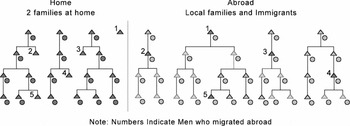
Fifth, migration occasionally led beyond influencing the character of families to transform ethnic identities through intermarriage. Figure 1 provides an heuristic example of the changes in identity that can be brought by a campaign of migration. The home population (shown in black) reproduces itself over time, with occasional migration of males—those numbered both at home and abroad where they settle. As prestigious emigrants, these men form families with local women (shown in white). In a patriarchal system, they pass their immigrant identity on to their children, especially the males (shown in gray). Regardless of whether the women are of local or ‘mixed’ ancestry, the combination of ‘mixed’ second- and third-generation male immigrants with the continuing stream of new male immigrants means that, as of the fourth generation, this population has gained, overwhelmingly, an immigrant identity—even though in biological terms, the great majority of its ancestry is local rather than immigrant. Such a story might well apply to parts of Brazil.
Migrating men change the ethnicity of a zone of settlement. (See accompanying text for description of the figure.)

Sixth, migration and familial mixing brought new criteria for hierarchy and new devices for social order. In societies with little migration, generational seniority in large families—supplemented by status ranking—provided the support for hierarchy and mobilisation. People knew their place in society through their lineage. In contrast, for societies with more migration and more variegated family ties, families among people recently displaced became too weak and fragmented to provide for much social order. In these complex and mixed migratory societies, other distinctions came to function as the markers of hierarchy and mobilisation: ethnicity, birthplace, legal status and racial or colour categorisation. In sum, the full range of identifiers for a child included his or her biological parentage (when acknowledged), birthplace (and that of parents), racial or colour designation (and that of parents), status (noble, free, slave or alien, along with the status of parents) and relationship (including residence) of parents. All of these social distinctions arose in large measure from migration and became current wherever migration was significant. The model suggests that certain social patterns recurred widely: for instance, a male spouse on the small side of a family was likely to be of high status, while a female spouse on the small side of a family was likely to be of low status. The latter instance is of particular interest: the expansion of migration and the resulting familial mixes in the seventeenth century suggests that a growth in extra-marital relationships may have brought new sorts of oppression and inequality to family life.
To recapitulate, this exploratory study makes the case for a world-historical approach to family, to supplement the advances in family history at more localised levels.Footnote 28 It argues that early modern family structures were not simply an accumulation of ethnic traditions, but were restructured through of the demographic, economic and social conditions of what A. J. R. Russell-Wood has called a ‘world on the move’.Footnote 29 These changes were proportionately greater in the Atlantic than in the Indian Ocean, but the varying types of changes were to be found in every region. The mosaic of family structures brought by migration brought with it a web of familial frontiers, marking the differences in the rules and the reality of family across each social boundary. Approaching family history with this framework has yielded hypotheses on changes in family size and structure in response to migration. Further exploration of these cases might suggest feedback effects, in which changing family structures may in turn have expanded or limited the rates of migration. In addition to identifying these interactions among regions, this approach also permits summing up the regional results, yielding global hypotheses that families worldwide became smaller in response to expanded migration and that the heads of large families became relatively less dominant. Further, while this study has focused on simple measures of family size and structure, the context of the discussion provides reminders that families are institutions not only for social reproduction, but also for the exercise of power, for the family as a whole or individuals within it.Footnote 30