INTRODUCTION
In the course of research carried out under the Moving Megaliths in the Neolithic (MegaGeo) project,Footnote 1 Portuguese archaeologist Rui Boaventura (1971–2016) consulted the photographic archive at the Museu Nacional de Arqueologia (National Archaeological Museum), in Lisbon. Documentation concerning the antas (dolmens) excavated in the 1930s by the second director of the museum, Manuel Heleno (1894–1970), had been put forward for digitisation. In the course of his work, Boaventura unearthed a number of photographs from the 1930s that showed several megalithic monuments; standing near to these megaliths was a mysterious lady dressed in a hat and long dark coat of the period. The monuments had been identified clearly, but not so the lady. On the back of some photographs was scribbled ‘Miss Guest’ with no first name, but other notes simply referred to an ‘English lady’. Who was this mysterious figure and what, if any, was the significance of her presence?
At the time it was not possible to discern the relation, if any, between ‘Miss Guest’ and the monuments with which she had been photographed. However, as a result of recent research,Footnote 2 it is now possible to identify with confidence the figure in the photographs as the English archaeologist Edith Guest, who was linked to two pioneering female archaeologists of the 1920s and 1930s: Margaret Murray and Gertrude Caton-Thompson.
EDITH GUEST
Edith Mary Guest was born in 1873 in Manchester, England, the daughter of Thomas and Mary Guest. Thomas Guest was a clergyman in the Church of England and, at the time of Edith’s birth, the vicar of St Mary’s church, Hulme, near Manchester. Her biographical details are sparse, and little is known about her personal life and her professional career. What we do know of her comes to us mainly from the work she published and, above all, from her connection to Margaret Murray and Gertrude Caton-Thompson, those great early pioneering archaeologists.
Aged seven, Edith Guest was living with her family in Stretford, Lancashire.Footnote 3 She appears again in the 1901 census: this time aged twenty-seven, single and living in Oxford, where she was working as a librarian.Footnote 4 Ten years later, according to the 1911 census, she is still single but now living in Llandudno, North Wales, where her occupation is given as ‘medical practitioner’.Footnote 5 In 1908 she had been awarded a Bachelor of Medicine and Bachelor of Surgery (MB BS) from the London School of Medicine for Women (LSMW). That same year she was elected a member of the British Medical Association (Metropolitan Counties Branch) and was also a member of the northern branch of the Association of Registered Medical Women.Footnote 6
This was no mean feat, even though Guest had undoubtedly benefited from the struggle of an earlier generation of women pioneers to achieve a medical education. In Britain, the 1880 Education Act had made school education compulsory for all children aged between the ages of five and ten, but higher education was still largely inaccessible. For women of all classes who wanted to study medicine, the barriers were not simply financial; there was a widespread belief among many institutions that medicine was unsuitable as a subject for women to study, so women were refused admittance. Only in 1869, after a lengthy campaign, was a group of women known as the ‘Edinburgh Seven’ and led by Sophia Jex-Blake (1840–1912), admitted to Edinburgh’s Medical School to study medicine. Even then, it was not until 1894 that Edinburgh would permit female students to qualify as doctors. Despite this hostile atmosphere, in 1874 Jex-Blake helped to found the LSMW in Handel Street, Bloomsbury. Two years later, the Medical Act 1876 allowed medical authorities to license all qualified applicants regardless of gender.
By the time Guest was training at the LSMW, the institution was thriving and had moved to purpose-built premises around the corner on Hunter Street. It was from this building that she graduated in 1908. In 1914 she was awarded a doctorate from the University of London. In August that year World War I began.
Initially, when war broke out officials did not see a role for female doctors, and there was a reluctance to consider women for duty in theatres of war.Footnote 7 Attitudes were slow to change, even after the Scottish Women’s Hospitals had distinguished themselves in France and Serbia.Footnote 8 Even so, the demand for medical doctors overseas was high, so in April 1916 the War Office began to recruit women. Such recruits were not sent to areas where there was actual fighting, but to Malta, where they could look after troops needing hospitalisation.Footnote 9 In August that year Guest was contracted to work for twelve months as a civilian surgeon attached to the Royal Army Medical Corps (RAMC). On 1 September 1916, she embarked for Malta as part of the Women’s Medical Unit RAMC and there she served as a doctor. On 17 December 1917 she embarked for Egypt, where she was on duty until 4 August 1918. She was recognised for her services during World War I and is listed in the Service Medal and Award Rolls Index.Footnote 10
In 1922 Guest returned to Malta as part of the British team that excavated the Borg en Nadur temple with Margaret Murray and Gertrude Caton-Thompson. Margaret Murray was Gertrude Caton-Thompson’s professor at University College London (UCL). Both women were suffragists, sharing the same ideals about the recognition of women’s rights. Margaret Murray, who coordinated the team, wrote in her autobiography that:
I spent five summers in Malta, four in excavating, and the last in the Museum compiling a corpus of Bronze-age pottery. My helpers on the excavations were Dr. Edith Guest (twice) and Francis Turville-Petrie. Miss Gertrude Caton-Thompson was one of our party but she came only to make a careful excavation of Ghar Dalem (Cave of Darkness) where two taurodont teeth had been discovered, and there were great hopes of finding the remains of early man.Footnote 11
Working conditions at the time were awful, as Murray pointed out in her memoirs:
The first year our party, Dr. Guest, Francis Turville-Petrie and I stayed at the Sailor’s Hotel at Birzebugia, and Professor Zammit had arranged that we should have a mule-cart at our disposal to take us to and from the dig. A Maltese mule-cart is perhaps the most uncomfortable vehicle ever invented …Footnote 12
Caton-Thompson gives this account of the difficulties experienced while sharing her precarious accommodation with Edith Guest:
I joined Margaret Murray and her assistant, Dr. Edith Guest, in a rented house in the small village of Birzebuggia. Only two bedrooms were available (the third we needed for store), so Dr. Guest and I made the best of each other. The room was also occupied by fleas and mosquitoes. What struck us as interesting was that all fleas came to me and mosquitoes to her …Footnote 13
Almost a decade later, in 1931, Guest appeared again in association with Margaret Murray – this time as part of the Cambridge team that carried out archaeological excavations on megaliths in Minorca, in the Balearic Isles. According to Margaret Drower FSA (1911–2012):
In the summer of 1931, at the suggestion of her friend Louis Clarke, director of the Cambridge Museum of Archaeology and Ethnology, Murray investigated megalithic remains on Minorca at the museum’s expense. The project was initially inspired by Edith Guest, who had visited the island on holiday one summer and had been struck by the remarkable megalithic remains and the little that appeared to be known about them …Footnote 14
However, the role of Guest in the exploration of the megalithic monuments of Minorca has an even greater relevance, according to the testimony of Murray herself, who wrote in her autobiography:
I had already visited the Balearic Islands with three women-doctors, Dr. Edith Guest, Dr. Green and Dr. Gurney. Dr. Green could speak Spanish fluently but Dr. Guest was the moving spirit in the whole affair. She got in touch with Señor Flaquer y Fabrigues, a lawyer in Mahón and the chief archaeologist in the island, who could both speak and write English. Then there was Señor Marti-Bella, a chemist at Alayor, and also a keen archaeologist, who, like Señor Flaquer, knew all the megaliths remains. So we were well guarded … So, when Dr. Louis Clarke asked me if I would go to Minorca and do an excavation for his museum, I accepted with alacrity. Our party consisted of Dr. Guest, Miss Hilda Champion, Mr. T. Balakrishnan Nayar, and Mr. John Vernon.Footnote 15
The expedition from Cambridge to Minorca resulted in the publication of three volumes, with one chapter written by Guest. Her interest in Megalithism in the Balearic Isles – and on Minorca, in particular – informed her decision to travel to Portugal in 1934: she was travelling to Alentejo to study Megalithism.
THE STUDY OF MEGALITHISM IN PORTUGAL
In 1929 Manuel Heleno was appointed as the second director of the Portuguese Ethnological Museum, now the National Museum of Archaeology, in Lisbon. Unlike the museum’s founder and first director, José Leite de Vasconcelos (1858–1941), Heleno gave priority to archaeological research to the detriment of other areas, such as ethnography. He intensified research and archaeological excavations in the context of Megalithism, especially in the Alentejo region of Portugal. He was not alone in this task and he benefited from contacts with foreign archaeologists, such as German prehistorians Hugo Obermaier and Georg and Vera Leisner; the Leisners, especially, would go on to play a fundamental role in the study of Portuguese Megalithism.
In Portugal, the scientific research on megalithic graves began in 1865 with the synthesis of the Portuguese dolmens, published three years later by Pereira da Costa (1851–1923).Footnote 16 Carlos Ribeiro (1813–82) excavated several dolmens around Lisbon and, in 1880, published his results.Footnote 17 In the late nineteenth century, Estácio da Veiga, another pioneer of Portuguese archaeology, maintained the view that the megalithic monuments of the necropolis of Alcalar (tholoi) predated the monuments of pre-Classical Greece, which had long been regarded as prototypes of the peninsular megalithic passage-graves.Footnote 18
Pere Bosch-Gimpera (1891–1974) FSA (hon) considered the megalithic phenomenon in the framework of the Iberian Peninsula, characteristic of its Western façade, covering the whole of Portugal, designating it ‘Portuguese and Central Culture’.Footnote 19 This conclusion resulted from contributions previously developed by several Portuguese archaeologists, especially José Leite de Vasconcelos, the founder and first director of the National Museum of Archaeology (in Lisbon), who excavated a number of dolmens in the Alentejo region and other parts of the country, along with Martins Sarmento, in Minho and António dos Santos Rocha in Beira Alta and in the coastal region of Figueira da Foz.
In the case of Leite de Vasconcelos, his first contact with the megalithic monuments of Montemor-o-Novo took place in 1897.Footnote 20 Three years later, at Easter, he travelled to Montemor-o-Novo and, with the collaboration of Stuart Carvalhaes, he excavated the Anta Grande da Comenda da Igreja (Comenda da Igreja dolmen), a remarkable monument both for its architecture and for the artefacts recovered within. For reasons that are not clear, only a few lines about this excavation were published in the Bulletin Anais da Academia das Ciências de Lisboa (Lisbon Academy of Sciences) in 1903. A second campaign followed in November of the same year, this time with the collaboration of Júlio César Garcia, an official of the National Museum of Archaeology.
In the years that followed, the museum’s excavations continued in Montemor-o-Novo, but without the participation of its director. There are reports of excavations in October 1902 and in April and November 1903.Footnote 21
In 1929, after the retirement of José Leite de Vasconcelos, Manuel Heleno was appointed director of the museum, and soon established the study of Megalithism in central Alentejo as a priority. Heleno had in mind the remarkable results obtained on the study of the dolmens in the same region by Vergílio Correia (1888–1944).Footnote 22 This explains Heleno’s intention to excavate those Montemor-o-Novo dolmens that had not been studied by José Leite de Vasconcelos in Comenda and Repôla. In this way, Heleno extended his investigations to the Ciborro area (fig 1), where he identified a remarkable number of new monuments. It was these new monuments that had just been discovered when Edith Guest arrived in Portugal.
Map of Portugal showing the location of the Ciborro region where Manuel Heleno excavated several dolmens in the 1930s. Edith Guest visited this region in 1934 at the invitation of Heleno. Drawing: the authors.

The material exhumed during the excavations of Manuel Heleno in the Alentejo dolmens is immense and constitutes one of the largest archaeological collections of the National Archaeological Museum. Unfortunately, the contents of the collection lay ‘dormant’ for decades because the system of codification used by Heleno did not make identification of the artefacts easy. However, the acquisition of Heleno’s notebooks by the National Archaeological Museum at the end of the twentieth century has allowed research to be carried out for the first time, essentially allowing artefacts to be compared with the excavation register.
In addition to the remarkable collection of recovered materials, Heleno left a precious photographic archive of his archaeological activity among the Alentejo dolmens. It is this photographic archive that has revealed the presence of Edith Guest in Portugal.
THE ‘MYSTERIOUS ENGLISHWOMAN’ OF THE CURRAL DA MOSCA DOLMEN
The first explicit references to the presence of Edith Guest in Portugal, so far as is known, occur in a photograph in which she appears standing next to the Curral da Mosca dolmen (figs 2 and 3) and also in two other photographs taken near the dolmen of Azinhal. In these, one sees the figure of a woman photographed from behind or at three-quarters, taking notes as she stands in front of the dolmens.
Edith Guest in front of the Curral da Mosca dolmen. AFMNA box 2, no. 155. Photograph: courtesy of the MNA.

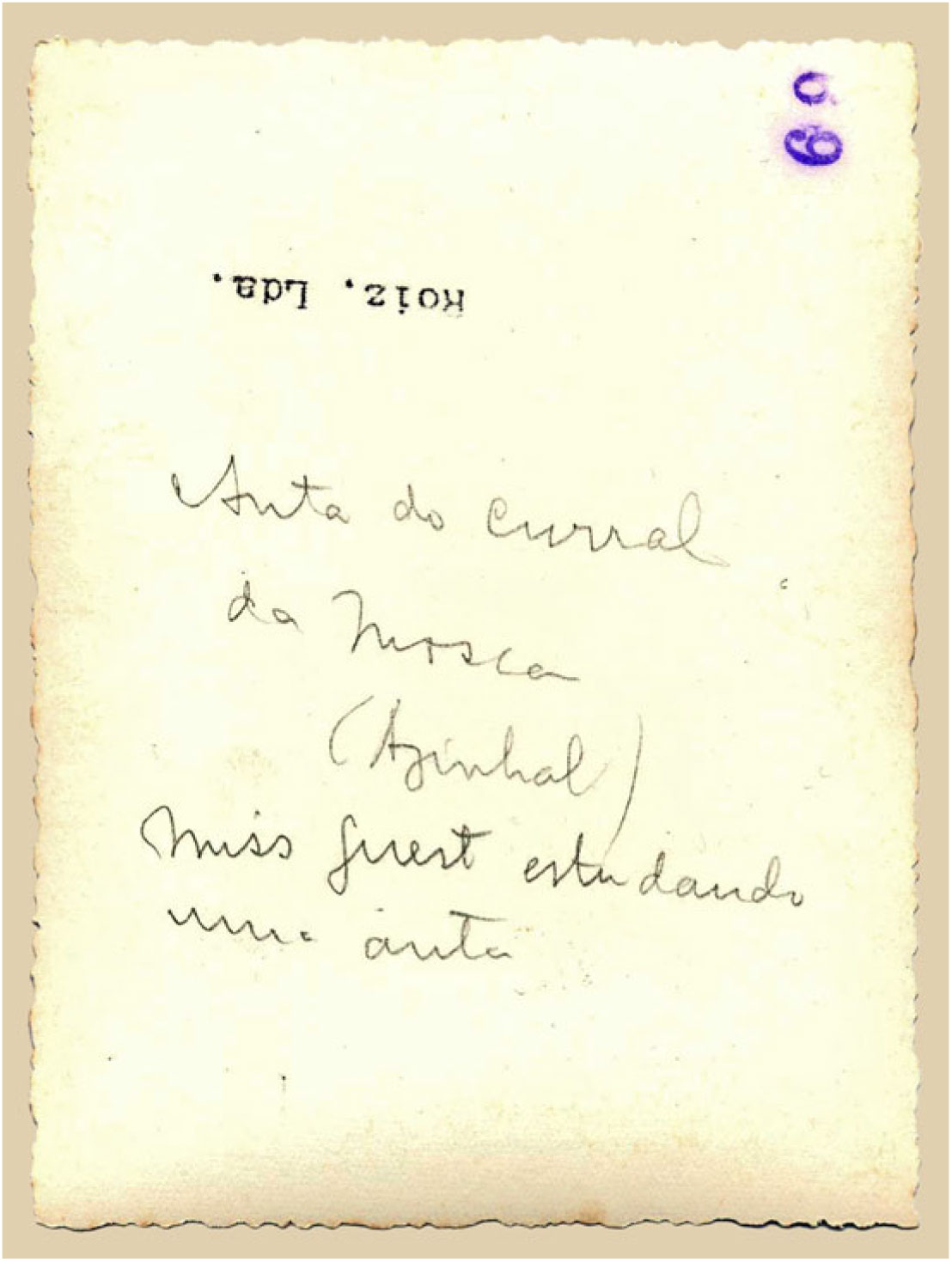
Verso of fig 2, with Manuel Heleno’s caption, ‘Anta do Curral da Mosca, Azinhal. Miss Guest estudando uma anta’ (‘Curral da Mosca dolmen, Azinhal. Miss Guest studying a dolmen’). AFMNA, box 2, no. 155. Photograph: courtesy of the MNA.

In another two photographs of the Azinhal dolmen we see the same figure, but this time her name has not been identified by Heleno, although, comparing her image with those in fig 2, there is no doubt that, once again, it is Edith Guest (fig 4).
Edith Guest in front of the dolmen of the Valley of the Azinhal 3. AFMNA box 2, no. 146. Photograph: courtesy of the MNA.

There are four other photos in the Photographic Archive of the National Archaeological Museum, which refer (although not explicitly) to the presence of Edith Guest at the dolmen of Vale das Covas.
Manuel Heleno recorded in the photographs the participation of the Englishwoman (Ingleza) – or ‘Miss Guest’, as she was always referred to – in the exploration of the dolmen of Vale das Covas, Azinhal.
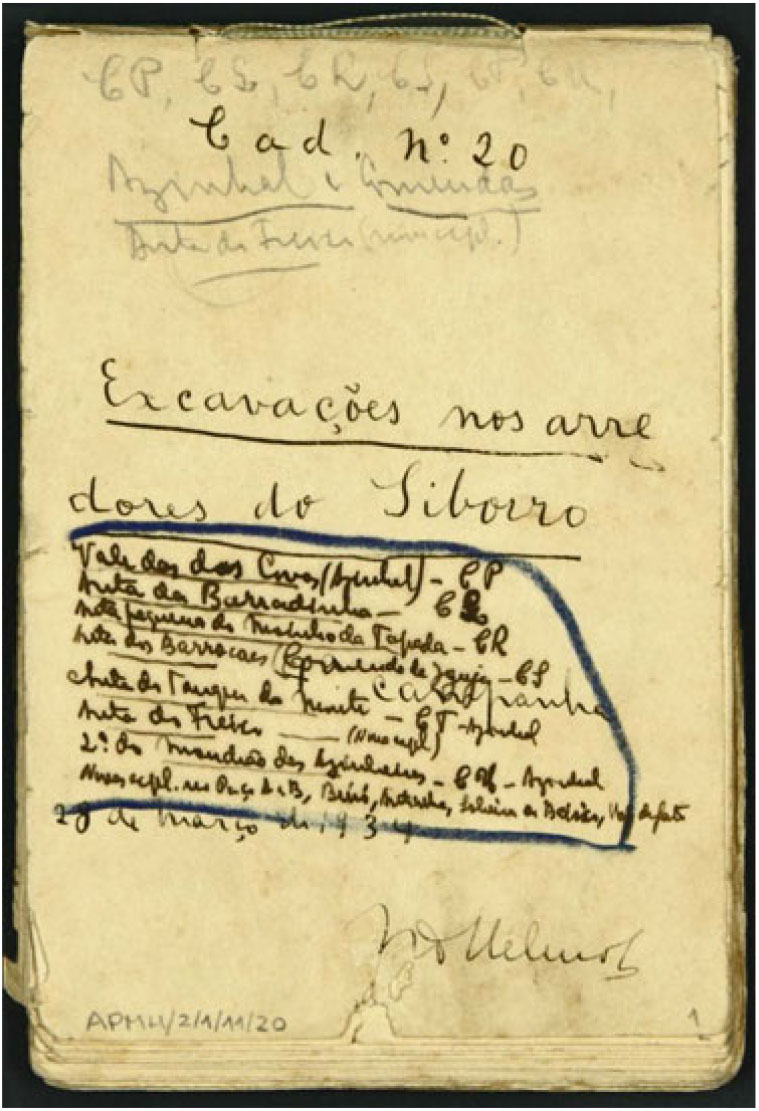
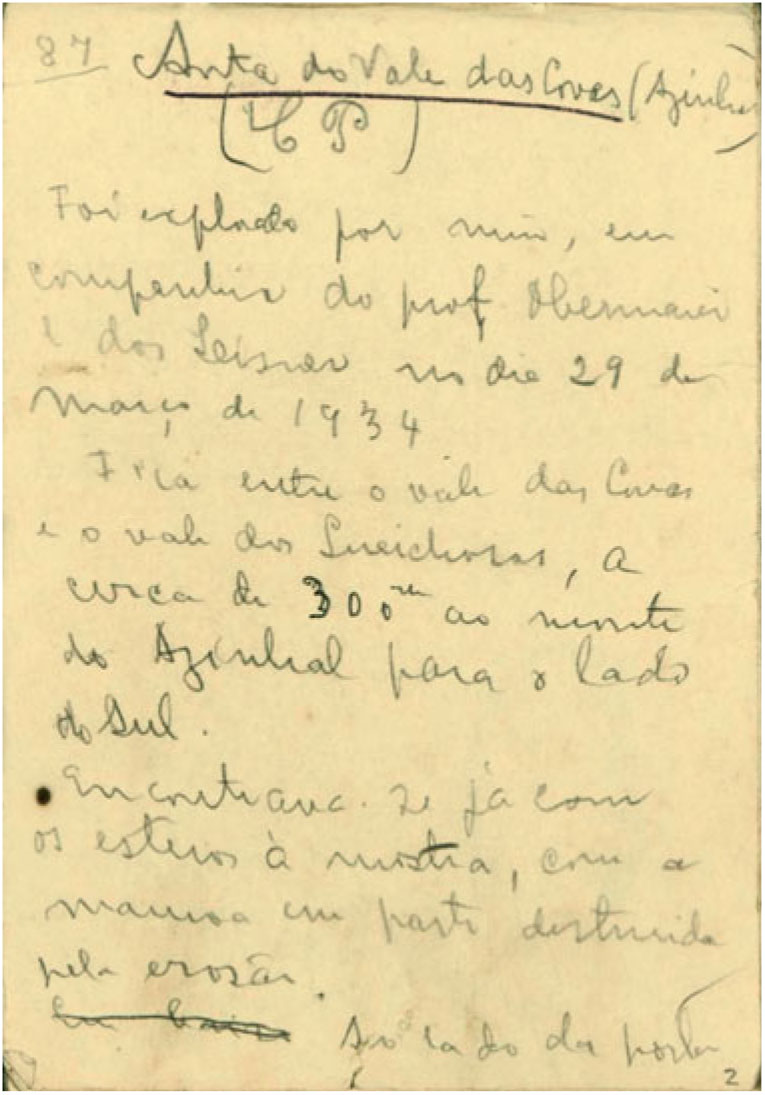
In his fieldwork notebook, No. 20, titled ‘Excavations on the outskirts of Siborro’ and dated from 28 March 1934 (fig 5), Heleno wrote of the dolmen of Vale das Covas that it ‘was explored by me, in the company of Prof. Obermaier and the Leisner couple on March 29, 1934’ (fig 6). Notebook No. 20 was begun on 28 March 1934 and the excavations began the next day, according to the notes written by Heleno (fig 7).
‘Caderno n.º 20, Excavações nos arredores do Siborro, 28 de Março de 1934’ (‘Fieldwork notebook no. 20. Excavations on the outskirts of Siborro. 28 March 1934’). APMH 2//1/11/20. Photograph: courtesy of the MNA.

Photograph taken by archaeologist Vera Leisner at dolmen Azinhal 3 showing Hugo Obermaier (sporting a cigarette), Manuel Heleno (wearing glasses), Georg Leisner (turning away towards Obermaier) and an unnamed mule driver. D-DAI-Mad-Leiv-Lei-03-028. Photograph: courtesy of the DAI-Mad.

‘Caderno n.º 20 Anta de Vale das Covas, Azinhal (CP), p. 37’ (‘Fieldwork notebook no. 20, Vale das Covas dolmen, Azinhal, (CP), p. 37’). APMH 2/1/11/20. Photograph: courtesy of the MNA.

The presence of the English archaeologist in the field coincided with that of Hugo Obermaier and the Leisner couple, according to the annotations on the back of the photographs and in the fieldwork notebook of Heleno.
So, it was Edith Guest in the photographs of the dolmens. But when and why did she travel to Portugal? What motivated her to make the journey from England and how did she establish contact with Manuel Heleno?
It is Edith Guest’s personal journey in the field of European archaeology that reveals the raison d’être of her presence in Portugal, an episode so little known that some eighty years later it remains ignored by British specialists of the history of archaeology.
EDITH GUEST’S TRIP TO PORTUGAL IN 1934
Having dated the photographs and identified the participation of Edith Guest in the excavations of the dolmens of Azinhal 3, Curral da Mosca and Vale das Covas, there remains one issue to resolve. Neither Margaret Murray nor Gertrude Caton-Thompson ever visited Portugal, so how did Guest establish contact with Manuel Heleno?
It would be natural to assume that Guest’s desire to visit Portugal in 1934 to study megalithic monuments was motivated by her previous experiences in Minorca two years earlier. But before she arrived, it would be vital to obtain support and information about the region and its prehistoric sites. Who better to ask than Edgar Prestage? At this time, Prestage (1869–1951) was serving as a professor of Portuguese; indeed, Prestage was a leading authority on Portuguese history and affairs. Born in Manchester – the same city as Guest – he spoke Portuguese and translated many of Portugal’s most eminent writers. As such, he corresponded with some of the leading Portuguese intellectuals, among them José Leite de Vasconcelos, who, in addition to his work in archaeology, was also an eminent philologist. For decades Prestage and de Vasconcelos maintained an intense correspondence, very evident in the large number (sixty-one) of letters exchanged between the two men from 1906 to 1940. These letters are now preserved in the Personal Archive of José Leite de Vasconcelos, at the National Museum of Archaeology, in Lisbon.
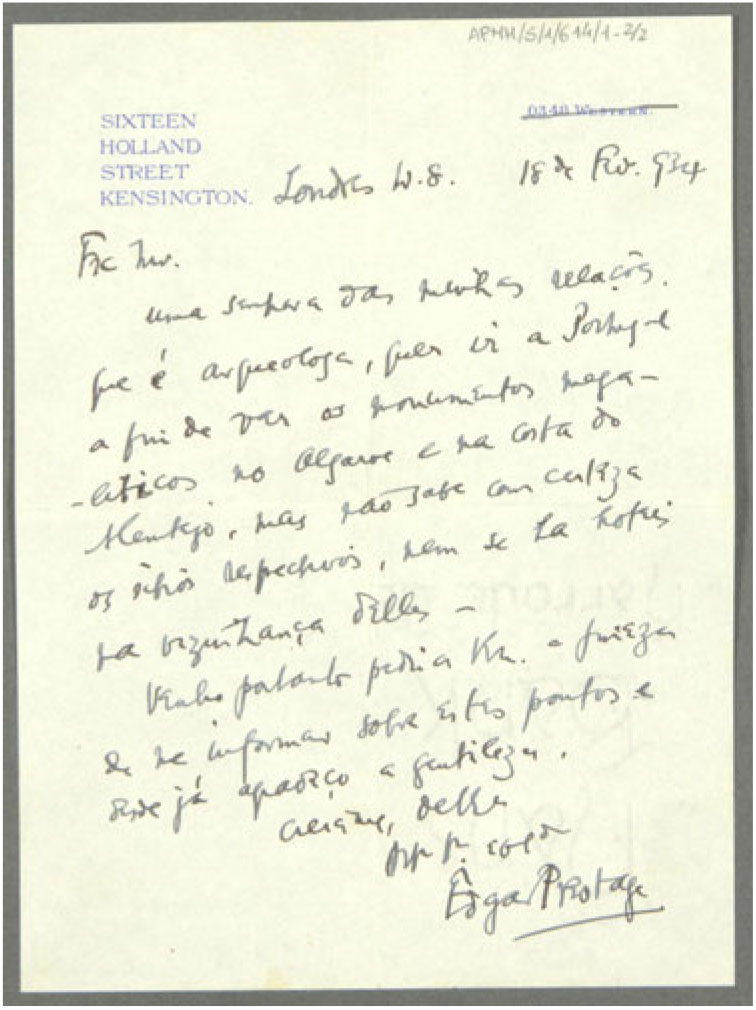
On 18 February 1934, Edgar Prestage wrote a letter from Kensington, in London, to Manuel Heleno, who had by now replaced de Vasconcelos in office (fig 8). In this letter, Prestage informs Heleno that:
a lady of my relations who is an archaeologist wants to go to Portugal to see the megalithic monuments in the Algarve and the Alentejo coast, but she does not know with certainty the respective sites, nor whether there are hotels in the vicinity of them. I am therefore asking you to inform me about these points and thank you in advance for your kindness.Footnote 23
Letter from Edgar Prestage to Manuel Heleno, dated 18 February 1934. APMH 5/1/614/1-2. Photograph: courtesy of the MNA.

Prestage does not name the female archaeologist in his letter, but there can be little doubt that this is Edith Guest. Some six weeks later she is in Portugal, has been photographed among the dolmens of Curral da Mosca and Azinhal 3, and her participation in the exploration of Vale das Covas dolmen is being noted in Heleno’s notebooks.
Both Edith Guest and Edward Prestage were certainly in London in the 1930s: Guest had connections to UCL and Prestage was working at King’s College. Like Guest, Prestage was born in Manchester and it is even possible that they met there, as their families lived in the same part of the city. Another intriguing possibility is that a connection was made through Prestage’s second wife, Victoria, who was very interested in Egyptology and had even visited Flinders Petrie (1853–1942) on an excavation before the World War I. If Victoria Prestage knew Petrie, it would be reasonable to assume that she also knew Margaret Murray and Edith Guest, at UCL.
Confirmation of Edith Guest’s arrival in Portugal is given by the ‘UK Incoming and Outgoing Passenger Lists (1878–1960)’. On 14 April 1934 Guest departed from London, bound for Lisbon, according to the passenger list of the Avila Star.
According to a letter from Prestage to Heleno, Guest’s initial plans to visit the megalithic monuments of the Algarve and the Alentejo coast were altered due to the circumstances. Guest instead went on to visit dolmens of the counties of Coruche and Montemor-o-Novo, which Heleno had been exploring since 1931. In 1934, Hugo Obermaier and the couple Georg and Vera Leisner, larger figures in the megalithic study of the Iberian Peninsula, also participated in that exploration.
The presence of these foreign archaeologists was well publicised in the daily Portuguese newspaper Diário de Notícias: on 9 May 1934 the arrival of Edith Guest in Portugal was announced, as was her election as a member of the Portuguese Institute of Archaeology, History and Ethnography (fig 9). This is even more important if we take into account the elusive personality of Heleno, who was very zealous of his discoveries yet lacked the skill of his predecessor, de Vasconcelos, to maintain a broad network of international contacts. In the account published in the Diário de Notícias of 9 May, we are told that:
Mrs. Edith M. Guest, from the Royal Archaeological Institute and other scientific societies, has recently visited the excavations that the Ethnological Museum is carrying out in the municipality of Montemor-o-Novo.
Extract from the Lisbon newspaper, Diário de Notícias, dated 9 May 1934, announcing the news of Edith Guest’s stay in Portugal and her election as a member of the Portuguese Institute of Archaeology, History and Ethnography, an organisation based in the Museu Nacional de Arqueologia, Lisbon.

Accompanied by Mr. Manuel Heleno, the illustrious archaeologist visited the monuments already explored by the Museum and had occasion to observe all types of Portuguese dolmens … The illustrious visitor also attended the exploration of a small rectangular dolmen …
This confirms the documentation presented above, referring in an enthusiastic tone to the presence of Guest:
After Prof. Dr. Hugo Obermaier, of Mrs. Leisner and Dr. Leisner, who have referred in the most honourable terms to the excavations directed by Dr. Heleno, it was now up to Mrs. Edith Guest to verify the effort that the Ethnological Museum, with small sums, is carrying out for the good name of Portuguese culture.
To conclude the apologetic tone in favour of the museum and its director, the report ends with the information that:
The Portuguese Institute of Archaeology, History and Ethnography, which has its headquarters in the Ethnological Museum, elected as corresponding member the erudite archaeologist [Edith Guest], who came purposely to Portugal to study our dolmens.
Thus, Edith Guest’s visit to Portugal and her brief foray into Portuguese Megalithism was marked with great enthusiasm. On 28 June 1934 she returned to England on board the Almeda Star.
DISCUSSION
Edith Guest, an English medical doctor, archaeologist and ethnologist, was not among the first rank of pioneering women of British archaeology. Nevertheless, she played an important and undervalued role in the study of Megalithism that has been somewhat overlooked in the face of the remarkable achievements of her two contemporaries: Margaret Murray, her friend and colleague in several fieldwork explorations; and Gertrude Caton-Thompson, with whom she worked in Malta. Examining the journeys of female pioneers of British archaeology of the first half of the twentieth century, we can see that they were not isolated cases. They established professional and personal relationships among themselves and handed on the torch to the following generation.Footnote 24
This was not the case in other European countries at the time (for example, Portugal) despite the firm intentions and efforts of some researchers, such as Professor Virgínia Rau, herself a student of Manuel Heleno (and later his assistant in the early 1940s), but who never achieved her ‘place’ in archaeology.Footnote 25 In Britain in the 1920s and 1930s, however, there were several influential female archaeologists. Their undeniable contribution to the development of Egyptology (Margaret Murray and Gertrude Caton-Thompson) and to archaeology in the Middle East (Dorothy Garrod and Kathleen Kenyon) is impressive. Let us not forget that the Wheeler method was originally called the Wheeler–Kenyon method!
Despite – or perhaps because of – such company, Edith Guest was able to make a contribution. As a medical doctor, Guest was able to assist Margaret Murray in matters related to the paleopathology of human remains exhumed in her archaeological excavations, especially in Egypt. At the time, this kind of interdisciplinary research was highly innovative.
Edith Guest travelled to Portugal at a very special juncture for Portuguese archaeology: the beginning of the systematic study of Megalithism in Alentejo by Manuel Heleno, whose results he wanted to augment with the presence of important names of archaeology such as Hugo Obermaier and the Leisners – and Edith Guest.
Guest also participated in the excavations at Erimi, in Cyprus, and wrote a chapter of the final report of 1936 that resulted from that excavation, titled The Excavations at Erimi 1933–35: final report. But from 1935 onwards, Guest’s publications would focus on the issue of ‘Sheila-na-gigs’ in Ireland. She died in Oxford, on 16 January 1942.
CONCLUSIONS
In this work, previously unknown documentation was analysed, including photographs, field notebooks and unpublished letters, proving the presence of Edith Guest in Portugal between April and June 1934, as well as the antecedents and some details of her stay, during which she visited and/or participated in the exploration of several dolmens in Central Alentejo: Curral da Mosca, Azinhal 3 and Vale das Covas.
The reasons for her visit lie in her previous excavation experience in Minorca, as a member of the Cambridge Museum expedition of 1932. It is probable that the field experience then acquired, in the context of the excavation and study of the megalithic monuments of the Balearic Islands, may have drawn her attention to the Megalithism of southern Portugal. There, she intended to visit the monuments of the Algarve and the Alentejo coast, the most important of which were known since the time of Estácio da Veiga (1828–91). An alteration in this project led her to the interior of Alentejo, where Manuel Heleno had been developing an ambitious programme of excavations in dolmen monuments since 1931, which was proceeding at a good pace in 1934. Thus, her presence in the Alentejo, that same year, must be framed with that of Georg and Vera Leisner, along with that of Hugo Obermaier, in the framework of a process of international recognition of the work that was being carried out by Manuel Heleno, and that he himself was promoting.
DEDICATION
The research that resulted in this paper is a tribute to the memory of Rui Boaventura, an archaeologist who left us too soon and who, despite having come to learn the name of ‘mysterious Englishwoman’ of the Curral da Mosca dolmen, was sadly no longer able to participate in this work.
ACKNOWLEDGMENTS
The authors are deeply grateful to Pamela Jane Smith, who was contacted by one of the authors and who put us in contact with Julia Roberts, administrator of the HARN network. Julia Roberts posted on HARN network webpage our request for information on biographical data and any additional information on Edith M Guest. We are grateful to all HARN network members who answered our request. We thank Margarita Diaz-Andreu who gave us access to the autobiography of Gertrude Caton-Thompson. Timothy Champion provided access to unpublished data from the biography of Edith M Guest. Lastly, the encouragement of Chris Scarre was important so that this article could achieve fruition. Our thanks also go to the director of the National Museum of Archaeology, Lisbon, António Carvalho, for allowing the access and publication of the sources here used.
ABBREVIATIONS & BIBLIOGRAPHY
Abbreviations
- AFMNA
Arquivo Fotográfico do Museu Nacional de Arqueologia, Lisboa (National Museum of Archaeology Photographic Archive, Lisbon)
- APMH
Arquivo Pessoal de Manuel Heleno, Museu Nacional de Arqueologia, Lisboa (Personal Archive of Manuel Heleno, National Museum of Archaeology, Lisbon)
- DAI-Mad
Deutsches Archäologisches Institut, Madrid (German Archaeological Institute, Madrid)
- HARN
Histories of Archaeology Research Network weblog
- MNA
Museu Nacional de Arqueologia, Lisboa (National Museum of Archaeology, Lisbon)