Just before the 2016 election, the Pew Research Center (2016) released a study finding that “Basic facts, not just policies, are in dispute.” Of those surveyed, 81% said that not only did supporters of Hillary Clinton and Donald Trump disagree over desirable policies, they also did not agree when it came to basic facts. These perceptions appear to have an empirical basis. Surveys reveal that liberals and conservatives differ in their beliefs about the fundamental facts that relate to many of the most important issues in recent years including, for example, the Iraq War (Kull, Ramsay, and Lewis 2003) and climate change (McCright and Dunlap Reference McCright and Dunlap2011). Of particular relevance for this study, beliefs about the trends in economic inequality are fundamentally shaped by political ideology. Conservatives are more likely than liberals to deny that income differences have increased (Bartels Reference Bartels2009). Moreover, Bartels (Reference Bartels2009) found that ideology interacts with political knowledge such that more politically aware Americans (i.e., those individuals expected to be most informed about the issues) display the greatest ideological polarization in their beliefs about this basic economic trend.
Indeed, rather than one’s perspective on a contentious policy topic being shaped primarily by what one “knows to be true,” what one “knows to be true” often appears to be influenced significantly by one’s ideological or policy perspective. For the most part, these processes operate simultaneously. New information can influence beliefs, but the degree to which and how this new information influences one’s perspective on a contentious issue often is shaped by prior attitudes regarding that issue. As many scholars have long recognized, this dynamic can make discussions and debates across ideological divides far less productive, hamper the development of informed policy, and undermine the legitimacy of the policy process and even of democratic governance (Delli Carpini and Keeter 1996).
This tendency for partisan leanings to influence individuals’ understanding of “facts” is especially likely in the contemporary media environment, in which the rise of cable news, Internet news sites, and social media allows consumers to select news sources that are consistent with their political predispositions (Bennett and Iyengar 2008; Stroud 2011). The ability to choose media that present information (and misinformation) that aligns with one’s beliefs exacerbates the problem caused by the psychological tendency toward motivated reasoning. Specifically, due to confirmation biases (whereby individuals seek out news sources that they expect to align with their views), prior attitude effects (whereby individuals judge arguments supporting their position as “stronger”), and disconfirmation biases (whereby individuals focus their cognitive skills on discrediting arguments that do not align with their prior views), greater media attention to an issue actually can lead to greater partisan bias about the relevant facts (Ditto et al. 1998; Jerit and Barabas Reference Jerit and Barabas2012; Taber and Lodge Reference Taber and Lodge2006).
Whereas the impact of media on informing the public about factual information on charged issues has been the subject of substantial study, the impact of educational efforts relative to these issues has received little attention. We believe it is important to examine whether teachers’ attempts to highlight the need for verifying truth claims and to support the development of students’ abilities to judge the accuracy of such claims lead to increased knowledge of factual information, especially concerning politically charged topics. This article considers the impact of these educational efforts by focusing on students’ knowledge of economic inequality. Footnote 1 It draws on data from the 2013 Youth and Participatory Politics survey (YPP), which was administered to a nationally representative sample of young people in the United States. Specifically, we examine the responses of 740 high school students to questions about their experiences discussing economic inequality in school and their knowledge of the issue.
The survey was administered by GfK online and by telephone, in both English and Spanish, between July 8 and November 7, 2013. The sample consisted of 2,343 US residents between the ages of 15 and 27, including oversamples of African American, Latino, and Asian American youth. This article examines the subsample of respondents (N=740) who reported that they attended a high school during the 2012–2013 academic year. Footnote 2
We believe it is important to examine whether teachers’ attempts to highlight the need for verifying truth claims and to support the development of students’ abilities to judge the accuracy of such claims lead to increased knowledge of factual information, especially concerning politically charged topics.
WHAT DO YOUNG PEOPLE BELIEVE ABOUT ECONOMIC INEQUALITY?
We begin our analysis by investigating what youth believe about recent trends in economic inequality. Specifically, the YPP survey asked, “Do you think the difference in incomes between rich people and poor people in the United States today is larger, smaller, or about the same as it was 20 years ago?” This question has long been asked on national surveys, so it enables comparisons to other periods and national norms. In addition, we chose this question because it addresses the central concern that drove expanded interest in income inequality as a political topic. As a factual matter, the evidence is also clear. The real incomes of the top 1% of US households increased by 62% between 1993 and 2013, whereas incomes of the bottom 99% increased by 7%. This means that 59% of total growth during the period was captured by only 1% of all households (Piketty and Saez Reference Piketty and Saez2003; 2015).
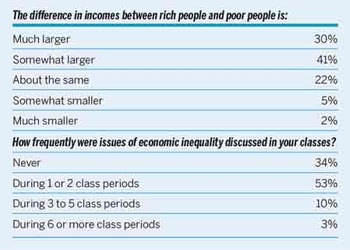
As shown in table 1, most students believe that differences in incomes have grown “somewhat larger” (41%) or “much larger” (30%). This percentage is only slightly lower than that observed for the adult population: 78% of adults asked the same question in the 2012 American National Election Study stated that inequality had increased in the last 20 years.
Students’ Beliefs and Learning about Economic Inequality

WHO HAS CLASSES ON ECONOMIC INEQUALITY?
The survey also asked students how frequently they had a class in which issues of economic inequality were discussed. The responses indicated that many young people had these classes but few had many discussions. Sixty-six percent of students reported having at least one class period in which issues of economic inequality were discussed, but only 12% reported having three or more class periods devoted to the subject.
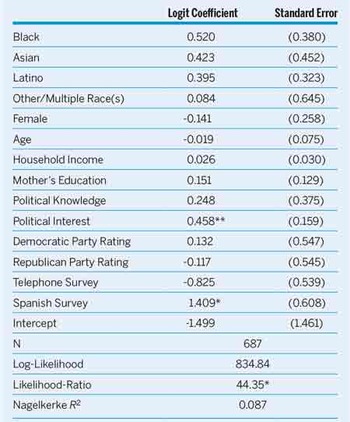
Table 2 presents the results of a logistic regression model of whether a student reported having a class in which the issue of economic inequality was discussed. Footnote 3 To test whether students self-select into these classes based on their political predispositions, the model includes four variables relating to their political orientations: political interest, political knowledge, and ratings of the Democratic and Republican parties. The model also includes a set of control variables: race, age, gender, household income, mother’s education level, survey mode (telephone or online), and survey language (English or Spanish). Footnote 4
Logit Model of Having a Class Discussion about Economic Inequality

Note: *p<0.05; **p<0.01 for a two-tail t-test.
Of all the political and demographic variables, the only one with a statistically significant effect on the likelihood of having a discussion about inequality is political interest. Thus, it appears that to the extent that there is any self-selection of students into classes in which economic inequality is discussed, it is most likely to be based on interest in politics. Footnote 5 We found no evidence that exposure to these classes was based on partisan preferences or political knowledge. This finding is important. If, for example, Democrats were more likely than Republicans to take classes in which economic inequality was discussed, then partisan polarization could explain the relationship we found between taking a course and having knowledge related to the topic. Similarly, if students who were more knowledgeable about politics were especially likely to take or to recall a class in which the topic was discussed, then political knowledge might explain the apparent association with knowledge specifically related to economic inequality. Because no relationship with political knowledge or partisanship was found, we are more confident that any relationship between taking a class and having knowledge is the result of learning that occurred through classroom instruction.
HOW DO CLASSES AFFECT KNOWLEDGE OF TRENDS IN ECONOMIC INEQUALITY?
Finally, we address the question of whether classroom discussions affect students’ factual knowledge regarding economic inequality. Table 3 shows that having even one class in which these issues were discussed is associated with a substantial increase in the probability of recognizing that economic inequality has increased in recent years. Of those students who did not have any classes in which this topic was discussed, 55% stated that economic inequality was larger. This percentage increased to 79% among those who had one or two class discussions about the issue and to 87% among those who discussed it in six or more class periods.
Beliefs about Economic Inequality Trends by Learning about Economic Inequality in School

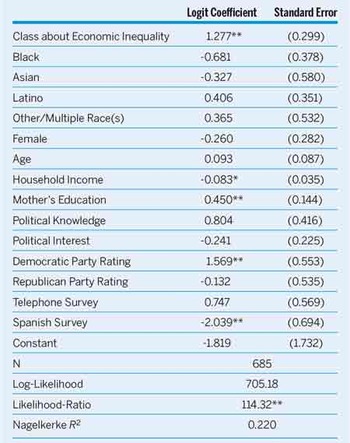
To isolate the effects of learning about economic inequality in school from other variables that might affect knowledge regarding the issue, table 4 displays results of a logit model regarding the belief that income differences have increased. The model includes as controls the same set of variables in the model regarding class discussions about economic inequality. Consistent with Bartels’s (2009) findings for adults, we found that partisanship is related to high school students’ perceptions about economic inequality, as the Democratic Party rating has a positive, statistically significant relationship with knowledge of the trend. Moreover, even after controlling for these political orientations and other control variables, we found that having at least one class in which economic inequality was discussed has a statistically significant, positive effect on the likelihood of stating that it has increased.
Moreover, even after controlling for these political orientations and other control variables, we found that having at least one class in which economic inequality was discussed has a statistically significant, positive effect on the likelihood of stating that it has increased.
Logit Model of Knowledge about Economic Inequality

Note: *p<0.05; **p<0.01 for a two-tail t-test.
In part, the robustness of this result depends on ruling out alternative explanations. The relationship described previously between political interest and the reported number of class discussions about inequality raises the possibility that only more interested students learned factual information from these discussions, or that they remembered taking the class and also already knew this information. To test this possibility, an additional specification of the model included an interaction between a class discussion of economic inequality and political interest. This interaction term did not have a statistically significant effect on knowledge that inequality had increased, as expected if interest were driving the relationship between class discussions and previous knowledge. We also tested similar interactions between a class discussion and three other political variables: political knowledge, Democratic Party rating, and Republican Party rating. We wanted to test, for example, whether classes on economic inequality increased knowledge of its growth only among Democrats. None of these interaction terms was statistically significant. Footnote 6 Thus, the effect of discussing economic inequality in school apparently increased knowledge about the issue for all students, irrespective of their interest in politics, general political knowledge, or partisanship.
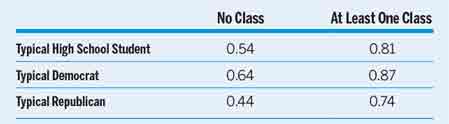
The substantive implications of the relationship between classroom experiences and knowledge of economic inequality were illustrated by calculating predicted probabilities for hypothetical students. All variables were held constant except whether they had a class in which economic inequality was discussed. The first row of table 5 shows these expectations for a “typical” student in our sample Footnote 7 : the predicted probability that a student who did not have a class about economic inequality would report that it had increased in the last 20 years is 0.54. This probability increased 50% to 0.81 for an otherwise identical student who had a class in which economic inequality was discussed.
Predicted Probabilities of Stating that Economic Inequality Has Increased by Classes about Economic Inequality
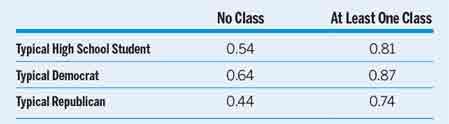
Note: Entries are predicted probabilities based on the model of answering that economic inequality has increased reported in table 4.
The substantive significance becomes even starker when one compares the effects of a classroom experience addressing economic inequality on the interaction that might occur between individuals of opposite partisanship. The last two rows of table 5 display these same calculations for a “typical Democrat” and a “typical Republican,” respectively. Footnote 8 For two otherwise typical students who had not taken a class in which economic inequality was discussed, there is only a 0.28 probability (0.64 x 0.44) that a Democrat and a Republican would agree that inequality had increased in the last 20 years. However, if these same two students had each taken a class about economic inequality, the joint probability that they would both be aware of the trend increases to 0.64 (0.87 x 0.74). That is, the likelihood that two students with opposing partisan attachments would have a shared understanding of this basic economic fact more than doubles if they both had been in a class in which economic inequality was discussed.
DISCUSSION
In the current period of partisan polarization and news media fragmentation, there is growing concern that public discussion of important issues is inhibited by a lack of agreement across partisan lines about basic facts. With respect to the high and growing level of economic inequality, public-opinion research has shown that Democrats and Republicans have rather different perceptions of reality (Bartels Reference Bartels2009; Norton and Ariely Reference Norton and Ariely2011). Moreover, it is not clear that media coverage of these issues corrects misperceptions or deepens the public’s knowledge of basic facts. The research presented here demonstrates that education can serve as a partial corrective by increasing young people’s knowledge regarding a controversial topic, independent of their prior convictions. Having even one class in which the issue was discussed appears to have a significant impact on whether high school students are aware of the trend in economic inequality.
In addition, for reasons discussed previously, our confidence in the robustness of this relationship is strengthened by the finding that neither overall political knowledge nor partisan leaning (Democrat or Republican) was related to reporting having a class discussion on economic inequality. In addition, we found that political interest, political knowledge, and partisan affiliation did not interact with reports of a classroom experience when predicting knowledge regarding economic inequality trends. These findings enhance our confidence that teaching about the issue leads to knowledge about it, and we are impressed by the magnitude of the effects.
These findings enhance our confidence that teaching about the issue leads to knowledge about it, and we are impressed by the magnitude of the effects.
Although having a class that discussed economic inequality appeared to decrease partisan polarization about economic trends, it did not completely eliminate the gap between Democrats and Republicans. At least in part, this may be due to psychological biases that lead individuals to seek out information that confirms what they already (think they) know and to be more likely to dismiss information that runs counter to their prior beliefs (Taber and Lodge Reference Taber and Lodge2006). This tendency does not appear to be confined to one side of the ideological spectrum. A recent experiment shows that liberals and conservatives alike display negative affective and cognitive reactions when exposed to evidence about science policy that is ideologically dissonant (Nisbet, Cooper, and Garrett Reference Nisbet, Cooper and Garrett2015). Given that partisan attitudes are instilled at a young age (Stoker and Jennings Reference Stoker and Jennings2008), it is not surprising that we observed polarization among high school students on the question of whether economic inequality in the United States is growing. All of this points to the critical role that educators have in ensuring that young people share a common factual understanding of their society so that they can have meaningful discussions and debates about public policy.
Unfortunately, we found that these types of discussions about economic inequality are not common in America’s classrooms. Our survey indicated that although two thirds of high school students report having had one or two classes in which the issue was discussed, few had many class periods devoted to the subject. This is consistent with a first-of-its-kind analysis of state social-studies frameworks in the United States and Canada, which suggests that American schools place low priority on teaching and learning about economic inequality (Westheimer and Rogers Reference Westheimer and Rogers2015). More generally, it is indicative of the findings of prior research that found that many teachers are hesitant to discuss controversial political and economic issues in their classroom (Hess Reference Hess2009).
Because our findings are based on the results of one survey, they must be interpreted cautiously. Our indicator of knowledge about economic inequality consists of only one item; future surveys could include more comprehensive measures of this knowledge and, of course, should consider other topics. Moreover, the kind of qualitative research that Flanagan (Reference Flanagan2013) conducted has been particularly useful in gauging the depth of students’ beliefs and understandings, and more work of this type would be valuable. In addition, we need to explore the types of classes in which these discussions are occurring, as well as the practices that teachers use when teaching about the subject. We need to know which types of curriculum and pedagogical practices prompt more accurate knowledge of relevant facts and perspectives as well as a more complex understanding of economic and social dynamics.
Finally, we believe these findings highlight a potentially significant role for schools relative to supporting informed deliberation. Civic education and education related to political issues are rarely attended to by political scientists. Especially given the current polarization prevalent in the news media and public opinion, we encourage political scientists concerned with how ignorance and motivated reasoning inhibit informed political discussion to more fully examine ways that educators can prepare young people to be informed participants in a democratic society.