


Rape during wartime, long dismissed as an inevitable consequence of conflict, is now widely recognized as an important problem of international security. It is arguably one of the most horrifying and least understood aspects of modern conflict. Its ruinous effects on victims, perpetrators, and local communities include forced displacement, the spread of disease, the burden of unwanted children, and deeply traumatized populations. Wartime rape can have devastating repercussions for international security, and it threatens prospects for postconflict peace and reconstruction (e.g., Plümper & Neumayer Reference Plümper and Neumayer2006). Additionally, some researchers suggest that its incidence is increasing (e.g., Green Reference Green2006).
Recent scholarship suggests that wartime sexual violence varies widely, in both its form and severity across and within conflicts (Cohen Reference Cohen2010; Leiby Reference Leiby2009; Wood Reference Wood, Shapiro, Kalyvas and Masoud2008). However, there have been few efforts to gather comprehensive cross-national data on wartime rape, and there is little agreement about why it occurs. Some scholars argue that rape occurs in all or most armed conflicts (Benard Reference Benard1994), whereas others contend that it is limited in some conflicts and widespread in others (Bourke Reference Bourke2007; Wood Reference Wood, Shapiro, Kalyvas and Masoud2008), with some researchers claiming that it is most likely to occur in ethnic wars (Bloom Reference Bloom1999; Plümper and Neumayer Reference Plümper and Neumayer2006). Others point to women's relative inequality as an explanation (MacKinnon Reference MacKinnon1994).
Without a clear comparative understanding of where and to what extent wartime rape occurs, it is difficult to draw defensible conclusions. In this article, I introduce an original dataset of rape during civil wars over the past three decades (1980–2009) and find substantial variation in the prevalence of rape both across and within conflicts. I use the dataset to test existing explanations for rape during conflict, which I organize into three sets of arguments about the causes of wartime rape: opportunism/greed, ethnic hatred, and gender inequality. The evidence does not support much of the conventional wisdom about the causes of wartime rape: It is not more likely to occur during ethnic wars, genocides, or in countries with greater gender inequality.
I offer an alternative explanation for the variation in rape during civil war: combatant socialization. One of the most puzzling aspects of wartime rape is that gang rape (rape by multiple perpetrators) is much more common in war than in peacetime (Asher et al. Reference Asher2004; Bourke Reference Bourke2007; Theidon Reference Theidon2007). Drawing on this observation, I argue that armed groups use wartime rape as a socialization tool. Combatant groups that recruit new members through forcible means, such as abduction or pressganging, must create a coherent fighting force out of a collection of strangers, many of whom were abused in order to compel them to join (Gates Reference Gates2002). Based on research from economics, sociology, and criminology, I argue that rape—especially gang rape—enables groups with forcibly recruited fighters to create bonds of loyalty and esteem from initial circumstances of fear and mistrust. I show that both state and insurgent armed groups that have recruited their members through abduction—which subsequently have the lowest levels of internal social cohesion—are more likely to commit widespread rape than are groups that recruited fighters through more voluntary methods.
Although the cross-national analysis demonstrates an association between abduction and rape, I turn to the case of Sierra Leone to explore how extreme forms of forced recruitment—but not weaker forms—are associated with rape, to show how rape creates cohesion in groups that have abducted their fighters, to examine a series of observable implications of the combatant socialization argument, and to demonstrate that an alternative argument does not explain the observed variation. Drawing both on interviews with ex-combatants from fieldwork in Sierra Leone and from existing survey data, I argue that there is substantial evidence that combatant socialization best explains the widespread rape in that conflict. In this article, I provide both cross-national and case study evidence that combatant socialization accounts for variation in wartime rape better than many rival explanations.
WARTIME RAPE AS A DISTINCT PHENOMENON
Following Wood (Reference Wood2006, 308), I define rape as “the coerced (under physical force or threat of physical force against the victim or a third person) penetration of the anus or vagina by the penis or another object, or of the mouth by the penis.” Wood (Reference Wood2006, 308) defines sexual violence as “a broader category that includes rape, coerced undressing and non-penetrating sexual assault” as well as a variety of other forms of violence. In this study, I focus on rape rather than the broader category of sexual violence.
Wartime rape may be devastating both to victims and perpetrators, causing psychological and physical harm. Its documented consequences, including trauma, shame, stigma, unwanted children, disease, and displacement, and their plausible effects on the durability of postconflict peace mean that a better understanding of its root causes is urgently needed.
In addition to normative justifications for analyzing rape separately from lethal violence, there are important theoretical reasons. Although scholars have made significant progress in recent years studying violence during conflict, research on the human costs of civil war has focused mainly on deaths. The most influential studies of violence against noncombatants during civil war have analyzed homicide to the exclusion of all other violence (Kalyvas Reference Kalyvas2006; Valentino, Huth, and Balch-Lindsay Reference Valentino, Huth and Balch-Lindsay2004; Weinstein Reference Weinstein2007), and the standard measure of conflict severity is wartime killing.Footnote 1 There is little explicit theoretical justification offered for this operationalization, other than that homicide is easier to measure (Kalyvas Reference Kalyvas2006, 20) and is presumed to correlate with levels of nonlethal violence, including rape. However, Wood (Reference Wood2009; see also Morris Reference Morris1996) argues that rape follows a different pattern from homicide and forced displacement. The cross-national data used in this analysis confirm that conflict-level battle death estimates—a combination of soldier and civilian deaths used as a proxy for civilian abuse in the literature—are correlated positively, but weakly, with conflict-level rape.Footnote 2
An additional problem is that wartime homicide is not randomly distributed. Men and boys are significantly more likely to be killed during the course of a conflict than are women and girls (Carpenter Reference Carpenter2006; Plümper and Neumayer Reference Plümper and Neumayer2006). Some studies suggest that women and girls are disproportionately more likely to experience nonlethal conflict violence, especially displacement and sexual violence (Human Security Report Project 2005), and are more likely to be affected by the long-term consequences of war, such as food and resource shortages and a lack of medical care (Plümper and Neumayer Reference Plümper and Neumayer2006). Very few studies have focused on rape, a form of violence that is primarily targeted at women (Leiby Reference Leiby2009; Wood Reference Wood, Shapiro, Kalyvas and Masoud2008, Reference Wood2009). It is both uncertain and unlikely that theories developed to explain the incidence of homicide can be readily applied to another type of violence that affects a distinct population.
Explanations for wartime rape can be grouped into three main themes: opportunism/greed, ethnic hatred, and gender inequality.Footnote 3 The arguments have implications for violence at different levels of analysis (either at the conflict level, or for insurgent-perpetrated or state-perpetrated violence). I have indicated which level is pertinent by underlining it in each hypothesis, and I test these in separate models.
Opportunism/Greed
Arguments for why rape occurs during war follow two related logics that derive from the claim that war affords men an unprecedented opportunity to rape. First, the breakdown of the state that may accompany conflict results in the destruction of social norms and legal prohibitions that exist in peacetime, which unleashes at least some men's latent desire to commit rape (Goldstein Reference Goldstein2001). If so, variation in the magnitude of state breakdown may help explain the degree of perceived impunity for crimes against civilians. Hence, state collapse may be a proxy for indiscipline among combatants.
H1: State collapse is correlated with higher state-perpetrated and insurgent-perpetrated levels of wartime rape.
A related set of arguments focuses on greed and on the types of people who are attracted to violent armed groups as a cause of civilian abuse (Mueller Reference Mueller2000). Weinstein (Reference Weinstein2007) argues that civilian abuse is more likely when insurgent groups have access to material resources, including contraband or external support. Two mechanisms explain why access to resources lead to violence. First, Weinstein (Reference Weinstein2007) argues that insurgent groups with access to material resources attract more violence-prone recruits than groups that rely on ideology and thus will be more likely to commit mass-scale civilian abuses. Second, the availability of material resources enables insurgent groups to be unaccountable to the civilian population. Exploitive violence against civilians is an unfortunate consequence of the lack of accountability, not a means to an end. Rape perpetrated by insurgents is hypothesized to be more likely in conflicts where insurgencies are fueled by “economic endowments,” especially those easily converted into selective incentives to entice new recruits (Weinstein Reference Weinstein2005).Footnote 4
H2: Rape by insurgents is more likely in conflicts where insurgent groups rely on material resources.
Ethnic Hatred
Ethnic war is a frequently cited environment for extreme violence, including rape (Bloom Reference Bloom1999; Horowitz Reference Horowitz1985; Plümper and Neumayer Reference Plümper and Neumayer2006), because ethnic conflicts “engage intense emotions and a sense of existential threat” (Fearon Reference Fearon, Weingast and Wittman2006, 682). Proponents of these arguments maintain that rape is most prevalent in conflicts where a major cleavage is based on ethnic differences and that rape plays an important role in humiliating the ethnic opponent. Wartime rape, then, should be correlated with ethnic conflict.
H3: Ethnic wars are associated with conflict-wide rape.
In contrast, some scholars argue that genocidal wars, rather than ethnic wars, are more likely to feature rape as a “central technique” (Mullins Reference Mullins2009) in genocide. Drawing on MacKinnon (Reference MacKinnon1994), feminist scholars refer to “genocidal rape.”Footnote 5 Sharlach (Reference Sharlach2000, 89) argues that, even if the victims are not killed, rape fits the definition of genocide in the 1948 Genocide Convention, which includes “causing serious bodily or mental harm to members of the group and/or deliberately inflicting on the group conditions of life calculated to bring about its physical destruction in whole or in part.” Hence, wartime rape should be more likely to be committed by actors who perpetrate genocide.
H4: States or insurgents who perpetrate genocide are more likely to commit wartime rape than those who do not.
In a final variation of the ethnic hatred argument, scholars argue that rape is an instrument of ethnic cleansing or of forced expulsion during secessionist wars.Footnote 6 Rape can ensure that an ethnic population will flee a disputed territory, guarantee that displaced people will not return, and “sexually contaminate” women of an opposing ethnicity (e.g., Bloom Reference Bloom1999; Farr Reference Farr2009; Sharlach Reference Sharlach2000). One scholar hypothesizes that, in secessionist wars, rape increases hatred and fosters the idea that “life together is finished” (Hayden Reference Hayden2000, 32).
H5: Secessionist wars, especially those featuring ethnic cleansing, are associated with insurgent-perpetrated rape.
Gender Inequality
Feminist scholars and human rights advocates have identified a relationship between gender inequality and wartime rape (Hansen Reference Hansen2001; HRW 2004; Koo Reference Koo2002). Although rape may also be more likely in contexts where women are gaining rights and men feel threatened (Baron and Straus Reference Baron and Straus1989), most arguments about gender and wartime rape predict a correlation between the relative lack of women's rights and widespread rape.
Scholarship on the status of women and rape during war focuses on the symbolic meaning of rape and holds that gender inequality facilitates acceptance of violence against women. In this view, rape is a crime that allows men to inflict psychological harm on women and their communities (Benard Reference Benard1994; Green Reference Green2006; Seifert Reference Seifert1996). It shames not only the victim but also her husband and male relatives, who have failed to protect her (Bastick, Grimm, and Kunz Reference Bastick, Grimm and Kunz2007; Hansen Reference Hansen2001). Further, scholars have demonstrated that gender inequality predicts the onset of civil war (Caprioli Reference Caprioli2005; Fearon Reference Fearon2010), but have not tested whether gender inequality is correlated with specific forms of violence, including wartime rape.
H6: Greater gender inequality is associated with conflict- wide rape.
FORCED RECRUITMENT, COHESION, AND GANG RAPE
Gang rape is far more common in wartime than in peacetime. Scholars have also noted that gang rape can create bonds between people in social groups and may provide psychological benefits to the perpetrators by improving group morale through inducing feelings of power and victory (Benard Reference Benard1994; Card Reference Card1996; Sanday Reference Sanday2007).Footnote 7 However, not all armed groups turn to this form of morale-boosting behavior. I argue that rape may be especially important in groups with low social cohesion.
Even where peacetime rape is thought to be common, researchers have noted a qualitative difference in the nature of peacetime and wartime rape. For instance before the war in the DRC, rape was mainly committed by one perpetrator in private; wartime rape was shocking to local people because of its increased brutality, multiple perpetrators, and public nature (Samset Reference Samset, Berdal and Suhrke2011). Although gang rape has received little scholarly attention (Franklin Reference Franklin2004), there are a small number of studies comparing various aspects of gang rape to single-perpetrator rape. In one of the earliest and most influential studies of gang rape, Amir (Reference Amir1971) introduced a “sociological theory of group rape,” which he defined as involving three or more perpetrators. He argues that it is a rite of passage in which aggression and humiliation are key features. Gang rape enables the perpetrators to establish status and reputations for toughness. Amir maintains that gang rape occurs only occasionally in such groups, but is found particularly during periods when group members’ status is questioned or threatened. Importantly for understanding wartime rape, Amir (Reference Amir1971, 185) writes that gang rape can assist in “solidify[ing] the status claims of a member as well as the cohesiveness of the whole group.”
Gaining and maintaining status within a group as a result of committing rape has become a common finding in the literature (Groth and Birnbaum Reference Groth and Birnbaum1979). Psychological and sociological studies of gang rape find that perpetrators experience increased mutual esteem and that rape serves as an act of camaraderie (Brownmiller Reference Brownmiller1975; Franklin Reference Franklin2004). Deemphasizing the attacks’ sexual nature, researchers argue instead that bonding is the primary motivator (Bijleveld and Hendriks Reference Bijleveld and Hendriks2003; Franklin Reference Franklin2004; Morrow Reference Morrow1993 in Diken and Laustsen Reference Diken and Laustsen2005). Gang rape is notable for its performance aspects, and perpetrators often watch each other and organize an order of their participation. Researchers believe that the intended “audience” of the performance is the other perpetrators, with the victim serving as their “vehicle” (Sanday Reference Sanday2007; Theidon Reference Theidon2007; see also Bourgois Reference Bourgois1996).
The social processes apparent in group rape are in stark contrast to those in rape committed by a lone offender. Single-offender rape is more often driven by personal sexual desire (Hauffe and Porter Reference Hauffe and Porter2008). Gang rapists are considered less pathological than single rapists (Bijleveld and Hendriks Reference Bijleveld and Hendriks2003), and perpetrators of group rape are far less likely to have previously committed sexual offenses than are lone perpetrators (Bijleveld and Hendriks Reference Bijleveld and Hendriks2003). Additionally, criminologists argue that co-offenders of gang rape have more in common with members of groups that commit other types of violence than with perpetrators of single rape (Bijleveld et al. Reference Bijleveld, Weerman, Looije and Hendriks2007). Likewise, wartime rape is more likely to be committed by those who might not rape during peacetime (Malamuth Reference Malamuth, Buss and Malamuth1996; Mezey Reference Mezey1994). The differences between lone perpetrators and group perpetrators shed light on acts of wartime rape, particularly by groups of abducted combatants who are not selected for their propensity to commit violence, but rather are randomly pulled out of their communities to join fighting forces.Footnote 8
Combatant groups with low levels of social cohesion may be more likely to commit rape, especially gang rape. Forced, random recruitment of fighters results in low social cohesion. Groups such as the Revolutionary United Front (RUF) in Sierra Leone, which kidnapped fighters into its ranks, consist of people who do not have much information about their peers and who may not feel particularly congenial toward each other. Being abducted itself is a violent act, often involving beating, forced labor, and, for women, rape and other forms of sexual violence. Interviewees in Sierra Leone reported feeling frightened and isolated when they were first abducted. Hence, armed groups face a central challenge: how to create a coherent force out of a group of frightened strangers who feel no loyalty toward the group of which they are now a member. Gang rape is one such method. Whereas previous literature has emphasized the ease with which social cohesion forms (e.g., Horowitz Reference Horowitz1985), I argue that, among fighters who have been abducted by their peers, cohesion is unlikely to form spontaneously.Footnote 9
The military sociology literature finds that violence plays an important role in building group cohesion. Wood (Reference Wood2009) writes that the study of cohesion within military units is based on research on combatants in World War II (Shils and Janowitz Reference Shils and Janowitz1948). These studies found that combatants’ main reason for fighting was a strong sense of commitment to fellow combatants, accomplished by severing previous social ties and building new loyalties (Morris Reference Morris1996). Wood and Morris both note that socialization among fighters may be formal (through basic training and drills) or informal (through hazing and initiation rites).
Gang rape is another means for increasing group cohesion (Goldstein Reference Goldstein2001). Social bonds are also strengthened and reproduced in the process of recounting the violence in the aftermath; scholars have noted that perpetrators may brag about the rapes in which they participated to “revel in a sense of enhanced masculinity” (Sanday Reference Sanday2007, 83). Morris (Reference Morris1996, 706–707) argues that sexual violence is central to some types of (mostly) male groups because of “rape-conducive sexual norms” that are “inadvertently . . . imparted” to members of military organizations. There are multiple examples from related contexts, including urban gangs and fraternities, of (mostly) male groups committing sexualized violence—in part, perhaps, because it communicates norms of masculinity, strength, and virility.
Rape is often understood as a type of violence that benefits the individual—a reward analogous to looting—and harms the group through reputational costs.Footnote 10 Certainly, rape reaps private benefits for the perpetrator, including sexual gratification, as well as acceptance and prestige among a group of violent strangers. But rape also carries grave risks to the perpetrator: the possibility of contracting debilitating sexually transmitted diseases, the emotional toll of the intimate contact required, and the fact that rape takes longer to commit than other, more time-efficient violations (Cohen Reference Cohen2010). These risks may serve to reinforce the utility of rape as a tool of cohesion. Unlike explanations focused on private motivations, an argument about combatant socialization does not assume that combatants have a biological or latent desire to rape noncombatants nor that rape must have an overt military purpose. The argument merely posits that, when trapped in a group of hostile strangers, individuals are likely to choose participation in costly group behavior over continued estrangement from their new peers.Footnote 11
Anxiety over individuals’ status within groups—such as armed groups and street and prison gangs—may lead to performative violence (Humphreys and Weinstein Reference Humphreys and Weinstein2006).Footnote 12 By participating in group rape—and perhaps by bragging about the individual rapes they have committed—combatants signal to their new peers that they are part of the unit and are willing to take risks to remain in the group. Thus, rape is part of the process of hazing new recruits and of maintaining social order among existing members.Footnote 13 The “need” for bonding may be greater in groups that have forcibly recruited their fighters and where the members must immediately begin to depend on each other for protection, food, shelter, and survival despite having little foundation for mutual trust. Perpetrating gang rape and boasting about single-perpetrator rape are effective methods for creating and perpetuating cohesion.
There is some basis for the notion that a small percentage of combatants may actively seek to rape noncombatants in all armed groups. A much cited study of “normal” men's inherent desire to rape found that an average of 35% of respondents reported they would be more than “not at all likely” to “personally . . . rape, if they could be assured of not being caught and punished” (Malamuth Reference Malamuth1981, 140). However, rape becomes a widespread practice of an armed group only under certain circumstances and may spread across armed groups as new fighters are recruited due to a growth in the overall size of the group or to replace fighters lost in battle. Whether rape becomes widespread may be explained by differences in recruitment strategies and the resulting variation in internal social cohesion.
Table 1 presents the logic underlying the relationship between the recruitment mechanism and violence.Footnote 14 Groups that can rely on social ties for in-group cohesion are expected to do so. The Civilian Defense Forces (CDF) in Sierra Leone, for instance, mainly recruited fighters through social and kinship ties within individual communities and committed far less rape than did the RUF. As Gates (Reference Gates2002) argues, ethnically homogeneous groups have stronger “solidary norms.” However, when combatant groups rely on the random abduction of strangers, they must turn to alternative methods for creating group cohesion.Footnote 15 Extreme forms of forced recruitment, such as abduction, are distinct from weaker forms, such as coercion and conscription, in at least two ways. First, evidence suggests that unlike coercion, abduction is not generally committed by bloc, in which groups of family or friends who are abducted together subsequently serve together.Footnote 16 Second, abduction involves direct violence, whereas coercion and conscription more commonly involve implicit or explicit threats of violence—thus allowing fighters a degree of agency in deciding to join. These differences are consequential for the internal cohesion of armed groups. The CDF, for example, relied more heavily on abduction later in the war, and the shift toward extreme forced recruitment corresponded with a predictable increase in rape.
H7: Insurgent groups that depend on abduction as a recruitment mechanism are more likely to perpetrate rape than groups that use other, more voluntary methods of recruitment.
States recruiting their fighters through kidnapping should be likely to suffer from the same problems of low cohesion.
H8: States that depend on pressganging as a recruitment mechanism are more likely to perpetrate rape than groups that use other, more voluntary methods of recruitment.
Combatant Socialization: Recruitment, Unit Cohesion, and Violence Outcomes

RAPE DURING CIVIL WAR: CROSS-NATIONAL DATA
Collecting reliable data on rape—a form of violence associated with shame for the victims that often leaves no visible scars—is challenging. There have been several efforts to create datasets and lists of wartime rape and sexual violence (Bastick, Grimm, and Kunz Reference Bastick, Grimm and Kunz2007; Farr Reference Farr2009; Green Reference Green2006), as well as detailed case studies of wartime rape (Bloom Reference Bloom1999; Leiby Reference Leiby2009; Sharlach Reference Sharlach2000; Wood Reference Wood2009).Footnote 17 However, these studies did not systematically gather relevant variables of interest across cases of both widespread and limited wartime rape. Therefore, I collected an original dataset that includes all 86 major civil wars between 1980–2009, as defined by Fearon and Laitin (Reference Fearon and Laitin2011), an update of Fearon and Laitin (Reference Fearon and Laitin2003).Footnote 18 I used coding procedures similar to those in Butler, Gluch, and Mitchell's (Reference Butler, Gluch and Mitchell2007) study of state-directed sexual violence, whose coding scheme is in turn based on the widely used Political Terror Scale (PTS), a five-point measure of the level and degree of physical integrity rights violations (Gibney, Cornett, and Wood Reference Gibney, Cornett and Wood2011). I extended the Butler et al. measure by coding reports of rape by both rebel groups and state actors, instead of only state security forces, and by coding all years from 1980 to 2009, instead of just 2003.
Using the U.S. State Department Human Rights Country reports (hereafter, State Department reports), I coded both state and nonstate perpetrators by armed group type for the years 1980–2009 in all countries that had experienced a civil war; the unit of analysis is the actor type-conflict-year (e.g., insurgent forces in Sierra Leone in 1995).Footnote 19 Instead of Butler et al.'s five-point scale, I used a modified four-point scale that reflects the magnitude of violence.Footnote 20 I collected four versions of Rape, the dependent variable: I coded the highest levels of rape perpetrated (1) by insurgent groups and (2) by state actors in each conflict-year; (3) I created a variable reflecting the highest level of rape in the conflict-year, using the maximum coded level by either actor type in the conflict-year; and (4) I coded a conflict-level version of the variable reflecting the highest level of rape by actor type in each conflict, to evaluate arguments about cross-conflict variation in robustness checks.
Although not fine-grained, the four-point scale does permit inferences about the relative magnitude of rape across conflicts. Because the dataset uses State Department reports, a coding of zero does not mean that no rape occurred in a particular conflict, only that the State Department received no reports of its occurrence. An alternative measure would be the number of reported victims per conflict-year. However, accurate counts of acts of rape or numbers of victims are only rarely available and are difficult, if not impossible, to construct.
Limitations of the Data
This dataset represents the first systematic effort to create a cross-national measure of rape across civil conflicts by perpetrator group. Three limitations should be noted. First, although the data are drawn from the same source over a period of time and presume consistency in the source's collection methods, there may be inconsistent interest in rape over time. For example, after rape in Bosnia Herzegovina received significant attention, human rights organizations may have increased their focus on rape. Thus an increase in magnitude over time may indicate increased interest rather than increased incidence.
Second, there are no precise measures of the number of victims, so coding was based on descriptors such as “isolated reports” and “widespread occurrence.” Of course, a term such as widespread may have different meanings in different contexts. Potential biases can also result from both the under- and overreporting of rape. Foreign observers may not have access to conflict zones, or victims may not want to speak about their experiences. Alternatively, victims and NGOs may sense an advantage in emphasizing or perhaps exaggerating certain forms of violence to receive aid (Cohen and Hoover Green Reference Cohen and Green2012).
A third potential source of bias is how the reports are produced. The field offices reporting human rights violations may vary in quality or focus. The global political climate may affect what gets recorded. Reports on human rights abuses from allied countries may be edited to appear less severe due to political pressures (Human Security Report Project 2008). However, even in cases where the United States was a strong supporter of one side in a civil conflict, I found reports of major human rights violations. For example, the government of El Salvador, to which the United States devoted enormous resources to support counterinsurgency efforts, is accused in the State Department reports of committing serious wartime violence against detained suspected insurgents, including beatings, rape, administering electric shocks, and forcing confessions. Finally, there are numerous potential sources of error introduced in the process of coding qualitative reports into a quantitative dataset; to minimize these sources of bias, I checked my coding against all other available sources that examined conflicts with high levels of sexual violence (see Table S2 in the Supplemental Appendix) and assessed intercoder reliability.
Additionally, I did not code gang rape specifically because the State Department reports often do not detail the form of rape. However, reports of gang rape are correlated with the reported intensity of wartime rape. Gang rape was specifically reported only during the most severe conflicts and was not reported for other conflicts.Footnote 21 Although the combatant socialization argument focuses on gang rape, social cohesion may not depend on it exclusively. The case study describes instances of bragging to peers about single-perpetrator rape.
Despite these limitations, the relative magnitude of rape across conflicts can be measured reliably. It is improbable that the variation in reporting and the reality of the occurrence of rape confound the extraction of any meaningful information (Wood Reference Wood2009); it is doubtful that a conflict with no reports of rape in fact experienced widespread rape. Although the four-point scale is a blunt instrument, it makes a contribution by allowing systematic comparisons of relative levels of rape across a range of conflicts.
Variation during Civil Conflict
The dataset contains all 86 civil wars between 1980–2009, for a total of 983 conflict-years. Civil conflict was unevenly distributed across various geographic regions.Footnote 22 The severity of wartime rape varies dramatically as well. Eighteen conflicts were coded as wars with widespread rape (with at least one conflict-year coded as 3), 35 as having many or numerous reports of rape (with at least one conflict-year coded as 2), 18 as having isolated reports (with at least one conflict-year coded as 1), and 15 wars had no reports of rape (all conflict-years coded as 0). The worst conflicts should come as no surprise to those familiar with so-called mass rape wars: Bosnia Herzegovina, Burundi, Democratic Republic of the Congo, Georgia, India (Kashmir and the Northeast), Indonesia/East Timor, Iraq (Kurds), Liberia (NPFL), Rwanda, Sierra Leone, Somalia (post-Barre and Isaaqs), Sudan (SPLA and Darfur), Tajikistan, Uganda (LRA), and Yugoslavia (UCK).
The data indicate that 62% of the conflicts (53 of 86) in the study period involved significant rape in at least one conflict-year (coded 2 or 3). This finding suggests that wartime rape is a major problem in many conflicts, but is not a ubiquitous feature of conflict.
Not only does the severity of wartime rape across conflicts vary but there is also variation within conflicts. Some armed groups exercise restraint, whereas others do not. At least isolated incidents of rape were reported in 71 conflicts—83% of all civil wars—in the period. Most often, both state and nonstate actors committed rape (44, or 62% of conflicts with reported rape). Perpetration of rape by the state only was less common (22, or 31%), and rape by insurgents only was relatively rare (5, or 7%).Footnote 23
ADDITIONAL VARIABLES AND CONTROLS
In addition to measures for magnitude and perpetrators of wartime rape, I collected data on armed groups’ recruitment practices. Other variables were drawn from existing quantitative studies and datasets.
Recruitment and Cohesion in Insurgent Groups
Recruitment mechanism is a useful proxy for the level of internal cohesion, as theorized previously. Using State Department reports, I coded two dummy variables: Abduction indicates whether abduction specifically was ever reported, and Forced Recruitment indicates whether any insurgent group ever used coercive recruitment more generally.Footnote 24 Recruitment practices in the State Department reports include descriptions such as the following: “The LRA regularly abducted children of both sexes for impressment into its own ranks” (coded as abduction, from Uganda) and “Guerrillas also committed human rights violations including. . .forced labor and recruitment” (coded as forced recruitment, from Guatemala). Abduction was not coded as such unless it was explicitly reported, as in the Uganda description, and thus it represents a more restrictive measure of forced recruitment.Footnote 25
In 32% of the conflicts in the period, insurgents forced or coerced recruits using methods short of abduction; abduction reports appeared in 13% of the conflicts. Thus 45% (39/86) of insurgencies in the study period recruited their fighters by force. These cases are not well explained by arguments about opportunism and greed (Mueller Reference Mueller2000; Weinstein Reference Weinstein2007) because fighters are not selecting to join an armed group, nor are they recruited for their propensity to commit violence.Footnote 26
Recruitment and Cohesion in State Militaries
Forcible recruitment into state armed forces may take two forms: (1) conscription, in which (usually male) citizens are legally required to serve for a specific term, and (2) pressganging, in which fighters are kidnapped into service without notice. Pressganging, typically considered an antiquated practice, is surprisingly common in modern civil wars and frequently occurred in the period (31% of conflicts). Based on State Department reports, I coded a dummy variable, Pressgang, for each conflict indicating whether pressganging was ever reported. Examples include statements such as “The Sandanista Army continued military impressment, conducting sweeps of public facilities and forcibly removing youths as young as 12” (from Nicaragua), and “Although a military service decree was issued and youth are being required to register, the authorities still frequently round up youth off the streets or seize them from their homes to press them into military service” (from Ethiopia).
The dichotomous Conscription variable (Pickering Reference Pickering2010) indicated whether the state used conscription. The measure varied by conflict-year, and in some cases, states switched from a volunteer army to a conscripted army (or vice versa) over the course of the war. Because conscription data were available only until 2001, I dropped the eight conflicts that begin after 2001 from the analysis in Model 4 in Table 3.Footnote 27 Additionally, Troop Quality (Pickering Reference Pickering2010), state military expenditures per military personnel, reflected the military's resources and training in each conflict-year.
Other VariablesFootnote 28
State- and conflict-level factors: To measure the magnitude of the failure of state authority, I used Magfail from the Political Instability Task Force (PITF) dataset.Footnote 29 Following others (Williams and Masters Reference Williams and Masters2011), I added a value of 0 to the original scale to indicate no failure of state authority. To determine ethnic war, I used Ethwar (Fearon and Laitin Reference Fearon and Laitin2011). Finally, I used three separate measures of gender equalityFootnote 30 from the CIRI dataset—Political Rights, Social Rights, and Economic Rights. Because the CIRI gender variables have been critiqued for not adequately reflecting women's actual lived experience (Caprioli et al. Reference Caprioli, Hudson, McDermott, Ballif-Spanvill, Emmett and Stearmer2009), I used Fertility, from the World Bank, as the main measure of gender inequality.Footnote 31 Caprioli et al. argue that the fertility rate captures both cultural factors—such as personal choice and the need for children—and structural inequalities, such as lower levels of education and employment.
Insurgent-related factors: I used Aim (Fearon and Laitin Reference Fearon and Laitin2011) to capture the rebels’ purpose in the war. For cases of significant contraband funding, I used the dichotomous Drugs variable (Fearon and Laitin Reference Fearon and Laitin2011). To measure diaspora funding, I created a dummy variable Diaspora to indicate whether the UCDP External Support dataset (2011) reported an insurgent group received diaspora support.
Violence-related factors: Genocide is a dummy variable based on the PITF (2006) update of Harff's (Reference Harff2003) data on genocide and politicide.Footnote 32 Because there are no existing cross-national data on ethnic cleansing, I created a dummy variable, Ethnic Cleansing, by combining the variables Ethwar and Aim (both from Fearon and Laitin Reference Fearon and Laitin2011). The presence of rebel groups with secessionist aims in an ethnic war may be a reliable indicator of ethnic cleansing by insurgents.Footnote 33 To account for the possibility that wars with more rape are simply wars with more lethal violence, I controlled for the lethality of the conflict by using multiple measures of wartime deaths. The measure in the main analysis is Kill from the CIRI data, a three-level variable reflecting extrajudicial killings by government officials and by private groups if instigated by the state.Footnote 34 Second, I used Battle Deaths (Lacina and Gleditsch Reference Lacina and Gleditsch2005) as a proxy because of the high correlation with civilian deaths (Weinstein Reference Weinstein2007, 306).Footnote 35
Controls: I controlled for Year in all regressions to capture whether time is a significant factor, either because measurement is improving over time or wartime rape is getting worse. I also calculated the Duration of the war as of 2009.Footnote 36 Finally, I controlled for Population (Penn World Tables 7) and Democracy (Polity2), which have both been found to be important factors in previous studies of repression and human rights violations.
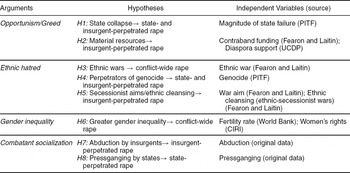
Table 2 summarizes the arguments, hypotheses and variables.
Explaining Wartime Rape: Arguments, Hypotheses, and Data Sources

ANALYSIS
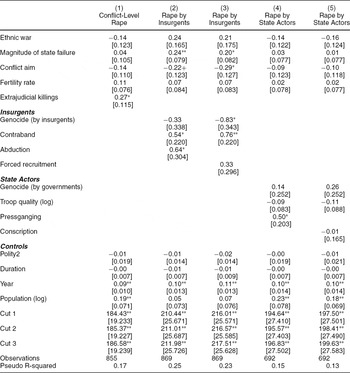
To evaluate each of the four arguments, I estimated a series of ordered probit regressions, with the standard errors clustered by conflict to account for the fact that they are not statistically independent of each other.Footnote 37 Table 3 displays the results, with models organized by the level of analysis (conflict level, insurgent-perpetrated violence, or state-perpetrated violence).
Rape during Civil War: Ordered Probit Results

Note: Robust standard errors, clustered by conflict, in brackets; **p < 0.01, *p < 0.05, + p < 0.10.
Combatant Socialization
First, there is strong evidence in support of the combatant socialization argument (H7 and H8). For insurgent violence (Model 2), the coefficient for abduction is positive and statistically significant at the .05 level, lending support to the argument that abduction is associated with rape. A broader measure of insurgent forced recruitment was not statistically significant (Model 3), suggesting that abduction in particular is associated with increased wartime rape. Similarly, the combatant socialization argument finds strong support for state actors; pressganging is a statistically significant predictor of state-perpetrated rape at the .05 level (Model 4). However, although conscription is negatively associated with wartime rape, it is not statistically significant, whether controlling for troop quality (Model 5) or not (not shown).Footnote 38
That extreme forms of forced recruitment (abduction and pressganging) are associated with rape whereas weaker forms (coercion and conscription) are not is evidence that different forms of impressment have different consequences for cohesion. Because abduction is often random, occurs with little advance notice, and can be so physically violent, it should be expected to have a more damaging effect on the internal cohesion of an armed group than weaker forms of forced recruitment, such as coercion and conscription. Weaker forms of forced recruitment typically occur more gradually and are facilitated by preexisting social ties that allow the fighters some (perhaps very small) degree of agency in deciding to join; as a result, the internal cohesion should be greater in groups that use these weaker forms of forced recruitment. I examine these differences in greater detail in the Sierra Leone case study.
Opportunism/Greed
For overall conflict-wide rape, the opportunism argument (H1) is not supported. The magnitude of state collapse is positively associated with overall conflict-wide rape, but the coefficient is not statistically significant (Model 1). However, for insurgent violence, there is support for several strands of the opportunism/greed argument. First, the magnitude of state failure (H1) predicts insurgent-perpetrated rape (Models 2 and 3), suggesting that the anarchy of state collapse affords rebel groups the ability to rape without fear of retribution or punishment by the state, perhaps even beyond the general chaos of wartime. Second, insurgent contraband funding (H2) is positive and statistically significant, confirming that lootable resources are associated with rape. However, diaspora support of insurgents is not significant either when controlling or not controlling for contraband funding (not shown).
These findings suggest that the type of material support for an insurgency matters. They provide evidence for the argument that forms of support that can easily become a selective incentive may be more likely to attract opportunistic fighters who are prone to violence (Weinstein Reference Weinstein2005). They also imply that lootable resources are more corrupting than diaspora support (the variable includes remittances and other types of support, such as sanctuary), perhaps also because they are more easily converted into selective incentives. In addition, it is lootable resources in particular—rather than unaccountable sources of funding more broadly—that are associated with wartime rape. Thus the recruitment mechanism may be more important than the accountability mechanism for explaining why material resources lead to rape. I consider the recruitment mechanism argument as an alternative to the combatant socialization argument in the case study.
For state forces, and in contrast with insurgent forces, the magnitude of state failure is in the predicted direction, but is not statistically significant. This finding may be the result of the coding for state weakness—the variable is a conservative measure capturing degrees of total state collapse. In those instances, it might be possible that the state no longer exists per se and that state forces have joined other active armed groups to commit violence—in which case, the violence would be coded as insurgent-perpetrated violence.
Ethnic Hatred
Ethnic hatred (H3) is not associated with overall conflict-levels of rape. The coefficient for ethnic war is in the wrong direction and is not statistically significant (Model 1). This is notable because ethnic hatred is commonly used to explain widespread wartime rape. However, the ethnic war variable is coded broadly, and it is possible that the ethnic cleansing variable more accurately captures the argument.
The ethnic hatred arguments for insurgents are not supported. Although ethnic war is in the predicted direction, it does not reach statistical significance (Models 2 and 3). Insurgent-perpetrated genocide (H4) is not in the hypothesized direction and is only significant in Model 3. The statistically significant coefficient indicates that genocide may actually decrease the likelihood of rape—perhaps because of pollution norms, whereby “sexual violence across ethnic boundaries may be understood. . .as polluting the [perpetrator]” (Wood Reference Wood, Shapiro, Kalyvas and Masoud2008, 341).Footnote 39 Additionally, conflict aim (H5) reaches statistical significance, but is also not in the hypothesized direction. These findings suggest that insurgencies aimed at the center are more likely than secessionist insurgencies to perpetrate rape, raising a question about why insurgents intent on leading a country would permit rape, which would only seem to erode public support for their cause.Footnote 40 Finally, ethnic cleansing (H5) is negatively associated with rape by insurgents; although this variable reaches statistical significance in some specifications (not shown), the variable's sign is consistently negative and thus is not in the hypothesized direction. This may reflect the possibility that ethnic/secessionist wars are not a precise measure of ethnic cleansing. However, until better cross-national data exist on incidents of ethnic cleansing, it is not possible to test this hypothesis more directly.
Lastly, ethnic hatred arguments are also not supported for state actors. Ethnic war (H3) is in the opposite direction of the prediction—states are more likely to commit rape in non-ethnic wars—but does not reach statistical significance. Finally, although state-perpetrated genocide (H4) is in the predicted direction, it does not reach statistical significance.
Gender Inequality
Although the consistently positive coefficient on fertility indicates that greater gender inequality is associated with higher levels of overall rape (H6), neither fertility rates nor any of the measures of women's rights—political, social, and economic—reached statistical significance in any specification (not shown). Once a war has begun, there is no apparent relationship between gender inequality and rape during civil war. However, as previously noted, scholars have found a strong relationship between gender inequality and conflict onset. The insignificant findings may therefore reflect that, for those countries undergoing major civil war, gender inequality is so widespread that it cannot account for the variation in wartime rape. Although it would be inaccurate to argue that gender inequality has no influence on wartime rape, there is no evidence that conflicts with high levels of rape are distinguished from conflicts with little or no rape by these factors.
Additional Factors and Controls
For overall levels of conflict violence, extrajudicial killing is statistically significant and is positively correlated with overall levels of wartime rape (see robustness checks for more details), supporting arguments that lethal violence and sexual violence may be associated in general, although not always in particular cases.Footnote 41 The controls for democracy and duration are consistently negative—suggesting that lower levels of democracy and shorter wars are associated with rape—but insignificant. Population (log) is consistently positive and significant for conflict-level rape and state-perpetrated violence. Larger populations may be more likely to experience state-perpetrated rape, echoing results from earlier studies that found evidence that, all else being equal, larger states may be more likely to repress their citizens (Poe and Tate Reference Poe and Tate1994).
Finally, the variable Year is consistently positive and statistically significant. This finding indicates that time is an important factor in worsening reports of rape. However, it does not settle the debate over whether rape has indeed increased over time or whether monitoring and reporting practices are improving, so what looks to be worsening human rights practices may be at least partially an artifact of measurement (Clark and Sikkink Reference Clark and Sikkink2013).
Substantive Results
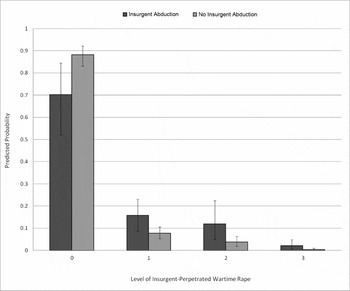
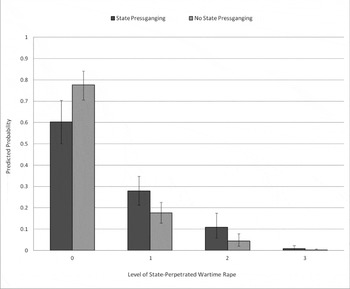
To determine the substantive impact of abduction and pressganging, I calculated the likelihood of each level of rape on the four-point scale with and without abduction by insurgents and with and without pressganging by states using CLARIFY (Tomz, Wittenberg, and King Reference Tomz, Wittenberg and King2003). Figure 1 shows the mean predicted probabilities, with 95% confidence intervals, of insurgent-perpetrated rape at each level of the dependent variable, given abduction or no abduction. Figure 2 displays the same information for state-perpetrated rape. In all cases, abduction and pressganging increase the probability of wartime rape. Rebel groups that rely on abduction are about 2 times, 3.2 times, and 5.5 times more likely to commit wartime rape at levels 1, 2, and 3, respectively, than those groups that do not abduct their fighters. State forces that rely on pressganging are about 1.6 times, 2.5 times, and 4 times more likely to commit wartime rape at levels 1, 2, and 3, respectively, than those government actors that do not pressgang. These findings support the hypothesis that abduction and pressganging have a sizable effect on wartime rape, even when controlling for numerous other factors.
Probability of Insurgent-Perpetrated Wartime Rape with and without Abduction
Note: Ordered probit model with standard errors clustered by conflict. Each simulation includes ethnic war, magnitude of state failure, aim, fertility rate, genocide by insurgents, contraband, Polity2, duration, year, and population (log) (all set at their mean values). The error bars represent the 95% confidence interval for each predicted probability value. Estimates calculated using CLARIFY. Two-tailed t-tests show that the differences in the mean predicted probabilities at levels 0, 1, and 2 are statistically significant at the 5% or 10% level. The difference between the mean predicted probability values for level 3 wartime rape falls just short of statistical significance (p = 0.13).

Probability of State-Perpetrated Wartime Rape with and without Pressganging
Note: Ordered probit model with standard errors clustered by conflict. Each simulation includes ethnic war, magnitude of state failure, aim, fertility rate, genocide by state actors, troop quality (log), Polity2, duration, year, and population (log) (all set at their mean values). The error bars represent the 95% confidence interval for each predicted probability value. Estimates calculated using CLARIFY. Two-tailed t-tests show that the differences in the mean predicted probabilities at levels 0, 1, and 2 are statistically significant at the 1% or 5% level. The difference between the mean predicted probability values for level 3 wartime rape is not statistically distinguishable from zero (p = 0.26).

Robustness Checks
On the conflict-year data, I tested an alternate measure of extreme lethal violence by the state—a dummy variable MassKill based on Valentino, Huth, and Balch-Lindsay's (Reference Valentino, Huth and Balch-Lindsay2004) measure of whether the state killed more than 50,000 civilians. In models of state-perpetrated wartime rape, including MassKill instead of Genocide did not alter the substantive results. I also tested an alternate measure of gender equality—female labor force participation—which ranged from 9–90% in the study period. As with the other proxies for gender equality, it was not statistically significant, and the main results remained robust.
Generating a separate conflict-level dataset (n = 86), with aggregated versions of the main dependent and independent variables, I also estimated a set of ordered probit regressions on conflict-level data using the highest reported level of rape by actor type as the dependent variable and a set of conflict-level measures of independent variables. On this conflict-level dataset, the main results hold and are robust to the inclusion of regional controls and clustering the standard errors by country.Footnote 42
Finally, it may be argued that the effects that the analysis uncovers are not necessarily causal. It is possible, for instance, that armed groups perpetrating rape have difficulty recruiting voluntary members and are therefore forced to abduct. To address identification issues, I controlled for numerous plausible omitted variables and, in some cases, used several proxies for the same variable. Additionally, there is a causal element to random abduction into a group and the violence the group perpetrates, because random abduction of civilians must occur temporally before the violence that the same people enact once they are a part of the armed group. Concerns about endogeneity or reverse causation can be at least partially addressed by tracing this mechanism on the micro level in the case study.
MICRO-LEVEL EVIDENCE FROM THE SIERRA LEONE CIVIL WAR (1990–2002)
Although the statistical analysis demonstrates a correlation between extreme forms of forced recruitment and rape, the nature of the relationship between these variables is best established through a case study. In particular, the case study can help explain why abduction and pressganging are associated with rape, whereas forced recruitment and conscription more generally are not. The case study also shows how rape creates cohesion in groups that have abducted their fighters. Additionally, it explores a series of observable implications of the combatant socialization argument. Finally, I show that an alternative argument that found support in the cross-national data does not explain the observed variation in this case as well as the combatant socialization argument does.
The following brief case study relies on three main data sources: a set of in-depth interviews conducted with ex-combatants in Sierra Leone;Footnote 43 the 2004 Sierra Leone War Crimes Documentation (SLWCD) survey (Asher et al. Reference Asher2004), a nationally representative survey of about 3,600 randomly selected households; and a nationally representative survey of ex-combatants (Humphreys and Weinstein 2004) with data on the combatant groups’ demographics, including information on recruitment patterns.
Based on available evidence, the large majority of victims of wartime rape in Sierra Leone identified their perpetrators as members of the Revolutionary United Front (RUF), the main rebel group.Footnote 44 That the RUF was reported to have committed the vast majority of rapes is not an artifact of the number of combatants in the group. Among the population of approximately 70,000 demobilized fighters, only about 34% were RUF combatants. The largest armed group was the Civilian Defense Forces (CDF), with about 50% of the total combatants, and the smallest of the major fighting factions was the Sierra Leone Army (SLA), with around 12% (Humphreys and Weinstein 2004). The evidence clearly demonstrates that the RUF disproportionately perpetrated rape; the important question is why.
The armed groups varied dramatically in how they recruited fighters. On joining, RUF combatants “typically knew nobody in their factions,” with 77% reporting that they knew neither friends nor family in their unit, leading Humphreys and Weinstein (2004) to conclude that the RUF was a group of “mutual strangers.” In contrast, 78% of the CDF reported being recruited by a friend, relative, or a community member, and CDF recruits usually served in units with friends and family members; only 7% knew no one in their unit (Humphreys and Weinstein 2004).
Although many members of the CDF were recruited by kin, they did not necessarily join voluntarily. A detailed conflict-mapping project notes that CDF fighters were coerced even in the early years of the war. For example, the project cites an incident in which a policeman ordered a chief “to gather all the hunters in the section” (Smith, Gambette, and Longley Reference Smith, Gambette and Longley2004, 164) to be sent to fight, and in another incident, members of a town were “instructed [by an army captain]. . .to give their young men to be trained as vigilantes” (453). Both of these examples demonstrate the use of weaker forms of forced recruitment—coercion and conscription—to garner fighters for the CDF. Notably, the fighters in these cases knew each other and were allowed a degree of agency in deciding to join. As the combatant socialization argument predicts, the CDF was not reported to commit widespread rape in this period.
In the later years of the war, however, individual units comprising the CDF expanded beyond defending only their home chiefdoms. As the CDF units moved into other regions and joined with other fighting forces, they began abducting, and the levels of violence, including rape, committed by the CDF increased. Smith et al. explicitly note this pattern, arguing that a cause of the increase in atrocities by the CDF was that the “new” CDF recruits, who were abducted by force, committed more atrocities than the “old” recruits, some of whom had been carefully selected by their chiefs (Smith, Gambette, and Longley Reference Smith, Gambette and Longley2004, 54). The CDF grew rapidly during recruitment drives in this period, and commanders reported being unsure how many fighters were under their supervision (Forney Reference Forney2012). The abduction of large numbers of fighters resulted in a significant loss of internal cohesion. As the CDF began using more extreme forms of recruitment their propensity to commit wartime rape increased accordingly.
The case study also demonstrates a number of observable implications of the combatant socialization argument. The first is that abduction and rape should covary. All factions in Sierra Leone reportedly abducted fighters over the course of the war, but the RUF abducted fighters most often. In addition, RUF was involved in 75% of all attacks and battles throughout the war, but lost almost two-thirds of the battles they fought (186 battles lost of 291 battles total).Footnote 45 Both the relatively large number of battles and the high proportion of losses suggest that the RUF, far more often than other fighting groups, needed to constantly draw in new members. Of fighters who reported joining in 1991, 78% said they were abducted, compared with 94% whose first year with the RUF was 1998 (Humphreys and Weinstein 2004). In general, reports of abduction and reports of rape covary over time. Data from the SLWCD survey show two spikes in reported rape in 1998 and 1999, and the number of reported incidents of abduction closely track these increases.Footnote 46 If the composition of the group changed little over time, there would be diminishing marginal effectiveness of gang rape. But there were periods of increased need for new fighters due to the nature of the war, including during periods of intense fighting. The loss of fighters and the subsequent abduction and integration of new recruits may be why the RUF invasion of the capital city of Freetown in January 1999 resulted in so many reports of gang rape.
A second observable implication is that, in cases where women are also abducted as fighters, there should be reports of perpetrators of both sexes. The RUF committed the most rape and had the largest proportion of female fighters (24%, according to Humphreys and Weinstein 2004). Of the reported incidents of gang rape in the SLWCD survey, 74% were committed by male-only groups. Mixed-sex perpetrator groups committed 25% of the incidents of gang rape, which comprised 19% of the total reported rape. That is, the survey data indicate that women participated in one in four of the reported incidents of gang rape, or nearly one in five of the total (gang and single-perpetrator) incidents of rape. In interviews, I found that women in the RUF were active perpetrators of gang rape, including restraining the victims and raping them with bottles and sticks.Footnote 47
A third observable implication is that ex-combatants reported that commanders rarely directly ordered them to rape. Few rank-and-file ex-combatants said they were ever commanded to rape, and only a small number of the unit commanders admitted they ever ordered their men to rape. One former RUF fighter said, “Commanders never ordered their men to rape, but they knew it was happening, and they did it themselves.”Footnote 48 Of the 34 ex-combatant interview subjects, about three-quarters of the sample said they had never seen or heard a commander give an order to rape—an important finding, because this admission is seemingly counter to the fighters’ self-interest.
In addition, for rape to serve a bonding function, the violence must be observable to other perpetrators. Of the reported rape in the SLWCD survey, 76% was committed by multiple perpetrators.Footnote 49 The survey instrument did not inquire about the exact number of perpetrators, but did distinguish single-perpetrator attacks from those with multiple perpetrators. Evidence from interviews confirms that gang rape happened regularly and was commonly viewed by other combatants and family members or villagers.
Finally, if rape functions as the combatant socialization argument predicts, then it should be a form of violence that creates social bonds between fighters. Interviews with fighters provide abundant detail that rape fostered cohesion rather than causing divisiveness within the group. One particularly revealing answer was the following reply to the question of what types of activities the group would typically do together: “The group rape of women,” said one RUF ex-combatant. “Afterward, we would feel good and talk about it a lot, discuss it amongst ourselves, and laugh about it.”Footnote 50 Others confirmed that rebels would often discuss their sexual prowess with each other, recounting the number of women they had raped during a particular raid. Another ex-combatant stated, “The rebels felt pleased that they were having so much sex, and we would brag to each other about enjoying it so much.”Footnote 51 Notably, these descriptions were in marked contrast to how ex-combatants recalled conducting other forms of group violence, such as looting and killing. Another measure of cohesion is whether former fighters stayed in contact in the postwar period. Despite the fact that members of the CDF were overwhelmingly recruited into their units by friends or relatives, RUF members were more likely to stay in touch with friends from their faction after the war than CDF members were (Humphreys and Weinstein 2004). This pattern suggests that, although fighters were mostly abducted—quite violently—into their units, the RUF combatants felt strongly socially cohesive with their fellow fighters.
Finally, the cross-national results supported the hypothesis that the availability of material resources predicts the types of recruits attracted to join a group and, in turn, whether civilian abuses will be committed on a mass scale (Weinstein Reference Weinstein2007). The argument, at its core, is concerned with combatants’ motivations, both for fighting and for committing other acts of violence, for those who “elect to participate” (Reference Weinstein2007, 7) in armed groups. Because the RUF comprised mostly abducted recruits, the group was made up of a broad variety of different people, few of whom chose to join. Evidence from interviews suggests rape was committed not only by those who joined voluntarily (i.e., those who might be considered “violent types”) but also by seemingly ordinary people who were abducted. Despite the availability of material resources, the selection of abusive types does not well explain rape in Sierra Leone, where abductees appear to have perpetrated the majority of rape.
CONCLUSION
Previous scholarship has shown that the occurrence of rape in war varies widely (e.g., Cohen Reference Cohen2010; Leiby Reference Leiby2009; Wood Reference Wood, Shapiro, Kalyvas and Masoud2008). What explains this variation? I have argued that the mechanism by which fighters are recruited affects the propensity for combatants to engage in wartime rape. When fighters are forcibly recruited, rape serves to socialize recruits into a coherent force. The findings show that the more extreme forms of forcible recruitment—the random abduction of strangers by insurgents and by states—provide a statistically significant explanation for the occurrence of wartime rape, even when controlling for many other factors, lending support to the combatant socialization argument.
Additionally, circumstances matter. Wartime rape by insurgents is associated with state collapse, which indicates that weak institutions and lack of enforcement of laws create opportunity. Insurgents who fund their operations through contraband are also more likely to commit rape; those relying on diaspora support are not. This finding suggests that access to lootable resources has an especially corrupting influence.
Several common suppositions were not supported. Wartime rape is not more likely during ethnic conflicts nor during genocides. Gender inequality is also not associated with wartime rape.
These findings have important implications for the scholarship on the human costs of war. First, the logics derived from the study of lethal violence may not serve to enhance the understanding of wartime rape. Explaining why rape is widespread in some conflicts but not in others requires further examination of the mechanisms by which fighters are recruited, trained, and socialized.
Second, the findings suggest that high levels of wartime rape may not be part of a military strategy—it may not be an overt “tool” or “weapon” of war—but instead serve to bond recruits together. If so, then the phenomenon often originates at the level of the rank-and-file fighters (see also Goldstein Reference Goldstein2001, 368), rather than at the level of commanders.
Reports of abduction by armed groups may serve as an early warning sign of an escalating threat of wartime rape. Such a threat may be especially acute under conditions of state collapse and the presence of lootable resources. In sum, the empirical support for the combatant socialization argument provides the basis for a new direction in academic analyses of wartime rape and possible policy interventions.





Comments
No Comments have been published for this article.