Implications
The study highlights the key role for animal scientists in developing and designing national and international mitigation policies. The study describes how market-based mitigation policies and standards require science-based information about the relationship between production practices, technologies and emissions. Similarly, international emissions trading schemes and other global policies depend on a producer, sectoral, or national accounting of emissions, which cannot be estimated without an adequate scientific underpinning. Furthermore, effective mitigation will require the research, development, and diffusion of new mitigation technologies, and improved capacities measure emissions from livestock production.
Introduction
The increase in demand for animal products driven by growing populations and incomes is stronger than for most food items. Global production of meat is projected to more than double from 229 million tonnes in 1999 to 2001 to 465 million tonnes in 2050, and that of milk to increase from 580 to 1043 million tonnes (Food and Agriculture Organization of the United Nations (FAO), 2006).
The livestock sector has a primary and growing role in human nutrition and the agricultural economy. At the same time, livestock has a major influence on the environment through its effects on water and air quality, deforestation and biodiversity (Steinfeld et al., Reference Steinfeld, Gerber, Wassenaar, Castel, Rosales and de Haan2006). In recent years, there has been growing awareness of livestock sector’s contribution to greenhouse gas (GHG) emissions, which has lead to increasing calls to expand the role of livestock and agriculture in national and international mitigation efforts.
Although total GHG emissions from livestock have likely been growing because of increasing animal numbers, there have been significant emission reductions on a per-unit of animal product basis in some regions (Capper et al., Reference Capper, Cady and Bauman2009). These declines are because of the efficiency gains in production – which allows for a decrease in the number of animals and amount of feed required to produce the same output, and to policies that are not targeted at GHG emissions but that achieved emissions reductions indirectly. For example, as stated in a report from the Second European Climate Change Programme (European Commission, 2005): ‘The GHGs emission trends observed are for the most part due to the side-effect of structural changes or Common Agricultural Policy or the implementation of water protection legislation, and not to specific climate change measures in the agricultural policy area.’
There is a substantial potential to reduce the sector’s contribution to climate change through policies that foster the adoption of a wide range of technologies and management practices that are available to reduce emissions from livestock farming and to increase carbon sequestration in agro-pastoral systems (Gill et al., Reference Gill, Smith and Wilkinson2009). However, a widespread adoption of these technologies faces a number of challenges stemming from the large number of livestock holders often owning a small number of animals, the great diversity of livestock production systems, each requiring adapted technical packages and policy instruments, and the wide variation in agro-ecosystems. To be feasible, policies must impose limited administrative costs on governments and limited transactions costs on producers (Chopra et al., Reference Chopra, Leemans, Kumar and Simons2005; World Bank, 2009). With much of the expected growth in livestock-related GHG emissions expected to occur in developing countries, a challenge also exists to provide incentives for producers in countries without United Nations Framework Convention on Climate Change (UNFCCC) obligations to reduce emissions, and to design policies that promote economic development and the livelihoods of smallholders.
A key role for animal scientists in the development and design of mitigation policies is to improve information about the linkage between production practices and technologies and emissions. Effective mitigation policies can only be designed if policymakers understand the effects of policies on emissions and production. Internationally, mitigation strategies based on national or sectoral level emissions require an ability to quantify and verify emissions. In order to function, international emissions trading schemes (ETSs) require accounting of emissions to be performed at a level of aggregation that can range from producer to national level. GHG inventories cannot be developed without an understanding of how emissions are related to particular production practices.
This study explores specific policy options available for taking advantage of the livestock sector’s mitigation potential and discusses these options in the context of national and international development agendas. We first briefly describe the main sources of GHG from livestock and review the available technologies for climate change mitigation in livestock systems. We then describe and assess the main policy instruments available to curb emissions and promote carbon sinks, and discuss the relative merits of alternative approaches and some recent experiences with these policies. In the section ‘National experiences with abatement policies,’ we analyze the experiences of three countries that have already designed and/or implemented mitigation strategies for the livestock sector to illustrate key issues and constraints in policy implementation. Finally, we explore the main issues and challenges surrounding international efforts to mitigate GHG emissions and discuss some possible ways to address these challenges in future climate agreements.
Livestock sector contribution to climate change and existing technologies for mitigation
Overview of emissions
Estimates of GHG emissions throughout the livestock commodity-chain are substantial. GHG emissions arise from feed production (for example through chemical fertilizer production, deforestation for pasture and feed crops, cultivation of feed crops, feed transport and soil organic matter losses in pastures and feed crops), animal production (for example through enteric fermentation and CH4 and N2O emissions from manure), and as a result of the transportation of animal products. According to Steinfeld et al. (Reference Steinfeld, Gerber, Wassenaar, Castel, Rosales and de Haan2006), livestock contribute about 9% of total anthropogenic CO2 emissions, but 37% of CH4 and 65% of N2O emissions. The combined emissions expressed in CO2 equivalent are estimated to amount to about 18% of anthropogenic GHG emissions. The commodity-chain methodology used by Steinfeld et al. (Reference Steinfeld, Gerber, Wassenaar, Castel, Rosales and de Haan2006) is not used by the Intergovernmental Panel on Climate Change (IPCC), and there is some variation in the attribution of emissions depending on methodology.
Along the animal food chain, the major sources of emissions are the following (Steinfeld et al., Reference Steinfeld, Gerber, Wassenaar, Castel, Rosales and de Haan2006):
• Land-use and land-use change: about 2.5 Gt of CO2 equivalent; including forest and other natural vegetation replaced by pasture and feed crop in the Neotropics (CO2) and carbon release from soils such as pasture and arable land dedicated to feed production (CO2).
• Feed production (except carbon released from soil): about 0.4 Gt of CO2 equivalent, including fossil fuel used in manufacturing chemical fertilizer for feed crops (CO2) and chemical fertilizer application on feed crops and leguminous feed crop (N2O and NH3).
• Animal production: about 1.9 Gt of CO2 equivalent, including enteric fermentation from ruminants (CH4) and on-farm fossil fuel use (CO2).
• Manure management: about 2.2 Gt of CO2 equivalent, mainly through manure storage, application and deposition (CH4, N2O and NH3).
• Processing and international transport: about 0.03 Gt of CO2 equivalent.
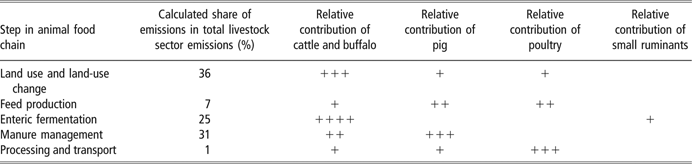
On comparing species, cattle and buffalo make the largest contribution to these emissions, compared with pigs and poultry (Table 1). Their emissions are predominantly related to land-use changes (such as deforestation) and pasture management, enteric fermentation and manure management. They contribute an especially large share of the livestock sector’s emission in Latin America and South Asia, where they are estimated to account for more than 85% of the sector’s emissions, mainly in the form of CH4.
Emissions of greenhouse gas along the animal food chain and estimated relative contribution from major species.

Adapted from Steinfeld et al. (Reference Steinfeld, Gerber, Wassenaar, Castel, Rosales and de Haan2006).
Low (+), moderate (++), significant (+++), high (++++).
Technical options for mitigation
This section summarizes current estimates of potential carbon sequestration in rangelands and potential GHG (CO2, CH4 and N2O) emission reduction from range-based and landless animal production systems.
Mitigating GHG emissions from rangeland-based systems
Rangelands capture significant quantities of CO2; the tropical savannas and temperate grasslands together account for about 27% of global carbon stocks, compared with about 6% for the croplands (IPCC, 2000). The IPCC Fourth Assessment Report indicates that agricultural practices collectively can make a significant contribution at low cost for increasing soil carbon sinks, to GHG emission reductions, and by contributing biomass feedstocks for energy use. Several existing technologies hold promise for their mitigation potential in livestock systems, and these are classified by Metz et al. (Reference Metz, Martino, Cai, Gwary, Janzen, Kumar, McCarl, Ogle, O’Mara, Rice, Scholes and Sirotenko2007) according to whether they reduce emissions, enhance removals, or avoid (or displace) emissions. Emissions can be reduced by managing livestock to make more efficient use of feeds, for example, which may reduce CH4 emissions. Management practices that increase the photosynthetic input of carbon and/or slow the return of stored carbon to CO2 through respiration, fire or erosion will increase carbon reserves and thus sequester carbon (Metz et al., Reference Metz, Martino, Cai, Gwary, Janzen, Kumar, McCarl, Ogle, O’Mara, Rice, Scholes and Sirotenko2007). Significant amounts of vegetative carbon can also be stored in agro-forestry systems or other perennial plantings on agricultural lands (Conant and Paustian, Reference Conant and Paustian2002; FAO, 2009a). Carbon dioxide emissions can be avoided by agricultural management practices that forestall the cultivation of new lands now under forest, grassland, or other non-agricultural vegetation (Metz et al., Reference Metz, Martino, Cai, Gwary, Janzen, Kumar, McCarl, Ogle, O’Mara, Rice, Scholes and Sirotenko2007).
Although technical options for mitigating emissions from grazing systems in developing countries do exist, there are various problems to be overcome, related to incentive systems, for example, institutional linkages, policy reforms, monitoring techniques for carbon stocks, and appropriate verification protocols. For the pastoral lands, given the relatively weak institutions and immediate need for improving access to food, Reid et al. (Reference Reid, Thornton, McCrabb, Kruska, Atieno and Jones2004) conclude that mitigation activities have the greatest chance of success if they build on traditional pastoral institutions and knowledge, while providing pastoralists with food security benefits at the same time.
Mitigating GHG emissions from landless systems
Technical options are also available to mitigate gaseous emissions of intensive systems (UNFCCC, 2008; Gill et al., Reference Gill, Smith and Wilkinson2009), which are mostly related to manure management (pig, dairy and feedlots) and enteric fermentation (dairy and feedlots). Anaerobic digestion allows CH4 emissions from animal storage to be reduced whereas at the same time producing biogas that can substitute for fossil fuel energy. Technology has shown to be highly profitable in warm climates (Gerber et al., Reference Gerber, Carsjens, Pak-uthai and Robinson2008). Recent developments in energy policy have also enhanced its economic profitability in countries such as Germany and Denmark (European Biomass Association (AEBIOM), 2009). Manure application practices are also available to reduce N2O emissions. Improved livestock diets and feed additives can substantially reduce CH4 emissions from enteric fermentation and manure storage (Steinfeld et al., Reference Steinfeld, Gerber, Wassenaar, Castel, Rosales and de Haan2006). Energy-saving practices have also shown to be quite effective in reducing the dependence of intensive systems on fossil fuel energy.
Although not taking place on the production unit, CO2 emissions associated with feed production, and especially soybean, are also substantial (Steinfeld et al., Reference Steinfeld, Gerber, Wassenaar, Castel, Rosales and de Haan2006). Improved feed conversion ratios have already substantially reduced the amount of feed required per unit of animal product, but there is substantial variation between production units and countries and further genetic and management improvement can be expected. A relaxation of the ban on meat and bone meal, a precautionary measure in response to the bovine spongiform encephalopathy crisis, could however result in a substantial reduction of soymeal consumption. It is estimated that to compensate for this source of protein, European Union (EU) farmers imported an additional 1.5 million tonnes of soymeal between 2001 and 2003 (Steinfeld et al., Reference Steinfeld, Gerber, Wassenaar, Castel, Rosales and de Haan2006). Options are also available to restore organic carbon in the cultivated soils used for soybean production and there is still a substantial yield gap to be bridged between experimental conditions and common practice.
Policy instruments to mitigate GHG from livestock
Mitigation policies seek to reduce the negative externalities associated with GHG emissions from livestock production. Mitigation options include market-based mechanisms, such as emission taxes, subsidies, and trading schemes; standards that proscribe specific technology or performance outcomes; and voluntary mechanisms that rely on producers or consumers making decisions that reduce emissions that might not be in their immediate economic self-interest. Mitigation policies can reduce GHG emissions by either altering the inputs and technologies used in the production process or by changing the basket of goods produced and consumed. In this section, we consider tradeoffs between alternative policy approaches and provide an overview of recent experiences with these policies.
Economic efficiency is among the key criteria for policy evaluation (Perman et al., Reference Perman, Ma, McGilvray and Common2003). Benefits to society from mitigating GHG from livestock include the economic, environmental, and health benefits from reducing the accumulation of GHG in the atmosphere. Benefits may also include environmental co-benefits, such as reductions in water or air pollution, and economic co-benefits in terms of economic development and growth (FAO, 2009a). Costs of mitigation policies might include higher livestock product prices, lower profits and higher transactions costs for producers, and increased administrative and budgetary costs for governments.
Administrative feasibility, which largely depends on costs associated with measuring and monitoring emissions, verifying compliance, and administering and enforcing policy, is another important criterion for evaluating policy. Incorporating livestock into existing incentive-based schemes to reduce GHG is challenging, in part, because it is often difficult to measure and verify emissions. Livestock production is geographically dispersed and emissions occur on a large number of relatively small operations. In addition, many potentially important aspects livestock GHG emissions, such as N2O emissions from soil, and CO2 emissions from deforestation are difficult to measure and attribute and are highly variable. Feasibility also depends on transaction costs incurred by farmers or agro-processors who participate in GHG mitigation schemes. Transaction costs include the time and expense associated with complying with a policy such as filing paperwork, obtaining legal advice, and registering property or emissions. Some policy approaches, like carbon offsets in an ETS, can impose large fixed transaction cost on producers, which makes participation infeasible for small-scale operations (FAO, 2009b).
Taxes
Emission taxes
Taxes based on actual measured emissions can be economically efficient if the tax rate equals the marginal damage caused by the emissions. Under an emissions tax, producers have an incentive to reduce emissions until their marginal cost of abatement equals the marginal tax – hence, producers with low abatement costs reduce emissions more than producers with high costs. Emission taxes provide producers with an incentive to reduce emission over time by updating their abatement technology, as new technologies become available.
A major obstacle for implementing emissions taxes in the livestock sector is the difficultly and cost of measuring actual emissions. An important exception is the case of CH4 emissions from manure storage facilities, for which clean development mechanism (CDM) methodologies exist (FAO, 2009b). In many countries, larger farms could be required to install and measure CH4 emitted from their manure facilities, which would provide, in theory, a basis for an emissions tax. Farmers could reduce emissions by installing a device to burn the CH4 (e.g. flaring, heating, or electricity generation) (Steinfeld et al., Reference Steinfeld, Gerber, Wassenaar, Castel, Rosales and de Haan2006; FAO, 2009b).
Unit taxes based on average carbon emissions
With most livestock GHG emissions, per unit tax on output would have lower associated administrative costs compared with an emissions tax. In its simplest form, output (e.g. meat and milk) would be taxed in proportion to the average carbon emitted in production by all farmers in a region (or country). A unit tax on output increases the marginal cost of production: to supply a given quantity, producers require a higher price, because the government collects the unit tax from each unit sold. In equilibrium, the tax results in less production and consumption, and consequently lower emissions, but also an increase in the commodity price.
With a unit commodity tax, production and consumption shifts toward products with lower associated emissions, and away from products with higher emissions. A disadvantage with an output tax is that it does not reward individual producers who adopt less-polluting technologies. There is no incentive for farmers to reduce their per-unit carbon emissions because the tax rate does not depend of the production technology. Hence, this type of tax is more appropriate in situations where the development of emissions abatement technology is likely to occur very slowly or where the adoption of new technologies is not feasible (Schmutzler and Goulder, Reference Schmutzler and Goulder1997).
Taxes based on inputs
Rather than basing tax rates on average emissions for a region, a per-unit output tax could be based on the quantity or quality of inputs used or the method of production. For example, beef raised in systems using manure lagoons having high carbon emissions would face higher tax rate than beef produced in a low-emissions pasture-based system. Another option would be to tax inputs (or production technologies) directly. For example, cattle farmers using an uncovered lagoon might face an annual lump sum tax based on the capacity (emissions) of the lagoon. If there is a direct link between the size of the lagoon and the volume of the farm’s output, then the tax burden increases with the farm’s output, and the effect of the input tax would be similar to an output tax based on the method of production.
It is administratively feasible to observe and verify the use of livestock production technologies (feed type, breed and manure management practices) and to link these technologies to emissions levels. A tax based on input use would require tracing production from farm to the market, and assessing an appropriate tax. This type of tax could vary substantially in complexity, depending on the number of different technologies and tax rates imposed. In some cases, there could be many possible production technologies, and determining an appropriate tax requires knowledge of the relationship between the production process and emissions.
A tax based on input use or production technology would provide an incentive for farmers to adopt cleaner technologies. However, such a tax rewards farmers for adopting only those inputs regulated by the tax scheme. To be included within the tax scheme a technology must exist and be easily verified by the regulator. Technologies that cannot be easily monitored or verified, such as specialized feed regimes, could not feasibly included in a tax regime. In addition, a technology-based tax would not promote the development of new technologies to reduce emissions, as there is no economic incentive for producers to develop or adopt technologies that are outside of the tax system, unless a mechanism is built to include new technologies in the system.
Experiences with taxes
Although several countries (including Sweden, Finland, the Netherlands and Norway) and regions (including the Canadian province of British Columbia and a few municipalities in the USA) have enacted carbon taxes on carbon-based fuels (oil, coal and natural gas), carbon taxes have not yet been applied to agricultural products. In 2003 the government of New Zealand proposed a tax on CH4 emissions from livestock, but it was ultimately dropped because of political oppostion from farmers. More recently, there have been proposals in Ireland, Denmark and the USA to tax CH4 emissions from livestock, but these have met substantial opposition from producers.
Subsidies
Abatement subsidies
With an abatement subsidy, farmers receive a subsidy for reducing emissions below a predetermined cap or initial emissions level. Output can provide a proxy for emissions, using an average emissions coefficient. Alternatively, producers could receive a subsidy for each unit reduction in production, but with the subsidy rate depending on the production technology used. For example, producers would receive a larger subsidy from reducing output from a high-emissions lagoon system compared with a low-emissions pasture system.
With an abatement subsidy, producers have an incentive to reduce emissions to gain the subsidy – the cost of emitting carbon is the forgone subsidy. Hence, like taxes, abatement subsidies increase the marginal costs of firms. In the short run, an abatement subsidy is equivalent to an output tax in terms of its effects on prices, production, consumption and emissions. If the subsidy is only available to those farmers operating when the subsidy was imposed, then the subsidy is also equivalent to a tax in the long run. However, if the subsidy is available to entering producers, then in the long run, subsidies can produce very different outcome than taxes, and can even be counterproductive in terms of reducing emissions (see, e.g. Baumol and Oates, Reference Baumol and Oates1988; Pearce and Turner, Reference Pearce and Turner1990; Kohn, Reference Kohn1992). Because subsidies lower average costs, farms earn above-normal profits, which creates an incentive for additional farms to enter production. The result is more total production and more total emissions (even though each farm produces less than the initial amount). Hence, to achieve a reduction in emissions, it is crucial to limit access to abatement subsidies to an initial group of producers. Unfortunately, limiting subsidies is usually politically and administratively difficult.
Abatement technology subsidies
Rather than subsidizing emissions or output reductions, governments could subsidize inputs or abatement technologies. Abatement technology subsidies could take two forms. One is a per-unit output subsidy for commodities produced using a lower emissions technology. In this case, the subsidy is not for reducing production below a certain amount, but rather for producing output using a cleaner technology. For example, beef produced in operations using lagoon covers or biogas collectors might receive a per-unit commodity subsidy, whereas beef produced using open lagoons would not. The second form is to subsidize the cost to producers of using an emission-reducing technology. For example, farmers might receive a lump sum subsidy for adopting a biogas collector or lagoon cover. These types of subsidies are an important component in existing carbon offset schemes, and are discussed in more detail below.
Unlike abatement subsidies that raise the marginal cost of production, abatement technology subsidies lower the marginal costs of production by reducing the capital expenditure, which gives producers an incentive to supply more output at a given price, rather than less. Consequently, these subsidies result in a net increase in total output and a decrease in the commodity price in the short run (and long run). Technology subsidies can reduce emissions by shifting production from polluting methods of production, toward cleaner methods. However, because abatement technology subsidies can result in greater output from the less-polluting sector, which causes the total pollution from this sector to increase, the effect of the subsidy on total emissions is ambiguous.
Experiences with subsidies
There are a variety of relatively new programs in North America and Europe that subsidize the adoption and diffusion of technologies to reduce GHG emissions from livestock. Most programs that directly target GHG emissions focus on capturing and burning CH4 emissions from manure storage facilities. The state government in California (USA), for example, has initiated several programs to encourage the manure treatment with anaerobic digesters, including the Dairy Power Production Program, the Self-Generation Incentive Program, which provide cost-share funding for capital investments toward the new installation of CH4 digesters (Center for Clean Air Policy (CCAP), 2009). Other US State programs provide tax incentives to install anaerobic digesters in livestock operations. In Europe, the German Agricultural Investment Assistance Program facilitates adoption of biogas systems, changes in manure storage and application practices, and energy use efficiency in production facilities. Also in Germany, the Renewable Energies Act (2004) provides subsidies for electricity generated using biomas from agricultural and forestry sources.
Tax-subsidy combinations
In cases (such as GHG emissions from livestock production) where it is administratively costly to monitor emissions, it is possible to increase the efficiency of an abatement technology subsidy by combining it with an output tax (Fullerton, Reference Fullerton1997; Fullerton and Wolverton, Reference Fullerton and Wolverton1999; Walls and Palmer, Reference Walls and Palmer2001). As discussed above, an abatement technology subsidy creates an incentive for producers to switch to a less-polluting technology, but it also decreases firms’ average costs of production and therefore decreases the equilibrium break-even price. Thus, a subsidy alone might increase output and could increase total pollution.
Combining a per-unit tax with an abatement technology subsidy can prevent an increase in output and emissions. The output tax raises firms’ costs of production, and therefore prevents excessive production. Hence, a tax-subsidy instrument uses the technology subsidy to achieve the desired substitution effect, and an output tax to correct the output effect. In cases where the emissions tax is not feasible, substantial gains in economic efficiency can be obtained relative to a simple subsidy by the addition of an output tax (Fullerton and Mohr, Reference Fullerton and Mohr2003).
Emissions trading
In a carbon emission trading or ‘cap and trade’ schemes, producers are assigned an emissions cap or quota and must obtain permits to pollute. Initially, permits can be freely allocated (e.g. based on historic emissions levels) or auctioned. Producers that reduce emissions below their cap can sell permits; those that emit above their cap must purchase permits in a tradable market. With a functioning emission permit market, producers above their cap respond as if they faced a tax (equal to the permit price) on carbon emissions, those below their cap respond as if they faced a subsidy (equal to the permit price) for their emission reductions. Hence, producers face a constant marginal cost to an additional emission unit, regardless of whether they are above or below their emissions target.
Initial efforts to reduce emissions of GHG using market mechanisms, such as the European Union Emission Trading Scheme have concentrated on major energy and industrial sectors because emissions from these sectors are substantial and can be measured and verified relatively easily. As discussed above, except for CH4 emissions from manure management facilities, the administrative costs associated with measuring emissions at the farm level are prohibitive. However, feasible carbon trading schemes could be designed where emission permits are based on output levels or input use – as with the tax and subsidy mechanisms described above. For example, emission permits could be based on average emissions per-unit. Alternatively, permits could be allocated based on the production process (e.g. X tonnes of carbon per-unit beef if raised using technology A and Y tonness if using technology B). These forms of carbon trading schemes have the same disadvantage as a tax or subsidy in not providing an incentive for producers to develop new technologies that are outside of the regulatory framework.
In the short run, when there is certainty about production costs, carbon trading has the same effect on prices, production, consumption, and emissions as a tax. In the long run, when the costs of production are uncertain, there can be important differences between tax and cap-and-trade schemes. Taxes are generally more efficient than emissions trading when abatement costs are unknown and can fluctuate over time. The costs of reducing emissions by a certain amount (the price of an emissions permit) could vary significantly from year-to-year depending on such things as the weather, energy prices, product prices, and or the development of new carbon-reducing technologies. Inflexible cap and trade systems require producers to make the same emission reductions whether the costs are high or low. In contrast, a tax provides a constant incentive for producers to reduce emissions, so they reduce emissions more when the abatement costs are low, and reduce them less when they are high. Because of this flexibility, studies have estimated that a tax could result in substantially greater net benefits than a cap and trade system (Hoel and Karp, Reference Hoel and Karp2001; Newell and Pizer, Reference Newell and Pizer2002; Pizer, Reference Pizer2002). The relative disadvantage of a cap-and-trade scheme can be reduced by setting a maximum (or minimum) permit price, which would be maintained by the government selling or purhasing permits as required.
Hybrid cap-and-trade
Analogous to the tax-subsidy combination scheme discussed above, a ‘hybrid’ cap-and-trade scheme combines a cap on overall emissions with subsidies for pollution abatement technologies. This has been proposed as a potential way of incorporating large dairy operations into a GHG reduction program in California (CCAP, 2009). With a hybrid cap-and-trade system, permit requirements would be based on livestock population by type of animal using average emissions factors. Farmers could earn subsidies (or offsets or marketable permits) based on verifiable adoption and use of emissions abatement technologies. Analogous to the tax-subsidy scheme, the hybrid cap-and-trade scheme corrects the output stimulus from the subsidy by capping the overall emissions and raising the marginal costs of production.
Offsets
Carbon offset programs allow farmers who reduce emissions to sell offset or credits to the emitters who are subject to caps. In practice, purchasers of the credits are usually outside the agricultural sector. Marketable credits/offsets are supposed to be for emissions reductions that would not have happened anyway (e.g. those that are additional to current laws, regulations, or practice). A key requirement of offset programs is the documentation of baseline emissions and the certification of changes in practices that would lead to emissions reductions.
Offsets function essentially as abatement technology subsidies, and have similar disadvantages. Farmers selling offsets enjoy higher profits (otherwise, they would not participate in the offset program). This creates an incentive for more farmers to increase production using the subsidized (offset) technology. As the abatement technology subsidy example above illustrated, total emissions might actually increase with an offset program, and the effect of an offset on emissions is, in general, ambiguous.
Experiences with offsets
Offsets for livestock CH4 mitigation have been included in some regional emission trading schemes including the Regional Greenhouse Gas Initiative (RGGI) (2009), the first mandatory market-based effort in the USA to reduce GHG emissions. Projects that reduce CH4 emissions from agricultural manure management operations are eligible for RGGI offset allowances. In Australia, the New South Wales Greenhouse Gas Reduction Scheme, which aims to reduce GHG emissions associated electricity production, uses project-based activities to offset the production of GHG emissions. Currently abatement certificates are being marketed by producers in Victoria for burning CH4 from pig livestock waste.
Standards
Command and control policies consist of technology standards, which require farmers to use specific abatement or production technologies and performance standards, which set specific emissions levels, but do not mandate particular technologies. Except for CH4 emissions from manure storage facilities, performance standards are not feasible for livestock GHG mitigation, because of the high administrative costs associated with measuring emissions.
Technology standards are generally less efficient than market mechanisms because standards require all producers to adopt the same technology, even if the costs for producers vary substantially. Abatement costs can vary due to a farm’s production design, physical configuration, locations and age of assets, etc. Because the costs of controlling emissions may vary greatly across farms, the appropriate technology in one situation may not be cost-effective in another. Technology standards also do not provide an incentive for emitters to adopt or develop cleaner technologies. A producer who has met the standard has no incentive to reduce emissions further.
In contrast, technology standards may offer benefits over market-based policies in terms of administrative costs. For example, while an abatement technology tax requires regulators to monitor and trace the production of each individual product, some technology standards can be enforced relatively inexpensively with random checks and penalties for non-compliance. As another example, it might not be administratively feasible to base a technology-based tax or subsidy on specialized feed additives because it is too costly or difficult to observe whether farmers are complying with the policy (it might not be possible to observe whether farmers are including the additive in the feed). However, with a technology standard, feed manufacturers or distributors could be required to include the feed additive into all feed, thereby eliminating the need to monitor individual farms.
Hence, when emission abatement costs are relatively homogenous and when the administrative costs of market-based are high, technology standards could potentially be more cost-effective than feasible market-based policies.
Experiences with standards
To date, governments have refrained using from implementing technology standards directly targeting GHG emissions. However, standards designed to reduce water pollution from nitrogen run-off and leaching, such as the EU nitrates directive, have indirectly reduced emissions of CH4 and N2O (UNFCCC, 2006c). In Denmark, GHG emissions have been reduced by the Ammonia Action Plan (2001), which includes rules on covering storage facilities for solid manure and slurry tanks, a ban on surface spreading and reduction of the time from field application of manure to incorporation (UNFCCC, 2008). Technology standards in Denmark are enforced, in part, by requiring permits for new or expanded swine operations.
Voluntary mitigation efforts
Voluntary efforts to mitigate emissions from livestock do not rely on price incentives or government enforcement to induce producers and consumers to alter their behavior. Voluntary carbon markets and carbon labeling are two approaches to GHG mitigation that are expanding in scope.
The voluntary carbon market is a carbon trading market that operates in parallel to regulated markets. As with the CDM, governments or producers create mitigation projects (like CH4 capture from swine manure) and independent agents verify the emissions reductions (FAO, 2009a). The offsets are then sold to companies, individuals, and other entities and activities not subject to mandatory limitations that wish to offset GHG emissions. Although the voluntary market is relatively small, it has been growing quickly with the US Carbon exchange volume increasing from USD 72 million in 2007 to USD 307 in 2008 (Science Daily, 2009).
Following the model of organic foods, carbon labeling allows consumers to choose voluntarily products with lower associated GHG emissions. The differentiation of commodities according to their related GHG emissions allows producers to be rewarded for their mitigation efforts. Carbon labeling is currently in early pilot stage of developments. The UK government is involved in developing a standardized GHG footprint methodology based on a life cycle analyses (British Standards Institution, 2008). On a similar rationale, Swedish authorities are developing guidelines on environmentally friendly food choices. For livestock commodities, recommendations include eating meat but reducing the amount, eating ruminant meat that is produced locally from grazing animals, and eating locally produced chicken (Swedish National Food Administration, SNFA, 2009).
National experiences with abatement policies
Only recently have countries begun to integrate GHG mitigation objectives into their agricultural and livestock policies. This section reviews the experience of three countries that have initiated this process. The countries were selected because they span a range of institutional, economic and agricultural backgrounds and illustrate several alternative policy formulation approaches: the integration of livestock production into the domestic Emission Trading Scheme in New Zealand, the promotion of anaerobic digestion in China, and the development of private/public partnerships in the UK.
New Zealand
New Zealand’s livestock sector is mostly based on extensive pasture systems, in which animals are grazed outdoors year-round. The sector is orientated toward the export of several key commodities, including dairy, meat and wool. Total exports from livestock (including dairy, meat, animal products, animals and meat/fish preparations) account for 35.4% of total merchandise exports value in 2008 (New Zealand Exports Merchandise trade by commodity, 2008). Following economic liberalization in the 1980s, most agricultural price supports and production subsidies were removed, and government expenditures on agriculture are now among the lowest of the Organization for Economic Cooperation and Development countries (OECD; New Zealand’s Fourth National Communication to UNFCCC, 2006a).
In 2003, GHG emissions from agriculture were estimated at 37 203 Gg CO2 equivalent, representing 49.4% of all domestic emissions and an increase of 15.6% compared with emissions in 1990. Enteric fermentation and manure management represent 63.9% and 2.1% of all agricultural emissions, respectively (UNFCCC, 2006a). This increase is attributed to increases in animal numbers and a shift in species, from sheep to dairy cows and deer. Methane and N2O emissions from the sector are expected to further rise until 2020, corresponding to an increase in animal numbers (New Zealand’s GHG inventory 1990 to 2005). Consequently, implementing cost-effective mitigation options for livestock to meet its Kyoto Protocol targets, is a major challenge for New Zealand.
Emission trading scheme
New Zealand is developing one of the first ETS to place limits on agricultural emissions. Under the 2008 draft legislation, the government proposed that the agricultural activities targeted by the scheme will be required to monitor their emissions until 2013, and will then be mandatorily included in the ETS. To facilitate the agricultural sector’s participation in the ETS, the sector will be provided with a free allocation of permits equal to 90% of 2005 emissions when it is brought into the ETS in 2013. The free allocation of permits to agriculture will decrease steadily until they are phased out completely in 2030.
The New Zealand ETS trading units will be linked with international Kyoto Protocol flexibility mechanisms, including the CDM and the joint implementation (JI). This means that the price of carbon on the New Zealand ETS will reflect the international price of carbon emissions.
Among the implementation issues under discussion is the question of the point of obligation for agricultural emissions. According to the draft legislation, the point of obligation will be nitrogen and fertilizer suppliers and meat and dairy processors, which will be responsible for the emissions that occur on farms, creating a tension between farmers and the industry. The Act allows the Government to shift the point of obligation to farm level before a cut-off date of 30 June 2010.
Research programs
The government is supporting its domestic agricultural sector through a national research strategy focusing on cost-effective technologies and management practices that can allow the sector to meet the target of reducing GHG emissions 10% below 2004 levels by the end of 2012. This large research effort is co-financed by the livestock sector in exchange of for a commitment made by the government to bear the cost of the agricultural sector’s non-CO2 emissions during the first commitment period (2008 to 2012) of the Kyoto Protocol (Pastoral Greenhouse Gas Research Consortium (PGGRC), 2009).
In addition, New Zealand launched the Livestock Emissions and Abatement Research Network (LEARN), (2009), an international initiative to facilitate the development GHG emissions mitigation solutions. It was launched in 2007 with the objective of enhancing international scientific cooperation on research to curb climate change. The main objectives of LEARN consist in improving the quantification of non-CO2 emissions from animal agriculture and facilitating the development of cost-effective and practical GHGs mitigation solutions. The network currently includes 25 member countries across different regions (North/South America, Europe, Africa, Middle East, Asia and Oceania) and focuses on four areas including: (i) CH4 emissions from livestock; (ii) N2O emissions from ruminants; (iii) integrated whole farm system impacts at all scales; and (iv) national agriculture inventory development.
Experience gained
The New Zealand case provides an example of the one of the most comprehensive climate policy frameworks being designed and implemented, both in terms of sector coverage (all sectors included) and of GHG emissions effectively addressed (including CH4 and N2O emissions, representing 63.4% and 34.9% of all New Zealand agriculture emissions, respectively). The ETS is one of the few examples of market-based measures being applied to agriculture, and it is being implemented with limited subsidies and is thus compatible with the country’s macroeconomic policies. It remains to see how the emissions trading approach will affect farmers’ income and the competitiveness of the sector as a whole. Through LEARN, New Zealand also positions itself as an international leader in addressing GHG emissions from the livestock sector.
China
China’s agriculture is characterized by scarce land, abundant labor and small-scale production using little mechanization. A large part of livestock production comes from small, part-time ‘backyard’ operations, but full-time ‘specialized’ household and commercial operations have grown rapidly in the last decades. Agriculture sector accounts for 50.1% of domestic CH4 emissions – mostly paddy rice, enteric fermentation and manure, and 92.4% of N2O emissions – mostly manure and chemical fertilizer application (UNFCCC, 1994). The level of Government support to China’s agriculture accounted for 6% of gross farm income in 2000 to 2003, mostly in the form of price support and input subsidies, and varying significantly with production type: milk and sheep production benefit from highest support, whereas support to pig meat, beef and eggs production is lower (OECD, 2005).
Biogas projects in China
Reducing the negative environmental impacts of rapidly increasing livestock production is one of the main challenges for China’s policymakers and support of biogas production has been a one response to this challenge (Jiang et al., Reference Jiang, Sui, Wu, Yang and Wang2007). The main objectives of policies supporting anaerobic digestion include reducing the negative impacts on water resources and human health of waste management, and improving odor control, enhancing energy supply in rural areas, and improving the fertilization capacity of manure (Anaerobic Digestion Community (ADC), 2009).
As early as 1975, the Communist Party adopted the slogan ‘biogas for every household’ and initiated a large program to promote small-scale biodigesters. Since the 1990s, the government has developed a territorial network (renewable energy divisions from different ministries and technical extension institutes at provincial level) to foster biogas development, and encourage the implementation of the required infrastructure. During the 10th Five-Year Plan on National Economy and Social Development (2001 to 2005), the Government invested 35 billion Yuan to promote an ecological farming model based on biogas. In 2000, there were 9.8 million household digesters in China (UNFCCC, 2008). In 2007, the number increased to 26.5 million (Methane to Markets, M2M, 2009). The 11th Five Year Plan (2006 to 2010) aims to increase the number households using digesters to 50 millions by 2010.
Only recently, with the Renewable Energy Law from 2006 has the reduction of methane emission from animal waste and the supply of carbon neutral energy become objectives of the policies supporting biodigestion (M2M, 2009). This change in emphasis has re-oriented the intervention toward larger-scale operations to take advantages of economies of scale. However, China has a limited experience with large scale biogas production technologies, especially with technologies appropriate to the cooler climates of northern China (Kangmin, Reference Kangmin2006). China is also lacking a comprehensive policy framework to promote renewable energies (i.e. including technology development, extension and feed-in regimes).
International cooperation for biogas project development
The reduction of GHG emissions from animal waste and the replacement of fossil fuel with biogas are practices eligible for CDM projects (see the section ‘Discussion: policy options in a global framework’). Three CDM biogas projects related to livestock have been registered to date in China. They all involve a partnership between an foreign buyer and a large animal farms (UNFCCC, 2009): two pig farms (Hubei Province, 58 440 t CO2 equivalent/annum and Henan Province, 110 461 t CO2 equivalent/annum) and a poultry farm (Shandong Province, 66399 t CO2 equivalent/annum).
Experience gained
While not initially aimed at curbing GHG emissions, China has recently incorporated this objective in its biogas development policy. Although limited to a single technology and type of emissions, the strategy builds on about four decades of experience an dhas been quite effective in addressing a significant part of China’s emissions The opportunity to engage in international cooperation and develop CDM projects improves the economic viability of biogas plants and facilitates the development of novel technologies for large scale production.
United Kingdom
Agriculture and forestry combined account for 7% of the United Kingdom’s total GHG emissions. Annual total emissions from agriculture and forestry have fallen by 22% between 1990 and 2004 and are projected to fall to 68% of 1990 levels by 2010, partly because of decreases in livestock numbers (UNFCCC, 2006b, Barclay, Reference Barclay2010). The government agricultural policy aims to promote a competitive and sustainable agriculture industry, with a strong focus on export markets. The principles of the UK climate change strategy are stated in the UK Climate Change Act. Key areas of the Climate Change Bill, under the Act of the same name, include the provision for legally binding emission reduction targets by 2020 and 2050. It also requires the Government to publish five-yearly carbon budgets, provides powers to establish trading schemes for the purpose of limiting GHG, and creates a Committee on Climate Change (Department for Environment Food and Rural Affairs (Defra), 2009a).
The milk roadmap
The UK food and agriculture department (Defra) develops sector-based strategies aiming at reducing the environmental impacts of specific food products along the food chain (from primary production to retailing). These strategies, or roadmaps assess the environmental impacts along the lifecycle of given products, identify the actions currently being taken to address these impacts, and develop voluntary action plans to address any gaps. The roadmaps are public-private partnerships being developed gradually and collaboratively among a variety of government and business stakeholders (Defra, 2009a).
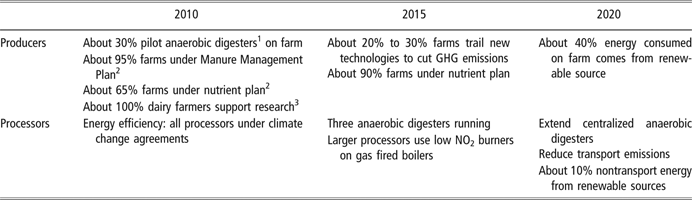
The milk roadmap (Defra, 2009b) is the first of ten such strategies being coordinated by Defra. The roadmap was elaborated through a partnership including farmers, milk processors, retailers and consumers, and is led by a taskforce chaired by representatives from the dairy industry. The roadmap sets a series of targets with milestones in 2010, 2015 and 2020. It is a ‘living document’ in the sense that the objectives and targets are regularly reviewed by the Sustainable Consumption and Production Taskforce. In addition, the targets are tightly linked to the results of ongoing research programs on mitigation strategies.
While the milk roadmap addresses a variety of environmental impacts associated with liquid milk supply chains, including water, energy use and waste disposal, it includes several measures related to GHG emissions at producer and processor levels (retailers are not yet included in the roadmap). Table 2 summarizes the roadmap targets that are related to climate change, which address manure management, anaerobic digestion, energy efficiency and N2O trapping. The main implementation mechanism of the roadmap is the Climate Change Agreements described below.
Summary of the Milk Roadmap targets related the mitigation of GHG emissions from production and processing activities.

GHG = greenhouse gas.
1To foster anaerobic digestate (AD) uptake, the Environment Agency together with Waste and Resource Action Programme (WRAP) is currently developing a quality protocol with the objective to facilitate collection, storage, transport and re-use of agriculture AD digestate. Standard defines the point at which waste may become a nonwaste material and can then be used without any waste regulation control. It is currently under review from the European Commission’s Technical Standards committee. Once agreed, the protocol would allow certified digestates to be used without control.
2Nutrient plans and manure management plans are both strategies not directly targeting climate change mitigation, but that do impact CH4 and N2O emissions from manure as collateral effects.
3Mitigation options are being considered through research programmes on the use of improved diets for the cattle. The Rowett institute (Aberdeen) is looking at the opportunity to develop feed additives (fumaric acid) for ruminants that inhibits CH4 formation by improving the feed efficiency. Dairy farmers already support research through the farmer levy. Research and development is a major priority under Dairy Co Business Plan, and 100% dairy farmers supporting research is targeted by 2010.
Climate change agreements
The UK Climate Change Agreements are voluntary approaches aiming to improve energy efficiency and reduce carbon emissions in industrial and public sectors (Defra, 2009a). The agreements were developed in 2001, as part of the domestic strategy to reduce GHGs and meet the Kyoto target. Participating industries in the livestock sector include: pig farming, poultry farming (meat and egg), egg processing, poultry meat processing and red meat processing The enforcement mechanism combines sector abatement targets, tax and emission trading. Targets for energy consumption reduction are negotiated by sectors. Industries can meet their assigned targets either by improving their energy efficiency or through emission trading on the domestic trading scheme.
The industry is ‘recertified’ by the Energy and Environment Agency at the end of each two-year target period if its sector target is met which allows it to benefit from the energy tax rebate (Defra, 2009c). Among the livestock activities participating in the program, only half had met their sector performance targets.
Experience gained
The United Kingdom approach is an interesting example of a public-private partnership. In the short run, it is a consensual way to move forward and identify the most effective options to address the sector’s emissions throughout the whole food chain. In the long run, however, such voluntary partnership may not be as effective as other options in achieving a reduction of emissions. The voluntary approach involves no liable commitment from the industry and relies on relatively weak incentives. The approach also allowed some participating sectors, including livestock processing, to have their targets lowered.
Discussion: policy options in a global framework
In many ways, global warming is the result of a classic ‘tragedy of the commons.’ Free and unrestricted access to the atmosphere, which has a limited capacity to aborb solar radiation, has resulted in excessive warming. The tragedy results because all the benefits from exploiting the atmosphere acrue to the individuals who emits GHG or destroys carbon ‘sinks’, while the costs of these actions are shared by everyone. This tragedy of the commons can be addressed through international collective action that requires individuals (through government policy) to reduce GHG emissions and maintain or expand carbon sinks.
International collective action to stabilize atmospheric GHG concentrations produced the UNFCCC, which enter into force in 1994. This international treaty established the requirement that Annex 1 countries (industrialized countries and economies in transition) make regular national submissions of a GHG inventory. Under the Kyoto Protocol, an important update to the UNFCCC adopted in December 1997, most industrialized nations and some central European economies agreed to legally binding reductions in GHG emissions. Currently there are ongoing negotiations in Copenhagen, Denmark on how to address global warming after the Kyoto Protocol, which expires at the end of 2012.
Annex 1 countries currently have an incentive to reduce GHG emissions from livestock – including CH4 and N2O from enteric fermentation and manure managent – because Annex 1 countries must report these emissions in their UNFCCC national inventory reports (UNFCCC, 2008). In contrast, non-Annex 1 countries do not have obligations to reduce emissions unless those reductions are supported by funding and technologies from developed countries.
In the case of livestock, the majority of GHG emissions originate in the 151 non-Annex 1 countries (less-industrialized countries without binding Kyoto Protocol obligations to reduce emissions) and most of the growth in emissions is expected to occur in these countries. For the case of CH4 emissions from livestock, it is estimated that 94% of livestock growth between 2008 and 2013 will occur in Asia, Latin America and Africa (Key and Tallard, Reference Key and Tallard2009). Consequently, effective global mitigation in the livestock sector will require a climate policy framework that provides incentives for non-Annex 1 countries to participate. However, such a framework faces substantial political and administrative challenges. In this, section we discuss some of the challenges and some policy options to address these challenges.
International mitigation efforts in non-Annex 1 countries
Current efforts to mitigate GHG from agriculture in non-Annex 1 countries are largely limited to CDM projects and voluntary technological transfer efforts funded by developed countries. To date, these programs have had a limited effect on total livestock emissions. The CDM allows a country with an emission reduction or emission-limitation commitment under the Kyoto Protocol to implement an emission reduction project in developing countries. Such projects can earn saleable certified emission reduction (CER) credits, which Annex 1 countries can count toward their Kyoto targets. The projects must qualify through a lengthy registration and issuance process aimed to ensure real, measurable and verifiable emission reductions that are additional to what would have occurred without the project.
Of the 1244 registered CDM projects as of December 2008, 98 (8%) were categorized as agricultural projects and 66 (5%) related to CH4 mitigation from livestock (UNFCCC, 2009). Most (82%) registered CDM livestock CH4 mitigation projects have been in Latin American countries, with almost all of the remaining located in Asia. The vast majority projects have been in the swine sector, with a few in the poultry sector.
The European Union Emissions Trading System (EU ETS), launched in January 2005, caps overall CO2 emissions from large emitters in energy-intensive industrial sectors and power generation in the EU (Ellerman and Joskow, Reference Ellerman and Joskow2008). The EU ETS ‘Linking Directive’ created a link between the Flexible Mechanisms of the Kyoto Protocol – JI and the CDM – and the EU ETS. Companies that carry out emission reduction projects outside the EU through JI or CDM can convert the credits they earn from those projects into allowances that can be used for compliance under the EU ETS. Several EU member states have also set up programs to buy emission reduction credits from CDM and JI projects, either directly or through government-financed ‘carbon funds,’ to help them meet their Kyoto targets cost-effectively.
International trade and leakage
Livestock is a globally traded product, so policies in one region can affect trade and consequently production, consumption, and prices other regions. Standards and market-based policies such as taxes, abatement subsidies, and emissions trading schemes raise the marginal costs of domestic producers, which cause consumption to shift from domestic to imported goods. With international trade, the effectiveness of GHG mitigation policies can be severely diminished if production expands outside of the regulated area. Emissions leakage occurs when policies designed to cut GHG emissions implemented in one jurisdiction cause the emitting activities to move elsewhere, thus undermining the attempt to reduce emissions. FAO research on livestock CH4 emissions found that approximately two-thirds of the CH4 emissions reductions resulting from a hypothetical carbon tax on livestock products in Annex 1 countries was offset by increases in emissions from non-Annex 1 countries.
To avoid the emission leakage, policies need to target both domestic and imported products. However, laws governing international trade may preclude trade restrictions based on production methods, so mitigation policies cannot be based on the carbon emissions embodied in a similar products.Footnote 1 For example, setting a higher tax rate for high-emission Brazilian beef than for low-emission US beef, or varying tax rates on beef based on the type manure storage facilities used, would likely be interpreted as inconsistent with World Trade Organization rules.
Trade laws would permit per-unit commodity taxes based on average embodied emissions, as long as all ‘like’ products are taxed equally. For example, beef could be taxed at a different rate than other meats, as long as all beef, domestic and imported, is taxed at the same rate. Such a consumption tax would have no negative leakage effects. In fact, to the extent that such a tax reduces imports into the taxed country, it would also lower emissions in non-taxed countries. However, the tax only reduces emissions to the extent that consumers switch from higher-emission products to lower-emission products. A consumption tax would not create incentives for producers to lower emissions by altering their input mix or production technology. Hence, such a tax is relatively effective at lowering emissions in cases where there is a high elasticity of substitution in consumption (consumers readily substitute between alternative products, like beef and poultry, in response to changes in relative prices) and where the technical opportunities for GHG mitigation are more limited.
Sectoral crediting mechanism (SCM) or ‘no-lose’ targets
A SCM is a potentially feasible way to incorporate non-Annex 1 countries into a global GHG mitigation framework (Baron and Ellis, Reference Baron and Ellis2006; Schmidt et al., Reference Schmidt, Helme, Lee and Houdashelt2008). Under a SCM, emissions are measured and monitored at the national sectoral level. Non-Annex 1 countries earn tradable permits if emissions in a sector are reduced below a defined target. The tradable permits would be sold to producers or nations outside of the sector in an emissions trading market. Participation in such as scheme is not binding and no penalties are incurred if actual emissions exceed the target.
A SCM offers several advantages. First, since there is no downside and potentially large gains for non-Annex 1 countries, such a framework could be expected to enjoy widespread support and participation. Second, because emissions are measured and monitored at the national sectoral level rather than producer level, administrative costs can be reduced. For example, CH4 from livestock enteric fermentation and manure management, and N2O from manure management could be relatively easily measured and monitored by non-Annex 1 countries at the national level using IPCC tier 1 methods, or by using somewhat more data intensive tier 2 methods. As mentioned above, Annex 1 countries already report these GHG in their national inventories, and established techniques for measuring emissions are in place. Third, unlike the CDM, the SCM obviates the need to assess whether individual projects are ‘additional’ – that is whether they contribute to a net reduction in total emissions in the host country. Finally, while the CDM is a pure offset mechanism, the SCM can lower total global emissions, if the non-Annex 1 target is set below business-as-usual levels.
The main disadvantage with the SCM is that it does not prevent carbon leakage. Many mitigation policies in Annex 1 countries would result in higher global livestock product prices. The higher price creates an incentive for producers in non-Annex 1 countries to increase output above their business-as-usual level. As participation in an SCM is voluntary, higher product prices would create a substantial disincentive for non-Annex 1 countries to invest the resources necessary to reduce emissions. This disincentive could be reduced with a higher carbon offset price, and higher (more easily achieved) emission target levels.
‘High-cap’ ETS
A ‘high-cap’ ETS is a second potentially feasible way to provide non-Annex 1 countries with an incentive to reduce emissions within a global framework. This scheme has several defining features. As with the SCM, emissions would be measured and monitored at the national sectoral level. Emission permit trading would occur at the national, rather than producer level. As with the SCM, each country would be free to pursue its own emissions reduction policies, which would allow countries to tailor policies to local circumstances and political constraints.
To encourage non-Annex 1 countries to participate, emissions caps for non-Annex 1 countries would need to be sufficiently ‘high’ – that is, above their expected business-as-usual emission levels. Caps for Annex 1 countries could be set below their expected emissions levels, but this is not necessary.Footnote 2 The livestock sector could produce a net demand or net supply of marketable permits depending on where the caps are set and on the carbon price. Hence, a high-cap trading scheme would need to operate in conjunction with an emissions trading market, where producers or nations outside of the sector buy permits from or sell to permits to the livestock sector.
The high-cap trading scheme provides all countries, both Annex 1 and non-Annex 1, an immediate incentive to reduce emissions – so as to either reduce the number of permits that must be purchased, or to increase the number of permits that could be sold. Unlike the SCM, non-Annex 1 countries would not have to reach a specific target level below their business-as-usual emissions before they could begin to earn tradable permits. Non-Annex 1 countries could immediately use the revenues from permit sales to measure and monitor emissions and to develop and adopt technologies to reduce emissions.
The high-cap scheme addresses the problem of emissions leakage as GHG emissions are priced. All countries that increased emissions would have to purchase additional permits or sell fewer permits – a symmetric and equivalent incentive not to increase emissions.
A potential downside to either a high-cap or SCM scheme, which is based on sectoral emissions, is that permit revenues flow to and from governments rather than individual producers. Hence, governments rather than producers have the incentive to reduce emissions. This requires governments to make potentially painful political decisions, such as enacting emissions taxes or standard, to induce emissions reductions from producers. In contrast, such a policy could be politically more palatable to producers as they would not directly have to purchase permits. Some political opposition for either high-cap or SCM schemes would likely stem from the potentially large flow of permit revenues from Annex 1 to non-Annex 1 countries. With high caps that would allow for substantial emission increases in non-Annex 1 countries, Annex 1 countries might begin transferring finances to non-Annex 1 countries even before when non-Annex 1 countries began to reduce the emissions.
Conclusions
Livestock’s contribution to climate change along the production chain is substantial, but so is its potential contribution to curbing anthropogenic GHG emissions. There are substantial technical opportunities for mitigation including sequestering carbon on grazing lands, mitigating carbon losses from soils used in feed production, reducing enteric fermentation in ruminants, and capturing and burning methane from manure storage. There is also a wide portfolio of incentive-based policies and standards that can be used to encourage the adoption and diffusion of these technical options. However, the design and adoption of economically efficient and administratively feasible policy measures is complicated because of the vast number and diversity of livestock production units and by the complex and poorly understood interactions between production practices, technologies and emissions. The lack of simple and accurate approaches to quantify emissions reduction and carbon sequestration has hindered the development of mitigation policies for the livestock sector. National inventories are also often too weak and outdated to effectively inform international negotiations. Animal scientists can play a key role overcoming these obstacles by improving our understanding of relations between animal management practices and GHG emissions at farm and food chain levels.
The implementation of effective mitigation policies faces the challenge of addressing multiple – and often conflicting – goals including poverty reduction, economic growth, and the protection of natural resources. Recent experiences with national mitigation policies suggest that political opposition to policies that raise the costs of production is a key impediment to policy adoption. Mitigation policies will generally achieve greater acceptance if they can enhance productive efficiency, raise farmers’ incomes, and reduce food costs. Hence, there is strong need for research on ‘win-win’ approaches that lower GHG emissions and produce economic and environmental co-benefits. Technological innovations that promote feed efficiency and land productivity, and that use manure more efficiently has the potential to achieve these objectives.
The tragedy of the commons that characterizes the problem of global warming can only be addressed through international collective action. However, most of the expected growth in GHG emissions from livestock will occur in non-Annex 1 countries that do not have obligations under the internationally negotiated UNFCCC. Consequently, mitigation of GHGs from the livestock sector will require development of new climate policies that provides incentives for non-Annex 1 countries to participate. International emission trading schemes with ‘high’ emissions caps for non-Annex 1 countries, or SCMs represent possible ways forward. Implementing such international policy arrangements will require a better understanding of the effects of mitigation policies on prices, national competitiveness, trade flows and emissions leakage. Animal scientists can play a crucial role in facilitating international policies and negotiations by enhancing the reliability and accuracy of national GHG inventories.