I. INTRODUCTION
Construction of multicomponent thin films whose thickness is precisely controlled is an important subject for the construction of solar cells, field-effect transistors, and organic light-emitting diodes.Reference Kanaizuka, Haruki, Sakata, Yoshimoto, Akita and Kitagawa1, Reference Kato2 In particular, chemical bond formation between functional molecules and an electrode enhances the performance of devices, because an electron can effectively transfer through the chemical bonding.Reference Matsuo, Kanaizuka, Matsuo, Zhong, Nakae and Nakamura3, Reference Ulman4 Layer-by-layer molecular fabricated films are attractive because all of the films are constructed using chemical bonding.Reference Haga, Takasugi, Tomie, Ishizuya, Yamada, Hossain and Inoue5–Reference Nishimori, Kanaizuka, Murata and Nishihara14 Therefore, we have constructed thin films of transition metal complexes using the layer-by-layer fabrication technique. We have previously reported the preparation of single-component ultrathin films of polypyridine ruthenium(II) complexes (RuLn) on glass plates and indium-tin-oxide (ITO) electrodes.Reference Kanaizuka, Kato, Moriyama and Pac15–Reference Kanaizuka, Kato, Moriyama and Pac17 These films were electrochemically and photoelectrochemically active. The photocurrent generation of the single-component film of tris(bipyridine) ruthenium(II) complex bearing phosphonic acid groups in a solution containing triethanolamine (TEOA) was increased with an increase in the deposition layer of the ruthenium complex. However, the photocurrent generation was saturated after several layers, probably because of the limitation of electron hopping in the films.Reference Kanaizuka, Kato, Moriyama and Pac15 We considered that a higher photocurrent generation could be obtained in heterolayered systems. It has been considered that effective electron transfer occurs by injection of the inner layer; however, the effect of the thickness and potential of the inner layer has not been well studied. Here, we report the preparation of multilayered films composed of the ruthenium complex and methyl viologen derivatives, and the ruthenium complex and alkyl chain derivatives in which the thicknesses of both molecules are controlled. This work describes the importance of the inner-layer effect in obtaining higher photocurrent generation efficiency in the layer-by-layer molecular assembly system.
II. EXPERIMENTAL
A. Materials and method: General
Electrochemical and photoelectrochemical measurements were performed on a BAS model 100B using a Pt counter electrode and saturated calomel reference electrode (SCE). The working electrode was ITO on a glass plate for a solution of 1 or a surface-modified ITO substrate for a film of 1. Cyclic voltammetric measurements were carried out in a phosphate buffer solution (pH 7), whereas a 0.5 M aqueous solution of NaClO4 containing 0.2 M TEOA was used as an electrolyte solution for photoelectrochemical cells. A Hitachi U-3500 (Tokyo, Japan) spectrometer was used for ultraviolet-visible (UV-vis) absorption spectra measurements.
B. Film preparation
The film preparation was carried out as in our previous papers.Reference Kanaizuka, Kato, Moriyama and Pac15–Reference Kanaizuka, Kato, Moriyama and Pac17 The ITO plate (10 Ω/sq) was immersed into a methanol solution of 3-(aminopropyl)trimethoxysilane (5 mM) for 3 h at 50 °C, rinsed with methanol, and then dried at 100 °C for 1 h.Reference Katz, Scheller, Putvinski, Schilling, Wilson and Chidsey18–Reference Simon, Ricco and Wrighton23 The plate was then immersed into an acetonitrile solution of POCl3 (25 mM) and 2,6-lutidine (25 mM) for 30 min, and then washed with acetonitrile, treated with distilled water, and dried. The pretreated substrate was immersed into a 20 mM aqueous solution of ZrOCl2 for 30 min at room temperature. This pretreated film was used for the construction of heterostructured films. To obtain ITO/2/1 (here, / indicates an interface), the next two processes were repeated. (i) The pretreated film was immersed into a 0.1 mM aqueous solution of 2 for 1 h at 80 °C, washed in water, and dried. (ii) The plate was immersed into a 0.1 mM aqueous solution of 1 for 1 h at 80 °C, washed in water, and dried. To obtain ITO/3/1, compound 2 in process (i) was changed to 3.
III. RESULTS AND DISCUSSION
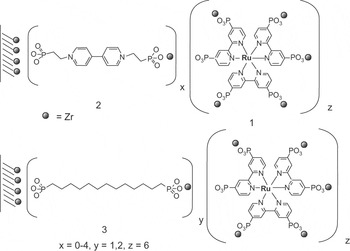
Figure 1 shows an illustration of heterocomponent films composed of ruthenium complexes and methyl viologen derivatives (i), and ruthenium complexes and alkyl chain derivatives (ii) using a layer-by-layer molecular assembly method.
Images of heterostructured films composed of methyl viologen derivatives and ruthenium complexes, and methylene derivatives and ruthenium complexes on pretreated substrates. x = 0–4, y = 1, 2, and z = 6.

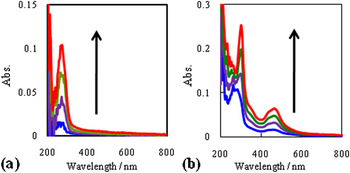
Figure 2(a) shows UV-vis absorption spectra of film 2 on substrates. The absorbance of the film linearly increased with the increase in deposition cycles. Figure 2(b) shows UV-vis absorption spectra of film 1 on the 2-fixed substrates. These electronic spectra are similar to the compounds in aqueous solutions. Provided that the molar absorption coefficient of 1 (ε = 2 × 10⁴) is unchanged in the multilayers, the surface coverage of chromophores was estimated to be 3.2 × 10⁻¹⁰ mol cm−2 per deposition cycle, which indicates that a densely packed complex film can be obtained using this stepwise fabrication method. It should be noted that the spectral features of the solid films are unchanged with the connection of 2 and 1, indicating electronic independence among the complexes and viologen derivatives in the ground state.
(a) Absorption spectra of (blue) 4-, (purple) 8-, (green) 12-, and (red) 16-cycle films of 2. (b) Absorption spectra of (blue) 1-, (purple) 2-, (green) 3-, and (red) 4-cycle films of 1 on 16-cycle films of 2.

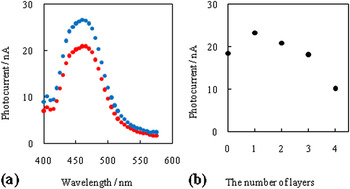
Figure 3(a) shows photocurrent action spectra of ITO electrodes modified with a 6-cycle deposition film of 1 (red), and with a 6-cycle deposition film of 1 on a 1-cycle deposition film of 2 (blue) in the presence of TEOA as an electron donor in a NaClO4 electrolyte solution. The numbers of chromophores of 1 on the ITOs are the same as that determined with UV-vis absorption spectra. The photocurrent action spectra for the two films are almost identical, corresponding well to the absorption spectrum of the multilayers. This indicates that photocurrent generation occurs by photoexcitation of the ruthenium chromophores fixed in the films. An interesting observation is that the viologen-anchored film ITO/2/1 (blue) gives 1.4-fold greater photocurrents than the film without the viologen anchor layer, ITO/1 (red). This indicates that electron transfer effectively occurs at the interface between the ruthenium chromophores and the viologen molecules. The most important issue is the thickness of the electron-acceptor layer; in other words, the number of inner layers strongly affects the photocurrent generation.Reference Denisevich, Willman and Murray24 As shown in Fig. 3(b), the photocurrent increased with the increase in the inner layer of 2 in the initial step; however, the photocurrent decreased with further increase of 2, such as with three or four layers.
(a) Photocurrent action spectra of (red) 6-cycle films of 1 and (blue) 6-cycle films of 1 on 1-cycle film of 2 on ITO in the presence of TEOA. (b) Plots of the photocurrent at 465 nm versus6-cycle films of 1 on various cycle films of 2.

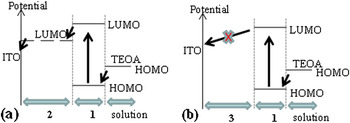
On the other hand, no photocurrent was observed in the heterolayer composed of dodecane compound 3 (2-cycle deposition) and 1 (6-cycle deposition); that is, ITO/3/1. These results indicate that the photocurrent generation was blocked at the interface between the ruthenium chromophores and dodecane compounds. These results indicate that the electron-transfer efficiency of the chromophores strongly depends on the chemical potential of the inner layer (Fig. 4).
(a) Potentials of a film of ITO/2/1 are shown. Electron transition occurs in the film of 1 upon photoirradiation, and electron injection occurs from the LUMO of 1 to the LUMO of 2, and also occurs from the HOMO of TEOA to 1. (b) Potentials of a film of ITO/3/1 are shown. Electron transition occurs in the film of 1 upon photoirradiation, and electron injection occurs from the LUMO of 1 to ITO through the film of 2, and also occurs from the HOMO of TEOA to 1.

IV. CONCLUSION
In summary, we have prepared two types of heterostructured films. One is the chromophore (outer layer) and methyl viologen (inner layer). In this system, higher photocurrent generation can be obtained than for a single component of the film of the chromophore, probably because effective electron injection occurred at the interface of the films. Another film consists of the chromophore (outer layer) and alkyl chain (inner layer). In this system, no photocurrent was obtained, probably because the alkyl chain acted as an electron-blocking layer. It has been believed that effective electron transfer occurs by injection of the inner layer, and this must be true. In this system, we have determined that the ideal thickness of the inner layer was estimated as one or two layers. Multilayer injection reduced photocurrent generation because of the limitation of electron hopping in the films. These concepts for the construction of heterocomponent films are useful for applications to solar cells, field-effect transistors, and organic light-emitting diodes.Reference Joachim, Gimzewski and Aviram25–Reference Richter28