Introduction
Begonia, with more than 1800 species (Hughes et al., Reference Hughes, Moonlight, Jara, Tebbitt, Wilson and Pullan2015), is one of the largest genera of angiosperms. The bulk of the species in this genus are narrow endemics, typically restricted to humid locations in tropical or subtropical regions (Tebbitt, Reference Tebbitt2005). Begonia micranthera Griseb., of Begonia sect. Eupetalum, is an atypical species, because it has a large distribution, is highly variable in its morphology, and occurs in both seasonally dry and perpetually humid locations. Begonia micranthera has been confused with B. cinnabarina Hook. in the past, sharing with that species a combination of an aerial stem arising from a tuber and asymmetric leaf blades, but differing most notably in flower colour. The tepals of Begonia cinnabarina are orange, whereas those of B. micranthera are never this colour but may be white to pink, or occasionally pale yellow. Begonia micranthera is widespread in the Andean regions of southern Bolivia (Smith & Schubert, Reference Smith and Schubert1945) and northern Argentina (Smith & Schubert, Reference Smith and Schubert1941; Instituto de Botánica Darwinion, no date), where it occurs from approximately 17°4′S (e.g. Hawkes et al. 6577) to 27°35′S (e.g. Schickendantz 168). Reflecting the highly variable nature of the species, Smith and Schubert (Reference Smith and Schubert1941) recognise six varieties of Begonia micranthera in their account of the Begonia of Argentina, three of which they also list from neighbouring Tarija Province, Bolivia (Smith & Schubert, Reference Smith and Schubert1945). In a later publication, Smith and Wasshausen (Reference Smith and Wasshausen1984) add one more variety from Argentina. The online Begonia account for the Flora of Argentina (Instituto de Botánica Darwinion, no date) similarly recognises these same seven varieties of B. micranthera.
Fieldwork conducted throughout the species’ range found that the pattern of infraspecific variation is more complex than the existing infraspecific taxonomy indicates. For example, several more local variants of the species occur than have been formally described. Multiple correlated characters distinguish some of the named and unnamed variants of Begonia micranthera. Sometimes these variants occur as geographically isolated populations. At other times they co-occur in the same area, where they occupy distinct altitude ranges or microhabitats that may be physically separated by just a few metres. In at least these latter cases, reproductive isolating mechanisms appear to be present between the distinct variants. In almost all cases, however, the taxonomic boundaries of these variants are blurred in part of their ranges by the occurrence of plants with intermediate morphologies. Smith and Schubert (Reference Smith and Schubert1941) previously acknowledged that there are no distinct boundaries between any of the morphological extremes represented by the six varieties that they recognise. Our studies indicate that the intermediate plants appear to represent in some cases hybrids and in others incomplete divergence of populations.
We have refrained from formally naming the majority of the undescribed variants because they have small distributions, differ from one another only in minor ways and are often very difficult to distinguish in the herbarium. Furthermore, the addition of large numbers of new infraspecific taxa would produce an unwieldy infraspecific taxonomy. Instead, we describe just two new infraspecific taxa, of which one is both particularly distinct and widespread, while the other has a unique chromosome count and is of considerable interest to horticulturalists because, uniquely for Begonia micranthera, its tepals are yellow, a colour that is rare in New World Begonia as a whole. Previous treatments (Smith & Schubert, Reference Smith and Schubert1941, Reference Smith and Schubert1945; Smith & Wasshausen, Reference Smith and Wasshausen1984; Instituto de Botánica Darwinion, no date) recognise the infraspecific variation within Begonia micranthera by designating varieties. In contrast, we recognise a combination of subspecies and varieties to more precisely reflect the assumed relationships and the degree of morphological differences between these taxa. Three subspecies are recognised herein. Of these, Begonia micranthera subsp. albonervia is newly described, while B. micranthera subsp. rhacophylla represents a new combination. Begonia micranthera var. hieronymi (Lindau) L.B.Sm. & B.G.Schub. is treated as a variety of B. micranthera subsp. rhacophylla. We recognise Begonia micranthera subsp. micranthera as containing four named varieties: var. micranthera, var. nana, var. venturii and var. flava, the last of which is newly described. Two of the previously recognised varieties of Begonia micranthera, namely var. fimbriata and var. foliosa, are no longer recognised as such, as further discussed below.
Examination of the type of Begonia micranthera var. fimbriata (West 8413 [GH, MO, UC]) along with an additional collection (Schreiter 10886 [GH (2), LIL]) cited by Smith and Schubert (Reference Smith and Schubert1941) in their original description showed that these specimens have the distinctive combination of velutinous hairs on their stems, leaves and peduncles, ovate leaf blades with crenately toothed margins, and orange perianth characteristic of B. cinnabarina. Accordingly, Begonia micranthera var. fimbriata is newly synonymised here with B. cinnabarina. Begonia cinnabarina is thus recognised as occurring in Argentina, as well as in Bolivia.
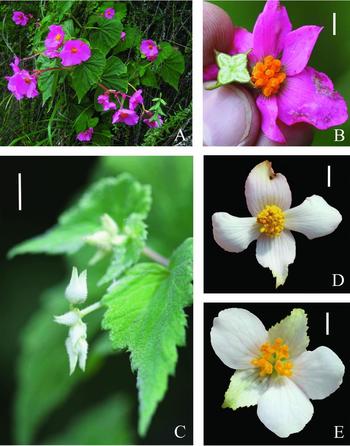
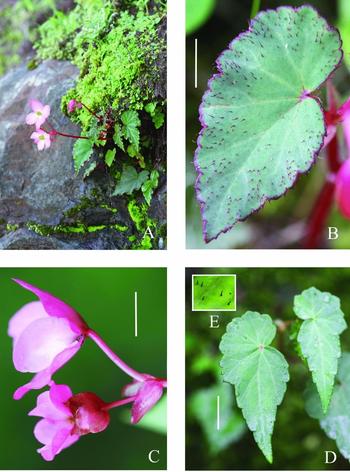
Smith and Schubert (Reference Smith and Schubert1941) in their original description of Begonia micranthera var. foliosa state that this variety is distinguished by its branched stems, numerous leaves, firm leaf blades that are 5–7(–11) cm long, and 3- or 4-locular ovaries. They also state that the plants are typically dioecious and more variable as to locule number than other varieties. Examination of the herbarium material cited by Smith and Schubert (Reference Smith and Schubert1941) and field observations at the locations where many of these specimens were collected indicates that the original description of Begonia micranthera var. foliosa includes two entities. One is composed of plants that are dioecious, with upright stems, and which have outer perianth segments that are more sepal-like than those of the inner whorl and have distinct acute apices and fimbriate margins. In the flower buds, the two outer perianth segments resemble forward-projecting horns. These plants also have 3 or 4 styles and 3 or 4 ovary locules and 4–6 female tepals (Fig. 1C–E). It was from this population, located near Yala in Argentina's Jujuy Province, that Smith and Schubert (Reference Smith and Schubert1941) selected the type (West 6216) of Begonia micranthera var. foliosa. The other entity (i.e. Jujuy, Dep. Dr Manuel Belgrano, Lagunas de Yala, C.A. O'Donell 4662 [LIL]; Tucumán, Dep. Trancas, Camino a Lara, 26°22′16.8S, 65°40′16.3′′W, 3245 m, 20 iv 2014, N.B. Muruaga & A. Slanis 1069 [LIL (2)]; Dep. Tafi, Cerro San José, [27°16′S, 65°58′W], 3200 m, 11 iii 1925, S. Venturi 3629 [B, LIL, US]), is morphologically similar but can be distinguished by its monoecious breeding system, less upright habit with more spreading branches, outer tepals that are more petaloid, and its female flowers that consistently have 5 tepals, 3 styles and 3-locular ovaries. We propose that the element that does not contain the type represents an unnamed variant of Begonia micranthera subsp. micranthera, while the type population of Smith and Schubert's B. micranthera var. foliosa represents a hybrid between this taxon and B. micranthera subsp. rhacophylla. Evidence of the hybrid nature of this taxon comes from multiple data sources. There is an unusually large amount of morphological variation in this population, and these plants combine characteristics usually restricted to one or other of the two subspecies (e.g. the female perianth segments vary from 4 to 6, while the locule and style numbers vary from 3 to 4). Furthermore, these putative hybrid plants exhibit irregularities during meiosis, as well as very low seed viability (only 5% of seed germinated under controlled conditions; Andrada, Páez & Tebbitt, unpublished). Photographs on the online Flora of Argentina (Instituto de Botánica Darwinion, no date) identified as Begonia micranthera var. hieronymi depict the undescribed variant of B. micranthera subsp. micranthera, while the photographs on that database identified as B. micranthera var. fimbriata represent the putative hybrid. Photographs on the online Flora of Argentina (Instituto de Botánica Darwinion, no date) identified as Begonia micranthera var. foliosa are B. micranthera subsp. rhacophylla.
Begonia micranthera subsp. rhacophylla var. hieronymi (Lindau) L.B.Sm. & B.G.Schub.: A, male plant; B, female flower and sectioned ovary with 4 locules; Begonia micranthera Griseb. subsp. micranthera × Begonia micranthera subsp. rhacophylla (Irmsch.) Tebbitt: C, male buds; D, male flower; E, female flower. Scale bars: B and C, 1 cm; D and E, 5 mm. (A, A.R. Andrada s.n. [LIL 611455]; B, A.R. Andrada, M.C. Tebbitt, E. Bulacio & H. Ayarde 0010; C–E, A.R. Andrada, M.C. Tebbitt, E. Bulacio & H. Ayarde 0014.)

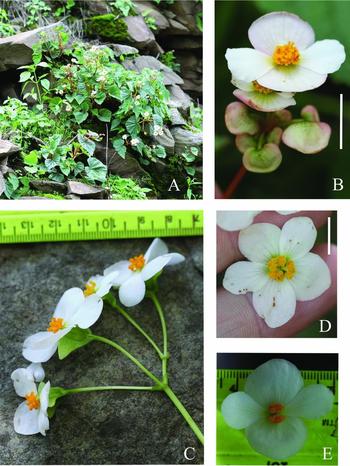
In addition to the named infraspecific taxa that we recognise here, we would also like to draw attention to a distinct population of Begonia micranthera subsp. micranthera from the mountains above San Pedro de Colalao, in Argentina's Tucumán Province (Fig. 2). This population is of considerable interest because it has a unique breeding system within Begonia. The population consists of three kinds of individual, with plants being male, female or monoecious. Furthermore, the female plants often have inflorescences bearing two kinds of flower: those with 5 tepals, 3 styles and 3 locular ovaries, and those with 4 tepals (resembling the perianth of male flowers), 2 styles and 2 locular ovaries. Although we are not proposing to formally name this variant, we suggest that this population deserves further study because it may offer insights into the genetic basis for the different breeding systems found in Begonia as a whole. Provisional cytological data suggest that this population is not of hybrid origin because no significant meiotic irregularities were found during our cytological studies (Andrada, Páez & Tebbitt, unpublished).
Unnamed variant of Begonia micranthera Griseb. subsp. micranthera. A, Monoecious plant; B, inflorescence of male plant; C, inflorescence of female plant; D, close-up of female flower with 5 tepals, and 3 styles and ovary locules from female plant; E, close-up of female flower with 4 tepals, and 2 styles and ovary locules from female plant. All scale bars: 1 cm. (A–E, A.R. Andrada, M.C. Tebbitt, E. Bulacio & H. Ayarde 0015.)

Taxonomic Treatment
Key to the infraspecific taxa of Begonia micranthera
1a. Perianth obviously separated into 2 sepal-like and 3 or 4 petal-like segments; flower buds with the outer two sepal-like perianth segments resembling forward-projecting horns
11. B. micranthera subsp. micranthera × B. micranthera subsp. rhacophylla
1b. Perianth not obviously separated into sepal-like and petal-like segments, all perianth segments petaloid; flower buds with perianth segments not resembling horns___________________________________________2
2a. Plant dioecious; leaf blade coriaceous or succulent; ovary locules and styles usually 4, very rarely 3; tepals usually bright pink, occasionally white; female tepals usually 6, rarely 5____________________________3
2b. Plant usually monoecious, very rarely dioecious; leaf blade usually slightly fleshy, occasionally subcoriaceous; ovary locules and styles 3; tepals usually white or pale pink, occasionally bright pink or pale yellow; female tepals 5___________4
3a. Leaf blades coriaceous; margin typically lobed, rarely unlobed, lobes 1.5–3.5 cm deep; upper surface obviously pubescent
8. B. micranthera subsp. rhacophylla var. rhacophylla
3b. Leaf blades succulent; margin unlobed to lobed, lobes when present to 1 cm deep; upper surface glabrous or with microscopic hairs that are not visible with the naked eye______________9. B. micranthera subsp. rhacophylla var. hieronymi
4a. Leaf blade narrowly reniform to reniform-orbicular, upper surface usually matt green above with greyish white veins but occasionally concolorous matt green throughout; inflorescences 1 or 2, in upper leaf axils; flowers held high above top of foliage on conspicuous, erect peduncles, 10–45 cm long
10. B. micranthera subsp. albonervia
4b. Leaf blade narrowly to broadly ovate, upper surface concolorous matt green throughout; inflorescences usually 3 to many, in upper leaf axils or along length of stem; flowers held to side or slightly above foliage on inconspicuous peduncles, 1.2–25 cm long___________________________________________5
5a. Tepals pale yellow 4. B. micranthera subsp. micranthera var. flava
5b. Tepals white or pink______________________________6
6a. Bracts usually entire rarely ciliate; leaf blades typically 2–4(-8) cm long; leaf blade under-surfaces usually purple, rarely green; margin crenate; tepals usually deep pink_________________________________5. B. micranthera subsp. micranthera var. nana
6b. Bracts usually ciliate to ciliate-dentate, occasionally entire; leaf blades typically 5–22 cm long; leaf blade under-surfaces usually green, rarely purple; margin usually denticulate, dentate or serrate, rarely crenate; tepals white to pale pink___________________________________________7
7a. Leaf blades narrowly ovate, upper surface of blade with patches of black hairs__________________________6. B. micranthera subsp. micranthera var. venturii
7b. Leaf blades broadly ovate, upper surface of blade with an even cover of sparse white hairs_________________________________3. B micranthera subsp. micranthera var. micranthera
1. Begonia micranthera Griseb., Abh. Konigl. Ges. Wiss. Gottingen 19: 148 (1874). – Type: Argentina, Siambón, iii 1872, P.G. Lorentz 281 (lecto GOET!, designated Martín et al., Reference Martín, Ospina and Zanotti2017); B drawings of specimen from GOET [2]!).
Perennial dioecious or monoecious tuberous herb, 2–100 cm tall. Tuber ± ellipsoid, 1.5–5 cm in diameter. Stem erect or suberect, glabrous to densely pubescent. Stipules ovate, triangular-ovate or lanceolate, 2–12 × 1–6 mm, margin entire to denticulate-fimbriate. Leaves few to many, alternate, basifixed; petiole 1–21.5 cm long, glabrous or with hairs as in stem; blade moderately succulent to coriaceous, asymmetric, ovate, narrowly reniform, reniform or reniform-orbicular, 2–22 × 2–20 cm, apex acuminate, abruptly acuminate or obtuse, base very shallowly obliquely cordate to obliquely cordate, margin crenate, denticulate, dentate or serrate, sometimes angular lobed or with regular or irregular ± triangular lobes, lobes to 3.5 cm deep, surfaces glabrous to pubescent, veins palmate, 7 or 8. Inflorescences 1 to many, axillary, erect or ascending, a symmetric cyme, with up to 2 branches, bearing 1–15 flowers, bisexual or unisexual; peduncle 1.2–45 cm long, pubescence same as stem; pedicels of male flowers 0.9–3 cm long, glabrous; pedicels of female flowers 0.5–2.4 cm long, glabrous to densely pubescent; bracts elliptic, transversely elliptic, transversely obovate, ovate or broadly ovate, 0.6–1.4 × 0.5–1.55 cm, apex usually obtuse, occasionally acute, margin usually denticulate-fimbriate or ciliate-toothed, but occasionally entire. Male flowers: tepals 4, usually white to pink, occasionally pale yellow, outer two ovate to orbicular, ovate-elliptic to broadly elliptic, or obovate, 0.9–2.7 × 0.7–2.7 cm, apex obtuse to almost truncate, margin entire or fimbriate-denticulate, inner two suborbicular, elliptic or obovate, 0.9–2.7 × 0.6–1.8 cm, apex usually ± truncate and shallowly notched, occasionally obtuse, margin entire; stamens 40–140, attached along the length of a 1–1.5 mm tall torus, filaments 1–5 mm long, anthers obovoid to broadly obovoid, 0.75–1 mm long, dehiscing via unilateral slits, connectives not extended. Female flowers: bracteoles absent; tepals 4–6(–7), same colour as males, outer whorl suborbicular, broadly elliptic, elliptic to obovate, or occasionally ovate, inner whorl usually obovate to spatulate, occasionally broadly spatulate or elliptic, subequal, 0.8–2.8 × 0.4–2.5 cm, apex acute to obtuse, sometimes shallowly notched, margin of outer tepals entire or fimbriate-denticulate, margin of inner tepals entire; ovary body ellipsoid to broadly ellipsoid, 3–10 × 3–7 mm, glabrous to pubescent, subequally 3- or 4-winged, or rarely unequally 3- or 4-winged or wingless, wings when present triangular to deltoid, to 1.4 × 1 cm, (2-)3- or 4-locular; placentas axile, bifid; styles (2–)3 or 4, shortly fused at base, 2–5 mm long, bifid from about half their height, stigmatic papillae in a spiral band. Fruiting pedicels to 45 cm long. Capsules usually erect but frequently subnutant, body ellipsoid to almost spherical, to 1.5 × 1.2 cm, glabrous to sparsely pubescent, subequally to unequally 3- or 4-winged, rarely wingless, wings when present usually triangular, occasionally ligulate, to 2.7 cm long and 1.7 cm wide.
Phenology
Usually flowering December to March but also occasionally in November or April.
Distribution
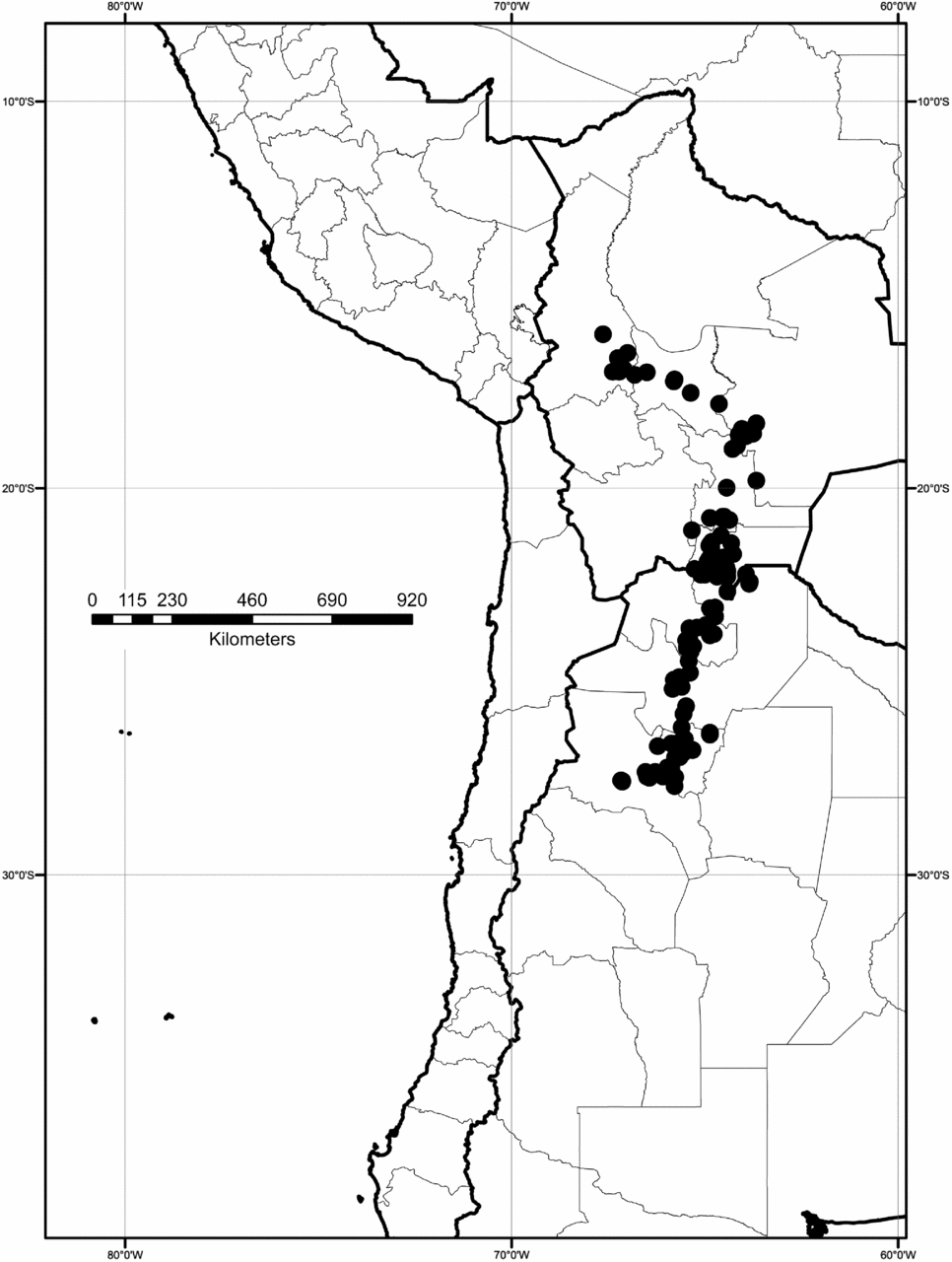
Eastern Andes of Bolivia (La Paz, Cochabamba, Santa Cruz, Chuquisaca and Tarija) and Argentina (Jujuy, Salta, Tucumán and Catamarca) (see Fig. 3).
2. Begonia micranthera Griseb. subsp. micranthera. Fig. 3.
Distribution of Begonia micranthera subsp. micranthera (circles).

Usually monoecious herb, very rarely a population containing both unisexual and bisexual plants. Stem 2–50(–100) cm tall, unbranched to few branched, glabrous to pubescent. Leaves few to many, membranous to moderately succulent, asymmetric, ovate, margin lacking lobes, crenate, denticulate, dentate or serrate, upper surface green, glabrous to sparsely pubescent, lower surface paler green or purple, glabrous to pubescent, hairs usually denser along the main veins. Inflorescences solitary to many; peduncle 1.2–25 cm long. Bract margins entire, ciliate, ciliate-dentate or fimbriate. Male flowers: tepals usually white to pink, occasionally pale yellow, outer pair suborbicular, transversely ovate or obovate, 0.9–2.7 × 0.7–2.7 cm, inner pair suborbicular, elliptic or obovate, 0.9–2.7 × 0.6–1.8 cm. Female flowers: tepals (4 or) 5, same colour as in males, outer two or three suborbicular, broadly elliptic, elliptic, obovate, or occasionally ovate, inner (two or) three usually obovate to spatulate, occasionally broadly spatulate, subequal, 0.8–1.8 × 0.4–1.8 cm; margins of outer tepals entire or ciliate, those of inner tepals entire; ovary subequally 3-winged, or rarely unequally 3-winged; 3-locular; styles 3.
Phenology
Flowering November to April, with peak bloom from January to March.
Distribution and habitat
Eastern Andes of Bolivia (La Paz, Cochabamba, Santa Cruz, Chuquisaca and Tarija) and Argentina (Jujuy, Salta, Tucumán and Catamarca) (see Fig. 3). Typically found in semideciduous tropical forest or Tucumano–Boliviano forest and neighbouring montane grassland, often on rocky slopes or ravines near streams, in semi- to deep shade. Usually growing at altitudes of 1000–3400 m but down to 440 m in some Argentinian populations (e.g. Bailetti 475).
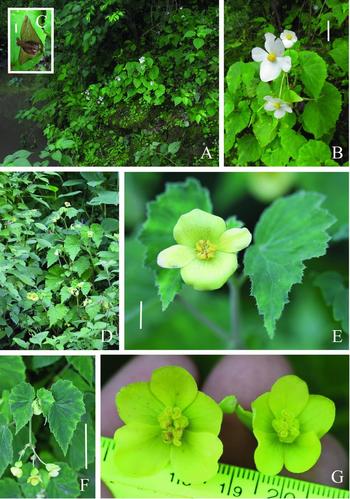
3. Begonia micranthera Griseb. subsp. micranthera var. micranthera. Fig. 4A–C.
Begonia micranthera Griseb. subsp. micranthera var. micranthera: A, plant in habitat; B, close-up of plant, showing inflorescence with male and female flowers; C, capsule. Begonia micranthera subsp. micranthera var. flava Andrada & Bulacio: D, habit; E, male flower; F, inflorescence bearing female flowers; G, female flowers. Scale bars: B and E, 1 cm; C and F, 5 mm. (A–C, R. Andrada 101; D–G, A.R. Andrada, M.C. Tebbitt, E. Bulacio & H. Ayarde 0003.)

Usually monoecious, rarely dioecious. Leaf blade membranous or slightly to moderately succulent, ovate, 2.5–22 × 2–20 cm, glabrous to sparsely pubescent. Bract margins entire or ciliate to ciliate-dentate. Female tepals (4 or) 5, white to pink, margins of outer tepals usually entire, occasionally ciliate, those of inner tepals entire. Chromosome number n = 14 and 2n = 28.
Phenology
Flowering November to April, with peak bloom from January to March.
Distribution and habitat
Eastern Andes of Bolivia (La Paz, Cochabamba, Santa Cruz, Chuquisaca and Tarija) and Argentina (Jujuy, Salta, Tucumán and Catamarca). Typically found in semideciduous tropical forest or Tucumano–Boliviano forest and neighbouring montane grassland, often on rocky slopes or ravines near streams, in semi- to deep shade. Usually growing at altitudes of 1000–3400 m but down to 440 m in some Argentinian populations (e.g. Bailetti 475).
Representative specimens examined. Bolivia. Cochabamba: Prov. Ayopaya, near Independencia, [17°4′S, 66°49′W], J.G. Hawkes et al. 6577 (C); Prov. Carrasco, Carrasco, 17°32′S, 65°22′W, 2900 m, 11 ii 1987, J.C. Solomon & M.H. Nee 16053 (LPB, MO); Prov. Chapare, zona del Sillar km 92 a 1 km al Este de la carretera, 17°11′44′′S, 65°47′24′′W, J. Terán, D. Soux, E. Rodríguez 3230 (BOLV, MO). La Paz: Prov. Inquisivi, following the slopes E of Comunidad Micayani to the río Khokhoni ± to the junction with a fork flowing down from Comunidad Yamora, and following the río Khokhoni upstream 1 km from this point, c.4 km SE from Inquisivi, 16°55′S, 67°06′W, 14 i 1989, M. Lewis 35095 (G, MO, NY); Prov. Nor Yungas, carretera fundam. 3, c.35 km S of Caranavi toward Coroico, road parallel to río Coroico, [16°1′S, 67°38′W], 10 xi 1976, C. Davidson 4897 (MO); Prov. Sud Yungas, Puente Villa, [16°23′S, 87°38′W], 1400 m, ii 1946, M. Cárdenas 3594 (GH). Santa Cruz: Prov. Caballero, 17°49′S, 64°38′W, 2914 m, 16 i 2011, M.C. Tebbitt 735 (USZ); Prov. Florida, 18°31′S, 63°55′W, 2475 m, 16 i 2011, M.C. Tebbitt 733 (MO, USZ); Prov. Vallegrande, El Khacllu, 5 km E of Vallegrande, farallones encima de la Cañada de Arteaga, 18°28′S, 64°2.5′W, 2100 m, 28–29 xii 1993, I.G. Vargas & M. Toledo 3081 (NY, USZ). Chuquisaca: Prov. Azurduy, camino de Azurduy cerca a Cañadas, 19°59′S, 64°26′W, 2740 m, 13 i 2004, H. Huaylla & I. Guachalla 953 (MO); Prov. Belisario Boeto, 1 km de Nuevo Mundo, 18°59′S, 64°17′W, 2231 m, 23 iii 2004, J.R.I. Wood & H.H. Gutiérrez J. 20521 (K); Prov. Oropeza, 29 km from Sucre on road to Ravelo, J.G. Hawkes et al. 4558 (C [2]); Prov. Sud Cinti, Puca Pampa, c.7.5 km de puesto ganadero, al SW, 20°44′S, 64°32′W, 2410 m, 12 ii 2004, J. Gutiérrez R., A. Lliully, R. León, I. Guachalla, E. Portal 580 (MO). Tarija: Prov. Arce, Municipio Padcaya, Reserva Nacional de Flora y Fauna Tariquía, bajando del campamento Potreros a la Guardianía de Alisos (SERNAP), 2450 m, 12 xi 2004, M. Serrano, S. Churchill, J. Villalobos et al. 5062 (MO); 7.4 km E of Emborozú on road to Bermejo, 22°16′S, 64°30′W, 1100 m, 24 iv 1983, J.C. Solomon 10063 (MO); Prov. Avilés, Cruzando el abra entre Pampa Redonda con dirección a Chocloca, [c.21°47′S, 64°30′W], 2250 m, 6 ii 1988, M. Liberman, F. Pedrotti & R. Venanzoni 2104 (US); Cuenca del río Camacho, quebrada margen derecho subiendo por el río Alisos, [c.21°54′S, 64°56′W], 2100 m, 19 xii 1987, M. Liberman & S.G. Beck 1507 (US); Bajando de Antigal hacia Alisos, 21°49′S, 64°53′W, 2090 m, 24 iv 2000, S.G. Beck & N. Paniagua 27263 (US); Prov. O'Connor, 10.8 km W of Narváez (Canaletas), 21°25′S, 64°19′W, 2200 m, 3 v 1983, J.C. Solomon 10443 (MO); Prov. Cercado, Rincón de la Victoria, 15 km SW of Tarija, [21°32′S, 64°50′W], 2150 m, 10 ii 1937, J. West 8313 (GH, MO, UC); Prov. Méndez, Cuesta de Sama, c.32 km NW of Tarija, on road to Villazón, 2800 m, 12 ii 1937, J. West 8330 (GH, MO, UC).
Argentina. Catamarca: Dep. Andalgalá, El Candado, [27°20′S, 66°17′W], 12 ii 1915, P. Jörgensen 1343 (B [2], GH, LIL, MO, US); Río Potrero, [27°27′S, 66°30′W], 1800 m, 10 ii 1949, H. & O. Brücher s.n. (S); Quebrada Muschaca, parte superior, [c.27°29′S, 66°26′W], ii 1876, F. Schickendantz 277 (B); Dep. Belén, Quebrada de Río Blanco-El Rincón, arriba de Granadillas, [c.27°34′S, 67°8′W], 2200 m, 26 i 1952, H. Sleumer 2469 (LIL, UC, US). Salta: Dep. Guachipas, Arroyo Querusillas, [c.25°38′S, 65°29′W], 1600–1800 m, 7 ii 1983, L. Novara & R. Neumann 3186 (MO); Estancia Pampa Grande, Cerro Cristal, 25°50′S, 65°33′W, 2300–2400 m, 20 iii 1966, J.G. Hawkes, J.P. Hjerting & K. Rahn 3649 (C), 3966 (C, K, MO); Dep. Gral. José de San Martin, 47 km de Piquirenda 7 km de El Chorrito, [c.22°13′S, 63°56′W], 25 xii 2001, O. Morrone, N.B. Deginini & S.S. Aliscioni 4095 (MO, SI); Dep. Gral. José de San Martin, Quebrada de la Zanja Honda, [c.22°25′S, 63°50′W], 600 m, 20 ii 1925, R. Schreiter 3589 (GH, LIL); Dep. Gral. José de San Martin, Cerro Tartagal, [c.22°28′S, 63°51′W], 17 iii 1948, S.A. Pierotti 7173 (LIL); Dep. Orán, Pucara, 2000 m, 3 iv 1945, S.A. Pierotti 1144 (NY, S, W); Ruta Prov. 19, 15 km del Puente Internacional Argentina–Bolivia camino a la Finca Yakulica, [c.22°40′S, 64°25′W], 14 xii 1998, O. Morrone, L.M. Giussani, D. Fernández, & C. Guerrido 3386 (MO); San Andrés, [c.23°06′S, 64°52′W], 1800 m, 8 ii 1945, S.A. Pierotti 308 (GH, NY, LIL); Dep. Rosario de Lerma, Quebrada del Toro, Ruta 51, Km 32.1, [24°53′S, 65°40′W], 1700–1780 m, 16 i 1988, L.J. Novara 7485 (G, S). Tucumán: Dep. J. B. Alberdi, along the ruta 9 from Juan B. Alberdi to Balcosna, 4 kms below Dique Escaba, [27°42′S, 65°47′W], 720 m, 16 ii 1993, W. Till 10251 (LIL, MO); Dep. Burruyacu, Cerro del Campo, 1500 m, 10 iv 1930, S. Venturi 10357 (B, MO); Dep. Chicligasta, Saladillo a El Bolsón, [27°14′S, 65°52′W], 2000 m, 5 iii 1949, T. Meyer 14846 (LIL); Dep. Lules, Quebrada de Lules, 750 m, 28 xi 1920, S. Venturi 1076 (GH); [26°50′S, 65°33′W], 500 m, i 1932, M. Quiroga s.n. (GH); 500 m, i 1932, M. Quiroga 14403 (GH); Dep. Tafi del Valle, Tafi, 2500 m, 20 ii 1924, S. Venturi 2897 (GH, MO); [Dep. Tafi], Siambón, Sierra de Tucumán, 9–18 i 1873, P.G. Lorentz & L. Hieronymus 1051 (B [2], F, GOET, NY, US, drawing of specimen in GOET B); Dep. Lules, Quebrada de Lules, 500 m, i 1932, M. Quiroga s.n. (LIL 14403); Quebrada de Lules, 550 m, 16 iv 1949, Hueck s.n. (LIL 386605); Dep. Tafí Viejo, Reserva Aguas Chiquitas, 26°36′28′′S, 65°10′35′′W, 612 m, 10 ii 2016, A.R. Andrada 101 (LIL); Reserva Aguas Chiquitas, 26°37′26′′S, 65°10′29′′W, 612 m, A.R. Andrada s.n. (LIL 615230); A.R. Andrada s.n. (LIL 615247); Tafí, Camino al Indio, 27°02′06′′S, 65°39′65′′W, 1169 m, A.R. Andrada s.n. (LIL 611167).
The nominate variety currently encompasses a great deal of variation and occurs in Bolivia and Argentina as indicated above. The type collection, however, was collected from a population representing a low-elevation variant restricted to Tucumán Province, Argentina, that is distinguished in particular by its combination of leaf blades that are broadly ovate and distinctly membranous in the dried state.
4. Begonia micranthera subsp. micranthera var. flava Andrada & Bulacio. – Type: Argentina, Prov. Jujuy, Dep. Ledesma, Parque Nacional Calilegua, Ruta Provincial 83, Difunta, 23°41′10′′S, 64°52′59′′W, 1500 m, 11 i 2011, E. Bulacio & H. Ayarde 2431 (holo LIL!), var. nov.
Begonia micranthera subsp. micranthera var. flava Andrada & Bulacio is distinguished from other infraspecific taxa of Begonia micranthera Griseb. by its tepals pale yellow (versus white to pink), its combination of pubescent leaves and stems and 3-locular ovaries, and its unique chromosome number n = 13 and 2n = 26 (versus n = 14 and 2n = 28 in other B. micranthera taxa we sampled; Appendix 1). Fig. 4D–G.
Monoecious. Leaf blade slightly fleshy, ovate, 2.5–14 cm long, upper surface with a covering of short, soft, white hairs. Bract margin ciliate-dentate. Female tepals 5, pale yellow, margin of outer two tepals shortly ciliate, margin of inner three tepals entire.
Phenology
Flowering January to February.
Distribution and habitat
Endemic to the vicinity of Park Nacional Calilegua, Jujuy Province, Argentina, where it occurs in a narrow altitudinal strip between 1300 and 1500 m. Growing on earth banks among herbaceous vegetation on the Yungas forest edge.
Additional specimens examined. Argentina. Jujuy: Dep. Ledesma, Parque Nacional Calilegua, 15 km del Arroyo Aguas Negras, 23°38′S, 64°51′W, 1300 m, 25 ii 1997, F.O. Zuloaga, O. Morrone, J.F. Pensiero 6224 (MO); Dep. Ledesma, Camino a Valle Grande desde Ruta Nac. 34, km 27, 16 xii 1996, F.O. Zuloaga 2919 (MO); Dep. Ledesma, Camino a río Jordán, a 4 km de Abra de Cañas, 1200 m, 14 ii 1965, P.R. Legname & A.R. Cuezzo 5215 C (LIL); Valle Grande, 26 ii 1940, A. Burkart & N.S. Troncoso 11483 (SI, UC); Ruta provincial 83, Sevinguillar, 23°41′30′′S, 64°52′44′′W, 1450 m, 31 i 2010, E. Bulacio & H. Ayarde 2055 (LIL); Parque Nacional Calilegua, Ruta provincial 83, 10 i 2017, A.R. Andrada, M.C. Tebbitt, E. Bulacio & H. Ayarde 0002 (LIL). Parque Nacional Calilegua, Ruta provincial 83, 23°41′51′′S, 64°52′26′′W, 1320 m, 14 i 2017, A.R. Andrada, M.C. Tebbitt, E. Bulacio & H. Ayarde 0003 (LIL).
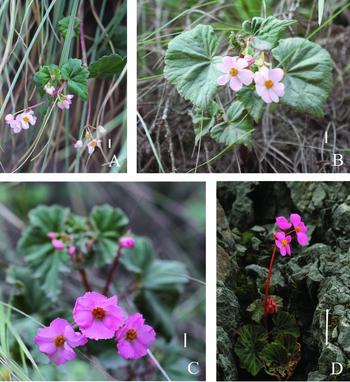
5. Begonia micranthera subsp. micranthera var. nana L.B.Sm. & B.G.Schub., Darwiniana 5: 94, pl. 6 (1941). – Type: Argentina, Prov. Jujuy, Volcán (Loma del Tambo), [c.23°36′S, 65°12′W], 2500 m, 22 ii 1924, R. Schreiter 2595 (lecto GH! [barcode 00068254], here designated; isolecto GH!, LIL [2]!). Fig. 5A–C.
Begonia micranthera Griseb. subsp. micranthera var. nana L.B.Sm. & B.G.Schub.: A, habit; B, leaf; C, inflorescence and bract. Begonia micranthera subsp. micranthera var. venturii L.B.Sm. & B.G.Schub.: D, leaf; E, close-up of hairs on leaf upper surface. All scale bars: 1 cm. (A–C, A.R. Andrada, M.C. Tebbitt, E. Bulacio & H. Ayarde 0007; D and E, A.R. Andrada s.n. [LIL 610791 A, B].)

Monoecious. Leaf blade slightly fleshy, ovate, 2–8 cm long, upper surface with a sparse covering of short, black hairs. Bract margin entire. Female tepals 5, deep pink, margins entire.
Phenology
Flowering January to February.
Distribution and habitat
Endemic to the mountains of north-western Argentina. This taxon is found in the eastern sector of the Cordillera Oriental, east of the Quebrada de Humahuaca, Jujuy Province, where it occurs from 2500 to 3500 m. Growing on open earth slopes, usually near streams.
Additional specimens examined. Argentina. Jujuy: Dep. Tumbaya, Est. Volcán, Mula Muerta, 3000 m, 15 i 1927, L. Castillón 158 (LIL); Dep. Tilcara, Maimará (Hualchin), [23°37′S, 65°24′W], 28 i 1906, E. Budin 53 & 63 (GH, LIL); Río Est. Vieja, cerca de Abra Mayo, 2500 m, 21 iii 1952, E. Petersen & J.P. Hjerting 54 (LIL). Salta: Dep. Orán, Sierra de Zenta, Yungas, Entre Rios, [c.23°19′S, 64°44′W], 24 iv 1998, A. Schinini, C. Saravia Toledo & R. Neumann 34794 (GH); Sierra de Zenta, 3500 m, E. Budin s.n. (LIL 14401); Dep. Ledesma, Cerro Hermosos, 2840 m, 11 i 2017, A.R. Andrada, M.C. Tebbitt, E. Bulacio & H. Ayarde 0006 (LIL); Dep. Ledesma, Camino a Co. Amarillo 23°35′49′′S, 64°54′05′′W, 2840 m, 12 i 2017, A.R. Andrada, M.C. Tebbitt, E. Bulacio & H. Ayarde 0007 (LIL).
Smith and Schubert (Reference Smith and Schubert1941) cite numerous collections for this variety, but we consider that those they list from west and south of Jujuy Province's Rio Grande do not belong within this variety but rather represent stunted examples of a mixture of other variants. The specimens that we consider to match the type of Begonia micranthera var. nana all share with this collection not only their short stature but also leaf margins that are distinctly crenate-toothed and flowers with deep pink tepals. This taxon also only occurs at relatively high elevations, between 2500 and 3500 m.
Smith and Schubert (Reference Smith and Schubert1941) cite the type of this and other taxa as being located in G, by which they are referring to Harvard University's Gray Herbarium rather than the herbarium of the Conservatoire et Jardin botaniques de la Ville de Genève.
6. Begonia micranthera subsp. micranthera var. venturii L.B.Sm. & B.G.Schub., Darwiniana 5: 97, pl. 8 (1941). – Type: Argentina, Tucumán, Dep. Tafi, Cerro de Taficillo, barranco en el alisal, 1800 m, 10 iii 1930, S. Venturi 10299 (holo GH!). Fig. 5D,E.
Monoecious. Leaf blade subsucculent, narrowly ovate, 5–8 × 2.5–5 cm, upper surface with a few scattered black hairs. Bract margins fimbriate. Female tepals 5, white or pink, margins entire. Chromosome number n = 14, 2n = 28.
Phenology
Flowering January to March.
Distribution and habitat
A narrow endemic of the Cumbre de Taficillo (Sierra de San Javier), in Argentina's Tucumán Province. Growing on shaded, rocky cliffs at an altitude of 1800–2300 m.
Representative specimens examined. Argentina. Jujuy: Dep. Dr. Manuel Belgrano, trail from Rio Yala to laguna near Smythe Hacienda, 16 km W of Yala, 1950 m, 8 iii 1936, J. West 6244 (GH, MO [2], UC). Tucumán: Dep. Chicligasta, El Bolsón, 2100 m, 9 iii 1949, T. Meyer 14834 (LIL); El saladillo a El Bolsón, 5 iii 1949, T. Meyer 14929 (LIL); Dep. Tafi Viejo, Cumbre de Taficillo, peñas de una quebrada, 1800 m, 4 iii 1928, S. Venturi 5897 (B, CAS, LIL, US); Dep. Tafi del Valle, El Rincón, 26°57′S, 65°46′W, A. Grau 03–024 (LIL) El Rincón, 02 iii 2010, A.R. Andrada s.n. (LIL 610791 A, B).
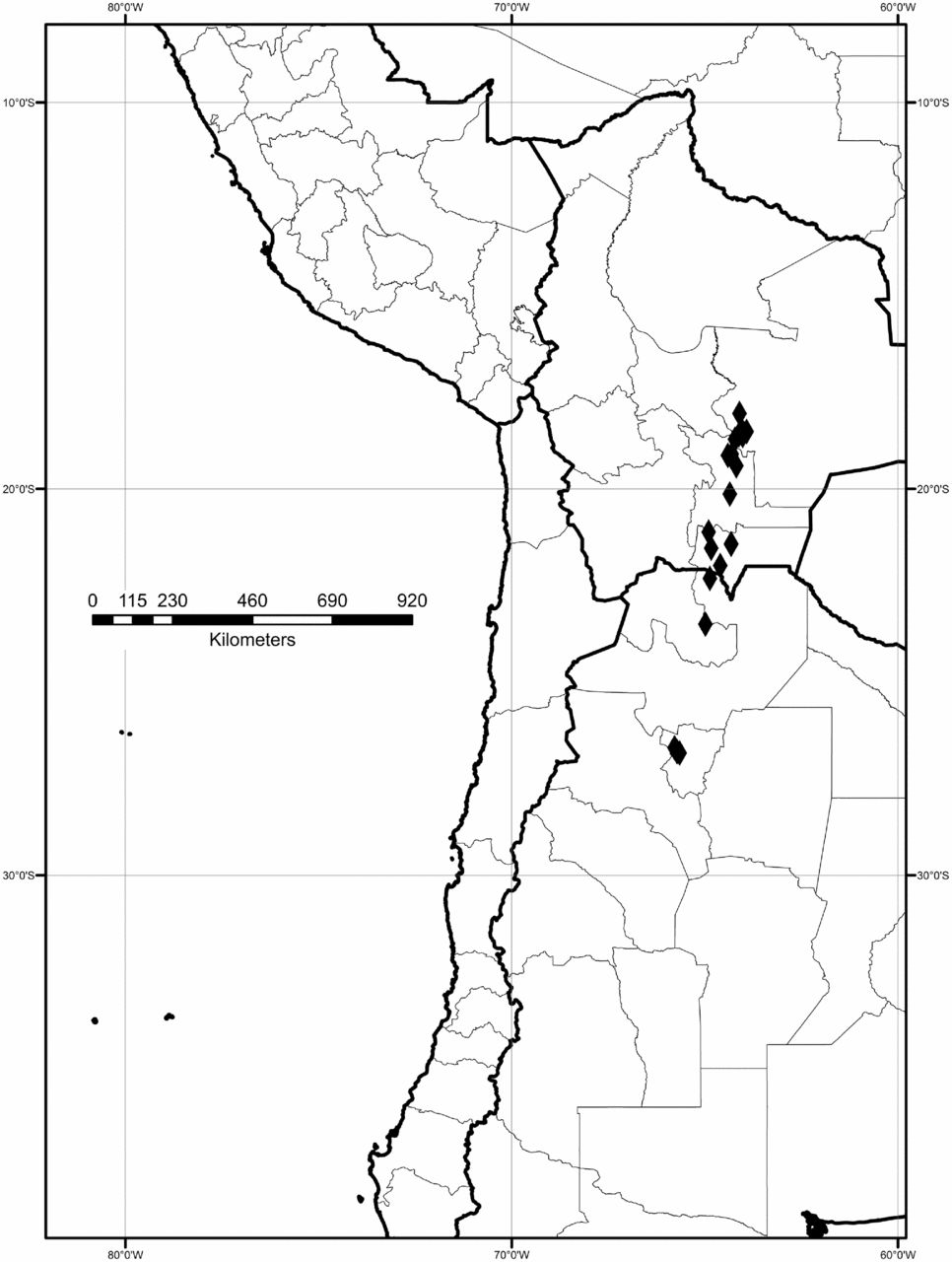
7. Begonia micranthera subsp. rhacophylla (Irmsch.) Tebbitt, stat. nov. Fig. 6.
Distribution of Begonia micranthera subsp. rhacophylla (diamonds).

Begonia hieronymi Lindau var. rhacophylla Irmsch., Bot. Jahrb. Syst. 74: 619 (1949). – Type: Argentina, Prov. Jujuy, Dep. Tumbaya, Volcan, Cerro Abra del Paraguay, bajo una peña, 2300 m, 14 ii 1927, S. Venturi 4948b (holo US!; iso B!; drawing of holo B!; LIL!).
Begonia micranthera Griseb. var. rhacophylla (Irmsch.) L.B.Sm. & D.C.Wassh., Phytologia 54: 467 (1984).
Usually dioecious or very rarely monoecious herb. Stem 25–100 cm tall, usually unbranched, rarely unbranched, densely pubescent. Leaves usually many, rarely few; blade coriaceous or succulent, asymmetric, lowermost leaf sometimes elliptic, other leaves ovate to broadly ovate, 5–10 × 4–7 cm, margin unlobed or with regular or irregular ± triangular lobes, lobes when present 1.5–3.5 cm deep, dentate or serrate, upper surface green, glabrous or pubescent, lower surfaces slightly paler green, glabrous or pubescent. Inflorescences many; peduncle 5.5–6.5 cm long. Male flowers: tepals 4–6, usually bright pink, occasionally white, outer two suborbicular, 1.5–1.6 × 1.6–2 cm, inner two obovate, 1.5–1.7 × 1.4–1.6 cm. Female flowers: tepals 6, same colour as in males, 0.8–1.8 × 0.4–1.8 cm, outer two or three suborbicular, inner two or three usually obovate, occasionally elliptic; ovary usually subequally 4-winged, or occasionally both subequally 4- and 3-winged on the same individual, or rarely both unequally 4- and 3-winged on the same individual, or occasionally wingless; usually 4-locular, occasionally with both 4- and 3-locular ovaries on the same individual; styles usually 4, occasionally bearing ovaries with both 4 and 3 styles on the same individual.
Phenology
Flowering December to March.
Distribution
Eastern Andes of Bolivia (Santa Cruz, Chuquisaca and Tarija) and Argentina (Jujuy, Salta and Tucumán) (see Fig. 6).
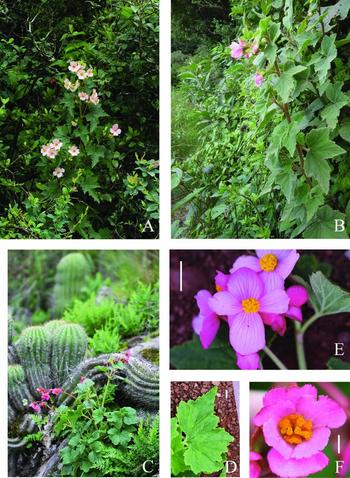
8. Begonia micranthera subsp. rhacophylla (Irmsch.) Tebbitt var. rhacophylla. Figs 6, 7.
Begonia micranthera Griseb. subsp. rhacophylla (Irmsch.) Tebbitt var. rhacophylla. A, Habit, male plant, Bolivia; B, habit, female plant, Bolivia; C, habit, female plant, Argentina; D, leaf, Argentina; E, male flower, Argentina; F, female flower, Argentina. Scale bars: D and E, 1 cm; F, 5 mm. (A, M.C. Tebbitt 733; B, M.C. Tebbitt 729; C, D and F, R. Andrada s.n. [LIL 611459]; E, A.R. Andrada, M.C. Tebbitt, E. Bulacio & H. Ayarde 0013.)

Usually dioecious or very rarely monoecious herb. Leaf blade coriaceous, asymmetric, lowermost leaf sometimes elliptic, other leaves ovate, 5–7 × 4–6 cm, margin usually with regular or irregular ± triangular lobes, occasionally unlobed, lobes when present 1.5–3.5 cm deep, serrate, upper surface green, pubescent, lower surface slightly paler green, pubescent. Male flowers: tepals 4, usually bright pink, occasionally white. Female flowers: tepals 6, usually bright pink, occasionally white. Capsule usually subequally 4-winged, or occasionally both subequally 4- and 3-winged on the same individual, or rarely both unequally 4- and 3-winged on the same individual, or occasionally wingless; usually 4-locular, occasionally with both 4- and 3-locular ovaries on the same individual; styles usually 4, occasionally bearing ovaries with both 4 and 3 styles on the same individual. Chromosome number n = 14, 2n = 28.
Phenology
Flowering December to March.
Distribution and habitat
Eastern Andes of Bolivia (Santa Cruz, Chuquisaca and Tarija) and Argentina (Jujuy and Salta) (see Fig. 6). Begonia micranthera subsp. rhacophylla var. rhacophylla occurs in and on the margins of Tucumano–Boliviano forest, where it is commonly found on wet seeps on and at the base of cliffs, at an altitude of 1400–2700 m. This taxon often occupies sites that are both wetter and less likely to dry up during the growing season than those of all other infraspecific taxa of Begonia micranthera. However, it does occasionally occur in relatively dry situations on open montane pasture, but in these situations the plants are often somewhat stunted. Begonia micranthera subsp. rhacophylla grows in both shade and full sun but is typically found in open sunny areas, unlike subsp. micranthera and subsp. albonervia, which usually prefer shaded localities.
Additional specimens examined. Bolivia. Chuquisaca: Prov. Azurduy, La Angostura, c.15 km de Azurduy hacia el cañon de la Angostura, 20°8′S, 64°21′W, 2500 m, 11 i 2004, H. Huaylla & I. Guachalla 672 (MO); Prov. B. Boeto, Comunidad Ovejeros, 4 km al NE de la localidad de Villa Serrano, 19°6′S, 64°18′W, M. Serrano 770 (HSB); Prov. Tomina 19°08′S, 64°24′W, [between Tomina and Villa Serrano], 2692 m, 5 i 2013, M.C. Tebbitt 742 (USZ); Prov. Tomina, Padilla 26 km hacia Monteagudo, [c.19°24′S, 64°11′W], 2600 m, 8 iii 1981, S.G. Beck 6326 (US). Santa Cruz: Prov. Vallegrande, 18°31′S, 63°54′W, [south of Tierras Nuevas], 2446 m, 14 i 2012, M.C. Tebbitt 729 (USZ); north west of Piraymiri, 18°32′S, 64°02′W, 2292 m, 10 i 2012, M.C. Tebbitt 715 (USZ); Camino entre Vallegrande y Postrervalle. 18°33′S, 64°00′W – 18°31′S, 63°55′W, 2632–2645 m, 3 ii 2009, L.P. Arroyo, S. Carreño, Y. Inturias, C. Roth & J. Dávalos 4474 (MO, USZ); north west of Piraymiri, 18°34′S, 64°03′W, 2276 m, 13 i 2012, M.C. Tebbitt 726 (USZ); Quebrada honda, c.10–15 km sobre el camino hacia La Higuera, 1 km de la carretera, siguiendo el curso del río, 18°34′S, 64°06′W, 2342 m, 14 iii 2003, J.M. Mendoza & R.N. Ledezma 492 (K, USZ); 19 km from Vallegrande on road to Pucará, 18°36′S, 64°07′W, 2650 m, 1 iii 1980, J.G. Hawkes, J.P. Hjerting & I. Aviles 6511 (C), 6514 (C [2]); 18°36′S, 64°07′W, 2843 m, 12 iii 2011, L.P. Arroyo, G.A. Parada, M. Betancur & M. Huanca 5487 (MO, USZ); north west of Piraymiri, 18°37′S, 64°01′W, 2080 m, 6 i 2012, M.C. Tebbitt 703 (USZ); Cala culo c.26 km S of Vallegrande camino a Khasa Monte, 18°38′S, 64°02′W, 2450 m, 27 ii 2002, L. Arroyo, S. Churchill, D. Arroyo, & C. Torrico 1873 (MO, USZ); Pucará, 18°43′S, 64°13′W, 2385 m, 3 xii 2011, G.A. Parada, Y. Inturias & M. Betancur 3995 (USZ); Tramo entre El Zapallar-Pujio, ubicado a 15 km al S de Pucará (línea recta), 18°54′S, 64°10′W, 2000 m, 29 xii 1990, I.G. Vargas 884 (NY, USZ). Tarija: Prov. Méndez, 20 km from Iscayachi on road to Tarija, [21°27′S, 64°52′W], 3100 m, 11 iii 1971, J.G. Hawkes, J.P. Hjerting, P.J. Cribb, & Z. Huamán 4658 (C [3]); Rincón de la Victoria, [21°32′S, 64°50′W], 14 ii 1960, T. Meyer & P. Legname 21259 (LIL, US [2]); Prov. O'Connor, Municipio Entre Ríos, Quebrada Canaletas, 21°26′S, 64°19′W, 2124 m, 16 i 2008, E. Portal, E. Cervantes & J. Villalobos 413 (MO).
Argentina. Jujuy: Dep. Valle Grande, Altos de Calilegua, 23°30′S, 64°59′W, 2600 m, 17 ii 1995, N.B. Deginani, A.L. Cialdella & E. Bortiri 934 (MO); Valle Grande, de río Jordán a Duraznillo (Cno. a Alto Calilegua [23°46′S, 64°46′W]), 29 xii 1977, R. Kiesling, E. Ulibarry & A.G. López 1630 (NY); Dep. Ledesma, Cerro Hermoso, 26°36′24′′S, 64°54′15′′W, 2833 m, 11 i 2017, A.R. Andrada, M.C. Tebbitt, E. Bulacio & H. Ayarde 0011 (LIL); 0012 (LIL); Dep. Ledesma, Camino a Co. Amarillo, 23°35′48′′S, 64°54′09′′W, 2833 m, 12 i 2017, A.R. Andrada, M.C. Tebbitt, E. Bulacio & H. Ayarde 0013 (LIL). Salta: Dep. Rosario de Lerma, río Manzano, 2000 m, 4 ii 1941, T. Meyer s.n. (LIL 79834); Dep. Santa Victoria, Santa Victoria, 2385 m, 28 i 1943, T. Meyer 4601 (LIL), 27 i 1945, T. Meyer 5025 (LIL); Santa Victoria, ente Lizonte y Rodeo Pampa, 3800 m, 04 ii 1943, T. Meyer 5027 (LIL); Santa Victoria – Cañani, [22°19′S, 64°52′′W], 24 i 1983, E.M. Zardini, M.L. Pochettino, J.A. Hurrell, C. Ludica & D. Ramadori 1763 (MO); Poscaya-Alrededores, 22°27′42′′S, 65°05′39′′W, 3300 m, 24 i 2010, A.C. Slanis, A.M. Kortsarz, A. Grau, K. Lázaro & F. Choin 3081 (LIL [2]); Cañani, [26°44′S, 65°36′W], 25 i 1983, E.M. Zardini, M.L. Pochettino, J.A. Hurrell, C. Iudica & D. Ramadori 1806 (MO); camino Nazareno-Poscaya, 2 km de Nazareno, 3300 m, 24 i 2010, A.C. Slanis, A.M. Kortsarz, A.Grau, K. Lázaro & F. Choin 3121 (LIL); Rincon de la Victoria, 2200 m, 27 i 1953, T. Meyer 17494 (LIL); Rincon de la Victoria, 14 ii 1960, T. Meyer, R. Cuezzo & R. Legname 21237 (LIL); Cuesta de Mesón, 2600–2700 m, 12 ii 1953, H. Sleumer 3976 (LIL); Los Toldos, entre Nogalar y El Mesón, 1700 m, 19 ii 1960, T. Meyer, R. Cuezzo & R. Legname 20536 (LIL).
Begonia micranthera subsp. rhacophylla was previously recognised at the rank of variety. Irmscher (Reference Irmscher1949) originally described the taxon as a variety of Begonia hieronymi Lindau, whereas Smith and Wasshausen (Reference Smith and Wasshausen1984) treated it as a variety of B. micranthera. Begonia micranthera subsp. rhacophylla is distinguished by its dioecious breeding system, coriaceous leaf blades, usually 4 ovary locules and styles (occasionally 3), tepals that are usually bright pink (occasionally white), and female flowers with 6 (versus 5) tepals. Irmscher (Reference Irmscher1949) described his Begonia hieronymi var. rhacophylla as a narrow endemic of the Cerro Abra del Paraguay in Jujuy Province, Argentina. In contrast, we consider Begonia micranthera subsp. rhacophylla as occurring in Bolivia as well as Argentina. In fact, the taxon is widespread, being found along the eastern Andes for a distance of about 900 km.
A hybrid population between Begonia micranthera subsp. rhacophylla and B. micranthera subsp. micranthera was seen along a 20-km stretch of the Cuesta del Obispo (Route Provincial 33) in Salta Province, Argentina (Fig. 8A–C). Plants along this road were highly variable in their morphology but at the same time also showed a rough morphological cline, whereby at lower elevations they were morphologically similar to Begonia micranthera subsp. micranthera and at higher elevations morphologically similar to B. micranthera subsp. rhacophylla. At lower elevations, plants had subcoreacous leaf blades, either 3 or 4 styles and ovary locules, white to pale pink flowers, and female flowers with 5 tepals, and the outermost male and female tepals had fimbriate margins. At higher elevations along this road, the population included a large proportion of plants with thicker leaf blades, tepals of a deeper pink colour, up to 7 female tepals (a number not otherwise found in Begonia micranthera), and 4-locular ovaries and 4 styles. In the eastern part of the range of Begonia micranthera subsp. rhacophylla var. rhacophylla in Bolivia's Santa Cruz Department, a limited number of intermediate specimens (e.g. Tebbitt 715 and Tebbitt 732) also occur between it and B. micranthera subsp. micranthera and may similarly represent hybrids.
Begonia micranthera hybrids. Begonia micranthera Griseb. subsp. micranthera × B. micranthera subsp. rhacophylla (Irmsch.) Tebbitt, Cuesta de Obispo, Salta, Argentina: A, low-elevation plant; B, mid-elevation plant; C, high-elevation plant. Begonia micranthera Griseb. subsp. albonervia Tebbitt: D, habit. Scale bars: A–C, 1 cm, D, 10 cm. (A–C, A.R. Andrada, M.C. Tebbitt, E. Bulacio & H. Ayarde 0016; D, M.C. Tebbitt 763.)
The online database for the Flora Argentina (Instituto de Botánica Darwinion, no date) includes several photographs that represent Begonia micranthera subsp. rhacophylla but which are misidentified as B. micranthera var. foliosa.
9. Begonia micranthera subsp. rhacophylla var. hieronymi (Lindau) L.B.Sm. & B.G.Schub. Fig. 1A,B.
Begonia hieronymi Lindau, Bot. Jahrb. Syst. 19 (Beibl. 18): 14 (1894).
Begonia micranthera var. hieronymi (Lindau) L.B.Sm. & B.G.Schub., Darwiniana 5: 96, pl. 7, (1941). – Type: Argentina, Tucumán, La Ciénaga, 10–17 i 1874, P.G. Lorentz & G.H.E.W. Hieronymus 644 (lecto, designated Martín et al., Reference Martín, Ospina and Zanotti2017: B 10 0186668!; isolecto B [3]!, CORD!, GOET!).
Begonia coriacea A.DC. sensu Griseb., Abh. Kgl. Ges. Wiss. Goett. XXIV: 136 (1879).
Usually dioecious, rarely monoecious herb. Leaf blade succulent, asymmetric, broadly ovate, 6–10 × 4–7 cm, lacking lobes or with triangular lobes to 1 cm deep, margin serrate, upper surface moderately covered with short white hairs barely visible to the naked eye or glabrous in plants growing in sunny situations. Male tepals 4–6, bright pink. Female tepals 5 or 6, bright pink. Capsule usually 4-locular with 4 styles and 4 short ± subequal wings, occasionally 3-locular with 3 styles and 3 short subequal wings, or rarely with both 4- and 3-locular ovaries on the same individual.
Phenology
Flowering December to February.
Distribution and habitat
A narrow endemic of Tafi del Valle Department, Tucumán Province, Argentina, that grows on rocky humid slopes in montane grassland from 2000 to 3500 m. Begonia micranthera subsp. rhacophylla var. hieronymi occurs approximately 350 km to the south of the known distribution range of subsp. rhacophylla var. rhacophylla.
Representative specimens examined. Argentina. Tucumán: Dep. Tafi del Valle, La Ciénaga, playa del arroyo cerca de la casa grande, 2500 m, 27 i 1950, H. Sleumer 269 (LIL); La Ciénaga, 12 xii 1888, M. Lillo s.n. (LIL 14315); La Ciénaga, 2500 m, 19 xii 1888, M. Lillo 1198 B (LIL); La Ciénaga, 13 iv 1901, M. Lillo 2752 (LIL); La Ciénaga, 2500 m, 13 ii 1905, M. Lillo 3998 (LIL); La Ciénaga, [26°44′S, 65°36′W], 14 ii 1905, M. Lillo 4027 (GH, LIL); La Ciénegas, 10–17 i 1874, G.H.E.W. Hieronymus & P.G. Lorentz 724 (B [2], GOET); Arroyo antes de la Bolsa, 2591 m, i 2003, A. Grau 03–022/023 (LIL); Camino a Amaicha del Valle, cerca del arroyo, 26°48′31′′S, 65°43′30′′W, 2542 m, 28 ii 2011, A.R. Andrada s.n. (LIL 611455); Camino a Amaycha, 26°42′47′′S, 65°47′48′′W, 2927 m, 15 i 2017, A.R. Andrada, M.C. Tebbitt, E. Bulacio & H. Ayarde 0010 (LIL).
Begonia micranthera var. hieronymi (Lindau) L.B.Sm. & B.G.Schub. is newly recognised as B. micranthera subsp. rhacophylla var. hieronymi. In Lindau's original description of Begonia hieronymi (1894), this taxon was described as having 3-locular ovaries and 4 branched styles. Examination of the herbarium material cited by Lindau, however, found that they have 4-locular ovaries with 4 styles, and that each style is bifid. Observation of living material from the type location and its vicinity (see Fig. 1A,B), indicates that the majority of these populations are composed of plants with 4-locular ovaries and 4 styles, but that a few populations are composed of plants with 3-locular ovaries and 3-styles. Furthermore, some individuals have female flowers with 5 tepals, whereas others have 6 tepals. These populations of var. hieronymi uniquely share with Begonia micranthera subsp. rhacophylla var. rhacophylla a dioecious breeding system, bright pink tepals, 6 female tepals, 4-locular ovaries and 4 styles, and for this reason are recognised here as belonging to subsp. rhacophylla.
Smith and Schubert (Reference Smith and Schubert1941) cite the collection Burkart & Troncoso 11483 (SI, UC) as being Begonia micranthera var. hieronymi, but our studies show it to be the newly recognised B. micranthera subsp. micranthera var. flava.
10. Begonia micranthera subsp. albonervia Tebbitt. – Type: Bolivia, Dep. Santa Cruz. Prov. Florida, Bella Vista bosque Chiquitano, sendero ecológico ‘El Chorro del El Fraile’ sobre la orilla del río, 18°18′S, 63°40′W, 1210 m, 13 xii 2007, D. Villarroel, N. Vargas, N. Vega, G. Cordova, O. Apaza & A. Yanana 1687 (holo MO!, iso USZ!), subsp. nov.
Begonia micranthera subsp. albonervia Tebbitt is distinguished from other infraspecific taxa of Begonia micranthera Griseb. by its narrowly reniform to reniform-orbicular leaf blades (versus leaf blades narrowly to broadly ovate, or elliptic), leaf blade upper surface usually with conspicuous greyish white veins (versus concolorous green), and inflorescences held on conspicuous, 10–45 cm long, erect peduncles (versus peduncles less conspicuous, because usually ascending and [1–]6–10[–25] cm long). Figs 8D, 9, 10.
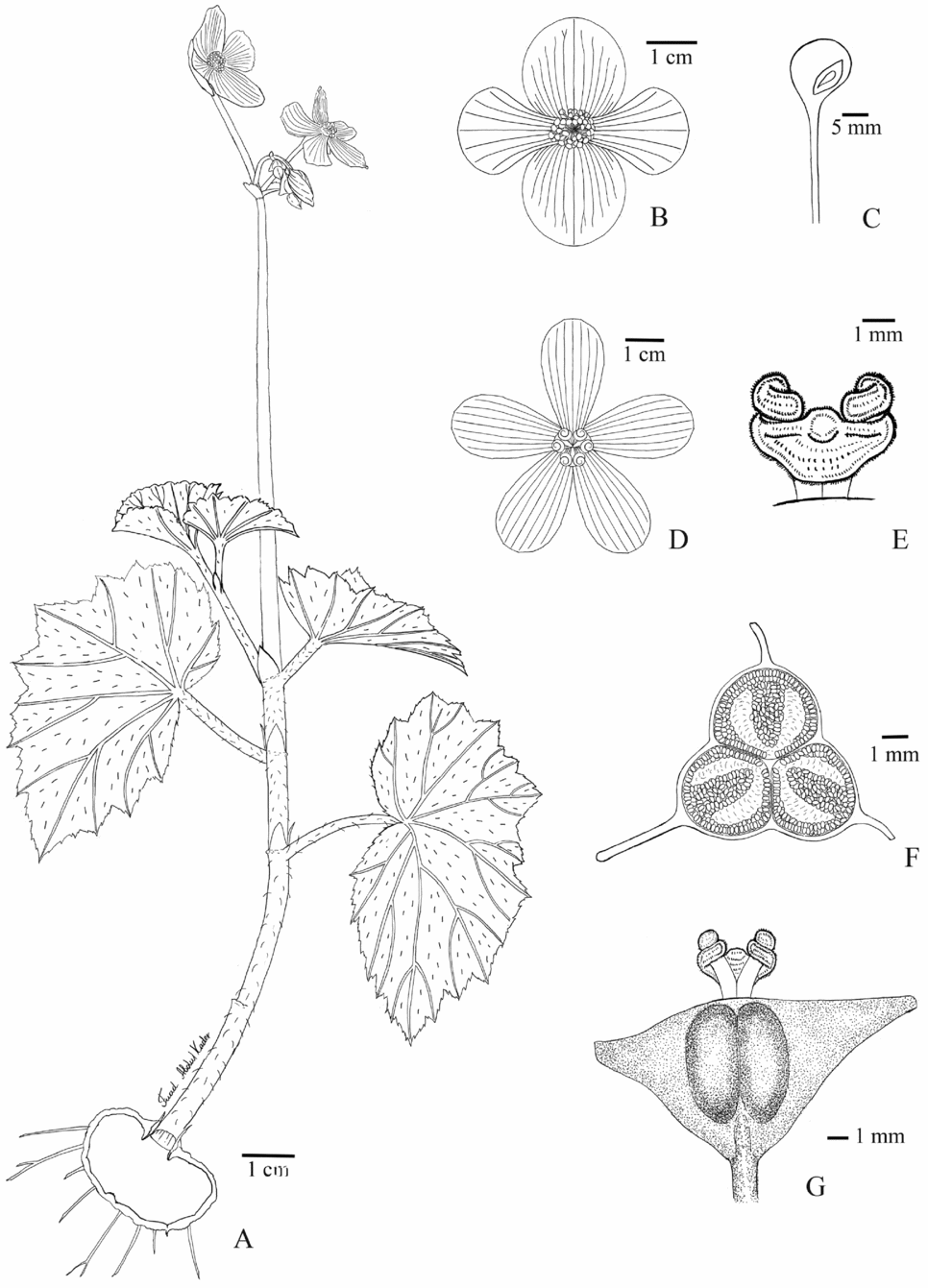
Begonia micranthera subsp. albonervia Tebbitt. A, Habit; B, male flower; C, stamen, side view; D, female flower; E, style and stigma, front view; F, ovary, transverse section; G, ovary, side view. (Drawn by Fuad Abdulkader, based on Tebbitt 762.)

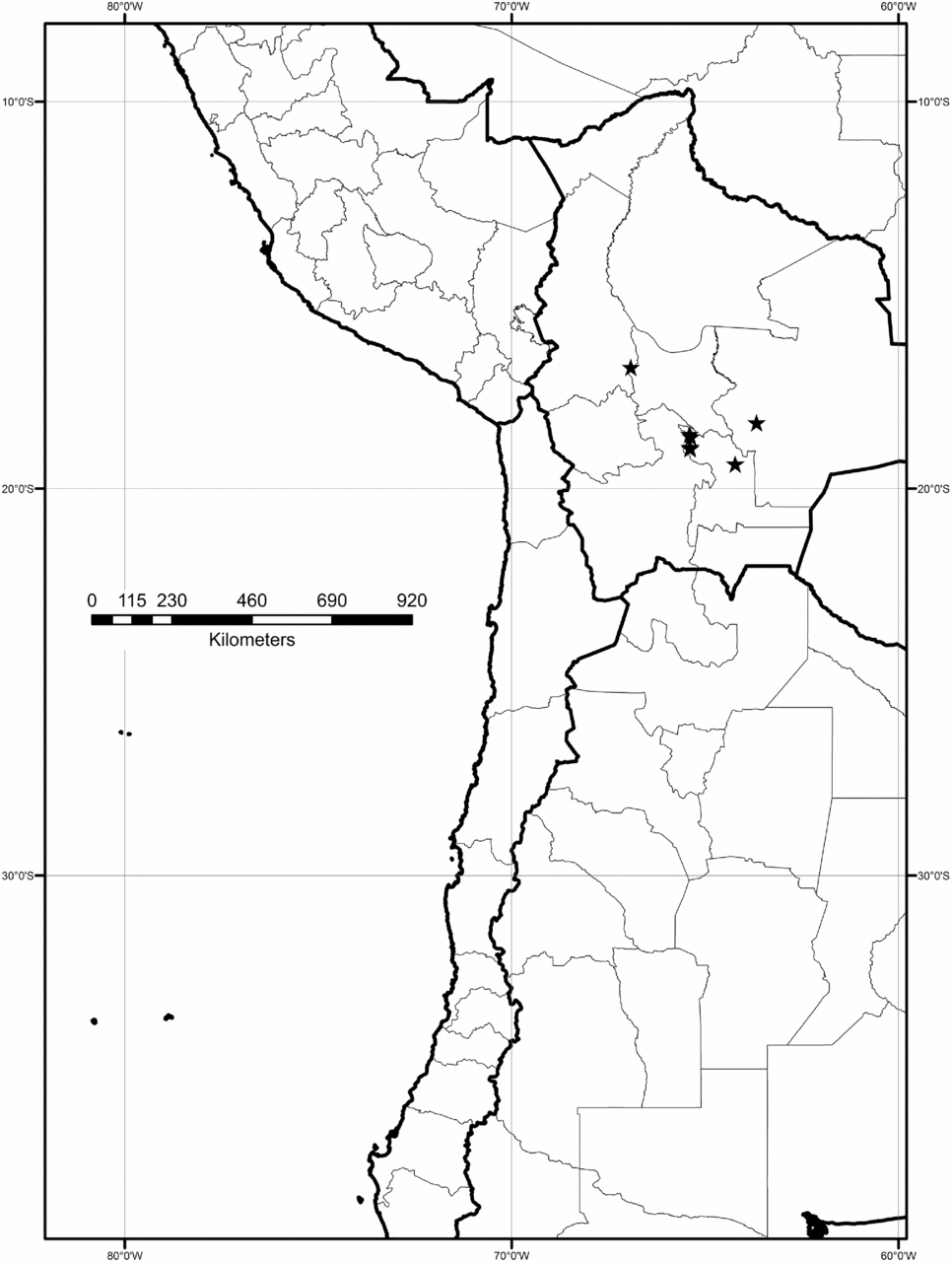
Distribution of Begonia micranthera subsp. albonervia (stars).

Monoecious herb. Stem 15–40 cm tall, unbranched, glabrous. Leaves typically 3–5; blade slightly succulent, never coriaceous, subsymmetric, narrowly reniform, reniform or reniform-orbicular, 5–11 × 5–11 cm, margin shortly triangular–lobed, dentate, upper surface usually matt green above with greyish white veins but occasionally concolorous matt green throughout, sparsely to moderately pubescent, lower surface concolorous green or with green veins and reddish tinged intervenal lamina, sparsely to moderately pubescent along veins, and intervenal regions glabrous. Inflorescences solitary to many; peduncle 10–45 cm long. Male flowers: tepals usually pink, rarely white, outer pair usually elliptic to broadly elliptic, occasionally orbicular, ovate-elliptic or obovate, 1.5–2.3 × 1.5–2.5 cm, inner pair obovate to spatulate, 2–2.8 × 1.6–1.9 cm. Female flowers: tepals same colour as males, outer two elliptic to elliptic-obovate, inner three obovate to spatulate, subequal, 1.3–1.5 × 0.7–0.9 cm; ovary unequally 3-winged with one wing longer than the other two; 3-locular, styles 3.
Phenology
Collected in flower from January to March.
Distribution and habitat
Begonia micranthera subsp. albonervia is locally common in Bolivia's Chuquisaca Department, and occasionally in south-western Cochabamba and western Santa Cruz Departments, occurring along the eastern Andes for a distance of about 400 km (see Fig. 10). The subspecies typically occurs in moist locations, often growing on rocky damp cliffs in wet gullies in the shade of Polylepis Ruiz & Pav., Alnus Mill. or Eucalyptus L'Hér., at an altitude of 1210–3362 m. Because this subspecies inhabits moist shady streamside microhabitats, it is remarkable in occurring in this microhabitat in an otherwise semiarid landscape.
Additional specimens examined. Bolivia. Cochabamba: Prov. Ayopaya, Sailapata, [c.16°52′S, 66°55′W], 2500 m, ii 1935, D. Cárdenas 3036 (US). Santa Cruz: Prov. Florida, Bella Vista, circuito ecotouristíco el “Chorro del Fraile”, 18°19′S, 63°40′W, 1249 m, 28 i 2007, M. Vargas C. 312 (MO, USZ); Prov. Vallegrande, camino de Vallegrande a San Blas, 18°27′S, 64°03′W, 2065 m, G.A. Parada et al. 2953 (FCQ, MO, USZ). Chuquisaca: Prov. Oropeza, 8 km from Poroma, 18°36′S, 65°24′W, 3362 m, 18 i 2013, M.C. Tebbitt 765 (USZ); 29 km from Sucre on road to Ravelo, 18°58′S, 65°23′W, 3314 m, 17 i 2013, M.C. Tebbitt 762 (USZ); Cajamarca, Cerro Chataquila, 18°58′S, 65°23′W, 3329 m, 17 i 2013, M.C. Tebbitt 763 (USZ); base of Cerro Chataquila, 18°58′S, 65°23′W, 3362 m, 18 i 2013, M.C. Tebbitt 764 (USZ); Prov. Tomina, Padilla, 21 km hacia Monteagudo, [c.19°22′S, 64°13′W], 2370 m, 8 iii 1981, S.G. Beck 6319 (US).
11. Begonia micranthera Griseb. subsp. micranthera × B. micranthera subsp. rhacophylla (Irmsch.) Tebbitt. Fig. 1C–E.
Begonia micranthera Griseb. var. foliosa L.B.Sm. & B.G.Schub., Darwiniana 5: 92, pl. 5 (1941). – Type: Argentina, Prov. Jujuy, 15 km west of Yala, [24°8′S, 65°28′W], 1800 m, 8 iii 1936, J. West 6216 (holo GH!; iso MO! [2], UC!, US!), syn. nov.
Dioecious. Leaves broadly ovate, 4.3–11 × 2.7–8.2 cm, slightly fleshy, with a moderate covering of short hairs. Female flowers with 2 sepal-like perianth segments and 3 petal-like perianth segments, or 2 sepal-like perianth segments and 4 petal-like perianth segments, sepal-like perianth segments white with a greenish tinge, petal-like perianth segments white, margin of sepal-like perianth segments ciliate-dentate, margin of petal-like perianth segments ciliate to entire; ovary locules 4. Chromosome number n = 14, 2n = 28.
Phenology
Flowering January to March.
Distribution and habitat
Restricted to the vicinity of the Lagunas de Yala in Argentina's Jujuy Province. Growing on earth banks on forest edge along the side of the road, at an altitude of 1600–2100 m.
Additional specimens examined. Argentina, Jujuy: Without further locality, ii 1907, L. Castillón s.n. (LIL); Dep. Dr. Manuel Belgrano, Lagunas de Yala, 24.1170°S, 65.4688°W, 1860 m, 21 i 2007, J. Paula-Souza 7551 (HUEFS); Lagunas de Yala, 2100 m, 10 i 1947, G. Romero s.n. (LIL); Yala, 2086 m, 22 i 1941, G. Romero 58 (LIL); camino de Yala a la Lagunas, 30 i 1947, C.A. O'Donell s.n. (LIL); Yala, camino a la laguna de Yala, 24°07′23′′S, 65°27′50′′W, 1669 m, 7 iv 2011, A.R. Andrada s.n. (LIL 611459); Cuesta a Tiraxi, 4–8 km NE del río Grande, [24°5′S, 65°18′W], 1500 m, 17 iii 1982, A. Schinini & R. Vanni 22455 (MO, UC, US); Juan Galán – Nogelo, 2000 m, 16 i 1918, L. Castillón 540242 (LIL); Juan Galán, Villa Concepción, 1600 m, 10 i 1918, L. Castillón 479181 (LIL); Camino a Laguna de Yala, 24°07′14′′S, 64°27′42′′W, 1713 m, 8 i 2017, A.R. Andrada, M.C. Tebbitt, E. Bulacio & H. Ayarde 0014 (LIL).
12. Begonia cinnabarina Hook., Bot. Mag. 75: tab. 4483, 1849. – Type: based on cultivated material collected as seed by Thomas Bridges in Bolivia and cultivated by Edward Henderson at Pine Apple Place Nursery, London (no material preserved). (lecto, here designated: Plate in W. J. Hooker, Bot. Mag. 75: tab. 4483 [1849]).
Begonia aurantiaca hort. ex Planchon, Fl. Serres Jard. Eur. I., 5: 530, pl. 1849, pro syn. Begonia cinnabarina W.J. Hooker (1849).
Begonia micranthera Griseb. var. fimbriata L.B.Sm. & B.G.Schub., Darwiniana 5: 98, pl. 9 (1941). – Type: Argentina, Prov. Salta, Hills back of Tartagal, [c.22°30′S, 63°49′W], 400 m, 23 ii 1937, J. West 8413 (holo GH!; iso MO!, UC!), syn. nov.
William Hooker (1849) originally described Begonia cinnabarina based on living material grown at Edward Henderson's Pine Apple Place Nursery in London, and which Thomas Bridges had collected as seed in Bolivia. Unfortunately, Bridges kept few records of where he collected, and subsequent scholars have found it difficult to retrace his collecting routes (Johnston, Reference Johnston1928). Bridges’ exact collecting locality remains uncertain but given our limited knowledge of his general route into the Andes and the morphological characteristics of the plants that he collected as seed, it was likely made in Bolivia's Chuquisaca Department. No preserved material representing this collection could be located in the herbaria where Bridges’ specimens are housed (BM, K, G, GH, OXF and P) or in the other herbaria utilised in this study. Likewise, Hooker does not appear to have made a voucher specimen of the cultivated material that he examined. Accordingly, the plate accompanying Hooker's original publication is here designated as the lectotype.
Additional specimens examined. Argentina. Salta: Dep. Santa Victoria, Los Toldos-camino a Parque Nacional Baritú, 20 xii 2009, A.R. Andrada 075 (LIL). Camino de los Toldos a Lipeo, por una senda a la derecha, por el viejo camino a 5 km del Lipeo, 1300 m, 10 xii 1973, P.R. Legname & A.R. Cuezzo 9865c (LIL); Dep. Orán, La Marama, 23 i 1945, S.A. Pierotti 57 (LIL).
Acknowledgements
We thank the curators of AAU, B, BKL, BM, BOLV, BR, BRIT, C, CAS, CGE, CORD, CPUN, CUZ, E, E-GL, F, G, GB, G-BOISS, G-DC, G-DEL, GH, GOET, HOXA, HUT, K, LIL, LPB, MEDEL, MO, MOL, MOL-WEB, NY, OXF, P, QCA, QCNE, QPLS, S, SEL, TEX, UC, US, USM, USZ, W and Z for loaning material or allowing us to work in their herbaria. We thank Peter Moonlight for sharing with us a photograph of a specimen from HUEFS. We thank the Bolivian Viceministerio de Medio Ambiente and the Dirección de Flora y Fauna de la Provincia de Tucumán, Administración de Parques Nacionales for granting us permission to conduct the fieldwork and collect specimens, and the American Begonia Society and Fundación Miguel Lillo for funding the fieldwork. We also thank Luis Huaylla Limachi for assistance with fieldwork and Fuad Abdulkader for providing the line drawing.
Appendix 1
Specimens examined in the cytological study
Begonia micranthera Griseb. subsp. micranthera var. micranthera
A.R. Andrada s.n. (LIL 615247)
Chromosome counts n = 14, 2n = 28
Begonia micranthera Griseb. subsp. micranthera var. flava Andrada & Bulacio
A.R. Andrada, M.C. Tebbitt, E. Bulacio & H. Ayarde 0003 (LIL)
Chromosome counts n = 13, 2n = 26
Begonia micranthera Griseb. subsp. rhacophylla (Irmsch.) Tebbitt
A.R. Andrada s.n. (LIL 610775)
Chromosome counts n = 14, 2n = 28
Begonia micranthera Griseb. subsp. micranthera var. venturii L.B.Sm. & B.G.Schub.
A.R. Andrada s.n. (LIL 615243)
Chromosome counts n = 14, 2n = 28
Begonia micranthera Griseb. subsp. micranthera × Begonia micranthera subsp. rhacophylla (Irmsch.) Tebbitt
A.R. Andrada, M.C. Tebbitt, E. Bulacio & H. Ayarde 0014 (LIL)
Chromosome counts n = 15 and 16 bivalents
Begonia cinnabarina Hook.
A.R. Andrada 075 (LIL)
Chromosome counts n = 14, 2n = 28