Introduction
Trichotillomania or hair pulling disorder is a psychiatric disorder that causes significant distress and social avoidance. Although it has gained more attention in the medical literature in the past few decades, little is known about this disorder and this is especially true outside of childhood years. Typically, it is a disorder with onset in adolescence and with a female preponderance (Flessner et al., Reference Flessner, Lochner, Stein, Woods, Franklin and Keuthen2010). It can, however, have onset at any age. We present a case of an older female presenting with new onset trichotillomania and the treatment challenges that were faced. Written informed consent to publication was provided by the patient's court appointed guardian.
Case presentation
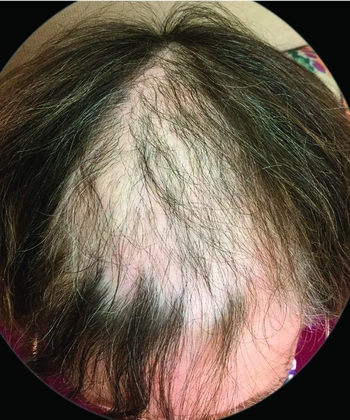
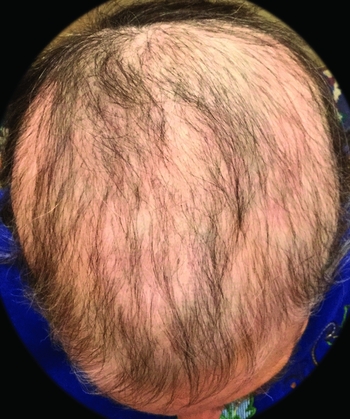
A 70-year-old female living in a foster care home was referred to Geriatric Psychiatry from Primary Care with a three-week history of hair pulling behavior that had already resulted in significant hair loss (Figure 1). Past medical history was significant for a lifelong history of anxiety and obsessive-compulsive traits, mainly revolving around frequent toileting behaviors and using excessive amounts of toilet paper, for which she was taking citalopram 20 mg daily. There was also a history of below average intellectual function with an IQ of 82, as determined by psychological testing ten years prior. Per her guardian of over 15 years and review of previous psychiatry notes dating back 12 years, there was no known history of previous hair pulling behaviors. On review with her guardian, it was noted that there had also recently been an escalation in her toileting. Her home environment was stable and no potential triggers of these behaviors were identified from the history. At the initial visit, she reported that when she heard the snap after she pulled her hair out it would give her an enjoyable calm feeling. She admitted that it was painful and she would prefer not to do it but said she was unable to stop. She described herself as looking like George Washington because of the extent of frontal hair loss. She was alert and cooperative. Mood was calm and affect was smiling. Her speech was clear and coherent. She denied any auditory or visual hallucinations. There was no evidence of suicidality. She scored 3 on the Patient Health Questionnaire (PHQ-9) (Spitzer et al., Reference Spitzer, Kroenke and Williams1999) and 0 on the Generalized Anxiety Disorder 7-item (GAD-7) scale (Spitzer et al., Reference Spitzer, Kroenke, Williams and Lowe2006). Baseline electrolytes and thyroid function were normal. She was started on Clomipramine 25 mg at night and referred to a therapist for habit-reversal training. Photos were taken to document extent of the hair loss (Figure 2). Dermatology opinion was sought to rule out other causes of hair loss. Dermatology subsequently agreed with the diagnosis, given the history and lack of inflammation or scarring on the scalp.
Scalp photograph taken at initial visit with primary care.

Photo taken two weeks later at initial visit with psychiatry.

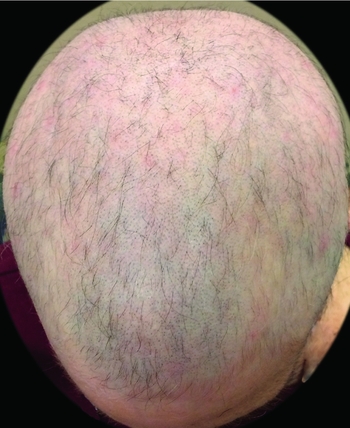
At follow-up two weeks later, she reported feeling less anxious, although hair loss was more extensive, now involving almost her entire scalp (Figure 3). She was now wearing a hair piece. She was accompanied by a staff member from her foster home, who remarked on a reduction in her anxiety and toileting behaviors. Staff also thought that she was pulling at her hair less often. The patient reported that she was using a scarf and also the hair piece which she liked. She noted the behavioral strategies she had learned from therapy (coloring, using a squeeze ball, making bead necklaces) were helpful to distract her when she had the urge to pull her hair. She was tolerating the Clomipramine well. PHQ-9 and GAD-7 scores were 0. Unfortunately, one month later, her hair loss was now affecting the entire scalp and her obsessions were noted to have increased by her caregiver. Clomipramine dose was increased to 50 mg daily. For the next five months, she continued with regular follow-up by Primary Care. Since she was doing well with associated hair regrowth, she did not return to Psychiatry.
Photo at psychiatry follow-up visit two weeks later.

Discussion
Although described over a century ago by a French dermatologist, trichotillomania has only been recognized as a psychiatric disorder in the past 30 years. It is currently classified as an obsessive- and compulsive-related disorder (American Psychiatric Association, 2013), having previously being classified under impulse control disorders. The current DSM diagnostic criteria require recurrent hair-pulling that results in hair loss, attempts to decrease or stop, it should not be due to another disorder or medical condition, and it should cause significant distress or impairment of functioning. This case is unique in that, as far as we could ascertain from collateral history, trichotillomania onset was at the relatively late age of 70 years. Cross-sectional data have shown no significant differences amongst hair pullers of early or later onset in terms of phenomenology, comorbidity, functional implications, and potential treatment response, although once again the late onset cases included were not old enough to be in the “geriatric” age category (Flessner et al., Reference Flessner, Lochner, Stein, Woods, Franklin and Keuthen2010).
For trichotillomania, there is no Food and Drug Administration (FDA) approved treatment and a clear lack of randomized controlled treatment trials. Similar to epidemiological data, any pharmacological data have largely come from younger patients, with infrequent geriatric patients. What have been studied most in trials are the selective serotonin reuptake inhibitors (SSRI), the tricyclic antidepressant (TCA) clomipramine, and behavioral therapy largely in the form of habit reversal therapy (HRT). A systematic review of these treatments included just seven randomized control trials (RCTs), and the resulting meta-analysis showed that clomipramine was more efficacious than placebo and that HRT was generally superior to pharmacological therapies (Bloch et al., Reference Bloch2007). A 2013 Cochrane review identified eight RCTs of pharmacological treatments (SSRIs, naltrexone, N-acetyl cysteine, TCAs, and olanzapine) and concluded that none of these definitively demonstrated efficacy, however, there was some evidence of treatment effects with clomipramine, N-acetyl cysteine, and olanzapine in very small samples (Rothbart et al., Reference Rothbart2013). Unfortunately, only one study included an older patient, a 68-year-old female in a trial with fluoxetine (Streichenwein and Thornby, Reference Streichenwein and Thornby1995). Case reports of treating trichotillomania in older patients with dementia have been published with variable successes and a range of pharmacological treatments used, including Risperidone and Naltrexone (Oravecz and Stuhec, Reference Oravecz and Stuhec2014), Mirtazapine with various SSRI's (De Sousa and Mehta, Reference De Sousa and Mehta2013) and Citalopram (Mittal et al., Reference Mittal, O'jile, Kennedy and Jimerson2001). Hence, a challenge in this case was treatment options, given her age and the fact that she was already on a SSRI at the maximum recommended dose for her age.
Like many issues in geriatric medicine and geriatric psychiatry, we often prefer a non-pharmacological treatment approach where possible. Specifically for trichotillomania, behavioral therapies have been tried in a small number of RCTs. HRT (Azrin and Nunn, Reference Azrin and Nunn1973) initially formed the mainstay of behavioral therapy but more recently, HRT has been augmented by other therapies, acceptance and commitment therapy (ACT) and dialectical behavior therapy (DBT), which have proven helpful at least in the short-term, albeit in small samples of younger patients (Woods et al., Reference Woods, Wetterneck and Flessner2006, Keuthen et al., Reference Keuthen2012). A recent meta-analysis confirmed a large effect for behavioral therapy in trichotillomania trials and suggested augmented HRT is more beneficial than core HRT alone (Mcguire et al., Reference Mcguire2014).
In conclusion, this case presents a rare example of late onset trichotillomania in an older female with obsessive-compulsive traits treated with a multidisciplinary treatment approach. Clearly, treatment of trichotillomania in the geriatric setting is challenging but a combination of behavioral therapy and pharmacotherapy may be most effective.
Conflict of interest
Dr Grant has received research grants from NIDA, National Center for Responsible Gaming, Brainsway, and Forest and Takeda Pharmaceuticals. Dr Grant receives yearly compensation from Springer Publishing for acting as Editor-in-Chief of the Journal of Gambling Studies and has received royalties from Oxford University Press, American Psychiatric Publishing, Inc., Norton Press, and McGraw Hill.
Description of authors' roles
Dr Bartley and Dr Lapid were responsible for the conception, preparation, and finalization of the manuscript. Dr Grant was responsible for reviewing, intellectual and expertise contributions, and finalization of manuscript.