





Introduction
Early exposure to a language plays a crucial role in developing linguistic abilities during childhood and later in adulthood. These linguistic benefits have been mainly attested in first- and second-language speakers of majority Indo-European languages (e.g., English, Dutch, Spanish, and French). Compared to the majority of languages spoken by ethnolinguistically dominant groups, minoritized languages present significant challenges for language development, as they often lack prestige, are used in restricted communicative contexts, and are rarely taught in formal education, resulting in limited literacy skills (Beatty-Martínez et al., Reference Beatty-Martínez, Navarro-Torres, Dussias, Bajo, Guzzardo Tamargo and Kroll2020; Ferreira et al., Reference Ferreira, Miglio, Schwieter, Benati and Schwieter2019). Speakers of minoritized languages often fail to attain full proficiency and become more proficient in the majority language, leading to a gradual decline in the use of the minoritized language, which eventually emerges as their heritage language (Valdés, Reference Valdés2005). Determining the extent to which early exposure to a minoritized language may suffice to develop linguistic competence and whether this early-acquired linguistic knowledge may remain accessible in adulthood is not a straightforward task. The present study used electrophysiological brain measures to examine whether adult speakers of a minoritized language can benefit from early exposure to their heritage language while learning written words in this language.
A heritage speaker is an early bilingual who acquires two languages during early childhood (before age 6), either simultaneously or sequentially, and is exposed to both a heritage language and the majority language; however, the majority language becomes dominant at some point during childhood (Benmamoun et al., Reference Benmamoun, Montrul and Polinsky2013). Similar to other bilingual populations, heritage speakers exhibit a dominant language in which they perform best across multiple linguistic tasks (Flege et al., Reference Flege, Mackay and Piske2002). In recent years, there has been a growing interest in understanding how heritage speakers recognize and speak words in their two languages (Jegerski & Sekerina, Reference Jegerski, Sekerina, Polinsky and Montrul2021). Previous studies suggest that heritage speakers exhibit less developed lexical knowledge and slower lexical access in their heritage language compared to their more dominant language (Basnight-Brown & Altarriba Reference Basnight-Brown and Altarriba2007; Gollan et al., Reference Gollan, Schotter, Gomez, Murillo and Rayner2014). Language production studies have shown reduced vocabulary repertoires in the heritage language, along with greater difficulty in word naming and retrieval (Hulsen, Reference Hulsen2000; O’Grady et al., Reference O’Grady, Schafer, Perla, Lee and Wieting2009). These findings have been attributed to limited exposure to the heritage language in childhood (O’Grady et al., Reference O’Grady, Schafer, Perla, Lee and Wieting2009), as reduced exposure to social contexts in which the language is used may affect children’s ability to comprehend and produce it (Hoff, Reference Hoff2006).
Building on this evidence, early exposure appears to play a crucial role in shaping the development of lexical knowledge in the heritage bilingual lexicon (Montrul & Foote, Reference Montrul and Foote2014). Indeed, heritage speakers—early bilinguals exposed to Spanish from birth in the home who later acquired English during childhood—showed greater accuracy in recognizing written Spanish words acquired early in life than those acquired later. By contrast, late L2 learners of Spanish were faster than heritage speakers when recognizing the same written words. Montrul and Foote (Reference Montrul and Foote2014) attributed this processing advantage in L2 learners to differences in learning modality. Specifically, L2 learners were exposed to Spanish in a formal classroom setting, thereby strengthening visual word recognition skills, whereas heritage speakers were exposed to Spanish primarily through oral interactions and therefore had less experience processing written words. Despite these group differences in processing speed, both participant groups showed a clear advantage for early-acquired vocabulary in the development of their less dominant language. These findings were interpreted as supporting the mapping hypothesis (Ellis & Lambon Ralph, Reference Ellis and Lambon Ralph2000), according to which words acquired early in development establish stronger connections between phonological, orthographic, and semantic representations than words acquired later. Consequently, these robust lexical representations are maintained over time, even as language use and exposure decline.
Further studies have reported that heritage speakers outperform L2 learners in word recognition paradigms (Davis et al., Reference Davis, Sánchez-Casas, García-Albea, Guasch, Molero and Ferré2010; Gor & Cook, Reference Gor and Cook2010). Not only does their lexical knowledge show stronger word-concept connections than that of L2 learners, but their lexical access is also more nativelike when compared to L2 learners (Gor, Reference Gor, Bauckus and Kresin2018). Building on these findings, a neurocognitive approach is particularly well suited to examining the nature of these lexical processing advantages, as it allows us to investigate how lexical knowledge of a heritage language develops and is accessed, especially in contexts where the language belongs to a minoritized linguistic group and its use is socially restricted. Neurocognitive methods, such as event-related potentials (ERPs), provide a continuous measure of brain activity during real-time word recognition and offer fine-grained insights into the temporal dynamics of word processing as it unfolds (Grainger & Holcomb, Reference Grainger and Holcomb2009; Winsler et al., Reference Winsler, Midgley, Grainger and Holcomb2018). Compared to behavioral measures such as reaction times and accuracy scores, ERPs can be more informative about the cognitive processes underlying word recognition in diverse linguistic contexts (Bice & Kroll, Reference Bice and Kroll2015).
The present study
The present study examined the lexical knowledge of heritage speakers who grew up within an Otomi language-speaking family and community and who were therefore exposed to this minoritized language from early childhood. Otomi is an indigenous Mexican language, whereas Spanish functions as the majority language, even within indigenous communities where most individuals use Otomi on a daily basis (Hekking, Reference Hekking2002). The language shift toward Spanish is even more evident among Otomi speakers who migrate from rural communities to urban areas, where the use of Otomi becomes restricted to the home domain. In such contexts, individuals born in the cities may not acquire their parents’ or grandparents’ mother tongue, thereby becoming heritage speakers of Otomi. For the purposes of the present study, heritage speakers were defined as early bilinguals who were exposed to Otomi early in life through their immediate relatives but who did not speak, read, or write their heritage language. To our knowledge, no previous neurocognitive studies have examined the extent to which lexical knowledge of a Mexican indigenous language can be accessed and maintained in the brain of heritage speakers despite their limited linguistic proficiency and lack of literacy. Rather than framing heritage speakers as exhibiting incomplete acquisition within a deficit perspective (Higby et al., Reference Higby, Gámez and Mendoza2023), the present research aims to elucidate the linguistic knowledge that heritage speakers of a minoritized language retain in memory and subsequently use in adulthood when engaging in the (re)learning of this language. Accurately assessing a heritage speaker’s language ability can be essential for predicting both the level of proficiency that can be attained in the heritage language and the degree of endangerment faced by an indigenous, minoritized language.
We used ERPs to investigate the extent to which heritage speakers benefit from early exposure to a minoritized language in order to determine whether such exposure confers a processing advantage for written words in their heritage language. Previous ERP studies on language processing have focused on the N400 component, a negative-going brain waveform with a centro-parietal distribution peaking around 400 ms after stimulus onset (Federmeier, Reference Federmeier2022; Kutas & Federmeier, Reference Kutas and Federmeier2011; Kutas & Hillyard, Reference Kutas and Hillyard1980). The amplitude of the N400 has been found to reflect the ease with which semantic information about words is retrieved from the mental lexicon (Carrasco-Ortiz et al., Reference Carrasco-Ortiz, Midgley and Frenck-Mestre2012; Desroches et al., Reference Desroches, Newman and Joanisse2009; Kutas & Federmeier, Reference Kutas and Federmeier2011; Newman et al., Reference Newman, Tremblay, Nichols, Neville and Ullman2012). A previous ERP study on the learning of an unknown language reported N400 effects associated with the activation of word meaning (Perfetti et al., Reference Perfetti, Wlotko and Hart2005). After a training phase in which adult learners associated novel words with their meanings, electrical brain measures were recorded as participants read word pairs containing a newly learned word followed by a semantically related or unrelated word. Results showed that semantically related word pairs elicited a reduced N400 amplitude, indicating that participants had successfully activated the meaning of newly learned words.
For the present study, we measured N400 amplitude to determine whether heritage speakers exhibit a lexical processing advantage associated with the activation of linguistic knowledge acquired early in their heritage language. We hypothesized that heritage speakers would benefit from their early exposure to the heritage language when processing written words, in contrast to novice L2 learners of Otomi who had no prior exposure to this language. To test this hypothesis, we recorded brain activity while Spanish-dominant speakers, either heritage speakers or L2 learners of Otomi, read words in Otomi. Brain activity was recorded after a two-day training program in which all participants were exposed to auditory Otomi words paired with images depicting their meanings, followed by their corresponding written forms. In the third and final session, ERPs were recorded using a match/mismatch paradigm in which only written word forms were presented, each preceded by an image depicting either its corresponding meaning (congruent) or an unrelated meaning (incongruent). This design allowed us to examine the extent to which participants’ brain responses reflected access to the meanings of the written Otomi word forms and whether heritage speakers exhibited a processing advantage over L2 learners in mapping these forms to meaning. In line with previous studies (Holcomb & Grainger, Reference Holcomb and Grainger2006; Kutas & Federmeier, Reference Kutas and Federmeier2011), the N400 is thought to reflect the mapping of lexical form onto semantic representations, with larger negative N400 amplitudes arising when the semantic interpretation of a word is not supported by the preceding context. Building on these findings, we expect N400 amplitude to be modulated by semantic congruency; specifically, incongruent trials should elicit larger N400 amplitudes than congruent trials, indicating the difficulty of integrating the meaning of a recently learned Otomi word with the meaning depicted in the preceding image. A processing advantage for written words would be evidenced by a larger N400 effect in Otomi heritage speakers relative to L2 learners. Such an advantage would provide insight into patterns of language maintenance in a minoritized heritage language whose use is socially restricted and rarely used outside the family domain.
Methods
Ethics statement
This research conforms to APA standards for the ethical treatment of participants and was approved by the Bioethics Committee of the Universidad Autónoma de Querétaro (FONFIVE-CEI-03/24).
Participants
Thirty-six participants were recruited from the student population of a Mexican university and gave their informed consent to take part in the study. All participants were native Spanish speakers from México, right-handed (Edinburgh Handedness Inventory-Oldfield, 1971, M = +80.9, SD = 15.3), had normal or corrected-to-normal vision, and had no history of psychiatric disorders.
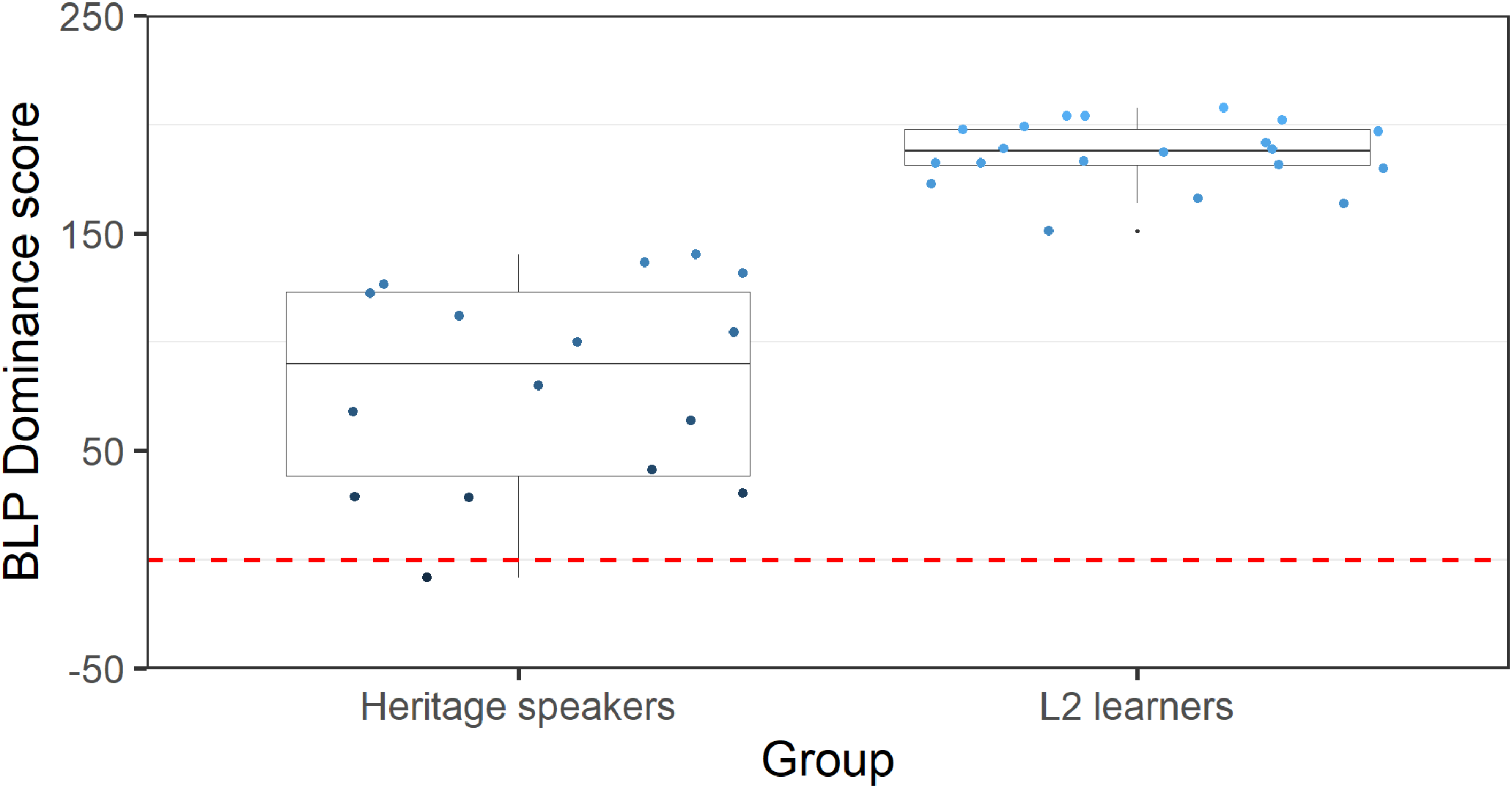
Knowledge and proficiency in Spanish, Otomi, and other languages were measured using the Bilingual Language Profile [BLP (Birdsong et al., Reference Birdsong, Gertken and Amengual2012)]. The BLP is an instrument for assessing language dominance through self-reports; it produces a continuous dominance score and a general bilingual profile considering a variety of linguistic variables across the included modules: language history, language use, language proficiency, and language attitudes (Birdsong et al., Reference Birdsong, Gertken and Amengual2012). Twenty participants were considered L2 learners, as they reported not having been previously exposed to Otomi, and their BLP scores showed a strong dominance of Spanish over Otomi (M = 187.8, SD = 15.2). Sixteen participants were considered heritage speakers of Otomi (or Hñäñho, the variety spoken in Querétaro), as they either belong to or were raised in close contact with an Otomi community. Most of them (n = 10) acquired Otomi simultaneously with Spanish, whereas the remaining participants (n = 6) learned Otomi as an L2 after the age of 3, with a mean age of acquisition of 9.6 years (SD = 2.6). According to their BLP scores (M = 81.6, SD = 46.8), Spanish was their dominant language. Both participant groups differ from each other in terms of their language dominance scores (t Welch = −8.61, df = 17.45, p < .01). BLP dominance scores by group are shown in Figure 1.
BLP dominance scores for heritage speakers and L2 learners.

Spanish language proficiency was measured using the Lextale-Esp (Izura et al., Reference Izura, Cuetos and Brysbaert2014). Following the scoring recommendations by Lemhöfer and Broersma (Reference Lemhöfer and Broersma2012) regarding LexTALE scores, 60–80% are associated with upper intermediate (B2), while scores of 80–100% correspond to upper and lower advanced/proficient user levels in the Common European Framework (CEF). Monolingual participants obtained a mean score of 80% (SD = 13.3), while the heritage speakers group obtained a mean score of 71% (SD = 11.1). The two participant groups differ significantly in their Spanish proficiency (t Welch = 2.21, df = 34, p < .05).
Stimuli
The complete set of stimuli consisted of 100 written words in Otomi, 100 corresponding images, and 100 corresponding auditory words. The critical written word stimuli (length: 4–6 letters) were mostly nouns that were selected from an Otomi-Spanish dictionary (Hekking, 2010). The word frequency was based on translating the stimuli into their corresponding Spanish words. Only high-frequency words were considered (HF: 3.9–5.8 Zipf values) according to the subtitle-based corpus SUBTLEX-ESP (Cuetos et al., Reference Cuetos, Glez-Nosti, Barbón and Brysbaert2011). Zipf values were calculated instead of frequency per million because Zipf values consider the total number of the analyzed corpus and can be compared across different-sized corpora (van Heuven et al., Reference van Heuven, Mandera, Keuleers and Brysbaert2014). The orthographic neighborhood density was controlled with the OLD20 measure (Yarkoni et al., Reference Yarkoni, Balota and Yap2008; M = 2.9, SD = 1.1). The stimulus set was constructed to exclude all Otomi-Spanish cognates, homographs, and homophones.
The 100 images were selected from the image databases of Duñabeitia et al. (Reference Duñabeitia, Crepaldi, Meyer, New, Pliatsikas, Smolka and Brysbaert2018) and Moreno-Martínez and Montoro (Reference Moreno-Martínez and Montoro2012) according to their correspondence to the Otomi words. The critical Otomi word stimuli and the selected images were piloted with five native speakers before the experiment to ensure that the images clearly corresponded to the stimuli for participants in the Otomi community. Finally, 100 audio files of the Otomi words were recorded by a native speaker and included in the stimuli. The speaker produced each word three times, and the second production was selected as the most natural. Recordings were edited to remove non-speech noise at the onset (e.g., breathing) whenever possible without affecting the speech signal. Audio stimuli were approximately 800 ms in duration (M = 807, SD = 85). To ensure smooth transitions between silence and the auditory stimuli during the experimental sequence, a 100 ms fade-in and a 100 ms fade-out were applied to each recording. These edits did not modify the target words, and all auditory stimuli were adjusted to have comparable durations.
The experimental materials have been made publicly available on the OpenScience Framework (OSF) platform. (Reference Number: https://osf.io/jfv62/).
Procedure
The experiment consisted of two training sessions and one assessment session on three consecutive days. The training sessions were conducted on two consecutive days (approx. 1 hour per day) in a quiet place on a laptop. During the first two training sessions, an association task was presented, which comprised the presentation of simultaneous image and audio, followed by the corresponding written form of the word. This task included passive learning and verification blocks that contained all the critical stimuli. In the passive learning block, participants saw images, followed by audio and written text in Otomi. In the verification block, participants saw the image, heard the audio, and had to decide whether the following written word in Otomi corresponded to the previously presented stimuli by pressing the “C” key or, if not, by pressing the “N” key (see Figure 2a and b for task details). Only twenty percent of the trials involved a mismatch among the image, the audio, and the subsequent written form.
Training sessions used an association task. An image was presented simultaneously with an auditory stimulus and followed by a written word in Otomi. Participants had to decide whether the word matched the meaning of the previously presented stimuli by pressing the “C” key (Panel A) or, if not, by pressing the “N” key (Panel B). The electroencephalography (EEG) session used a no-go task in which participants were instructed to press a yellow button on a response box after word presentation only when the image did not match the word’s meaning (panel C).

The third session was conducted on the third consecutive day in a soundproof and electrically shielded room. Participants were seated comfortably at approximately 60 cm from a computer screen. Two electrodes were placed over the left and right mastoids for offline re-referencing. An additional electrode was placed below the left eye and another next to the right eye to register eye movements. Brain electrical signals were collected using a cap where 32 electrodes were placed and connected to a NeuroScan system with a 1000 Hz sampling rate. Impedances were kept under 10 kΩ. A no-go task of image-written word verification was conducted while the EEG signal was recorded. The task involved 100 critical words split into two verification blocks. Each trial began with a fixation point (500 ms) followed by an image (1000 ms), after which a written word was presented for 500 ms, followed by a 2500 ms inter-trial interval (Yum et al., Reference Yum, Midgley, Holcomb and Grainger2014). Four randomly ordered lists were created and counterbalanced across participants. Participants had to press a yellow button on a button box after the word presentation only when the image did not correspond with the word’s meaning and had up to 3000 ms to respond from stimulus onset (see Figure 2c for task details). In order to minimize muscular artifacts, only twenty-five percent of critical words involved a mismatch in meaning with the preceding image. Upon completing the EEG recording session, individuals performed LexEsp (Izura et al., Reference Izura, Cuetos and Brysbaert2014). The experiment lasted approximately 1.5 hours in total.
Analysis of behavioral data
The statistical analysis of the behavioral data was conducted based on accuracy and reaction times for the verification tasks of the first two sessions and separately for the no-go task of the third session. Linear mixed-effects models were conducted using the lme4 package (Bates et al., Reference Bates, Mächler, Bolker and Walker2015) in R version 4.1.0 (R Core Team, 2016). The initial models for the first two sessions were full models, incorporating random intercepts for subjects and items, as well as random slopes by subjects incorporating the interaction of the analyzed factors (Barr et al., Reference Barr, Levy, Scheepers and Tily2013). However, the random structure was simplified in some models to achieve convergence. After achieving convergence, the models were then simplified in a step-by-step backward model selection procedure. Session (first vs. second) and group (L2 learners vs. heritage speakers) were included in the full model. Effects’ coding was used (−0.5, 0.5) for congruency, session, and group. The resulting model was submitted to a type 3 ANOVA analysis, with denominator degrees of freedom estimated by Satterthwaite’s approximation (lmerTest::anova). The results of the final model with significant interactions of interest are reported. To further explore significant interactions in the final model, pairwise comparisons of the means were carried out with Tukey’s Honestly Significant Difference (HSD) contrasts (emmeans::emmeans).
EEG data collection, pre-processing, and ERP analyses.
Data was pre-processed in the EEGlab version 2022.1 toolbox (Delorme & Makeig, Reference Delorme and Makeig2004) and ERPlab (Lopez-Calderon & Luck, Reference Lopez-Calderon and Luck2014) version 9.0 (plug-in) in Matlab version 2018b. The data was filtered with a high-pass above 0.1 Hz, re-referenced to the average of the mastoids, and subjected to an Independent Composition Analysis (ICA) decomposition (runica). Components related to eye movements, muscle activity, or linear noise were identified using the ICLabel tool from EEGlab with a threshold from 0.7 to 1 for muscle activity, 0.8 to 1 for eye movements, and 0.5 to 1 for line noise. These components were subsequently removed from the data prior to signal reconstruction. The cleaned data were then low-pass filtered at 30 Hz. Time-locked epochs from −100 to 800 ms relative to stimulus onset were extracted. Bad epochs were identified and rejected using the ERP artifact detection, excluding epochs with activity exceeding 80 µV, falling below −80 µV, or exhibiting step-like voltage changes. Epochs were sorted by item condition, and averages per condition were calculated by participant. The grand average across participants was then calculated.
ERP analyses were conducted in the N400 time window (between 300 and 500 ms) by fitting a linear mixed-effects model (lme4:lmer). Models included a two-factor level of congruency (congruent vs. incongruent) and a two-level factor of group (L2 learners vs. heritage speakers). The spatial distribution of the ERPs was investigated by entering a three-by-five array of regions of interest, including three levels of line (left vs central vs right) and five levels of ant-post sites (F3/Fz/F4 vs FC3/FCz/FC4 vs C3/Cz/C4 vs CP3/CPz/CP4 vs P3/Pz/P4). The maximal random-effects structure was specified with random intercepts for Participant and by-subject random slopes for the effect of Congruency (see Barr et al., Reference Barr, Levy, Scheepers and Tily2013). The resulting model was submitted to a type 3 ANOVA analysis, with denominator degrees of freedom estimated by Satterthwaite’s approximation (lmerTest::anova). Significant effects were followed up with pairwise post-hoc comparisons of the means using Tukey’s HSD contrasts (emmeans::emmeans).
Behavioral results
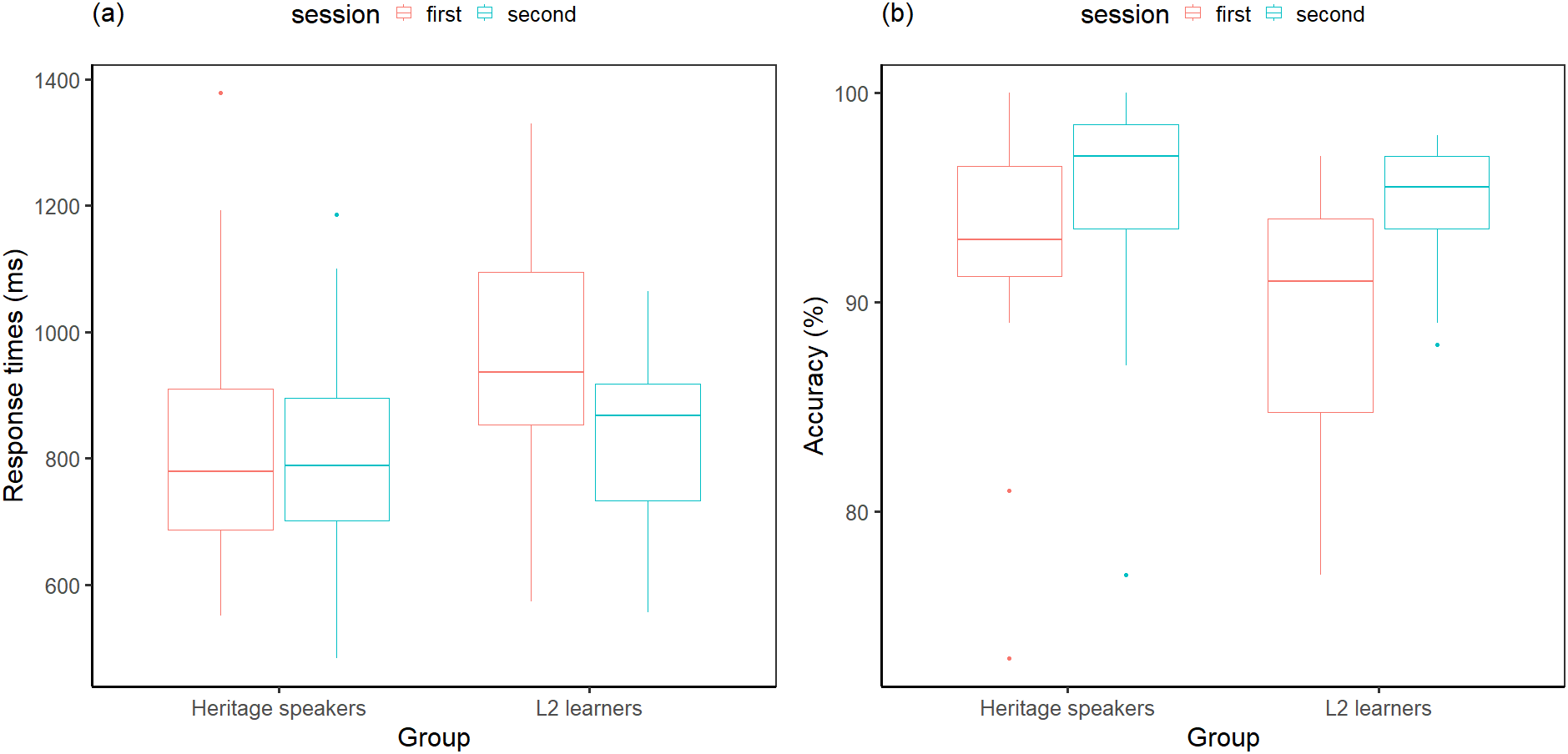
The results for the training sessions were analyzed in separate models for reaction times and accuracy. The final model for reaction times included a random intercept for participants and items (see Table 1 in Appendix 1). This model revealed a significant main effect of Session (F(1, 6904) = 71.11, p < .001) and a significant interaction between Group and Session (F(1, 6904) = 27.79, p < .001). As shown in Figure 3a, post-hoc analyses indicated that heritage speakers responded significantly faster (M = 837 ms, SD = 43.4) than L2 learners (M = 961 ms, SD = 39.1) in the first session (p < .05), but no significant difference was observed across participant groups in the second session (heritage speakers: M = 808 ms, SD = 43.6; L2 learners: M = 836 ms, SD = 39.0; p = .58). As is often the case in psycholinguistic experimentation and even more so with bilingual speakers, the model’s explained variance is only moderate: R2 marginal = 0.020, R2 conditional = 0.215.
ANOVA results on the linear mixed effect model for reaction times computed on the correct responses in the two training sessions

Table 1. Long description
A table with three rows and six columns comparing the effects of Session, Group, and their interaction on reaction times. The columns are labeled SumSq, MeanSq, NumDF, DenDF, F, and Pr(>F). The rows are labeled Session, Group, and Session:Group. Row 1: Session, SumSq 8087882, MeanSq 8087882, NumDF 1, DenDF 6445.6, F 67.8935, Pr(>F) 2.20E-16. Row 2: Group, SumSq 222957, MeanSq 222957, NumDF 1, DenDF 34, F 1.8716, Pr(>F) 0.1803. Row 3: Session:Group, SumSq 2843592, MeanSq 2843592, NumDF 1, DenDF 6446, F 23.8705, Pr(>F) 1.06E-06. The table shows significant effects for Session and the interaction between Session and Group, but not for Group alone.
Mean response latencies (in milliseconds; panel a) and percent accuracy rates (panel b) in training sessions 1 and 2 in each group.

The final logistic regression model for accuracy included a random intercept for participants and items (see Table 2 in Appendix 1). This model revealed a significant main effect of session (X 2 = 55.01, p < .01). As shown in Figure 3b, both participant groups responded more accurately in the second session compared to the first session. The model’s explained variance is only moderate: R2 marginal = 0.039, R2 conditional = 0.230.
The final logistic regression model for accuracy across the two training sessions

Table 2. Long description
A table with four rows and three columns comparing the effects of session, group, and their interaction on accuracy. The columns are labeled Chisq, DF, and Pr(>Chisq). The rows are labeled Session, Group, and Session:Group. Row 1: Chisq, 55.01; DF, 1; Pr(>Chisq), 1.197E-13. Row 2: Chisq, 3.33; DF, 1; Pr(>Chisq), 0.06. Row 3: Chisq, 3.14; DF, 1; Pr(>Chisq), 0.07. The table indicates significant effects for session and marginal effects for group and the interaction between session and group.
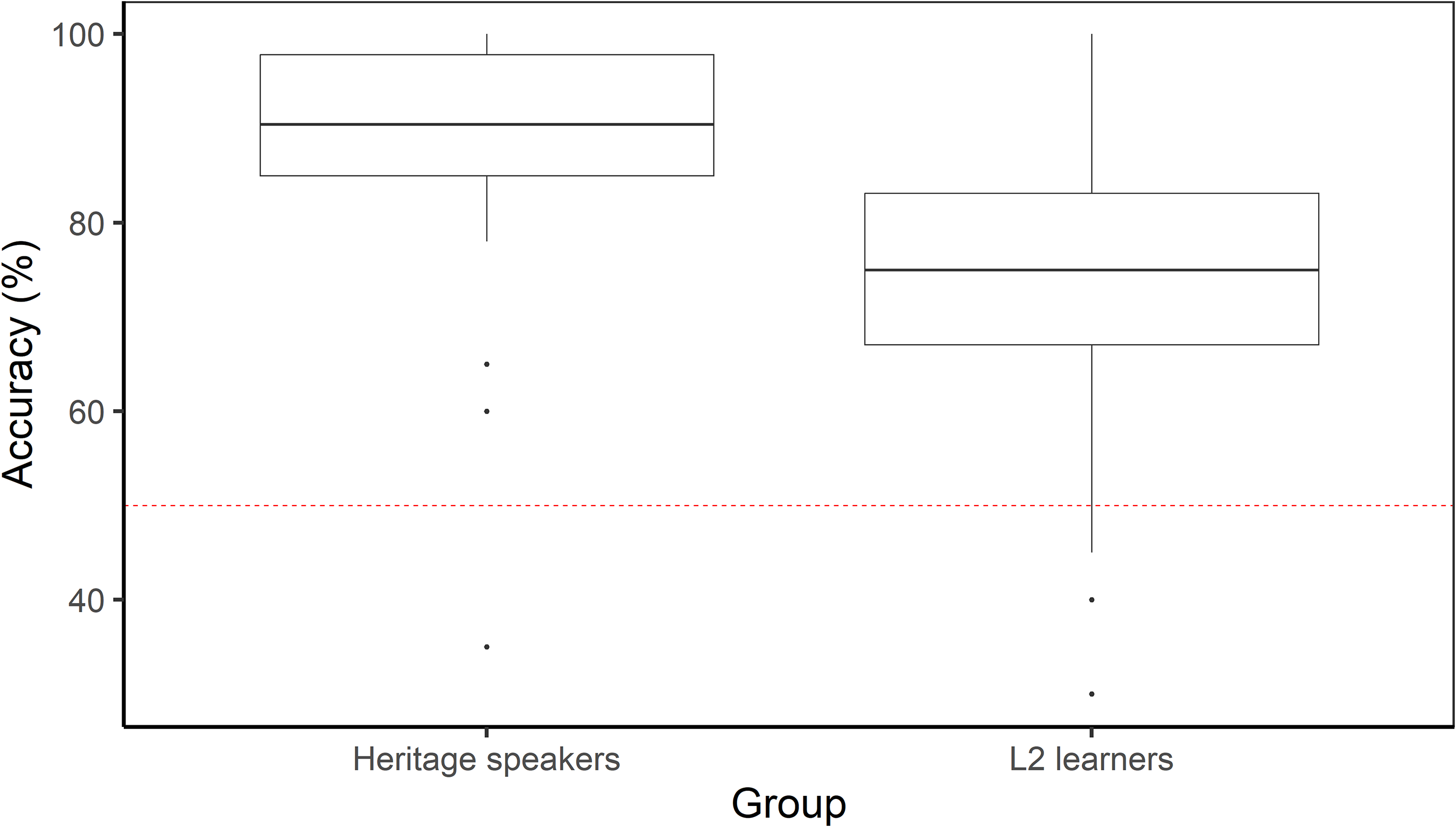
The final logistic regression model for the accuracy of the third task included random intercepts for participants and items (see Table 3 in Appendix 1). A main effect of group was observed (X 2 = 17.42, p < .001); overall, heritage speakers were more accurate than L2 learners, as seen in Figure 4.
The final logistic regression model for accuracy for the EEG session

Table 3. Long description
A table with one row and three columns. The row is labeled ‘Group’. The columns are labeled ‘Chisq’, ‘DF’, and ‘Pr(>Chisq)’. The values in the row are ‘17.42’ under ‘Chisq’, ‘1’ under ‘DF’, and ‘2.983E-05’ under ‘Pr(>Chisq)’. The table indicates a significant main effect of group in the logistic regression model.
Percent accuracy rates in the third session for each group.

Event-related potential results
The final model for the 300–500 ms time window, including by-subject random intercepts and random slopes for congruency, was significantly better than the model including by-subject random intercepts only (X 2 (2) = 558.41, p < .001). The syntax for the final model in this time window is the following: µV ∼ Group × Congruency × Line × Ant-Post + (1 + Congruency|Participant). The predictors were analyzed for collinearity by computing variance inflation factors (VIF). All variance inflation factors were below 7.5. The model’s explained variance was high: R 2 marginal = 0.214, R 2 conditional = 0.878.
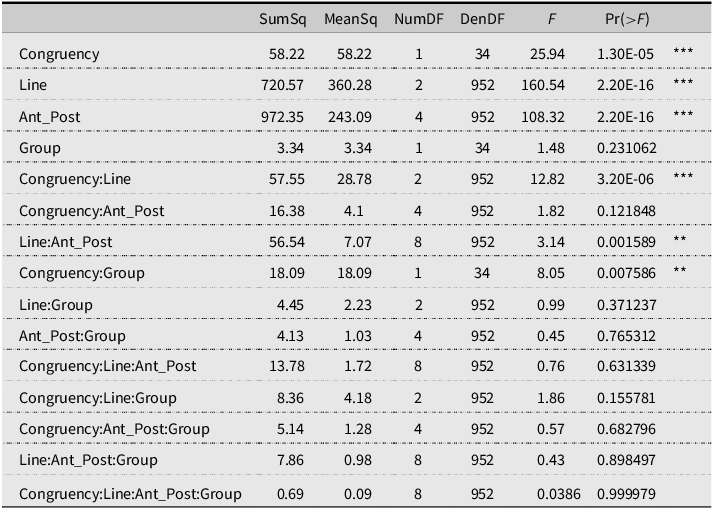
Crucially, a significant interaction between Group and Congruency revealed an N400 effect that varied as a function of Congruency for heritage speakers but not for L2 learners of Otomi (see Table 4 in Appendix 1). As can be seen in Figure 5a for heritage speakers of Otomi, critical written words that were congruent in meaning with the previously presented images elicited reduced N400 amplitudes compared to written words whose meaning did not match the images (Congruencycong-incong = 3.83 µV, t(34) = 5.32, p < .001). As can be seen in Figure 5b for L2 learners, written words that were incongruent in meaning with images elicited a non-significant larger negative N400 amplitude in comparison with written words whose meaning did match with images (Congruencycong-incong = 1.09 µV, t(34) = 1.69, p < .10).
ANOVA results on the final linear mixed model for the mean amplitude between 300 and –500 ms

Table 4. Long description
A table with ANOVA results for a linear mixed model on mean amplitude between 300 and 500 ms. The table has 16 rows and 7 columns. Column headers are SumSq, MeanSq, NumDF, DenDF, F, and Pr(>F). Row labels include Congruency, Line, Ant_Post, Group, Congruency:Line, Congruency:Ant_Post, Line:Ant_Post, Congruency:Group, Line:Group, Ant_Post:Group, Congruency:Line:Ant_Post, Congruency:Line:Group, Congruency:Ant_Post:Group, Line:Ant_Post:Group, and Congruency:Line:Ant_Post:Group. Each row contains values for SumSq, MeanSq, NumDF, DenDF, F, and Pr(>F). Notable values include significant p-values for Congruency, Line, Ant_Post, Congruency:Line, Line:Ant_Post, and Congruency:Group.
Grand-average event-related potentials elicited by congruent (black lines) and incongruent (red lines) conditions in heritage speakers of Otomi (panel a) and L2 learners (panel b). Data are plotted in the −100 to 800 ms time window post-stimulus onset. Negative is plotted up. Voltage maps show the scalp distribution of the voltage difference between incongruent and congruent conditions.

The data have been made publicly available on the OpenScience Framework (OSF) platform. (Reference Number: https://osf.io/jfv62/).
Discussion
In the current study, we employed electrophysiological brain measures to examine whether adult heritage speakers of Otomi, a minoritized language, benefit from early exposure to their heritage language when processing recently learned written words in Otomi. Results from the training sessions revealed an increase in accuracy in the second session for both heritage speakers and control L2 learners of Otomi, suggesting comparable learning progress across groups, as both were similarly effective in mapping images onto the meanings of the written Otomi words. However, relative to L2 learners, heritage speakers exhibited shorter response latencies to Otomi words during the first training session. This processing advantage suggests that heritage speakers activated previously acquired linguistic knowledge of their heritage language, which may have enhanced the processing of written Otomi words from the outset of training. This lexical processing advantage was further confirmed by the end-of-training accuracy scores, in which heritage speakers outperformed L2 learners in correctly identifying Otomi words that were incongruent with the meaning of the corresponding image.
Critically, the two participant groups exhibited distinct ERP responses to Otomi written words. Whereas L2 learners showed no modulation of the N400 amplitude as a function of the semantic congruency between the written words and the preceding images, heritage speakers exhibited larger N400 amplitudes in response to Otomi words that were semantically incongruent compared with congruent word-image pairs. In light of previous studies (Federmeier & Kutas, Reference Federmeier and Kutas1999; Kutas & Federmeier, Reference Kutas and Federmeier2011), we assume that increased N400 amplitudes reflect the greater effort required to integrate the meaning of a written word that is unrelated to the preceding image. Accordingly, the fact that an N400 effect emerged only for heritage speakers suggests that they were able to rapidly activate semantic features associated with Otomi words stored in their long-term memory representations. It is also likely that heritage speakers automatically activated phonological knowledge associated with these written word forms, thereby facilitating access to words’ meaning. This interpretation aligns with previous research on visual word recognition, showing that readers rely on phonological information when processing written words (Carrasco-Ortiz et al. Reference Carrasco-Ortiz, Midgley and Frenck-Mestre2012; Ferrand & Grainger, Reference Ferrand and Grainger2003; Van Orden & Kloos, Reference Van Orden, Kloos, Snowling and Hulme2005). Overall, the heritage speakers’ cortical responses reveal patterns of lexical maintenance indicating that knowledge of the heritage language remains accessible across the lifespan, even when the language is socially restricted and rarely used outside the family domain.
These findings contribute to the growing body of research on heritage bilingualism (Clemons, Reference Clemons2022; Ortega, Reference Ortega2020), which challenges deficit frameworks that have portrayed heritage bilingualism as harmful in contexts involving ethnically minoritized groups. We found a modulation of brain responses that was specific to adult heritage speakers of a minoritized language during the learning of Otomi written words, demonstrating that early exposure to a heritage language can provide lasting benefits. Even after years of reduced use and minimal linguistic input, the bilingual brain can maintain and recruit lexical knowledge of the heritage language acquired during childhood (Gor, Reference Gor, Bauckus and Kresin2018).
Our results are also consistent with previous research showing that early language exposure plays a crucial role in the development of the bilingual lexicon, regardless of subsequent patterns of language use (Montrul & Foote, Reference Montrul and Foote2014). However, unlike Montrul and Foote (Reference Montrul and Foote2014), we observed a lexical processing advantage for heritage speakers from the earliest stages of learning. This difference can be explained by the learning modality, as our training involved pairing auditory word forms with their written forms; bilinguals were able to benefit from their greater experience with oral language. These findings extend Montrul and Foote’s proposal by showing that when learning is supported by auditory input, heritage speakers can establish stronger phonological-semantic associations with novel written forms, thereby facilitating lexical access. Together, these findings further support the proposal that modality-specific language experience shapes lexical acquisition and the development of the bilingual lexicon.
Furthermore, heritage speakers appeared to possess a smaller Spanish vocabulary than L2 learners, as indicated by their performance on the Spanish vocabulary size test (Lextale-Esp). These findings align with previous research on bilingual receptive vocabulary, which has shown that bilinguals typically know fewer words in each of their languages when compared to monolingual speakers of the same language (Bialystok & Luk, Reference Bialystok and Luk2012). It is thus not unexpected that heritage speakers exhibited reduced lexical knowledge in Spanish relative to individuals raised in a monolingual context. This difference has been attributed to the bilinguals’ need to distribute their language-learning experiences across two languages, as certain lexical items may occur only in contexts where one of the languages is used.
One possible methodological consideration concerns the response requirements during the behavioral and EEG sessions. To ensure methodological consistency with previous studies, we adopted the procedure described by Yum et al. (Reference Yum, Midgley, Holcomb and Grainger2014), which served as the basis for the present study. During the behavioral training sessions, participants responded using separate “yes” or “no” keys. During the EEG recording session, participants were required to respond to no-go trials, responding only to trials in which the meanings of the written word did not match the preceding image. To minimize variability associated with hand dominance, all participants responded with their dominant hand and were confirmed to be right-handed using the Edinburgh Handedness Inventory (Oldfield, Reference Oldfield1971). Although the lack of response-hand counterbalancing represents a potential methodological limitation, counterbalancing the response hand could itself have introduced additional variability in response accuracy and ERP measures. Nevertheless, because the same response requirements were applied to both participant groups, this methodological feature is unlikely to account for the observed group differences. Consistent with this interpretation, only heritage speakers exhibited a robust behavioral advantage during the first learning session and an N400 effect for semantically incongruent Otomi word–image pairs, whereas no comparable neural modulation was observed in the L2 learners.
Overall, these findings show that, despite being dominant in the majority language, heritage speakers can still develop and preserve linguistic knowledge of a minoritized language and can draw on this knowledge in adulthood when re-learning the language (Ionin, Reference Ionin2007; Montrul, Reference Montrul2005). Finally, the present findings contribute to research examining how heritage languages are represented and stored in memory, thereby offering insights relevant to predicting learners’ attainable proficiency. Such evidence also informs assessments of the degree of endangerment faced by a minoritized language.
Replication package
Replication data and materials for this article can be found at https://osf.io/jfv62/.
Acknowledgements
The authors gratefully acknowledge all the participants who took part in this study, as well as the support of the following institutions, whose funding made this research possible: the National Council for Science and Technology (CONACYT, now SECIHTI), which supported Beerelim Corona-Dzul as a postdoctoral researcher (Grant Nos. 2018-000005-01NACV-01617 and 2019-000019-01NACV-00280); the Fondo para el Fortalecimiento de la Investigación, Vinculación y Extensión (FONFIVE, 2024–2026) at the Universidad Autónoma de Querétaro (UAQ); and the 2026 Tinker Visiting Professor Program at the Lozano Long Institute of Latin American Studies (LLILAS), The University of Texas at Austin, awarded to Haydée Carrasco-Ortiz.
Appendix I
Linear mixed-effects models were calculated for reaction times (Table 1) and the logistic regression models for accuracy during the two training sessions (Table 2) and the final EEG session (Table 3). A linear mixed-effects model was calculated for the N400 component (Table 4). Significant values are marked as follows: “***” 0.001 “**” 0.01 “*” 0.05 “†” 0.1 “ ” 1. Significant values are marked as follows: *** indicates p < .001 ** indicates p < .01 * indicates p < .05 † indicates p < .10 a blank space indicates p ≥ .10 (not statistically significant).






 Open access

