Introduction
Ménière's disease is an inner-ear disorder characterised by recurrent spontaneous vertigo, hearing loss, tinnitus and ear fullness. It is a condition of cochleovestibular dysfunction and is defined as the idiopathic syndrome of endolymphatic hydrops. In the course of the disease, damage to the vestibular and cochlear organs occurs, which hampers any therapeutic procedure. Vertigo attacks accompanied by nausea and vomiting, and fluctuating sensorineural hearing loss, affect the patient's daily activities.
The common medical therapy is a low-sodium diet, diuretic therapy, corticosteroids and vasodilator therapy. If a patient continues to have episodic vertigo in spite of an adequate trial of medical therapy, surgical management, including transtympanic middle-ear overpressure treatment (using the Meniett® device), intratympanic gentamicin administration, transmastoid endolymphatic sac surgery, transmastoid labyrinthectomy and retrosigmoid vestibular nerve section, should be considered.
Tympanostomy tube placement is one of the surgical management methods for intractable Ménière's disease and is a treatment in which residual disability is less.Reference Montandon and Guillemin1, Reference Thomsen, Bonding, Becker, Stage and Tos2 It is considered preferable to the Meniett, intratympanic gentamicin administration and transmastoid endolymphatic sac surgery procedures. Although tympanostomy tube placement has been performed for intractable Ménière's disease at many facilities, only a few studies have been published on the treatment.
We studied patients with tympanostomy tube placement and examined the therapeutic effects after one and two years, comparing our results with previous reports.
Materials and methods
Fifteen patients (5 women and 10 men, aged 26 to 77 years (mean age, 52.4 years)) with intractable Ménière's disease were studied. The patients were followed up for at least two years after the placement of tympanostomy tubes for intractable Ménière's disease.
Diagnosis of definitive Ménière's disease was based on the history of the disease and findings of neuro-otological examinations, which assessed the coexistence of recurrent episodic vertigo and fluctuating cochlear symptoms including hearing loss, tinnitus and aural pressure. Diagnosis was made according to the American Academy of Otolaryngology-Head and Neck Surgery (AAO-HNS) foundation 1995 guidelines proposed by the Committee on Hearing and Equilibrium.3 All patients underwent audiological and otoneurological examinations before insertion of the tympanostomy tube in order to exclude other inner-ear disorders and retrolabyrinthine disorders.
All patients had previously received medical management therapy for at least six months before undergoing placement of a tympanostomy tube. The insertion of a tympanostomy tube was suggested to them as a first-line surgical attempt to prevent the occurrence of vertigo attacks or reduce the severity of the attacks. The tympanostomy tube was placed in the anterior-inferior part of the tympanic membrane under topical anaesthesia; anaesthesia was achieved with lidocaine drops in the external auditory canal using iontophoresis.
The treatment outcomes of hearing and equilibrium were evaluated according to the AAO-HNS criteria.3 We evaluated these outcomes at one and two years after treatment. The frequency of definitive vertigo attacks experienced during the 6 months before treatment was compared with the number of attacks experienced between 6 months and 12 months (1 year) and between 18 and 24 months (2 years) after treatment. In order to express the effect of treatment on vertigo attacks, a numeric value was calculated; that is, the average number of definitive attacks per month after tube placement was divided by the number that occurred prior to tube placement (as per the AAO-HNS guidelines3). Control of vertigo, as determined by the numeric value, was categorised as follows: 0 = A, complete control; 1–41 = B, substantial control; 41–80 = C, limited control; 81–120 = D, insignificant control; >120 = E, worse (poor) control; F, secondary treatment initiated because of vertigo-related disability.
Hearing change was also evaluated using AAO-HNS criteria.3 These criteria consider the thresholds of 0.5, 1, 2 and 3 kHz, but threshold levels of 3 kHz are not usually measured in Japan. Therefore, we considered the average hearing thresholds of 0.25, 0.5, 1 and 2 kHz. The patients' poorest hearing levels using a four-frequency (0.25, 0.5, 1 and 2 kHz) pure tone average were assessed before and after treatment (short-term, 6–12 months; long-term, 18–24 months). Hearing change was defined as: improved (gain of more than 10 dB), unchanged (±10 dB) or worse (loss of more than 10 dB).
Results
Vertigo attacks
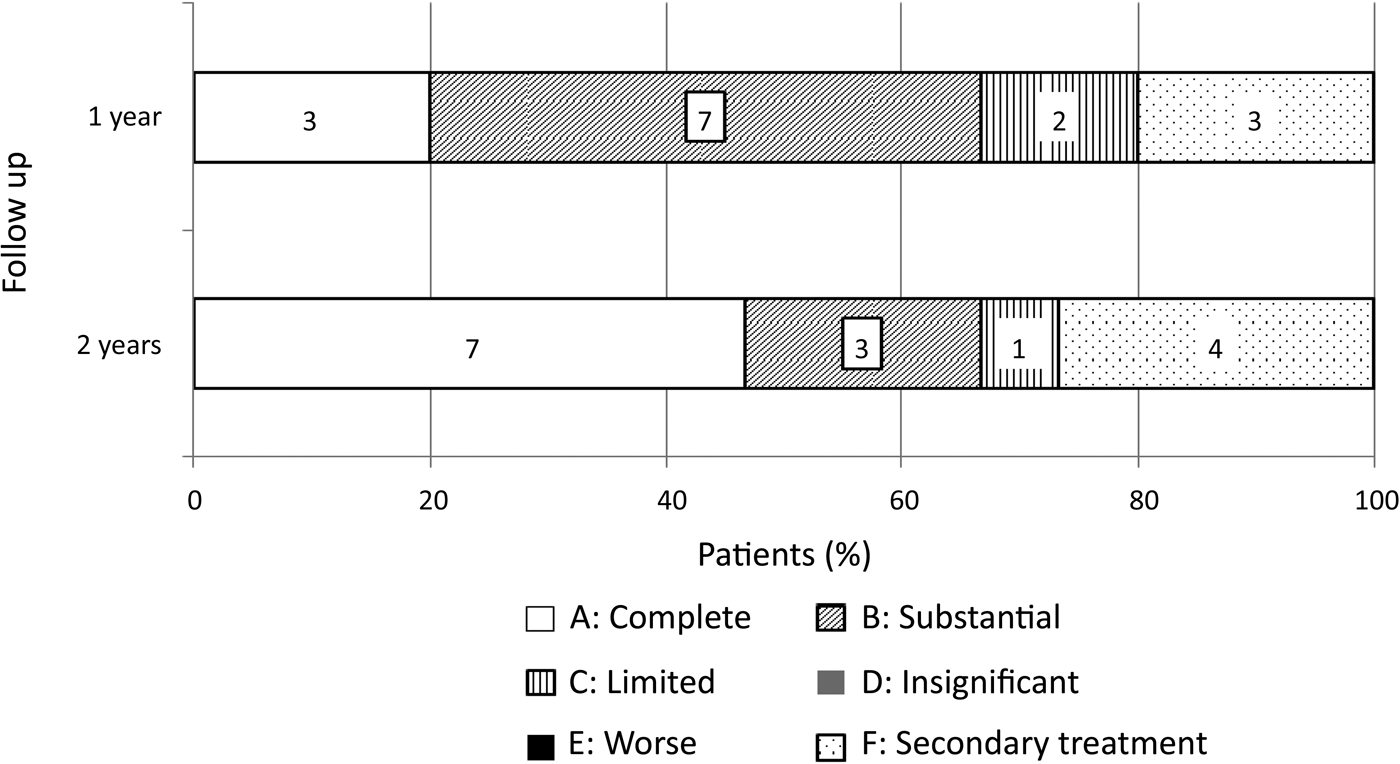
At 12 months after treatment, 3 patients (20 per cent) showed complete control of vertigo, 7 (47 per cent) showed substantial control and 2 (13 per cent) showed limited control. Three patients (20 per cent) required other treatment (Figure 1): one patient underwent transmastoid endolymphatic sac surgery and afterwards intratympanic gentamicin administration, and the other two patients underwent intratympanic gentamicin administration, which led to control of the vertigo.
Control of vertigo attacks following tympanostomy tube placement: comparison of effectiveness at one and two years' follow up.

At 24 months after treatment, 7 patients (47 per cent) showed complete control of vertigo, 3 (20 per cent) showed substantial control and 1 (7 per cent) showed limited control (Figure 1). One patient required intratympanic gentamicin administration at 15 months after tympanostomy tube placement.
The percentage of patients who experienced complete control of vertigo obviously increased after two years when compared with the therapeutic effects after one year (Figure 1). Of the seven patients with complete control at the two-year evaluation, two patients showed complete control, three patients showed substantial control and two patients showed limited control at one year.
Changes in hearing
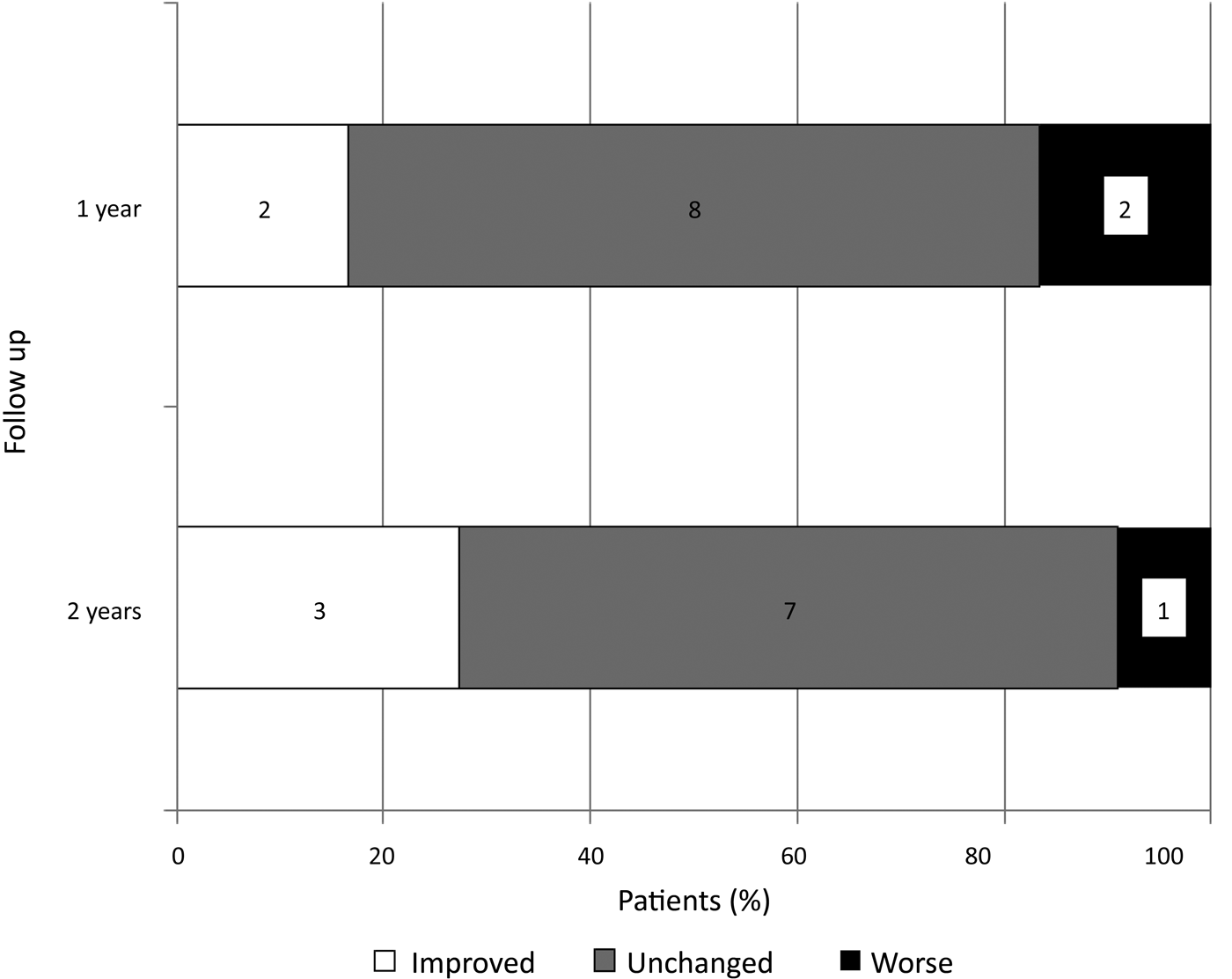
At 12 months after treatment, hearing had improved in 2 patients (13.3 per cent), was unchanged in 8 (53.3 per cent) and was worse in 2 (13.3 per cent) (Figure 2). At 24 months after treatment, hearing had improved in 3 patients (20 per cent), was unchanged in 7 (46.7 per cent) and was worse in 1 (6.7 per cent) (Figure 2). There were no obvious differences between the therapeutic effects at one and two years (Figure 2).
Changes in hearing level following tympanostomy tube placement: comparison of effectiveness at one and two years' follow up. (Patients that underwent secondary treatment were excluded.)

Tympanostomy tube loss
Four patients retained the tympanostomy tube for over two years. The tympanostomy tube fell out within two years in eight of the patients. The tube loss occurred between 6 months and 22 months after insertion (at 6 months in 1 patient, 13 months in 3, 15 months in 1, 18 months in 2 and 22 months in 1). In two patients, vertigo attacks recurred; tube placement was performed again and the vertigo subsided. Another six patients with tube loss suffered no further vertigo attacks and the tubes were not replaced. One patient had vertigo after 2 years; he underwent intratympanic gentamicin administration at 30 months after tube placement. The other patients did not require more invasive surgical therapy. Three of these patients had substantial control of vertigo according to the criteria.
Discussion
The insertion of a tympanostomy tube as a treatment for patients with Ménière's disease was initially proposed by Tumarkin, in 1966.Reference Tumarkin4 TumarkinReference Tumarkin4 and LallReference Lall5 found that the eustachian tube was often blocked in patients with Ménière's disease. The conclusions were supported by the concept that endolymphatic hydrops in Ménière's disease was correlated with eustachian tube dysfunction. In 1975, CinnamondReference Cinnamond6 disputed this concept by stating that eustachian tube dysfunction was not a consistent feature of Ménière's disease and that the use of a grommet tube to alleviate symptoms was futile. The therapy was also rejected by Hall and Brackmann,Reference Hall and Brackmann7 in 1977.
In 1988, Montandon et al.Reference Montandon and Guillemin1 reported reintroducing this treatment clinically; they treated 28 intractable Ménière's disease patients with tympanostomy tubes. The findings showed improvement or a complete remission of vertiginous attacks in 23 patients (82 per cent). In 1998, Thomsen et al.Reference Thomsen, Bonding, Becker, Stage and Tos2 compared the effect of 2 surgical modalities in 29 intractable Ménière's disease patients: 15 patients underwent transmastoid endolymphatic sac surgery and 14 underwent tympanostomy tube placement. There were statistically significant reductions in dizzy spells for patients in both groups post-operatively, but there were no statistical differences between the groups. Two of the patients in the sac surgery group developed severe hearing loss. The authors concluded that tympanostomy tube placement should be the first choice of surgical treatment for Ménière's disease patients who have vertiginous symptoms refractory to medical treatment.
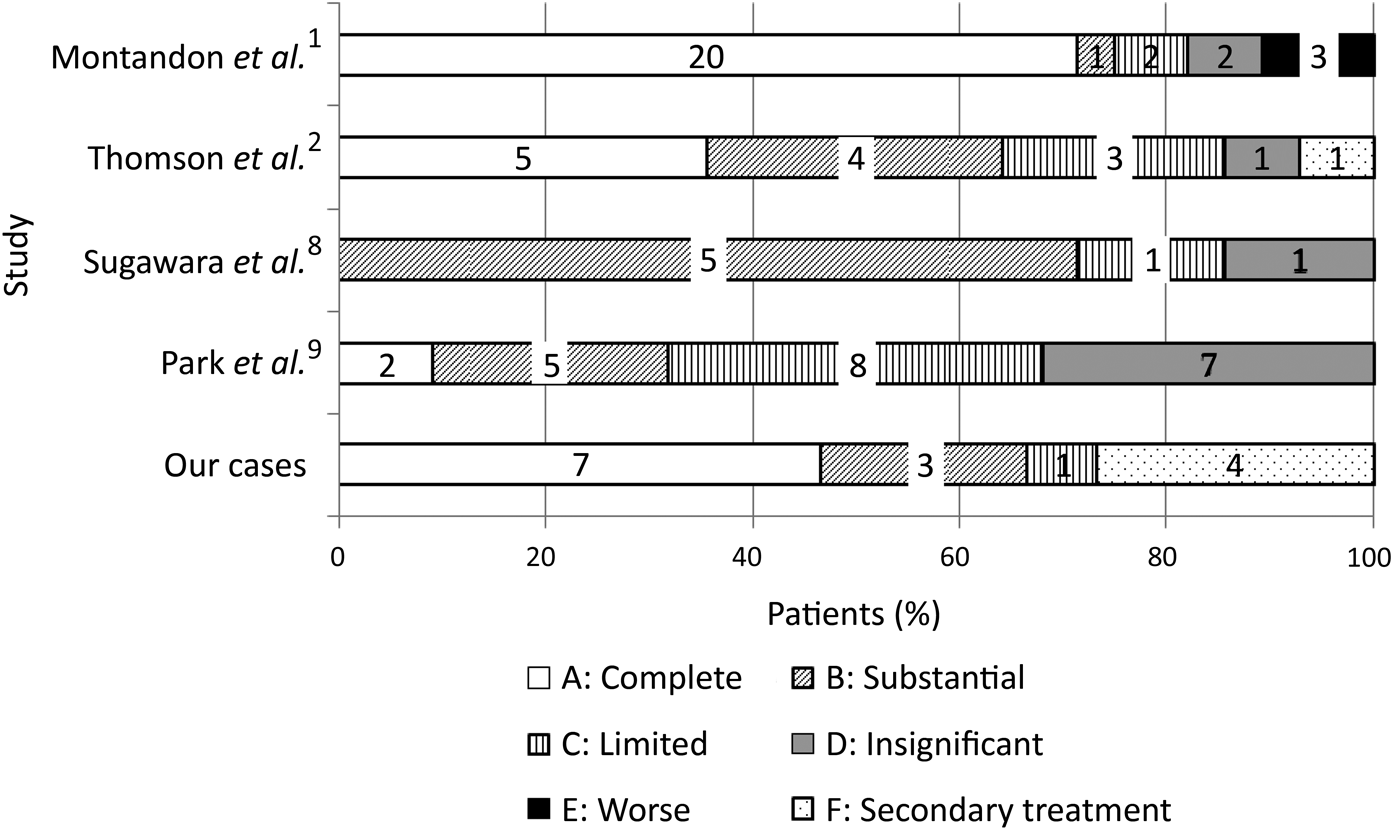
Our results showed that tympanostomy tube placement in the affected ear offered complete control of vertigo in three patients and substantial control in seven patients at one year, and complete control in seven patients and substantial control in three patients at two years. Our findings were similar to those of other studies with respect to the control of vertigo at two years after tube placement (Figure 3).Reference Montandon and Guillemin1, Reference Thomsen, Bonding, Becker, Stage and Tos2, Reference Sugawara, Kitamura, Ishida and Sejima8, Reference Park, Chen and Westhofen9
Therapeutic effect of tympanostomy tube placement on vertigo attacks: comparison with previous reports.

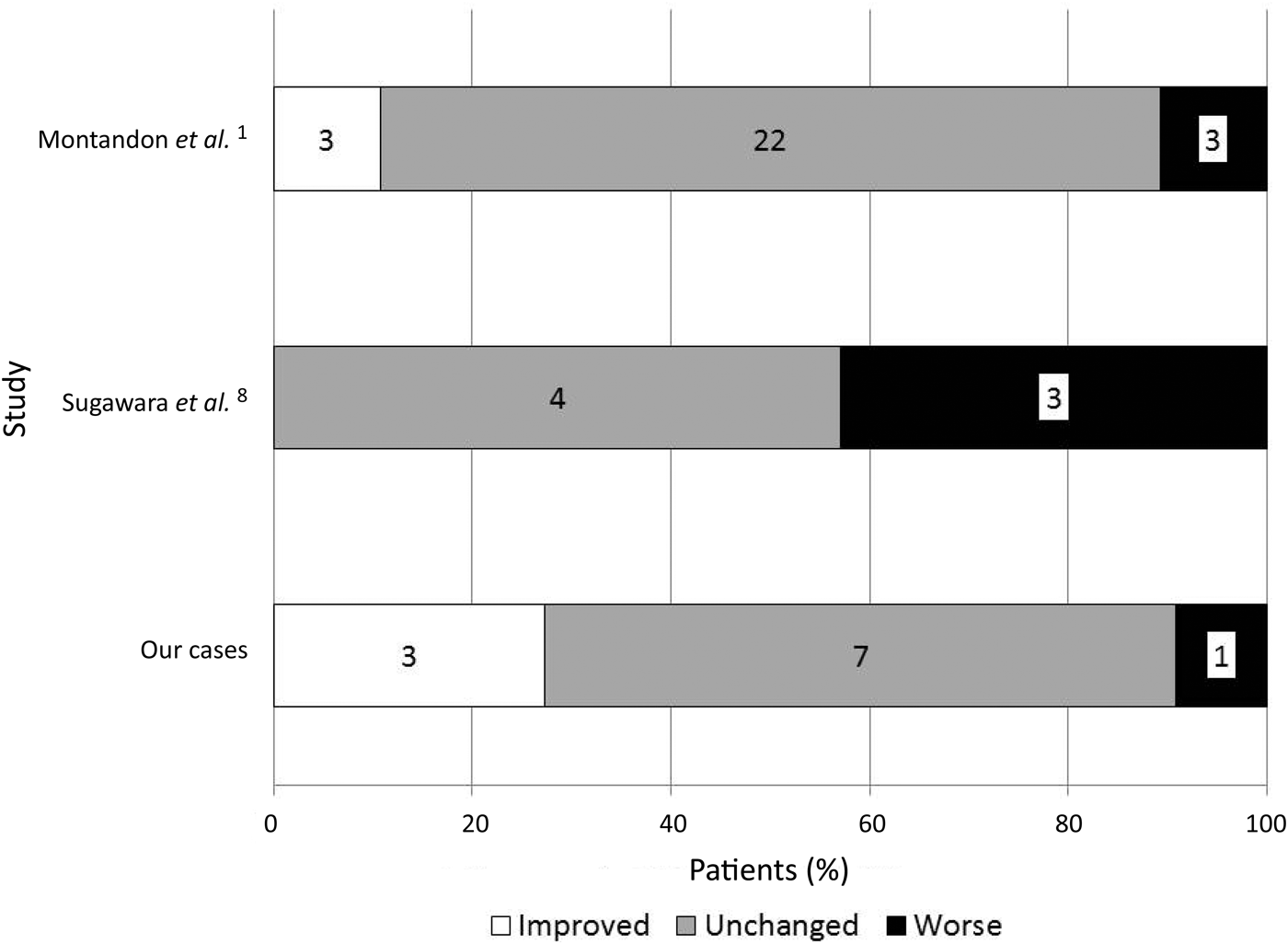
We found that tympanostomy tube placement had an insignificant effect on hearing, in agreement with the literature (Figure 4). A total of five patients (33.3 per cent) required more aggressive treatment (transmastoid endolymphatic sac surgery or intratympanic gentamicin administration): three patients required this treatment within one year, one patient within one to two years, and one patient after more than two years. In comparison with previous reports, the proportion of patients whose hearing became worse or who experienced an insignificant improvement was smaller, and the proportion of patients with complete, substantial or limited improvement in hearing was larger.Reference Montandon and Guillemin1, Reference Thomsen, Bonding, Becker, Stage and Tos2, Reference Sugawara, Kitamura, Ishida and Sejima8, Reference Park, Chen and Westhofen9
Therapeutic effect of tympanostomy tube placement on hearing change: comparison with previous reports. (Patients that underwent secondary treatment were excluded.)

Montandon et al.Reference Montandon and Guillemin1 reported a recurrence of vertigo attacks in 15 (53.6%) patients whose tube became obstructed or extruded; the attacks disappeared immediately after the reinsertion of a tympanostomy tube. Among our patients, there were eight whose tube extruded in less than two years, and vertigo attacks recurred in two of the eight patients. The number of vertigo attacks was immediately reduced in these two patients after the tympanostomy tube was replaced. There was no recurrence of vertigo attacks in the other six patients, even though the tympanic membrane was closed. It is not clear whether the tympanostomy tube placement was effective or not in these six patients.
The frequency of definitive episodes of vertigo in Ménière's disease has been reported to decrease over time, and many individuals reach a steady-state phase free of vertigo.Reference Perez-Garrigues, Lopez-Escamez, Perez, Sanz, Orts and Marco10 PickardReference Pickard11 described the natural course of Ménière's disease based on a series of 37 patients who received no treatment. Two of the patients in this series had no further attacks following the first consultation, 26 patients (70.3 per cent) ceased to have any further attacks by the end of 12 months and only 5 patients (13.5 per cent) were still suffering from attacks at the end of 2 years. In our study, there were 3 patients in whom the tympanostomy tubes extruded within 6 to 18 months whose evaluation at 1 year showed limited or insignificant control of vertigo. Nevertheless, the evaluation of these patients at two years indicated complete control of vertigo, and it is presumed that they were cured naturally rather than by tube placement.
The exact pathophysiological explanation for the effect of tympanostomy tube placement is still unclear. Park et al.Reference Park, Chen and Westhofen9 investigated whether the reduction in vertigo attacks following ventilation tube insertion was the result of changes in vestibular function. They examined vestibular-evoked potential and sinusoidal harmonic acceleration test findings before and after tympanostomy tube placement in 22 patients with unilateral Ménière's disease. They reported no effects on saccule function or on lateral semicircular canal function after the tube placement. The symptoms of Ménière's disease were believed to result from endolymphatic hydrops.
Kimura and HuttaReference Kimura and Hutta12 demonstrated that middle-ear ventilation procedures significantly reduced experimentally induced endolymphatic hydrops in guinea pigs. The authors presumed that the inhibition of hydrops was due to pressure release in the middle ear, and oxygenation of the middle and inner ears. According to our results, tympanostomy tube placement seemed to be effective in reducing vertigo attacks, but actually there were some patients who showed no effects from the tympanostomy tube placement. We cannot discount the possibility that some patients attained complete control of vertigo as a result of natural healing. On the other hand, there were some patients whose vertigo attacks were obviously reduced by tympanostomy tube placement.
• Tympanostomy tube placement is a surgical management option for intractable Ménière's disease patients
• Few studies have been published on tympanostomy tube placement as a treatment for Ménière's disease
• Tympanostomy tube placement has no effect on hearing recovery
• Following tube extrusion, vertigo attacks recurred in two patients, but vertigo subsided after repeat tube placement
• It is worth trying tympanostomy tube placement in intractable Ménière's disease patients because the treatment is less invasive
This treatment is not effective in all those who suffer from Ménière's disease. Nevertheless, it is worthwhile trying this technique in intractable Ménière's disease patients because the treatment is less invasive than other surgical procedures such as intratympanic gentamicin administration and transmastoid endolymphatic sac surgery, which also carry the risk of sensorineural hearing loss. In order to use the Meniett device in Japan, private personal importation is necessary and the proceedings are complicated. Tympanostomy tube placement might be an additional surgical option to consider prior to using the Meniett device or undertaking ablative therapy. Tympanostomy tube placement might enable decisions regarding more invasive treatments to be postponed. Tympanostomy tube placement should be the first choice of surgical treatment for Ménière's disease patients, especially elderly patients or those who do not want to undergo more invasive treatments.
Acknowledgements
The authors are indebted to the Department of International Medical Communications of Tokyo Medical University for the editorial review of the English manuscript. This study received financial support from a Grant-in-Aid for Scientific Research (category ‘C’) from the Ministry of Education, Culture, Sports, Science and Technology, Japan, and a Grant-in-Aid for Disease (Vestibular Disorders) from the Ministry of Health, Labor and Welfare, Japan. A follow-up grant for a Tokyo Medical University research project was also received.