1. Introduction
Minerals precipitated in mesodiagenetic regimes document fluid evolution and migration during basin subsidence through inversion (e.g. Worden & Burley, Reference Worden, Burley, Worden and Burley2003). Thus, understanding the timing and thermal regime of diagenetic reactions is crucial for the interpretation of basin evolution and may lead to a thorough understanding of fluid–rock interaction processes and their consequences for, for example, reservoir quality (e.g. Taylor et al. Reference Taylor, Giles, Hathon, Diggs, Braunsdorf, Birbiglia, Kittridge, Macaulay and Espejo2010). Paragenetic sequences provide information about relative ages and the succession of fluid–mineral interaction processes during basin evolution. Additional information about the age of precipitations allows for (i) dating specific diagenetic events, (ii) constraining the absolute duration of fluid–rock interaction processes, and (iii) relating the diagenetic events to subsidence history and tectonic evolution.
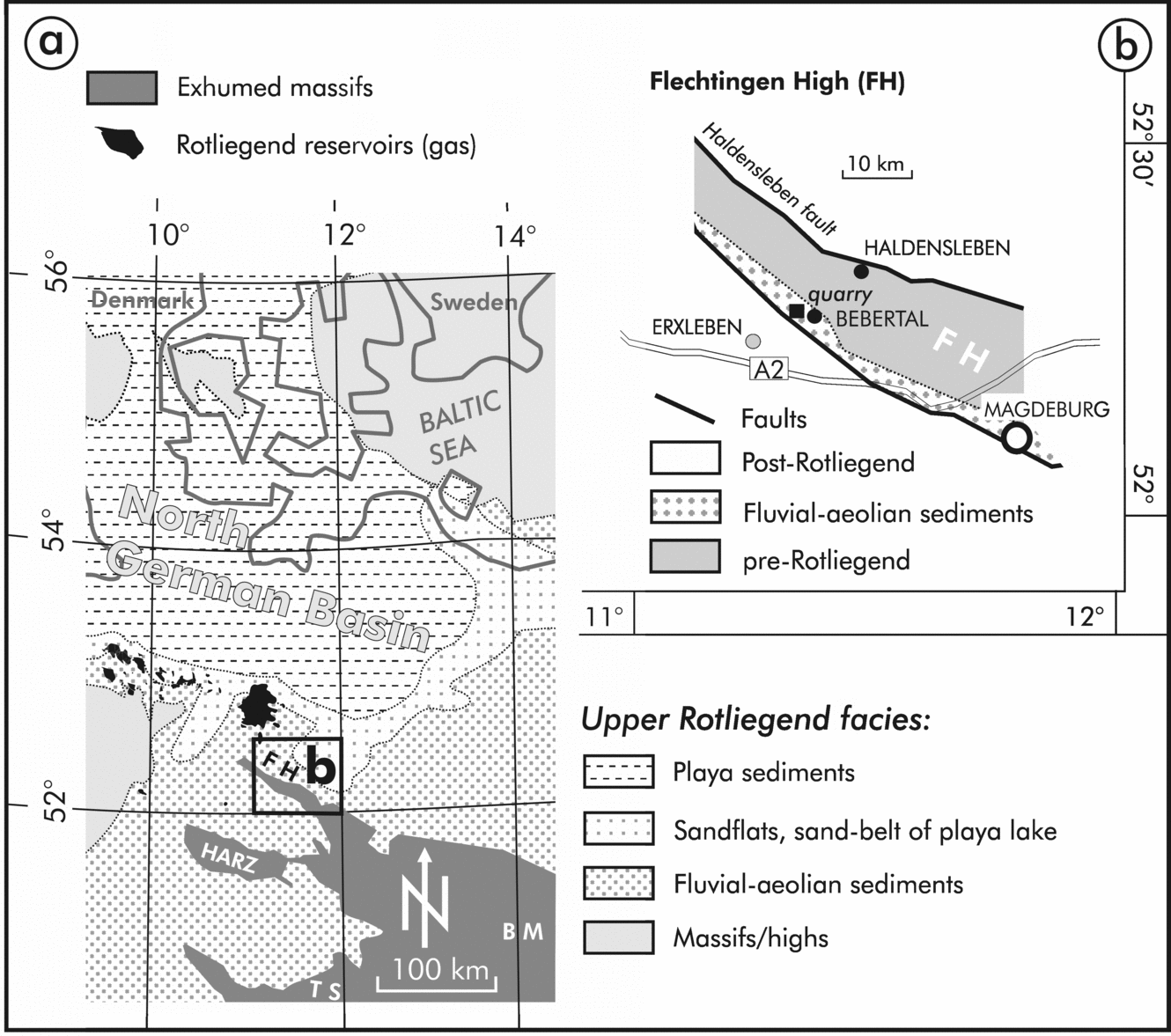
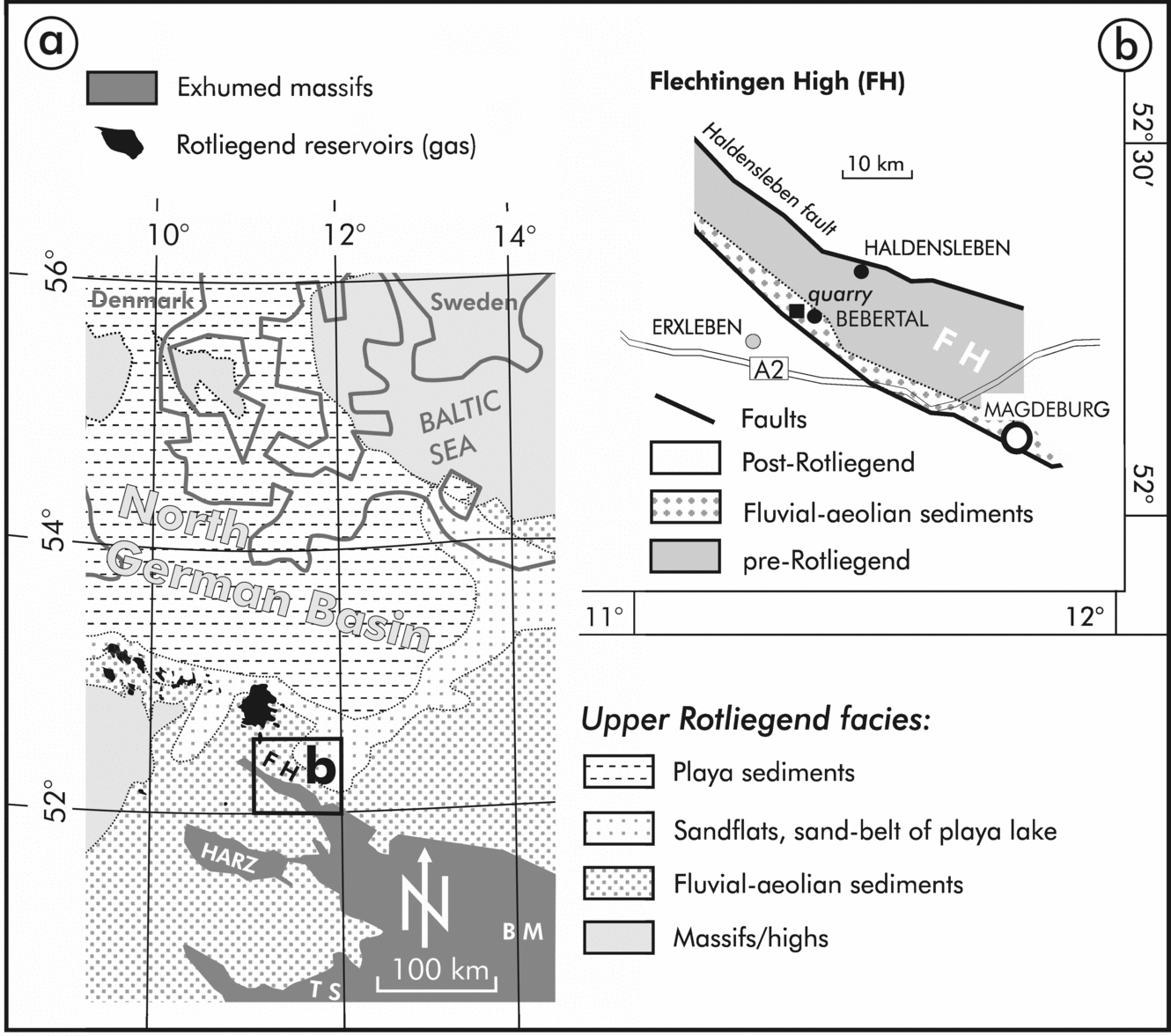
The aeolian-fluvial Rotliegend sediments from Bebertal (Flechtingen High, North Germany) (Fig. 1) are the famous analogue for deeply buried Upper Rotliegend sandstones on the southern flank of the North German Basin (NGB) (Kulke et al. Reference Kulke, Gast, Helmuth, Lützner, Mulock-Houwer, Pilaar and Graaff-Trouwborst1993; Gast et al. Reference Gast, Dusar, Breitkreuz, Gaupp, Schneider, Stemmerik, Geluk, Geissler, Kiersnowski, Glennie, Kabel, Jones, Doornenbal and Stevenson2010), part of the Southern Permian Basin (SPB). Over the last few decades, numerous core samples from gas wells have yielded petrographic data and interpretations of the diagenetic history of buried Rotliegend sandstones from the NGB (e.g. Glennie, Reference Glennie2001). Authors focused on characterization of predominant cements and basin-wide spatial distribution of diagenetic pattern (Gaupp et al. Reference Gaupp, Matter, Platt, Ramseyer and Walzebuck1993), the origin and spatial distribution of several diagenetic clay minerals, such as illite, chlorite and kaolinite (e.g. Platt, Reference Platt1993; Gluyas & Leonard, Reference Gluyas and Leonard1995; Hillier, Fallick & Matter, Reference Hillier, Fallick and Matter1996; Ziegler, Reference Ziegler2006), the influence of maturation products from hydrocarbon source rocks on diagenetic reactions and products (Schöner & Gaupp, Reference Schöner and Gaupp2005), or the impact of brines derived from the overlying Zechstein sequence (e.g. Purvis, Reference Purvis1992). A general conclusion is that besides sedimentary facies, variations in mesodiagenetic processes and products are among the main factors controlling intergranular volume, porosity and permeability and, thus, reservoir quality. Besides the basin-wide variation in cementation type and occurrence, small-scale variations can help to understand reservoir compartmentation. The Bebertal outcrop on the Flechtingen High does not only offer the unique opportunity to study three-dimensional facies variation of the aeolian-fluvial Rotliegend strata (Fischer et al. Reference Fischer, Gaupp, Dimke and Sill2007). Additionally, spatial anisotropy of cementation of these strata, otherwise deeply buried, is accessible. Inhomogeneities of diagenetic pattern at the metre scale to sub-kilometre scale can be studied in this outcrop.
(a) Upper Rotliegend facies distribution in the North German Basin (NGB) (Gast et al. Reference Gast, Dusar, Breitkreuz, Gaupp, Schneider, Stemmerik, Geluk, Geissler, Kiersnowski, Glennie, Kabel, Jones, Doornenbal and Stevenson2010) and German Rotliegend gasfields after Pasternak et al. (Reference Pasternak, Brinkmann, Messner and Sedlacek2006). FH – Flechtingen High; TS – Thüringisches Schiefergebirge; BM – Bohemian massif. (b) The Bebertal quarries on the FH are the northernmost outcrops of sediments of Upper Rotliegend sandstones of the NGB.
As a first step to understand the diagenetic history of these strata in greater detail, we present a general paragenetic sequence of the aeolian Rotliegend sandstones from Bebertal based on petrographic data. We compare the occurrence of diagenetic minerals to the well-known paragenetic sequence of aeolian Rotliegend reservoir rocks from the southern part of the NGB (Gaupp et al. Reference Gaupp, Matter, Platt, Ramseyer and Walzebuck1993; Gast et al. Reference Gast, Dusar, Breitkreuz, Gaupp, Schneider, Stemmerik, Geluk, Geissler, Kiersnowski, Glennie, Kabel, Jones, Doornenbal and Stevenson2010).
The second aspect of this study is to combine relative and absolute chronology data in order to determine the duration and thermal regime of mesodiagenetic fluid–rock interaction processes within the Upper Rotliegend strata from this proximal section of the southern part of the Central European Basin. Because the amount of diagenetically formed illite is low in the aeolian-fluvial sandstones from Bebertal, 40Ar–39Ar dating of diagenetic K-feldspar was performed. We also apply fission-track (FT) and (U–Th–Sm)/He thermochronology of detrital zircon and apatite. These data constrain both the maximum temperature and the duration of the mesodiagenetic thermal conditions.
2. Geological background
The NGB is one of the three sub-basins of the SPB that was formed in Early Permian time as an intracontinental basin after the Variscan consolidation of Central Europe (Ziegler, Reference Ziegler1990). This was the initial period of the evolution of the Central European Basin System, a complex sedimentary basin system in which sediments accumulated under varying tectonosedimentary conditions over a period of more than 250 million years (Littke, Bayer & Gajewski, Reference Littke, Bayer and Gajewski2005). Long-term thermal decay and subsidence followed the initial subsidence related to intense volcanism (van Wees et al. Reference van Wees, Stephenson, Ziegler, Bayer, MCCann, Dadlez, Gaupp, Narkiewicz, Bitzer and Scheck2000). Spatially and temporally differentiated subsidence led to the formation of sub-basins (e.g. Littke et al. Reference Littke, Krooss, Idiz and Frielingsdorf1995; Scheck et al, Reference Scheck, Barrio-Alvers, Bayer and Gotze1999). Uplift of parts of the basin occurred during the Late Cretaceous to early Tertiary inversion (Kockel, Reference Kockel2003; Voigt, von Eynatten & Franzke, Reference Voigt, von Eynatten and Franzke2004; von Eynatten et al. Reference von Eynatten, Voigt, Meier, Franzke and Gaupp2008).
The Rotliegend basin fill (Schröder et al. Reference Schröder, Plein, Bachmann, Gast, Gebhardt, Graf, Helmuth, Pasternak, Porth and Süssmuth1995) of the NGB (Fig. 1a) consists of saline lake sediments in the central part (Gast, Reference Gast1991) and fluvial as well as aeolian sediments at the basin margins (Ziegler, Reference Ziegler1990). In this study, we investigate sandstones collected from the northernmost outcrop of aeolian-fluvial strata of the Upper Rotliegend in Central Europe, located on the southern margin of the Flechtingen High (Schreiber, Reference Schreiber1960; Ellenberg et al. Reference Ellenberg, Falk, Grumbt, Lützner and Ludwig1976; Legler, Gebhardt & Schneider, Reference Legler, Gebhardt and Schneider2005; see Fig. 1b). A profile of about 15 m, built up mainly of aeolian and minor fluvial strata, is exposed in Schwentesius quarry near Bebertal. The directly underlying strata are known from three wells. The profiles comprise mainly coarse-grained fluvial clastic sediments with several aeolian intercalations (Fischer et al. Reference Fischer, Gaupp, Dimke and Sill2007). According to the regional stratigraphic correlation, the Rotliegend sediment sequence of the study area belongs to the Parchim Formation of the Havel Subgroup (Schneider & Gebhardt, Reference Schneider and Gebhardt1993). Sedimentation age is around 265 Ma (Menning et al. Reference Menning, Gast, Hagdorn, Kading, Simon, Szurlies and Nitsch2005).
3. Material and methods
Samples were collected from outcrop walls of freshly mined sections in Schwentesius quarry (Bebertal, Flechtingen High, Germany) (e.g. Kulke et al. Reference Kulke, Gast, Helmuth, Lützner, Mulock-Houwer, Pilaar and Graaff-Trouwborst1993). The outcrop is in an active quarry where aeolian grainflow-layers are mined. Thirty-two samples were collected from the aeolian strata of the succession exposed at Bebertal. For details about sedimentary facies distribution at outcrop scale of this aeolian-fluvial succession see Fischer et al. (Reference Fischer, Gaupp, Dimke and Sill2007).
Thin-section analysis including point-count analysis (300 points/sample) quantified the amount of detrital components, porosity and cements. Intergranular volume (IGV) was calculated from porosity and cement percentages. Optical microscopy using a ZEISS Axioplan 2 microscope concentrated on authigenic mineralogy and on selection of samples showing pronounced authigenic feldspar overgrowths. We used a JEOL JXA8900RL electron microprobe (Abt. Geochemie, Univ. Göttingen), Ua = 15 kV, Ia = 15 nA for K and Na mapping to distinguish between newly formed Na-feldspar and K-feldspar as well as detrital feldspar grains with secondary porosity as well as (partial) Na-feldspar and K-feldspar grain replacements. A thin-section showed about 50 to 100 μm thick K-feldspar overgrowths and clear features of K-feldspar grain dissolution and subsequent precipitation of newly formed K-feldspar. Because of the pronounced, thick K-feldspar overgrowths, this sample was chosen for 40Ar–39Ar geochronology. An unmounted polished specimen with a diameter of 20 mm and a thickness of approximately 500 μm was then prepared from the same hand-specimen previously used for thin-section preparation. Eleven grain replacements and 13 overgrowths from this specimen were dated using the 40Ar–39Ar laser spot fusion method. 40Ar–39Ar experiments were carried out in the geochronology laboratory at Vrije Universiteit in Amsterdam. The mineral standard used was DRA-1 sanidine (24.99 ± 0.07 Ma; Wijbrans et al. Reference Wijbrans, Pringle, Koppers and Scheveers1995). The sample was irradiated for 1 hour in a Cd-lined rotating facility (RODEO) at the NRG-Petten HFR (The Netherlands). The sample spots were fused with an argon ion laser (λ = 488–524 nm). The argon gas was purified in an extraction line containing Al–Zr and Fe–V–Zr getters operated at 400°C and 250°C, respectively. After purification, the gas was expanded into a MAP215–50 noble gas mass spectrometer operated in static mode. The argon spectrum was measured by stepping (12 cycles) through the mass spectrum from m/e 40–35.5. A Balzers 217 SEM detector measured the beam signals. Aliquots of air and of 38Ar spiked air were measured routinely to monitor the mass discrimination. For offline data reduction, we used ArArCalc2.2c (Koppers, Reference Koppers2002). The ages are reported with a 2σ uncertainty level.
Recent 40Ar–39Ar authigenic feldspar age investigations applied a new UV laser ablation method (Mark et al. Reference Mark, Parnell, Kelley, Lee and Sherlock2010). Owing to higher energy, the application of UV laser enables a smaller spot size and higher accuracy of ablation spot position (Sherlock et al. Reference Sherlock, Lucks, Kelley and Barnicoat2005) compared to the visible light laser type applied for this study. This also enables analysis of smaller feldspar overgrowths (thickness clearly below 50 μm) than those investigated in this study. The approach using the UV laser ablation method is therefore more appropriate in routine analysis of K-feldspar overgrowth ages. Owing to the limitations of visible light laser ablation in terms of low light absorption in feldspar and potential heating of surrounding areas (for more details see Kelley, Reference Kelley, Potts, Bowles, Reed and Cave1995), we analysed only large feldspar overgrowths and use the here-obtained data only for a tentative interpretation.
For FT geochronology, samples were treated by common heavy liquid and magnetic separation processes to concentrate apatite and zircon minerals. Because the investigated Upper Rotliegend sandstones do not contain apatite, we also sampled structurally and, with respect to thermal history, comparable units from Lower Rotliegend rhyolites (porphyry) and Carboniferous greywackes of the Flechtingen High. The external detector method was used (Gleadow, Reference Gleadow1981). After mounting and polishing, the zircon and apatite crystals were etched according to Gleadow, Hurford & Quaife (Reference Gleadow, Hurford and Quaife1976) and Donelick, Ketcham & Carlson (Reference Donelick, Ketcham and Carlson1999) and irradiated in the TRIGA nuclear reactor at Oregon State University. FT ages were determined by the zeta method (Hurford & Green, Reference Hurford and Green1983), which used CN2 and CN5 uranium glasses and age standards from the Fish Canyon Tuff, Buluk Member Tuff, Tardree Rhyolite and Durango (ages and references in Hurford, Reference Hurford, den Haute and Corte1998). Double Poisson dispersion calculated errors (Green, Reference Green1981). The software Trackkey (Dunkl, Reference Dunkl2002) and PopShare (Dunkl & Székely, Reference Dunkl and Székely2002) created calculations, plots and the identification of single-grain age clusters.
Single-crystal aliquots were used for zircon (U–Th)/He geochronology. Euhedral crystals were preferred; the shape parameters were determined and archived by multiple digital micrographs. The crystals were wrapped in platinum capsules of c. 1 × 1 mm size. The Pt capsules were heated up by an infra-red laser for 7 minutes. The extracted gas was purified using a SAES Ti–Zr getter at 450°C. The chemically inert noble gases and a minor amount of other rest gases were then expanded into a Hiden triple-filter quadrupol mass spectrometer equipped with a positive ion counting detector. He blanks were estimated using the same procedure on empty Pt tubes. Crystals were checked for degassing of He by sequential reheating and He measurement. The He signal was processed and evaluated by the factory-supplied mass spectrometer software (MASsoft, HIDEN). During standard and sample measurements, 240 readings of the mass spectrometer were recorded. Following degassing, samples were retrieved from the gas extraction line, spiked with calibrated 230Th and 233U solutions, and dissolved in Teflon bombs using a mixture of double distilled 48% HF and 65% HNO3 at 220°C during five days. Each sample batch was prepared with a series of procedural blanks and spiked normals to check the purity and calibration of the reagents and spikes. Spiked solutions were analysed as 1.4 ml of ~ 0.5 ppb U–Th solutions by isotope dilution on a Perkin Elmer Elan DRC II inductively coupled plasma mass spectrometer (ICP-MS) with an APEX micro-flow nebulizer. Sm, Pt and Ca were determined by external calibration. The oxide formation rate and the PtAr–U interference was always monitored, but the effects of these isobaric argides were negligible relative to the signal of the actinides. The data from the ICP-MS measurements were processed by in-house freeware software (PEPITA), http://www.sediment.uni-goettingen.de/staff/dunkl/software.
Usually 40 to 70 readings were considered, and the individual outliers (spikes) of the 233U/238U and 230Th/233Th ratios were tested and rejected according to the 2 standard deviations criterion. The ejection correction factors (Ft) were determined for the single crystals using the modified algorithm of Farley, Wolf & Silver (Reference Farley, Wolf and Silver1996) using an in-house spreadsheet.
4. Results
The first part of this Section is concerned with the types of diagenetically formed minerals in the aeolian strata of the Bebertal quarry. The second part presents the spatial distribution of cements regarding the sedimentary bounding surfaces of the aeolian facies. A general description of the sedimentary facies of the aeolian-fluvial succession exposed in Schwentesius quarry (Bebertal) as well as the spatial distribution of lithofacies types is given by Fischer et al. (Reference Fischer, Gaupp, Dimke and Sill2007). The third part of this Section deals with the reconstruction of thermochronological constraints on (meso-)diagenetic processes. In Section 5 we combine these results for the reconstruction of a paragenetic sequence of diagenetic processes, including interpretations about thermal history and fluid flow.
The aeolian sandstones are lithic subarkoses with well-sorted laminae and rounded to well-rounded grains. Grains have diameters of 100–200 μm in fine-grained laminae and 250–400 μm in coarse-grained laminae and grainflow avalanche deposits; for more details see Fischer et al. (Reference Fischer, Gaupp, Dimke and Sill2007).
4.a. Diagenetic minerals
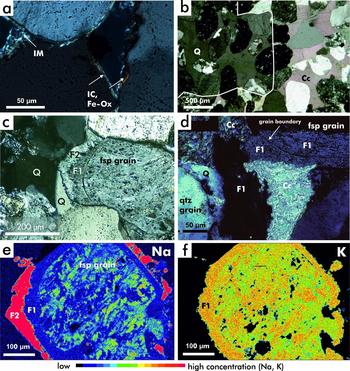
Frequently the sandstones show coatings on the detrital grains. Both the translucent colour and interference colour of the coatings indicate that the coatings are composed of iron oxide and illite. The thickness of the coatings is a few microns (Fig. 2a). A detailed explanation about variation in coating thickness and occurrence as well as implications for diagenetic facies is given in the next Section and Figure 4. Some samples do, however, lack grain coatings (Fig. 2b). In such cases, early carbonate and quartz cements were precipitated directly on the grain surfaces. In contrast to later carbonate and quartz precipitations, the early cements are large poikilotopic crystals. They cause bright stains of several millimetres in diameter that are macroscopically visible on cut rock surfaces. Rock sections with such early cements show high IGV of up to 40% (see Fig. 4, Houseknecht diagram); in contrast, samples without such intense cementation show only approximately 20% IGV. Grain coatings are the substratum of a rather rare platy illite meshwork (IM) that precipitated in the pore space (Fig. 2a).
Thin-section micrographs illustrating the diagenetic sequence of the aeolian sandstones. (a) Eodiagenetic grain coatings (iron oxide and illite (IC)) and mesodiagenetic illite meshwork (IM) (crossed polarized light). (b) Eodiagenetic poikilotopic quartz (Q) and calcite (Cc) cements on grains without coatings (crossed polarized light). (c) Mesodiagenetic K-feldspar (F1), Na-feldspar (F2) and quartz (Q) cements (crossed polarized light). (d) Mesodiagenetic calcite (Cc) formed after F1 and Q (crossed polarized light). (e, f) Electron microprobe Na- and K-mapping of a detrital K-feldspar grain with K-feldspar rim (F1) and albite rim (F2).

Two generations of diagenetic feldspar overgrowths were detected: an older K-feldspar generation (F1) was found to be the first overgrowth on detrital K-feldspar grains. A younger albite generation (F2) is found above F1 (Fig. 2c, e). Detrital K-feldspar grains often show secondary porosity. The diagenetic K-feldspar precipitated as well after leaching of the detrital feldspar grains within the secondary porosity (Fig. 2d). Electron microprobe element mapping verified the occurrence of Na-feldspar, which always precipitated later than the K-feldspar cements (Fig. 2e, f). Both types of feldspar overgrowths show thicknesses of up to approximately 100 μm. Barite and more commonly calcite (Fig. 2d) form the latest pore-filling cements.
4.b. Spatial distribution of cements and differences in intergranular volume
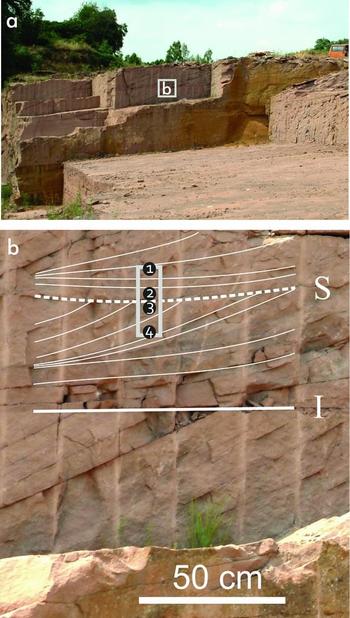
For a first approach to heterogeneity in the cementation of the aeolian strata from Bebertal, samples were collected directly above and below sedimentary bounding surfaces. Samples were collected at aeolian superimposition surfaces (S) (see Fig. 3). This type of widespread bounding surface was chosen owing to its occurrence within aeolian facies, in contrast to interdune migration surfaces (I) that are often associated with subaqueous interdune sedimentation, i.e. wet interdune strata. For more information about genetic and geometric models of aeolian bounding surfaces see Fryberger (Reference Fryberger, North and Prosser1993).
(a) Aeolian-fluvial strata at Schwentesius quarry, Bebertal, Flechtingen High (North Germany), and (b) sampling profile over a sedimentary bounding surface (superimposition surface, S) within aeolian sediments. (I-surface: interdune bounding surface). Numbers 1–4 refer to positions of samples (see Fig. 4).

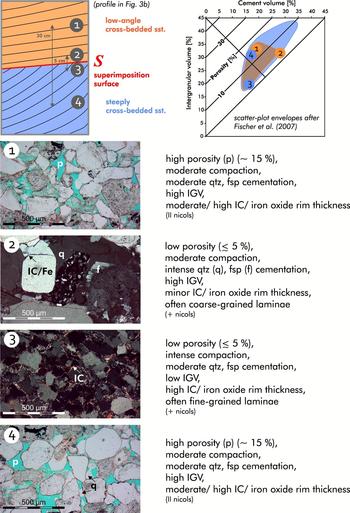
The sample types 1–4 (see Figs 3 and 4 for sample position and information about distance to bounding surface) were analysed for total cement volume, porosity and IGV using a point-counting technique. Data were plotted in a Houseknecht diagram (Houseknecht, Reference Houseknecht1987) together with cement volume and IGV data from other Bebertal aeolian sandstone samples (sampled far from and close to other bounding surfaces) analysed in a previous study (Fischer et al. Reference Fischer, Gaupp, Dimke and Sill2007).
Petrographic analysis of sandstones 1–4 (see Fig. 3) sampled above and below a superimposition (S) surface (2, 3 – crossed polarized light). Houseknecht diagram shows cement volume and intergranular volume (IGV) of the described sample types as well as literature data for comparison. IC – illite coatings; IC/Fe – illite and iron oxide coatings.

Remarkably, the total porosity range of aeolian sandstones (petrographic analysis: 1–18%) is almost completely covered by those sandstones sampled above and below the bounding surfaces. Sandstones from directly above and below the superimposition surface (sample nos 2 and 3 in Fig. 4) show similar porosity. However, they differ remarkably in cement volume (~ 15% v. 27%) and IGV (~ 17% v. 30%). It was also found that high cement volumes coincide with thin grain coatings (Fig. 4, micrograph 2: mainly brown-coloured iron oxide coatings) and intense quartz cementation. Minor cement volumes were found in samples with thick grain coatings (Fig. 4, micrograph 3). Those coatings consist mainly of illite (IC). About 15 cm above or below the bounding surfaces, however, porosity is close to maximum values (~ 15%). For both sample types (sample nos 1 and 4 in Fig. 4), similar volumes of diagenetic minerals were detected.
4.c. Thermochronology and geochronology
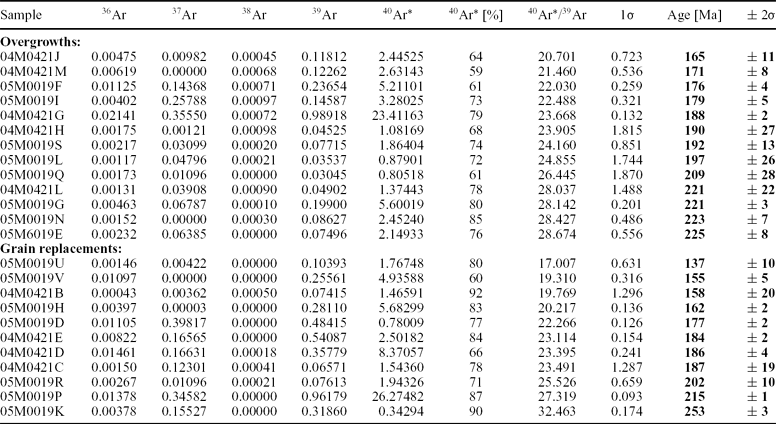
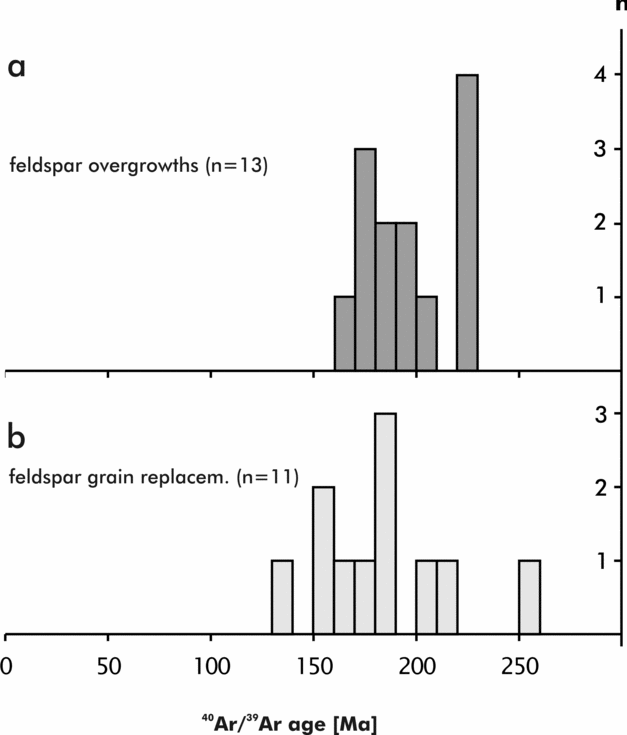
An 40Ar–39Ar laser spot fusion technique was applied to date K-feldspar grain replacements (11 analyses) and overgrowths (13 analyses) (Table 1). Argon ages of overgrowths range between 165 ± 11 Ma and 225 ± 8 Ma and show two age clusters of 186 ± 14 Ma (n = 9) and 222 ± 2 Ma (n = 4), as identified using PopShare software (Dunkl & Székely, Reference Dunkl and Székely2002) (Fig. 5). The diagenetic K-feldspar precipitates in the secondary porosity of the grains yield a broad unimodal age distribution between 137 ± 10 Ma and 253 ± 3 Ma with a mean age of 183 ± 32 Ma. Relatively low concentrations of analysed Ar related to small overgrowths cause the sometimes high 2σ deviations.
40Ar–39Ar ages and 2σ deviations of diagenetic K-feldspar overgrowths and grain replacements as well as relative abundances of Ar isotopes and 40Ar*/39Ar plus uncertainty
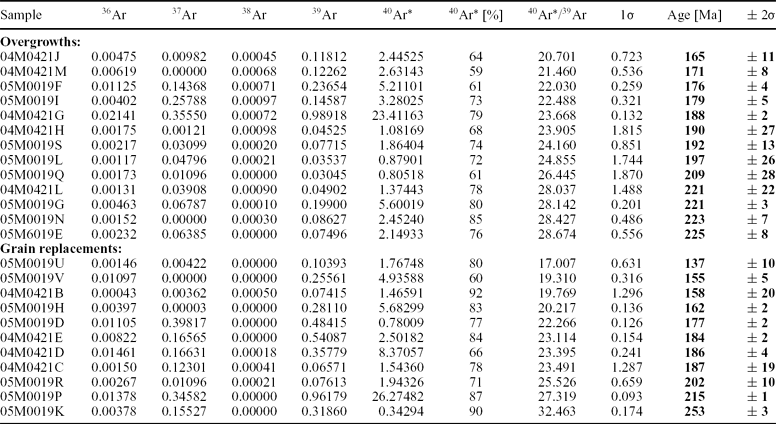
J = 0.004637 (1σ = 0.3%).
* Radiogenic Ar
40Ar–39Ar age distribution measured in diagenetically formed K-feldspar overgrowths (n = 13) (a) and diagenetically replaced grains (n = 11) (b).

Zircon FT geochronology indicates apparent ages of 251 ± 19 Ma for the Rotliegend sandstone sequence as well as 226 ± 13 Ma and 244 ± 15 Ma for the adjacent Lower Permian porphyry and slightly deeper buried Carboniferous greywackes of the Flechtingen High, respectively (Table 2).
Apatite and zircon fission track data and ages

Cr – number of dated crystals; ρ – track densities (105 cm2); N – number of tracks counted; S – spontaneous; I – induced; D – detector, P(χ2) – probability for n degrees of freedom (where n = Cr-1); Disp – dispersion
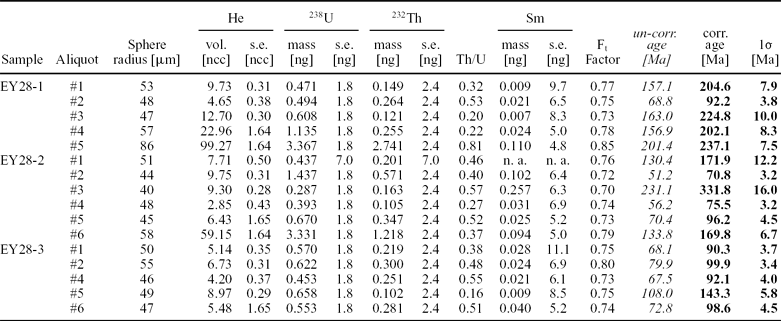
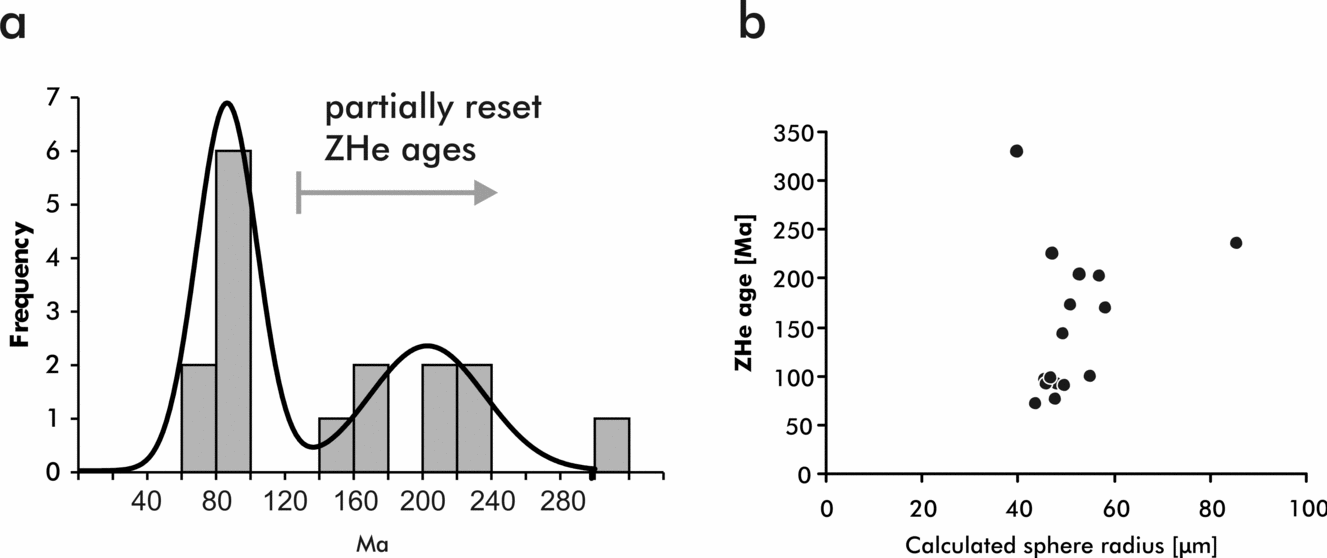
Zircon He ages from three samples scatter between Palaeogene and Carboniferous ages. Eight out of 16 samples, however, fall into a relatively narrow Late Cretaceous age range (70.8 ± 3.2 Ma to 99.9 ± 3.4 Ma) with an average of 92 Ma (Table 3, Fig. 6; see also histogram data in Fig. 6a). In Figure 6b the apparent ZHe ages are shown as a function of the radius of the sphere calculated by the surface to volume ratio (Meesters & Dunai, Reference Meesters and Dunai2002). The diameter of the crystals is proportional to the closure temperatures. The correlation between crystal diameter and apparent ZHe age indicates that smaller crystals experienced stronger thermal reset. This supports that the above-mentioned ZHe ages with broad scatter towards older ages (partially reset ZHe ages in Fig. 6a) indicate temperatures within the partial retention zone of He in zircon, i.e. 170–190°C.
Zircon He age data and ages
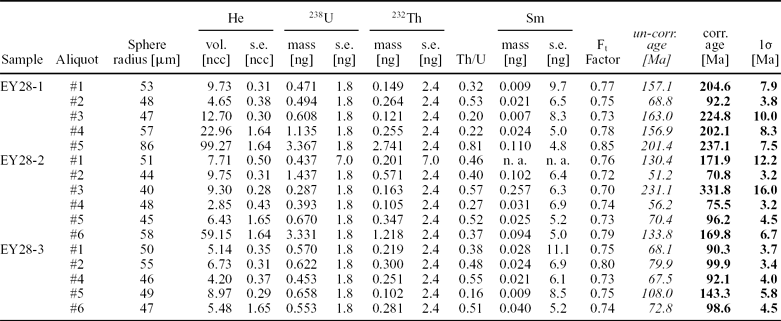
Sphere radius (r) calculated by the surface to volume ratio (Meesters & Dunai, Reference Meesters and Dunai2002). Amount of helium is given in nano-cubic-cm [ncc] in standard temperature and pressure. Amount of radioactive elements are given in nanograms [ng]. Ft – alpha-ejection correction (according to Farley, Reference Farley2002); s.e. – standard error. Error on average age is 1σ, as (SD)/(n)1/2; where SD = standard deviation of the age replicates and n = number of age determinations. n. a. – not analysed.
(a) Frequency of ZHe age classes (n = 16) and probability density plot. Maximum at 80–100 Ma class (population age: 92 ± 12 Ma). (b) ZHe ages as a function of calculated sphere radius.

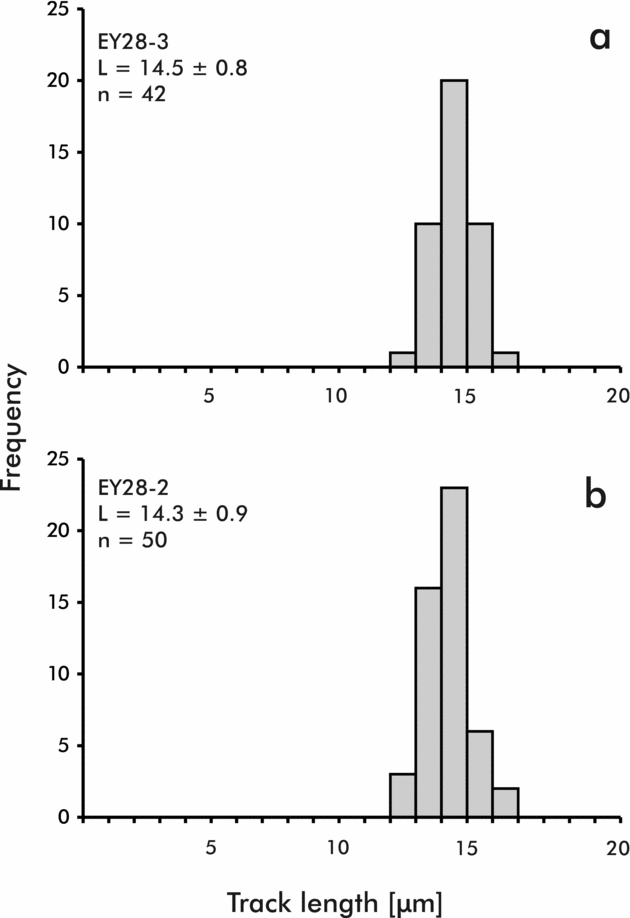
Apatite FT dating of the greywacke and the porphyry samples yield ages of 75.1 ± 6.3 Ma and 71.5 ± 6.3 Ma, respectively (Table 2). The Rotliegend sandstone samples did not yield sufficient apatite for FT dating; therefore, samples from directly underlying strata (Schreiber, Reference Schreiber1960; Kulke et al. Reference Kulke, Gast, Helmuth, Lützner, Mulock-Houwer, Pilaar and Graaff-Trouwborst1993) were investigated. The apatites have long tracks, > 14 μm on average, and a very narrow track length distribution (Fig. 7).
Confined track length distribution in apatite samples of the Flechtingen High (in μm). (a) EY 28–3 Lower Permian porphyry (n = 42) and (b) EY 28–2 Carboniferous greywacke (n = 50).

5. Discussion
5.a. Diagenetic minerals
Diagenetically formed minerals in the Upper Rotliegend aeolian sediments have been the subject of discussion for several decades owing to their strong impact on reservoir quality (summarized in Gast et al. Reference Gast, Dusar, Breitkreuz, Gaupp, Schneider, Stemmerik, Geluk, Geissler, Kiersnowski, Glennie, Kabel, Jones, Doornenbal and Stevenson2010). A general diagenetic sequence for the Upper Rotliegend deposits from the NGB was derived and discussed by Gaupp et al. (Reference Gaupp, Matter, Platt, Ramseyer and Walzebuck1993) and so-called diagenesis types were defined for better understanding of paragenetic sequences (Gaupp, Reference Gaupp1996). The diagenesis types provide a grouping of diagenetic products and a generalization in terms of major processes such as differential compaction, precipitation and inhibition during diagenetic evolution. Finally, this approach enables a better predictability of porosity and permeability because of the well-known challenge of quantifying clay mineral concentrations by petrographic observations. The porosity of the aeolian sediments here investigated from the Bebertal strata is about 3–18% and radial permeability range is about 10−2 to 103 mD. The highest permeability was found for sections of steeply cross-bedded sandstones. For detailed information see Fischer et al. (Reference Fischer, Gaupp, Dimke and Sill2007).
The sandstones investigated here show two major diagenesis types. Firstly, intense cementation of pore-occluding eodiagenetic quartz and calcite was found, which is responsible for high IGV and low porosity. Such eodiagenetic precipitations are typical for environments with high evaporation (e.g. Amthor & Okkerman, Reference Amthor and Okkerman1998). Because the IGV is completely occupied by early precipitates, these sandstones do not contain younger cements. The second and more common diagenesis type interpreted from our observations is characterized by intense mesodiagenetic cementation of K-feldspar, albite, calcite, quartz and only minor amounts of illite meshwork. Compared to the first diagenetic type, the second diagenetic facies often has lower IGV, caused by the lack of pre-compaction pore space-occluding cements. The second type also shows grain coatings from infiltrated fines (e.g. Ryan & Gschwend, Reference Ryan and Gschwend1992). Infiltrated fine-grained particles (i.e. mineral colloids) adsorb preferentially on rough grain surfaces (Fischer et al. Reference Fischer, Karius, Weidler and Lüttge2008). Coatings consist of illite and/or iron oxide. The variation in illite coating concentration is quite remarkable (see discussion in Section 5.b about spatial heterogeneity of cementation). Owing to thermal alteration, the coating minerals developed from precursors such as iron oxyhydroxide adsorbed to swellable clays (e.g. Weibel, Reference Weibel1999). The reasons for variances in abundance and thickness of such coatings in sandstones are still under discussion; however, parameters like solution ionic strengths, particle concentrations and flow velocities (Kuhnen et al. Reference Kuhnen, Barmettler, Bhattacharjee, Elimelech and Kretzschmar2000) as well as detrital grain surface roughness variation (Darbha et al. Reference Darbha, Schäfer, Heberling, Lüttge and Fischer2010) may play an important role.
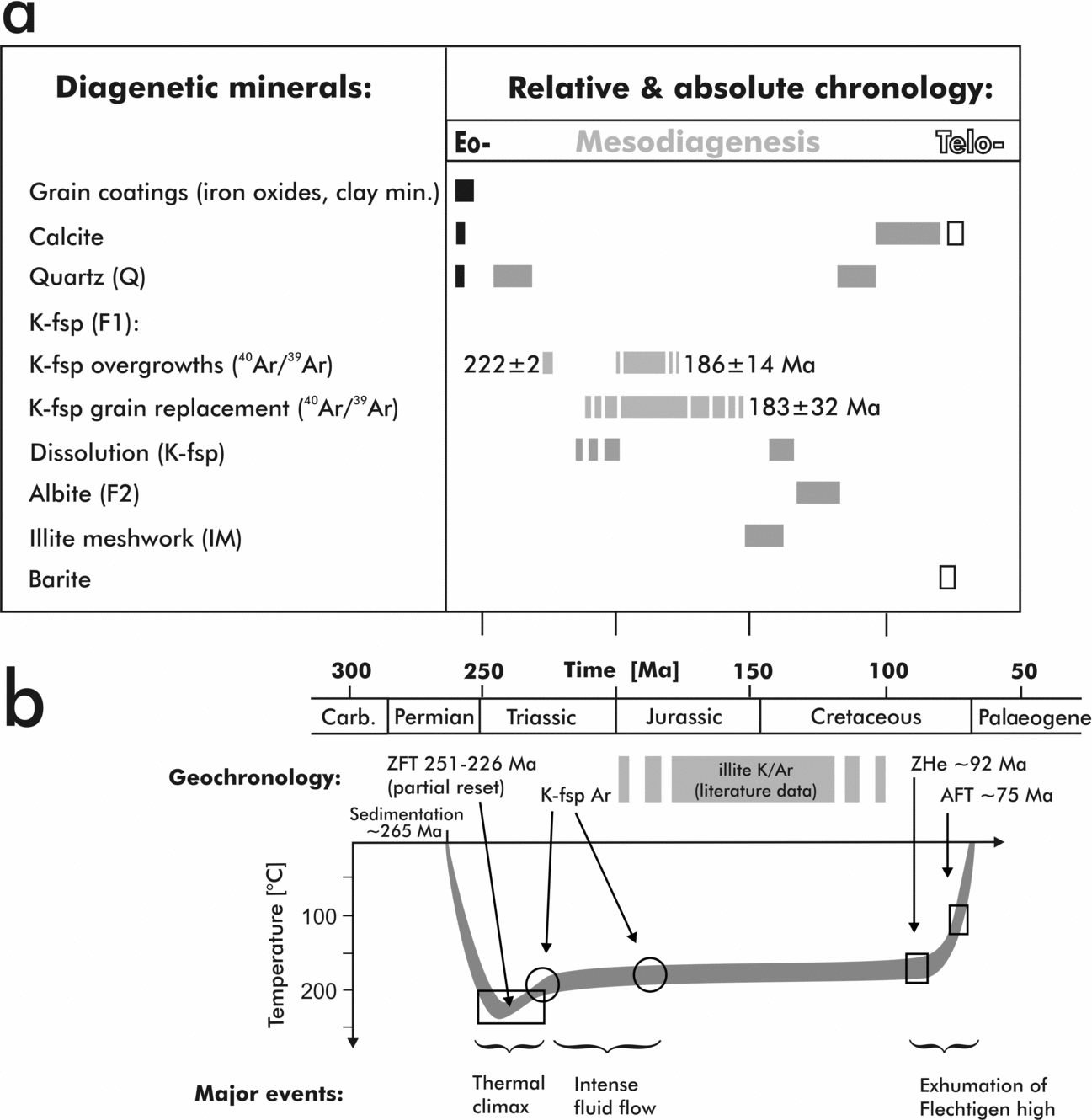
From petrographic investigations a paragenetic sequence was interpreted (Fig. 8). Mesodiagenesis started with quartz and a first K-feldspar precipitation. Afterwards, feldspar grains experienced intense dissolution. The resulting secondary porosity is in part occupied by a second K-feldspar cement generation as well as by calcite and sparse illite meshwork cements. Youngest mesodiagenetically formed cements are albite, quartz and calcite. 40Ar–39Ar age determination of K-feldspar cements shows broad spectra. Therefore, and because of the known limitations of the visible light laser technique, we use the age data only for a tentative interpretation. A first K-feldspar overgrowth generation age could be interpreted to occur at around 220 Ma. A second K-feldspar generation, forming overgrowths and filling secondary pore space in (partly) leached feldspar grains, peaks at 180–190 Ma. The interpretation of two generations makes sense in the light of additional information about the basin history. New ZFT data suggest a partial thermal reset during Triassic time. This can be explained by rapid burial of the basinal area investigated here, related to the Elbe fault system (Bayer et al. Reference Bayer, Scheck, Rabbel, Krawczyk, Gotze, Stiller, Beilecke, Marotta, Barrio-Alvers and Kuder1999, Reference Bayer, Grad, Pharaoh, Thybo, Guterch, Banka, Lamarche, Lassen, Lewerenz, Scheck and Marotta2002). Permian elevated heat flow is also documented by Rotliegend syn- to post-magmatic fluid inclusions (Schmidt-Mumm & Wolfgramm, Reference Schmidt-Mumm and Wolfgramm2002, Reference Schmidt-Mumm and Wolfgramm2004). The first K-feldspar cement generation could then be related to conditions of enhanced fluid flow due to rapid burial. The second phase of enhanced fluid flow and associated cement precipitation is at least in part supported by published K–Ar age data of diagenetic illite. Literature data regarding the K–Ar ages of diagenetically formed illite in Rotliegend sandstones of the southern Central European Basin show a broad range between 210 Ma and 120 Ma, but focus between 200 and 160 Ma, i.e. in Early to Middle Jurassic time (Ziegler, Reference Ziegler2006). Illite precipitation was interpreted to coincide with periods of tectonic activity and resulting enhanced fluid flow and precipitation reactions (Ziegler, Sellwood & Fallick, Reference Ziegler, Sellwood and Fallick1994; Zwingmann, Clauer & Gaupp, Reference Zwingmann, Clauer, Gaupp and Parnell1998, Reference Zwingmann, Clauer and Gaupp1999; Liewig & Clauer, Reference Liewig and Clauer2000). For example, Lee, Aronson & Savin (Reference Lee, Aronson and Savin1985) reported illite ages of 120–150 Ma from the Southern North Sea (Groningen field) and interpreted this to be a period of gas emplacement in reservoir sandstone. From a similar location (northeastern Netherlands), Lee, Aronson & Savin (Reference Lee, Aronson and Savin1989) found illite ages of 100–180 Ma, synchronous with Jurassic Kimmerian orogenic movements and Late Cretaceous–early Tertiary inversion movements. Robinson, Coleman & Gluyas (Reference Robinson, Coleman and Gluyas1993) determined illite precipitation ages of 158 ± 19 Ma; their interpretation was coincidence of illite growth and rifting processes. Overall, the onset of illite precipitation ages in about Early to Middle Jurassic time coincides with the here-reported age range of a second K-feldspar cement generation. Moreover, the intense feldspar grain dissolution after a first K-feldspar overgrowth precipitation and before a second K-feldspar precipitation could be caused by reactions initiated by fluid flow associated with early rifting processes at around the Triassic–Jurassic boundary.
(a) Relative and absolute chronology of diagenetic processes and products in the Upper Rotliegend sandstones of Bebertal, and (b) sketch of temperature evolution of buried Upper Rotliegend strata over time based on ZFT, ZHe and AFT data. A simplified distribution of diagenetic illite ages from literature is shown for comparison (Ziegler, Reference Ziegler2006).

The diagenetic history of the Flechtingen High contrasts with most other parts of the basin in having a remarkably low concentration of diagenetic illite versus the high concentration of K-feldspar cement. From theoretical and experimental considerations it is known that the precipitation of illite versus K-feldspar cements is controlled by K+ activity (e.g. Small, Reference Small1993; Lanson et al. Reference Lanson, Beaufort, Berger, Bauer, Cassagnabere and Meunier2002). For a given temperature and pressure, the widely used phase diagram of the system K2O–Al2O3–SiO2–H2O illustrates the phase boundary between illite and K-feldspar. For a given solution silica content, the a(K+)/a(H+) ratio variation will define the precipitation of illite or K-feldspar, with higher ratios favouring K-feldspar precipitation (Small & Manning, Reference Small, Manning, Manning, Hall and Hughes1993; Rae & Manning, Reference Rae and Manning1996). Higher potassium concentrations of fluids are often interpreted to be related to Zechstein evaporite-derived fluids that percolated into down-faulted structures (Leveille et al. Reference Leveille, Primmer, Dudley, Ellis, Allinson, Ziegler, Turner and Daines1997).
The lack of chlorite cements is another difference of the diagenetic sequence discussed here. Early chlorite cementation (chlorite I, according to Gaupp et al. Reference Gaupp, Matter, Platt, Ramseyer and Walzebuck1993) is usually interpreted to be caused by alkaline fluids. These fluids are derived from playa sediments during initial compaction. Therefore, the lack of chlorite cements in Bebertal sandstones could be caused by either the marginal position of the strata investigated here or the lack of eodiagenetic alkaline fluids during this early phase (graben sediments of the Parchim Formation) of basin evolution (Gast et al. Reference Gast, Dusar, Breitkreuz, Gaupp, Schneider, Stemmerik, Geluk, Geissler, Kiersnowski, Glennie, Kabel, Jones, Doornenbal and Stevenson2010).
5.b. Spatial heterogeneity of diagenetic minerals
Spatial distribution of porosity and IGV variances were found to be governed by sample distance to sedimentary bounding surfaces, i.e. aeolian superimposition surfaces (Fig. 4). The sample position correlates with the abundance of illite-rich versus iron oxide-rich grain cutans. Above superimposition surfaces, the cutans show clearly lower illite concentrations. Below the bounding surfaces, the illite concentration of the cutans is much higher. The higher sheet silicate concentration correlates positively with higher compaction. This interpretation is derived from the Houseknecht diagram visualization (Fig. 4). The supporting impact on chemical compaction due to juxtaposition of sheet silicates and quartz grains is known from studies about differential compaction, e.g. Oelkers, Bjorkum & Murphy (Reference Oelkers, Bjorkum and Murphy1996). According to the interpretation of Oelkers and co-authors, the variation in infiltrated clay mineral concentration can explain differences in IGV at the decimetre scale. Differences in the intensity of infiltration can be explained, e.g. owing to variations in duration of filtration of fines in eodiagenetic fluids as well as by differences in concentration and composition of fines.
The observed differences may also explain permeability contrasts at bounding surfaces in sandstones. Both intense quartz and feldspar cementation above bounding surfaces as well as intense illite/iron oxide grains rims (and resulting high compaction) are able to cause a remarkable reduction in permeability along bounding surfaces. As a result, a fluid-flow barrier and baffle system is established according to the spatial arrangement of bounding surfaces (Fischer et al. Reference Fischer, Gaupp, Dimke and Sill2007).
5.c. End of mesodiagenetic processes: uplift of the Flechtingen High
The mesodiagenetic processes reported here ended owing to the Late Cretaceous basin inversion in this part of the NGB (Littke et al. Reference Littke, Scheck-Wenderoth, Brix, Nelskamp, Littke, Bayer, Gajewski and Nelskamp2008). As a result of inversion tectonics, the Flechtingen High was formed owing to the large displacement of the Haldensleben fault (Schretzenmayer, Reference Schretzenmayr1993). Zircon (U–Th)/He ages indicate Late Cretaceous (92 ± 12 Ma) cooling from the temperature range of helium retention in zircon. These new ZHe ages evidently post-date the rifting period of the basin evolution and the age of maximum burial and indicate that processes during Late Cretaceous basin inversion exhumed the Flechtingen High from the reset temperature of He in zircon (c. 180°C, according to Reiners et al. Reference Reiners, Spell, Nicolescu and Zanetti2004). Apatite FT ages of 75.1 ± 6.3 and 71.5 ± 6.3 Ma strongly support the zircon He data. Track length data clearly indicate rapid cooling of apatites through the partial annealing zone (PAZ, 60–120°C), consistent with a model of rapid exhumation to the surface within a few million years, similar to the uplift of the Harz block further south (von Eynatten et al. Reference von Eynatten, Voigt, Meier, Franzke and Gaupp2008).
6. Conclusions
Petrographic data supported by electron microprobe element mappings and a variety of geo- and thermochronological techniques applied to the Upper Rotliegend sandstones from Bebertal suggest a time-constrained paragenetic sequence characterized by:
(1) Spatial anisotropy at the decimetre scale of concentration of eodiagenetically infiltrated clay minerals/iron oxides that form grain rims and are responsible for the contrasting evolution of IGV within the investigated sandstone body during burial diagenesis;
(2) Low concentration of diagenetic illite, i.e. illite meshwork versus high concentration of K-feldspar cement due to high K+ activity during burial diagenesis;
(3) Two generations of diagenetic K-feldspar, related to (i) rapid burial of the basinal area during Permian and Triassic time and (ii) associated with early rifting processes at around the Triassic–Jurassic boundary;
(4) An Early to Middle Triassic thermal climax of approximately 200–250°C; and
(5) End of mesodiagenetic processes in Late Cretaceous time owing to rapid exhumation of the Flechtingen block to the surface within a few million years.
Acknowledgements
We thank Andreas Kronz (Georg-August-Universität Göttingen, Geowiss. Zentrum, Abt. Geochemie) for analytical assistance with electron microprobe analysis element mapping. Reviews by two anonymous reviewers and editorial handling by Andy Whitham are gratefully acknowledged.