Introduction
Incidence of mediastinitis after cardiovascular (CV) surgery ranges from 0.2–5%. Reference Abu-Omar, Kocher and Bosco1,Reference Barker, O’Brien and Welke2 Consequences of these infections are severe; while pediatric outcomes data are limited, morbidity is common and reported mortality reaches 42% in intensive care unit (ICU) patients. Reference Barker, O’Brien and Welke2,Reference Harder, Gaies and Yu3 Multiple risk factors for mediastinitis in this population have been identified, including younger age, duration of surgery, delayed sternal closure, preoperative hospitalization, and medical complexity. Reference Barker, O’Brien and Welke2–Reference Iguidbashian, Feng and Colborn6 Given the significance of these infections, multiple groups track them to support hospitals in benchmarking against their peers. These include the Centers for Disease Control and Prevention’s National Healthcare Safety Network (NHSN), 7 the Society of Thoracic Surgeons (STS) Congenital Heart Surgery Database, 8 and Solutions for Patient Safety (SPS), a network of pediatric hospitals with the shared goal of reducing hospital-acquired conditions. Reference Schaffzin, Harte and Marquette9 Unfortunately, despite this investment from multiple groups, none capture the breadth of pediatric mediastinitis cases. Reference Naureckas Li, Bonebrake, Mansavage, Moravec and Schroeder10
Multiple practices such as appropriate skin prep and antibiosis are known to be protective against mediastinitis. Reference Cannon, Hersey and Harrison11 Notably, use of intervention “bundles” for infection prevention is a well-established and effective strategy. Reference Schaffzin, Harte and Marquette9
In monitoring our local mediastinitis rates following CV surgery, although they were slightly below the SPS median, as part of a larger hospital effort to improve hospital-acquired condition rates Reference Naureckas Li, Stuart, Green, Studer, Schroeder and Wheeler12 we recognized an improvement opportunity. We aimed to approximately quadruple days between episodes of postoperative mediastinitis from an average of 58 to greater than 223, the upper control limit of our baseline data, within two years.
Methods
Context
This work was undertaken at a large quaternary pediatric hospital in the midwestern United States that performs over 250 cardiopulmonary bypass surgeries a year. Our program had three CV surgeons for most of the study period. The hospital has a 44-bed acuity-adaptable cardiac care unit (CCU), which allows patients to remain in the same location for their duration of hospitalization, while the team caring for them changes depending on the required level of care. Patients admitted to the CCU receive preprocedure Methicillin-Resistant Staphylococcus Aureus (MRSA) screening; those outpatient prior to their procedure are not routinely screened.
Our hospital joined SPS in 2012, and we have submitted data to the American College of Surgeon’s National Surgical Quality Improvement Program (NSQIP) since 2012 and the STS Congenital Heart Surgery database since 1994. Our major surgical site infection (SSI) prevention efforts prior to the start of this work focused on routine use of the SPS SSI infection prevention bundle – these are defined by SPS as preoperative bath, avoiding razor use for hair removal, appropriate prophylactic antibiotic timing, appropriate skin antisepsis, and appropriate antibiotic redosing. 13 Our hospital has a robust infection prevention and control (IP&C) department with an infection preventionist with time dedicated to NHSN and SPS mediastinitis reporting.
A lead multidisciplinary team was formed that included an infectious diseases physician with training in QI methodology, critical care cardiologist, CV surgery nurse coordinator, infection preventionist with expertise in SSIs, hospital STS data manager, and CV scrub technician. Additional stakeholder input was sought as needed from relevant groups including CV surgeons, IP&C leadership, antimicrobial stewardship, environmental services, facility operations, operating room (OR) administration, anesthesia, and CCU quality leadership.
Our lead team reviewed all mediastinitis cases since January 2020, the start of our current CV surgery data collection structure, to identify potential areas of opportunity. A key driver diagram of factors influencing the development of mediastinitis in our institution was created (Figure 1). As work progressed, all mediastinitis cases were reviewed in depth by this group, and findings were used to select additional interventions.
Key driver diagram.
Note: Interventions in black have been implemented, those in gray have not yet been trialed.

Interventions
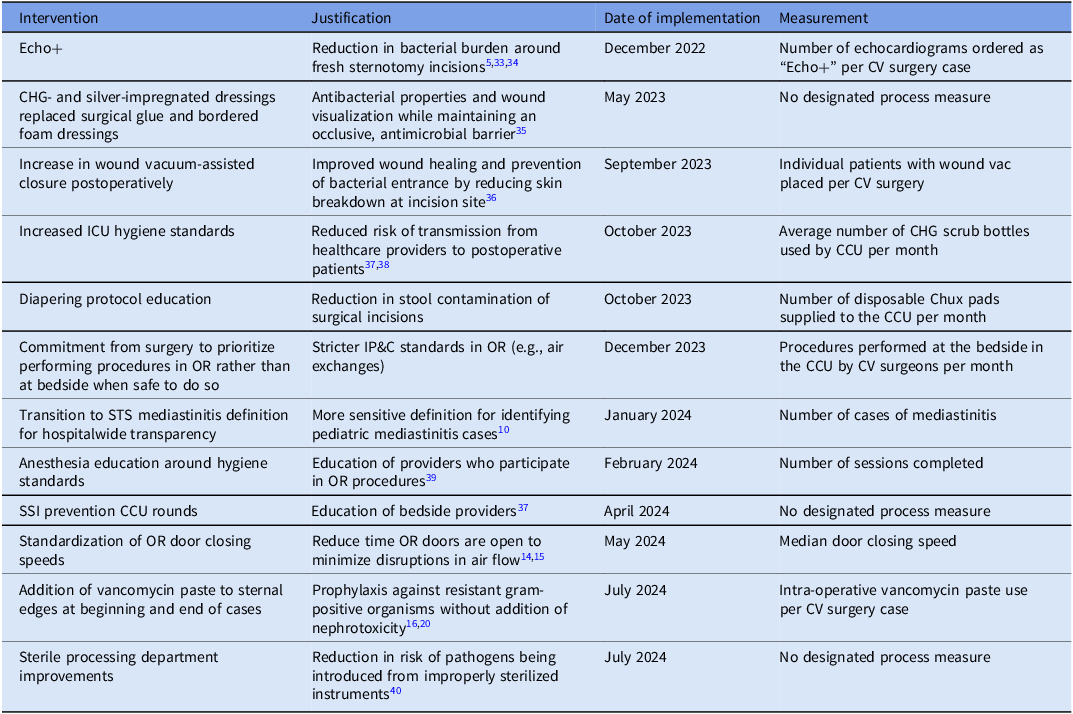
Interventions that comprised Plan-Do-Study-Act cycles fell into two main categories: those impacting workflows in the ORs and those focused on pre and postsurgical care in the CCU (Table 1).
Summary of implemented interventions

Operating room-based interventions
In May of 2023, Chlorhexidine Gluconate (CHG-) and silver-impregnated dressings were implemented for all patients over two weeks old and two kilograms. Clear material allowed for wound visualization while maintaining an occlusive, antimicrobial barrier. These dressings replaced the previously used surgical glue and bordered foam dressing.
In September 2023, our surgeons standardized use of wound vacuum-assisted closure to include application for all re-do sternotomies, neonates, patients with a tracheostomy or gastrostomy tube, and others deemed to be high-risk for infection at the surgeon’s discretion.
Project stakeholders from the OR noted that anesthesia colleagues were frequently not in compliance with hand hygiene expectations and wore hand or wrist jewelry when contacting the sterile field (e.g., when placing central lines). The team recognized that anesthesia trainees rotated through our cardiac ORs but did not receive formal training when they started in our hospital. An educational session on hand hygiene and sterile technique in the ORs taught by a CV surgery scrub technician, CV surgery nurse coordinator, and infectious diseases physician was given in February 2024 and repeated in August 2024, with intent to include yearly during the trainee orientation. Although the lecture intended to target trainees, CV anesthesia faculty also attended and could benefit from a reminder of the content.
Our IP&C team completed multiple rounds of OR observations and recognized several areas of opportunity related to airflow, Reference Teter, Guajardo, Al-Rammah, Rosson, Perl and Manahan14,Reference Birgand, Azevedo and Rukly15 including that that the door between the OR and the semi-restricted corridor was frequently open during cases. All OR doors in our hospital are set to close on a delay to allow safe equipment transport. This IP&C finding prompted facilities management review, and they found that this set speed varied from seven to 53 seconds across ORs. Stakeholders went to the OR and timed themselves moving equipment through OR doors. Based on those observations, all doors between ORs and the semi-restricted corridor were set to a 17 second closing time in May 2024.
We recognized many of our mediastinitis cases were due to coagulase-negative Staphylococci (Figure 3), which are frequently not susceptible to standard peri-operative cefazolin. Our team strongly wanted to avoid adding parenteral vancomycin to our standard perioperative prophylaxis given associated toxicities. Based on adult literature showing the efficacy and safety of vancomycin applied locally to the sternal edges, Reference Kowalewski, Pasierski and Makhoul16 in July 2024 our cardiac surgeons began applying vancomycin paste to sternal edges at the beginning and end of cases when they determined the patient was at high risk of mediastinitis (e.g., complex congenital heart disease staged repairs and planned delayed sternal closure).
In July 2024, multiple processes were updated in our sterile processing department (SPD), building upon prior improvement work in this area. Reference Natarus, Shaw and Studer17 These included sterilizing loaner trays on a separate rack to allow for better aeration and more efficient drying poststerilization, increased auditing for correct placement of trays on sterilizer racks and of trays prior to closure and sterilization to monitor for bioburden. OR leadership also worked with vendors to ensure loaner trays arrived earlier to allow adequate time for full SPD processes.
CCU-based interventions
In December 2022 the CCU implemented a new practice named “Echo+,” that included chest cleaning with a CHG-impregnated cloth pre and postimage acquisition, sterile probe covers, sterile gel, and sterile gloves during echocardiograms performed in the 14 days after sternotomy.
In October 2023, new IP&C hygiene standards were implemented across all ICUs in our hospital, including the CCU. At baseline, the Illinois department of public health required hand and wrist jewelry removal prior to entering a neonatal ICU. This guidance was extended to our other ICUs, with only a single ring and/or watch allowed. The new standard required a CHG scrub the first time providers entered an ICU each day. Any lab coats, sweatshirts, or jackets not freshly laundered were not allowed at the bedside, and long sleeves had to be rolled up above the elbow. Artificial nails and chipped nail polish were prohibited; all nail polish was discouraged.
Recognizing that enteric pathogens drove many of our mediastinitis cases (Figure 3), in October 2023 we also began an educational campaign to re-implement a “diapering protocol” in our CCU. This process emphasized standard precautions such as hand hygiene and glove use while changing a diaper. It also included storage of all diapering materials in a designated area outside of the bed/crib and use of a disposable Chux pad under the patient to prevent fecal material from inadvertently soiling bedsheets.
As procedures performed at bedside are at higher risk SSIs due to differences in infection control standards, the CV surgeons made a commitment in December 2023 to critically considering whether a patient could be safety transported for a procedure and to prioritize performing procedures in the OR whenever safe.
At our hospital, absolute counts of predetermined high-impact hospital-acquired safety events are displayed on a “patient safety index” on digital signage around the institution. Reference Naureckas Li, Stuart, Green, Studer, Schroeder and Wheeler12 Historically we displayed the number of cases reported to SPS, but our lead team received feedback from front-line caregivers that this number did not reflect the higher burden of cases seen in their daily practice. After extensively comparing the reporting definitions, we recognized that less than half of the cases performed by our CV surgeons were eligible for SPS reporting. Acknowledging the limitations of the SPS and NHSN reporting definitions, Reference Naureckas Li, Bonebrake, Mansavage, Moravec and Schroeder10,18,Reference Atchley, Pappas and Kennedy19 to ensure that we were maximizing transparency to our workforce and to promote trust between front-line staff and our lead team, in January 2024 we updated our process to display STS-defined mediastinitis cases.
In April 2024, we began mediastinitis bedside rounds every other week. A lead team physician and nurse visited bedside nurses of patients who had recently undergone cardiac surgery to understand front-line caregiver perspectives and provide just-in-time education about mediastinitis prevention topics such as hand hygiene and diapering protocol.
Measures
As STS reporting criteria most comprehensively captured the breadth of procedures performed at our hospital, allowing for a longer time during which an infection can be identified, clinical diagnosis by an attending physician, inclusion despite an intervening procedure, and out-of-OR procedures, Reference Naureckas Li, Bonebrake, Mansavage, Moravec and Schroeder10 we chose to use this reporting definition as our outcome measure. Our trained CCU data manager (AM) performed STS data extraction in line with STS guidance. Days between episodes of mediastinitis were monitored on a t statistical process control (SPC) chart (Figure 2). We applied standard rules for special cause variation.
Outcome measure.
Note: T SPC of days between mediastinitis cases. The final dashed line indicates that no additional cases occurred following the last shown point. CCU, Cardiac Care Unit; ICU, Intensive Care Unit, OR, Operating Room.

Pareto chart of organisms identified in cases of mediastinitis.

We followed multiple process measures to track the success of our interventions. These included number of echocardiogram orders in which the “Echo+” option was selected, number of Chux pads stocked in the CCU, average number of CHG scrub bottles supplied to CCU, number of CV surgery cases using vancomycin paste, number of bedside CV surgery procedures, number of patients with a wound vacuum-assisted closure after CV surgery, and median door closing time in the CV surgery ORs. We followed two balancing measures: postoperative mortality as defined by STS, and, although published literature is reassuring about the safety of vancomycin paste, Reference Lazar, Barlam and Cabral20 we also tracked rates of acute renal failure to ensure that there was not undetected systemic absorption leading to patient harm. Data were collected via STS reports, electronic medical record reports, and supply chain data queries. We followed our process and balancing measures on u SPC charts when monthly counts were available and descriptive statistics when they were not.
We performed analyses in JMP Pro (JMP Pro version 16.0.0, SAS Institute Inc, Cary, NC).
Ethical Considerations
This work was deemed exempt from full review by the Lurie Children’s institutional review board.
Results
January 2020–January 2025, our hospital performed 2,397 CV surgeries. At baseline, our hospital experienced a case of mediastinitis meeting the STS definition an average of once every 58 days (of note, per the STS definition, patients who have mediastinitis after extracorporeal membrane oxygenation cannulation or ventricular assist device implantation are not included). The last mediastinitis case in our hospital was in March of 2024, so at the time of writing, there have been no cases in over 450 days, far above the upper control limit of our t SPC chart (Figure 2).
The centerline on the u chart of Echo+ orders per CV surgery increased from 0 to 0.8 in December 2022, on the u chart of CCU bedside procedures per CV surgery decreased from 0.007 to 0 in August 2023, on the c chart of disposable Chux units supplied to the CCU increased from 1541 per month to 2048 per month, on the u chart of CV surgery cases using vancomycin paste per CV surgery increased from 0 to 0.3 in July 2024, and on the u chart of patients with wound vacuum-assisted closure per CV surgery from 0.2 to 0.4 in July 2023. (Figure 4). The median set door speed closing time in our CV surgery ORs decreased from 40.5 seconds to 17 seconds. The average number of CHG scrub bottles used by CCU increased from 2.6 per month prior to the intervention to 3.4 per month postintervention. No special cause variation was noted in mortality following CV surgeries in the postintervention period or in acute renal failure following vancomycin paste implementation (Figure 5).
Process Measures.
Note: Panel A shows an increase in intra-operative vancomycin paste use from none to 0.3 orders per CV surgery case following implementation. Panel B shows a decrease in CCU bedside procedures from 0.007 to none following a commitment from CV surgery to minimize out-of-OR procedures when safe to do so. Panel C shows an increase in echocardiograms ordered as “Echo+” increasing from none to 0.8 per CV surgery case following implementation. Panel D shows an improvement in Chux disposable pad use supplied to the CCU from 1541 to 2059 per month following re-investment in the diapering protocol campaign. Panel E shows an increase in patients with wound vacuum-assisted closure per CV surgery from 0.2 to 0.4 in July 2023. Note: CCU, Cardiac Care Unit; CV, Cardiovascular; OR, Operating Room.

Balancing Measures.
Note: Panel A shows cases of renal failure per CV surgery with no special cause variation noted after implementation of vancomycin paste. Panel B shows mortality per CV surgery with no special cause variation noted during the study period.

Notably, our hospital experienced an unexpected systems downtime in early 2024, so some process measure data are unavailable. However, mediastinitis data from that time were accurately tracked and are included here.
Discussion
Through a series of multidisciplinary interventions, we have now gone well over a year since our last mediastinitis case, a significant improvement from our CCU’s baseline of an infection approximately every other month.
While broad stakeholder input is important in all rigorous QI work, Reference Leviton and Melichar21 involvement and advocacy of stakeholders from both the OR and CCU was critical to our success. Many previous publications around SSI prevention for other procedure types focus heavily or entirely on interventions that occur intraoperatively or in the immediate perioperative period. Reference Calderwood, Yokoe and Murphy22–Reference Falconer, Ramsay, Hudson and Watson24 However, in pediatric CV surgery, postoperative hospitalizations for children who undergo complex congenital heart surgeries can stretch weeks to months. Reference Martin, McBrien, Marchak, Atallah, Al Aklabi and Mackie25,Reference Luna, Kuhnell and Wooton26 In some situations, the sternum cannot be closed at the time of the initial procedure, which increases vulnerability to deep-seated infections. Reference Iguidbashian, Feng and Colborn6,Reference Glenn, Harman and Marietta27 Similarly to other groups that have worked on pediatric CV SSI reduction, Reference Golden, Murphy and Rosenblum28,Reference Jha, Woodward, Gardner, Pietz and Husain29 we found it was essential to focus on opportunities for improvement at all stages of the patients’ procedures and recoveries. While we did not implement significant preprocedural changes, this may represent another area of opportunity to consider if cases rise again.
A unique aspect of our work was reduction of fecal contamination. We recognized that enteric pathogens contributed to many of our infections, and risks from enteric pathogens are well described in other procedure types, such as spinal fusions in patients with fecal incontinence. Reference Olsen, Mayfield and Lauryssen30 This has been less of a focus in the CV surgery space, where hand hygiene-based interventions have played a more prominent role. Reference Golden, Murphy and Rosenblum28,Reference Jha, Woodward, Gardner, Pietz and Husain29 Our process measure showed that our education-based interventions successfully increased the use of Chux pads in the CCU, suggesting they were being used during diaper changes to reduce fecal contamination of bedsheets that would later contact sternal incisions.
Another key aspect of our success was use of the most comprehensive reporting definition in defining our outcome measure. Our group has previously described deficiencies of the NHSN and SPS mediastinitis reporting definitions. Reference Naureckas Li, Bonebrake, Mansavage, Moravec and Schroeder10 Because these definitions are rooted in adult procedures, they fail to capture many of the complex surgeries performed for children with congenital heart disease. Unfortunately, those procedures are at particularly high risk of postoperative mediastinitis, Reference Costello, Graham and Morrow5 and capturing them in data monitoring is essential to understand the full scope of opportunities for improvement. Additionally, transparency is critical in establishing support from those at the front lines of care, Reference Dixon and Shofer31 and if bedside providers felt that their lived experience with mediastinitis in their patients was not reflected in the data we reported to the organization, it would have been challenging to earn their trust and participation in interventions. This issue with national reporting definitions failing to capture the full scope of pediatric infections is not limited to CV surgeries Reference Naureckas Li, Bonebrake, Schroeder, Lam and Raskin32 and should be a consideration by any teams initiating pediatric SSI reduction work.
We recognize that mediastinitis prevention, like many other hospital-acquired infection (HAI) prevention initiatives, relies strongly on individual behaviors such as hygiene practices. While some interventions were hard-wired to promote sustainability, such as the Echo+ order that serves as a built-in reminder every time a provider in the CCU orders an echocardiogram and the set OR door speeds, several others relied on culture change. We are fortunate to have hospital leadership investment in reduction of HAIs and a well-supported hospital-acquired condition committee in addition to our infection prevention team, Reference Naureckas Li, Stuart, Green, Studer, Schroeder and Wheeler12 so following our successful initial culture shift we anticipate that we are in a strong position to detect drift and repeat education periodically as necessary.
This work has limitations. We were building upon preexisting prevention work bolstered by our participation in the SPS collaborative, so our work may not be generalizable to sites that are starting this work de novo. Our hospital also had a change in CV surgery leadership during the study period, and there may be undetected culture changes that contributed to this improvement. Similarly, separate initiatives by our infection prevention and control team to address hand hygiene overlapped with this work, and we are not able to fully understand the impact of that work on our outcomes. We were additionally unable to evaluate the impact of our interventions on staff job satisfaction. Some process measures are indirect measures of our interventions, so we cannot definitively know that the interventions led to our improved outcomes or which had the greatest impact when multiple were implemented in a short time period. Our acuity-adaptable unit may limit generalizability, although we did not focus on interventions more targeted to this structure, such as environmental services challenges created by accumulation of personal belongings. Our work and interventions had strong support from hospital leaders, which likely played a role in its success. While all teams may not enjoy that same support as they start work in this space, we hope our success highlights the importance of investment in this work to leaders at other sites.
Conclusion
Pediatric CV surgery is an essential component of care for some of the most vulnerable children in our healthcare system. Through a series of interventions that targeted both intraoperative and postoperative components of care, we dramatically reduced our incidence of mediastinitis, supporting these children in reaching their full potential.
Supplementary material
To view supplementary material for this article, please visit https://doi.org/10.1017/ice.2025.10366
Acknowledgements
The authors would like to thank Emily McGiness, Lynn McCloud, Brian Stahulak, Derek Wheeler, Marcelo Malakooti, Alexa Mendoza, and all the caregivers who support patients in our hospital Cardiac Care Unit. All authors have no conflicts of interest to disclose.
Financial support
There was no external funding supporting this work.
Competing interests
The authors have no conflicts of interest relevant to this work relevant to disclose.