Introduction
Several phase III trials and the resultant meta-analysis have demonstrated the benefit of post-operative whole-breast radiotherapy (RT) in patients with early-stage carcinoma of the breast undergoing breast-conserving treatment (BCT).Reference Fisher, Anderson and Redmond1, Reference Darby and McGale2 These studies confirmed a reduction in ipsilateral breast tumour recurrence and breast cancer-specific mortality.Reference Fisher, Anderson and Redmond1, Reference Darby and McGale2 In keeping with these results, current national consensus treatment recommendations include whole-breast RT in suitable patients undergoing BCT.3
Despite these favourable cancer-specific results, recent large retrospective studies have suggested that left-whole-breast RT increases the risk of long-term ischaemic cardiac injury, pericarditis and valvular disease,Reference Darby, McGale and Taylor4–Reference Darby, Ewertz and McGale6 which could offset a more dramatic improvement in survival found in reducing cancer recurrence rates. One well-known study by Darby et al.Reference Darby, Ewertz and McGale6 suggested that increased cardiac dose caused a linear increase in lifetime cardiac risk with no apparent threshold. According to this manuscript, major coronary events increased by 7·4% for each 1 Gy of increased mean dose to the heart. Another study showed that doses as low as 2·6 Gy to the heart can increase the lifetime risk of ischaemic heart disease.Reference Carr, Land and Kleinerman7 These results and others have led to an increased national awareness of the risks of RT and an effort to reduce dose to adjacent organs-at-risk (OAR).
These population-based studies that have suggested an increased cardiac risk for left-sided breast cancer patients receiving RT are criticised for being outdated; for instance, using clinical or fluoroscopic simulation as opposed to the computed tomography (CT)-based planning commonly utilised today.Reference Darby, McGale and Taylor4, Reference Darby, Ewertz and McGale6 As stated by Darby et al.Reference Darby, Ewertz and Hall8 in a letter to the editor, ‘Almost all the women who were included in our study were treated before the era of radiotherapy planning with the use of patient-specific scans based on CT, so our dose estimates could not take into account differences in anatomy’. However, another study has shown that despite modern left-breast RT techniques (including CT-based planning), as much as half of left-sided breast cancer patients may have a maximum heart dose over 20 Gy.Reference Bartlett, Colgan and Carr9
Owing to these findings, more advanced techniques continue to be developed and tested to reduce OAR dose during radiation treatments.Reference Ahmed, De Los Santos and Fiveash10–Reference Sardaro, Petruzzelli and D’Errico14 In terms of treatment setup and immobilisation, deep inspiratory breath hold (DIBH) technique leads to a reduction in normal tissue irradiation by physically separating the chest wall and breast from the heart during treatment delivery, reducing cardiac irradiation.Reference Borst, Sonke and den Hollander11–Reference Nissen and Appelt19 In terms of irradiation technique, intensity-modulated radiotherapy (IMRT) can use inverse treatment planning software to arrange multiple conformal beams to cover a target, showing particular dosimetric benefit in concave targets, like that of the breast and chest wall interface.Reference Ahmed, De Los Santos and Fiveash10, Reference Pignol, Keller and Ravi20 The use of IMRT in breast cancer has increased over the past decade, particularly in non-academic centres.Reference Wang, Mougalian and Soulos21
Active breathing control (ABC) is a method (comparable with DIBH) used at some centres during breast RT. A recent study from Mast et al.Reference Mast, van Kempen-Harteveld and Heijenbrok12 evaluated 20 patients that underwent left-sided BCT and evaluated dosimetric outcomes using a 2×2 design to evaluate ABC versus free-breathing CT simulation and 3DCRT versus IMRT. Their results showed that ABC reduced OAR irradiation. They also found that when using ABC, IMRT reduced dose to the heart, left anterior descending coronary artery (LAD), lung, total body and total monitor units (MUs) required compared with 3DCRT in almost all endpoints studied (mean dose, D max, V10, V20 and total MUs), supporting the use of IMRT even when delivered under ABC conditions.
Both DIBH and IMRT offer a promising technique to reduce normal tissue irradiation. The purpose of the current study was to investigate any dosimetric benefit of combined DIBH and IMRT in breast treatment delivery in modern RT centres today. We aimed to compare the dose to OAR in IMRT and 3DCRT during DIBH for patients with left-sided breast cancer.
Methods
We retrospectively analysed 20 consecutive patients with left-sided breast cancer that underwent breast-conserving surgery for early-stage invasive breast cancer. Each patient underwent a CT scan utilising DIBH after recovering from breast-conserving surgery. These images were used to create whole-breast RT treatment plans utilising 3DCRT and IMRT. Dosimetric endpoints were then compared between plans. This study was approved by our Institutional Review Board with waiver of consent.
Patient positioning
Patients were positioned on a breast board with both arms raised over their head and a Vac-Lok (Med Tech, Inc., Orange City, IA, USA) bag positioned to immobilise the patient’s arms during simulation and treatment delivery. This positioning is typical of women treated at our institution.
Patient breath-hold monitoring
Before simulation, each patient was asked to hold their breath under deep inspiration a few times, allowing them to become familiarised with the procedure. The Varian Real-time Position Management (RPM) system (Varian Medical Systems, Palo Alto, CA, USA) was used during the DIBH scan to initiate imaging and to monitor the length and displacement of breath hold for each patient. The RPM block was positioned 2 cm below the xiphoid, facing the camera perpendicularly, and this position was marked on the patient at simulation for setup during treatment delivery.
For each fraction, the RPM breath-hold signal obtained at the simulation was used as the baseline for breath-hold reproducibility. An upper and lower limit of 0·5 cm from the baseline displacement was set so that the treatment would occur only when the patient’s breath hold was within the displacement gate. Between each image acquisition and between each treatment field, patients were allowed to perform free breathing. If the patient had to perform multiple breath holds, a minimum of 15 seconds was allowed for free breathing between breath holds.
CT simulation and contouring
Patients were scanned with a 16-slice Philips (Philips Healthcare, Andover, MA, USA) large-bore CT scanner during DIBH. Scan duration for the DIBH helical CT was ~20 seconds. The Pinnacle treatment planning system (Philips Medical Systems, Fitchburg, WI, USA) was used for planning, contouring and dosimetric comparisons. A single physician contoured the heart, LAD, lungs, right and left breast in each dataset based on a contouring atlas published by the Radiation Therapy Oncology Group (RTOG).22
Treatment planning
Both treatment plans were optimised on the DIBH CT datasets. In the 3DCRT plans, tangential beams with the inclusion of the lung (with <2 cm central lung distance) in the treatment fields were utilised to treat all of the left breast tissue with 2 cm of flash on the anterior breast skin. ‘Field-in-field’ planning using a multileaf collimator was used to optimise dose homogeneity.Reference Onal, Sonmez and Arslan23, Reference Woo, Pignol and Rakovitch24 A single dosimetrist created the two plans for each patient, respectively.
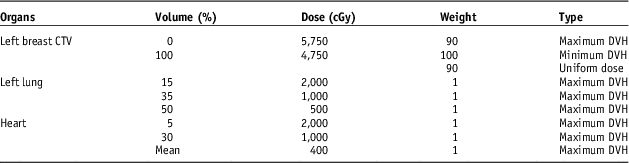
IMRT plans were planned using six non-coplanar beams (three medial and three lateral) using the gantry, collimator and table angles of a standard plan for conventional radiation therapy of the left breast and then shifting the couch +10 and −10° on each side, as previously reported.Reference Ahmed, De Los Santos and Fiveash10 Initial inverse planning constraints used during the optimisation procedure were gathered from an ongoing trial from the RTOG22 1005 trial. The constraints are given in Table 1. A prescription of 50 Gy in 2 Gy fractions was utilised in both techniques. Figure 1 demonstrates a representative comparison between 3DCRT and IMRT plans.
Representative axial images for three-dimensional conformal radiotherapy (3DCRT) (left) and intensity-modulated radiotherapy (IMRT) (right) plans.

Initial inverse planning optimisation constraints for intensity-modulated radiotherapy plans
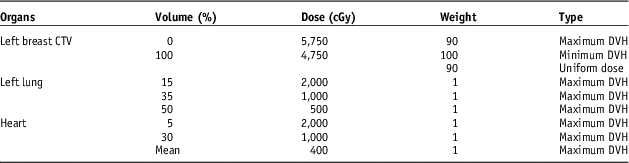
Abbreviations: CTV, clinical target volume; DVH, dose–volume histogram.
Dosimetric analysis
For the dosimetric comparison between 3DCRT and IMRT, the mean volumes of the heart, LAD, total lung and right breast receiving 5–95% (in 5% increments) of the prescription dose were calculated. Figure 2 demonstrates a representative dose–volume histogram comparison between plans. The integral dose to the breast was calculated by multiplying breast volume by the mean dose to breast. The same technique was employed to obtain integral dose to contralateral breast and lung.
Representative dose–volume histogram for three-dimensional conformal radiotherapy (dashed) and intensity-modulated radiotherapy (solid) plans (red: planning target volume, green: left anterior descending coronary artery, blue: right breast, yellow: total lung, tomato: heart).
Statistics
A sample size of 20 was chosen to obtain 80% power to detect a 10 cGy decrease in mean heart dose with either plan. Each 3DCRT plan was matched with the respective IMRT plan for the same patient. A matched pair t-test was performed to assess dose differences in IMRT versus 3DCRT for each of the structures of interest for each patient. A p-value of ≤0·05 was considered statistically significant.
Results
Target coverage and MUs
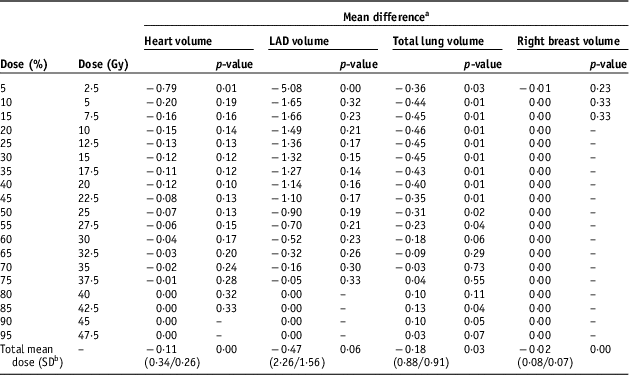
IMRT demonstrated improved dose homogeneity in the target volume, and mean dose to target was higher for 3DCRT (51·03 Gy) compared with IMRT (50·47 Gy, p<0·01). Less MUs were delivered per fraction in the 3DCRT plan with an average difference of 225 MU/session (p<0·01). Table 2 demonstrates dosimetric results identified.
Mean difference in organ-at-risk volume (%) receiving different dose levels in intensity-modulated radiotherapy (IMRT) and three-dimensional conformal radiotherapy (3DCRT) plans
Notes:
a 3DCRT is used as the reference technique: a negative value indicates that 3DCRT resulted in a lower volume of tissue irradiated.
b Standard deviation given as (SD of IMRT mean dose)/(SD of 3DCRT mean dose).
Abbreviation: LAD, left anterior descending coronary artery.
Heart and LAD
The volume of heart receiving 5% of the prescription dose (2·5 Gy) was lower in the 3DCRT plan (p<0·01), but otherwise did not differ for doses ≥5 Gy. The mean dose to the heart was reduced with 3DCRT with the average mean dose to heart being 87 versus 77 cGy (p<0·01) for the IMRT and 3DCRT plans, respectively.
The volume of LAD receiving 5% of the prescription dose (2·5 Gy) was lower in the 3DCRT plan (p<0·01), and likewise, did not differ for doses ≥5 Gy. The mean dose to the LAD trended lower in the 3DCRT plan, but this was not statistically significant. The average mean dose to the LAD was 269 versus 222 cGy (p=0·055) between IMRT and 3DCRT plans, respectively.
Total lung
The volume of total lung receiving between 5 and 55% of the prescription dose (2·5–27·5 Gy) was lower in the 3DCRT plan (p<0·05 for each 5% increment), but higher in the 3DCRT plan for doses from 85 to 95% of the prescription dose (45–47·5 Gy). The mean dose to the lung was reduced with 3DCRT (p=0·03). The average mean dose to lung was 254 versus 237 cGy (p=0·03) between IMRT and 3DCRT plans, respectively.
Right breast
The volume of right breast receiving 5–95% of the prescription dose did not differ between plans. The mean dose to the right breast was reduced with 3DCRT (p<0·01), but the absolute difference was small. The average mean dose to right breast was 19 versus 17 cGy (p<0·01) between IMRT and 3DCRT plans, respectively.
Discussion
The average mean dose to the heart was lower with 3DCRT compared with IMRT in the current study. However, it is important to consider the difference between a dosimetric advantage and a clinical advantage in cardiac dose reduction. These absolute differences between IMRT and 3DCRT (when administered under DIBH) for left-sided breast cancer were relatively small, and we suspect that such small differences would be unlikely to dramatically influence clinical outcomes such as late cardiac toxicity. Based on existing long-term data regarding cardiac irradiation, it is likely that a mean cardiac dose <2 Gy would minimise risk of atherosclerotic disease.Reference Darby and McGale2, Reference Darby, McGale and Taylor4, Reference Darby, Ewertz and McGale6, Reference Carr, Land and Kleinerman7 Many researchers advocate dose reduction to the LAD as well, as this is a common site of clinically significant coronary artery disease, although its threshold and dosimetric criteria have not been as well established.Reference Taylor, Povall and McGale25 Although target homogeneity was improved with IMRT, we suspect that such a small absolute difference, as well, is not clinically relevant.Reference Rajan, Sharma and Kumar26 These results demonstrate that for most patients with left-sided breast cancer, under DIBH conditions, IMRT did not appear to offer a dosimetric advantage in OAR irradiation compared with modern day 3DCRT techniques, and it is not necessary to utilise IMRT when DIBH is available.
These results are in contrast to the evidence provided by Mast et al., which support IMRT use under ABC for a reduction in heart dose. The ABC system differs from the DIBH system in many ways, but dosimetric differences between techniques are minute. During ABC, patients typically do not hold their breath at deep inhalation, rather somewhere in mid-inhalation. In such a situation, physical separation between the heart and left breast is not as profound as seen in DIBH. Regardless, a recent study by Bartlett et al.Reference Bartlett, Colgan and Carr9 compared these two techniques and found that OAR doses were unchanged between techniques, but DIBH provided faster setup times and was the preferred technique by therapists and patients.
The 3DCRT plans in the Mast study were created using opposed wedge tangential fields,Reference Mast, van Kempen-Harteveld and Heijenbrok12 as opposed to the ‘field-in-field’ technique used in the current study. Physical wedges used in breast irradiation have been known from previous studies to increase dose to OARs as well as total MUs because of attenuation and scatter created in the wedge.Reference Onal, Sonmez and Arslan23, Reference Woo, Pignol and Rakovitch24 A common practice at most RT centres in the United States is to use control point-based forward-planning technique like that described in the current study’s methods during tangential breast irradiation. As such, the doses to OARs presented in the Mast paper may not accurately represent clinical doses to OARs in many modern therapy centres today.
If considered dosimetrically equivalent, 3DCRT could potentially be considered superior owing to other aspects associated with IMRT versus 3DCRT. There is evidence that 3DCRT administered under DIBH provides logistical benefits, including patient and therapist preference.Reference Bartlett, Colgan and Carr9 The reduction in cost of 3DCRT compared with IMRT in breast cancer ($8,786·69 versus $19,181·90 total reimbursed for 3DCRT and IMRT, respectively) as well as reduction in treatment time has been previously demonstrated.Reference Reardon, Read and Morris15
We recognise there are several limitations to this study. A total of 20 patients with relatively ‘normal’ chest wall anatomy were selected and contouring was performed by a single investigator. Moreover, dose–volume histograms estimating average and maximum doses of whole organs may not be the best predictors of radiation-related toxicity. IMRT would undoubtedly offer additional dosimetric advantage in select patients with particularly difficult concave chest wall anatomy with very anterior hearts despite DIBH. In addition, these results would not be applicable to centres that do not offer respiratory-managed treatment delivery. Volumetric-modulated arc therapy techniques were not included in the current study but could offer alternative dosimetric advantages.
The use of hypofractionated whole-breast irradiation has gained acceptance recently in many patients and may largely replace ‘standard’ fractionation in years to come.Reference Whelan, Pignol and Levine27, Reference Smith, Bentzen and Correa28 Techniques aimed at reducing OAR dose will likely be of increased importance as the use of hypofractionated RT increases under the assumption that an increased radiobiologic equivalent dose to the heart causes an increase in long-term cardiac toxicity. Further clinical research will be required to validate these hypotheses.
When administered under DIBH, absolute differences between 3DCRT and IMRT are small in most patients and there is limited rationale for the routine use of IMRT. 3DCRT under DIBH should be considered an excellent technique in patients with left-sided breast cancer.
Acknowledgement
The authors thank Paul Read, MD, PhD, for his advice and support.
Financial Support
None.
Conflicts of Interest
None.