


Introduction
There exists a general impression that slush-flow activity, i.e. the rapid mass movement of water-saturated snow, is confined primarily to Arctic and high sub-Arctic regions. The formation of this impression is due partly to the numerous accounts of the occurrence of slush-flow phenomena in such regions. Slush flows were first cited in modern literature by Reference Washburn and GoldthwaitWashburn and Goldthwait (1958), despite the fact that knowledge of slush-flow activity has a much longer history. Reference OsbornOsborn (1852) described slush-flow activity near Barrow's Strait in the Canadian Arctic and slush-flow occurrences have been recorded by the Japanese for over 300 years (personal communication from S. Amma).
Recent work by Reference HestnesHestnes (1985) reported slush-flow activity in southern Norway. The occurrence of these events in lower latitudes encouraged the present authors to conduct a global survey to identify slush-flow occurrences and their characteristics. Questionnaires were sent to 927 universities, research centers, engineering institutes, and individuals in 44 countries (Table I). Most of the addresses were selected from mailing lists obtained from the International Glacio-logical Society, International Snow Science Workshop Committee, the American Association of Avalanche Professionals, and the publication World of learning.
Although responses to the questionnaire were fewer than had been hoped for, 129 questionnaires were returned. Of these, only 80 have been analyzed, because the remaining 49 respondents reported that they had little or no knowledge of slush flows. Another 18 replies were not used for reasons such as that they were returned to wrong addresses. Much of the information contributed indicates the existence of both an institutional and a national under-standing of slush flows.
Questionnaire distribution and response

* With answers.
† Incorrect address.
Locations of slush-avalanche occurrence

Responses to the questionnaire dealing with geographic location indicate that the geographic distribution of slush flows is much broader than would be generally expected. Although the greatest number of occurrences reported are still in the higher latitudes of the sub-polar and polar regions, there are impressive numbers of documented slush flows from the lower latitudes of Europe, Central Asia, China, Japan, and North America, as well as some in the Southern Hemisphere. Locations of the slush-flow occurrences reported in the questionnaires are shown in Figure 1. This information broadens the area of interest and raises many questions concerning those factors which initiate slush-flow occurrence. The initial impression is that higher latitudes present those environments most conducive to slush-flow activity; this conclusion was based solely on the numbers of reported events. However, it now appears that the originally proposed causal factors, of the accelerated rate of snow-pack melting due to intrusion of warm air masses and 24 h of radiation input (Reference OnestiOnesti, 1987), are not the only factors which can induce slush flows. New questions, or more accurately other questions, now enter into the field of slush-flow research.
Nomenclature
In an attempt to determine which English or international terms have been most commonly used when referring to slush-flow-like phenomena, the following list was provided:
Wet-snow avalanche.
Slush avalanche.
Slush flow.
Mountain torrent.
Wildback.
Other.
Responses were grouped into categories according to the numbers of similar answers as follows:
(1) Slush avalanche Slush flows 39%
(2) Wet-snow avalanche Slush avalanche Slush flow 25%
(3) Wet-snow avalanche 12%
It was difficult to interpret some of the replies to the questionnaire since it proved problematic for the informants to differentiate between slush flows and wet-snow avalanches. Several questions are raised by the above responses; for example, are there characteristic differences between wet-snow avalanches and slush avalanches or slush flows? If so, what are these differences and how can they be quantified?
In the literature, the terms slush flow and slush avalanche have been used synonymously and the term wet-snow avalanche also sometimes appears, presumably with the same meaning intended. Reference NybergNyberg (1985) suggested that the term slush avalanche might be restricted to major events, while slush flow could be applied also to small-scale stream break-ups. (In these cases the snow is always saturated.) The term wet-snow avalanche could then better be reserved for avalanches with lower free-water content.
Meteorological Conditions Related to Slush-Flow Release
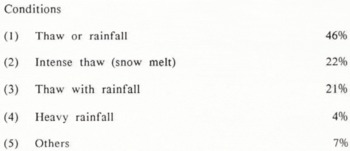
The questionnaire asked if the process of slush flow was initiated by intense thaw (snow melt), heavy rain, or by other causes. The responses are indicated in Table II.
The high percentage of all slush flows accounted for by intense thaw and/or rainfall could be explained in several ways. Intense melting or heavy rainfall could act as initiating factors if this was seen to imply that slush-flow occurrence could be/is controlled by seasonality of climate. Slush flows caused by intense melting tend to take place in early spring and those due to heavy rainfall take place during the rainy season. The combination of intense melting and heavy rainfall as major causal factors suggests a marine west-coast type of climate where warm-front intrusions and associated rainfall can be experienced at any time during the winter months. 7% of the total respondents indicated causes other than those mentioned above; they are as follows: (I) flow from springs after break-up, (2) snowfall on warm soil followed by rainfall, and (3) rain combined with other water sources such as a faulty irrigation system. Slush flows are initiated by metamorphosis of the snow-pack under the influence of rapid infusion of free water as the result of intense thawing (accelerated snow melt), heavy rainfall, or both. These conditions appear to be the common denominators that link together the vast majority of slush-flow releases.
Meteorological conditions related to slush-flow release
Slush-Flow Seasons
Until recently, reports in the international literature have associated slush-flow activity with the spring break-up period and accelerated snow melt. Reference HestnesHestnes (1985) and Reference Hestnes and SandersenHestnes and Sandersen (1987) have indicated that slush flows also occur during the winter months when they are associated with the heavy rainfall and above-freezing temperatures experienced during the intrusion of low-pressure systems and associated warm fronts.
Responses to the questionnaire concerning the seasonal occurrence of slush flows showed considerable variation in pattern. Two major seasons of slush-flow activity did emerge, the spring break-up period and the winter season. This was perceived to be the situation for both the Northern and the Southern Hemispheres, although the actual months in which the events occurred varied due to differences both in latitude and in elevation. The climatic environment of a site is also a controlling factor.
48% of all respondents indicated that slush flows normally occurred in the spring, being associated with intense snow melt. However, the period identified as spring ranged from March to July. Slush flows which take place in regions of continental climates in the lower mid-latitudes occur as early in the year as March or April. The spring break-up season for slush flows in high-latitude continental climates takes place much later in May, June, or July. Elevation is a significant factor in this timing difference.
16% of the response contributors reported that in the Northern Hemisphere slush flows took place during the winter months of December, January, February (or in the corresponding Southern Hemisphere months). In all cases, winter slush flows were associated with areas dominated by a marine west-coast climate.
Slush flows which occur during the summer months account for 18% of those recorded and reported in response to our questionnaire. These data are difficult to interpret because the summer months ranged from April to October; however, the majority of the respondents indicated events in July and August. In most cases, the geographic location of summer slush-flow occurrences suggests that they are happening in areas of higher elevation, normally on ice caps.
Slush-Flow Terrain Association
Slush flows were reported to occur in a variety of terrain settings, with no particular type of terrain category dominant. Responses to this section of the questionnaire are presented in Table III. Reference Clark and SeppäläClark and Seppälä (1988) indicated that slush flows also occur in non-alpine areas of the Arctic and sub-Arctic. However, regardless of terrain, slush flows are most likely to occur when appropriate water input to snow-pack and suitable starting-zone conditions are available.
Slush-flow terrain association

Starting-Zone Locations
The location of slush-flow starting zones is extremely important because of the unique set of requirements for the initiation of flowage. Reports of slush-flow occurrences indicate that prior to release the snow-pack in the starting zone either has a very high water content or is already in a saturated condition due to an excess of water in drainage channels or to the presence of constrictions, obstructions, or depressions where free water can accumulate and/or be retained.
39% of respondents indicated that slush-flow starting zones were most frequently located in stream channels (Table IV). In mountainous terrain, these stream channels are of low order with steep-sided slopes, but slush flows also occur in stream channels on broad open flood plains. 31% of replies suggested that slush flows frequently originate from shallow depressions, whilst another 25% indicated that the starting zones were located on open slopes. Starting zones where slush flows occur less frequently were also identified by the contributors (Table IV).
Starting-zone locations

Slush-Flow Tracks
Recipients of the questionnaire were asked to select the characteristic configuration of the slush-flow tracks. The choices offered were as follows: channelled (defined), open slope (undefined), or alternating channelled-undefined. The choices made are shown in Table V. Characteristics of the track are important when a general examination of slush flows is being undertaken. The planimetrie geometry of the track will be dictated by the configuration of the terrain, and also by the texture and structure of the snow-pack below the starting zone. When considering only those starting-zone locations where slush flows are normally observed, certain similarities become apparent between the characteristics of the starting zone and those of the slush-flow track (Tables IV and V). Slush flows frequently appear in stream channels, open slopes, and shallow depressions. Although shallow depressions rank second in frequency in Table IV, they may be found in both stream channels and on open slopes. The questions which the respondents were asked about starting zones and flow tracks are likely to be inter-related, in that basically they reflect the geomorphic setting within which slush flows occur.
Geomorphic Activity of Slush Flows
Reference RappRapp (1960) indicated that slush flows have the potential for acting as a significant geomorphic agent in Arctic areas. Reference NybergNyberg (1985) described in detail several erosional and depositional forms produced by slush-flow activity in northern Swedish Lappland, and evidence of slush-flow erosion and deposition is extremely widespread in the Central Brook Range in Alaska (Reference OnestiOnesti, 1985). Although literature relating to the consideration of the geomorphic function of slush flows is not very extensive, it is a phenomenon which has been documented.
Responses to the questions about the geomorphic activity of slush flows were fairly uniformly distributed. The respondents indicated that erosion, transportation, and deposition are all part of the geomorphic process associated with slush flows. 30% indicated that slush flows erode, 38% that they transport, and 35% that they deposit (Table VI). The percentage associated with erosion is somewhat lower than the percentage for the other processes but, since transportation and deposition are already taking place, it would naturally follow that erosion would also occur. The term entrainment may possibly be a more suitable one than erosion for use in this context, and in future this may become the appropriate term to use.
Slush Flows as Hazards
Slush flows have long been recognized as a serious natural hazard (Reference RappRapp, 1966; Reference JahnJahn, 1967; Reference Hestnes and SandersenHestnes and Sanderson, 1987). The impact of slush flows on human activities is probably less severe than that of snow avalanches, since most reported occurrences have been in relatively remote or isolated areas. However, the questionnaire has revealed that slush flows encroach upon the everyday life of the inhabitants in the same countries as do snow avalanches, and trends in recent decades indicate increasing encroachment of human activity into existing or potential slush-flow zones. Table VII summarizes the numbers of reports that indicated damage, and shows the types of damage which were described.
It is difficult to estimate the indirect economic consequences of slush flows such as loss of life, disruption of road, rail and utility links, construction costs for defending structures, industrial losses due to power output, delays to commercial traffic, and problems of debris removal from transportation routes. The construction of defending structures in slush-flow run-out zones was reported by 16 of the respondents, whilst 38 indicated that no safety devices whatsoever were being used. The types of control method reported are typical of those used in snow-avalanche areas; that is to say, methods such as hazard zoning and limitation of access, forecasting warning systems, controlled release of the flow, and the construction of defending structures.
Conclusion
Responses to our questionnaire revealed information with respect to slush-flow activity worldwide which was not previously available to the scientific community. In addition, the questionnaire also indentified respondents who have first-hand experience of slush-flow processes. Slush-flow occurrence has a much broader geographic distribution than has generally been perceived to be the case. The bulk of the literature on slush flows suggests that the vast majority of significant events take place in the Arctic. In contrast, the use of our questionnaire has demonstrated that slush flows occur in sub-Arctic and mid-latitude regions as well.
Slush-flow track characteristics

Geomorphic activity associated with slush flows

Damage reports

The geomorphic setting and meteorological conditions which are associated with slush-flow activity vary according to latitude, altitude, and climatic conditions, all of which are interdependent.
It appears that slush flows can occur both during the spring and during winter months due to the variety of factors or conditions which trigger the flow process. This variety in initiating factors in turn makes slush flows more difficult to predict than snow avalanches.
The purpose of our questionnaire was to summarize, in a qualitative manner, information from individuals and institutes who had first-hand experience with slush-flow activity. There is very little quantitative information available regarding the slush-flow process and hence, from this standpoint, more research and resources must be focused on this topic. Giving due consideration to present and likely future trends, it seems inevitable that human activity will encroach more and more into slush-flow-prone areas, for purpose of recreation, mining, utility and pipeline installation, general construction activity, military maneuvers, and settlement. The probability of death and property damage will correspondingly increase.
Acknowledgements
This research was sponsored and funded by the Norwegian Geotechnical Institute and the Department of Geology, Indiana University, Bloomington, U.S.A., for which help the authors are very grateful. Our appreciation is extended to the International Glaciological Society, the International Snow Science Workshop Committee, and the American Association of Avalanche Professionals for the provision of their mailing lists, and to all respondents for their participation in the survey.



