1. Introduction
Antimonopoly regulation, which is sometimes referred to as ‘antitrust’ regulation, initially emerged in the US, but grew elsewhere internationally after 1945. This process provoked a contention between the indigenous states traditions and an American approach; the spread occurred: ‘within a contested cross-cultural public discourse that recognized Americanization as an active element primarily in relation to indigenous factors already constituting capitalist systems’ (Freyer, Reference Freyer2006: 1). The development of antimonopoly regulation has caused a significant transformation in countries outside the US, which assumed before World War II that: ‘anticompetitive collaboration through cartels among business, government, and producer was necessary to preserve social order at home and competitive advantage abroad’ (Freyer, Reference Freyer2006: 3). This transformation led to the emergence of antimonopoly regulators as a state actor in the countries outside the US. At the same time, because the traditional sentiment in favour of state−business collaboration existed in those countries, the introduction of an approach in favour of competition and antimonopoly regulation was contested; this is a sector directly affected by the extent to which competition is prioritized.
This article explores antimonopoly regulation in Japan after the 1980s as a case study of state transformation in response to the challenges of governance in the sector and beyond, focusing on the state at a macro level and drawing on an elitist approach. It challenges the pluralist and rational choice schools in Japanese politics. In so doing, it unfolds the process and nature of state transformation in a specific political tradition. The case study will reveal the flexible change of power relations within the core executive, through which it retained dominance in policy-making. This set of adaptation processes is regarded as the reconstitution of the state. Drawing on the above, the article argues that the nature of state transformation in Japan's antimonopoly regulation after the 1980s is the sustained dominance of the core executive as a collective group over the sector − through its adaptation to the challenges of governance and the resulting reconstitution of the state. The following aims to verify this set of claims.
States have significantly been transformed in recent decades. This transformation, debated within political science literature since the 1970s (Pierre, Reference Pierre and Pierre2000: 1–10; Richards, Reference Richards2008), is also evident in Japan; the state has significantly changed since the late nineteenth century and the period of the Japanese post-war economic miracle in the 1960s (Vogel, Reference Vogel1996: 224). However, unlike countries such as the UK, where a perceived juncture appeared with, for example, the emergence of the Thatcher Government and its neo-liberal rhetoric that created debate about the nature of the transformation of the British state, the transformation of the Japanese state after the 1990s has been relatively more gradual and evolutionary. It has not been fully examined in the literature on Japanese politics, in which three major schools have contested the state and power: state centric, pluralist, and rational choice.
Johnson's (Reference Johnson1982) ‘developmental state’ thesis characterized the state centric approach in the 1980s. Its influence can be observed in successive literature; for instance, Vogel (Reference Vogel1996) adapts Johnson (Reference Johnson1982) to explore regulatory reforms in Japan and the UK, describing the former's approach as managerial oriented.
A challenge to the developmental state thesis was presented later by pluralist literature, highlighting actors other than just bureaucrats, such as party politicians (Muramatsu and Krauss, Reference Muramatsu, Krauss, Yamamura and Yasuba1987), private sector actors (Calder, Reference Calder1993), and trade associations (Schaede, Reference Schaede2000). Elsewhere, the rational choice literature, which explains Japan's politics as a result of actors’ rational choice, has presented another challenge; as an example, Ramseyer and Rosenbluth (Reference Ramsayer and McCall Rosenbluth1993) claim with the principal–agent theory that the ruling Liberal Democratic Party (LDP) has dominated policy-making by mobilizing civil servants (Wright, Reference Wright1999: 949).
The literature regarding Japanese politics began reporting significant changes after the 1990s (e.g. Pempel, Reference Pempel1998; Schaede, Reference Schaede2008; Vogel, Reference Vogel2006; Rosenbluth and Thies, Reference Rosenbluth and Thies2010), highlighting micro level issues; bureaucracy was losing its traditional developmentally oriented approaches and private sector actors took more responsibility and risks (Schaede, Reference Schaede2008; Vogel, Reference Vogel2006). However, this group of literature has not illuminated how the Japanese state at a macro level has evolved.
Elsewhere, the 2000s saw the emergence of a group of statist researchers, such as Wright (Reference Wright2002), George Mulgan (Reference George Mulgan2005, Reference George Mulgan2006), and Kawabata (Reference Kawabata2006), who highlighted state actors as key in policy-making. In referring to their approaches, this article employs a framework that locates power within the centre of the state, thus regarding the central state as the key locus of power resources and allowing it to be the dominant actor influencing and steering society (Smith, Reference Smith2009). Such an approach challenges the dominant views on Japan offered by pluralist and rational choice accounts; they reveal the detail of the transformation of the Japanese state but fail to address how the Japanese state at a macro level has been transformed. This article then critiques the established body of pluralist and rational choice literature by presenting an elitist account of Japan's state and power; the state has been reconstituted to respond to the recent challenges of an emergent era of governance, suggesting an adaptation process by the core executive in relation to both resources and strategic-leaning capabilities to reshape its existing capacities and develop new forms of intervention to sustain its position as the dominant actor in the policy-making arena (Richards, Reference Richards2008: 96–98).
The research method used is a case study of Japan's antimonopoly regulation after the 1980s drawn from elite interviewing.Footnote 1 The following sections will reveal the changing power relations between core executive actors: Seimu sanyaku,Footnote 2 party politicians outside the Cabinet, and officials of the Fair Trade Commission, Japan (JFTC), and relevant government ministries, such as the Ministry of International Trade and Industry (MITI) reorganized as the Ministry of Economy, Trade, and Industry (METI) in 2001.
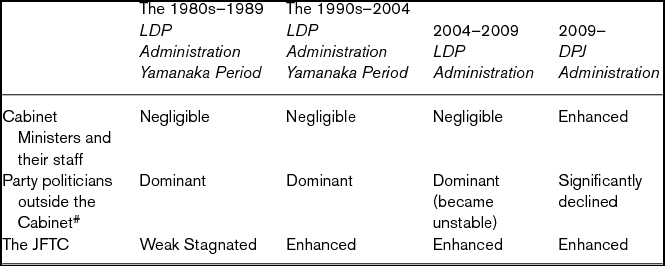
The 1980s and 1990s saw the dominant power of party politicians outside the Cabinet including the LDP AMA (Antimonopoly Act: Dokusen kinshi hō) Examination Committee members with titular chief cabinet secretaries. This was gradually transformed with the change of key figures and government. The emergence of the DPJ (Democratic Party of Japan) government in particular drastically changed the situation by taking previously powerful non-Cabinet LDP politicians out of power. The JFTC steadily enhanced its power after 1989, when the Structural Impediments Initiative (SII)Footnote 3 offered a significant disjuncture. This set of changing power relations is summarized in Table 1.
Relative strength among actors in antimonopoly regulation

Note: #Including the LDP AMA Examination Committee.
Source: Created by the author.
Based on the above, the next section sets out the analytical framework followed by a review section regarding the background of the case study; the subsequent section explores power and relationships within the core executive after the 1980s, revealing how power relations have changed. Last, the conclusion presents the summary of the case study analysis and its implications.
2. The analytical framework
This article employs the concept of the core executive from British political scienceFootnote 4 as the key analytical framework, referring to the principle of concept travelling (Sartori, Reference Sartori1970: 1033–1053).
The key characteristic of this concept is its ontological view on power: ‘power has to be seen as fluid and relational, not static. In that sense, power does not lie anywhere within the system because it is everywhere − all actors have resources, and the outcomes need to be negotiated’ (Smith, Reference Smith1999: 14). Commentators such as Smith (Reference Smith1999) further set out an approach that the specific resources allow the core executive as a single unit to establish the dominant position over other actors in policy-making, alongside the fluid and changeable nature of power within the core executive based on the interdependent relationships between the members of the core executive. Actors in Smith (Reference Smith1999) are dependent on each other rather than compete. They aim at achieving their respective goals through the process of acquiring necessary resources from others. This process depends on the contest and the choice of strategy and tactics of the actors within the limitation of the external politico-economic context (Smith, Reference Smith1999: 246). Focusing on functions rather than positions and personality, the concept of the core executive has offered an alternative to the previous approach and an ontological shift in the study of executive politics; in British political science, it has replaced prime ministerial versus cabinet government studies and the focus of academic attention has shifted to a broader consideration of the central government space, incorporating the study of ministers, civil servants, agencies, and the like (Elgie, Reference Elgie2011: 74). It has also demonstrated a significant transferability (Elgie, Reference Elgie2011: 72); examples applying the concept to the Japanese cases include Itō (Reference Itō2006) and Kamikubo (Reference Kamikubo2010). Referring to this set of literature, this article regards the following as the core executive in Japan's antimonopoly regulation: prime ministers, Seimu sanyaku, civil servants (JFTC, other relevant government ministries including the MITI/METI), and key party politicians outside the Cabinet. It should be noted that the concept of the core executive is not a synonym for the state, although the specific nature of antimonopoly regulation makes the scope of the core executive in this article similar to that of the state; policy formulation and implementation involve a single regulating organization together with relevant party politicians, and no non-core state actor exists. The core executive is the heart of the machine, where, typically, key decisions are formed. It is a key analytical concept to explore the state; by exploring the actors and structure within the core executive and the networks involving the core executive actors and their societal counterparts, research can explore how the state has been transformed.
Turning to case study selection, this article explores Japan's antimonopoly regulation after the 1980s, where significant development can be observed after conclusion of the SII (Freyer, Reference Freyer2006: 243; Schaede, Reference Schaede2000: 42–44). Regulation is the field in which governance has significantly changed; the government's increasing reliance on principal–agent regulation, in addition to its traditional methods of authority, bureaucracy, and force, is characteristic of developed countries after the 1980s (Smith, Reference Smith2009: 1). This article focuses on regulation because of its significance to contemporary state transformation. As the 1990s saw significant changes within Japanese politics (Vogel, Reference Vogel2006; Schaede, Reference Schaede2008), the timing of transformation within antimonopoly regulation suggests that it can be an example of Japan's state transformation. As antimonopoly regulation oversees all the economic sectors of a country, it needs to respond to the changes that emerge in multiple economic sectors. In addition, Japan's antimonopoly regulation is unusual as it is administered by a rare independent regulator meant to fend off the influence from politics. This offers a contrast to other regulated fields, where regulation has been implemented by government ministries, such as the ICT. Exploring power relations between key actors within this unusual example has the potential to offer useful implications on how political factors have shaped the state and regulation to cope with the challenge of governance in the sector and beyond since the 1980s.
Elsewhere, the political analysis of Japan's antimonopoly regulation has been relatively rare; Schaede (Reference Schaede2000) and Freyer (Reference Freyer2006) address this issue, and both highlight the regulator (JFTC), its officials, and businesses as key research targets. Beeman (Reference Beeman2002) unravels the pattern of Japan's antimonopoly policy-making, although he analyses the policy-making mechanism rather than the state at a macro level in which changing power relations between actors reconstitute the state itself. Like Schaede (Reference Schaede2000), he covers the period up to the 1990s and fails to address the period afterwards. Legal and business studies literature also address this issue, but the nature of the research prevents it from focusing on power as the centrepiece. This article fills this lacuna by exploring state transformation in Japan's antimonopoly regulation with a specific focus on the state at the macro level. The next section further reviews the development of the sector after the 1980s.
3. The background of the case study: the development of antimonopoly regulation
The transformation of Japan's antimonopoly regulation has had a gradual impact on its core executive. With its independence, the JFTC has not only fended off party politicians’ interventions but also embraced protection from its adversaries, such as other government ministries. The influence of party politicians has concentrated on the policy-making process, typically in the form of endorsing infrequent law amendment bills. More active policy-making after the SII has increased opportunities to be involved in political processes, such as law amendments. The 2009 government change from the LDP to the DPJ accelerated this tendency, when the DPJ government assigned the new Seimu sanyaku specifically responsible for the JFTC.
A key actor to emerge in 1975 in Japan's antimonopoly regulation was the LDP AMA Examination Committee (Hayashi, Reference Hayashi2008: 314). Located within the LDP's PARC (Policy Affairs Research Council), the function and impact of the LDP AMA Examination Committee can be compared to the PARC's other divisions [Bukai]. The interests and arguments represented by LDP politicians became the LDP's view through the process of debating policy issues in the AMA Examination Committee (Inoguchi and Iwai, Reference Inoguchi and Iwai1987: 99). The LDP AMA Examination Committee exercised its power through typically examining AMA amendment bills, which was vital for the bills to be put before the Diet under the LDP/LDP-led coalition government.
The LDP AMA Examination Committee was also the arena where Sadanori Yamanaka (1921–2004) emerged as a key figure in antimonopoly regulation. The relationship between the JFTC and the ruling parties in the 1980s and 1990s can be described as a support network.
Yamanaka's dominance was not continuous. His appointment as the MITI Minister in 1982 led to his resignation as the Chairman of the LDP AMA Examination Committee and so sidelined his role in antimonopoly regulation. After his brief comeback to the Committee in the late 1980s, Yamanaka's failure in the general election in January 1990 kept him out of politics until 1993. Yamanaka's return to politics following the 1993 general election revived his influence in antimonopoly regulation. He retained this influence until 2004 when he died in the middle of his tenure as the Chairman, as well as a Member of the Diet (Shiozaki, Reference Shiozaki2013a, Reference Shiozaki2013b).
Significant turning points occurring in antimonopoly regulation after the 1980s can be seen as a result of the SII. Commentators agree that the impact of the SII created a significant disjuncture in Japan's antimonopoly regulation (Freyer, Reference Freyer2006: 203, 216; Uesugi, Reference Uesugi2007: 146; Tsuruta, Reference Tsuruta1997: 149–150). Freyer (Reference Freyer2006: 203–212) reports on the change in Japan's traditional approach as a result of the SII and on the collapse of the ‘bubble economy’.Footnote 5 He highlights the necessity for the LDP to form a coalition with smaller political parties, such as the Social Democratic Party of Japan (SDPJ) and New Party Sakigake between 1994 and 1998, as a major reason why the LDP embraced deregulation and stronger antimonopoly regulation measures − a different approach to that of the LDP in the early 1980s (Freyer, Reference Freyer2006: 203). This set of challenges prompted the change of governance in antimonopoly regulation through its enhancement.
Strengthening the JFTC's enforcement structure became symbolically and practically important during the implementation of the SII after 1989 (Freyer, Reference Freyer2006: 216). Three significant actors supported this theme: the US government (Department of Justice Antitrust Division), the Keidanren, and the ruling coalition of the day, including the LDP (Freyer, Reference Freyer2006: 216). The JFTC's expansion was evidenced in the form of its upgrading. Promoting the ranks of the JFTC senior staff (e.g. the Secretary-General from the Bureau Chief level to the Vice-Minister level) substantially enhanced the JFTC's negotiating power in bureaucracy, as well as its enforcement capacity (Freyer, Reference Freyer2006: 218; Tsuruta, Reference Tsuruta1997: 182).
Another significant issue emerged in relation to relaxing holding companies prohibition. Japan was unusual in supporting an outright ban on holding companies by Article 9 of the AMA as a measure to prevent the revival of Zaibatsu Footnote 6 despite permission by other major industrial countries (Freyer, Reference Freyer2006: 217; Tsuruta, Reference Tsuruta1997: 180). However, this issue was domestically contentious. The Keidanren and the MITI supported the relaxation, while a group of party politicians including the SDPJ opposed it (Freyer, Reference Freyer2006: 223–224; Uesugi, Reference Uesugi2007: 200). The fact that this regulation prohibited all the holding companies with no actual anticompetitive behaviour implies that its nature was ex ante. Therefore, relaxing holding companies prohibition can be interpreted as a retreat from ex ante regulation. Its impact on the JFTC's power may be contentious; some can regard that relaxing holding companies prohibition reduced the JFTC's power by abolishing a regulatory tool of the commission.
The adoption of these two measures by the Diet (JFTC upgrade in 1996, holding companies regulation relaxation in 1997) is evidence of how much Japan's antimonopoly regulation has been transformed. They shifted from ex ante oriented to ex post oriented, focusing on the JFTC's AMA enforcement. The 2000s sustained this trend, as Prime Minister Jun'ichiro Koizumi (2001–2006) urged in his policy speech in May 2001: ‘to strengthen the organization of the JFTC and establish competition policies suitable for the twenty-first century’.
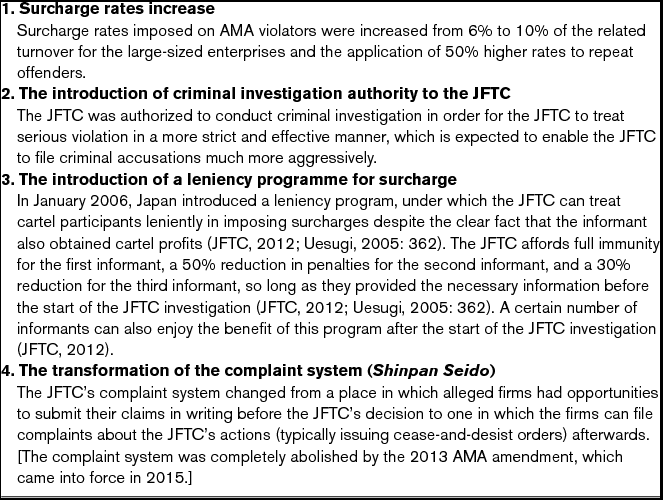
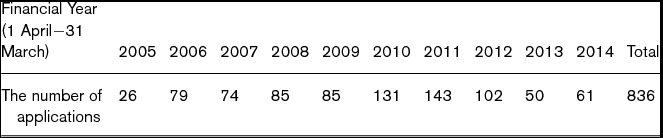
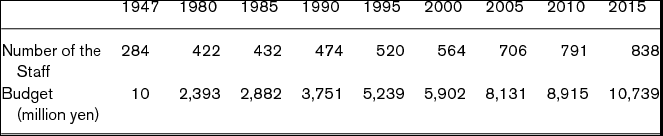
The impact of the Koizumi Government was evident in the 2000s. A significant event in antimonopoly regulation was the introduction of a leniency program for surcharges in 2006 by the 2005 AMA amendment, together with the rise of surcharge rates (see Table 2). Japan's leniency program is linked to the surcharge system, because: ‘Japan's criminal law does not usually countenance the use of leniency in this fashion’ (OECD, 2004: 73). The introduction of a leniency system was expected to enhance the capacity of the JFTC through giving incentives to those involved in cartels to report to the JFTC. The actual number of applications in Table 3 suggests that this expectation was right. The JFTC's staff number and budget grew discernibly during this period, as Table 4 reveals. For example, the JFTC's budget grew by more than 1 million yen from 6,035,756,000 yen in 2001 to 7,686,000,000 yen in 2002.
The major points of the amendment to the AMA in 2005

Sources: Based on Takeshima (2007), JFTC (2012), Uesugi (Reference Uesugi2005).

The staff and the budget of the JFCT

Source: Based on the data offered by the JFTC during an interview session in 2011 (JFTC, 2015b).
Until the 2009 government change, the key actor in shaping major decisions had been the ruling party; the LDP's AMA Examination Committee had a significant role. It offered an arena where a group of party politicians involved in antimonopoly regulation, such as Yamanaka, shaped key decisions. In the 1990s, the existence of a coalition government between the LDP and its partners, such as the SDPJ, enabled the coalition partners and their politicians to significantly influence policy-making processes, typically through negotiation with the LDP PARC (Oikawa, Reference Oikawa1999: 256–305). In the case of the relaxing of holding companies regulation in 1997, the negotiation between the LDP PARC and its SDPJ counterpart was key in shaping both a consensus and the subsequent relaxation (Oikawa, Reference Oikawa1999: 256–305). Under the LDP/LDP-led coalition government, policy issues in antimonopoly regulation, such as AMA amendments, were shaped in this set of frameworks characterized by the significant influence of the ruling parties’ internal processes. Government change in 2009 dismantled this set of frameworks by replacing the LDP and its coalition partner with the DPJ and its partners.
Under such a decision-making framework, between the 1980s and 2000s the AMA and the JFTC significantly enhanced their authority (e.g. introducing a leniency system) and organizational scale (e.g. budget and staff increase), although the process of enhancement has not been coherent. The impact of the SII on Japan's antimonopoly regulation since the 1990s has been regarded as significant by both US and Japanese antitrust authorities; in their assessment: ‘the (J)FTC's enforcement record (since the 1990s) may be seen as relatively effective, though the paucity of private actions was a major problem in Japan’ (Freyer, Reference Freyer2006: 243).
The development of Japan's antimonopoly regulation reveals a piecemeal institutional growth of the sector and the JFTC's gradual organizational expansion. The JFTC's approach as an independent regulator is formally meant to be at arm's length from political decision-making by law. At the same time, the constitution of Japan requires government organizations, including the JFTC, to be under the control of the Cabinet.Footnote 7 AMA amendments are put before the scrutiny of the Diet, as are other law amendments.
Power relations within antimonopoly regulation have gradually changed. Before the SII, the MITI and the Keidanren opposed stronger antimonopoly regulation. As the MITI and the Keidanren changed their view and the JFTC became highlighted, transformation emerged and resulted in enhancing antimonopoly regulation during the early 1990s. Referring to the related actors’ view, party politicians retained their power and shaped key decisions.
The actors and frameworks highlighted above did not change until the 2009 government change. As such, the nature of state power in antimonopoly regulation still remained. However, the growth of the JFTC as an antimonopoly regulator led to the gradual enhancement of state power within the traditional framework. This transformation was significantly inspired by the SII (Freyer, Reference Freyer2006: 203, 216; Uesugi, Reference Uesugi2007: 146; Tsuruta, Reference Tsuruta1997: 149–150). The disjuncture resulting from the SII launched the transformative process that continues today.
Taking account of the SII's significance, the next section explores the transformation of power relations in antimonopoly regulation by analysing how power within the core executive changed through the adaptation to challenges after the SII.
4. Independence and political control: the relationship within the core executive
4.1. LDP/LDP-led coalition government until 2004: the LDP AMA Examination Committee and its Chairman
Japan's antimonopoly regulation can be characterized by its relationship with politics. The JFTC is formally independent of politics, as the AMA (Article 28) stipulates that: ‘the chairman and commissioners of the Fair Trade Commission shall perform their authority independently’. Often called ‘the independence of authority’, this provision ensures the independent investigation of each antimonopoly case from interventions, including those from party politicians. ‘In principle there is an understanding that the JFTC is an independent administrative organization unintervenable even by elected politicians.’Footnote 8 In return, what the interviews reveal is an indifference to antimonopoly regulation and the JFTC among party politicians. At the same time, the JFTC is under the supervision of the Cabinet as an executive organization pursuant to the Constitution of Japan (Article 65). In practice, the JFTC has informally been shaped by political pressures.
Under the LDP/LDP led coalition government, party politicians only were involved in law amendments, and the chief cabinet secretaries who had previously been responsible, had no regular briefing on the JFTC because of its independence from authority.Footnote 9 Therefore, the JFTC contacted party politicians only when it amended laws. In the Shōwa period (1926–1989) when comparatively few substantial AMA amendments emerged (see Section 2): ‘the JFTC wasn't close to the ruling parties’.Footnote 10
The relationship between the JFTC and ruling parties in the 1980s and 1990s can be described as a network surrounding Sadanori Yamanaka. Almost all the interviewees, both within and outside the core executive, referred to him as crucial to the relationship between the JFTC and party politicians. Antimonopoly regulatory measures in the 1980s and 1990s were formulated in the circle surrounding Yamanaka.Footnote 11 Key policy issues such as surcharge rises through law amendments were debated in the Examination Committee after the JFTC had ensured that Yamanaka fully understood them through frequent briefings.Footnote 12
The nature of Yamanaka's role is described as a mentor rather than a key man.Footnote 13 The description ‘mentor’ suggests that Yamanaka did not closely cooperate with the JFTC but supported it at arm's length. ‘When the AMA Examination Committee Chairman endorsed in preliminary briefings that everything would work, the JFTC didn't feel the need for a key man equivalent to other government organizations.’Footnote 14
These accounts highlight the nature of the relationship between the JFTC and party politicians. Focusing on AMA enforcement, the JFTC has not had a strong relationship with party politicians. It has mainly contacted party politicians in the process of AMA amendments. Such circumstances have created a weak relationship with politicians, compensated by the relationship with Yamanaka. This observation is backed by a comment by a retired JFTC senior civil servant: ‘without Mr Yamanaka, the JFTC may have needed a key man, as disturbing interventions from politicians would probably try to stop things sooner or later’.Footnote 15 His dominant power was also witnessed by an outside observer: ‘the LDP AMA Examination Committee was very mysterious; it's only an organization under the PARC, but under Mr Yamanaka's dictatorial influence . . . Chairman Yamanaka dictatorially decided AMA (related affairs) during his tenure.’Footnote 16
If Yamanaka played such a significant role, the nature of his role should be a topic of further exploration. The civil servants of the time (the period until 2004) expressed a discernibly positive view of Yamanaka. One witnessed that Yamanaka rejected aspects that contrasted with his firmly held views of how the AMA should be, even if they came from the Prime Minister.Footnote 17 According to another, Yamanaka revealed that he addressed tax systems and antimonopoly issues as specific examples based on his idea of the Japanese economy and people's lives; his approach as no mere JFTC supporter offered a sense of trust among officials beyond the JFTC's.Footnote 18 These accounts suggest Yamanaka was not mobilized by interest groups but by his own judgment.
Elsewhere, Yamanaka's role was decision-making based on JFTC proposals rather than active management; the term ‘mentor’ can describe this characteristic. He ‘didn't actively give concrete instructions. Rather, we said “we want this”, “we want that”; he said “you can't do that”, or sometimes “that's good. Interesting, do it”. It depends on the cases.’Footnote 19 Yamanaka's approach like a court judge was also witnessed by a business organization official: ‘at that time it was called the Yamanaka−Hayashi regime; Chairman Yamanaka and the Head of the Secretariat Hayashi . . . but in reality Mr Yamanaka's decision was materialized by Mr Hayashi. Debates were impossible when Mr Yamanaka said “this”.’Footnote 20
The above accounts reveal the impact of Yamanaka's influence. The LDP's internal rulesFootnote 21 suggest that his power could draw in part from his seniority in the LDP and his experience and expertise in antimonopoly regulation. However, what made him exercise his power was probably his internal position in the LDP as the Chairman of the AMA Examination Committee and the LDP's status as the ruling party. In pulling the above together, Yamanaka's power can be understood as that drawn from his personal assets (experience, expertise, character, and relationships with other politicians) as well as structural elements (his position as the LDP AMA Examination Committee Chairman, the LDP's position as the ruling party). It was a product of conflation between agency and structure.
4.2. LDP/LDP-led coalition government until 2009: the Chief Cabinet Secretaries’ hollow influence
In contrast to Yamanaka's power and influence, party politicians formally responsible for the JFTC did not exercise significant influence over the JFTC and antimonopoly regulation under the LDP administration. The Prime Minister (PM) is formally responsible for the JFTC according to the provision of the AMA.Footnote 22 The actual responsibilities of the PM were assigned to the Chief Cabinet Secretary (Cabinet Minister) pursuant to the provision of the Act for Establishment of the Cabinet Office.Footnote 23 The impact of the Chief Cabinet Secretaries, who were formally responsible for antimonopoly regulation under the LDP/LDP-led coalition government, on policy issues was limited according to interview accounts. Because the JFTC has independence of authority pursuant to the provision of the AMA, what the Chief Cabinet Secretaries actually did was ceremonial; their portfolio included explanation of government bills, gratitude for bill adoption in the Diet committees, and remarks of respect to attached resolutions (if any).Footnote 24 This account is mirrored by another JFTC official.Footnote 25 The nature of the relationship between the JFTC and the responsible Cabinet Minister (the Chief Cabinet Secretary) was described as ceremonial, offering a possible interpretation that the political control by the Chief Cabinet Secretary was negligible under the LDP/LDP-led coalition government.
What emerges is the degree of control by a party politician outside the Cabinet (AMA Examination Committee members, such as Yamanaka) and the weak control by the formally responsible Cabinet Minister (Chief Cabinet Secretary); the power was not vested in the formally responsible Cabinet Ministers but in a key LDP politician whose authority depended upon the LDP as well as his personal assets.
4.3. The JFTC under the LDP Administration
Under Yamanaka's strong influence, the independence of authority bestowed on the AMA gave the JFTC significant freedom from intervention by party politicians. It even gave JFTC officials significant freedom from formal control by the responsible Cabinet Minister (Chief Cabinet Secretary), who did not supervise antimonopoly regulation implementation.
The JFCT's case offers a striking contrast to other government ministries’, where responsible Cabinet Ministers have the authority to supervise policy implementation, and implicates a lack of democratic control and poor political coordination when the JFTC drafts law amendment bills. Because many policy-making issues emerge in the form of law amendments, enhancing antimonopoly regulation prompted more frequent law amendments. This offered challenges of democratic accountability and political coordination. In law amendment processes, the Diet and party politicians exercise their power. The JFTC's role in law amendment processes offers a clue to explaining this relationship. A lawyer specialized in the AMA offered the following observation from his experience in the LDP AMA Examination Committee and other relevant places:
I guess ideas for AMA amendments originate from various places. It is, for instance, from foreign developed countries with antimonopoly regulation that offered their opinions in places like the SII . . . Another comes from private firms and other government ministries. The third is what the JFTC think inconvenient. Or, the final output is made by the JFTC. When making outputs the JFTC often insert their own view.Footnote 26
He argued that the JFTC has not frequently offered future visions but has skillfully managed the process:
When we think about where the ideas of AMA amendments originated, I don't think the JFTC has created so much but it has adopted various outside opinions. I also think that the JFTC is good at adapting the law amendments so that they can conveniently be implemented.Footnote 27
His view reveals that the JFTC's approach to law amendments has drawn on process management and coordination. Another interviewee went further and labelled the JFTC ‘powerless’ and not the major reform promoter.Footnote 28
These accounts from antimonopoly regulation specialists in society reveal that the nature of the JFTC's role has been a coordinator. It has not been strategic but has informally inserted its will into issues. Such an approach is different from examples of Japanese government ministries offered by Johnson (Reference Johnson1982) (MITI) and Vogel (Reference Vogel1996) (MPT: Ministry of Posts and Telecommunications). The JFTC's approach can be called bureaucratic management rather than strategic. The JFTC has drawn power from its institutional authority as an antimonopoly regulator; in political activities such as setting new regulatory frameworks through legislation it was subject to the ruling parties. The JFTC maneuvered the legislation process and monopolized the implementation. In summary, the nature of the JFTC's power was policy implementation with a limited range of policy steering on the LDP's decisions.
A disjuncture resulting from the SII did not change the power relations and roles between party politicians and the JFTC. Although enhancing the JFTC and the AMA became a priority, the concrete measures to materialize such a goal were deliberated and implemented under the supervision of the LDP AMA Examination Committee. Those civil servants interviewed did not witness a significant disjuncture in the LDP–JFTC relationship under the LDP/LDP-led coalition government between the 1980s and 2000s. Rather, a senior civil servant revealed that the 2009 amendment under the LDP required the same process as before:
I was just involved in the last part of the AMA amendment in 2009; we abolished the bill in 2008 and redrew it in 2009, and at that time (the bill was examined by) probably the joint LDP committee of the AMA Exam Committee and the Economy and Industry Division; the AMA Exam Committee was held, and I had a little odd feeling . . . the policy authorization process such as consulting the LDP's PARC, and then the General Council was the same.Footnote 29
This implies that the LDP/LDP led coalition government retained their internal process with no explicit change in power relations until the 2000s. Such an observation was verified by another JFTC senior civil servant, emphasizing the role of the LDP AMA Examination Committee as ‘the most influential over law amendments’.Footnote 30 These accounts by senior civil servants indicate that the institutional framework under the LDP administration underwent few changes in terms of the process and power relations among actors until its departure in 2009.
4.4. The changes prompted by Yamanaka's death in 2004 and the 2009 government change
Elsewhere, some interviewees highlighted the overt change of circumstances that emerged in the 2000s. In their view, such changes were prompted first by Yamanaka's departure in 2004 and second the government change in 2009. Yamanaka's departure was described as the most significant key disjuncture by a business organization senior official as after his death ‘smooth working became unworkable’.Footnote 31
A retired senior civil servant offered a different view. He argued that the LDP's approach did not change with Yamanaka's departure, suggesting that the influence from government change in 2009 may have created more of an impact on the JFTC: ‘under the LDP Administration a good relationship has been established (between the JFTC and the LDP) and the ruling parties have treated the JFTC properly. But, I am concerned how the DPJ actually treats the JFTC’.Footnote 32 The impact of government change in 2009 was described in a rather different way by a current JFTC civil servant, regarding it as a common experience among government organizations resulting from governance challenges including the complexity or ambiguity of the power balance between political parties.Footnote 33
What then was the impact of government change? ‘After the DPJ government began . . . the relationship with the Seimu sanyaku intensified under the umbrella of the Policy Coordination Meeting. And, we have policy issues and implementation issues, and policy issues have frequently been reported, I heard’.Footnote 34 The increased involvement of DPJ politicians on policy issues was also witnessed by others:
The current AMA amendment bill was drafted under the leadership of the Parliamentary Secretary. It was written in the excited period just after government change . . . 2009 saw government change, so from that autumn; on 9 December, 2009, the direction was issued in the form of the Seimu sanyaku paper, and between these points the direction was contemplated under the leadership of the Parliamentary Secretary. This was distinctively led by the Parliamentary Secretary.Footnote 35
This changing relationship between party politicians and civil servants was also witnessed by a DPJ politician who was in the Seimu sanyaku in charge of the JFTC:
The DPJ government decided to create a responsible Seimu sanyaku and appointed those responsible for the JFTC. With the JFTC's independent authority, essentially the job was the law of the Diet: the Seimu sanyaku is involved in what should be done about the law, but each member of the Seimu sanyaku had their respective idea on to what extent he should be involved in the daily business, and my approach was a restrained one.Footnote 36
This set of accounts implies that the DPJ's Seimu sanyaku played a significant role in policy-making, different from the previous LDP/LDP led coalition government where the formally responsible Chief Cabinet Secretaries (Cabinet Ministers) played only a ceremonial role. The DPJ's approach was explained by Yukio Edano, the first DPJ Cabinet Minister assigned to the JFTC:
after the recent government change the Seimu sanyaku of the Cabinet Office to which the JFTC is administratively attached . . . has been assigned to the JFTC . . . I'll do my best to realize fair markets by strengthening the JFTC's function and organization. In particular, I'll make efforts to have Japanese industries develop under fair market competition with a significant change of the global environment and markets. (The House of Representatives, 2010a)
He also referred to the limitation of his remit: ‘because the JFTC is an independent administrative commission as the law enforcement organization, I can't directly command and control it’ (The House of Representatives, 2010b).
Also, the DPJ politician's account indicates that their approaches were not unified; some argued for a more proactive approach to antimonopoly regulation, while others preferred a more reserved one. The politician further elaborated:
There is a debate about whether Senior Vice-Ministers and Parliamentary Secretaries are necessary. A JFTC Chairman endorsed by the administration will solve the problem. And the Chairman sufficiently communicates with the administration. But the Chairman is from bureaucracy, from the MOF . . . basically Mr Takeshima wasn't appointed because of the DPJ's wish. So as an interim approach, it is acceptable that the Seimu sanyaku get involved so that the JFTC can work in line with the DPJ's view.Footnote 37
His account reveals that the DPJ's approach was a set of trials based on each politician's method rather than a coordinated approach. Also, he highlighted the problem of accountability; because the current JFTC Chairman was selected by the LDP, the DPJ government was distrustful of the Chairman as their agent. At the same time, the DPJ was unable to sack the Chairman because the AMA protects the Chairman's tenure to safeguard the JFTC's independence. This suggests that the independence of authority created a new governance problem, which the LDP never had during its long tenure.
A business organization official claimed that the DPJ failed to realize significant reforms in antimonopoly regulation.Footnote 38 This critical view was shared by another interviewee, who witnessed that the DPJ Government stopped policy-making activities through freezing consultation committees with no alternatives in antimonopoly regulation.Footnote 39 A consumer group leader offered a similar account that the DPJ Seimu Sanyaku decided matters, policy committees in government ministries generally stopped and became their own, and civil servants could not move and work but wait.Footnote 40 This set of accounts from outside observers indicates that the DPJ dismantled the LDP's governing system and failed to establish their own. The result suggests an unstable situation where no established rules controlled the governing machine.
5. Conclusion
In drawing the above case study section together, what emerges is the sustained dominance of the core executive in which power fluidly changed.
Party politicians have been dominant, retaining their decision-making role. Under the LDP Administration, this role was played by key party politicians, including Yamanaka who demonstrated the dominant power in policy-making processes. This framework was retained after Yamanaka's departure in 2004. Government change in 2009 dismantled the LDP's traditional governing machine. What emerged instead was intervention from the newly assigned Seimu sanyaku by the DPJ, as witnessed by officials and those outside the government. The change of the dominant actor occurred within the group of party politicians. The continuous characteristic of this set of frameworks is the dominant nature of party politicians as the key decision-makers.
Party politicians have had access not only to the JFTC but also to other key actors, such as the MITI and the Keidanren; these actors usually oppose the JFTC by lobbying party politicians. Key party politicians, such as Yamanaka, have made decisions referring to the views of those involved, such as the JFTC, the MITI, and the Keidanren. This system is similar to the British core executive analysed by Smith (Reference Smith1999: 251). The party politician's role as the key decision-maker places them at the centre of the policy community on antimonopoly regulation; they have decided which direction and views the government will employ. The DPJ Seimu sanyaku played a similar role to the LDP politicians because it made key policy decisions on policy-making, such as formulating bills. The major decisions shaping the regulatory framework have been decided by key party politicians.
The JFTC's power stemmed from its institutional authority as an independent antimonopoly regulator. Its nature has been policy implementation and a limited range of policy steering within the LDP/DPJ's decisions. The JFTC's power and role in policy-making is subject to the dominance of party politicians; it had no capacity to counter the party politicians’ decisions. Instead, the JFTC manoeuvred legislative processes and monopolized implementation. The JFTC's skilful management, by which it controlled antimonopoly regulation, and independent implementation has shaped antimonopoly regulation under the supervision and dominance of party politicians. In contrast to the change within the group of party politicians, no significant change can be observed in the relative strength of the JFTC vis-à-vis party politicians.
Other government ministries, including the MITI/METI, have had an impact on a couple of significant events, such as relaxing holding companies prohibition in 1997, in which the MITI together with the Keidanren tried to promote the relaxing; some may regard the MITI's role as the Keidanren’s agent. These ministries also have been significant core executive actors in the policy-making process of antimonopoly regulation.
Playing a significant role in the transformation after the 1980s, the power relation changes between actors and structures reconstituted the Japanese state. As the transforming core executive mobilized the changes, the reconstitution can be understood as an event prompted by the core executive. In the 1980s and 1990s, party politicians outside the economic sectors administered by the Cabinet (Muramatsu and Krauss, Reference Muramatsu, Krauss, Yamamura and Yasuba1987) dominated the core executive. Antimonopoly regulation was an example of this. After 2009, non-Cabinet LDP politicians lost their traditional power and the DPJ Seimu sanyaku emerged as a significant actor. The situation was unstable rather than under equilibrium; this is considered by interviewees as a challenge emerging under the DPJ government: stopping significant aspects of policy-making, or creating an awkward relationship between the DPJ and the JFTC Chairman. There is the potential that further change will take place in the future, although no significant example has been observed yet, even since the 2012 government change from the DPJ to the LDP (e.g. Yomiuri online 2014). Indeed, the Abe Administration retained the post of Cabinet Minister responsible for the JFTC, which was created by the DPJ government. The observable impact of this post is not significant with no explicit assignment regarding the JFTC on the official government website as of September 2016 (Kantei, 2016). The previously influential LDP AMA Examination Committee was renamed the Competition Policy Examination Committee in 2013 with the appointment of new Chairman Yoshiaki Harada. A significant event emerging in antimonopoly regulation under the Abe Administration is probably the 2013 AMA amendment; effectuated in 2014, it replaced the JFTC's quasi-judicial complaint system with the court. This reform was first proposed under the LDP led Coalition Administration before 2009 (Yasuoka, Reference Yasuoka2008) and the resulting bill was first formulated in 2010 under the DPJ Administration. The 2010 bill was abandoned for technical reasons in the Diet in 2012 and was transformed to the 2013 AMA amendment bills with practically the same content (JFTC, 2014: 19). This sequence indicates that it was not started by the Abe Administration but by a broader consensus among both the LDP and the DPJ. After the effectuation of the 2013 amendment, few political events with significant impacts on the sector seem to have emerged; for example, the fact that Chairman Harada posted one brief article regarding antimonopoly regulation on his Facebook page from 2015 to September 2016 indicates that the sector was involved in few political issues.
The reconstitution of the Japanese state can be understood as the core executive's response to the challenges of governance after the 1980s. The SII (1989–1990) prompted a significant change within antimonopoly regulation by enhancing the JFCT, together with the burst of the bubble economy and the emergence of the LDP's coalition partners (see Section 2). Government change in 2009 transformed the power relations within the core executive by taking the previously powerful LDP politicians outside the Cabinet (e.g. LDP AMA Examination Committee members) out of power and appointing the Seimu sanyaku specifically responsible for the JFTC. In addition to these external changes of governance, internal changes such as the departure of influential figures (e.g. Yamanaka) also had a significant impact over antimonopoly regulation. These events have caused dynamic state reconstitution processes led by the core executive.
Elsewhere, the transformation has retained the asymmetric dominance of the core executive; it is asymmetric for societal actors could not join the decision-making process on the same terms as the core executive actors (Smith, Reference Smith1999). Focusing on the state at a macro level, the evidence from this article reveals that the core executive retained asymmetric dominance by changing power relations within its community. The core executive has employed state reconstitution as its strategic tool to retain asymmetric dominance within the sector.
Pulling the above considerations together regarding the case study result, this article argues that the core executive, in which party politicians and officials are interdependent of each other through exchanging their resources, has dominated the sector; it successfully retained its asymmetric dominance in Japan's antimonopoly regulation after the 1980s by reconstituting the state in response to the challenges of governance in the sector, highlighting the core executive's asymmetric dominance in state reconstitution as the core characteristic of the Japanese state of the period. In so doing, it highlights a state dominated by the elites as the key locus of power, in contrast to pluralists who regard the state at a macro level as insignificant (e.g. Muramatsu and Krauss, Reference Muramatsu, Krauss, Yamamura and Yasuba1987; Calder, Reference Calder1993; Schaede, Reference Schaede2000), and rational choice approaches (e.g. Ramseyer and Rosenbluth, Reference Ramsayer and McCall Rosenbluth1993), which highlight actors and leave the state and structures untouched. Together with the case study of ICT regulation (Mogaki, Reference Mogaki2015), this article claims that the continued dominance of the core executive is the key characteristic of the Japanese state, although further research on different cases is necessary to firmly establish this.
The argument is a contribution explicitly employing the concept of the core executive, referring to the previous statist literature focusing on state actors. This approach offers the advantage of wider explanatory scope, identifying not only bureaucrats but also party politicians in the sectors as key. Despite its accounts addressing the details of Japan's political arena and its transformation, previous literature on Japanese politics drawing on pluralist and rational choice approaches has failed to reveal the nature of the Japanese state: the dominance of the core executive through state reconstitution in response to the challenges of governance. By revealing it, this article exposes the core nature of the Japanese state and governance drawn not from a pluralist or rational choice approach, but one addressing the state at a macro level.
About the author
Masahiro Mogaki is a Lecturer at the International Centre, Keio University, Japan. He attained a PhD in Politics in the University of Sheffield in the UK in 2013, focusing on the transformation of the Japanese state in ICT (Information and Communications Technology) regulation and antimonopoly regulation after the 1980s. His research interest aims at public policy and administration, governance study, regulation and governance, and executive politics, drawing on his experience as a practitioner in the civil service in the field of ICT regulation, foreign and international affairs, bilateral and multilateral science and technology cooperation, national security and crisis management including cyber security. His key publications include ‘The evolving power of the core executive: a case study of Japan's ICT regulation after the 1980s’ (Pacific Affairs, 88(1): 27–49).