INTRODUCTION
Our understanding of host-parasite dynamics has lagged behind that of many other ecological interactions such as competition, predation, and intrasexual and intersexual conflict. Only in the last 20 years has robust evidence begun to emerge revealing that parasites can substantially affect the viability of their hosts (e.g., Hudson et al. Reference Hudson, Dobson and Newborn1998; Moore and Wilson, Reference Moore and Wilson2002). Specific features of host phenotype (e.g., age, sex, size and body condition), ecology and behaviour (e.g., diet, habitat use, self-cleaning) can influence the probability that an individual will become infected, as well as its ability (based on immunocompetence and/or energy reserves) to combat that infection (Wilson et al. Reference Wilson, Bjørnstad, Dobson, Merler, Poglayen, Randolph, Read, Skorping, Hudson, Rizzoli, Grenfell, Heesterbeek and Dobson2002). Variation in such traits among individuals within a population is reflected in field surveys that show strong among-individual variance in infection intensities (Shaw and Dobson, Reference Shaw and Dobson1995; Wilson et al. Reference Wilson, Bjørnstad, Dobson, Merler, Poglayen, Randolph, Read, Skorping, Hudson, Rizzoli, Grenfell, Heesterbeek and Dobson2002). Commonly, specific age groups, body sizes or sexes within the host population may exhibit disproportionately high infection rates (Freeland, Reference Freeland1983; Wilson et al. Reference Wilson, Bjørnstad, Dobson, Merler, Poglayen, Randolph, Read, Skorping, Hudson, Rizzoli, Grenfell, Heesterbeek and Dobson2002). Such correlations between host phenotype and infection parameters can clarify the processes that render an organism vulnerable to infection; and also, can reveal consistent costs to the host inflicted by infection.
Biological invasions provide ideal model systems with which to explore this issue. They can alter local host-parasite dynamics through numerous pathways, and any impacts of interactions between host and parasite may be extreme since they have not been blunted by long periods of co-adaption (Lee and Klasing, Reference Lee and Klasing2004). Introduced species may bring new parasites that can host-switch to infect local susceptible species, and/or they may act as hosts for previously introduced or endemic parasites in the new range (Daszak et al. Reference Daszak, Cunningham and Hyatt2000). The toxic cane toad (Rhinella marina, previously Bufo marinus) was introduced to northeastern Australia in 1935 in a failed attempt at controlling beetle pests of sugar cane (Lever, Reference Lever2001). It has since spread widely across the tropics of Queensland, the Northern Territory and most recently, Western Australia (Kearney et al. Reference Kearney, Phillips, Tracy, Christian, Betts and Porter2008). Our study sites were at the forefront of the expanding range of the invasive cane toad in the tropics of the Northern Territory. Toads arrived at the study sites in 2005 and have since acquired a parasite (the pentastomid Raillietiella frenatus) from sympatric invasive Asian house geckos (Hemidactylus frenatus). Although the identity of this parasite has been clarified with molecular and morphological data (Kelehear et al. Reference Kelehear, Spratt, Dubey, Brown and Shine2011b), ongoing taxonomic discussion suggests that R. frenatus is a junior synonym of Raillietiella indica and Raillitiella hebithamata (D. Spratt, personal communication). In the absence of taxonomic resolution we use the species name R. frenatus here because it is most commonly used in the literature. For reference, we have deposited 2 ethanol-preserved voucher specimens in the Australian National Wildlife Collection (Accession numbers W/L HC#P135, P136).
Raillietiella frenatus is native to southeast Asia (Ali et al. Reference Ali, Riley and Self1981) and was presumably brought to Australia either with these invasive geckos, or with their invertebrate intermediate hosts (Barton, Reference Barton2007). Although R. frenatus may have entered Australia as early as 1976 (D. Barton, personal communication), it has only recently established in R. marina (Kelehear et al. Reference Kelehear, Spratt, Dubey, Brown and Shine2011b). We investigated seasonal variation in pentastome infection dynamics, and quantified relationships between pentastome infection and host phenotype to clarify the parasite's pathogenicity in this invasive host.
Pentastomids are trophically transmitted blood-feeding lung parasites that primarily infect reptiles, but are also known from the respiratory passages of some anurans, birds and mammals (including humans; Pare, Reference Pare2008). Pentastomids can severely harm their hosts by physically occluding respiratory passages (inducing suffocation), by perforating lung tissue (causing haemorrhaging), and by inducing putrid pneumonia (Jacobson, Reference Jacobson and Jacobson2007). The study of pentastomids is a neglected field, impaired by risk of zoonosis (e.g., Yao et al. Reference Yao, Wu and Tang2008), difficulties in species identification (see Kelehear et al. Reference Kelehear, Spratt, Dubey, Brown and Shine2011b), and complex life cycles (involving at least 1 intermediate host) that hamper experimental manipulation. Most pentastomid research concerns evolutionary classification, taxonomy, new species descriptions, new host reports, notes on prevalence and intensity, and occasional veterinary and clinical case studies on pathology or death due to pentastomiasis (Pare, Reference Pare2008). Correlations between rates of infection and host anatomy or physiology have rarely been reported, but a study on pentastomes (Raillietiella frenatus) of an introduced gecko (Hemidactylus turcicus) in Texas, USA reported that geckos with heavy pentastome infections had reduced fatbody masses during the reproductive season, implying a cost of infection (Pence and Selcer, Reference Pence and Selcer1988). Considering the zoonotic potential of these parasites, the adverse consequences of infection, and the ability of some pentastomes to host-switch to novel species, emerging cases of pentastomiasis warrant careful monitoring.
MATERIALS AND METHODS
Pentastome life cycle
Raillietiella frenatus is a small pentastome (<10 mm in R. marina: Kelehear et al. Reference Kelehear, Spratt, Dubey, Brown and Shine2011b) with a long and complex life cycle spanning a minimum of around 8 months (Ali and Riley, Reference Ali and Riley1983). This parasite infects lizards (geckos, skinks, anoles, agamids) and anurans (bufonids, and hylids) in Australia (Barton, Reference Barton2007; Kelehear et al. Reference Kelehear, Spratt, Dubey, Brown and Shine2011b), southeast Asia (Ali et al. Reference Ali, Riley and Self1981), North America (Pence and Selcer, Reference Pence and Selcer1988; Goldberg and Bursey, Reference Goldberg and Bursey2000) and Brazil (Anjos et al. Reference Anjos, Almeida, Vasconcellos, Freire and Rocha2007). The parasite's life cycle has been experimentally elucidated in its ancestral definitive host, the Asian house gecko (Ali and Riley, Reference Ali and Riley1983), but is yet to be confirmed in the cane toad. In the Asian house gecko, pentastome eggs pass up the trachea, are swallowed, and pass out to the environment with feces. The eggs are ingested by a coprophagic cockroach intermediate host and develop over a minimum of 42 days into infective nymphs within cockroach fatbodies. When a gecko consumes an infected cockroach, the infective nymphs burrow out of the gecko's stomach and migrate through tissue to the lungs where they begin feeding on whole blood. Nymphs differentiate into adult male and female pentastomids and mate. Adult female pentastomes begin laying eggs at a minimum of 188 days post-infection, and continue laying throughout their lifetime to produce a total of 5000 to 6000 eggs. The life cycle can be completed in a minimum of 230 days (Ali and Riley, Reference Ali and Riley1983).
Seasonality of pentastome infections
Rainfall is seasonally distributed in the Australian wet-dry tropics, with most falling in the ‘wet’ (defined here as Dec–Feb). We define the ‘build-down’ as Mar–May, the ‘dry’ as Jun–Aug, and the ‘build-up’ as Sep–Nov (for detailed information on seasonality of climatic variables at the study site see Brown et al. Reference Brown, Kelehear and Shine2011). To investigate seasonal changes in pentastome infection dynamics, we collected toads on a regular basis from 2 sites where pentastome prevalence is high: Darwin Royal Australian Air Force Base (RAAF) golf course (12°25′S, 130°51′E), and Marlow Lagoon Recreational Reserve (12°29′S, 130°58′E). We visited each site once a month over a 27-month collection period (Darwin = 26 collection months; Marlow Lagoon = 23 collection months) from Sep 2008 to Apr 2011. We collected 6 to 33 toads (mean 12±s.e. 0·8) from each site each month.
Collection, euthanasia and dissection of cane toads
We collected toads by hand between 19.30 and 22.30 h and kept them overnight in moist cloth bags in the laboratory. The following morning we euthanised toads with an overdose of sodium pentabarbital, weighed them (to the nearest 0·1 g) and measured their snout-urostyle length (SUL) to the nearest 0·1 mm. We removed both lungs and counted and identified all pentastomids (according to Kelehear et al. Reference Kelehear, Spratt, Dubey, Brown and Shine2011b) in both lungs. We then patted dry and weighed testes, fatbodies and spleen (to 0·001 g: Precision Balance FX-200i WP, A&D Company Limited). Using the terminology of Margolis et al. (Reference Margolis, Esch, Holmes, Kuris and Schad1982), we report ‘prevalence’ as the number of toads infected with pentastomes divided by the total number of toads examined, and ‘intensity’ as the number of pentastomes within an infected toad.
Data analysis
Factors influencing pentastome prevalence and intensity
We used a 2-stage (‘hurdle’) model to assess factors affecting infection with pentastomes. The first stage of the model uses logistic regression to model presence vs absence of pentastomes. For individuals that are infected, the second stage of the model uses general linearized negative binomial regression to assess the factors that affect the intensity of infection (because intensity is applicable to infected hosts only, uninfected hosts are excluded from the second stage of the model). For both stages of the model, our independent variables included sex, body size, and season, and all 2-way interactions among these variables. We removed interaction terms that were not significant and re-ran the analyses on the reduced model. Our data on the intensity of pentastome infections followed a negative binomial distribution, typical of parasite data (Wilson et al. Reference Wilson, Bjørnstad, Dobson, Merler, Poglayen, Randolph, Read, Skorping, Hudson, Rizzoli, Grenfell, Heesterbeek and Dobson2002). We carried out this analysis using the ‘pscl’ package in R (Jackman, Reference Jackman2011).
Effects of infection
To assess how pentastome infection affects toads, we used multivariate analysis of variance (MANOVA) to examine data on toad organ mass. Our sample of toads was heavily male-biased (493 of 626 toads), and prevalence of infection was low among females, so we restricted our analyses of the effects of pentastome infection on organ mass to male toads. Ln-transformed values for masses of fatbodies, testes and spleen were used as conglomerated dependent variables. We used pentastome presence and intensity as independent variables in separate analyses and ln-SUL and season were included as covariates in each analysis. Because some of the sampled toads were infected or co-infected with a nematode lungworm, Rhabdias pseudosphaerocephala (mean prevalence in the tropics of the Northern Territory = 60%) that is known to reduce toad growth (Kelehear et al. Reference Kelehear, Brown and Shine2011a), we carried out a preliminary analysis that included Rhabdias infection status as an additional explanatory variable. Among the male toads for which we had measurements of fatbody and spleen and testes mass, the smallest individual infected with pentastomes was 92 mm SUL. Therefore we excluded all toads <92 mm SUL from analyses with organ weights as dependent variables.
RESULTS
We collected 493 male cane toads, 131 females, and 2 intersex individuals (with both testes and ovaries; these intersex animals were excluded from all analyses). We dissected 345 toads from Darwin, and 281 from Marlow Lagoon. Of these 626 toads, 180 (29%) were infected with R. frenatus, at a mean intensity of 6·9±s.e. 0·7 (min = 1, max = 61, median = 3·5 pentastomes). On average, we collected 57±s.e. 9 (min = 16, max = 120) toads per 3-month season for 11 seasons over the 3-year study period.
Factors influencing pentastome prevalence
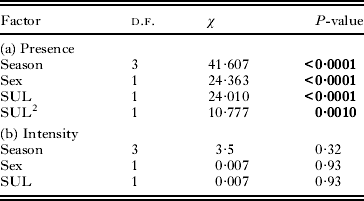
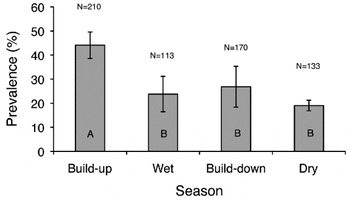
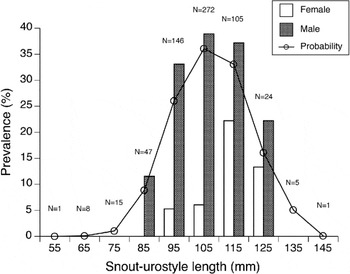
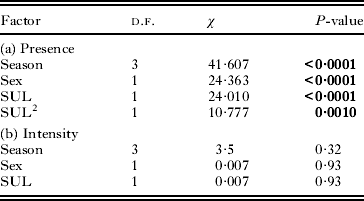
Visual inspection of plots of pentastome infection against body size (SUL) suggested a curvilinear relationship. We therefore added a centred polynomial term for SUL (reported as SUL2) in the logistic regression model. Pentastome prevalence varied with season, sex and body size (Table 1a). Interactions among these factors were not significant and were removed from the final logistic regression model. The probability of infection was higher during the build-up than in other seasons (Fig. 1), was higher among males (prevalence = 34·3%) than females (prevalence = 8·4%) and was highest at intermediate body sizes (105 mm SUL, Fig. 2).
Results from statistical analyses of factors influencing pentastome (Raillietiella frenatus) presence and intensity in cane toads (Rhinella marina) of the Northern Territory, Australia. (a) Results from a logistic regression of factors affecting pentastome presence in cane toads. N = 624 toads. (b) Results from zero-truncated negative binomial regression of factors affecting intensity of pentastome infections in cane toads. N = 180 toads
Seasonal variation in the prevalence (mean±s.e.) of a pentastomid lung parasite (Raillietiella frenatus) in cane toads (Rhinella marina) in tropical Australia across consecutive seasons spanning September 2008 to April 2011. The number of toads examined is given above each column. A and B denote seasons that are statistically different from one another.

Relationship between prevalence of a pentastomid lung parasite (Raillietiella frenatus) and the body size of its host (cane toad Rhinella marina). Bars show prevalence grouped by host size class. Open columns show females, shaded columns show males. Solid line with open circles represents probability curve fitted from a quadratic logistic regression of presence on host body size. The total number of toads (females + males) examined for each size class is given above each column.

Factors influencing pentastome intensity
Among the 180 toads infected with pentastomes, we found no significant relationship between the toad's size or sex and the number of pentastomes infecting it, nor any effect of season on the intensity of infection (Table 1b).
Correlations between infections and organ sizes of male toads
Co-infections
Australian populations of R. marina are commonly infected with a lung nematode, R. pseudosphaerocephala (Kelehear et al. Reference Kelehear, Brown and Shine2011a). To control for the potential confounding influence of co-infections (i.e. toads containing both nematodes and pentastomes), we conducted a MANOVA model including weights of all 3 organs as dependent variables. This analysis indicated that the presence of R. pseudosphaerocephala had no significant effect on toad organ mass (F3,287 = 2·57, P = 0·054) whereas pentastome presence (F3,287 = 3·36, P = 0·019), body size (F3,287 = 108·3, P < 0·0001) and season (F9,699 = 7·71, P < 0·0001) did have significant effects on organ mass. Therefore, we removed R. pseudosphaerocephala infection as a factor in further analyses, instead focussing on pentastome effects only.
Fatbody mass
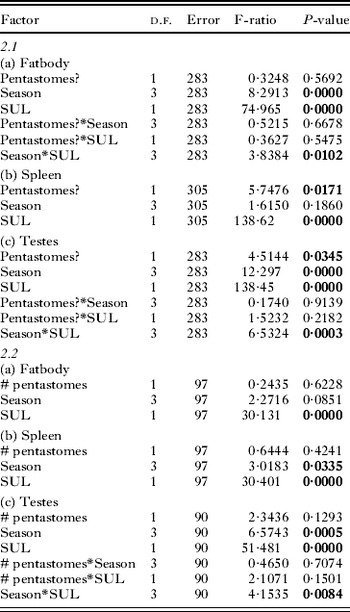
The presence of pentastomes did not influence fatbody mass either as a main effect or in interaction with other independent variables (Table 2.1a). Fatbody mass was influenced by a season * body size interaction: the slope of the relationship between fatbody mass and body size was steeper in the build-up and dry season than in the build-down and wet season.
Results of multiple regressions of the effects of pentastomids, season and body size on cane toad (Rhinella marina) organ masses. 2.1. Effects of pentastome infection status (infected vs uninfected), season and host body size (SUL) on host (a) fatbody mass; (b) spleen mass; (c) testes mass. N = 296 male toads >92 mm SUL. 2.2. Effects of pentastome intensity, season and host body size (SUL) on (a) fatbody mass; (b) spleen mass; and (c) combined testes mass. N = 103 male toads

Spleen mass
Larger toads had heavier spleens, but (after correcting for body size) male toads infected with pentastomes had heavier spleens than uninfected toads (least squares means: infected = 0·050 g vs uninfected = 0·043 g; Table 2.1b).
Testes mass
The mass of testes was affected by the presence of pentastomes, season, body size and a significant interaction between season and body size (Table 2.1c). Toads infected with pentastomes had relatively larger testes (least squares means: infected = 0·29 g vs uninfected = 0·27 g), testes were largest in the build-up (least squares means: build-up = 0·33 g, wet season = 0·29 g, build-down = 0·24 g, dry season = 0·28 g), and testes increased in size with body size. The rate at which testes mass increased with body size was lower in the wet season than in other seasons.
Pentastome infection intensity
The intensity of pentastome infection (excluding uninfected individuals) did not influence the size of any organ, either as a main effect or in interaction with season or body size (N = 101 infected male toads with all 3 organs weighed; Table 2.2). Masses of all 3 organs increased with toad body size. Spleen mass varied seasonally and testes mass was affected by an interaction between season and body size (Table 2.2). Because these latter results have no bearing on effects of pentastome infection, we do not discuss them further.
DISCUSSION
Our data reveal strongly non-random patterns in pentastome infection among invasive cane toads. Infection prevalence varied seasonally, and pentastome presence was affected by host sex and body size. We found no significant relationship between infection intensity and season, host sex or size, or male toad organ masses (fatbodies, spleen or testes). Among male toads, energy stores (size of the fatbodies) did not differ significantly between infected and uninfected individuals. However, infected male toads had larger testes and spleens relative to body size, than did uninfected conspecifics.
Pentastome prevalence varied with season in our tropical study sites. Prevalence was highest in the build-up (Sep–Nov), just prior to the wet season. If we assume that pentastomes have a similar pre-patent period in toads as they do in their usual gecko host (>240 days), the high prevalence in the build-up implies that peak transmission occurs from mid-wet season to mid-build-down (Jan–Apr). The prevalence and intensity of R. frenatus in 3 lizard species (Cosymbotus platyurus, Gehyra mutilata and H. frenatus) from Indonesia (Matsuo and Oku, Reference Matsuo and Oku2002) show comparable mean values to our own data, but do not reveal any seasonal variation. However, the Indonesian data are difficult to interpret because they are based on a single wet season and a single dry season sampled 3 years apart. Mean pentastome prevalence in introduced Hawaiian cane toads (Barton and Riley, Reference Barton and Riley2004) was similar to that reported here (30% vs 28% respectively) but we cannot comment on seasonal similarities as the Hawaiian sampling occurred in a single season. The seasonal patterns we observed may be related to temporal variation in abundance or activity of infected intermediate hosts (affecting their likelihood of being consumed by toads), and/or in host susceptibility to infection. Importantly, infection intensity did not vary with season. If the abundance of infective stages in the environment varied with season, we would expect infection intensities to fluctuate accordingly, unless precluded by concurrent changes to host immunity. Thus the chances of toads eating an infected intermediate host may vary seasonally, but the number of infective larvae that an intermediate host contains, and which subsequently establish in the toads, may be a less consistent parameter.
Toads infected with R. frenatus had relatively larger spleens. The spleen is the most important secondary lymphoid organ in all vertebrates – it is largely responsible for foreign antigen recognition, lymphocyte differentiation (B-cells) and proliferation (B-cells and T-cells), and the production and destruction of erythrocytes (Hansen and Zapata, Reference Hansen and Zapata1998). Presumably, spleen size increases as the immune system is stimulated (and lymphocyte production and storage increases) by the presence of parasites. It is difficult to directly compare our results with others since there are no studies on parasite infection and spleen size in amphibians or on the relationship between pentastomid infection and spleen size in any host taxa. Among birds, species that are infected by a greater range of nematode species tend to have larger spleens (Morand and Poulin, Reference Morand and Poulin2000). Another meta-analysis documented correlations between nematode infections and spleen sizes in female (but not male) birds, and found no relationship between cestodes, trematodes and spleen size (John, Reference John1995). Curiously, we found no relationship between intensity of infection and spleen size. The virulence of macroparasites is generally intensity dependent, that is, more individual parasites cause a greater reduction in host health (Poulin, Reference Poulin2011). In our study, intensities of pentastomid infection were generally low (88% of infected hosts had ⩽15 pentastomids), and R. frenatus are quite small in R. marina (mean = 5 mm long and 1 mm wide; Kelehear et al. Reference Kelehear, Spratt, Dubey, Brown and Shine2011b); greater intensities may be required to induce intensity-dependent effects.
Host sex had a strong influence on pentastome presence; male toads were 4 times more likely to be infected than female toads. Among the infected toads however, males did not contain more individual pentastomes than did females. Parasite infections are biased towards male hosts across a wide range of taxa, perhaps reflecting sex differences in habitat use, immune-suppressing effects of testosterone, or physiological attributes of the host that preclude or facilitate infection (Poulin, Reference Poulin1996; Schalk and Forbes, Reference Schalk and Forbes1997; McCurdy et al. Reference McCurdy, Shutler, Mullie and Forbes1998). Interestingly, a meta-analysis also found parasite prevalence to be higher amongst males but intensity of infection did not vary between sexes (excepting increased intensities in mammalian males with nematode infections; Poulin, Reference Poulin1996). Few studies have surveyed pentastome prevalence with sufficient sample sizes to accurately detect sex effects, with most datasets based on less than 10 hosts of each sex. One notable exception is a study on R. frenatus in an introduced gecko (Hemidactylus turcicus) in Texas (Pence and Selcer, Reference Pence and Selcer1988) that found no significant relationship between pentastome prevalence and host sex (based on N = 203 females, N = 277 males).
In our study system, divergent levels of parasitism between male and female toads is unlikely to reflect immediate mortality of infected females, or more effective immune systems in females than in males. Infected males suffered no obvious ill effects, and we cannot imagine a physiological difference that would render females so much more susceptible, or so much more capable of mounting an effective immune response. More plausibly, the sex difference in parasite prevalence may relate to behavioural differences between the sexes. In many host species, sex differences in movement rates, diet, and microhabitat use influence encounter rates with infective stages of the parasite life cycle (Poulin, Reference Poulin1996). Because R. frenatus has an insect intermediate host (Ali and Riley, Reference Ali and Riley1983), behavioural traits that maximize encounter rates between toads and infected insects will drive infection dynamics. Rates of movement are fairly similar between male and female cane toads at our study sites (Phillips et al. Reference Phillips, Brown, Greenlees, Webb and Shine2007) and no dietary differences were recorded between sexes in Cope's toad, Rhinella scitula (Maragno and Souza, Reference Maragno and Souza2011). However, there are stark differences in habitat use between male and female toads. In tropical environments, toads can breed year round (Jørgensen et al. Reference Jørgensen, Shakuntala and Vijayakumar1986), and reproductively active males stay at pond margins calling throughout the year (C.K., personal observations). In contrast, female toads primarily visit ponds for breeding, and otherwise utilize terrestrial habitat away from ponds (e.g., Bartelt et al. Reference Bartelt, Peterson and Klaver2004; Bull, Reference Bull2006; Morton and Pereyra, Reference Morton and Pereyra2010). These differences in habitat use may explain the difference in parasitism, if the pentastomid intermediate host is associated with ponds. We have no data to test this hypothesis. Experimental life-cycle studies utilized cockroaches as intermediate hosts for R. frenatus (Ali and Riley, Reference Ali and Riley1983) but no field data exist on the matter. Thus, R. frenatus may use alternative or additional coprophagous insect intermediate hosts in Australia. Our data suggest a pond-associated insect species but the catholic nature of the toad diet renders it very difficult to pinpoint a culprit.
In keeping with the hypothesis that male toads are more likely to become infected (at pond margins) than are dispersed females, males with larger testes were more likely to be infected with R. frenatus. Reproductively active male anurans are more likely to be found at pond margins (Davies and Halliday, Reference Davies and Halliday1979). Male Couch's spadefoot toads (Scaphiopus couchii) infected with adult monogenean parasites (Pseudodiplorchis americanus) consistently had larger testes (Tinsley, Reference Tinsley1995), and parasite species richness was greatest during the breeding season in pond-dwelling male wood frogs (Lithobates sylvaticus; Pulis et al. Reference Pulis, Tkach and Newman2011). These correlations also are consistent with the immunocompetence-handicap hypothesis, whereby elevated testosterone associated with increased sexual investment in males leads to reduced immunocompetence (Folstad and Karter, Reference Folstad and Karter1992). Experimental manipulations are required to tease apart cause and effect in this host-parasite system; however, the pentastome life cycle must be elucidated in its cane toad host before this is possible.
Finally, the likelihood that these lung parasites will infect females may be reduced by some physiological or morphological sexual dimorphism. Male and female anurans differ in important structural features of the respiratory system, such as the size of the larynx (McClelland and Wilczynski, Reference McClelland and Wilczynski1989; Suthers et al. Reference Suthers, Narins, Lin, Schnitzler, Denzinger, Xu and Feng2006). Marked differences in the structure of the vocal cords between male and female R. marina (Schmidt, Reference Schmidt1972) mean that the females are mute (Bowcock et al. Reference Bowcock, Brown and Shine2008). Further, males may have increased lung volume to sustain lengthy and aerobically taxing advertisement calls (Noble, Reference Noble1931). Sexual dimorphism also exists in the circulatory system of anurans. For example, male spring peeper frogs (Pseudacris crucifer) have relatively larger heart ventricles and higher concentrations of haemoglobin than females have (Zimmitti, Reference Zimmitti1999), and male northern leopard frogs (Rana pipiens) have increased haematocrit, haemoglobin concentration and erythrocyte counts compared to females (Harris, Reference Harris1972). Such differences between sexes may influence uptake of pentastomids either during the migrating larval phase (when they must crawl from the stomach through to the lungs) or the adult blood-feeding phase in the lung.
Pentastomes were more often present in intermediate-sized toads, but there was no significant relationship between toad body size and pentastome intensity. Similar relationships between parasite presence and host body size in other parasites have been attributed to acquired immunity (Hudson and Dobson, Reference Hudson, Dobson, Grenfell and Dobson1995; Wilson et al. Reference Wilson, Bjørnstad, Dobson, Merler, Poglayen, Randolph, Read, Skorping, Hudson, Rizzoli, Grenfell, Heesterbeek and Dobson2002). This process might operate through 2 related pathways. First, older (larger) toads may develop the immune capacity to actively rid themselves of existing pentastome infections. Second, when an existing pentastome infection runs its course and dies out, the toad may be immune to re-infection. This pathway is exemplified in another amphibian host-parasite system whereby secondary infections of monogeneans (Protopolystoma xenopodis) in the African clawed frog (Xenopus laevis) are moderated by host immunity (Jackson and Tinsley, Reference Jackson and Tinsley2001). The lack of pentastome infections in small/young toads may again reflect behavioural patterns, small gape size precluding consumption of infected intermediate hosts, or simply the long pentastome life cycle – whereby any pentastomes in small/young toads would be miniscule and perhaps still migrating to the lungs, rendering them undetectable under our methodology. Congruent with a prominent role for acquired immunity in driving pentastomid infection dynamics, we found no relationship between toad sex and the intensity of infection. That result implies that toads that become infected often do so by consuming a single infected intermediate host, and then they become immune to re-infection. If pentastomid infections in toads occur as single pulse infections such as this, rather than repeated infections that build-up in susceptible (i.e. male) toads, then we would expect infection intensities to be similar across host phenotypes. Therefore, the source of variation would be in the number of infective pentastomid larvae contained within each intermediate host, a variable that will vary among intermediate hosts in accordance with the density of pentastomid eggs in the feces they consume.
There have been few comprehensive studies on the pathology of pentastomid infections. However, clinical case studies report severe destruction of host tissue culminating in death in lizards (e.g., Awachie, Reference Awachie1974; Zhang et al. Reference Zhang, Zhang, Li, Chen and Xie1988) and snakes (e.g., Riley and Walters, Reference Riley and Walters1980; Almeida et al. Reference Almeida, Guedes, Freire and Vasconcellos2008; Ayinmode et al. Reference Ayinmode, Adedokun, Aina and Taiwo2010), as well as in incidental hosts such as dogs (Brookins et al. Reference Brookins, Wellehan, Roberts, Allison, Curran, Childress and Greiner2009) and humans (e.g., Abadi et al. Reference Abadi, Stephney and Factor1996; Yapo Ette et al. Reference Yapo Ette, Fanton, Adou Bryn, Botti, Koffi and Malicier2003; Yao et al. Reference Yao, Wu and Tang2008). More subtle effects include reduced fatbody masses and a 21% decline in egg production in geckos (Hemidactylus turcicus) infected with R. frenatus (Pence and Selcer, Reference Pence and Selcer1988). We found no significant relationship between pentastomid infections and our measure of toad body condition (fatbody mass), implying that these pentastomids do not have deleterious effects on their host's condition. Male toads with relatively larger testes were more likely to be infected, suggesting that pentastomids do not reduce male reproductive effort in R. marina. The divergence in pathology between geckos and toads may relate to the relative sizes of the host and the parasite: R. frenatus are smaller in toads than in their Asian house gecko ancestral host (Kelehear et al. Reference Kelehear, Spratt, Dubey, Brown and Shine2011b), and geckos are smaller than toads; a larger parasite likely has greater effects in a smaller host.
The cane toad is an unwelcome addition to Australian fauna and we have documented the patterns of its infection with a novel parasite. This novel parasite raises the possibility of pentastomes acting as a means of biological control of cane toads, but our preliminary (correlative) results are not encouraging in this respect: pentastomes appear to have only minor pathological effects on cane toads. Additionally, the pentastome has also been found in native frogs (Litoria caerulea; Kelehear et al. Reference Kelehear, Spratt, Dubey, Brown and Shine2011b). A more thorough assessment of pathological effects could be obtained by experimental infection studies.
The role of the newly arrived host species (the cane toad) in infection dynamics between pentastomes and their traditional Asian house gecko host also warrants further study. The apparent ability of toads to become resistant to pentastome infection, despite continuing to ingest the infective nymphs, suggests that they could alter the abundance of infective stages available to infect the normal definitive host (the gecko). To address this hypothesis, future work could usefully examine infection patterns of pentastomes in intermediate and final hosts (cockroaches and geckos) among sites where toad density has been experimentally manipulated.
ACKNOWLEDGEMENTS
We thank L. Pizzatto for help with collecting and dissecting toads, the staff of Darwin RAAF golf course for access to the site, and the Northern Territory Land Corporation for logistical support. This work was approved by the University of Sydney Animal Ethics Committee (L04/1-2010/3/5193; L04/5-2010/2/5334).
FINANCIAL SUPPORT
This work was supported by the Invasive Animals Cooperative Research Centre (S2915) and the Australian Research Council (DP0984888).