Implications
Because of the specific digestive physiology of rabbits, the dietary level and quality of starch can play an important role in their growth and health. The literature provides conflicting results regarding starch digestion and the unfavourable role of undigested starch on the caecal microbial activity and digestive health in growing rabbits. This work attempted to clarify this question by comparing the effects of highly digestible starch (from wheat) to those of digestion-resistant starch (from potato) on the growth and digestive processes in the rabbit.
Introduction
Starch is the primary source of carbohydrates and one of the main energy sources in monogastric diets, and it is generally hydrolysed by amylolytic enzymes in the small intestine. However, a fraction of starch, which is defined as resistant starch, is not digested in the small intestine and reaches the large intestine, where it is hydrolysed and fermented by microorganisms. Potato starch (PS) is 20% amylose, which has large granules and a B-crystalline structure that is not generally accessible to digestive enzymes (Champ and Colonna, Reference Champ and Colonna1993; Noda et al., Reference Noda, Takigawa, Matsuura-Endo, Suzuki, Hashimoto, Kottearachchi, Yamauchi and Zaidul2008). In vitro hydrolysis of raw potato starch with amylolytic enzymes showed significant resistance to these enzymes (Lee et al., Reference Lee, Brooks, Kim, Heitlinger and Lebenthal1985; Bauer et al., Reference Bauer, Murphy, Wolf and Fahey2003). Thermal treatments can modify the structure of starch and decrease its resistance to amylases (Kingman and Englyst, Reference Kingman and Englyst1994).
Wheat starch (WS) is commonly used in diets for rabbits. This starch is predominantly composed of amylopectin and can be almost fully digested in the small intestine (93% to 98%, Blas and Gidenne, Reference Blas and Gidenne2010) because it contains only small amounts of resistant starch. Even in the case of highly digestible starch, such as raw wheat starch, several authors have hypothesised that an excess of starch in rabbit feeds could lead to an increase of undegraded starch flowing through the small intestine due to limited amylolytic capacity. When this undegraded starch reaches the caecum and the colon, it may unbalance the microbiota and cause digestive disturbances (Cheeke and Patton, Reference Cheeke and Patton1980). However, Blas and Gidenne (Reference Blas and Gidenne2010) showed that there is no direct relationship between the dietary starch level and mortality, which depends instead on fibre intake (Gidenne et al., Reference Gidenne, García, Lebas and Licois2010), namely, the type of fibre and feed composition (De Blas, Reference De Blas2012).
A review of the literature concerning the digestion of starch in the rabbit (Blas and Gidenne, Reference Blas and Gidenne2010) indicated that few studies have examined the problem of its digestion in the small intestine and the effect of the nature of starch on the microbial activity and digestive health of the growing rabbit, particularly during the growing period. Moreover, only a small number of reports have studied the effect of the nature (origin) of the starch. The available studies on the effects of starch on rabbits mainly compared diets based on wheat, barley, maize and peas (Gidenne and Perez, Reference Gidenne and Perez1993a; Gutiérrez et al., Reference Gutiérrez, Espinosa, García, Carabaño and De Blas2002; Xiccato et al., Reference Xiccato, Trocino, Sartori and Queaque2002). Studies in other species, mainly rats (Mathers et al., Reference Mathers, Smith and Carter1997; Le Blay et al., Reference Le Blay, Michel, Blottiere and Cherbut2003) and pigs (Martin et al., Reference Martin, Dumon and Champ1998; Hedemann and Knudsen, Reference Hedemann and Knudsen2007; Bhandari et al., Reference Bhandari, Nyachoti and Krause2009), primarily studied the effects of the incorporation of raw potato on the fermentative characteristics of starch in the large intestine.
Experiments were performed to determine the effects of high intake of starches with different origins (wheat and potato) on the growth performance, health, success in digestion, caecal fermentative traits and fibrolytic activity of growing rabbits.
Material and methods
Diets and experimental design
The trials were carried out in the animal facility of the University of Trás-os-Montes e Alto Douro at Vila Real. Rabbits were kept in a closed and temperature-controlled facility (18°C to 23°C and received 12 h of light daily (0700 to 1900 h). Animals were handled according to the principles of the care of animals in experimentation (Port. no 1005/92).
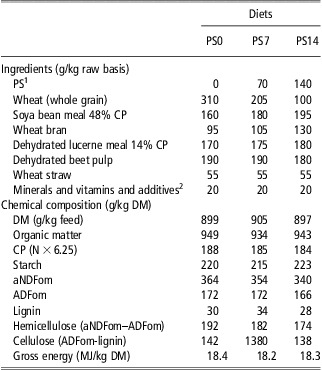
Three experimental diets were formulated (Table 1) to obtain a linear replacement of wheat starch by purified raw potato starch ‘PS’ (Roquette SA, Lestrem, France) at levels of 0%, 7% and 14% for the PS0, PS7 and PS14 diets, respectively. The level of starch, fibre and CP were similar in all diets (Table 1). The diets contained 16% acid detergent fibre (ADFom), corresponding to the minimal ADF levels required for growing rabbits (De Blas and Mateos, Reference De Blas and Mateos2010; Gidenne et al., Reference Gidenne, García, Lebas and Licois2010). To attempt to generate a potential detrimental effect of a high ileal flow of starch on caecal microbial activity and rabbits’ health, the level of starch in diets was high (22%). In the PS7 and PS14 diets, ∼1/3 and 2/3 of the dietary starch, respectively, came from raw PS (resistant starch).
Major ingredients, chemical composition and nutritive value of experimental diets

PS = potato starch; DM = dry matter; aNDFom = neutral detergent fibre; ADFom = acid detergent fibre.
1Chemical composition (%): humidity 20.5; CP 0.3; crude fibre 0.1; fat 0.1; minerals 0.3; gross energy 14.23 MJ/kg (according to the supplier).
2Calcium phosphate 300 mg, calcium carbonate 400 mg, methionine 200 mg, copper 17.4 mg; iron 64 mg; zinc 37.3 mg; manganese 18.4 mg; vitamin A 900 000 U.I.; vitamin D3 100 000 U.I.; vitamin E 16.5 mg; vitamin B1 1 mg; vitamin C 50 mg; robenidine 66 mg (per kg of feed according to supplier).
Growth performances and health status
To measure growth performance and health status, the experimental diets were given ad libitum to three groups of 48 rabbits of both sexes (New Zealand × Californian), which were housed individually in cages, from weaning (28 days) to slaughter (70 days). Feed intake and live weight (LW) were recorded weekly. The results are summarised in the following three periods: for 28 to 42, 42 to 70 and 28 to 70 days.
Health status was recorded individually three times a week. All clinical signs of sickness (e.g. transitory diarrhoea, presence of mucus in excreta, abnormal behaviour) were registered. Morbidity was defined as the animals’ having abnormally low intake or growth (<mean – 2.2 s.d.) or clinical signs of sickness. Animals with morbidity were not included in growth performance analyses. The sanitary risk index (SRi) was calculated as the sum of mortality and morbidity.
Whole tract digestive efficiency and digesta sampling
Whole tract digestibility was measured according to the method of Perez et al. (Reference Perez, Lebas, Gidenne, Maertens, Xiccato, Parigi Bini, Dalle Zotte, Cossu, Carazzolo, Villamide, Carabaño, Fraga, Ramos, Cervera, Blas, Fernández Carmona, Falcão-e-Cunha and Bengala Freire1995) between 37 and 41 days and between 65 and 69 days on three groups of 10 rabbits from the same litters. Rabbits were housed individually in metabolic cages from weaning (28 days) to 69 days and were fed the experimental diets. Data from rabbits with diarrhoea or other signals of sickness were rejected.
At 42 and 70 days, 10 rabbits per diet were slaughtered (between 1130 and 1230 h) by sudden cervical dislocation. For each rabbit, one sample of the contents of the terminal ileum (segment of 20 cm before the ileo-caecal junction) was taken to measure the starch level, and four samples of the caecal contents were taken to measure dry matter, volatile fatty acids (VFA), ammonia (NH3) and fibrolytic activity. The samples for enzymatic fibrolytic activity were collected in precooled (4°C) tubes containing an anaerobic buffer and were stored at −80°C until further processing, and the other samples were stored at −20°C until analysis.
Chemical analysis and caecal fibrolytic activity
Samples of feed and faeces were analysed for ash, dry matter, organic matter, crude fat and CP (total nitrogen × 6.25) according to Gidenne et al. (Reference Gidenne, Perez, Xiccato, Trocino, Carabaño, Vilamide, Blas, Cervera, Falcão e Cunha and Maertens2001). The content of neutral detergent fibre (aNDFom) was determined without sodium sulphite and with a heat-stable amylase (Van Soest et al., Reference Van Soest, Robertson and Lewis1991). ADFom and ADL (lignin) were determined by sequential analysis and expressed exclusive of residual ash (Van Soest et al., Reference Van Soest, Robertson and Lewis1991).
Nitrogen was determined by the Dumas combustion method using Leco apparatus (model FP-428, Leco Corporation, St. Joseph, MI, USA). Starch of all samples was hydrolysed enzymatically (Edwards, modified by Kozlowski, Reference Kozlowski1994), and the resultant glucose was measured using the hexokinase (EC 2.7.1.1) G6PDH (NAD) (EC 1.1.1.49) system (Boëhringer Mannheim). The gross energy of the diets was measured with an adiabatic calorimeter (PARR Instrument; Moline, IL, USA). The in vitro assay of starch hydrolysis of samples of the raw material (WS and PS) used to prepare the diets was performed at 37°C and 60°C according to the method of Tollier and Guilbot (Reference Tollier and Guilbot1974). This in vitro analysis was performed with diets only at 60°C. The raw material and the diets were incubated in triplicate with stirring, and samples of the solution (1 ml) were taken at different times (0, 5, 10, 20, 30, 60, 120 and 210 min) to measure reducing sugars. The results were expressed as a proportion of the starch incubated. The resultant reducing sugars were measured according to the DNS method (Miller, Reference Miller1959).
The VFA of the caecal contents were analysed by gas liquid chromatography (CP9000, Chrompack, Middelburg, The Netherlands) on a semi-capillary column. The VFA pool was calculated by multiplying the VFA concentration (μmol/l) by the caecal contents (g) by the percentage of water in the caecal contents (Demigé and Rémésy, Reference Demigé and Rémésy1985). The caecal NH3 measurements were performed using the colorimetric method of Verdouw et al. (Reference Verdouw, Van Echteld and Dekkers1977).
The fibrolytic activity of the caecal contents was analysed by measuring the concentration of cellulase, xylanase and pectinase synthesised by the bacteria as described by Gidenne et al. (Reference Gidenne, Jehl, Segura and Michalet-Doreau2002).
Statistical analysis
Data on the growth and feed intake of the rabbits were examined by one-way ANOVA with the GLM procedure of the Statistical Analysis System (SAS, online guide). The digestibility coefficients of the feeds, caecal characteristics, fibrolytic activity of caecal contents and ileal starch results were tested for the effect of age, diet and the interaction age*diet. Means were subsequently compared using the Scheffe test. When a significant interaction (P < 0.05) occurred between the effect of age and the effect of the diet, the data were further subjected to the following two types of statistical analyses: within the same age (among the three diets) and within the same diet (between the two ages). The catmod procedure (SAS) was utilised for the analysis of mortality, morbidity and sanitary risk. The linear effect of the potato starch level in the feed was analysed for all studied parameters of growth performance and digestibility. Differences among the means with P < 0.05 were accepted as representing statistically significant differences. Differences among means with 0.05 < P < 0.10 were accepted as representing tendencies toward differences.
Results
Diets and starch in vitro hydrolysis
As expected, the diets had similar concentrations of starch, protein and fibre (Table 1). The gross energy of the diets was also analogous, varying from 18.2 to 18.4 MJ/kg.
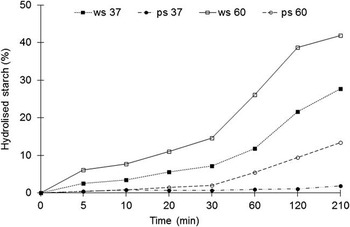
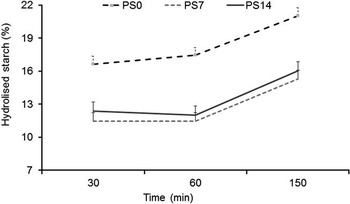
The in vitro hydrolysis of the two types of starch (wheat and potato) at 37°C and 60°C revealed a lower speed of hydrolysis for potato starch compared with wheat starch (Figure 1). Within 210 min at 37°C, 30% of the wheat starch was hydrolysed compared with <2% of the potato starch. The increase in the incubation temperature increased the hydrolysis of both the potato starch and the wheat starch by a similar value (ca. 15% units). The in vitro hydrolysis at 60°C exhibited lower values with the PS7 and PS14 diets over any time of incubation (Figure 2).
Comparative in vitro hydrolysis (at 37°C and 60°C) of WS or PSs (n = 3). WS = wheat starch; PS = potato starch.

Comparative in vitro hydrolysis at 60°C of different diets (n = 3). PS = potato starch.

Growth performances and health status
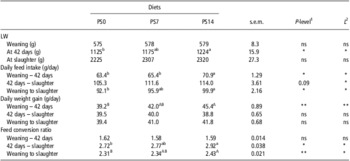
The dietary level of potato starch had no significant effect on the LW of rabbits at slaughter (Table 2). However, at 42 days of age, rabbits fed diet PS14 showed a higher LW (+99 g) than rabbits fed diet PS0 (P < 0.05).
Effect of crude PS dietary incorporation on growth and feed intake of rabbits from weaning (28 days) to slaughter (70 days) by (n = 48 animals per treatment)

PS = potato starch; s.e.m. = standard error of the mean; LW = live weight.
1In the same line, means with different superscripts differed significantly (lowercase P < 0.05 and uppercase at P < 0.01).
2Linearity test of starch level.
With the increase of the level of potato starch, feed intake increased 11% during the 2 weeks after weaning (P < 0.05). In the finishing period (42 to 70 days), the feed intake tended to a further increase (more 8%; P = 0.09). Over the total growing period, rabbits fed the PS14 diet showed a higher feed intake than those fed PS0 (P < 0.05). In all periods studied, the addition of potato starch had a significant linear effect on daily feed intake (P < 0.05).
The daily weight gain during the post-weaning period increased with the incorporation of PS (+14% for PS14, P < 0.01). Over the whole growth period (35 to 70 days of age), weight gain was similar among diets.
In the finishing (42 to 70 days of age) and whole growth periods, feed conversion was higher with the PS14 than with PS0 diets (P < 0.05). In these periods, the potato starch level showed linear effects on feed conversion (P < 0.05).
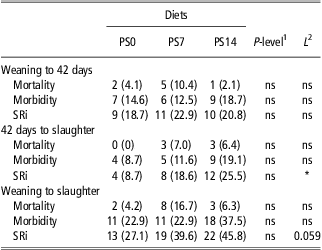
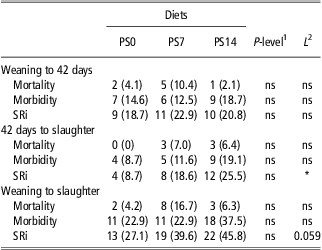
Mortality and morbidity were not significantly different between diets (Table 3). In the period from 42 days to slaughter, the sanitary risk doubled with the PS7 diet (4% v. 8%) and tripled with the PS14 diet (4% v. 12%) with respect to the PS0 diet. Accordingly, the linear analysis showed that the SRi between 42 and 70 days old increased with the addition of PS to the diet (P < 0.05), and tended increase over the whole growth period (P = 0.059).
Effect of crude PS dietary incorporation on health status (morbidity, mortality and SRi; number and (%)) of the growing rabbit (n = 48 animals per treatment)
PS = potato starch; SRi = sanitary risk index.
1Significance level.
2Linearity test of starch level.
Digestibility coefficients
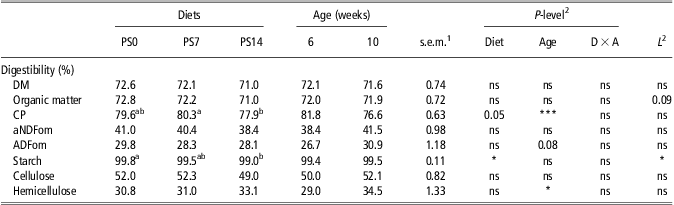
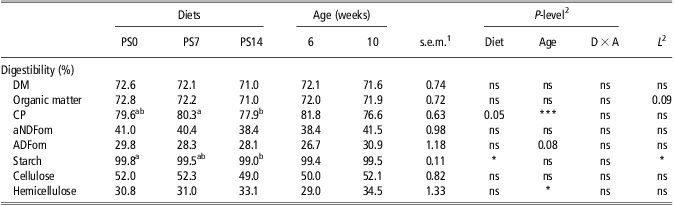
Except for starch and CP, whole tract digestibility was not affected by the incorporation of any level of potato starch in the diet (Table 4). The digestibility of starch was higher (+0.8 unit, P = 0.04) with the PS0 diet than with the PS14 (99.8% and 99.0%, respectively). The analysis of the effect of age on whole tract digestibility showed a higher protein digestibility at 6 weeks than at 10 weeks (+5 units, P < 0.05). At 10 weeks, a higher hemicellulose digestibility was found (P < 0.05) in addition to a trend for higher ADFom digestibility (P = 0.08).
Effect of crude PS dietary incorporation and age on whole tract digestive efficiency (n = 10 animals per treatment)
PS = potato starch; DM = dry matter; s.e.m. = standard error of the mean; aNDFom = neutral detergent fibre; ADFom = acid detergent fibre.
1In the same line, means with different superscripts differed significantly (P < 0.05).
2Linearity test of starch level.
The linear analysis of the effect of potato starch level on the whole tract digestibility indicated a significant negative effect on starch digestibility (P < 0.05) and a trend toward decreasing organic matter digestibility (P = 0.09).
Caecal microbiota activity and ileal starch concentration
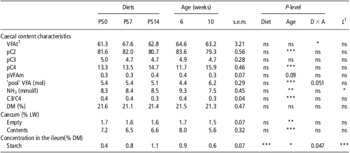
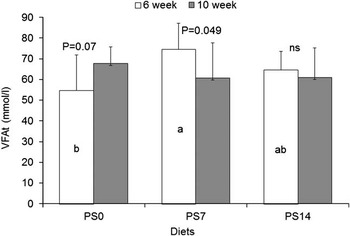
A significant interaction (P < 0.05) between the effect of the age (6 v. 10 weeks) and the effect of the diets was observed for the caecal VFA concentration (Table 5 and Figure 3). In 6-week-old rabbits, the VFA level was higher with the PS0 diet than with the PS7 diet (68 v. 54 mmol/l, P < 0.05); conversely, at 10 weeks of age, no significant effect of the dietary treatments was observed.
Effect of crude PS dietary incorporation and age on caecal fermentative activity and starch concentration in the ileum of growing rabbits (n = 10 animals per treatment)

PS = potato starch; s.e.m. = standard error of the mean; LW = live weight; DM = dry matter; VFA = volatile fatty acid; pC2 = proportion of acetic acid; pC3 = proportion of propionic acid; pC4 = proportion of butyric acid.
1Linearity test of starch level.
Effect of crude potato starch (PS) dietary incorporation and age on total volatile fatty acid (VFA) concentration in the caecum of growing rabbits. Within the same age, means with different superscripts (a, b) differ at the level P = 0.05 (effect of diet). Within the same diet, means with a different superscript differed at P < 0.05 (effect of age).

Acetic acid (C2) was the predominant VFA, representing ∼80% followed by butyric (C4) and propionic (C3) acids. The proportions of acetic (pC2) and butyric (pC4) acids were affected by age (P < 0.05). The proportion of propionic (pC3) was not affected. Ten-week-old rabbits had a higher butyrate proportion that was compensated by a decrease in acetate. In the oldest rabbits, the NH3 concentration and the C3/C4 ratio decreased (P < 0.05). The pool of VFA showed a trend to be higher in the 10-week-old rabbits (+43%; P = 0.051).
The weights of empty caecum and caecal content as a proportion of the rabbits LW (Table 5) decreased with age (P < 0.01).
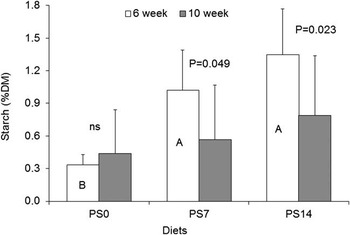
A significant interaction (P < 0.05) between the effect of age (6 v. 10 weeks old) and the effect of diet was detected on the ileal starch concentration (Table 5 and Figure 4). In 6-week-old rabbits, the ileal starch concentration increased sharply (P < 0.05) from diet PS0 to PS7 to PS14 but remained <1.5%, even with diet PS14. At 10 weeks of age, the ileal starch concentration remained similar among diets (mean 0.5%). The starch concentration in the ileum decreased with age (6 v. 10 weeks) in rabbits fed diets PS7 and PS14 (P < 0.05).
Effect of crude potato starch (PS) dietary incorporation and age on starch concentration in the ileum of growing rabbits. Within the same age, means with different superscripts (a, b) differ at the level of P = 0.05 (effect of diet). Within the same diet, means with different superscripts differed at P < 0.05 (effect of age).

The linear analysis of the effect of potato starch level only showed a significant effect on the NH3 caecal concentration (P < 0.05) and the ileal concentration of starch (P < 0.001). In both cases, the values increase with the increase of potato starch level.
Treatments did not affect cellulase, xylanase and pectinase activities (Table 6).
Effect of crude PS dietary incorporation and age on bacterial fibrolytic activity in the caecum of growing rabbits (n = 10 animals per treatment)

PS = potato starch; s.e.m. = standard error of the mean.
1Linearity test of starch level.
2mmol of reducing sugars by g DM/h.
Discussion
High starch intake and digestion in the growing rabbit
The knowledge on the effects of starch origin and quality on the digestive response of the growing rabbit remain limited because there are few studies that analyse the effect of origin (wheat, barley, corn, pea, potato) and because the studies are restricted to the effects on growth and digestibility (Lee et al., Reference Lee, Brooks, Kim, Heitlinger and Lebenthal1985; Gidenne and Perez, Reference Gidenne and Perez1993a and Reference Gidenne and Perez1993b; Gutiérrez et al., Reference Gutiérrez, Espinosa, García, Carabaño and De Blas2002; Xiccato et al., Reference Xiccato, Trocino, Sartori and Queaque2002; Blas and Gidenne, Reference Blas and Gidenne2010).
Raw potato starch is known to be resistant to digestion in the small intestine. Martin et al. (Reference Martin, Dumon and Champ1998) observed that 56% of starch is not digested in the small intestine in pigs fed a diet containing 6.5% potato starch. The results obtained in the in vitro hydrolysis of potato starch by Lee et al. (Reference Lee, Brooks, Kim, Heitlinger and Lebenthal1985) and in the present study confirm these findings.
Several studies have shown that thermal treatment of resistant starch can reduce its resistance to hydrolyse and can have a positive effect on starch digestibility (Kingman and Englyst, Reference Kingman and Englyst1994; Sun et al., Reference Sun, Laerke, Jorgensen and Knudsen2006). The in vitro hydrolysis achieved in present work confirmed this effect, suggesting that the temperature of feed manufacture can have positive effect on starch digestibility. However, this effect does not seem to be dependent on the starch origin. Consequently, it is expected that after granulation, diets with potato starch should maintain a high level of resistant starch. This finding was confirmed by the in vitro starch hydrolysis of the diets in which ∼85% remained not hydrolysed. However, the in vivo study with rabbits exhibited notably high levels of starch digestibility (99%) of the diets with potato, which was only slightly lower than the starch digestibility of the diet with wheat. The results of in vitro starch hydrolysis of raw material at 37°C and 60°C and diets at 60°C seem to show that the high in vivo starch digestibility of the PS7 and PS14 diets are not simply due to a thermal effect of diet granulation on resistant starch. These results of in vitro hydrolysis show a similar positive effect of temperature on both types of starch (wheat and potato), although a higher fraction of potato starch remains resistant. Consequently, we can affirm that rabbits have a higher capacity to digest potato starch than what has been observed in other animal species, such as the pig.
The observed starch concentrations in the terminal ileum contents of rabbits fed diets with wheat or potato starch was low (0.4% to 1.2%). Blas and Gidenne (Reference Blas and Gidenne2010) found similar values when wheat was used as raw material and slightly higher values with corn. These values represent a marginal loss of starch in the faeces, lower than the faecal loss observed by Gidenne and Perez (Reference Gidenne and Perez1993a) in growing rabbits fed with diets containing barley starch (losses of 1%) and resistant corn starch (losses of 6%). Pinheiro and Gidenne (Reference Pinheiro and Gidenne1999) reported 1.4% with a diet similar to PS0, which represents an estimated ileal starch loss lower than 2 g per day. These concentrations of starch in the ileum suggest that more than 90% of the starch was digested before the caecum, even when two-thirds of the starch ingested had potato origin (diet PS14). This high capacity of rabbits to digest starch, including resistant starch, could be explained by the endogenous amylase activity and also by amylase activity provided by the bacteria of soft faeces of previous intakes stored in fundus of the stomach (Scapinello et al., Reference Scapinello, Gidenne and Fortun-Lamothe1999).
According to Gidenne and Perez (Reference Gidenne and Perez1993b) and Arruda et al. (Reference Arruda, Carregal and Ferreira2000), the increase in ileal starch flow would enhance fibre digestion in the caecum. The results of these authors seem to be related to a surprisingly low starch digestibility (75% to 86%). The results obtained by Xiccato et al. (Reference Xiccato, Trocino, Sartori and Queaque2002), Gidenne et al. (Reference Gidenne, Segura and Lapanouse2005a) and the results obtained in the present work do not support such a hypothesis because no change in fibre digestibility was observed. It is likely that the small increase of the quantity of undigested starch entering in the caecum with the PS7 and PS14 diets had a reduced effect on the caecal microbial population. The observed lack of effect of diets with potato starch on fermentative activity, weight of caecal contents and development of the caecum are in keeping with this small effect. Furthermore, the studies of Nizza and Moniello (Reference Nizza and Moniello2000) and Xiccato et al. (Reference Xiccato, Trocino, Sartori and Queaque2002) failed to observe effects of the starch source (barley v. maize) on fermentative activity. It is probable that the potato starch changed the microorganism profile, contributing to observed increase of the degrading enzymatic activity of pectinases and hemicellulases without affecting the cellulolytic activity. These effects of starch on enzymatic activity are in agreement with previous studies on rabbits (Marounek et al., Reference Marounek, Vovk and Skrivanova1995; Gidenne et al., Reference Gidenne, Pinheiro and Falcão e Cunha2000). In the present work, these changes in enzymatic activity were not enough to increase fibre digestibility.
According to Cheeke and Patton (Reference Cheeke and Patton1980), a high flow of starch into the caecum could impair gut health because it may imbalance the microbial population. However, in the present work, the increase of resistant starch in the diet had no effects on the frequency of digestive troubles. This may be related to the small effect of the increase in potato starch on the quantity of undigested starch entering in the caecum and on the caecal microbial population previously described. The preceding studies reported higher ileal starch concentrations (5 to 10 times higher, Gidenne et al., Reference Gidenne, Segura and Lapanouse2005a) that were not associated with a higher frequency of digestive troubles in the growing rabbit (Gidenne et al., Reference Gidenne, Jehl, Perez, Arveux, Bourdillon, Mousset, Duperray, Stephan and Lamboley2005b). The small effect observed on digestive troubles could be linked to the similar fibre level among the PSO, PS7 and PS14 diets. Therefore, our results supported the previous works showing that fibre intake plays a primary role in the frequency of digestive troubles (Gidenne, Reference Gidenne2003; Gidenne et al., Reference Gidenne, García, Lebas and Licois2010). However, the significant linear effect between potato starch level and sanitary risk suggested that with high starch levels and minimal ADF levels (16%), detrimental effects of starch intake on the digestive health of the growing rabbit could be observed.
The post-weaning and complete growth performance confirmed that rabbits have the ability to efficiently use diets containing digestion-resistant starches, such as raw potato starch. However, high levels of PS in the diet (14%) increased feed intake and feed conversion as result of the slightly lower digestive efficiency of these animals. The previous results also showed a slight detrimental effect of maize starch (more resistant to digestion than wheat) on feed conversion and were associated with a higher intake (Gidenne et al., Reference Gidenne, Jehl, Perez, Arveux, Bourdillon, Mousset, Duperray, Stephan and Lamboley2005b).
Effect of age of rabbits
Starch digestibility in the whole digestive tract of rabbits remained notably high (over 99.5%) and was only slightly lower at 42 days of age. Consequently, a higher value of ileal starch was found in rabbits at 6 weeks of age than at 10 weeks, although both values were low (0.9% and 0.6%). Blas et al. (Reference Blas, Cervera and Fernandez Carmona1994) found ∼7% starch in the ileum content of 5-week-old rabbits. The effect of rabbit age on ileal starch interacted with the nature of the starch. The effect of age on the starch in ileal contents, with higher levels being observed at 6 weeks of age than at 10 weeks, was evidenced only in rabbits fed diets with resistant potato starch and was not significant with the PS0 diet. This finding was in agreement with Gidenne et al. (Reference Gidenne, Pinheiro and Falcão e Cunha2000), which reported similar starch levels of the ileal contents in rabbits fed a diet of wheat starch at 6 or 10 weeks. We measured a lower level of ileal starch (<1.3%), in 6-week-old rabbits fed the PS14 diet. The differences among the previous values may also be due to difficulties in the measurement of starch in the ileal contents of the rabbit due to the low quantities of samples available and variable intake pattern of rabbits fed ad libitum, thereby leading to high inter-individual variability (≈20%).
From 6 to 10 weeks of age, VFA production by rabbits was similar, although there were changes in the fermentation pattern, with a higher proportion of butyrate and lower proportion of acetate being observed in agreement with previous studies (Gidenne et al., Reference Gidenne, Jehl, Segura and Michalet-Doreau2002; Guedes et al., Reference Guedes, Mourão, Silva, Gomes, Rodrigues and Pinheiro2009).
Conclusions
The rabbit has a high capacity to digest starch, even after weaning and when potato starch is present in the diet. Consequently, a high intake of potato starch had no major impact on caecal microbial activity, digestive health and growth performance of the growing rabbit.
Acknowledgements
The authors thank Muriel Ségura, Carole Bannelier and André Lapanouse (INRA, UMR 1289 TANDEM Toulouse) and António Silva (Universidade de Trás-os-Montes e Alto Douro, Vila Real) for their technical assistance.