Introduction
Depression causes substantial disability, is set to become the second largest cause of disease burden by 2020 (WHO, 2001), affects between 5% and 10% of the population and is the third most common reason for primary-care consultation (Singleton et al. Reference Singleton, Bumpstead, O'Brien, Lee and Meltzer2001). It is associated with significant distress, impairment of functioning, disturbance to interpersonal relationships and an increased risk of suicide (Hirschfeld et al. Reference Hirschfeld, Keller, Panico, Arons, Barlow, Davidoff, Endicott, Froom, Goldstein, Gorman, Guthrie, Marek and Maurer1997). Psychological treatments, particularly cognitive behavioural therapy (CBT) are recommended to treat depression (Hollon et al. Reference Hollon, Thase and Markowitz2002; NICE, 2004), however, less than 10% of those affected receive such treatment (Singleton et al. Reference Singleton, Bumpstead, O'Brien, Lee and Meltzer2001).
CBT combines both behavioural and cognitive techniques in each treatment programme. The standard approach is Beck's cognitive therapy (Beck, Reference Beck1976) using both behavioural and cognitive techniques to identify, question and modify maladaptive thought processes, life rules and core beliefs.
However, recent research has suggested that pure behavioural models utilizing an operant conditioning formulation to develop a structured daily action plan may be as effective as full cognitive therapy (CT) (Jacobson & Gortner, Reference Jacobson and Gortner2000, Jacobson et al. Reference Jacobson, Martell and Dimijan2001). Ferster (Reference Ferster1973) pioneered the early incorporation of learning theory to the treatment of depression in the 1970s followed by the establishment of the ‘coping with depression’ intervention (Lewinsohn & Graf, Reference Lewinsohn and Graf1973). With the development of cognitive models, behavioural interventions lost popularity, until recent renewed interest led to research reminding us of their potential (Jacobson & Gortner, Reference Jacobson and Gortner2000). The optimum combination of behavioural and cognitive techniques within CBT is unknown (Jacobson et al. Reference Jacobson, Dobson, Traux, Addis, Koerner, Gollan, Gortner and Prince1996).
Behavioural therapy (BT) may provide a more parsimonious treatment option as it may be simpler to deliver (Jacobson et al. Reference Jacobson, Dobson, Traux, Addis, Koerner, Gollan, Gortner and Prince1996). If similar health outcomes could be achieved with such a lesser ‘dose’ of psychotherapy, service and training procedures could be radically overhauled. Narrative reviews conducted by advocates for behavioural approaches suggest positive outcomes (Martell et al. Reference Martell, Addis and Jacobson2001, Hopko et al. Reference Hopko, Lejuez, Ruggiaro and Eifert2003), however, such reviews are prone to bias. Alternatively, systematic reviews of psychotherapy for depression have looked at behavioural interventions in the context of considering the effect of other psychological approaches (Dobson, Reference Dobson1989; Gloaguen et al. Reference Gloaguen, Cottraux, Cucherat and Blackburn1998; Churchill et al. Reference Churchill, Hunot, Corney, Knapp, McGuire, Tylee and Wessley2001).
Therefore, we conducted a systematic review of randomized controlled trials of behavioural interventions for depression compared to other psychological approaches and controls. We explored effectiveness in terms of depressive symptoms, dropout and recovery rates.
Method
Identification of suitable studies
We searched a range of databases from inception to January 2006 (Medline, EMBASE, PsycINFO, Cochrane Library DARE, CINAHL, AMED and the British Nursing Index), incorporating randomized controlled trial filters. We reviewed reference lists of identified studies to find additional trials. Two authors (D.E. and D.R.) considered abstracts and screened the full text of selected studies for relevance.
Inclusion criteria
We included all available randomized controlled trials in any language to reduce the potential for publication bias (Khan & Kleijnen, Reference Khan, Kleijnen, Khan, ter Riet, Galanville, Sowden and Kleijnen2002). Studies included participants who were adults (aged ⩾16 years), treated in community or in-patient settings with a primary diagnosis of depression. We excluded studies including participants with psychosis or bipolar disorder, substance misuse problems, cognitive impairment or without depression as primary diagnosis. We included trials of individual time-limited behaviourally orientated psychotherapeutic approaches to the treatment of depression with an alternative psychotherapy, control with confirmation of randomized allocation.
BT
We included trials in the behavioural intervention group if the treatment was based upon the rescheduling of activities to reintroduce positive reinforcement and reduce avoidance. Such interventions manipulate the behavioural consequence of a trigger (environmental or cognitive) rather than directly interpret or restructure cognitions.
Comparators
Treatment as usual/control
A range of standard treatments or non-treatment options (waiting list, usual general practitioner treatment, inert control conditions) delivered to the patient in the absence of any ‘active’ psychotherapy.
CBT/CT
Interventions that directly identified, questioned and modified cognitive responses to situations and their emotional consequences. We included any intervention conceptualized as an intervention to directly challenge thinking including ‘thought catching’ and ‘challenging’ through diary-keeping or behavioural experiments.
Brief psychotherapy
Approaches that focused on developing insight and subsequent character development through interpersonal relationships with the therapist, including brief interpersonal therapy (IPT; Klerman et al. Reference Klerman, Weissman, Rounsaville and Chevron1984) or brief psychodynamic therapy (Luborsky et al. Reference Luborsky, Mark, Hole, Barber and Crits-Christoph1995).
Supportive counseling
We included any approach which focused upon the therapist's use of core relationship conditions (Rogers, Reference Rogers1961) to develop self-awareness by the patient.
We excluded marital, couple or group therapy as the change in therapist contact coupled with other group-member interaction would introduce substantial clinical heterogeneity and was outside the aims of this review.
Outcome measures
Our primary outcome measure was depression symptom-level self-rated [e.g. Beck Depression Inventory (BDI); Beck et al. Reference Beck, Ward, Mendelson, Mock and Erdbaugh1961] or clinician-rated [e.g. Hamilton Depression Rating Scale (HAMD); Hamilton Reference Hamilton1960], presented by means and standard deviations (continuous data) or clinical improvement/non-clinical improvement (dichotomous data). As psychotherapy trials often present multiple symptom measures we adopted an algorithm so that validated self-report measures took precedence over clinician-rated measures and performed sensitivity analysis to explore the impact of this approach. We entered recovery and dropout rates as dichotomous data, dropout being viewed as a proxy for acceptability.
Quality assessment
Two authors (D.E. and D.R.) rated study quality using criteria to explore bias (Khan et al. Reference Khan, ter Riet, Papay, Nixon, Kleijnen, Khan, ter Riet, Galanville, Sowden and Kleijnen2002). Other than concealment of allocation, clear guidance on aspects of study quality that directly influence outcomes is unclear (Jadad et al. Reference Jadad, Moore, Carroll, Jenkinson, Reynolds, Cavaghan and McQuay1996; Schultz & Grimes, Reference Schulz and Grimes2002). We assessed studies against two standards each relating to selection, measurement, performance and attrition bias resulting in an overall score of between 1 and 8. Disagreements regarding study quality were dealt with through discussion.
Data extraction and synthesis
We extracted data from each trial at post-treatment and follow-up (6 months or nearest available dataset). We synthesized data using the Cochrane collaboration RevMan program (Cochrane Collaboration, 2003). We sought missing data from study authors by email. We imputed missing standard deviation (s.d.) scores from other relevant studies where these data were not available following the above procedure (Furukawa et al. Reference Furukawa, Barbui, Cipriani, Brambilla and Watanabe2006).
Data pooling
We combined continuous data to estimate the standardized mean difference (SMD) across trials to facilitate analysis of the same outcome (depression symptom level) using different scales as a standardized unit (SMD). Where studies included two comparisons under the same category (i.e. CT and CBT) we entered these comparisons separately but halved numbers in the behavioural arm to avoid double counting and inaccurate weighting of trials. Where studies presented results using sub-categories (e.g. high/low depression severity), we entered data as two separate trials, provided that stratification occurred prior to randomization. We assigned effect sizes according to the standard convention where the SMD is small (0–0.32), medium (0.33–0.55) and large (⩾0.56) (Lipsey & Wilson, Reference Lipsey and Wilson1993). We present dichotomous data for dropout and recovery rate as odds ratios (OR), which demonstrates the chance of an event (improvement or dropout) in the intervention group compared to the comparison group. We present pooled data with 95% confidence intervals (CI) using a random-effects model (Sutton et al. Reference Sutton, Abrams and Jones1998) taking into account both within- and between-study variance. We consider such a model as appropriate based upon anticipated heterogeneity for this review (number of sessions, therapy approaches and setting, etc.).
Exploration of heterogeneity
We measured statistical heterogeneity using the I 2 statistic for statistical variation across studies (Higgins et al. Reference Higgins, Thompson, Deeks and Altman2003); values of 25% are low, 50% moderate and 75% high.
Three sources of clinical and statistical heterogeneity were identified a priori: (1) baseline severity of depression; (2) training level of the therapist (graduate versus postgraduate/experienced therapist qualification); (3) number of sessions. We considered study quality as a source of potential heterogeneity, by assessing the impact of lower quality studies on overall outcomes; using a cut-point of 6 on the 8-point quality scale.
We explored the impact of these sources of heterogeneity using sensitivity analyses and meta-regression (Thompson & Higgins, Reference Thompson and Higgins2002). We analysed outcomes using meta-regression, specifying sources of heterogeneity as predictive covariates. We used a permutation test (using 1000 Monte-Carlo simulations) to calculate p values, and to reduce spurious false-positive findings (Higgins & Thompson, Reference Higgins and Thompson2004). The amount of heterogeneity explained by predictive covariates was examined by reductions in the I 2 inconsistency statistic within our model. Analyses were conducted using the metan and metareg commands in Stata 8 (Stata Corporation, 2003).
The possibility of publication bias was assessed through a Begg funnel plot graph (Begg, Reference Begg, Cooper and Hedges1994) and testing for asymmetry using the Egger weighted regression test (Egger et al. Reference Egger, Davey-Smith, Schneider and Minder1997) where the intercept is 0 if no bias is present.
Results
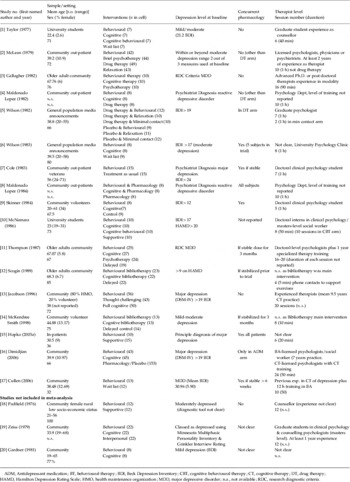
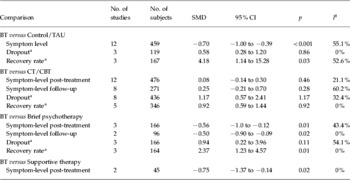
Searches conducted between December 2005 and February 2006 identified 3353 studies (see Fig. A1 for study flow chart; available in online Appendix). We identified 20 randomized controlled trials (Table 1), three of which were excluded from the meta-analysis [18–20] due to insufficient reported data. (Note: throughout the following sections numbers within square brackets refer to the Study numbers listed in Table 1.) We meta-analysed the remaining studies which included 1109 subjects (Table 2).
List of studies included in review

ADM, Antidepressant medication; BT, behavioural therapy; BDI, Beck Depression Inventory; CBT, cognitive behavioural therapy; CT, cognitive therapy; DT, drug therapy; HAMD, Hamilton Depression Rating Scale; HMO, health maintenance organization; MDD, major depressive disorder; n.a., not available; RDC, research diagnostic criteria.
Meta-analyses of studies examining the effects of behavioural therapy

BT, Behavioural therapy; CBT, cognitive behavioural therapy; CT, cognitive therapy; CI, confidence interval; SMD, Standardized mean difference; TAU, treatment as usual.
a Indicates odds ratio.
Comparison 1: Behavioural interventions versus waiting list/placebo control
Scope
Twelve studies with a total of 459 patients contributed data to this analysis [1, 2, 4–7, 9, 11, 12, 14, 16, 17]. Participants were taken from adult community sources consisting of out-patients [2, 4, 6, 7, 11, 12, 16, 17], volunteers [5, 8, 14] and students [1], two studies used older adults [11, 12]. Control interventions consisted of delayed treatment [1, 3, 9, 11, 12, 14, 16, 17], treatment as usual [4, 5, 7] and relaxation [2, 5]. All comparisons were taken immediately after intervention. Interventions ranged from supported bibliotherapy [12, 14], brief therapy with six 40-min sessions [1] to 24 50-min sessions [16]. Facilitators were advanced graduate psychology/therapy students in five studies [1, 5, 6, 7, 9], experienced psychotherapists in four studies [2, 11, 16, 17] and unclear in one study [4]. Depression symptom level was assessed using either BDI self-report measure [1, 2, 4, 5, 7, 9, 17] or the HAMD assessor rating scale [12], or both [6, 11, 14, 16]. Recovery was defined by clinical interview in one study [11] and by BDI score in two studies [2, 14].
Outcome 1: Depression symptom level post-treatment
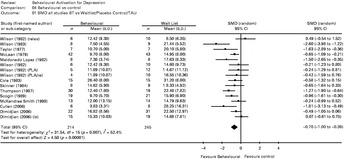
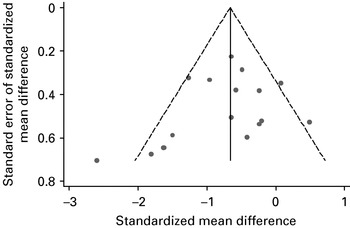
The effect of behavioural interventions against control interventions was large with a pooled SMD of −0.70 (95% CI −1.00 to −0.39), demonstrating a highly significant difference in symptom-level scores favouring the behavioural group (p<0.001) (Fig. 1). There was no evidence of publication bias for this outcome (Eggers test −1.04; 95% CI −3.39 to 1.29, p=0.35), a funnel plot showed no evidence of asymmetry (Fig. 2).
Behavioural therapy (BT) versus wait list/control/placebo symptom-level post-treatment.

Begg funnel plot symptom level: behavioural therapy versus control interventions/usual care.

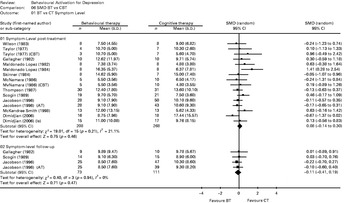
Behavioural therapy (BT) versus cognitive behavioural therapy (CBT) symptom-level post-treatment and follow-up.

Heterogeneity and sensitivity analysis
Variation in effect size (I 2) attributable to heterogeneity was 55.1%. Effect size was not significantly related to the level of baseline severity (meta-regression β-coefficient 0.04, 95% CI −0.04 to 0.12; I 2=54%, p=0.28) (Fig. A2 online). Quality assessment indicated seven studies fell below our quality threshold [1, 4–7, 9, 14], and the pooled SMD was not affected by study quality (meta-regression SMDlow quality=−0.67; SMDhigher quality=−0.75, p difference=0.77). Behavioural therapists with graduate and postgraduate qualifications produced similar effect sizes (meta-regression SMDgraduate=−0.82; SMDpostgraduate=−0.59, p difference=0.61; I 2=59%). There was no clear relationship between effect size and number of sessions (meta-regression β-coefficient 0.03; 95%CI −0.03 to 0.09; I 2=0.49, p=0.27) (Fig. A3 online). Prioritizing clinician-rated assessment in precedence over self-rated where possible made no significant difference to overall effect size (SMD −0.68, 95% CI −0.98 to −0.38).
Outcome 2: Dropout rate
Three studies contributed data to this analysis [2, 14, 16] on a total of 119 subjects with an average dropout rate of 19.17%. We found no difference between rates of dropout between intervention and control (OR 0.58, 95% CI 0.28–1.20, p=0.86).
Heterogeneity and sensitivity analysis
Variation in effect size (I 2) attributable to heterogeneity was 0%. There were insufficient studies and negligible heterogeneity to explore the impact of our a priori sources of clinical heterogeneity.
Outcome 3: Recovery rate
Three studies contributed data to this analysis [2, 11, 14] on a total of 167 subjects. There were greater rates of recovery in the behavioural intervention group (BT 52%, control 21.05%) with an odds ratio of 4.18 (95% CI 1.14–15.28, p=0.03). There were insufficient studies to test for publication bias for this outcome.
Heterogeneity and sensitivity analysis
Variation in effect size attributable to heterogeneity (I 2) was 52.6%. Low-quality studies [14] were excluded in a sensitivity analysis resulting in an odds ratio of 8.56 (95% CI 0.40–182.63, p=0.04) with an I 2 statistic of 76.4%. There were insufficient studies to explore the underlying causes of this heterogeneity further.
Comparison 2: BT versus CT/CBT
Scope
Twelve studies with a total of 476 patients contributed data to this analysis [1, 3, 4, 6, 8–14, 16]. Participants were taken from adult community sources consisting of out-patients [3, 4, 8, 11–13, 16], volunteers [6, 9, 14] and students [1, 10], with three studies using older adults [3, 11, 12]. Interventions ranged from supported bibliotherapy [12, 14], brief therapy with six 40-min sessions [1] to 24 50-min sessions [16]. Therapy was facilitated by advanced graduate psychology/therapy students in four studies [1, 6, 9, 10], experienced psychotherapists in four studies [3, 11, 13, 16] and was unclear in two studies [4, 7]. Depression symptom level was assessed using either the BDI self-report measure [1, 4, 8–10] or the HAMD assessor rating scale [12], or both [3, 6, 11, 13, 14, 16]. Recovery was defined by diagnostic interview in two studies [3, 11] and by BDI score in three studies [10, 13, 16].
Outcome 1: Depression symptom level post-treatment
No difference in effect between behavioural interventions and CBT/CT was identified with a pooled SMD of 0.08 (95% CI −0.14 to 0.30, p=0.46) (see Fig. 3). There was no evidence of publication bias for this outcome using Egger's test [intercept (0 if unbiased)=1.07; 95% CI −0.23 to 2.38, p=0.10], and a funnel plot showed no evidence of asymmetry.
Heterogeneity and sensitivity analysis
Variation in effect size (I 2) attributable to heterogeneity was 21.1%. Seven studies fell below our quality threshold [1, 4, 6, 7, 9, 10, 14] and the pooled SMD was not significantly affected by study quality (meta-regression SMDlow quality=+0.23; SMDhigher quality=−0.13, p difference=0.12; I 2=0%). Comparative effectiveness of BT versus CT/CBT varied according to baseline severity of depression, BT demonstrating a greater level of effectiveness at more severe levels of depression (meta-regression β-coefficient −0.05, 95%CI −0.10 to −0.01; I 2=0%, p=0.04) (Fig. A4 online).
Graduate-level behavioural therapists produced slightly worse results compared to those with postgraduate qualifications in comparison to CBT, although this did not reach significance (meta-regression SMDgraduate=0.28; SMDpostgraduate=−0.135, p difference=0.11; I 2=0%). There was no clear relationship between effect size and number of sessions (meta-regression β-coefficient −0.025, 95% CI −0.056 to 0.006; I 2=0.08, p=0.11). Prioritizing clinician-rated assessment in precedence over self-rated where possible made no significant difference in overall effect size (SMD 0.09, 95% CI −0.12 to 0.29).
Outcome 2: Depression symptom level at follow-up
Eight studies contributed data to this analysis [1, 3, 4, 6, 8, 10, 12, 13] on a total of 271 subjects with an average follow-up period of 4 months. Overall there was no difference in effect of BT compared to CBT/CT with a pooled SMD of 0.25 (95% CI −0.21 to 0.70, p=0.28) (Fig. 3).
Heterogeneity and sensitivity analysis
Variation in effect size (I 2) attributable to heterogeneity was 60.2%. After exclusion of low- quality studies [1, 4, 6, 8, 10] and those with follow-up of <3 months [1, 6] in a sensitivity analysis the pooled SMD was −0.11 (95% CI −0.41 to 0.19, p=0.47). There were insufficient studies to explore the underlying causes of this heterogeneity further.
Outcome 3: Dropout rate
Eight studies contributed data to this analysis [1, 3, 6, 11–14, 16] on a total of 436 subjects with an average dropout rate of 15.36%. We found no difference in rates of dropout with an odds ratio of 1.17 (95% CI 0.57–2.41, p=0.67).
Heterogeneity and sensitivity analysis
Variation in effect size attributable to heterogeneity (I 2) was 32.4%. Low-quality studies [1, 6, 14] were excluded in a sensitivity analysis resulting in an odds ratio of 1.47 (95% CI 0.60–3.61, p=0.40) with an I 2 statistic of 42.9%. There were insufficient studies to explore the underlying causes of this heterogeneity further.
Outcome 4: Recovery rate
Five studies contributed data to this analysis [3, 10, 11, 13, 16] on a total of 346 subjects. We found a pooled recovery rate of 55% with no difference between the two treatment approaches (OR 0.92, 95% CI 0.59–1.44, p=0.72).
Heterogeneity and sensitivity analysis
Variation in effect size attributable to heterogeneity (I 2) was 0%. Low-quality studies [8] were excluded in a sensitivity analysis resulting in an odds ratio of 0.93 (95% CI 0.59–1.47, p=0.77) with an I 2 statistic of 0%.
Comparison 3: Behavioural interventions versus brief psychotherapy
Scope
Three studies with a total of 166 patients contributed data to this analysis [2, 3, 11]. Participants were from adult out-patient community sources, two studies using older adults [3, 11]. Brief psychotherapy interventions were based upon a psychodynamic model in all studies. Interventions ranged from 10 to 20 sessions, all studies used experienced therapists. Studies assessed depression symptom level using the BDI alone [2] or both BDI and HAMD [3, 11]. Two studies assessed depression at intake using structured clinical interviews [3, 11], the third using cut-off points from validated self-report measures [2]. Recovery was defined by clinical interview in two studies [3, 11] and by BDI score in one study [2].
Outcome 1: Depression symptom post-treatment
The positive effect of BT against brief psychotherapy was large with a pooled SMD of −0.56 (95% CI −1.0 to −0.12, p=0.01). There were insufficient studies to test for publication bias.
Heterogeneity and sensitivity analysis
Variation in effect size attributable to heterogeneity (I 2) was 43.4%. All studies were above the quality threshold, hence we performed no sensitivity analyses. There were insufficient studies to explore the underlying causes of this heterogeneity further. Prioritizing clinician- rated assessment in precedence to self-rated assessment where possible made no difference in overall effect size (SMD −0.52, 95% CI −1.01 to −0.03).
Outcome 2: Depression symptom level follow-up
Two studies contributed data to this analysis [2, 3] on a total of 96 subjects with an average follow-up period of 4.5 months. The positive effect of behavioural interventions against brief psychotherapy was medium with a SMD of −0.50 (95% CI −0.90 to −0.09, p=0.02).
Heterogeneity and sensitivity analysis
Variation in effect size attributable to heterogeneity (I 2) was 0%. Both studies collected follow-up beyond the 3-month point and were above the quality threshold so we performed no sensitivity analyses.
Outcome 3: Dropout
Three studies contributed data to this analysis [2, 3, 11] on a total of 166 subjects with an average dropout rate of 14.45% across studies. No difference in dropout was observed with an odd ratio of 0.94 (95% CI 0.22–3.96, p=0.11). There were insufficient studies to test for publication bias.
Heterogeneity and sensitivity analysis
Variation in odds ratio attributable to heterogeneity (I 2) was 54.1%. All studies were above the quality threshold so no sensitivity analysis was performed.
Outcome 4: Recovery rate
Three trials contributed data to this analysis [2, 3, 11] on a total of 164 subjects (note two subjects deceased). Greater rates of recovery were observed in BT (56.79%) compared to brief psychotherapy (36.14%) with an odds ratio of 2.37 (95% CI 1.23–4.57, p=0.01). There were insufficient trials to test for publication bias.
Heterogeneity and sensitivity analysis
Variation in odds ratio attributable to heterogeneity (I 2) was 0%. All studies were above the quality threshold so no sensitivity analysis was performed.
Comparison 4: Behavioural interventions versus supportive therapy
Scope
Two studies with 45 subjects contributed data to this analysis [10, 15]. Participants were university students [10] and in-patients [15].
Interventions ranged from six 20-min sessions [10] to eight, 50-min sessions [15], delivered by doctoral clinical psychology students [10] or a clinical psychologist [15]. Both studies measured depression symptom levels by self-report measures (BDI), with one [10] using HAMD also. Depression at baseline was assessed by self-report measures [10] or clinical interview [15].
Outcome 1: Depression symptom level post-treatment
The positive effect of BT against supportive therapy was large (SMD −0.75, 95% CI −1.37 to −0.14, p=0.02). There were insufficient studies to test for publication bias.
Heterogeneity and sensitivity analysis
The variation in effect size attributable to heterogeneity (I 2) was 0%. Both studies fell below the quality threshold therefore no sensitivity analysis was performed. Insufficient data were available in this comparison for further analysis.
Discussion
We found clear evidence that BT is an effective treatment for depression. It provides superior outcomes to control, supportive counselling and brief psychotherapy. BT and CBT provided equivalent results with no statistically significant differences in post-treatment and follow-up symptom levels, in recovery rate or dropouts.
The BT trials were variable in design and delivery. To some degree, we have been able to utilize this variability to explore factors relating to magnitude of effectiveness. Such meta-regression analysis makes observational associations and is exploratory in nature and as such loses the power of causal inference (Higgins & Thompson, Reference Higgins and Thompson2004). We considered such an approach viable and efficient in this review as the alternative of planning large-scale prospective trials with many arms is costly and time consuming. Sufficient data for this analysis were available only where BT was compared to controls or CT/CBT post-treatment on symptom level. Our meta-regression found that compared to controls, baseline severity, length of treatment and level of qualification were not related to BT effect although there is a positive relationship between greater baseline severity and BT efficacy compared to CT/CBT. Such findings provide direction in the development of BT for future research. They indicated that further exploration is needed into length of treatment and skill level required for optimum BT delivery. Our review identified a number of trials directly comparing BT with drug therapy; this was not included as an a priori comparator. Such a comparison would be a useful addition in any future review as BT would appear equivalent, if not superior, to pharmacology in the included studies.
Our meta-analysis complements and concurs with other publications that include behavioural interventions as part of wider CBT reviews (Dobson, Reference Dobson1989; Gloaguen et al. Reference Gloaguen, Cottraux, Cucherat and Blackburn1998; Churchill et al. Reference Churchill, Hunot, Corney, Knapp, McGuire, Tylee and Wessley2001), or focus on activation alone (Cuijpers et al. Reference Cuijpers, van Straten and Warmerdam2007). In contrast to these previous reviews we chose to focus on individual rather than group interventions, and included dropout and recovery rate analyses. Our review includes more studies than previous reviews due to our broader inclusion criteria and the inclusion of recent and unpublished data. The studies drew patients from a range of settings such as in-patient, psychiatric out-patient and volunteer cohorts in adult, older adult and student settings. Interventions varied considerably across studies from supported self-help using minimal therapist contact to full psychotherapy. The quality of included trials varied considerably, with some of low quality delivering results that deviated considerably from the overall picture [4, 8]. We attempted to account for this by the use of sensitivity analysis, random-effects modelling and meta-regression of a priori variables. Interpretation of our results must be made with such factors in mind. Caution must also be exercised in interpreting the comparisons of behavioural interventions with brief psychotherapy and supportive therapy due to the low numbers of studies and small sample sizes.
Of particular interest is the observed equivalence between behavioural interventions and the CBT/CT strongly recommended in guidelines (e.g. NICE, 2004). In addition to similar levels of mean symptom improvement, we observed no difference in recovery or dropout. These combined findings indicate that behavioural interventions are as effective and acceptable as CBT/CT. Such findings partially endorse the BT parsimony hypothesis advanced by Jacobson and colleagues (Jacobson et al. Reference Jacobson, Dobson, Traux, Addis, Koerner, Gollan, Gortner and Prince1996, Reference Jacobson, Martell and Dimijan2001). They question the utility of adding ‘complex’ cognitive techniques to simpler behavioural interventions to improve clinical outcome. One of the attractions of behavioural interventions is that they may lend themselves to shorter training of less-qualified individuals, thus assisting the current scarcity of therapist availability and overwhelming demand (Centre for Economic Performance's Mental Health Policy Group, 2006). We found no direct evidence in this review to support such an assumption, as we found no studies using non-psychology- or non-psychotherapy-trained individuals delivering BT. However, when we examined the impact on level of training of those who had delivered BT in meta-regression, we did not find that superior outcomes were associated with ‘higher level’ qualifications. Such findings may support the assertion that BT may be suitable for shorter training and hence improve access by increasing available therapists within limited resources. We recommend further research of this question based upon our findings.
In summary, BT for depression is an effective intervention that has equal, if not better, outcomes than alternative and currently recommended therapies. Our review adds to the literature in the area as it provides a broad overview of the current evidence, reports data on recovery, dropout and explores the effect of baseline covariants in relation to depression symptom change. We recommend further research into the efficacy of behavioural treatments of depression, in particular Jacobson et al.'s (Reference Jacobson, Dobson, Traux, Addis, Koerner, Gollan, Gortner and Prince1996) parsimony hypothesis where the intervention is delivered by ‘technicians’ rather than therapists.
Declaration of Interest
None.
Note
Supplementary information accompanies this paper on the Journal's website (http://journals.cambridge.org).