INTRODUCTION
Major tropical rivers may act as barriers to dispersal for some animal taxa, thus promoting genetic divergence in their populations and ultimately their speciation. The river barrier hypothesis, proposed by Wallace (Reference WALLACE1852) to explain the distribution of monkeys in the Amazon, and later suggested as an explanation of the extraordinary species diversity in the Amazon in general, implies that (1) rivers cause increased genetic divergence between conspecific populations, (2) geographical distribution of species is constrained by rivers, and (3) species on the same side of the river tend to be closely related, forming monophyletic groups. These effects should depend on the size of the river, increasing thus from the headwaters to the river estuary. The river barrier hypothesis has been tested using (1) molecular markers in populations (mammals: Patton et al. Reference PATTON, DASILVA and MALCOLM1994, Peres et al. Reference PERES, PATTON and DASILVA1996; birds: Aleixo Reference ALEIXO2004; frogs: Funk et al. Reference FUNK, CALDWELL, PEDEN, PADIAL, DE LA RIVA and CANNATELLA2007, Gascon et al. Reference GASCON, LOUGHEED and BOGART1998, Noonan & Wray Reference NOONAN and WRAY2006, Zhao et al. Reference ZHAO, DAI and FU2009; insects: Tantrawatpan et al. Reference TANTRAWATPAN, SAIJUNTHA, PILAB, SAKDAKHAM, PASORN, THANONKEO, THIHA, SATRAWAHA and PETNEY2011), (2) distribution of geographical ranges of species (mammals: Harcourt & Wood Reference HARCOURT and WOOD2012; birds: Hayes & Sewlal Reference HAYES and SEWLAL2004; insects: Knopp et al. Reference KNOPP, RAHAGALALA, MIINALA and HANSKI2011), and (3) phylogeographical analysis (frogs: Symula et al. Reference SYMULA, SCHULTE and SUMMERS2003; insects: Hall & Harvey Reference HALL and HARVEY2002). While numerous studies have not found rivers acting as barriers (Gascon et al. Reference GASCON, LOUGHEED and BOGART1998, Knopp et al. Reference KNOPP, RAHAGALALA, MIINALA and HANSKI2011, Patton et al. Reference PATTON, DASILVA and MALCOLM1994, Symula et al. Reference SYMULA, SCHULTE and SUMMERS2003), others documented an increased diversification across the river at least in some circumstances or taxa (Aleixo Reference ALEIXO2004, Hayes & Sewlal Reference HAYES and SEWLAL2004, Noonan & Wray Reference NOONAN and WRAY2006, Peres et al. Reference PERES, PATTON and DASILVA1996, Tantrawatpan et al. Reference TANTRAWATPAN, SAIJUNTHA, PILAB, SAKDAKHAM, PASORN, THANONKEO, THIHA, SATRAWAHA and PETNEY2011, Zhao et al. Reference ZHAO, DAI and FU2009). As summarized by Haffer (Reference HAFFER1997) for Amazonia, rivers are not unimportant, but have been overrated as barriers.
Almost all studies focused geographically on rivers in Amazonia (but see Tantrawatpan et al. Reference TANTRAWATPAN, SAIJUNTHA, PILAB, SAKDAKHAM, PASORN, THANONKEO, THIHA, SATRAWAHA and PETNEY2011, Zhao et al. Reference ZHAO, DAI and FU2009) and considered their importance for the origin of species (Haffer Reference HAFFER1997). Here, we broaden the analysis to examine whether rivers, acting as dispersal barriers, can also impact on the quantitative composition of communities. In particular, barriers may slow down, rather than completely prevent, dispersal which may lead to metapopulation dynamics, where each population could follow its own population dynamics, and to some extent function independently from other populations (Hanski Reference HANSKI1999). Rivers acting as barriers could thus also cause heterogeneity in quantitative community composition, and not only influence the presence and absence of species. Their effect will be examined here using frog assemblages in the lowland rain forests surrounding the Sepik, one of the major tropical rivers outside the Amazon.
METHODS
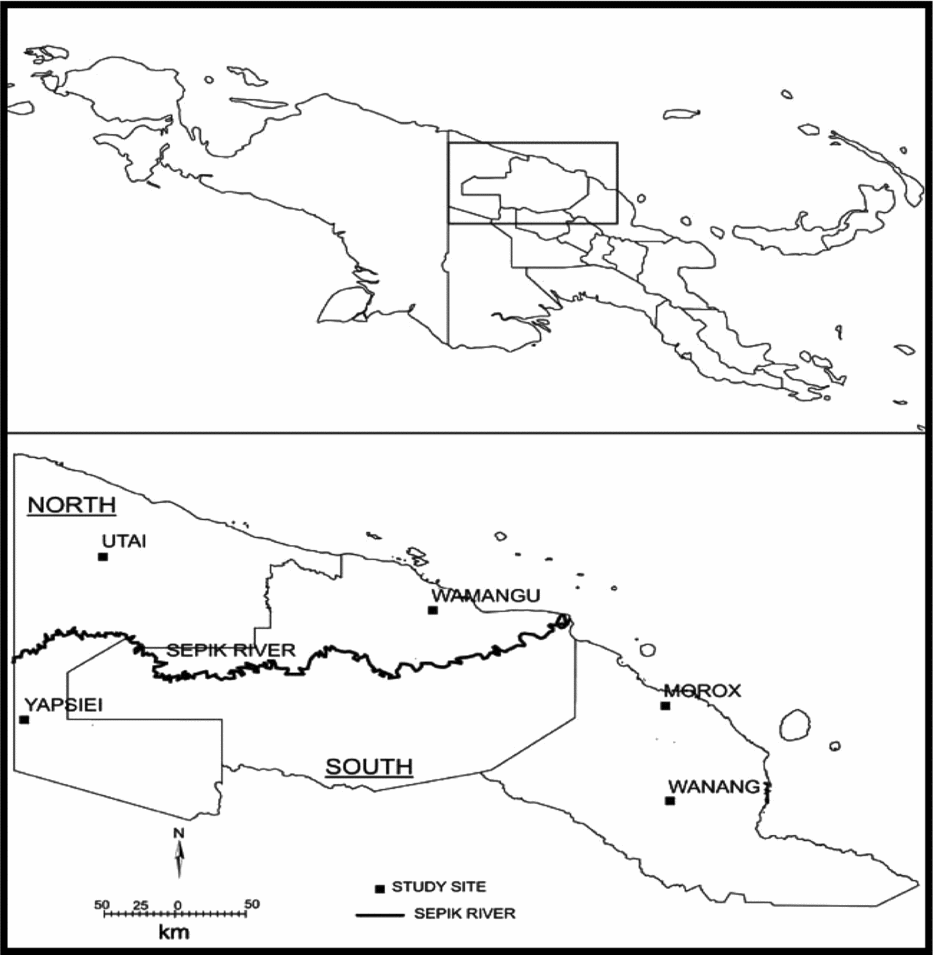
The study was situated in northern New Guinea, within lowlands bisected by the Sepik, a major tropical river (Figure 1). The Sepik River is 1100km long, and has a mean discharge of 7000 m3 s−1 (Mitchell et al. Reference MITCHELL, PETR and VINER1980). It is the largest river system in Papua New Guinea in terms of area drained (78000km2). It dissects approximately 7500km2 of relatively uniform lowland rain forest on its floodplains (Novotny et al. Reference NOVOTNY, MILLER, BASSET, JANDA, SETLIFF, HULCR, STEWART, AUGA, MOLEM, MANUMBOR, TAMTIAI, MOGIA and WEIBLEN2007). The study area is part of a complex tectonic region at the convergence of the Australian and Pacific plates. The northern lowlands in New Guinea originated as a result of the accretion of volcanic arc terranes to the central cordillera which borders our study area in the south. The Bewani and Torricelli ranges bordering the study area in the north accreted 30–35 million years ago (Davies et al. Reference DAVIES, PEREMBO, WINN, KENGEMAR and Hancock1997, Pigram & Davies Reference PIGRAM and DAVIES1987). The last accretion event involved the Adelbert and Finisterre block and took place about two million years ago (Abbott Reference ABBOTT1995).
Map of Papua New Guinea showing the study area with five surveyed sites, two on the northern and three on the southern side of the Sepik River.

The study area comprises a 500 × 150-km area of lowland terrain with continuous rain forest. The Sepik River, which is up to 1 km wide, accompanying floodplain swamps, lakes and grasslands, up to 70 km wide, represent the only large discontinuity in the rain forest ecosystem of the study area (Reiner & Robbins Reference REINER and ROBBINS1964). We surveyed five sites (03°24′–05°14′S, 141°05′–145°12′E), including two sites on the north side of the river and three sites south of the Sepik River (Figure 1). All sites were located in the lowland rain forest (40–250 m asl) with a mean annual rainfall of 2000–4000 mm, a moderate dry season from July to September, and a mean air temperature of ~26 °C (McAlpine et al. Reference MCALPINE, KEIG and FALLS1983).
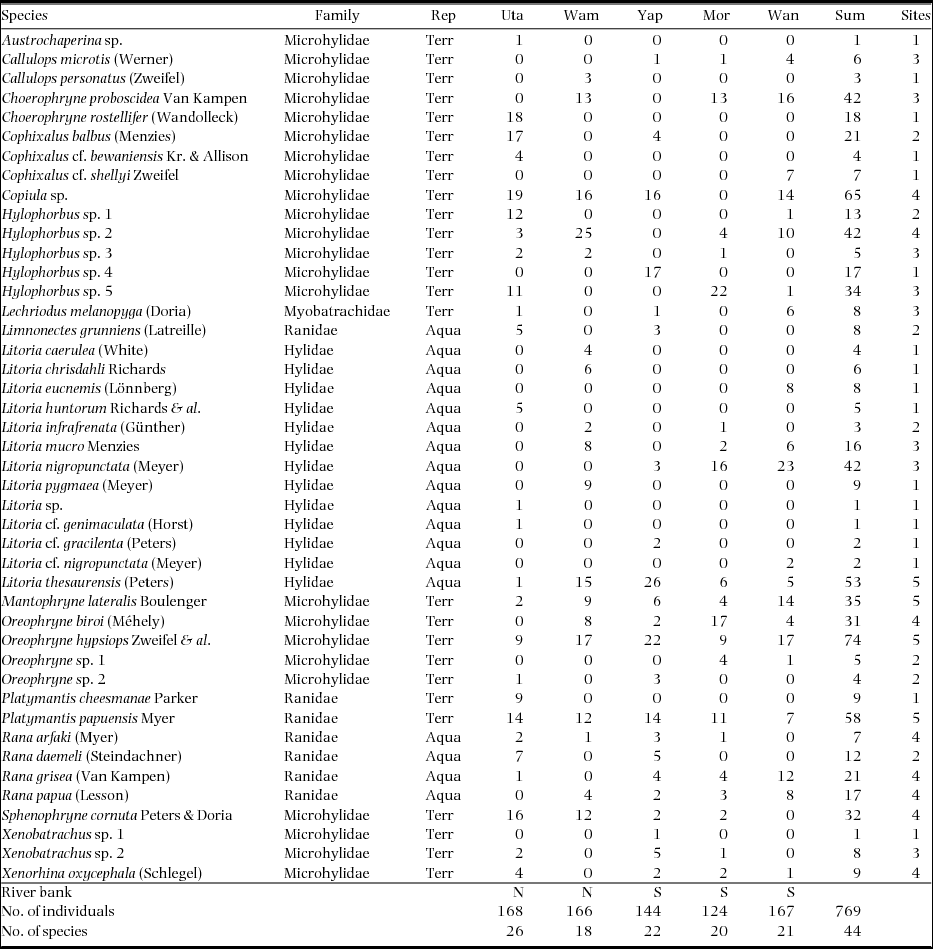
Each site was surveyed once, during the wet season, between May 2004 and March 2005. All habitats within an approximately 5-km2 area, including primary and secondary forest vegetation, swamps and stagnant water bodies, were surveyed at each site between 18h30 and 03h30 for 13–20 consecutive nights. This sampling effort was sufficient to survey local assemblages (Dahl et al. Reference DAHL, NOVOTNY, MORAVEC and RICHARDS2009) and its results are used in the present analysis (Appendix 1). We detected frogs visually using a headlamp and also by their advertisement calls. The frog calls were recorded, specimens were photographed and vouchers deposited at the University of Papua New Guinea (Port Moresby) and the South Australian Museum (Adelaide).
The frog species were classified into aquatic breeders, those having a tadpole stage, and terrestrial breeders that are independent of water as they have direct embryonic development from egg to a fully formed hatchling frog (Anstis et al. Reference ANSTIS, PARKER, HAWKES, MORRIS and RICHARDS2011, Austin et al. Reference AUSTIN, HAYDEN, BIGILALE, DAHL and ANAMINIATO2008, Zweifel & Tyler Reference ZWEIFEL and TYLER1982). These two ecological groups were analysed separately.
DATA ANALYSIS
The similarity of frog assemblages was measured using the Chao–Jaccard similarity index which measures the proportion of shared species corrected for possible bias owing to incomplete sampling of rare species. We also calculated the Bray–Curtis similarity index which responds to differences in abundance of individual species, not only their presence and absence. Both similarity measures were calculated using EstimateS. The possible change in species composition in frog assemblages from opposite sides of the river was explored by the Detrended Correspondence Analysis (with species abundance log transformed and rare species down-weighted) (Leps & Smilauer Reference LEPS and SMILAUER2003). The analysis was implemented in the program Canoco 4.5. The distribution of frog species at the same or different sides of the river was tested against the null hypothesis for each species retained and the number of sites where it was sampled, but we randomized their position with regards to the Sepik River.
RESULTS
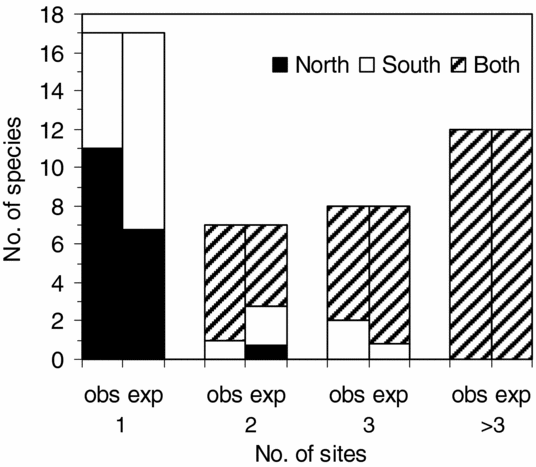
We sampled a total of 769 individual frogs from 44 species (Appendix 1). Species richness ranged from 18 to 26 species per site. Seventeen species (39%) were recorded from only a single site, while 12 species (27%) were widespread; occurring at four–five sites and thus inevitably on both sides of the Sepik River. The seven species present at two sites had 40% probability of being limited to a single side of the river by chance, for the eight species present at three sites the probability was 10%. The combined random distribution expectation for species found at two or three sites was 3.6 species limited to a single side of the river, which was not significantly different from three species which exhibited this distribution (χ2 = 0.132, df = 1, P > 0.7, Figure 2).
The distribution of frog species (limited to the northern or southern Sepik River bank, or on both sides of the river) recorded from one, two, three, and more than three sites. The observed numbers of species (obs) are compared to the numbers expected (exp) for random distribution of species which retains the number of sites from which each species was recorded but randomizes their position with respect to the Sepik river.
Ten from the total of 18 species breeding in water were recorded from a single side of the river, as well as 11 from the 26 terrestrially breeding species. The proportion of species with restricted distribution was not significantly different between aquatic and terrestrial breeders (56% and 42% respectively, Fisher's exact test, P > 0.05).
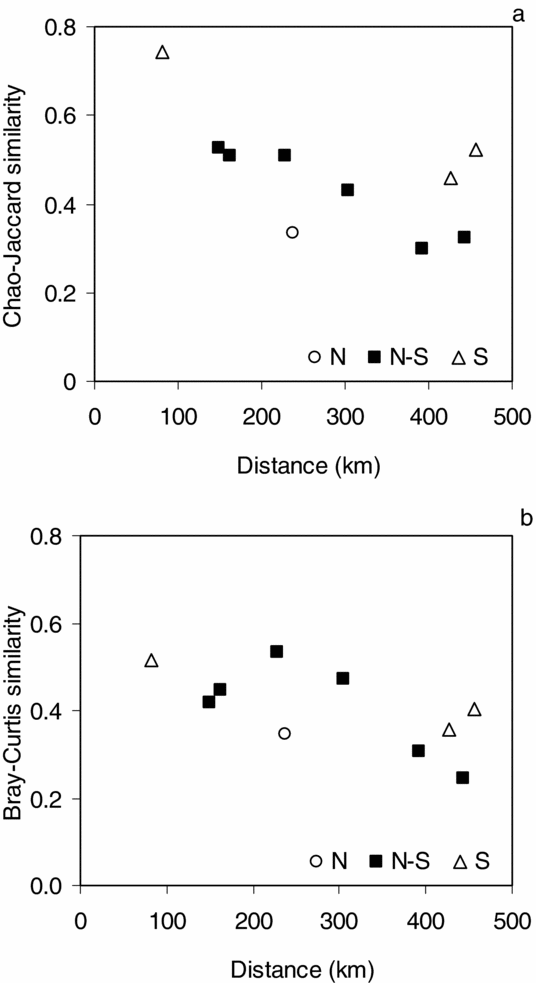
The similarity of species composition (Chao–Jaccard index) between sites decreased with the logarithm of their distance. Further, the Bray–Curtis index which measures the similarity in the abundance of species decreased linearly with geographical distance (Figure 3). The similarity values for the paired sites on the same side of the river and those paired sites from the opposite sides of the river followed the same decreasing similarity of the distance relationship, although our data are too limited for formal statistical tests.
The relationship between similarity of frog assemblages, Chao–Jaccard (a) and Bray–Curtis (b) indices, and their geographical distance in Papua New Guinea. The similarity decay with distance function (logarithmic for Chao–Jaccard and linear for Bray–Curtis indices) was fitted to all pairs of sites, including those confined to the northern (N) or southern (S) side of the river and those including sites from the opposite sides of the river (N–S).
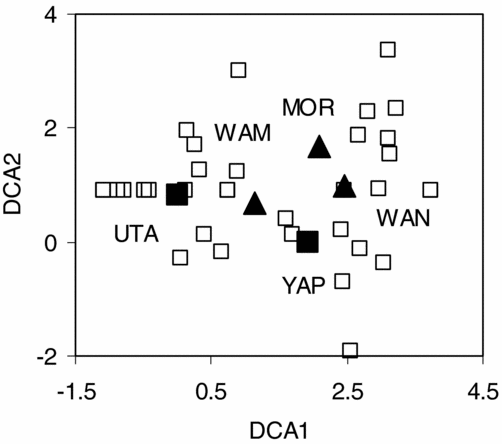
The quantitative composition of frog assemblages as depicted by DCA did not reveal any dichotomy between the northern and the southern sides of the river (Figure 4).
The DCA ordination of frog assemblages showing similarity relationships between study sites on the northern (solid squares) and southern (solid triangles) banks of the Sepik river. Empty squares show distributional optima of all frog species. Centroids show individual study sites: UTA = Utai, WAM = Wamangu, YAP = Yapsiei, MOR = Morox, WAN = Wanang.
DISCUSSION
We tested the riverine barrier hypothesis by surveying frogs in all habitat types, viz. the forest floor, arboreal habitats and forest streams at a series of sites on both sides of the Sepik River. Although the assemblages exhibited distinct geographical patterns, as indicated by their similarity decay with increasing geographical distance, we found there was no evidence that the Sepik River acts as a barrier to frog dispersal in northern Papua New Guinea. These results support the conclusions of Novotny et al. (Reference NOVOTNY, MILLER, BASSET, JANDA, SETLIFF, HULCR, STEWART, AUGA, MOLEM, MANUMBOR, TAMTIAI, MOGIA and WEIBLEN2007) who found that the Sepik River was not a dispersal barrier for herbivorous insects (Lepidoptera). This conclusion was likely expected for the aquatic breeders but interestingly applied to terrestrial-breeding frog species constituting the majority of species in New Guinea's forest.
Our study area represents a highly dynamic landscape, which is characteristic for New Guinea (Johns Reference JOHNS1986). Most areas with our study sites between the central and the northern ranges submerged from the Early Miocene until the Pliocene epoch (Davies et al. Reference DAVIES, PEREMBO, WINN, KENGEMAR and Hancock1997). The oceanic incursions continued during the periods of elevated sea level, including a sea that stretched 100 km inland and has separated our Wamangu and Wanang sites as recently as 6000 y ago (Swadling Reference SWADLING1997). The vegetation has also changed over time; a mosaic of broadleaved open and closed forests covered the study area during a cooler and drier period about 17000 y ago (Nix & Kalma Reference NIX, KALMA and Walker1972). The rapid changes in the course of the river, the extent of flowing water, the stagnant water and the swampy habitats, as well as the sea incursions suggest that our analysis tests the recent dispersal ability of frog species in a highly variable landscape, rather than ancient barriers to speciation.
Other tropical studies also failed to find major effects of rivers on the species composition of frogs (Gascon et al. Reference GASCON, MALCOLM, PATTON, DA SILVA, BOGART, LOUGHEED, PERES, NECKE and BOAG2000) or on the intraspecific genetic differentiation among their populations (Gascon et al. Reference GASCON, LOUGHEED and BOGART1998, Gehring et al. Reference GEHRING, PABIJAN, RANDRIANIRINA, GLAW and VENCES2012, Lougheed et al. Reference LOUGHEED, GASCON, JONES, BOGART and BOAG1999, Zhao et al. Reference ZHAO, DAI and FU2009). However, rivers can still be important barriers to other taxa, such as birds (Briggs Reference BRIGGS1974, Hayes & Sewlal Reference HAYES and SEWLAL2004), or frogs in certain ecological situations. For instance, rivers are barriers to gene flow to the frog species Rana kukunoris at high elevations (Li et al. Reference LI, CHEN, TU and FU2009). Further, Fouquet et al. (Reference FOUQUET, LEDOUX, DUBUT, NOONAN and SCOTTI2012) detected restricted gene flow across a river for a terrestrially breeding species Adenomera andreae with limited dispersal ability.
In conclusion, it appears that Papua New Guinean rivers may not be important barriers limiting frog dispersal, a pattern also prevalent elsewhere. Our conclusions are preliminary since our study was based on a limited number of sites. On the other hand, we have expanded previous analytical approaches to explore the effect of rivers on quantitative community composition, which potentially affects the metapopulation dynamics at the species level. Both qualitative and quantitative results suggested that the river had no effect. In contrast mountain ridges, and in particular the central cordillera that divides the island's lowlands into northern and southern parts, played a major role in determining the frog distributions, as suggested by the differences in the frog faunas between the Papua New Guinea's northern and southern lowlands (Allison Reference ALLISON, Keast and Miller1996, Richards Reference RICHARDS2002).
ACKNOWLEDGEMENTS
We acknowledge funding support from Conservation International to S.J.R. and C.D., the Czech Ministry of Education (CZ.1.07/2.3.00/20.0064, LH11008) to V.N., the UK Darwin Initiative to C.D. and V.N., and the US National Science Foundation to C.D. and V.N. (DEB0211591) and to Christopher C. Austin (DEB0445213). We thank the PNG Wildlife Conservation Society and the PNG Institute of Biological Research for logistical support, Jimmy Moses for the study map in Figure 1, the numerous field assistants for their help and the forest owners for the permission to work on their lands.
The number of individual frogs recorded for each species and study site. Each species is characterized by its family, mode of reproduction (Rep., Aqua = Aquatic or Terr = Terrestrial), the number of individuals at each study site (Uta = Utai, Wam = Wamangu, Yap = Yapsiei, Mor = Morox, Wan = Wanang), the total number of individuals (Sum) and the number of sites.