


Political science has a diversity problem. Gendered gaps in the profession are now well documented (Brown et al. Reference Brown, Horiuchi, Htun and Samuels2020; Teele and Thelen Reference Teele and Thelen2017); studies on inequalities based on race and ethnicity (Garcia and Alfaro Reference Garcia and Alfaro2021; Reid and Curry Reference Reid and Curry2019; Smith Gillooly, and Hardt Reference Smith, Gillooly and Hardt2022) and sexual orientation are also increasing (Novkov and Barclay Reference Novkov and Barclay2010; Smith Reference Smith2011). A dimension that has received comparatively less attention is the territorial diversity of authors in international journals.
Whereas political science is now more “globalized” and scholars based in different settings increasingly address similar questions using similar methods (Montal, Pauselli, and Yamin Reference Montal, Pauselli and Yamin2022), scholarship by Global South–based political scientists nevertheless rarely appears in prestigious political science journals (Barceló et al. Reference Barceló, Paik, van der Windt and Zhai2025). International journals influence whose scholarship is widely read in the field. Thus, the absence of Global South authors from these publications means that scholars based in the Global North effectively shape political science scholarship (Zimbalist and Omodei Reference Zimbalist and Omodei2026).
Research outputs are the product of demand and supply factors. Demand factors, such as editors’ assessments of topic relevance (Brown Reference Brown2021) and methodological preferences (Samuels Reference Samuels2018), may influence the likelihood of acceptance in top general-interest journals. However, supply factors also matter. For instance, women’s lower submission rates and perceptions of journals as more “masculinized” or “feminized” rather than gender bias in the review process explain gender gaps in publication across journals (Brown et al. Reference Brown, Horiuchi, Htun and Samuels2020; Djupe, Smith, and Sokhey Reference Djupe, Smith and Sokhey2019; Samuels Reference Samuels2018). Critically, gaps in submission rates may emerge early, during graduate school (Tudor and Yashar Reference Tudor and Yashar2018), and persist throughout a career.
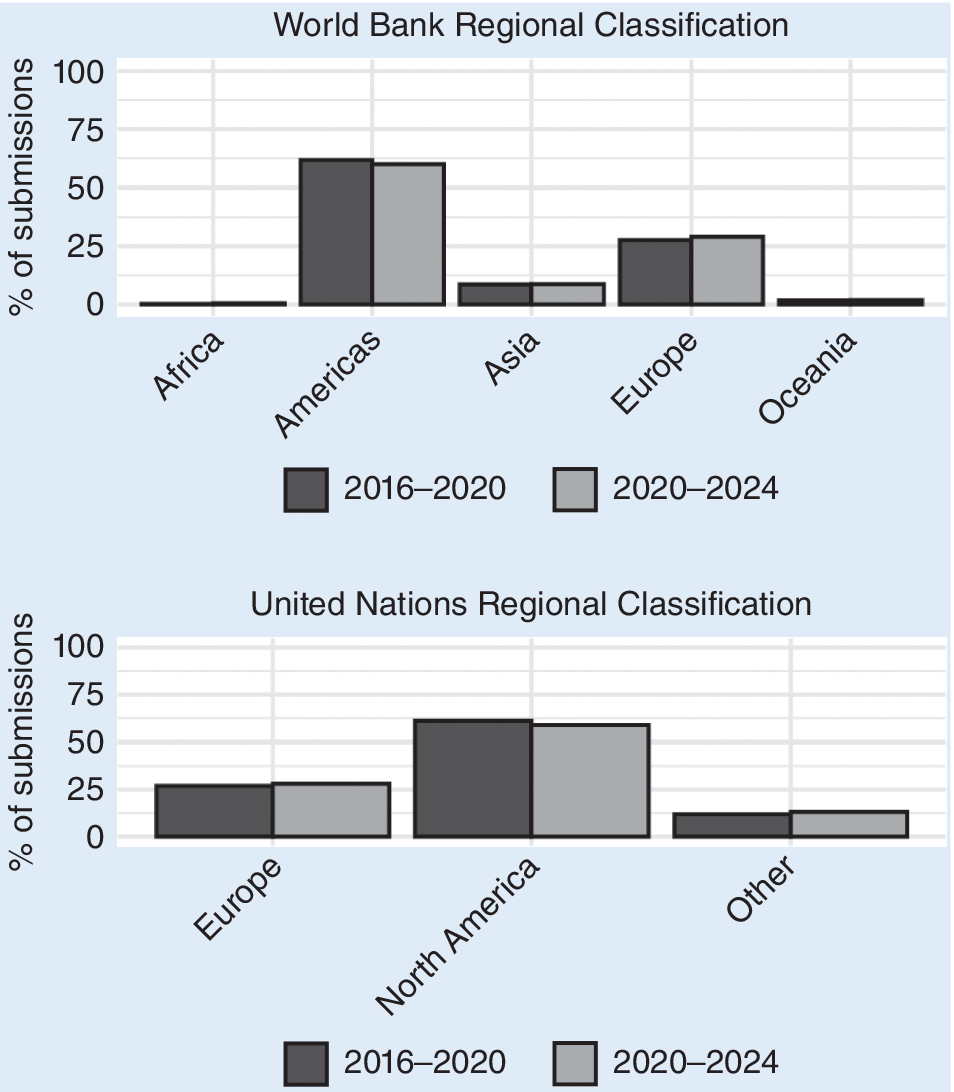
Indeed, there is evidence that editorial and reviewer demand for articles on Global South cases is lower than for articles on cases from North America and Western Europe (Wilson and Knutsen Reference Wilson and Knutsen2022). However, on their own, demand-side factors may not explain the underrepresentation of Global South–based authors in international journals (Breuning et al. Reference Breuning, Feinberg, Gross, Martinez, Sharma and Ishiyama2018; Montal, Pauselli, and Yamin Reference Montal, Pauselli and Yamin2024). Given its status as the discipline’s top outlet, American Political Science Review provides a useful benchmark for assessing territorial inequality (Breuning et al. Reference Breuning, Feinberg, Gross, Martinez, Sharma and Ishiyama2018). As shown in figure 1, an examination of the distribution of new submissions by the corresponding authors’ locations between 2016 and 2024—spanning two distinct editorial teams—revealed a striking and persistent concentration of scholarly activity in the Global North.
New Submissions to APSR by Location of Corresponding Author, 2016–2024
Prepared by the authors with data from the American Political Science Review Annual Editorial Report (Tripp and Dion Reference Tripp and Dion2024). The y-axis shows the percentage composition of submissions by corresponding authors from different regions across two editorial teams (2016–2020 and 2020–2024).

Figure 1 Long description
The figure consists of two vertically stacked panels. Both panels share a Y-axis labeled percentage of submissions ranging from 0 to 100 in increments of 25. A legend at the bottom of each panel identifies dark gray bars as 2016 to 2020 and light gray bars as 2020 to 2024.
Top Panel: World Bank Regional Classification.
* Africa: Submissions are near 0 percent for both periods.
* Americas: The highest volume, with approximately 62 percent in 2016 to 2020, slightly decreasing to 60 percent in 2020 to 2024.
* Asia: Approximately 10 percent for both periods.
* Europe: Approximately 28 percent in 2016 to 2020, increasing slightly to 30 percent in 2020 to 2024.
* Oceania: Near 0 percent for both periods.
Bottom Panel: United Nations Regional Classification.
* Europe: Approximately 28 percent in 2016 to 2020, increasing slightly to 30 percent in 2020 to 2024.
* North America: Approximately 62 percent in 2016 to 2020, decreasing to 60 percent in 2020 to 2024.
* Other: Approximately 12 percent in 2016 to 2020, increasing slightly to 14 percent in 2020 to 2024.
As illustrated in figure 1, across both periods, authors based in North America and Europe accounted for the overwhelming majority of submissions, comprising almost 90% of the total. By contrast, submissions from outside of these regions remained limited, increasing only marginally from 11.9% in 2016–2020 to 13.1% in 2020–2024. Because the percentages show submissions rather than acceptances, they reveal inequalities that arose before editorial selection.
Addressing the underrepresentation of Global South–based scholars in international journals requires tackling demand-side factors, such as diversifying the pool of journal editors—overwhelmingly composed of Global North–based scholars (Naxera Reference Naxera2026)—promoting more inclusive citation practices, and methodological diversity (Zimbalist and Omodei Reference Zimbalist and Omodei2026). However, it also requires improving supply-side factors: if Global South–based scholars are not submitting articles to international journals, as recent data and examples suggest (Breuning et al. Reference Breuning, Feinberg, Gross, Martinez, Sharma and Ishiyama2018), their studies will not appear in them.
Although we echo the broader calls for changes to demand-side factors, this study focuses on what was within our reach. The Writing Academy was a training and mentorship program funded by the British Academy and designed to promote the internationalization of political science doctoral students in Brazil. Similar initiatives have been implemented to address gaps within the discipline, including efforts to reduce gender inequalities in methods training in the United States and Europe (Adida et al. Reference Adida, Lake, Shafiei and Platt2020; Barnes, Beaulieu, and Krupnikov Reference Barnes, Beaulieu and Krupnikov2014; Gatto et al. Reference Gatto, Gohdes, Traber and Van Der Velden2020), as well as race-based disparities (Reid and Curry Reference Reid and Curry2019). With funding now increasingly available to support these initiatives in the Global South, particularly through organizations such as the British Academy, comparable programs are proliferating in Latin America, Africa, and Asia. This expansion underscores the importance of systematically evaluating their impact, as was done for earlier interventions aimed at promoting diversity in Global North contexts (see, e.g., Barnes et al. Reference Barnes, Beaulieu and Krupnikov2014; Mitra et al. Reference Mitra, Kapiszewski, Kleinpaste and Smith2024; and Stoll, McLaughlin-Zamora, and Anderson Reference Stoll, McLaughlin-Zamora and Anderson2023).
The choice to carry out the intervention in Brazil was well justified given the strength of its academic environment in political science but continued underrepresentation in international journals. The country hosts a large and increasingly professionalized scholarly community, with students exposed to research from an early stage through funded opportunities to conduct original research during their undergraduate studies (iniciação científica). This is complemented by research-oriented master’s programs, which typically provide two years of funding and emphasize methodological training through core coursework and summer schools.
Brazilian students also benefit from resources that support internationalization, including funding to attend conferences and opportunities to spend extended periods abroad at leading international departments. Doctoral training, although diverse—as also is the case across the Global North, including Europe (Gatto et al. Reference Gatto, Gohdes, Traber and Van Der Velden2020)—tends to be structured, with students actively embedded in research networks and often collaborating with faculty members as research assistants.
Academic incentives also place strong emphasis on graduate students publishing in peer-reviewed journals, particularly those with high impact factors, thereby encouraging international publication. New guidance published by the Brazilian Federal Agency for Support and Evaluation of Graduate Education (CAPES) uses the journal impact factor as the primary criterion for assessing publication quality and ranks political science programs based on the volume and quality of PhD students’ research output. Therefore, the relatively low presence of Brazilian scholars in international outlets is unlikely to reflect a lack of research capacity or incentives, and it points to other barriers that we explore in this study.
This article proceeds as follows. We first introduce the Writing Academy and then use applicant survey data to identify the main barriers to international publishing. We show that knowledge of international publication rules, rather than language, is the main obstacle to international publication. We then examine post-intervention survey data to assess whether targeted training and mentorship can reduce knowledge and confidence gaps. We conclude by reflecting on the potential of training and mentoring programs to promote diversity in the profession.
We show that knowledge of international publication rules, rather than language, is the main obstacle to international publication.
THE WRITING ACADEMY
Funded by the British Academy, the Writing Academy was a two-year program designed to train political science doctoral students in Brazil to publish in international journals. To achieve its goals, the program combined interactive sessions with individual feedback on participants’ papers. The program was developed in collaboration with political science professors based in Brazil who have international publishing experience and who supervise doctoral students. It was conceived to address the principal challenges to internationalization identified through the applicant survey and by Brazilian colleagues and that reasonably could be mitigated through an intervention of this nature.
As such, the program focused primarily on reducing knowledge gaps about the “rules” of international publishing. Sessions introduced participants to the international publication environment, demystified the core elements of an article for publication in an international journal, and outlined the steps of the publication process (see online appendix A for the full program). The program combined two in-person workshops, online feedback sessions, and a mock double-anonymized peer-review process between 2024 and 2025. To deliver the sessions and mentor-selected participants, we recruited a team of experienced scholars based in the United Kingdom, Brazil, and the United States. The mentorship team also included editors from leading international and Brazilian journals.
The call invited applicants to submit an abstract for a proposed paper to be published in an international journal. In the selection process, each of the three main convenors independently scored proposals for theoretical coherence and empirical viability (e.g., data access and availability), without favoring any methodological approach. Average scores formed the basis for an initial ranking. Because the Writing Academy was a two-year program, we also prioritized students who were not finalists and therefore could commit to the full program. Selection criteria also considered within-country inequalities.
Research from other contexts has revealed that gendered and racialized gaps emerge early in graduate school (Casey et al. Reference Casey, Rutledge-Prior, Young, Malloy and Berdahl2023; Gatto et al. Reference Gatto, Gohdes, Traber and Van Der Velden2020; Smith, Gillooly, and Hardt Reference Smith, Gillooly and Hardt2022). To ensure that the program was not reducing gaps internationally while exacerbating them domestically (Cândido, Campos, and Feres Reference Cândido, Campos and Feres2021), we established that both the cohort of participants and the team of mentors should be gender balanced, racially diverse, and drawn from across Brazil’s regions. This information was made clear to applicants in the call for applications and the questionnaire information sheet.
From the 95 applications received, we selected 15 PhD students (i.e., a 16% acceptance rate). Because the selection criteria included promoting diversity across region, gender, and race and ethnicity, there was a lower proportion of participants from Southeast institutionsFootnote 1 than among applicants and a higher proportion of nonwhite students (Araújo, Gatto, and Inácio Reference Araújo, Malu and Inácio2026). Participants otherwise had profiles similar to those of other applicants in key characteristics, such as the disciplinary area of their prior training, whether their doctoral studies were funded, and whether they were beneficiaries of affirmative-action policies (figure 2).
Writing Academy Participants’ Profile
Prepared by the authors with survey data collected as part of the Writing Academy (N=92). The y-axis shows the percentage composition of each group (selected and not selected), indicating the proportion of applicants who are/are not from an institution in the Southeast; are/are not women; are/are not nonwhite; have/do not have a master’s in humanities or social sciences; receive/do not receive funding for pursuing a PhD; entered/did not enter their programs as part of affirmative-action policies.

Figure 2 Long description
The Y axis represents Composition percentage from 0 to 100. Each panel contains two stacked bars: Not selected on the left and Selected on the right. Dark gray represents Yes and light gray represents No.
* Southeast institution: Not selected is 62 percent Yes and 38 percent No. Selected is 47 percent Yes and 53 percent No.
* Women: Not selected is 52 percent Yes and 48 percent No. Selected is 53 percent Yes and 47 percent No.
* Non-White: Not selected is 34 percent Yes and 66 percent No. Selected is 53 percent Yes and 47 percent No.
* M A in Human. forward slash Soc. Sciences: Not selected is 70 percent Yes and 30 percent No. Selected is 73 percent Yes and 27 percent No.
* Funded P h D: Not selected is 75 percent Yes and 25 percent No. Selected is 73 percent Yes and 27 percent No.
* Benef. of Affirmative action: Not selected is 18 percent Yes and 82 percent No. Selected is 13 percent Yes and 87 percent No.
WHICH SUPPLY-SIDE FACTORS INFLUENCE SUBMISSION TO INTERNATIONAL JOURNALS?
First, we examined the primary obstacles Brazilian doctoral students face in publishing internationally. To this end, we used data collected as part of the students’ applications to the Writing Academy in May 2024.Footnote 2 Because this round of data collection took place before the intervention, we refer to it as T0. A total of 95 students applied to the program, of whom 92 consented to the use of their anonymized data for research purposes.Footnote 3
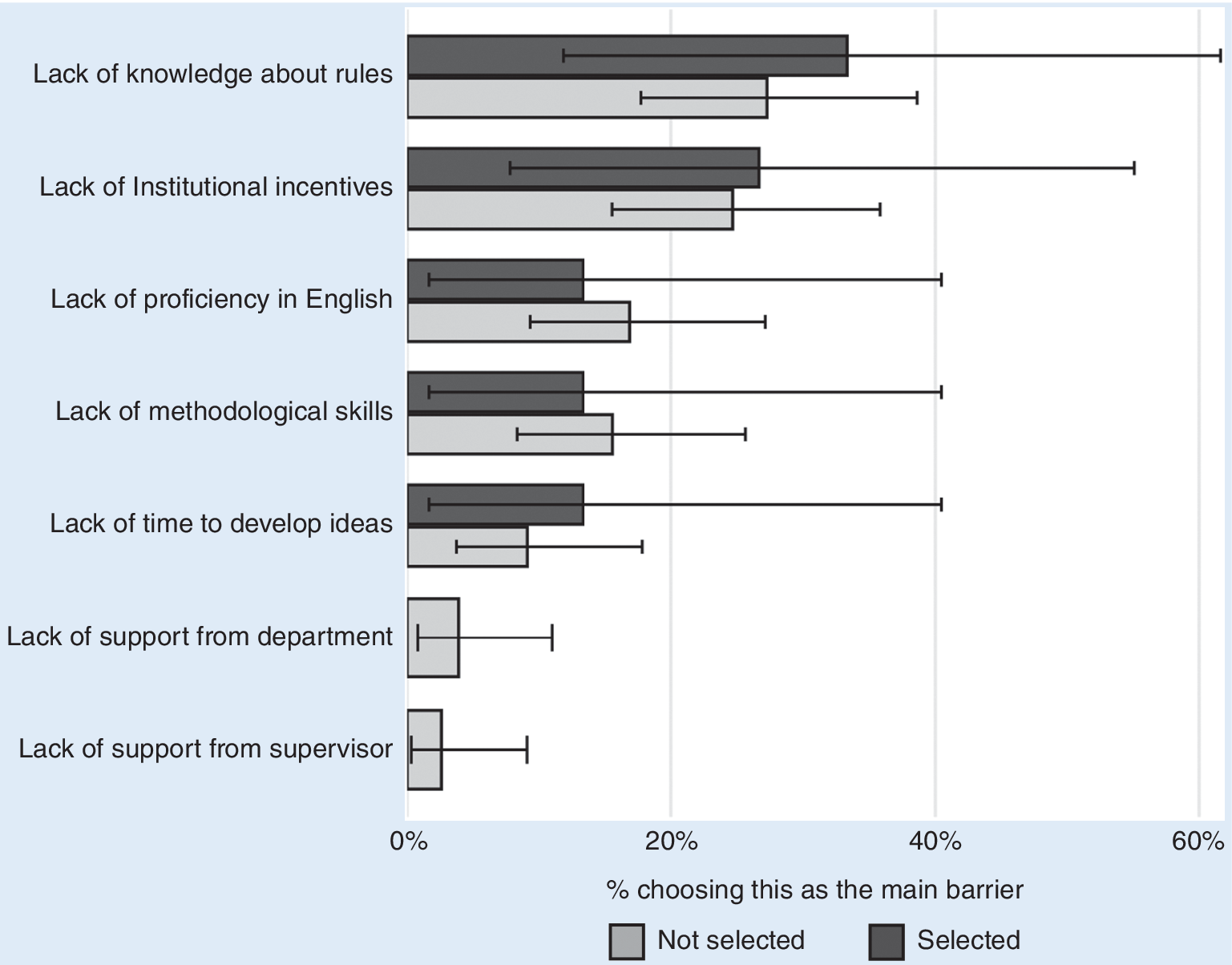
To understand what Brazilian doctoral students perceive as the primary barriers to publishing in international journals, we analyzed responses to a question that asked applicants to rank—from most to least important—the factors that they perceived as barriers to submitting articles to international English-language journals. We provided seven possible answers, identified inductively from the experiences of Brazil-based colleagues with supervision responsibilities. The options included, for example, “lack of proficiency in English,” “lack of knowledge about the rules of academic publishing outside of Brazil,” and “lack of support from my supervisor.”Footnote 4 To capture what students considered the primary hurdle to international publishing, we focused our analysis on those respondents who selected each option as their top choice.
As shown in figure 3, a substantial proportion of respondents cited process and institutional constraints—such as unfamiliarity with the rules of international academic publishing (28%) and a lack of incentives (25%)—as the primary obstacles to publishing in English-language journals. By contrast, lack of English proficiency was not ranked as the top issue; only 16% of respondents cited it as the primary barrier. Concerns about methodological suitability, time availability, and supervisor and departmental support were less frequently cited as the major hurdles.
Barriers to Publishing in International Peer-Reviewed Journals
Prepared by the authors with survey data collected as part of the Writing Academy (N=92). The x-axis shows the percentage of respondents who selected each of the seven barriers as the top (first-ranked) barrier to publishing in international English-language journals. “Selected” refers to applicants admitted to the Writing Academy and “Not selected” denotes those not admitted.

Figure 3 Long description
The x-axis represents the percentage of respondents choosing a barrier as the main one, ranging from 0 percent to 60 percent. The y-axis lists seven barriers. Each barrier has two bars: a dark gray bar for Selected and a light gray bar for Not selected. Error bars indicate the range of responses.
* Lack of knowledge about rules: Selected is approximately 34 percent; Not selected is approximately 27 percent.
* Lack of Institutional incentives: Selected is approximately 27 percent; Not selected is approximately 25 percent.
* Lack of proficiency in English: Selected is approximately 13 percent; Not selected is approximately 17 percent.
* Lack of methodological skills: Selected is approximately 13 percent; Not selected is approximately 15 percent.
* Lack of time to develop ideas: Selected is approximately 13 percent; Not selected is approximately 9 percent.
* Lack of support from department: Selected is 0 percent; Not selected is approximately 4 percent.
* Lack of support from supervisor: Selected is 0 percent; Not selected is approximately 3 percent.
A legend at the bottom indicates that light gray represents Not selected and dark gray represents Selected.
Our findings reinforce the extant literature, which demonstrates that publishing in international journals is a learned process shaped by socialization within global networks (Montal, Pauselli, and Yamin Reference Montal, Pauselli and Yamin2022) and by knowledge of “hidden” rules (Barham and Wood Reference Barham and Wood2022). Moreover, for those based in the Global South, barriers to publishing internationally may persist even among those with experience publishing domestically. That is, 80% of applicants to the Writing Academy already had published at least one academic article in a Brazilian political science journal and only 13% (11 of 92) had published at least one article in English.
…publishing in international journals is a learned process shaped by socialization within global networks.
Our results also suggest that because the structure and norms of international scholarly publications differ significantly from those of Brazilian academia, even Brazilian scholars fluent in both spoken and written English often struggle to publish in English and to collaborate with international scholars. These results align with recent research revealing that Global South–based scholars trained in the Global North are more likely to submit articles to and publish in top political science journals (Barceló et al. Reference Barceló, Paik, van der Windt and Zhai2025; Montal, Pauselli, and Yamin Reference Montal, Pauselli and Yamin2024).
Overall, our findings indicate that interventions have the greatest impact if they prioritize training in the publishing process and structured mentorship, with language support as a complementary rather than central need. This is precisely what the Writing Academy sought to do.
CAN TARGETED INTERVENTIONS ADDRESS BARRIERS TO SUBMISSION?
Recognizing that Brazilian political science doctoral students perceived their limited knowledge of academic publishing practices outside of Brazil as the primary obstacle to publishing in international outlets, we investigated whether an intervention such as the Writing Academy had the potential to overcome this barrier. For these analyses, we compared the answers of non-selected applicants and selected participants to questions at T0, with participants’ answers after program activities. Specifically, in addition to the first round of data collection conducted as part of the application process, this analysis relied on a second and a third round of data collection that surveyed only the students who were selected to participate in the Writing Academy (N=15). The second round of data collection took place in August 2024, after the first in-person workshop in Belo Horizonte (T1). The third round of data collection took place in August 2025, after the second in-person workshop in Belo Horizonte (T2).
To examine whether the Writing Academy impactedFootnote 5 barriers that may contribute to the supply of submissions from students, we used answers to a series of questions related to respondents’ (1) familiarity with different Brazilian and international journals; and (2) confidence in publishing in Brazilian and international outlets. The question on knowledge of academic journals asked respondents to estimate the difficulty of publishing in each listed journal. To capture their (un)familiarity with each journal, we assigned a value of 1 to those who selected the option “I don’t know this journal” (and 0 otherwise) in a question that asked them to rank the difficulty of publishing in different journals. We assigned a value of 1 to those who answered “very confident” and “confident” when they were asked about their level of confidence in publishing (1) in peer-reviewed Brazilian journals; (2) in peer-reviewed international journals; (3) chapters from their PhD dissertation in English; and (4) a book from their PhD dissertation in English.
As required by our funding sponsor (i.e., the British Academy), the program also included a session on opportunities for pursuing academic careers abroad. To examine the potential of the program in internationalizing careers beyond publication efforts, we also used the same procedure to measure respondents’ levels of confidence in (1) presenting at an international conference; (2) securing a postdoctoral position abroad; (3) securing a fixed-term position abroad; and (4) securing a tenure-track position abroad.
We began by examining whether the Writing Academy improved familiarity with international outlets. Journal familiarity is important because it not only indicates a direct understanding of the international publication environment; it also enables scholars to better navigate the system and make strategic choices, such as selecting journals based on their reputation or acceptance rates (Montal, Pauselli, and Yamin Reference Montal, Pauselli and Yamin2024). As such, the first in-person meeting of the Writing Academy included a session titled, “The Different Types of International Journals and How to Select Them.” It discussed different types of journals (e.g., general journals, subfield journals, and area-studies journals) and provided key relevant examples from the discipline, including the journals we asked about in the survey.
A clear pattern is shown in figure 4: at baseline (T0), “I don’t know this journal” responses were common across the board—including for prominent journals—indicating a substantial information gap even for well-established outlets. This surprisingly high level of unfamiliarity highlights why the Writing Academy’s emphasis on demystifying outlets and editorial processes was necessary.
Familiarity with Selected Top General Journals and High-Impact Field Journals
Prepared by the authors with survey data collected as part of the Writing Academy. T0 refers to the data collected during the application process (N=92) and T1 (N=15) and T2 (N=15) refer to the data collected from selected participants in August 2024 and August 2025, respectively. The y-axis shows the percentage of respondents who selected “I don’t know this journal” when asked about the difficulty of having a paper accepted in the (A) American Political Science Review (APSR), (B) American Journal of Political Science (AJPS), (C) Journal of Politics (JoP), (D) Comparative Political Studies (CPS), (E) Latin American Research Review (LARR), and (F) Brazilian Political Science Review (BPSR). “Selected” refers to applicants admitted to the Writing Academy and “Not selected” denotes those not admitted.

Figure 4 Long description
A six-panel bar chart grid labeled A through F. The y-axis for all panels is Don't know the journal percentage, ranging from 0 to 100 percent in increments of 25. The x-axis lists three time points: T 0, T 1, and T 2. Light gray bars represent Not selected participants and dark gray bars represent Selected participants. Error bars indicate variability.
* Panel A A P S R: At T 0, Not selected is approximately 20 percent while Selected is 0. At T 1 and T 2, both groups are at 0.
* Panel B A J P S: At T 0, Not selected is approximately 20 percent while Selected is 0. At T 1 and T 2, both groups are at 0.
* Panel C J o P: At T 0, Not selected is approximately 35 percent and Selected is 15. At T 1 and T 2, Selected remains low at roughly 8 percent while Not selected is 0.
* Panel D C P S: At T 0, Not selected is 30 percent and Selected is 25. At T 1 and T 2, Selected drops to approximately 8 percent while Not selected is 0.
* Panel E L A R R: At T 0, Not selected is 40 percent and Selected is 40. At T 1 and T 2, Selected drops to approximately 8 percent while Not selected is 0.
* Panel F B P S R: At T 0, Not selected is 25 percent and Selected is 8. At T 1 and T 2, both groups are at 0.
Participants selected for the Writing Academy were less likely to report unfamiliarity with academic journals in T1 and T2. In other words, the Writing Academy seems to have improved awareness of the journal landscape. For example, in T0, more than 25% of selected participants reported not knowing the Journal of Politics and Comparative Political Studies, two leading journals in the discipline. After the two-year intervention, the proportion of participants who were unfamiliar with these journals decreased by more than 20 percentage points.
Increased familiarity with most journals indicates that the intervention helped respondents to become knowledgeable about various outlets in the discipline. Together, the results suggest that the Writing Academy’s activities—for example, exposure to editorial processes and sessions on the different types of journals and how to select where to publish—reduced general knowledge gaps about the international publication landscape.
Next, we examined whether the intervention impacted participants’ confidence in publishing their research. As shown in figure 5 (panel A), at baseline, confidence already was high for domestic outlets: more than 70% of selected participants at T0 felt confident or very confident about publishing in peer-reviewed Brazilian journals. The goal of the Writing Academy was to improve internationalization; therefore, we did not expect much change in this area. The high baseline also left little space for improvement in this dimension, with confidence levels in T1 and T2 reaching 100%.
Levels of Confidence in Publishing
Prepared by the authors with survey data collected as part of the Writing Academy. T0 refers to the data collected during the application process (N=92) and T1 (N=15) and T2 (N=15) refer to the data collected from selected participants in August 2024 and August 2025, respectively. The y-axis shows the percentage of respondents who stated that they would be confident or highly confident to publish in (A) peer-reviewed Brazilian journals, (B) peer-reviewed international journals, (C) chapters from the PhD dissertation in English, and (D) the PhD dissertation as a book in English.

Figure 5 Long description
Four bar charts labeled A through D share a Y-axis titled Confident and highly confident percentage from 0 to 100 percent. The X-axis marks three time points: T 0, T 1, and T 2. A legend at the bottom indicates light gray bars for Not selected and dark gray bars for Selected participants.
* Panel A, Publishing in peer-reviewed Brazilian journals: At T 0, both groups are approximately 75 to 80 percent confident. At T 1 and T 2, the selected group reaches 100 percent confidence.
* Panel B, Publishing in peer-reviewed international journals: At T 0, confidence is low, around 35 percent for not selected and 20 percent for selected. At T 1 and T 2, the selected group rises sharply to nearly 95 and 100 percent respectively.
* Panel C, Publishing chapters from the P h D dissertation in English: At T 0, confidence is moderate at 60 to 65 percent. At T 1 and T 2, the selected group increases to 100 percent.
* Panel D, Publishing the P h D dissertation as book in English: At T 0, confidence is lowest, around 25 to 30 percent. The selected group shows a steady increase to approximately 73 percent at T 1 and 80 percent at T 2.
All bars for the selected group at T 1 and T 2 include vertical error bars indicating variability.
The Writing Academy explicitly intended to improve submissions to international outlets, particularly peer-reviewed journals. As shown in figure 5 (panel B), the intervention appears to have been successful in achieving one of the main goals: confidence to publish in peer-reviewed international journals increased from 25% at T0 to more than 90% at T1 and almost 100% at T2.Footnote 6 This is a promising result because offering training on publishing articles in international journals was the key aim of the Writing Academy. More tentatively—and noting that differences were not statistically significant at the 95% level—we observed increased confidence in publishing English-language book chapters and books, which suggests possible implications beyond journal submissions.
Furthermore, as shown in online appendix C, the program appears to have improved confidence in other aspects of internationalization, particularly in securing a postdoctoral position abroad. This increased by approximately 25 percentage points from T0 to T1 (see online appendix C, figure C1, panel B), which suggests a somewhat clearer perceived pathway to an international research career.Footnote 7
CONCLUSION
Political science is becoming increasingly aware of the necessity for greater diversity within the discipline. Whereas significant efforts have been directed toward addressing disparities related to gender, race, and ethnicity, another critical area that warrants attention is the territorial diversity of authors contributing to international journals. This aspect has not received the same level of focus, underscoring the need for ongoing initiatives to expand representation across geographical boundaries.
To contribute to the debate and action on diversifying the discipline, we piloted and analyzed data from the Writing Academy— a training and mentorship program funded by the British Academy—that sought to promote the internationalization of political science doctoral students in Brazil. Our analyses revealed that the barriers preventing Brazilian scholars from participating in international academic discourse may not be predominantly linguistic but instead are deeply rooted in a lack of familiarity with the international publication landscape. As this study demonstrates, targeted training and mentorship programs can reduce supply-side gaps in international publications. By improving Brazilian students’ knowledge of the international publishing environment and their confidence in their ability to publish in international journals, the program has the potential to translate into higher submission rates to international journals in the medium and long terms.
…targeted training and mentorship programs can reduce supply-side gaps in international publications.
Of course, the results produced in Brazil may not apply to all Global South contexts. The Brazilian political science community is large, embedded in wider international networks, and Brazilian doctoral students and researchers at all levels benefit from publicly funded opportunities for internationalization. Such an intervention may not be welcome or yield positive results in settings with low demand, weak incentives, or limited infrastructure for fostering internationalization. In addition, as with any pilot intervention, findings should be interpreted with caution, given the small Writing Academy cohort and the self-disclosed responses to knowledge and confidence questions. We expect to report on the intervention’s impact on concrete outputs in the medium term. In the meantime, our results suggest a potential tool for further diversifying the discipline.
SUPPLEMENTARY MATERIAL
To view supplementary material for this article, please visit http://doi.org/10.1017/S104909652610256X.
ACKNOWLEDGMENTS
We are deeply indebted to Octavio Amorim Neto, Marta Arretche, Luiz Augusto Campos, Ricardo Fabrino, Dalson Figueiredo Filho, Leany Lemos, Gabriela Lotta, Nara Pavão, Timothy Power, Cristiano Rodrigues, Rafael Sampaio, and David Samuels for kindly accepting our invitation to join us in Belo Horizonte in 2024 or 2025 and for providing guidance and mentorship to the selected participants. Along with the generous financial support of the British Academy (Grant No. IWW23\100338), the program was made possible by the outstanding logistical support of the professional services staff based at the University of Reading—namely, Nicola Humphrey, Rachel Tregidgo, and Alice Williams—as well as the local team of volunteers based at the Universidade Federal de Minas Gerais (Luiza Aikawa, Alessandra Costa, Rafael Fonseca, Lara Lanny, Natália Pinto, Ananda Ridart, Eliene Silva, and Jonatas Silva).
DATA AVAILABILITY STATEMENT
Research documentation and data that support the findings of this study are openly available at the PS: Political Science & Politics Harvard Dataverse at https://dataverse.harvard.edu/dataset.xhtml?persistentId=doi%3A10.7910%2FDVN%2F1GXMJC&version=DRAFT.
CONFLICTS OF INTEREST
The authors declare that there are no ethical issues or conflicts of interest in this research.



 Open access

