Introduction
Injuries threaten health worldwide; eight of the 15 leading causes of death for people between the ages of 15 and 29 years are injury related (WHO, 2007). For every injury-related death, hundreds of people seek medical care. In the USA, approximately 30 million Americans seek care for injury in an emergency department (ED) annually (CDC, 2005). The majority of injuries are minor and are not life-threatening. However, the emotional and functional impact of minor injury may be considerable. Although many individuals are thought to fully recover from minor injuries, an appreciable number may not recover completely (Mooney et al. Reference Mooney, Speed and Sheppard2005).
Patients with minor injuries are generally treated and discharged from the ED with instructions for follow-up with their primary or specialty care provider. Emergency care focuses exclusively on treatment of the physical injury and little follow-up assessment is made regarding emotional or functional outcome. The focused evaluation in the ED is not unexpected given the burden currently on the emergency care system (Committee on the Future of Emergency Care, 2007). This narrow focus, however, may contribute to suboptimal recovery.
Most studies of functional recovery after injury have focused on specific at-risk groups such as older adults (Kempen et al. Reference Kempen, Sanderman, Scaf-Klomp and Ormel2003; De Jonge et al. Reference De Jonge, Kempen, Sanderman, Ranchor, van Jaarsveld, van Sondern, Scaf-Klomp, Weening, Slaets and Ormel2006), serious injury patients (Rapoport et al. Reference Rapoport, Kiss and Feinstein2006) or assault victims (Elklit, Reference Elklit2002). Studies indicate that psychological responses to injury are common and may contribute to impaired function. These studies focus primarily on serious injury, thus a substantial gap in knowledge about the millions of patients who sustain minor injuries exists and excess disability from these injuries and related psychological responses could have considerable public health ramifications. The purpose of this study was to describe the influence of post-injury depression on functional recovery in the year after minor injury. We hypothesized that individuals who have post-injury depression would be less likely to return to pre-injury levels of function in the year after minor injury than individuals without post-injury depression.
Method
This prospective cohort study followed participants for 12 months after minor injury. The study was approved by the Institutional Review Board of the University of Pennsylvania.
Setting
Participants were recruited from a university hospital ED that treats approximately 57 000 patients yearly. All patients seen arriving at the ED were triaged immediately upon arrival and assigned a preliminary diagnosis.
Participants
Participants were enrolled over 4.5 years (October 2002–March 2007); follow-up was completed by March 2008. Adults aged ⩾18 years who presented to the ED for care of a minor injury were candidates for inclusion. Minor injury was defined as an anatomical injury with an Injury Severity Score (ISS) of 2–8 and normal physiology, defined by a Triage Revised Trauma Score (tRTS) of 12. The ISS is derived from injury severity across six body systems; scores range from 1 (least severe) to 75 (most severe) (Baker et al. Reference Baker, O'Neill, Haddon and Long1974; Baker & O'Neil, Reference Baker and O'Neill1976). The tRTS is based on systolic blood pressure, respiratory rate and the Glasgow Coma Scale (Champion et al. Reference Champion, Sacco, Copes, Gann, Gennarelli and Flanagan1989). Only patients with a normal tRTS of 12 qualified for the study and this score indicated normal mental status. The combination of a tRTS of 12 and an ISS of 2–8 provided a cohort of patients with minor injury based on an internationally accepted standard classification (Kilgo et al. Reference Kilgo, Meredith and Osler2006). Blood alcohol levels were not routinely drawn in practice and were not drawn for the purpose of this study; however, no patients considered for this study were intoxicated at the level that affected cognition. Patients were excluded if they reported a physical injury requiring ED care in the prior 2 years, a current injury resulting directly from a concurrent medical illness or domestic violence, current major depressive or psychotic disorder.
Variables: data sources/measurements
Standard demographic and injury data were obtained from the ED record. Pre-injury and post-injury function were measured with the Functional Status Questionnaire (FSQ; Cleary & Jette, Reference Cleary and Jette2000), a generic measure used across diseases (Murphy et al. Reference Murphy, Confavreux, Haas, Konig, Roullet, Sailer, Swash and Young1998). The FSQ provides a comprehensive assessment of physical (activities of daily living), role (instrumental activities of daily living), psychosocial (well-being) and social functioning across six subscales, and measures of work performance, social function and social interaction. It includes items on bed disability days, days lost from usual activities, and an overall assessment of health status. Scores were transformed to a scale of 0 to 100, with higher scores indicating higher levels of function. Reliability, construct and criterion validity are well established (Jette et al. Reference Jette, Davies, Cleary, Calteins, Rubenstein, Fink, Kosekoff, Young, Brook and Delbonco1986; Jette & Cleary, Reference Jette and Cleary1987).
The Structured Clinical Interview for DSM-IV-TR Axis I disorders, Patient Version (SCID) is a semi-structured psychiatric interview that yields judgments with respect to all five axes of the DSM-IV (APA, 1994; First et al. Reference First, Spitzer, Gibbon and Williams1994). It served as the primary instrument for psychiatric diagnostic case ascertainment (Zimmerman et al. Reference Zimmerman, Coryell, Pfohl and Stangl1986). The SCID captured alcohol and/or drug use, abuse and dependence.
The Longitudinal Interval Follow-up Evaluation (LIFE; Keller et al. Reference Keller, Lavori, Friedman, Nielsen, Endicott, McDonald-Scott and Andreasen1987) was used to detect emergence of a new psychiatric disorder during the post-injury year. The LIFE provides an interval, retrospective diagnostic assessment based on a semi-structured interview. LIFE screens for depression, mania/hypomania, psychotic disorders, anxiety disorders, post-traumatic stress disorder (PTSD), alcohol and substance use disorders. When participants screened positive on LIFE, the full module of the SCID was used for diagnostic verification.
Social support was measured by the brief version of the Social Support Questionnaire (Sarason et al. Reference Sarason, Sarason, Shearin and Pierce1987). This version is a six-item psychometrically sound instrument that has performed well in ethnically diverse samples (Richmond & Kauder, Reference Richmond and Kauder2000). Social network scores range from 0 to 54 and support scores from 0 to 6.
Procedure
Consecutively admitted patients with a triage diagnosis of injury had the ISS and the TRTS calculated in the ED, under the supervision of the attending ED physician. All patients with an injury triage diagnosis, an ISS of 2–8 and a tRTS of 12 underwent a brief screening interview in the ED to establish inclusion and exclusion criteria. Patients were asked if they had a history of psychiatric disorders, if they were being treated for a current psychiatric disorder, and to report any injuries they had experienced in the previous 2 years. Those who reported a current depression, psychotic disorder or an injury requiring care in an ED in the previous 2 years were excluded from the sample at this point. Those meeting entry criteria were given a general description of the study by our enrollment team (Hollander et al. Reference Hollander, Sparano, Karounos, Sites and Shofer2004) and were asked for verbal permission to release their contact information to the research team. At this time we obtained injury information from the ED record and all potential participants completed the FSQ to document pre-injury level of function to reduce recall bias. This technique of acquiring pre-injury information has been widely used in injury studies to obtain the patient's pre-injury level of function (MacKenzie et al. Reference MacKenzie, Shapiro, Smith, Siegel, Moody and Pitt1987; Richmond, Reference Richmond1997; Holbrook et al. Reference Holbrook, Anderson, Sieber, Drowner and Hoyt1999). This group served as the population from whom the sample was randomly drawn.
Intake data were faxed confidentially to the research team. Because the intensity of follow-up precluded the use of a consecutive sample, we enrolled 6.41 patients a month based on a computerized randomization protocol, using the Stata built-in random number generator (StataCorp, 1999). This protocol generated a list of 114 random numbers that correspond with hours 1–114 within each 4.75-day block. The smallest random number within a block identified the enrollment hour used for each 4.75-day period. The randomization was weighted automatically to reflect the flow of patients into the ED (85% arrive between 08:00 and 24:00 hours). When selected randomly, the study coordinator called the randomly selected patient, explained the study and answered all questions. If verbal consent was provided, an appointment for the in-person intake interview was made. If consent was not provided, the patient with the next treatment room admission time closest to the randomly selected date and time was enrolled.
Psychiatric diagnostic interviews were performed by one social worker with over 30 years of experience in this area. For this study, he had 40 h of additional training at the Depression Research Unit at the University of Pennsylvania. Training included reviewing SCID-I and -II training tapes with scoring; administering and videotaping practice SCIDs to students and clinic patients; supervising his taped interviews; and training on the LIFE. Training was considered complete when all diagnoses (or absence of diagnoses) concurred with the study psychiatrist. During the study, on 10 occasions diagnostic queries or patient-related concerns were resolved by consensus between the diagnostic rater and the study psychiatrist. Less urgent questions were discussed during monthly team meetings that were attended by the interviewer, the principal investigator and the study psychiatrist. At this time, the interviewer and the study psychiatrist reviewed the diagnoses to assure accuracy.
The SCID intake interview was conducted within 1–2 weeks of the ED visit. Written informed consent was obtained. Participants completed detailed demographic and injury data, underwent the SCID and completed the post-injury FSQ and other covariate instruments (e.g. social support, drug and alcohol use). All interviews were face to face. The intake interview was specifically scheduled within 2 weeks of the injury to eliminate participants who met criteria for a current major depressive episode (meaning that they had a major depression at the time of injury). If so, they were discontinued from the study and not included in the analysis. At interview completion, participants were told to call the study team prior to the next visit if they experienced any physical or emotional problems that concerned them. Face-to-face follow-up interviews were conducted at 3, 6 and 12 months after injury to diagnostically determine whether a depression emerged in the interim time periods. The LIFE was used at follow-up interviews and if participants screened positive for a new disorder; the full SCID module was used to determine if diagnostic criteria were met. At each interview, FSQ measures focused on the month prior to the visit. Incentives to continue participation in the study were provided at the completion of each interview with payment of $30, $30, $30 and $60 (intake, 3, 6 and 12 months respectively).
Statistical methods
Sample size calculations were conducted using nQuery sample size calculation software based on the premise that 15% of participants would have depression (Elashoff, Reference Elashoff1999). For a comparison of means between participants who did and did not have depression, based on a one-sided two-sample t test with 250 participants, there was 80% power, with α=0.05 to detect an effect size of 0.44 s.d.
Frequencies with 95% confidence intervals (CIs) described the proportion of participants diagnosed with depression in the year after injury. Participants were categorized as depressed if they met diagnostic criteria for a major depressive disorder (MDD), depression not otherwise specific (NOS), or dysthymia. Means and standard deviations for all function measures for the depressed and non-depressed groups were calculated and compared using t tests.
To test the hypothesis that individuals with depression in the post-injury year would be less likely to return to their pre-injury levels of function, the individual was placed in the depressed group if the symptoms leading to the diagnosis emerged prior to the structured interview at 3, 6 or 12 months. Regardless of whether the depression resolved, the individual remained coded as depressed for the remainder of the analyses. Thus, the diagnosis of depression was determined to precede the outcome of return to pre-injury function. Function, as measured by the FSQ, consisted of several subscales and each scale was dichotomized to yes/no on return to pre-injury baseline of function. This allowed each participant to serve as his/her own control.
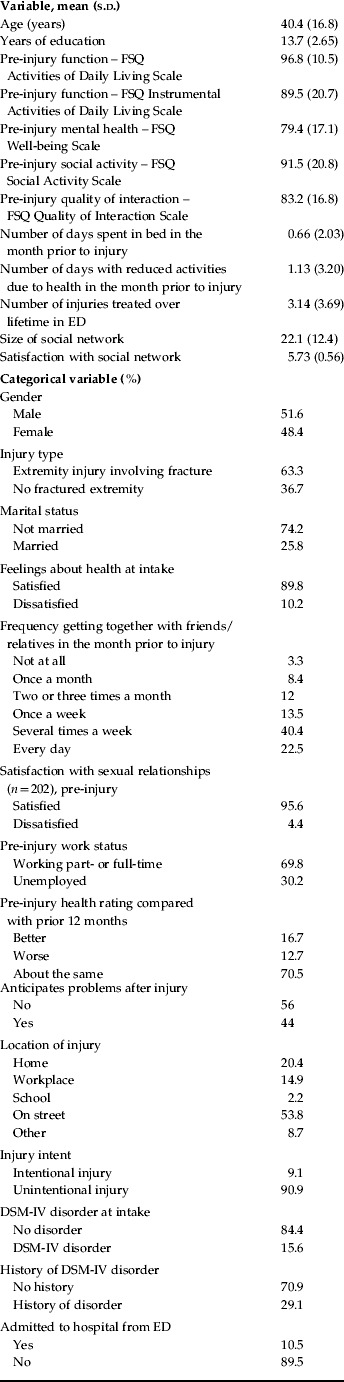
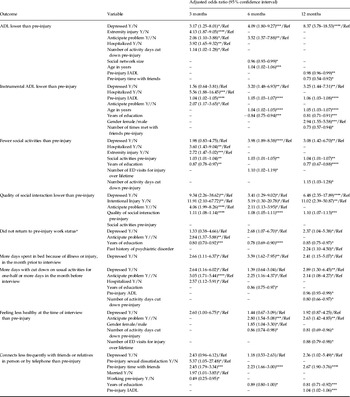
Clinically and theoretically relevant covariates, present prior to or as a result of the injury, were included in the multivariate models. All covariates (see Table 1) were entered into the multivariate logistic regressions. No significant interactions were found. To be the most conservative, we also used the pre-injury FSQ scores as a covariate to minimize potentially spurious effects of varying levels of pre-injury function.
Pre-injury and injury covariates in the multivariate models (n=275 unless otherwise noted)

FSQ, Functional Status Questionnaire; ED, emergency department; s.d., standard deviation.
Significance was set at p<0.05 for the final multivariate models. The mood disorder indicator was forced to be in the model regardless of the significance level. Other non-significant variables were removed from the models to obtain final odds ratios (ORs). To guard against the potential inflated Type 1 error, we verified significance by performing a longitudinal analysis using generalized estimating equations (Liang & Zeeker, Reference Liang and Zeeger1986).
Results
Participants
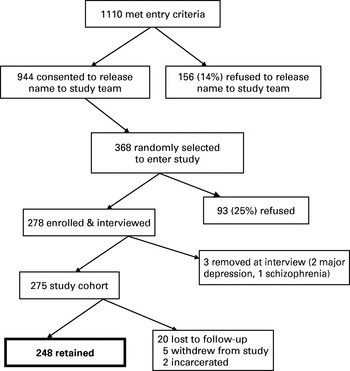
Three hundred and sixty-eight patients were randomly selected for study entry (see Fig. 1). Of these, 278 agreed to participate in the study. Three were excluded from the study at the intake diagnostic interview (one for major depression; two for schizophrenia). The final sample of 275 consisted of 142 men (52%) and 133 women (48%). The majority were single (53%) and employed (71%), with only 10% of the sample unemployed. Over half of the sample were Black (57%), then Caucasian (40%) and Asian (3%). The mean education level was 13.7 years (s.d.=2.7). Income level was evenly distributed: 32.1% earning <$20 000 per year, 22.8% earning >$60 000 per year, and 45.1% falling in between. The dominant injury cause was a slip or fall (48%) followed by motor vehicle/pedestrian/bike crash (28.7%), sports (8.4%) and assaults (8%). The mean ISS was 4.1 (s.d.=1.1). Twenty-nine of the participants (11.7%) were admitted to the hospital from the ED.
Sampling tree.

Follow-up data were obtained from 248 (90%) individuals, although some of these participants may have missed one of the three follow-up visits (8 at 3 months, 13 at 6 months, 10 at 12 months). t tests, analysis of variance, χ2 and Fisher's exact tests were used to compare participants who completed the study and those who were lost to follow-up. Individuals lost to follow-up were more likely (p<0.05) to be male, injured in a motor vehicle crash, have a less severe injury, and have a mean of 1.5 years less education than those who completed the study.
Descriptive data
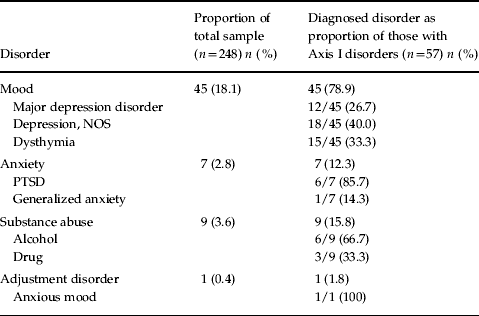
Fifty-seven participants (23%; 95% CI 17.7–28.2) were diagnosed with a post-injury DSM-IV-TR Axis I disorder (see Table 2). These diagnoses included mood (78.9%), substance abuse (3.6%), anxiety (2.8%) and adjustment disorders (0.4%). Among the sample for whom there were follow-up data, 18.1% (45/248; 95% CI 13.3–22.9) had depression. Of those diagnosed with mood disorders (n=45), 26.7% had MDD, 40% depression NOS, and 33.3% dysthymia. Four participants had an Axis I disorder co-morbid with depression: two with PTSD, one with generalized anxiety disorder, and one with alcohol abuse.
Frequency of Axis I disorders present in the year after injury
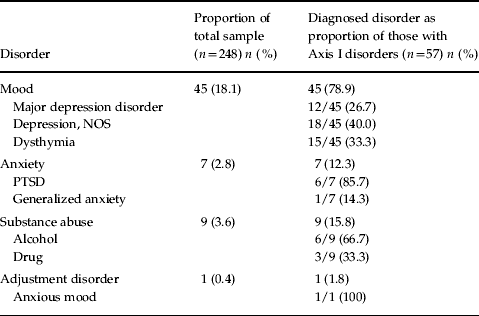
MDD, Major depression disorder; NOS, not otherwise specified; PTSD, post-traumatic stress disorder.
Four persons had co-morbid diagnoses (MDD and anxiety; MDD and PTSD; depression, NOS and PTSD; dysthymia, alcohol, substance).
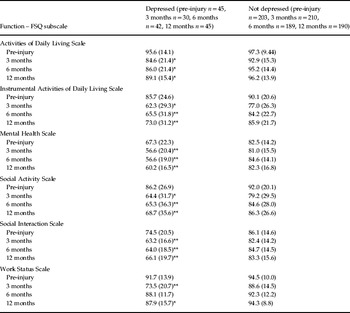
The depressed and non-depressed groups were compared at each time point (see Table 3). There were no differences in any pre-injury function subscales between the two groups. Post-injury function was significantly lower at all post-injury time points for the depressed group, with the exception of work status at 6 months.
Comparison of depressed and non-depressed patients on function at 3, 6 and 12 months
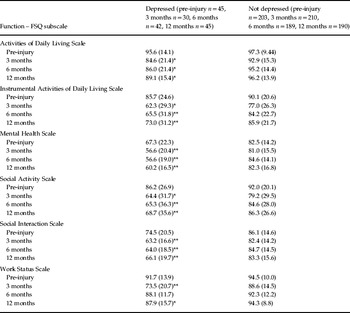
FSQ, Functional Status Questionnaire (higher scores reflect higher levels of function).
Values given as mean (standard deviation).
To determine whether those diagnosed as depressed in the post-injury year differed in pre-injury function, all 45 diagnosed as depressed at any time in the post-injury year were compared to those who were never depressed at any time in the post-injury year.
* p<0.01, ** p<0.001.
Participants diagnosed with depression were only included in the depressed group if the depression was diagnosed prior to the assessment of function. After adjusting for covariates, depression was found to significantly and consistently increase the odds of not returning to pre-injury baseline levels of function in all functional domains (see Table 4). The impact of depression on return to function was negative, sustained and significant.
Post-injury effect of depression diagnosis on the primary outcome of return to pre-injury level of function logistic regression analysis, adjusting for key pre-injury and injury related factors
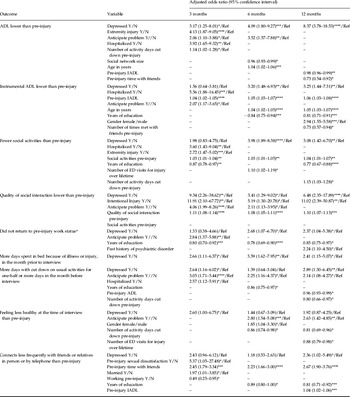
IADL, Instrumental Activities of Daily Living Scale; ADL, Activities of Daily Living; Y, yes; N, no; ED, emergency department; Ref, reference.
For non-categorical variable scoring included in the models: Scales for Pre-Injury IADL, Pre-injury Quality of Social Activity, Pre-Injury Social Activities, Pre-injury ADL, and Pre-injury Work all range from 0 to 100, with higher scores reflecting higher levels of function. All other continuous variables are self-explanatory (i.e. age in years, educational level in years, number of people in the social network, number of activity days cut down, and number of days spent in bed).
a Based on the 171 participants working at time of injury.
* p<0.05, ** p<0.01, *** p<0.001, **** p<0.0001.
As shown in Table 4, depression affected many domains of function at 3 months, but other factors such as the presence of an extremity injury, a cause of injury that was intentional, or hospitalization exerted stronger effects on return to function. However, by 6 months, depression was the dominant contributor to the inability to return to pre-injury levels of function and this continued through the 12 months after injury.
At 1 year post-injury, participants who had ever been diagnosed with depression were eight times more likely to not return to baseline activities of daily living, three times more likely to not return to baseline instrumental activities of daily living, more than six times more likely to not return to baseline quality of social interaction, three times more likely to have a lower level of social interaction, and almost three times more likely to have cut down on activities usually performed. Of the 171 individuals working at the time of injury, the depressed group was 2.3 times more likely to not return to their pre-injury work status at 1 year post-injury.
Discussion
We examined the effect of post-injury depressive disorders on functional recovery after minor physical injury. Using structured diagnostic interview techniques, 18% of patients were diagnosed with a mood disorder (MDD, depression NOS, dysthymia) in the year after minor injury. Individuals with depression were less likely to return to pre-injury levels of function at 1 year post-injury. This finding expands the growing literature showing the impact of acute psychological responses to injury on subsequent levels of function (O'Donnell et al. Reference O'Donnell, Creamer, Elliott, Atkin and Kossmann2005b; Van Gool et al. Reference Van Gool, Kempen, Penninx, Deeg, Beekman and van Eijk2005), and indicates that the impact of post-injury depression is not limited to patients with serious injury.
The use of a semi-structured interview to determine the presence or emergence of a DSM-IV-TR Axis I diagnosis is a strength of this study and overcomes the limitations of earlier studies that assessed only psychiatric symptom severity (Mason et al. Reference Mason, Wardrope, Turpin and Rowlands2002). Using structured diagnostic interviews to establish all Axis I disorders allowed us to comprehensively assess the broad range of psychiatric consequences that may occur after injury. In contrast to the substantial body of research that has focused on PTSD (Bisson et al. Reference Bisson, Shepher, Joy, Probert and Newcombe2004; Hepp et al. Reference Hepp, Moergeli, Buchi, Wittmann and Schnyder2005; Carty et al. Reference Carty, O'Donnell and Creamer2006), our findings indicate that depression was the predominant diagnosis in the post-injury year. Furthermore, in contrast to other studies that report high co-morbidity between depression and PTSD (Shalev et al. Reference Shalev, Freedman, Peri, Brandes, Sahar, Orr and Pitman1998; O'Donnell et al. Reference O'Donnell, Creamer, Pattison and Atkin2004), only two participants were found to have this co-morbidity. The literature indicates that serious injury is not a prerequisite for PTSD, and in fact PTSD occurs in the absence of physical injury. However, it is likely that the mechanisms leading to injury in this study were insufficient to invoke a person's response as one of intense fear, helplessness or horror (APA, 1994).
Depression that is co-morbid with chronic physical illness significantly increases functional disability (Stein et al. Reference Stein, Cox, Afifi, Belik and Sareen2006). Our study adds to this literature in that it focuses on an acute event (injury) and demonstrates that, even after controlling for important covariates, individuals diagnosed with depression are significantly less likely to return to pre-injury levels of function. As injury is temporally grounded at a point in time, we were able to determine that the depression preceded subsequent assessments of return to function. Once coded as depressed, the case remained in the depressed group, and thus the value of the prospective follow-up design is that it allowed us to examine temporal patterns of the emergence of depression and its subsequent effect on function.
Previous studies have demonstrated an increase in health-care costs in the 2 years following motor vehicle crashes in patients with PTSD, not through its independent contribution to costs but perhaps by its effect on physical health (O'Donnell et al. Reference O'Donnell, Creamer, Elliott and Atkin2005a). Our study was not designed to assess the health-care costs post-injury. However, our findings suggest that there is a potential and significant economic impact due to the sustained effect of depression on not returning to pre-injury work status and the increased number of days spent in bed compared with pre-injury. Both of these findings indicate the economic impact of depression following injury and require further exploration.
This study was designed to be a naturalistic follow-up study and did not include an intervention arm. Participants who were diagnosed with a new or worsened disorder were formally notified of the diagnosis, with the recommendation that they follow up with their primary health-care provider. In the absence of an existing health-care provider, a referral for treatment was offered.
Limitations
Previous research has been hampered by using outcomes measures with mental health scales embedded. In this study, the FSQ was selected to measure the primary outcome, to allow us to remove the mental health/well-being scale from the analysis of outcomes, which would have potentially inflated the effect of depression. We did, however, include the pre-injury mental health/well-being subscale as a covariate in the multivariate models to more rigorously examine the effects of post-injury depression on return to function.
The directionality of effect can be argued: does depression worsen function or does poor function increase depression (Scaf-Klomp et al. Reference Scaf-Klomp, Sanderman, Ormel and Kempen2003)? In this prospective study, the use of repeated measures in the year following injury allowed us to verify the onset of depression prior to measuring outcomes. Finally, although this study controlled for many covariates, the presence of pain and its severity were not measured. Pain can possibly contribute to impaired function (Read et al. Reference Read, Kufera, Dischinger, Kerns, Ho, Burgess and Burch2004; Arinzon et al. Reference Arinzon, Gepstein, Shabat and Berner2007; Soberg et al. Reference Soberg, Bautz-Holter, Roise and Finset2007) either directly or indirectly (Fishbain et al. Reference Fishbain, Cole, Cutler, Lewis, Rosomoff and Rosomoff2003), and future studies should explicitly examine the potential interaction between pain and depression.
Patients with MDD at the time of injury were excluded from the study. Because we assessed patients using a structured interview at intake (within 2 weeks of injury), we were able to definitely exclude anyone with major depression. However, a few patients included who had not reported a current depression and were not receiving treatment were found to be dysthymic at the intake SCID. Because of this recruitment decision, we verified the robustness of the multivariate models and tested our models both with and without the small group of patients who had a dysthymia at the time of injury and found no substantial difference.
The absence of a general population comparison group was a study limitation. However, the use of a prospective, longitudinal cohort design with repeated measures and with a pre-injury measure of function was a very strong design for testing the hypothesis posed in this study. Our data demonstrate that there was no difference in pre-injury function in participants who did and did not become depressed.
This study had a robust retention (90%). Nonetheless, it is important to take into consideration that the group lost to follow-up was more likely to be male, injured in motor vehicle crash, have a less severe injury, and have 1.5 years less education than those who completed the study. Finally, minor injury accounts for millions of trips to ED annually; this sample was drawn from an urban ED, and it is not yet known if these findings would extend to individuals in rural environments.
Bias
The intensity of the psychiatric diagnostic interviews precluded the use of a consecutive sample. To avoid a potential bias inherent in a convenience sample, we randomly drew participants from the population of all minor injury patients in the ED. Race/ethnicity has been known to result in either over- or underdiagnosis of psychiatric disorders (Rosenthal & Berven, Reference Rosenthal and Berven1999; Flaskerud, Reference Flaskerud2001; Aklin & Turner, Reference Aklin and Turner2006). We used structured psychiatric interviews that are shown to minimize bias associated with race/ethnicity (Akpaffiong et al. Reference Akpaffiong, Kunik, Hale, Molinari and Orengo1999).
Interpretation
Emergency and trauma providers anticipate that serious, life-threatening injuries are associated with psychological consequences and risk for poor functional recovery. Individuals with minor injuries are primarily treated and released from the ED with the clear expectation that they will quickly and fully recover with few if any residual effects. The findings of our study demonstrate that not all patients return to pre-injury function and that one of the etiologies of this poor recovery is post-injury depression. Subtypes of depression other than major depression are considered to exert less impact on function (Kessing, Reference Kessing2007); however, we elected to include all subtypes (MDD, depression NOS, dysthymia) and still found a statistically and clinically significant effect of depression on outcomes.
Depression is a diagnosable and treatable disorder, and as such it represents a modifiable factor that can be targeted to improve post-injury recovery. Collaborative interventions to address post-traumatic emotional disturbances have been tested in hospitalized injured survivors (Zatzick et al. Reference Zatzick, Roy-Byrne, Russo, Rivara, Koike, Jurkovich and Katon2001), and these interventions, when indicated, are more likely to be initiated in hospitalized patients. People who sustain minor injury and receive care in an ED are classically ‘treated and streeted’, with referrals for follow-up by specialty services as required by injury type (e.g. orthopedics for extremity fracture), who provide focused care. The silo nature of today's health care coupled with the discharge of patients from the ED with follow-up by specialty care places minor injury patients at high risk for not having their depression recognized, diagnosed and treated. Given the findings of this study that indicate depression is a major risk for not returning to pre-injury levels of function, it is imperative for primary care providers to carefully assess their patients who have sustained injury and initiate treatment as needed in order to maximize functional recovery after injury.
Acknowledgments
This study was funded by the National Institute of Mental Health (NIMH) grant R01MH63818 (to T.S.R.). The NIMH had no role in the design and conduct of the study; the collection, management, analysis, and interpretation of the data; or the preparation, review, or approval of the manuscript.
Declaration of Interest
J.D.A. is currently receiving research grant support from the NIMH, NIH/NCCAM, Lilly Research Laboratories, Novartis Inc., and Sanofi-Aventis Inc. He is on the speaker's bureau of Wyeth and Bristol–Myers–Squibb.