The prevalence of children diagnosed with autism spectrum disorder (ASD) has increased dramatically, such that current estimates are that approximately 1% of the population are affected (American Psychiatric Association, 2013; Anagnostou et al., Reference Anagnostou, Zwaigenbaum, Szatmari, Fombonne, Fernandez, Woodbury-Smith and Scherer2014). As detailed in the Diagnostic and Statistical Manual of Mental Disorders (5th ed., DSM-5; American Psychiatric Association, 2013), ASD is characterised by social communication impairments and restricted, repetitive behaviour patterns. Lack of social skills may negatively influence the quality of life of children with ASD and their families; therefore, strategies are required to teach social skills to these children (Lee, Simpson, & Shogren, Reference Lee, Simpson and Shogren2007; Weiss & Harris, Reference Weiss and Harris2001).
Different interventions have been developed to improve social skills in children with ASD, such as video-modelling (Nikopoulos & Keenan, Reference Nikopoulos and Keenan2003), video-based social stories™ (Litras, Moore, & Anderson, Reference Litras, Moore and Anderson2010) and self-management (Morrison, Kamps, Garcia, & Parker, Reference Morrison, Kamps, Garcia and Parker2001). Researchers have shown that parental involvement in intervention implementation may increase the effectiveness of interventions, with improved parental knowledge and skills, reduced stress, and increased parent–child interaction all potential added benefits (McConachie & Diggle, Reference McConachie and Diggle2007; Strauss, Mancini, & Fava, Reference Strauss, Mancini and Fava2013). Parent involvement may also contribute to reducing financial costs and saving programmer and therapist time.
Self-management training is one of the more extensively researched behaviour change intervention procedures for children with ASD. Carr, Moore, and Anderson (Reference Carr, Moore and Anderson2014) concluded that sufficient evidence exists to consider self-management an evidence-based procedure. Generally, self-management can be defined as the use of operant techniques to produce socially desired change in one's own behaviour (Cooper, Heron, & Heward, Reference Cooper, Heron and Heward2007). Self-management intervention packages vary, but they typically include one or a combination of five active components: goal-setting, self-monitoring, self-recording, self-evaluation, and self-reinforcement (Carr et al., Reference Carr, Anderson, Moore and Evans2014; van Vonderen & de Bresser, Reference van Vonderen and de Bresser2005).
Reported advantages of the application of self-management include: the promotion of independence in children with ASD (Lui, Moore, & Anderson, Reference Lui, Moore and Anderson2014; Wilkinson, Reference Wilkinson2008); promising maintenance and generalisation effects (Pierce & Schreibman, Reference Pierce and Schreibman1994; Stahmer & Schreibman, Reference Stahmer and Schreibman1992); effectiveness across different settings and behaviours (Carr et al., Reference Carr, Anderson, Moore and Evans2014; Lee et al., Reference Lee, Simpson and Shogren2007); and the potential of obtaining collateral gains (Koegel, Koegel, Hurley, & Frea, Reference Koegel, Koegel, Hurley and Frea1992; Loftin, Odom, & Lantz, Reference Loftin, Odom and Lantz2008).
Specifically, a number of researchers (Koegel et al., Reference Koegel, Koegel, Hurley and Frea1992; Loftin et al., Reference Loftin, Odom and Lantz2008; Morrison et al., Reference Morrison, Kamps, Garcia and Parker2001; Newman & Ten Eyck, Reference Newman and Ten Eyck2005; Strain, Kohler, Storey, & Danko, Reference Strain, Kohler, Storey and Danko1994) have reported successful outcomes from using self-management in teaching social skills to children with ASD. Although general positive generalisation and maintenance effects have been reported (Koegel et al., Reference Koegel, Koegel, Hurley and Frea1992; Loftin et al., Reference Loftin, Odom and Lantz2008; Morrison et al., Reference Morrison, Kamps, Garcia and Parker2001; Newman & Ten Eyck, Reference Newman and Ten Eyck2005), more research is needed to further investigate these effects.
Among the aforementioned studies, only Loftin et al. (Reference Loftin, Odom and Lantz2008) addressed the issue of social validity of self-management procedures. Further research is required to address the social importance of the aims and the social appropriateness of the procedures as well as the social significance of the outcomes (Wolf, Reference Wolf1978) of self-management interventions. Also, given the known benefits of parent involvement, it is important to examine whether self-management interventions can be implemented effectively by parents. Strain et al. (Reference Strain, Kohler, Storey and Danko1994) alone involved mothers in the implementation of the self-management intervention; although positive results were reported, more research is required to further examine the effect of parent-implemented self-management interventions.
Self-management intervention packages often involve a process of discrimination training, usually involving in vivo role play/modelling by the trainer, opportunity to practise, and feedback to teach participants how to discriminate appropriate from inappropriate behaviour (Harrower & Dunlap, Reference Harrower and Dunlap2001; Koegel et al., Reference Koegel, Koegel, Hurley and Frea1992; Stahmer & Schreibman, Reference Stahmer and Schreibman1992; Shabani, Wilder, & Flood, Reference Shabani, Wilder and Flood2001). Considering evidence of the effectiveness of video-modelling procedures for children with ASD (Bellini & Akullian, Reference Bellini and Akullian2007; Moore et al., Reference Moore, Anderson, Treccase, Deppeler, Furlonger and Didden2013), and that many individuals with ASD prefer and better process visual information and avoid face-to-face interactions (Charlop-Christy, Le, & Freeman, Reference Charlop-Christy, Le and Freeman2000; Corbett & Abdullah, Reference Corbett and Abdullah2005; Shah & Frith, Reference Shah and Frith1983), video modelling is a potentially useful tool for discrimination training. However, to date, no published research has trialled the use of video modelling to teach how to discriminate behaviour in the process of self-management. Video-modelling procedures may enhance this learning process and simplify the implementation of the self-management intervention.
The aim of this study was to assess the effects of a simple, partially parent-implemented self-management intervention involving self-recording, self-monitoring, and parent-managed reinforcement, while using video modelling to do discrimination training in teaching social skills to a child with ASD. It was hypothesised that:
1. the application of a partially parent-implemented self-management intervention using video modelling to teach discrimination would improve three social skills in the training setting;
2. the improvement of these three social skills would generalise to non-training settings;
3. the improvement of social skills would maintain during the fading of the intervention and in follow-up; and
4. the social validity of the partially parent-implemented self-management intervention would be high.
Method
Participants
Abby (pseudonym) was a 9-year-old girl with ASD. At the age of 2, she was diagnosed by an independent agency. She displayed both social communication impairments and restricted, repetitive behaviour patterns, such as solitary play, ritualistic play, and ignoring others. She also engaged in destructive behaviour. She was assessed as having a full scale IQ score of 59 (verbal scale: 53; performance scale: 73; general language scale: 75) on the Wechsler Preschool and Primary Scale of Intelligence — 3rd Edition (WPPSI-3), indicative of a degree of intellectual disability. The Oral and Written Language Scale (OWLS) was used to assess her receptive and expressive language abilities, and results showed a significant delay.
Abby was the younger of two children. She lived with her parents and elder sibling, an 11-year-old typically developing girl. She attended a special school, and was not on any medication. According to her parents and school reports, Abby had problems with social skills.
Settings
All self-management training sessions and observation sessions were conducted either in the living room of Abby's home (no interruption and asking for opinions) or on the street between her home and school (greeting unfamiliar adults). Generalisation sessions were conducted in the home of Abby's grandmother, at a supermarket, and a swimming pool near her home.
Materials
Three videotapes were used in the discrimination training sessions to teach Abby to discriminate appropriate from inappropriate behaviours. Each video depicted one target behaviour. In the videos, for no interruption and for asking for opinions, Abby's sister served as the model, showing both appropriate and inappropriate behaviours. In the third video, two adults role-played both appropriate and inappropriate exemplars of greeting unfamiliar adults. Each video clearly stated which behaviour was appropriate and which was inappropriate by using age-appropriate written text (such as right or wrong and good or bad) superimposed on the image. In the process of video production, iTouch™, an Apple MacBook™ laptop and iMovie™ were used.
Abby's favourite chocolate bars, identified by her parents, were used as reinforcers. Self-recording sheets were used by Abby to self-record incidents of the appropriate behaviours. There were 10 non-coloured flowers on each self-recording sheet. Event-recording forms were created to record the number of inappropriate and appropriate behaviours displayed by Abby. A treatment fidelity checklist, adapted from Busick and Neitzel (Reference Busick and Neitzel2009), which included every step of the procedure, was used to determine whether the implementation of the self-management intervention adhered to the designed procedures.
Adapted versions (pre- and postintervention) of the Behavior Intervention Rating Scale (BIRS; Von Brock & Elliott, Reference Von Brock and Elliott1987) were used to assess social validity. The validity and reliability of the scale are reported to be relatively high (Cronbach's alpha was 0.97; Elliott & Treuting, Reference Elliott and Treuting1991). Twenty-four items are rated on a 6-point Likert scale (from 1: strongly disagree to 6: strongly agree), and a total score is calculated by summing the scores, ranging from 24 to 144. Higher levels of acceptability are indicated by higher total scores: 84 and above are considered acceptable scores (Elliott & Treuting, Reference Elliott and Treuting1991).
Data Collection
Defining target behaviour
The three target behaviours were no interruption, asking for opinions, and appropriately greeting unfamiliar adults. ‘No interruption’ was defined as going away, playing alone, or playing with others (e.g., her sister) when mum is busy. The associated inappropriate behaviour was defined as interrupting mum by emitting any vocal (e.g., repeatedly saying ‘Let's play’ or ‘Play with me’; keeping calling ‘Mum, mum, mum’; screaming and crying) or gestural (e.g., shaking her hands and arms; and throwing objects) behaviour when mum was busy (on the phone or cooking).
‘Asking for other's opinions’ was defined as asking ‘What do you think?’ when having a conversation with others. The associated inappropriate behaviour was defined as telling others what to say (e.g., saying ‘Say this’ or ‘Say cat’).
‘Appropriately greeting unfamiliar adults’ was defined as saying ‘Hi’, ‘Hello’ or ‘Good morning/afternoon’ only, when greeting unfamiliar adults. The associated inappropriate behaviour was defined as emitting gestural behaviour that was too intimate (e.g., hugging or kissing on the face) with unfamiliar adults or telling strangers personal information (e.g., home address).
Measurement of target behaviour
The number of appropriate behaviours and problem behaviours displayed during 20-minute observation sessions was recorded on the event-recording forms. A ‘+’ was circled by the observer to indicate each occurrence of appropriate behaviour, and a ‘−’ was circled to represent each occurrence of inappropriate behaviour.
Interobserver Agreement Reliability
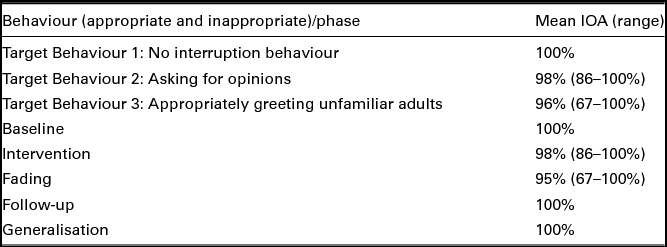
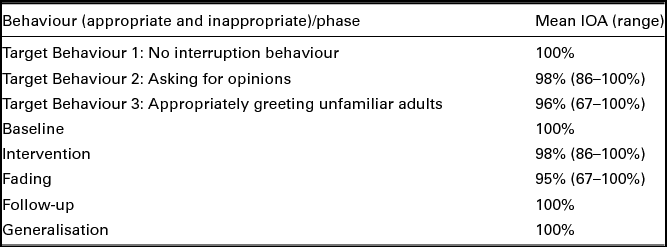
Two observers independently observed 30% of the sessions, including at least one session in each experimental phase across the three target behaviours. Interobserver agreement (IOA) was determined for each target behaviour by dividing the lesser score by the larger and multiplying the product by 100. Interobserver agreement of at least 80% is considered acceptable (Cooper et al., Reference Cooper, Heron and Heward2007). In this study, mean IOA scores ranged between 95 and 100% across the three target behaviours and phases (see Table 1).
Obtained Interobserver Agreement Reliablility
Treatment Fidelity
In order to determine whether the parent-implemented self-management intervention adhered to the planned procedures, parent self-reports and independent direct observation were used to collect treatment fidelity data. The parent was asked to complete a procedural checklist by ticking procedures they conducted correctly. The number of procedures completed correctly was divided by the total number of procedures and then multiplied by 100, to obtain a measure of treatment fidelity. In addition, the first author independently observed 30% of the sessions, completed the checklist, and calculated the same fidelity index. Both parent self-report and independent direct observation measures yielded 100% fidelity scores, indicating that the implementation of the intervention adhered closely to the planned procedures.
Design
For the purpose of exploring the functional relationship between the parent-implemented self-management intervention and behaviour change of the participant, a single-subject, multiple baseline across three behaviours design was used (Cooper et al., Reference Cooper, Heron and Heward2007). The independent variable was the parent-implemented self-management intervention. The dependent variables were the percentages of the three target behaviours (appropriate) observed in each session, which were calculated by dividing the number of appropriate behaviours by the total number of appropriate plus inappropriate behaviours. There were four experimental phases: baseline, intervention, fading, and follow up. In addition, several generalisation probes for each target behaviour were obtained across the four phases.
Procedure
Ethical approval was obtained from the Monash University Human Research Ethics Committee (MUHREC) prior to all data collection (Ref CF11/0588-2011000259).
Interview
A 60-minute interview with Abby's parents was conducted before baseline data collection. During this interview, basic background information about Abby and her parents was gathered and, in discussion, the three target behaviours and reinforcer were identified. As required by Abby's parents, no interruption was targeted first. The intervention was subsequently introduced to asking for opinions and finally to appropriately greeting unfamiliar adults.
Video production
The first author produced the videos used in the discrimination training using iTouch™ to film at Abby's home (in the kitchen with her mother and elder sister) and, with two adults assistants, at the university campus. Raw footage was edited on an Apple MacBook™ laptop using the editing program iMovie™.
Baseline
No intervention was conducted during the baseline phase. The number of occurrences of the three target behaviours (both appropriate and inappropriate) displayed by Abby during each 20-minute session was recorded.
Training session: Discrimination training
After completing baseline data collection for no interruption, a 60-minute training session was conducted to teach Abby how to discriminate appropriate from inappropriate behaviour for no interruption. At the beginning of the session, the mother played the video for Abby to watch. Then, the mother and first author role played 10 scenarios for no interruption (five appropriate and five inappropriate depictions), and Abby was asked whether the researcher's behaviour in each scenario was appropriate or inappropriate. Reinforcers were given for correct answers, and when her answer was wrong, the video was replayed and Abby was retested until she answered correctly. Discrimination training for no interruption was completed when Abby was able to answer all questions correctly. After completing the baseline data collection for asking for opinions and appropriately greeting unfamiliar adults, discrimination training for these behaviours was conducted in the manner described above.
Self-recording training
After the discrimination training session for no interruption, Abby and her mother were also trained to self-record correctly during a 30-minute training session. First, the researcher gave a self-recording sheet and a colour pen to Abby. Abby was then told to colour a flower for every time she displayed an appropriate target behaviour. The researcher demonstrated to Abby how to self-record, and the researcher and Abby's mother role played six scenarios (three appropriate, three inappropriate), after each of which the researcher self-recorded for the behaviours. Abby was then asked whether the researcher self-recorded correctly. If she answered correctly, a reinforcer was given. If she answered incorrectly, the researcher repeated the correct self-recording procedures and asked her to answer again. The training session ended when she answered all questions correctly.
Intervention
Abby's mother implemented the self-management intervention. For each target behaviour, reinforcement was initially provided on a Fixed Ratio 3 schedule, that is, in exchange for three coloured flowers. The number of coloured flowers achieved in the most recently completed session was the number required for reinforcement in the next session. Verbal praise (e.g., ‘good girl’ or ‘well done’) was given to her each time she displayed appropriate behaviour.
Fading
After achieving a steady high rate of the occurrence of no interruption (appropriate), the intervention was faded by withdrawal of the self-management recording materials. Abby was told that she would not need to record her behaviour, and only verbal praise was given for appropriate behaviour. Subsequently, the self-management intervention for asking for opinions and appropriately greeting unfamiliar adults were faded in the same way.
Follow-up
The follow-up phase began 1 month after the completion of the intervention (fading phase). The number of appropriate and inappropriate behaviours was recorded during each session under conditions equivalent to those in baseline. Reinforcers were not provided.
Generalisation probes
Generalisation probes were conducted for all three target behaviours across each phase. Generalisation probes for no interruption and asking for opinions were conducted in Abby's grandmother's home, and generalisation sessions for appropriately greeting unfamiliar adults were conducted at a supermarket and a swimming pool near her home.
Social validity
In order to assess social validity, Abby's mother was asked to complete the BIRS-Adapted (Von Brock & Elliott, Reference Von Brock and Elliott1987) before and after the completion of the self-management intervention.
Effect size
Effect size was estimated by calculating Percent Non-Overlapping Data (PND), which refers to the proportion of data points in the intervention phase that did not overlap the highest data point in baseline (Scruggs, Mastropieri, & Casto, Reference Scruggs, Mastropieri and Casto1987). Interventions with PND scores from 70–90% are considered effective treatments; and interventions with PND scores more than 90% are considered very effective treatments (Carr, Anderson, Moore, & Evans, Reference Carr, Anderson, Moore and Evans2014; Scruggs & Mastropieri, Reference Scruggs and Mastropieri1998).
Results
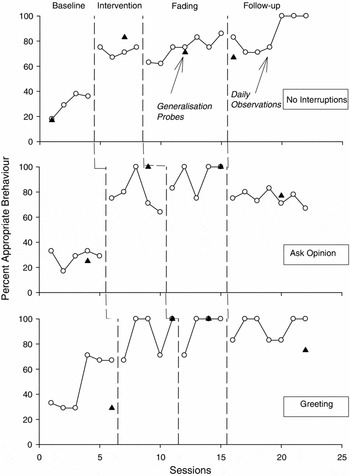
Figure 1 presents the percentage of appropriate behaviour per session for the three target behaviours across baseline, intervention, fading, and follow-up phases, together with generalisation probes. Visual analysis shows overall that, with the staggered implementation of the self-management intervention, the occurrence of the three appropriate behaviours increased and the behavioural gains maintained in the fading and follow-up phases, and generalised to other settings.
Percentage of appropriate behavior per session.

Increase in Appropriate Behaviour and Maintenance
The mean percentage of no interruption during the baseline phase was 30% (range 18–38%). During the intervention phase, this increased to 72% (range 67–75%) with no data points overlapping scores in the baseline phase. During the fading and follow-up phases, the percentage of no interruption maintained (fading: M = 74%; range 62–86%; follow-up: M = 86%; range 71–100%).
The mean percentage of asking for opinions during the baseline phase was 28% (range 17–33%). During the intervention phase, this increased to 78% (range 64–100%), with no overlap with baseline data. During the fading and follow-up phases, the percentage of appropriate asking for opinions maintained (fading: M = 92%; range 75–100%; follow up: M = 75%; range 67–83%).
The mean percentage of appropriately greeting unfamiliar adults during the baseline phase was 49%, with some between-session variability evident (range 29–71%); specifically, there was a clear increase midway through the baseline phase for appropriately greeting unfamiliar adults. However, it was clear that the appropriate behaviour improved further following the first session in the intervention phase, resulting in an intervention phase mean of 88% (range 67–100%). During the fading and follow-up phases, the percentage maintained (fading: M = 93%; range 71–100%; follow-up: M = 93 %; range 83–100%).
Generalisation
As shown in Figure 1, generalisation across settings was evident in the data trajectories of the three target behaviours, with some evidence of deterioration in performance at follow-up. For no interruption, scores in generalisation increased from 17% in baseline to 83% in intervention, this maintaining at 71% and 67% respectively in fading and follow-up. For asking for opinions, the baseline score in the generalisation setting was low (25%), increasing in the intervention and fading phases to 100%. The follow-up score was 77%. For appropriately greeting unfamiliar adults, the baseline generalisation score was 29%, this increasing to 100% in intervention and fading, and in follow-up, maintaining at 75%.
Effect Size
Across the three target behaviours, the overall PND was 93%, indicative of this being a very effective intervention (Scruggs & Mastropieri, Reference Scruggs and Mastropieri1998). This PND calculation is consistent with the visual analysis.
Social Validity
The scores on the BIRS-Adapted before and after the intervention were 114 and 123, respectively. Scores greater than 84 are considered acceptable (Elliott & Treuting, Reference Elliott and Treuting1991). In addition, the increase between the preintervention and postintervention scores suggests that following implementation of the intervention, the mother rated the procedure as more acceptable. Abby's mother reported that the goals of the intervention were socially important and the procedures were appropriate for Abby. In addition, she also indicated that she was very satisfied with the outcomes and would like to use the self-management procedure again in the future.
Discussion
This study was designed to explore the effects of a partially parent-implemented self-management intervention using video-modelling to do discrimination training in teaching social skills to a child with ASD. Results supported the hypotheses that: (1) the application of the procedure would increase the rates of three social skills in the training setting; (2) these improvements would generalise to non-training settings; (3) the observed improvements would maintain during the fading of the intervention and in the follow-up phase 1 month later; and (4) the social validity of the procedure as measured by the BIRS-Adapted was shown to be high. Overall, effect size calculations indicate that the self-management intervention was very effective.
Consistent with previous research (e.g., Koegel et al., Reference Koegel, Koegel, Hurley and Frea1992; Loftin et al., Reference Loftin, Odom and Lantz2008; Morrison et al., Reference Morrison, Kamps, Garcia and Parker2001; Newman & Ten Eyck, Reference Newman and Ten Eyck2005; Strain et al., Reference Strain, Kohler, Storey and Danko1994), the self-management intervention was effective in improving social skills of a child with ASD. However, unlike past studies, video modelling was used as the discrimination training tool, simplifying implementation of the intervention and potentially beneficial for those children with ASD who have difficulty with in vivo modelling or instruction. Also, unlike most of the previous research, the self-management intervention in this study was partially parent-implemented, demonstrating that Abby's mother could implement the procedures correctly and effectively. The observed intervention effects and the social validity outcomes achieved in this study further supported the aforementioned benefits of parent involvement in interventions. Similarly, the positive generalisation and maintenance results are indicative of potentially robust and broader gains arising from self-management interventions.
Also, the fact that the behaviour gains were maintained and generalised bears testimony to the social validity of the goals and the effects of the intervention; in order to maintain and generalise these new behaviours, they probably needed to meet with naturally occurring reinforcement, indicative of their adaptive value.
There are a number of limitations of this study. First, the usual caveats concerning the generalisability of findings from single-case design research clearly apply. Systematic replication of the study is required to provide evidence for the external validity of the findings. Second, although follow-up observations were implemented to assess the maintenance of the intervention effects, the follow-up phase was conducted only 1 month after the completion of the intervention. More extensive maintenance probes in future research would provide useful information regarding the longer-term effects of these procedures.
Third, although the study addressed the issue of social validity, this was based on self-reporting, with the usual limitations inherent in such procedures. The parent was clearly not naive to the aim and hypotheses of the study; therefore, her personal expectations might have influenced the results, negatively impacting the reliability of these findings. Future research examining how we might better assess the social validity of such interventions is clearly justified. It may also be valuable to explore the feasibility and utility/value-add of incorporating other self-management procedures, such as goal setting, self-evaluation and self-reinforcement, into parent-implemented self-management interventions.
Although a functional relationship between the onset of the intervention and changes in the target behaviours was demonstrated, the minimal lags between introduction of the intervention for the second and third behaviours (one session each) is a methodological limitation of the study. A more extended intervention period with each target behaviour before commencing intervention with the other behaviours would strengthen the demonstration of the treatment effect.
In conclusion, this partially parent-implemented self-management intervention using video modelling for the discrimination training proved effective in teaching social skills to this 9-year-old child with ASD. Generalisation and maintenance effects were observed, and high social validity assessments were obtained. Importantly, this research indicated that the self-management intervention could be implemented correctly and to good effect by the parents. Future replications of this study may establish the generalisability of the findings, and the systematic exploration of the differential effects of incorporating other procedures, including goal setting, self-evaluation and self-reinforcement, would extend our understanding of the application of self-management procedures with children with ASD.