Introduction
Inherited hearing loss classification and diagnosis are based on symptoms, other associated abnormal findings and inheritance mode. The causes of many types of sensorineural hearing loss (SNHL) in children are unknown, but some cases may have genetic causes. The SLC26A4 gene encodes the pendrin protein and is a causative gene for nonsyndromic hearing loss associated with nonsyndromic enlargement of the vestibular aqueduct and Pendred syndrome.Reference Everett, Glaser, Beck, Idol, Buchs and Heyman1–Reference Usami, Abe, Weston, Shinkawa, Van Camp and Kimberling3 Pendred syndrome has autosomal recessive inheritance; it is associated with congenital hearing loss and an enlarged vestibular aqueduct, as well as goitre and an iodine organification defect affecting thyroid hormone synthesis.Reference Reardon and Trembath4 The most frequent SLC26A4 gene mutations differ among racial groups. In the Japanese population, c.2168A > G (p.H723R) is the most common mutation,Reference Usami, Abe, Weston, Shinkawa, Van Camp and Kimberling3, Reference Tsukamoto, Suzuki, Harada, Namba, Abe and Usami5 whereas in Western populations c.1001+ 1G > A (IVS8–1G > A), c.1246A > C (p.T416P) and c.1790T > C (p.L597S) are the most frequent.Reference Campbell, Cucci, Prasad, Green, Edeal and Galer6 The c.1105A > G (p.K369E) mutation is relatively rare, having so far been discovered in only a few Japanese families.Reference Usami, Abe, Weston, Shinkawa, Van Camp and Kimberling3, Reference Tsukamoto, Suzuki, Harada, Namba, Abe and Usami5 Hearing loss caused by SLC26A4 mutations is more pronounced at higher frequencies, and in many affected young people audiogram profiles show variable progression. We report the case of a patient with a different form of SNHL affecting the low-frequency range, with image evaluation suggesting endolymphatic hydrops.
Case report
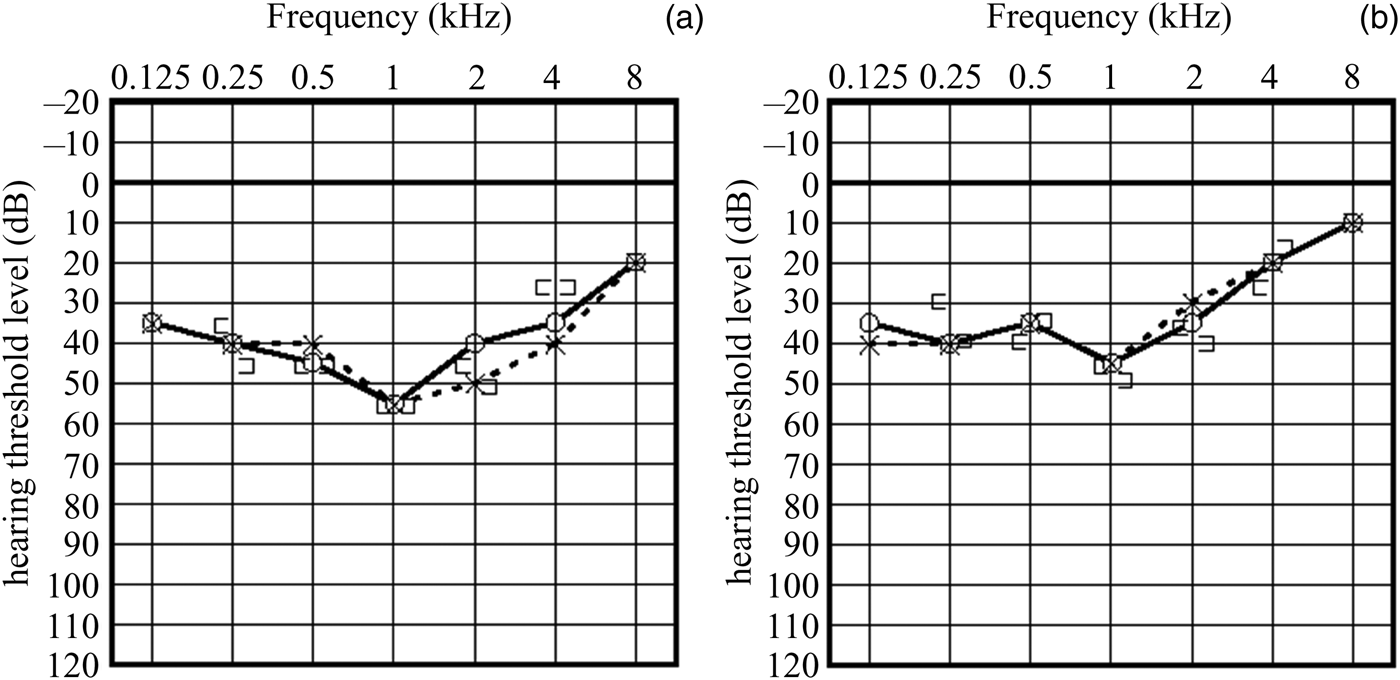
Hearing loss was first identified in a 13-year-old girl at an elementary school health check. Hearing loss was again indicated at a junior high school health check, and she was later examined at our hospital. She had been aware of a reduced hearing ability since starting junior high school, and the family requested genetic testing. No specific abnormalities were detected at birth. She had no history of other medical conditions or of mumps infection. No tympanic membrane abnormalities were seen upon microscopic observation, and there was no thyroid enlargement. A family history revealed her father had low-frequency SNHL (Figure 1a) and the patient's paternal aunt and grandfather used hearing aids. No maternal family members had hearing loss. Hearing tests showed bilateral and symmetric low-frequency SNHL (Figure 1b). Distortion product otoacoustic emission testing showed a poor response in the low-frequency range in the right ear and no response in the left ear.
(a) Pure tone audiogram of the patient's father, showing bilateral, symmetric low-frequency sensorineural hearing loss. (b) Pure tone audiogram of the patient, showing fairly mild bilateral, symmetric low-frequency sensorineural hearing loss resembling that of the father.

Genetic testing revealed a heterozygous SLC26A4 c.1105A > G (p.K369E) mutation. The genetic test screened 10 genes and 46 mutations using the invader method, the cost of which is covered by national health insurance in Japan.Reference Abe, Yamaguchi and Usami7, Reference Usami, Nishio, Nagano, Abe, Yamaguchi and Consortium8 Tests for genes not included this genetic test, including the WFS1 gene, were not desired. Genetic testing for hearing loss was approved by the ethics committee of the Nagoya University School of Medicine. Consent was not obtained for genetic testing of the patient's blood relatives, including her father.
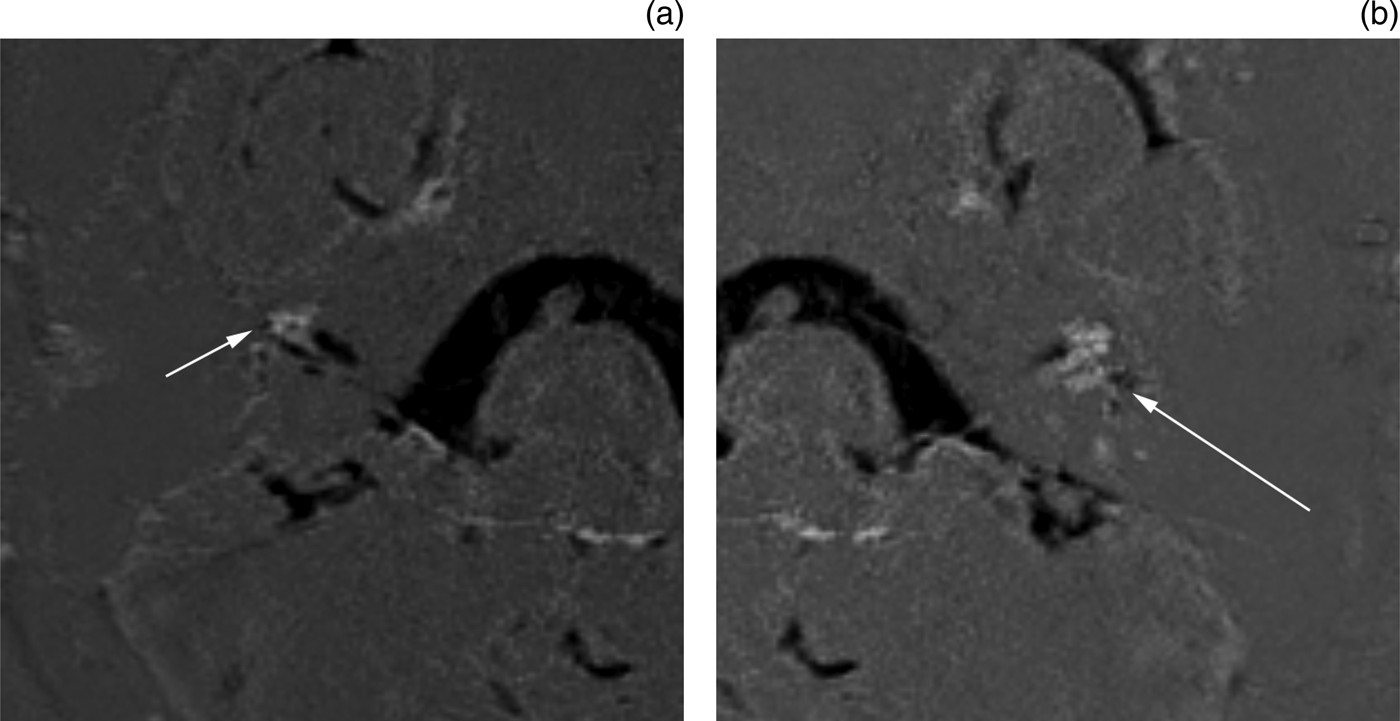
Imaging tests were performed because of the possibility of Pendred syndrome, but the characteristic vestibular aqueduct enlargement and inner-ear malformation were not seen on computed tomography imaging. Mild endolymphatic hydrops in the right cochlea and marked endolymphatic hydrops in the left vestibulum were seen by magnetic resonance imaging 4 hours after an intravenous gadolinium injection. No endolymphatic hydrops was seen in the right vestibulum or left cochlea (Figure 2).
Photographs showing inner-ear magnetic resonance images four hours after an intravenous gadolinium injection. (a) Mild endolymphatic hydrops is seen in the right cochlea (arrow) and (b) marked endolymphatic hydrops in the left vestibulum (arrow).
Discussion
This is the first reported case of a patient carrying the SLC26A4 gene mutation c.1105A > G (p.K369E) who has low-frequency SNHL. Research has shown that audiogram shape can provide evidence of inheritance in cases of hearing loss. In bilateral hearing loss, right and left audiograms that show correspondence are called ‘symmetrical’ and are thought to indicate that a hereditary factor contributes to hearing loss. In cases when there is a family member with hearing loss, similarity between audiograms is considered strong evidence for inherited hearing loss. By superimposing the audiograms of family members affected by hearing loss, inherited hearing loss is presumed when at least one of the three principle elements are seen in all individuals: non-crossover, correspondence and separation. In this case, the audiograms of the patient and her father fulfilled the principle of audiogram non-crossover (i.e. there were no areas of crossover in the superimposed audiograms), and therefore their hearing loss may be considered inherited.
• The SLC26A4 c.1105A > G (p.K369E) gene mutation seems to be relatively rare
• The phenotype associated with K369E gene mutations is thought to be relatively mild
• In this patient, magnetic resonance imaging showed cochlear and vestibular endolymphatic hydrops
• No vestibular aqueduct enlargement or inner-ear malformation was present
• Endolymphatic hydrops may be associated with low-frequency hearing loss in this patient
SLC26A4 gene mutations cause nonsyndromic hearing loss associated with nonsyndromic enlargement of the vestibular aqueduct and Pendred syndrome. Ishihara et al. investigated the cellular localisation of the protein products of 10 different SLC26A4 gene mutations, including those encoding pendrin K369E and H723R. They reported that pendrin K369E and C565Y localise to the cell membrane, similar to the wild-type protein, while the other eight mutant proteins localise to the cytoplasm.Reference Ishihara, Okuyama, Kumano, Iida, Hamana and Murakoshi9 The mutant phenotype associated with pendrin K369E is therefore thought to have relatively mild effects on morphology and pathology compared with other SLC26A4 gene mutations. When the c.1105A > G (p.K369E) mutation is heterozygous, it is possible that low-frequency hearing loss without enlarged vestibular aqueduct is the presenting phenotype. In hearing loss caused by other Pendred syndrome causative gene mutations, an air–bone gap is often seen in the low-frequency range. However, this was not seen in the present patient, probably because there was no enlargement of the vestibular aqueduct. In acute low-frequency SNHL, mild or more pronounced endolymphatic hydrops was reported in the cochlea in 82 per cent of ears and the vestibulum in 88 per cent.Reference Shimono, Teranishi, Yoshida, Kato, Sano and Otake10 It is thus possible that endolymphatic hydrops is also involved in hearing loss in the present patient. We report a patient with a relatively rare heterozygous SLC26A4 mutation encoding pendrin K369E, who presented with low-frequency SNHL without enlargement of the vestibular aqueduct. Similar cochlear and vestibular endolymphatic hydrops is seen in acute low-frequency SNHL, suggesting a possible association with that pathology.