INTRODUCTION
Why are there so many species in the tropics? This is a deceptively simple question since the monotonous increase in diversity towards the tropics appears to be a complex result of evolutionary history and contemporary ecological interactions (Schemske et al. Reference SCHEMSKE, MITTELBACH, CORNELL, SOBEL and ROY2009). The large numbers of insect herbivores coexisting in tropical communities require an ecological explanation, pointing to the study of interspecific interactions, particularly their host specialization (Novotny & Basset Reference NOVOTNY and BASSET2005). The coexistence of tropical herbivores can be facilitated by their highest host specialization (Dyer et al. Reference DYER, SINGER, LILL, STIREMAN, GENTRY, MARQUIS, RICKLEFS, GREENEY, WAGNER, MORAIS, DINIZ, KURSAR and COLEY2007), but there is currently no quantitative theory predicting latitudinal trends in species diversity for individual herbivore guilds from their host specificity. The existence of latitudinal trends in herbivore specificity remains controversial. It has been documented for Neotropical Lepidoptera (Dyer et al. Reference DYER, SINGER, LILL, STIREMAN, GENTRY, MARQUIS, RICKLEFS, GREENEY, WAGNER, MORAIS, DINIZ, KURSAR and COLEY2007), but not for Palaeotropical leaf-chewers (Novotny et al. Reference NOVOTNY, DRODZ, MILLER, KULFAN, JANDA, BASSET and WEIBLEN2006). Further, more species from highly specialized herbivore guilds should be able to coexist on any particular plant species than from generalist guilds. However, the empirical pattern in tropical guilds appears to be exactly the opposite (Novotny et al. Reference NOVOTNY, MILLER, HRCEK, BAJE, BASSET, LEWIS, STEWART and WEIBLEN2012). Here we examine host specificity patterns among rain-forest trees, and contrast them with temperate zone trees, in two sap-feeding guilds and examine their importance as determinants of local and latitudinal patterns in species diversity.
There may be 10000 herbivorous insect species feeding on 200 species of tree in a single lowland rain-forest ecosystem in New Guinea (Novotny et al. Reference NOVOTNY, MILLER, BAJE, BALAGAWI, BASSET, CIZEK, CRAFT, DEM, DREW, HULCR, LEPS, LEWIS, POKON, STEWART and WEIBLEN2010). This extraordinary diversity is composed from multiple, ecologically distinct guilds, characterized by a broad range of host-specificity patterns (Novotny et al. Reference NOVOTNY, MILLER, BAJE, BALAGAWI, BASSET, CIZEK, CRAFT, DEM, DREW, HULCR, LEPS, LEWIS, POKON, STEWART and WEIBLEN2010). Unfortunately, not all these guilds have received equal attention from researchers. In this respect, the contrast between leaf- and sap-feeding herbivores is particularly striking, the latter being rather neglected probably because it is difficult to verify their host plant species (Novotny & Basset Reference NOVOTNY and BASSET2005). Most do not cause visible damage to plants which complicates feeding experiments, and rearing their larvae to adult requires live plants for the xylem- and phloem-feeding species. This gap in our knowledge is problematic since sap-feeding herbivore lineages are species-rich and abundant on tropical plants and have potentially high, but largely unknown, impacts on their host plants, from nutrient extraction (Raven Reference RAVEN1983) to pathogen transmission (Nault & Ammar Reference NAULT and AMMAR1989, Stafford et al. Reference STAFFORD, WALKER and ULLMAN2012).
A major group of sap-feeding herbivores, the leafhoppers and planthoppers (Auchenorrhyncha, Hemiptera), represent approximately 10% of all herbivore species in local assemblages on tropical tree species (Basset et al. Reference BASSET, CIZEK, CUÉNOUD, DIDHAM, GUILHAUMON, MISSA, NOVOTNY, ØDEGAARD, ROSLIN, SCHMIDL, TISHECHKIN, WINCHESTER, ABERLENCE, BAIL, BARRIOS, BRIDLE, CASTAÑO-MENESES, CORBARA, CURLETTI, DEBAKER, DELABIE, DEJEAN, FAGAN, FLOREN, KITCHING, MEDIANERO, MILLER, OLIVEIRA, ORIVEL, POLLET, RIBEIRO, ROISIN, ROUBIK, SORENSEN and LEPONCE2012, Novotny et al. Reference NOVOTNY, MILLER, BAJE, BALAGAWI, BASSET, CIZEK, CRAFT, DEM, DREW, HULCR, LEPS, LEWIS, POKON, STEWART and WEIBLEN2010). Their local diversity on mixed tropical vegetation has been estimated at 200–500 species by light and Malaise trapping, canopy fogging and sweep netting (Casson & Hodkinson Reference CASSON and HODKINSON1991, Novotny Reference NOVOTNY1993, Stork Reference STORK1991, Sutton et al. Reference SUTTON, ASH and GRUNDY1983, Wolda Reference WOLDA1988). While the host specificity of sap-feeding larvae has been studied in the tropics for agricultural pests (Wilson & Nault Reference WILSON and NAULT1986, Witt & Edwards Reference WITT and EDWARDS2000), there are no quantitative studies from tropical rain forests. Here we report results of such a study, based on rearing Auchenorrhyncha larvae sampled from 14 focal tree species from a lowland rain forest in Papua New Guinea and contrasted with a temperate zone dataset from Germany. Using data from the current tropical study and the data already available from the temperate region, we addressed the following hypotheses: (1) host specialization of Auchenorrhyncha increases from the temperate to tropical areas, thus facilitating the coexistence of a higher number of species in the tropics, (2) the xylem-feeding guild is more host specific than the phloem-feeding guild, and (3) plant phylogeny is an important determinant of host plant range in Auchenorrhyncha.
METHODS
Insect sampling and rearing
All species of Auchenorrhyncha are members of one of the three sap-feeding herbivore guilds (Novotny & Wilson Reference NOVOTNY and WILSON1997): (1) xylem-feeding Cercopoidea, Cicadoidea, Cicadellidae: Cicadellini (sensu Hamilton Reference HAMILTON1983), Cicadellinae (sensu Young Reference YOUNG1968) and Mileewini (their feeding guild is unclear, but they were treated as xylem-feeders, based on observations by Novotny & Basset Reference NOVOTNY and BASSET1998); (2) mesophyll cell-feeding Cicadellidae: Typhlocybinae; (3) phloem-feeding, which includes the remaining species. All phloem- and xylem-feeding species were sampled from above-ground vegetation; the cell-feeding guild was not part of this study as they require different rearing techniques, but is reported on elsewhere (Baje et al., in review). The phloem-feeders studied here represent a taxon-guild (sensu Simberloff & Dayan Reference SIMBERLOFF and DAYAN1991) since they do not include Sternorrhyncha.
The study area is situated in a mosaic of primary and secondary lowland forests near Ohu Village (145°41′E, 5°14′S, 200 m asl, Papua New Guinea (PNG) with approximately 200 tree species ha−1 with dbh > 5 cm (Novotny et al. Reference NOVOTNY, MILLER, LEPS, BITO, JANDA, HULCR, BASSET, DAMAS and WEIBLEN2004). The mean annual rainfall in the area is 3600 mm with a mild dry season from July to September, mean monthly temperature ranging from 26.2°C to 26.7°C (McAlpine et al. Reference MCALPINE, KEIGH and FALLS1983).
Auchenorrhyncha nymphs were sampled from 14 woody species, including three Ficus and one Artocarpus species (Moraceae), two Macaranga species (Euphorbiaceae), three species representing different genera of Rubiaceae, and five species representing five other families from all major lineages of plant phylogeny, including gymnosperms, basal eudicots and monocots (Gnetaceae, Monimiaceae, Ruscaceae, Myrtaceae and Sapindaceae; Appendix 1). This selection thus included both closely and distantly related species. The phylogenetic relationships among the focal plants were estimated using molecular data and methods described in Novotny et al. (Reference NOVOTNY, MILLER, HRCEK, BAJE, BASSET, LEWIS, STEWART and WEIBLEN2012).
The focal plant species represented pioneer vegetation from early secondary rain-forest succession as well as primary forest (Leps et al. Reference LEPS, NOVOTNY and BASSET2001). Their distribution was surveyed in 50 plots, 20 × 20 m each. All stems with dbh >1 cm were recorded. The succession optimum index for plant species j was estimated as OSj = BAPj/(BAP j + BAS j), where BAP and BAS is the basal area of each species in primary and secondary forest respectively.
Auchenorrhyncha nymphs were hand-collected from the focal tree species twice a week from February 2007 to July 2009, with approximately constant sampling effort throughout the study period. The studied trees were sampled from the ground or climbed. The sampling effort corresponded to approximately 1500 m2 of foliage inspected per plant species and included numerous individual trees within approximately 500 ha of primary and secondary forests. The number of sampled trees varied from 50 to 250 individuals per species, most of them sampled repeatedly. The nymphs were collected by an aspirator and reared to adults on saplings of the same species from which they were collected. Two saplings of each host plant, 30–100 cm high, were transplanted from the forest to individual muslin cages in a shade house at the edge of the study site. Poorly performing saplings were replaced with new ones as needed. The nymphs were kept in the cages and reared adults regularly harvested from them.
Adult sap-feeding insects (Auchenorrhyncha) were also collected by hand or sweep net from accessible foliage of 13 Ficus (Moraceae), 12 Euphorbiaceae, two Phyllanthaceae and one Rubiaceae tree species (Appendix 1). The sampling effort was quantified only approximately, by the number of tree visits, i.e. a particular tree sampled on a particular day. The number of tree visits ranged from 20 to 355 per tree species (3761 tree visits in total) and was not kept constant among tree species. The sampling took place in the study forest of Ohu, as well as in two similar forests < 20 km apart, in Baitabag and Mis Villages. The samples were collected from July 1995 to December 1997.
Data analysis
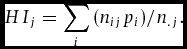
The quantitative plant × herbivore matrix included the number of herbivore individuals from species i feeding on plant j (nij) obtained for 1, . . ., i,. . ., H herbivore and 1, . . . i, . . . . P plant species. Trophic relationships recorded as only a single reared individual (nij = 1) were excluded as poorly documented in the host specificity analysis. This data filtering allowed us to estimate host specificity for 35 species. Host specificity was expressed as the number of host plant species for each Auchenorrhyncha species i (pi). Each herbivore assemblage on a particular plant species j was then characterized by the number of herbivore individuals (herbivore load, n.j) and herbivore species (species richness, hj). The host specificity of herbivores on plant j was quantified as the mean number of potential host plant species per herbivore species (HSj) and the mean number of potential host plant species per herbivore individual:
 \begin{equation*}
HI_j = \sum\limits_i {(n_{ij} p_i )/n_{.j} }.\end{equation*}
The latter parameter corresponds to the host plant range expected for a herbivore individual randomly drawn from the assemblage on a particular plant species.
The number of host plant species recorded for a particular herbivore species is constrained by the number of reared individuals. We compared the observed number of hosts with the number of host species expected for the same number of individuals drawn from a large population (we used 100000 individuals) distributed equally among all 14 studied hosts, obtained by rarefaction.
The relationships among abundance, diversity and host specificity parameters characterizing herbivore assemblages on individual plant species was explored using classical correlation with 14 focal plant species as individual data points, as well as by independent contrasts methods, taking into account phylogenetic relationships among these plant species. The latter analysis was done by Compare 4.6 software, using the phylogeny of plant species estimated from molecular data as described in Novotny et al. (Reference NOVOTNY, MILLER, BAJE, BALAGAWI, BASSET, CIZEK, CRAFT, DEM, DREW, HULCR, LEPS, LEWIS, POKON, STEWART and WEIBLEN2010). A matrix of phylogenetic distances, measured as the absolute number of nucleotide substitutions in rbcL sequences in the ultrametric tree, was calculated for all pairs of host plant species.
The similarity in herbivore species feeding on a pair of plant species was quantified by Jaccard's index J = a/(a+b+c) where a is the number of herbivore species shared by both plant species, and b and c are species limited to one of them. J can be also interpreted as a host specificity index as it equals the probability that a herbivore species from the combined pool of species feeding on the two compared plant species feeds on both of them. The similarity of herbivorous communities was correlated with phylogenetic distance of their host plants, using Pearson correlation with Mantel test.
Comparative host specificity data for the temperate region was extracted from Nickel & Remane (Reference NICKEL and REMANE2002) for all phloem- and xylem-feeding Auchenorrhyncha that feed partially or exclusively on trees and woody shrubs in Germany. The majority of these host-plant associations had been established by field recording of adults or nymphs on particular host plant species as opposed to the experimental rearing approach adopted here. Nevertheless, we expect the two datasets to be comparable, at least to the level of the broad generalizations that we produce here.
RESULTS
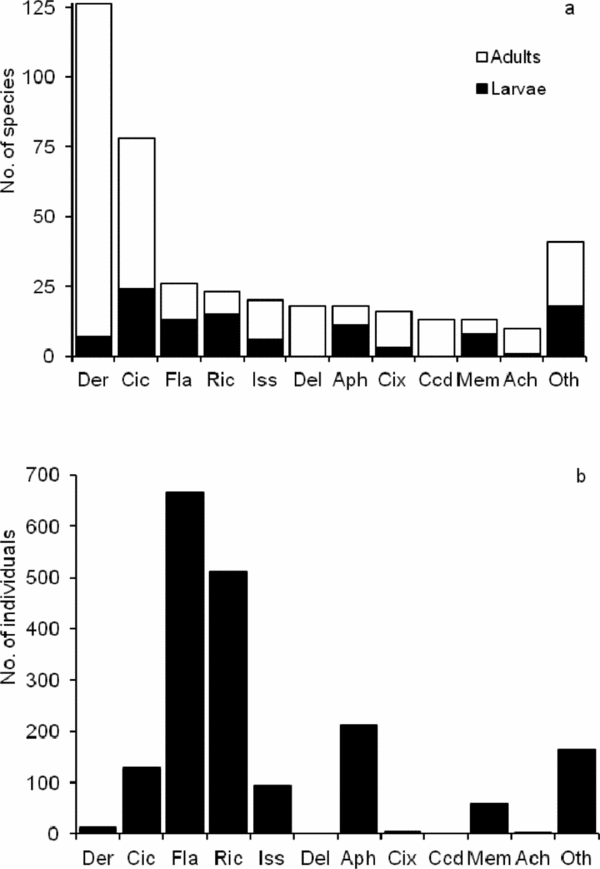
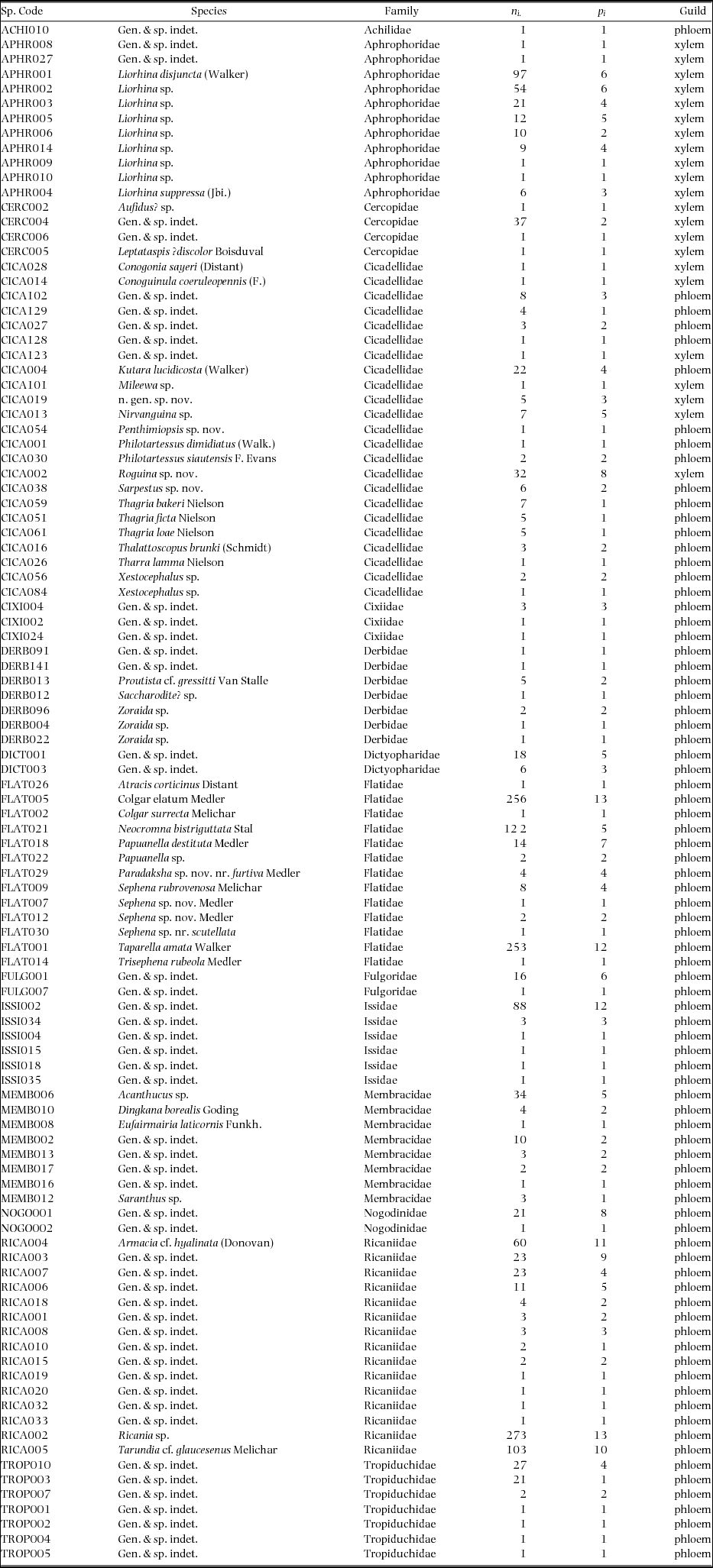
We sampled 52087 adult Auchenorrhyncha from 389 species and 20 families from the forest vegetation. Further, we reared to adult 1853 individual nymphs from 106 species and 15 families and documented 294 plant–herbivore trophic interactions, including 156 interactions supported by more than one reared individual (Appendix 2). The combined local diversity sampled as adults or nymphs amounted to 402 species (Figure 1a), including 350 phloem- and 52 xylem-feeding species. The Derbidae and Cicadellidae comprised approximately half of all species. The reared species were mostly from Cicadellidae (22 species), Ricaniidae (15 species), Flatidae (13 species) and Aphrophoridae (11 species). The proportion of species sampled as adults and also reared from larvae varied widely among families, from zero to 65% of species in Ricaniidae (Figure 1a). The assemblages of reared individuals were numerically dominated by Flatidae and Ricaniidae (Figure 1b).
The number of Auchenorrhyncha species reared as larvae from 14 focal tree species and sampled as adults from 28 focal tree species (a) and the number of Auchenorrhyncha individuals reared from the focal plant species (b) in PNG. Der = Derbidae, Cic = Cicadellidae, Fla = Flatidae, Ric = Ricaniidae, Iss = Issidae, Del = Delphacidae, Aph = Aphrophoridae, Cix = Cixiidae, Ccd = Cicadidae, Mem = Membracidae, Ach = Achilidae, Oth = Other families. Sampling was conducted in the forests near Baitabag, Mis and Ohu villages in Madang, Papua New Guinea.

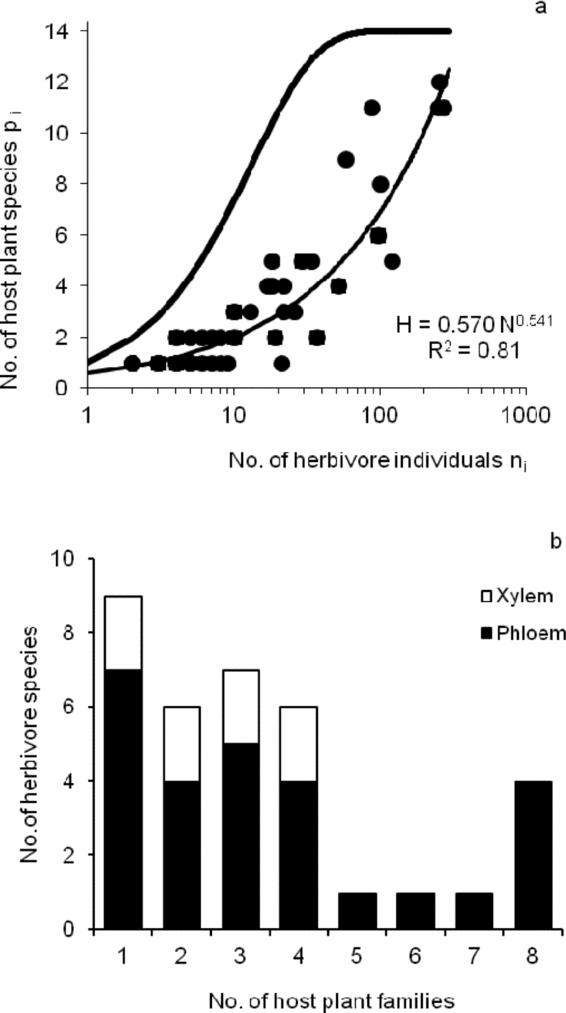
The number of host plant species increased predictably with the number of reared individuals both for xylem- and phloem-feeding species so that there were no abundant species which were also highly specialized. However, the increase in host range with the number of individuals was slower than predicted for a model assuming complete polyphagy (Figure 2a). Both xylem- and phloem-feeding guilds exhibited wide host plant ranges, feeding typically on more than one plant family (Figure 2b). There were only nine species (i.e. 26%) specialized to a single plant family (Figure 2b).
The relationship between the number of individuals reared and the number of host plant species recorded for Auchenorrhyncha species (a), and the number of host plant families recorded for these species, belonging either to the xylem- or the phloem-feeding guild (b). The expected number of host plant species for random distribution of individuals among the 14 studied plant species, obtained by rarefaction, is shown by the top black line. The study site is located near Ohu village in Madang, Papua New Guinea.
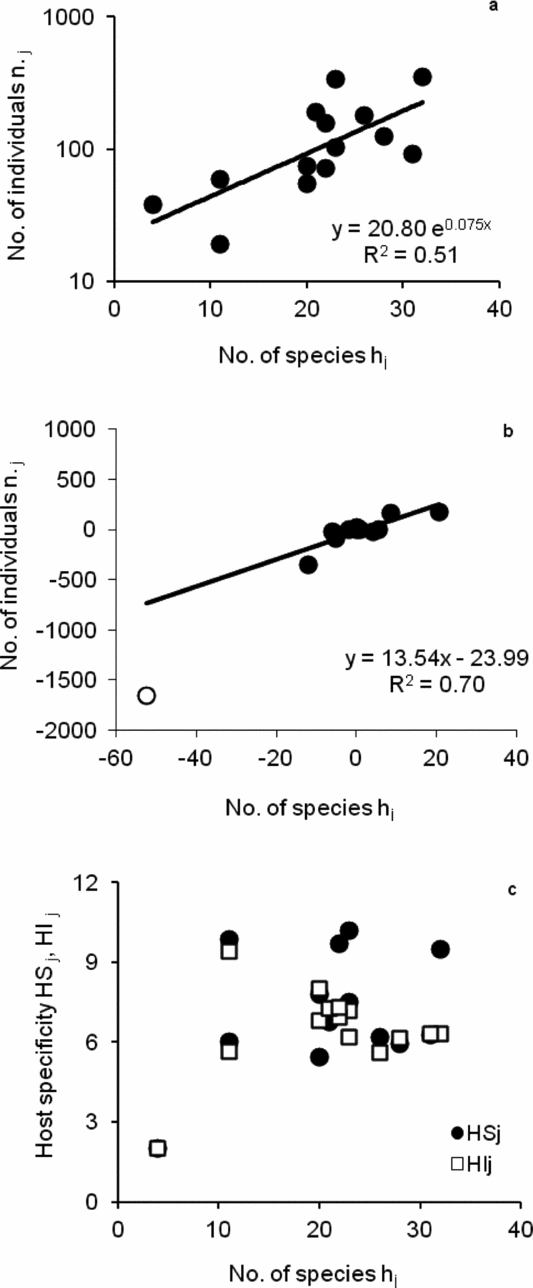
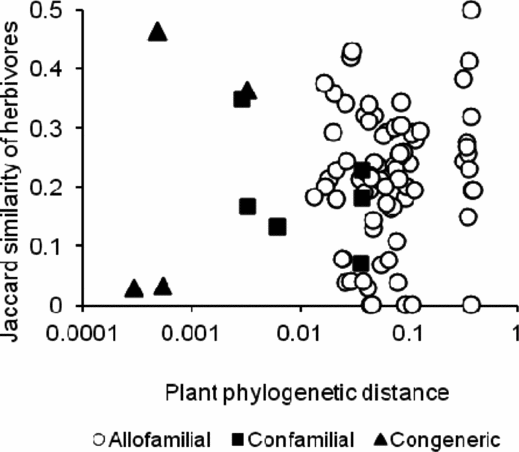
The number of Auchenorrhyncha individuals feeding on a particular plant species (n.j) increased with the number of species feeding on that plant (hj), while it was not correlated with host specificity of Auchenorrhyncha (HIj) or succession optimum (OS j) of the host plant species (multiple regression of log n.j on hj, HIj, and OSj, R2 = 0.499, F3,10 = 5.32, P = 0.019, n = 14, Figure 3a). This pattern was confirmed by the independent contrast analysis (multiple regression of log n.j on hj, HI j, and OSj, R2 = 0.874, F3,8 = 26.4, P < 0.001, n = 12, Figure 3b). There was no correlation between host specificity and species richness of Auchenorrhyncha assemblages across the 14 plant species (Figure 3c, Pearson r between h and HIj, P > 0.10 for both classical and independent contrast analyses). The similarity of reared Auchenorrhyncha assemblages from different host plant species was unrelated to the phylogenetic distance of these plant species (Figure 4). The similarity between Auchenorrhyncha assemblages was also unrelated to the similarity in succession optimum for their host plant species, measured as the difference between their OSj values (Pearson r, P > 0.05, Mantel test).
The relationship between the number of species in Auchenorrhyncha assemblages on the 14 focal plant species in PNG and their herbivore load analysed by classical regression, where the data points represent assemblages on individual tree species (a), their herbivore load analysed using independent contrasts based on phylogenetic relationships of the plant species (b), and host specificity (HSj – mean number of potential host species per herbivore species, HIj – mean number of potential host species per herbivore individual) (c). Contrast between assemblages on Ficus bernaysii and the remaining two Ficus species (open circle) was excluded from the regression as an outlier. The study was conducted near Ohu village in Madang, Papua New Guinea.
Relationships between phylogenetic distance of plant species and Jaccard similarity of their reared Auchenorrhyncha assemblages. All pairs of 14 plant species are shown, classified as congeneric, confamilial and allofamilial. There was no correlation between the two variables (Pearson r, P > 0.05, Mantel test). The study was carried out in the forest near Ohu Village, Madang, Papua New Guinea.
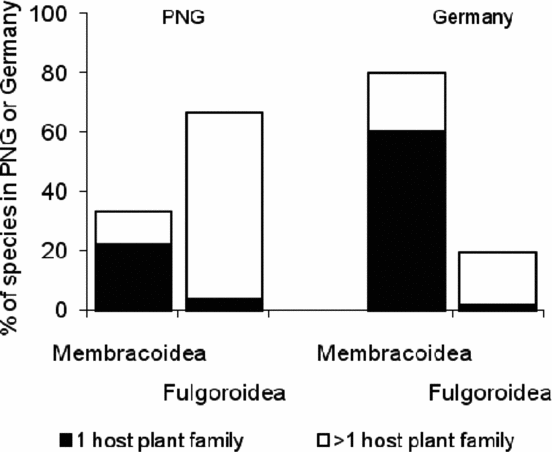
The proportion of species feeding on only one plant family was higher among the 101 arboreal, phloem-feeding species occurring in Germany than among the 27 species in our PNG rain-forest communities (Figure 5). The difference in host specificity was entirely due to different relative species richness of Membracoidea and Fulgoroidea in Germany and PNG. While PNG communities were dominated by generalists Fulgoroidea, the German fauna was dominated by more specialized Membracoidea. At the same time, there was no latitudinal difference in host specificity in either Membracoidea or Fulgoroidea (Figure 5).
The taxonomic composition and host specificity of arboreal Auchenorrhyncha in PNG rain-forest communities and European regional fauna. The proportion of species feeding on 1 and >1 plant family, and recruited from the Membracoidea and Fulgoroidea lineages, are shown for the phloem-feeding species from woody plants in PNG (the present study) and in the fauna of Germany (from Nickel & Remane Reference NICKEL and REMANE2002). The total of 27 PNG and 101 German species represent 100% totals for the respective countries. The relative species richness of Membracoidea and Fulgoroidea is significantly different between PNG and Germany (P < 0.001, Fischer's exact test). The overall host specificity is significantly different between PNG and Germany (P < 0.001), but host specificity in both Membracoidea and Fulgoroidea does not differ between the two countries (P > 0.4, Fischer's exact test). The respective study locations are near Ohu village in Papua New Guinea and in Germany.
DISCUSSION
We have documented one of the most species-rich assemblages of adult Auchenorrhyncha on tropical rain-forest vegetation, comprising 402 phloem- and xylem-feeding species. Results for at least a further 136 mesophyll cell-feeding species (Cicadellidae: Typhlocybinae) will be published separately (Baje et al., in review). Other studies of rain-forest Auchenorrhyncha reported local diversity of 300–500 species, on the basis of general sampling from diverse vegetation by sweeping, fogging or light trapping (Casson & Hodkinson Reference CASSON and HODKINSON1991, Novotny Reference NOVOTNY1993, Stork Reference STORK1991, Sutton et al.1983, Wolda Reference WOLDA1988). Our sampling of adults from a limited number of focal tree species thus apparently enabled us to sample most of the local Auchenorrhyncha assemblage, comprising both species feeding on the focal trees and tourists. The fact that we were able to sample adults from a large proportion of local Auchenorrhyncha species by targeting only a fraction of local plant diversity (14 from > 200 woody species) suggests a large proportion of tourist species in our samples of adults and thus the importance of feeding experiments and rearing of larvae for the study of trophic interactions in Auchenorrhyncha, as opposed to distribution studies of adults.
Our results also support the assumption that a large part of Auchenorrhyncha diversity recorded by sampling of adults was dependent on resources other than plant foliage in the larval stage. In particular, the most species-rich family of Derbidae, as well as Achilidae, were poorly represented among reared species as their nymphs mostly feed on fungi (Wilson & O'Brien Reference WILSON, O'BRIEN, Wilson and Nault1987) and as such should be considered as a separate guild. Cicadidae have subterranean larvae and Delphacidae feed mostly on grasses and other monocotyledoneous plants (Denno & Roderick Reference DENNO and RODERICK1990). In contrast, Cicadellidae, Flatidae, Ricaniidae and Aphrophoridae dominated the reared assemblages of Auchenorrhyncha as they all have larvae feeding on green plant parts.
The Auchenorrhyncha assemblages exhibited low host specificity. This was expected for the xylem-feeding guild which was already known for its low host specialization (Novotny & Wilson Reference NOVOTNY and WILSON1997), as its food resource is extremely poor in secondary metabolites as well as nutrients (Raven Reference RAVEN1983). In contrast, phloem-feeders typically range widely from specialists to generalists. Our rearing was limited to 14 plant species, a small proportion of > 200 woody plant species present in the studied forest (V. Novotny, unpubl. data). This restricted sampling certainly missed many specialists feeding on non-sampled plants, but also additional host plants for some apparently specialized species. The relationship between host specificity estimates and sample size is complex (Novotny et al. Reference NOVOTNY, BASSET, MILLER, DRODZ and CIZEK2002) so that broader sampling is needed to verify our conclusions.
The low average host specificity documented here was surprising, particularly in comparison with higher host specificity in the temperate-zone, in Germany. The Auchenorrhyncha community in PNG was dominated by Fulgoroidea while the German arboreal fauna was dominated by Membracoidea. Different representation of these taxa was entirely responsible for differences in host specificity because in both countries, Membracoidea were more specialized than Fulgoroidea. Hodkinson & Casson (Reference HODKINSON and CASSON2000) suggested that while small body size, coupled with high abundance, was advantageous for seeking out rare food resources, larger size and lower abundance may be associated with lower specialization. This pattern fits the difference in host specificity between relatively small and specialized Membracoidea and Fulgoroidea, which is dominated in PNG by Flatidae and Ricaniidae, known for their large body size and low host specialization (Medler Reference MEDLER1989).
It should be noted that our tropical–temperate comparison is tentative as it contrasts local assemblages in the tropics with regional pools of Auchenorrhyncha species and their trophic interactions in the temperate zone. Standardized sampling of Auchenorrhyncha communities along latitudinal transects is needed for more detailed analyses.
The low host specificity also generated a rather unusual lack of similarity decay in herbivore assemblages with increasing phylogenetic distance between their host plant species. This was due to many Auchenorrhyncha species feeding on plant species from multiple families. Usually, phylogenetic distance between plant species is a good predictor of similarity between their herbivore assemblages, as documented for instance for caterpillar assemblages from our study site where phylogenetic distance of hosts explained 18% of variability in the assemblages of externally feeding caterpillars (Novotny et al. Reference NOVOTNY, MILLER, BAJE, BALAGAWI, BASSET, CIZEK, CRAFT, DEM, DREW, HULCR, LEPS, LEWIS, POKON, STEWART and WEIBLEN2010).
Classical niche theory explains the coexistence of herbivorous species sharing the same host plant species by exploitation of different resources. The assemblages dominated by specialized species should thus be more species-rich than those comprising mostly generalists but this was not the case here. Furthermore, the number of Auchenorrhyncha species feeding on a particular plant species was a strong predictor of herbivore abundance. This pattern suggests that these herbivore assemblages are not saturated with species and that species coexistence on the same plant species is independent of the division of limited resources (Novotny et al. Reference NOVOTNY, MILLER, HRCEK, BAJE, BASSET, LEWIS, STEWART and WEIBLEN2012). An increasing number of studies suggest that insect herbivore communities are rarely saturated with species and that their diversity is determined by the size of the regional species pool from which they are assembled (Caley & Schluter Reference CALEY and SCHLUTER1997, Harrison & Cornell Reference HARRISON and CORNELL2008, Ricklefs Reference RICKLEFS2004).
The position of individual plant species on the succession gradient did not explain either the species richness or host specificity of their Auchenorrhyncha assemblages. Tropical rain-forest succession is often dominated from the beginning by woody pioneer plants, which are already sufficiently apparent (sensu Feeny Reference FEENY, Wallace and Mansell1976), i.e. large and long-lived, for specialized insect herbivores (Leps et al. Reference LEPS, NOVOTNY and BASSET2001). In contrast, early succession vegetation in the temperate zone comprises short-living, often annual herbaceous plants, where generalist species with good dispersal ability in Auchenorrhyncha assemblages are favoured on pioneer plant species (Novotny Reference NOVOTNY1994a, Reference NOVOTNY1994b).
In conclusion, xylem- and phloem-feeding Auchenorrhyncha represent an important part of herbivore assemblages on tropical vegetation. Their impact on this vegetation type remains unknown, although, judging by the pest status of many species in agricultural systems, their effects are likely to be profound. Their low host specificity makes them ideal agents for dynamically linking various unrelated plant species in the forest ecosystem, through their herbivory, potential spread of pathogens, and also as a resource for predators, parasitoids and mutualists.
ACKNOWLEDGEMENTS
We thank Joel Gum, Benson Sam and Kelly David for assistance in the field and Brus Isua for advice on the actual construction of the rearing cages. We are grateful to K. Damas, J. Medler, K. Molem, M. R. Wilson and M. Webb for taxonomic assistance. This work was supported by the National Science Foundation (DEB 0515678), the Grant Agencies of the Czech Republic (P505/10/0673), Czech Ministry of Education (LH11008, CZ.1.07/2.3.00/20.0064), Darwin Initiative for the Survival of Species (14/054) (UK), Commonwealth of European Union, ACP and the EU-ACP FORENET.
Appendix 1
Plant species sampled for Auchenorrhyncha adults (A) and larvae (L). Euphorbiaceae: Codiaeum ludovicianum Airy Shaw (A), Endospermum labios Schodde (A), Homalanthus novoguineensis K. Schum. (A), Macaranga aleuritoides F. Muell. (AL), Macaranga cf. brachytricha Airy Shaw (A), Macaranga densiflora Warb. (A), Macaranga ducis Whitmore (A), Macaranga novoguineensis J.J.Sm. (A), Macaranga quadriglandulosa Warb. (AL), Mallotus mollissimus (Geisel.) Airy Shaw (A), Melanolepis multiglandulosa Rchb. & Zoll. (A), Pimelodendron amboinicum Hassk. (A); Gnetaceae: Gnetum gnemon L. (L); Monimiaceae: Kibara cf. coriacea (Blume) Hook.f. & Thomson (L); Moraceae: Artocarpus camansi Blanco (L), Ficus bernaysii King (AL), Ficus botryocarpa Miq. (A), Ficus conocephalifolia Ridley (A), Ficus copiosa Steud. (AL), Ficus dammaropsis Diels (A), Ficus hispidioides S. Moore (A), Ficus nodosa Teysm. & Binn. (A), Ficus phaeosyce Laut. & K. Schum. (AL), Ficus pungens Reinw. ex Blume (A), Ficus septica Burm. f. (A), Ficus trachypison K. Schum. (A), Ficus variegata Blume (A), Ficus wassa Roxb. (A); Myrtaceae: Syzygium sp.(L); Phyllanthaceae: Breynia cernua (Poir.) Muell. Arg. (A), Phyllanthus lamprophyllus Muell. Arg. (A); Rubiaceae: Pavetta platyclada K. Schum. & Lauterb. (AL), Psychotria micralabastra Valeton (L), Randia schumanniana Merr. & L.M. Perry (L); Ruscaceae: Dracaena angustifolia Roxb. (L); Sapindaceae: Pometia pinnata Forster (L).
The phloem- and xylem-feeding Auchenorrhyncha species reared from the 14 focal plant species. ni. = number of reared individuals, pi = number of host plant species.