Introduction
In spring 2002, the presence of the insect Dryocosmus kuriphilus Yasumatsu (Hymenoptera: Cynipidae) was reported in chestnut groves and forests of Cuneo Province (Piemonte region, Italy). Over nine years, the cynipid has spread all over Italy and in many other European countries. This gall-wasp is indigenous to China and was previously introduced into Japan (1941), Korea (1963) and USA (1974) where it caused serious yield losses to chestnut.
D. kuriphilus is a univoltine and thelytokous species; it lays eggs in chestnut buds during summer. At the time of budburst, the larva induces the formation of greenish-red, 8–15 mm large galls, which develop in mid-April on new shoots. Gall development suppresses shoot elongation, reduces fruiting and causes twig dieback. Severe infestation can result in mortality of young trees (Payne et al., Reference Payne, Menke and Schroeder1975).
The reason of its rapid spread is explained by the sale of young infested plants from nurseries located in infested areas (Quacchia et al., Reference Quacchia, Moriya, Bosio, Scapin and Alma2008). Commercial exchange is usually done during winter when the buds are dormant; and, since buds remain asymptomatic until the following spring, it is impossible to note the presence of the cynipid in the period between oviposition and budburst, before the gall formation. Yet, a rapid and unequivocal detection of D. kuriphilus in dormant buds is very useful to stop infested material before cynipid leak and consequently to reduce the spread of the infestation. The larvae detection procedure can be done by cutting buds and searching for their presence using a stereomicroscope, but it is time consuming and often inaccurate.
The development of an efficient and reliable technique able to detect the insect in dormant buds would be highly valuable and useful for the application of protective measures against the spread in the European Community of this harmful organism, in compliance to the Commission of the European Communities Decision 2006/464/EC stating that “Member States shall conduct official annual surveys for the presence of the organism or evidence of infestation by the organism in their territory”.
Polymerase chain reaction (PCR) analysis of species-specific mitochondrial DNA (mtDNA) and ribosomal nuclear sequences is currently the most commonly used method for species identification (Simon et al., Reference Simon, Franke, Martin, Hewitt, Johnston and Young1991). Eukaryotic nuclear rDNA is tandemly organized with high copy numbers up to ca. 5000. Each repeat unit consists of genes coding for the nuclear small subunit (18S), large subunit (25–28S) and 5.8S rDNAs (Hwang & Kim Reference Hwang and Kim1999).
The mtDNA of multicellular animals consists of a closed circular DNA molecule. It ordinarily contains 36 or 37 genes: two for ribosomal RNAs (16S rRNA and 12S rRNA), 22 for tRNAs and 12 or 13 for subunits of multimeric proteins of the inner mitochondrial membrane (cytochrome oxidase, ATP synthase, NADH dehydrogenase and cytochrome b apoenzyme (Wolstenholme, Reference Wolstenholme1992). Mitochondrial DNA is known to evolve much faster than the nuclear genome; 12S rDNA, however, is highly conserved like the nuclear small subunit (18S) rDNA, and it has been employed to illustrate phylogeny of higher categorical levels, such as in phyla or subphyla (Ballard et al., Reference Ballard, Olsen, Faith, Odgers, Rowell and Atkinson1992). Compared to the nuclear rDNA, it is more difficult to design universal primers for amplifying specific regions in mtDNA due to a high variability. This is why only a few mitochondrial genes, such as 12S rDNA, 16S rDNA, Cytb, ND1 and COI, have been employed in phylogenetic studies.
All information considered, we tested four primer pairs designed on nuclear and mitochondrial sequences of a set of seven gall wasp taxa, in order to develop a simple detection method based on PCR reaction. The goal was to identify the presence of first instar larvae of D. kuriphilus in dormant buds.
Material and methods
Multiple alignment and primer design
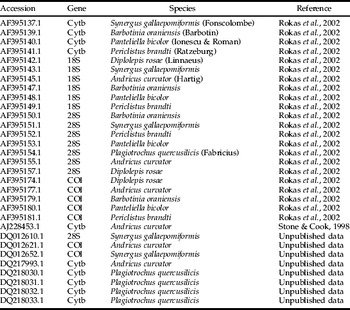
All available full-length nuclear and mitochondrial sequences of 18S, 28S, COI and Cytb of gall wasp taxa (table 1) were retrieved from GenBank (http://www.ncbi.nlm.nih.gov/genbank/) and aligned by ClustalW (Thompson et al., Reference Thompson, Higgins and Gibson1994).
Accessions of 18S, 28S, COI and Cytb of gall wasp taxa, retrieved from GenBank.

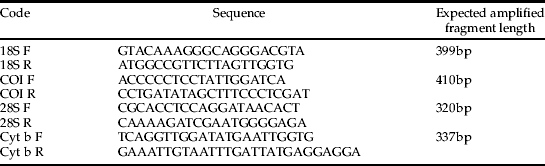
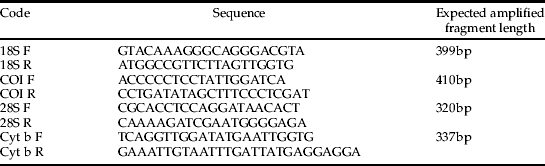
Four primer pairs were designed on conserved regions; sequences and expected amplified fragment length are reported in table 2.
Primer sequences and expected amplified fragment length.
Sample preparation
DNA from D. kuriphilus and four more oak gall wasps, Andricus quercustozae (Bosc) collected in Garessio (CN), Aphelonyx cerricola (Giraud) (Montemignaio, Arezzo), Biorhiza pallida (Olivier) (Moiola, Cuneo) and Andricus polycerus (Giraud) (Capodimonte, Viterbo) was obtained from a single larva, fresh or stored in 99% ethanol, by crushing it in 40 μl of TE buffer inside a well of an ELISA plate. The suspension was transferred into a 1.5 ml eppendorf tube, briefly sonicated (2 min) in an ultrasonic bath, and then boiled for 5 min; a final centrifugation (1 min at 8000 rpm) was done to precipitate insect debris.
To test the sensitivity of the technique and to exclude the possibility that false positives may occur, the following levels of infestation were simulated by adding the larvae to uninfested buds before crushing tissues for DNA extraction:
(i) 2 g buds without larvae
(ii) 2 g buds with one larva
(iii) 2 g buds with two larvae
(iv) 2 g buds with five larvae
The buds were collected from chestnut plants grown in pots under a screenhouse with insect-proof barriers and then added with first instar larvae, which is the same developmental stage they are found in dormant buds.
DNA from buds was extracted with EZDNA Plant Maxi Kit (Omega Bio-Tek, Norcross, Georgia).
Direct and nested PCR
The four primer pairs (18S, 28S, COI, Cytb), designed as described above, were initially tested for amplification using the DNA of the five cynipids. Five μl of the extracted DNA were amplified in a 20 μ1 direct PCR using 0.5 units of Taq polymerase (Bioline, London, UK) per reaction. Each 20 μ1 reaction consisted of 2 μl of buffer 10×, 0.9 μl of MgCl2 50 mM (both solutions supplied with the polymerase), 1 μl of forward and 1 μl of reverse primer (20 pM μl−1), 0.2 μl nucleotide mix (20 mM), 0.5 Unit of BIOTAQ polymerase (Bioline, London, UK) and 9.8 μl sterile distilled water. After 3 min at 95°C, DNA fragments were amplified through 32 cycles at the following steps: 30 s at 95°C, 45 s at 55°C and 1 min at 72°C; a final extension step was carried out at 72°C for 10 min. Amplification products were run on 2% agarose gel and visualized with a UV transilluminator, after ethidium bromide staining.
The same primers were tested also on the four simulated levels of infestation: 5 μl of the extracted DNA (about 50 ng μl−1) were amplified in a 20 μ1 direct PCR using 0.5 units of Taq polymerase (Bioline) per reaction. Each 20 μ1 reaction consisted of 2 μl of buffer 10×, 0.9 μl of MgCl2 50 mM (both solutions supplied with the polymerase), 1 μl of forward and 1 μl of reverse primer (20 pM μl−1), 0.2 μl nucleotide mix (20 mM), 0.5 Unit of BIOTAQ polymerase (Bioline) and 9.8 μl sterile distilled water. After 3 min at 95°C, DNA fragments were amplified through 37 cycles at the following steps: 30 s at 95°C, 45 s at 55°C and 1 min at 72°C; a final extension step was carried out at 72°C for 10 min. Two μl of the amplification product were then used as template for the nested PCR, carried out for 28 cycles at the same conditions as the direct PCR.
Amplification products were run on 2% agarose gel and visualized with a UV transilluminator, after ethidium bromide staining.
Test on field material
To check the reliability of the technique, a test was conducted on material collected in a nursery by the regional plant protection service, both from plants grown under tunnels with insect-proof barriers and from plants growing in open field where the pressure of the gall wasp is high. A sample of 90 buds (three repetitions of 30 buds each) was collected and examined both by stereomicroscope examination and 28S diagnostic PCR.
Results
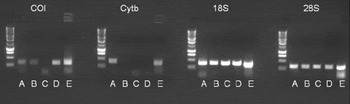
Each four primer pairs (18S, 28S, COI and Cytb), tested for amplification on DNA of five cynipids (D. kuriphilus, A. quercustozae, A. cerricola, B. pallida and A. polycerus) produced amplicons with D. kuriphilus DNA. As concern the DNA of the other cynipids, 18S and 28S gave a good amplification in all samples, Cytb couldn't only amplify A. quercustozae DNA and COI produced amplification only for B. pallida (fig. 1). The Cytb and COI band are a little smeared.
Amplicons of Cytb, COI, 18S and 28S primer pairs obtained by PCR on five different cinypid DNAs. A, Biorhiza pallida; B, Aphelonyx cerricola; C, Andricus quercustozae; D, Andricus polycerus; E, Dryocosmus kuriphilus.

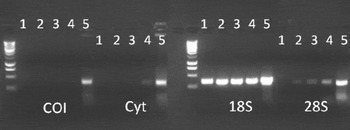
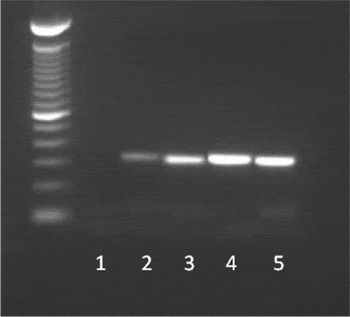
The results of diagnostic PCR for each primer pair, when tested on buds with different simulated level of infestation, are shown in fig. 2. COI never detected the gall wasp presence; Cytb gave a weak signal only when five larvae were added to buds; 18S amplification product was strangely present also in uninfested buds. Finally, 28S showed an increasing signal intensity in the three samples with increasing level of infestation (1, 2, 5 larvae in second to fourth lanes) and no amplification in buds without larva (first lane) (fig. 3). The fragment length (320 bp) corresponded to the size of the amplicon from the pure insect DNA (fifth lane).
Amplicons of Cytb, COI, 18S and 28S primer pairs obtained by PCR on four different infestation level. 1, no larva; 2, one larva; 3, two larvae; 4, five larvae; 5, D. kuriphilus.

Amplicons of the 28S primer pair obtained by nested PCR. 1, no larva; 2, one larva; 3, two larvae; 4, five larvae; 5, D. kuriphilus.

In regard to the test on field material, the stereomicroscope observation and the molecular method confirmed the absence of larvae on buds collected from plants grown under tunnels with insect-proof barriers. On the contrary, the presence of the wasp was highlighted by the diagnostic PCR into material collected in the open field in a highly infested area.
Discussion
The aim of this research was to identify the presence of D. kuriphilus first instar larvae in dormant buds of chestnut.
The primer pairs, developed for diagnostic PCR, have proved useful for detecting, in total DNA, the presence of genetic material not only belonging to D. kuriphilus but also to other species of gall wasp.
Therefore, profiles obtained from amplification of different cynipids with 18S and 28S were more well-defined then the ones obtained with Cytb and COI (fig. 1); this may be due to better conservation of nuclear than mitochondrial DNA (Hwang & Kim, Reference Hwang and Kim1999). Moreover, the mitochondrial primers (Cytb and COI) are not sensitive enough, probably because of the difficulty of extracting properly this kind of genetic material.
With regard to nuclear primers, the 18S is probably aspecific because it amplified even in uninfested buds (fig. 2). On the contrary, the 28S amplification product (figs 2 and 3) was absent in not infested buds, but present in infested buds. Moreover, it produced a signal of increasing intensity with increasing level of infestation.
Although the 28S primer pair detected the presence of all the species of gall wasp tested in this study (A. quercustozae, A. cerricola, B. pallida and A. polycerus), it can be considered a good marker to reliably detect D. kuriphilus in chestnut, because D. kuriphilus is the only one able to induce galls on Castanea spp. (Stone et al., Reference Stone, Schönrogge, Atkinson, Bellido and Pujade-Villar2002; Aebi et al., Reference Aebi, Schönrogge, Melika, Alma, Bosio, Quacchia, Picciau, Abe, Moriya, Yara, Seljak, Stone, Ozaki, Yukawa and Ohgushi2006).
The proposed technique could be applied in a basic laboratory, equipped with a normal centrifuge (× eight vials) and a thermal cycler; one unskilled operator can safely process up to 16 g of buds per day. This quantity corresponds to a number of buds which can vary from 480 to 1280 approximately, depending on the cultivar. Optimizing the extraction step by performing more sets of extractions per day, it is possible to process up to 192 g of buds in five days. Alternatively, the bud check at the stereomicroscope is able to process approximately 200 to 500 buds per day, depending on the required precision level.
Finally, the detection method developed in this study could help phytosanitary services to contain D. kuriphilus diffusion, identifying the insect at its first larval instar and speeding up the analysis.
Acknowledgements
Authors wish to thank Giovanni Bosio (regional phytosanitary service) for supplying the plant material. The research was funded by Regione Piemonte Administration (project ‘Valutazione della sensibilità varietale e meccanismi molecolari di risposta al cinipide galligeno del Castagno’).