For all the wealth of work on Gandhi, little attempt has been made to consider how his thought and practice was received in the imperial center, leaving us to assume an unproblematic translation from colony to metropole. Often, it seems, we are left with the residue of that saintly image of Gandhi popularly propagated in both “East” and “West,” which tended to endow his politics with an inherent truthfulness and universality. Recent studies in colonial history have begun to unpick the logic behind such assumptions, showing how frequently ideas and practices were challenged and mutated in the passage between colony and metropole, and vice versa.Footnote 1 However, despite the frequent rhetorical insistence upon the mutually constitutive nature of these exchanges, considerably greater attention has been paid to the transitions and translations of people, goods, and practices from metropole to colony, leaving the reverse process relatively underexamined.Footnote 2 This is not to ignore the ever-burgeoning body of work that has sought to put empire back into British history, but it is to suggest that much of that work has often seemed to reproduce remarkably durable liberal conceptions of the free flow of subjects and texts across imperial boundaries (rarely is Britain's transnational history seen to extend beyond its empire).Footnote 3 Surprisingly, for all the recent emphases on the transnational, the transmission of news and information from colony to metropole, and its dissemination in the imperial center where it came to shape the metropolitan public's knowledge of the empire, has been largely ignored.Footnote 4 If we still have much to learn from imperial historians like Bayly who believe information to be a neutral category, awaiting collection and systemic organization in order to make knowledge and rule possible, we perhaps have still more to learn from colonial historians like Cohn and Dirks who have shown us that information systems always inscribe and produce knowledges that delineate the nature of rule.Footnote 5 Yet, we also need to push further by recognizing that material processes and pressures, as much as discursive influences, came to shape the ways in which the British read about and knew their empire.
This article focuses upon how Gandhi's dietary practice and fasting articulated a nationalist politics, which for all its “Indianness,” still drew upon a symbolic repertoire India's colonial governors could comprehend. Yet, critically, it also seeks to evaluate how this political idiom was interpreted at the metropolitan heart of empire by examining how his dramatic fasts of September 1932 and February to March 1943 were portrayed in British national newspapers. Giving due attention to how only certain events and forms of information were assembled as imperial news, and the ways in which that news was constituted, will, we hope, demonstrate some of the material and discursive constraints that helped shape the metropolitan reception of Gandhi's fasts. We want to emphasize at the outset that we do not assume an unproblematic relationship between press representation of Gandhi's fasts and “public opinion.” Our interest is less in how accurately the press reflected something called “public opinion,” a category whose contemporary meaning was in any case being actively manufactured in Britain at this time, than in how colonial systems of information management helped constitute the news and knowledge of anticolonial struggle in particular ways. Despite the emergence of radio and newsreel, our concentration upon the national newspaper press reflects its continuing status as the prime medium for the dissemination of news, and thus the major conduit through which competing understandings of Gandhi's fast were promulgated and discussed in Britain.Footnote 6
India witnessed a spate of hunger strikes and fasts directed explicitly against the government of India and the management of the colonial world in general in the years following the First World War. The protagonists sought to represent the injustices of the colonial encounter as a corporeal drama, at once individual and heroic, yet representative of the suffering of the wider nation in front of an audience that, via the printed media, extended to the heart of empire itself. In doing so, they drew upon a mode of political protest recently well-established in Britain and its broader colonial empire. From Tsarist Russia the use of hunger strikes had spread quickly across the British Empire: from suffragettes in Britain after 1909 to their counterparts in Ireland during 1912, from protests against the colonial color bar by Gandhi in South Africa in 1913 and Sikh migrants to Canada in 1914 to conscientious objectors in Britain and Irish nationalists from 1916.Footnote 7 However, the period from 1916 through to the 1940s can perhaps be represented as the golden age of the hunger strike in anticolonial struggles.Footnote 8 Despite numerous individual and collective hunger strikes by a variety of groups in Ireland, India and Burma that left many martyred dead, historians of the phenomenon, much like contemporary commentators, tend to consider the central figure to be the diminutive one of Mohandas Gandhi.Footnote 9
The reasons for this are not hard to divine. Not only did Gandhi undertake at least fifteen significant fasts during his lifetime, many of these were explicitly depicted by himself, his interlocutors, acolytes, and critics, as central to his intertwined projects of national and self-(re)formation.Footnote 10 So embedded was fasting in Gandhi's everyday life that it is difficult to neatly separate its practice as a regime of the self from its performance as an act of national significance. Indeed, as we shall see, this was precisely the point, to inscribe the self upon the nation, and the nation upon the self, in ways that elevated Gandhi's claims to moral leadership. Between February 1914 and January 1948 Gandhi undertook fasts as penance for the immoral behavior of his ashramites in South Africa, for outbreaks of violence among satyagrahis in 1919 and between Hindus and Muslims in 1924, 1947, and 1948, as well as the “epic” fast of 1932 against the Communal Award and the 1943 protest against being held largely responsible for the Quit India movement of the previous year. During this period the fast became a central weapon in Gandhi's attempts to represent the trials of the idealized Indian nation upon his person, a confrontational practice complementing his more mundane dietary “experiments with truth” publicized in his various writings.
It was from a position of exile, during the journey from London to South Africa in 1908, that Gandhi first articulated what remained the classic statement of his nationalist politics in Hind Swaraj or Indian Home Rule.Footnote 11 The concept of swaraj (or self-rule) went to the heart of Gandhi's moralized notion of the nation. Its meanings extended far beyond home rule and freedom from colonial government, rather it evoked a freedom that could only be achieved through the ethical government of the self and the rigorous practice of self-discipline in the pursuit of truth. India would only be free as a nation when its individuals had succumbed to the search for truth and reformed their souls, when they had embraced sarvodaya (selfless service). Only then, from a position of moral strength, could the weapon of satyagraha (militant nonviolence) take effect. Without first governing the soul of the nation, home rule would be tantamount to accepting “English rule without Englishmen” of rendering India “not Hindustan but Englishtan.”Footnote 12 It is in this context, of a highly moralized pursuit of truth through self-control, that we must place Gandhi's ceaseless experimental quest for mastery over the pleasures of the flesh. Much has recently been written of Gandhi's belief in brahmacharya (the practice of celibacy) and his anxious determination to overcome wet dreams and restore his body, enfeebled by desire, to its natural state.Footnote 13 Less has been written of the relationship between sexual purity and social hygiene in Gandhi's thought and practice, his attempts to contest and tropicalize British discourses of public health.Footnote 14 However, Jospeh Alter has recently drawn attention to the intimate relationship between Gandhi's pursuit of brahmacharya and his preoccupation with diet and fasting, as well as a host of other keys to moral health and self-control such as yoga, fresh air therapy, and naturotherapy.Footnote 15 Later we will have more to say about the particular logic of Gandhi's dietary regimes, their fusion of Western nutritional science with ayurvedic principles and Hindu practices. Here we want simply to emphasize how central the politics of diet and fasting was to Gandhi's vision of swaraj, connecting the disciplines of the individual with the moral and physical health of the national community, allowing him to present himself as the embodiment of a remoralized Indian nation.
Gandhi wrote profusely about food and its importance to regimes of self-control, publishing the results of his restless experiments on a range of diets and modes of preparation in Young India and Harijan between 1929 and 1946.Footnote 16 His readers were spared little; whether it was a discussion of the nutritional value of peanuts, the mechanics of mastication, or the consistency, weight, and regularity of his bowel movements. Throughout, Gandhi was at pains to assure readers of the value of these seemingly mundane details to the exercise of self-control and the quest for simplicity, purity, and truth, urging others to join him and to share the fruits of their labors:
As a searcher for Truth I deem it necessary to find the perfect food for a man to keep body, mind and soul in sound condition. … I should count no cost too dear for making a search which in my opinion is so necessary from more points of view than one. I therefore still seek information and guidance from kindred spirits. To those, who are not in sympathy with this phase of my life and who out of their love for me are anxious about me, I give my assurance that I shall not embark upon any experiment that would endanger my other activities.Footnote 17
Clearly, while such exercises were open to all, they also served to reify Gandhi's body and equate it with the nation itself, so that the frail figure could be seen to be suffering on behalf of not just his own, but the nation’s, moral health.
Nowhere was this more evident than in his practice of fasting which became a kind of dietary equivalent of brahmacharya, the supreme exercise of self-denial and thus the ultimate test of the satyagrahis.Footnote 18 Like his dietetic experiments, fasting was not open to all aspiring brahmacharya, for if used wrongly it would merely enhance appetite and become a “weapon of indulgence,” just as a “mind consciously unclean cannot be cleansed by fasting.”Footnote 19 The practice of self-restraint was not confined to such heroic gestures. Gandhi repeatedly called for simplicity and economy in the matter of dietary practices, for a purging of what he called “the pleasures of the palate,” the “lusts for delicacies and luxuries,” urging the development of a simplified, cheaper, and unitary national diet, “common dishes for common people,” in place of the proliferation of provincial styles and increasingly elaborate and extravagant tastes.Footnote 20 Greed and self-gratification had to be overcome. Only simple, plain food was needed to fulfill the body's basic nutritional requirements and such a disciplined diet would ensure that there was food enough for the wider community. For Gandhi, however, fasting was critical to his project of satyagraha: a test of his own self-rule and variously either an act of penance for a sinful nation or a moral challenge to British colonial rule.Footnote 21 Given the number and regularity of his fasts, both those performed to test the limits of his own self-rule as well as those undertaken publicly to challenge others, it is perhaps not an exaggeration to claim that Gandhi's fasts became synonymous with his style of leadership and his particular vision of the nation and its fight for independence from Britain.
In what follows we concentrate on just two of these fasts: the eleven-day fast of September 1932 while imprisoned in Yervada gaol against the Lothian Committee's proposal to award separate electoral representation for “the untouchables” and his twenty-one-day fast in February and March 1943 during his almost two-year incarceration following the outbreak of the Quit India Movement in 1942. Although these were arguably two of his most notorious fasts, they were also the only two that were substantively reported in Britain.Footnote 22 Both fasts were received in Britain with a mixture of detachment, skepticism, bewilderment, concern, and hostility—a mixture that varied predictably from newspaper to newspaper, and the circumstances under which the particular fasts were undertaken. Without question it was the fast of 1932 that proved most troubling to the British press, in part because the lines of cleavage appeared unclear, in part because it represented the first time they had had to explain the politics of Gandhi's fast to their publics. Indeed, even Gandhi's most recent foray into the sphere of imperial popular politics in Britain, his visit to Lancashire to explain his advocacy of a boycott of Lancashire textiles during the Round Table Conference of 1931, had gone almost unreported in the national press (with the notable exception of the Manchester Guardian), leaving the Mahatma's distinctive political modus operandi only hazily legible to the metropolitan public.Footnote 23
Long prior to his fast in 1932, Gandhi had been exorcised by the position of the untouchables, viewing their discrimination as a blight upon all Hindus, a corruption of the purity of their faith, and an erasure of the principle of community.Footnote 24 For Gandhi the prospect of separate representation for untouchables, while supported by the leaders of the depressed classes, threatened to legally entrench their position as a distinct caste, rather than eradicate such distinctions. The previous March, he had written to the secretary of state for India, Sir Samuel Hoare, warning of his intention to fast over the proposal, recognizing that while such a course of action would be regarded by many “as hysterical if not much worse,” it was for him “not a method [but] … part of my being. It is the call of conscience which I dare not disobey, even though it may cost whatever reputation for sanity I may possess.”Footnote 25 He reiterated that the fast was not a political gesture the week before its enactment, this time in a letter to the government of Bombay, declaring that it was instead “resolved upon in the name of God, for His work, and as I believe in all humility, at His call.”Footnote 26 As a divine act of penance, this yajna, was presented to the government of India as being directed less at them than at the Hindu community, to cleanse it of the stigma of untouchability. In doing so, he was careful to emphasize not just the spiritual legitimacy of the act, but his unique position to answer “His call” and to practice satyagraha on behalf of his people:
Fasting for light and penance is a hoary institution. I have observed it in Christianity and Islam. Hinduism is replete with instances of fasting for purification and penance. But it is a privilege if it is also a duty. Moreover, to the best of my light, I have reduced it to a science. As an expert, therefore, I would warn friends and sympathisers against copying me blindly or out of false or hysterical sympathy. … Lastly, in so far as I know myself this fast is being undertaken with the purest of motives and without malice or anger against any single soul. For me it is an expression of and the last seal on non-violence.Footnote 27
Pyarelal faithfully presented the fast in precisely this light: as a “supreme gesture” of “stupendous sacrifice,” a “resplendent self-purification,” a demonstration of the “power of satyagraha, of the matchless alchemy of love and self-sacrifice, once more bringing together the disrupted human family to live under a common paternal roof in perfect amity and love.”Footnote 28 Lest we forget, he solemnly reminded his readers, the fast was not intending to evoke sympathy for the nation's matchless champion, but to inspire all Hindus to purify themselves.Footnote 29
In Britain, Gandhi's fast on behalf of the untouchables was generally met with an equal measure of confusion and condescension. To a public dimly aware of Gandhi's previous fasts, but familiar with the hunger strikes of suffragettes and Irish nationalists, a range of explanatory histories were offered by the press. The News of the World, in a “special” report, located its coverage of Gandhi's pledge to fast unto death in the broader context of “Historic Fasts” stretching back to the case of a Palestinian Bishop in 356. It also highlighted how “East and West ‘Meet’ in Matter of Hunger Striking” by citing both British and Indian precedents such as the “Jani fanatic” Hira-vi-Jaya Guri whose death by starvation in prison had been memorialized at Una Nagar together with the Quakers who had died on hunger strike in 1656 in Ipswich, Marlborough, and Exeter gaols.Footnote 30 Old India hands, such as the “Former Resident” who wrote a feature for the Manchester Guardian, situated Gandhi's fast within the long-held Indian custom of “sitting Dhurna,” commonly deployed to recover a debt, where the creditor fasts to death until the debtor makes good his arrears. Noting that this custom had been outlawed under the Indian Penal Code of 1860 because it was perceived as manipulative and coercive, he nonetheless counseled against overly simplistic interpretations of the practice. Instead, tracing its provenance in ancient Ireland and India as an ascetic act through which saints brought pressure to bear upon kings and gods, he suggested that the practice had once been universal and still had the capacity to hold sway amongst “simple folk everywhere and in all ages.” The Manchester Guardian's India expert concluded that for all Gandhi's worldliness as a lawyer and politician, “his actions are usually to be found … in the traditional mythology and philosophy of Mother India.”Footnote 31
It was a narrative that had been rehearsed two decades previously, for this was not the first time that the British press had featured a discussion of the practice of sitting dhurna. In March 1913, amid the sound and fury that engulfed the suffragette hunger strikes, two old India hands had debated the history and significance of the custom in the letters pages of The Times. Mr H. Macauley Posnett, citing the authority of his friend the late eminent jurist Sir Henry Maine, recounted the “barbarous and immoral” Indian practice of sitting dhurna and its elimination under the civilizing agency of the British imperial regime. By hunger striking the suffragettes had revealed themselves to be “degenerates in heart and intellect,” no better than “barbourous Indians”; “let them starve,” he counseled.Footnote 32 Yet, the following day, this merciless account was contested by George Birdwood, a retired Indian official well acquainted with antiquarian investigations of Indian customs and with firsthand experience of this particular custom from his service in Bombay, where the local women had sat dhurna against him until he blessed them with sons.Footnote 33 Prefiguring the discussions of 1932, Birdwood claimed a biblical and mythological universality for the custom of dhurna, one “based on the strongest and deepest instincts of humanity,” which the British had failed to understand. The much-vaunted Indian Penal Code had thus merely served to perpetuate a primitive practice that had been dying out naturally before its implementation.Footnote 34 On a practical level, as no man could allow starvation, Birdwood advocated cautiously paternalistic reform for imperial subjects and “militant suffragettes” alike as the best way forward, as long as the individual subject could be deemed responsible and deserving.
It is worth emphasizing two things here. First, even the more sympathetic accounts of this custom, in portraying it as emphatically premodern, suggested that its practitioners should not be penalized, but protected and improved under the nurturing wing of the paternalistic, modernizing, and hence legitimate British state in India. Second, these discussions of dhurna undoubtedly drew upon the compendiums assembled by British orientalists, administrators, and antiquarians in India during the eighteenth and nineteenth centuries, which, it could be suggested, by simultaneously (re)constructing an impeccably Indian genealogy to the custom while highlighting comparable practices in the West, opened up the possibility of its appropriation into the canon of nationalist protest by figures such as Gandhi.Footnote 35 Gandhi hailed from a region of India where bhakti asceticism and “traditional,” face-to-face modes of political protest were extant into the late nineteenth century. Lloyd and Susanne Rudolph have identified how these influences in general, and the culture of self-denial in particular, suffused the Gandhi household via his mother, whom Gandhi was later to attribute as the source of any purity he might possess.Footnote 36 Yet it is worth stressing other influences upon Gandhi's political thought: specifically that of Sir Henry Maine, one of the many scholars to delineate the practice of dhurna and compare it to Western analogues such as senchus mor. Indeed, it is not too fanciful to suggest that Gandhi's observation of the “hoary institution” of fasting in Christianity as well as Hinduism quoted above emanated from this source.
But, to return to the events of 1932, for all the attempts to locate and explain Gandhi's fast historically, there remained widespread confusion, as to whether the fast was an act of opposition to the colonial government or to the leaders of the depressed classes. Indeed, even within the determinedly liberal Manchester Guardian, the threat to fast, when the government of India had made a constitutional arrangement that ostensibly reflected many of Gandhi's concerns for the untouchables, was presented as perplexing. Although the nuances of Gandhi's argument gradually became better understood by the Manchester Guardian in the week between the announcement of his intention to fast and its commencement, the evident conflict between Gandhi and the political leadership of the depressed classes over the issue served to muddy the waters further, deflecting criticism from the government of India. News of the settlement and the concomitant cessation of the fast after five days was thus greeted with relief by the Guardian, but depicted neither as a triumph for Gandhi nor a defeat for the colonial government.
In predictable contrast, the majority of the press ridiculed Gandhi, depicting his fast as willful suicide, the act of a fanatic doing as much to hinder settlement as to help it in a desperate attempt to deflect criticism of his own political failings onto the government of India.Footnote 37 In this reading it was Gandhi's failure to reconcile the Congress and the depressed classes that had forced the modernizing colonial government to bring forward its own proposals and act as the true champion of the oppressed.Footnote 38 However, as the dissension among Indian politicians came to the fore and the crisis reached a relatively speedy conclusion, the Daily Telegraph deviated from this argument to take a less trenchant line. In a leader entitled “A Victory for the Untouchables,” Gandhi's fast was depicted as “a success that may have historic consequences.” For once Gandhi had used fasting for something other than ”minor issues,” and although the threat was directed against the government of India, “the device did not for a moment blind the Hindu community to the reality of the position … it was to them that pressure was being applied.” Printed alongside a feature on “The Tragedy of India's 43,000,000 ‘Untouchables,’” detailing the “tragic conditions” forced upon them by the Hindu religious and social system, the Telegraph thus celebrated an agreement that had dealt “a staggering blow” to untouchability, albeit achieved by “one of those freaks of the Gandhian mentality which have always made it so incalculable as an influence in Indian affairs.”Footnote 39
Thus, even within the more generous readings of Gandhi's fast in the British press, there remained a studied refusal either to grant it a heroic dimension or to acknowledge the difference of India's politics of hunger. In their determination to reduce the fast to a contest between the colonial administration and its unruly subject, the British press largely preferred to dismiss Gandhi freakishness and fanaticism than engage with his distinctly un-British conception of the political. Not for the first or last time, the Daily Herald stood alone, providing Gandhi unqualified support and portraying the fast as a heroic sacrifice and an act of devotion.Footnote 40 Yet despite the best, but unreported, efforts of the Friends of India and an all-night vigil at Kingsley Hall, the British public remained unmoved by Gandhi's fast. Gandhi himself was evidently disappointed at the metropolitan reception of what he described as his “appeal from this fiery bed”: “My fast is an appeal not merely to Hindus and India in general but to British conscience, indeed, to the whole world. This distrust of and misrepresentation of a man who loves British people is an enigma to me. … I had hoped that appeal from this fiery bed would somewhat wake up the British public as it seems to have marvelously roused India. But God's will was perhaps otherwise.”Footnote 41
If the complexities of Gandhi's position in 1932 and the difficulties of its cultural translation helped prevent an auspicious representation of the fast in Britain, there were also material obstacles that shaped the conditions of possibility for its reception. In contrast to the events of 1857–58 in India, where the flow of harrowing (and often wildly fantastic) “eye-witness” accounts from soldiers and the Anglo-Indian community offered potently uncontrollable material that often directly contradicted the authority of “official” sources, news of Gandhi's fasts reached the British press via a far more homogenous and manageable information network. The structures and policies of the press management system operated by the government of India and the India Office are relatively underresearched fields, but an outline can be given here.
The two key bodies were the Central Bureau of Intelligence within the government of India Home Department and the Information Department of the India Office in London. Established in the teeth of the rising nationalist challenge, and in the light of a new appreciation of the benefits of information management engendered by the experiences of World War I, the Central Bureau of Information was instituted by the government of India in order to actively inform and influence public opinion in India and abroad, in recognition of the fact that it had previously suffered “from its attitude of silent aloofness” in this arena.Footnote 42 The nationalist postwar upsurge contributed to the emergence of a vigorous nationalist press that made it important for the government of India to “develop the capacity to orchestrate, if not absolutely control, the reporting of newsworthy events. The Government had to anticipate unfair criticism, know what the public wanted and develop the skills required to present its position effectively.”Footnote 43 Although repression and proscription were the ultimate sanctions available to the government in India, such measures were a last resort, running contrary to the liberal progressive image it was keen to cultivate, and sure to inspire still greater nationalist hostility. The Central Bureau of Information thus devoted its efforts to proactive publicity work: preparing and circulating articles, telegrams, and press releases explaining government policy to the native and foreign press; circulating additional information to interested parties in India and abroad; placing articles in the Indian daily press; distributing leaflets, pamphlets, and brochures on Indian current affairs to organs and institutions around the world; and alerting the press to important official pronouncements and information campaigns. In a more reactive vein, articles giving a misleading interpretation of government policy and activity were contradicted where they emanated. Resentment of this government intervention by Indian newspaper editors was strongly tempered by the value attached to access to official lines of information, even by explicitly nationalist organs. The bulk of this activity was ostensibly directed toward the Indian, rather than the international press, but this nevertheless had an impact upon the British press, which syndicated some of its Indian material from news agencies (most notably Reuters) and correspondents working for Indian publications.Footnote 44
Although both the imperial government and its Indian nationalist antagonists were keenly aware of the potential benefits of influencing hearts and minds among European and American publics, their activities in these arenas were constrained by a relative lack of resources, on one hand, and a lack of faith in the efficacy of such measures, on the other. Congress supported Indian nationalist activists and publicity bodies overseas on an ad hoc fashion in the years following the First World War, yet both Nehru and Gandhi doubted their efficacy, with Nehru skeptical as to how far any nation would support India's cause unless it was deemed “conducive to its own well-being.”Footnote 45 The extent of press coverage of Indian affairs in the British print media between the wars seems to justify this skepticism, with the bulk of British newspapers carrying minimal Indian news, and even The Times failing to give editorial coverage to major events such as the Dandi March in 1930. However, the government of India was sufficiently concerned by these activities to appoint a publicity agent in England to the India Office in 1920, and this arrangement facilitated the distribution of material to the British press and pronationalist M.P.s such as Fenner Brockway, with the latter deemed to become a markedly more moderate opponent as a result.Footnote 46 Another stratagem deployed in both Britain and North America was the provision of such material to private individuals and bodies interested in the subcontinent and offering to carry out publicity work such as giving public talks and corresponding with newspapers on Indian affairs on their own initiative. The government benefited from these arrangements through not having to maintain a costly formal publicity network, while having agents untainted by overt links with the official establishment. The India Office also exercised the power to decide the level of accreditation (and hence access to leading political figures) afforded to correspondents of the Fleet Street organs in India, while the increased intervention of the government in press affairs generated a shared understanding of the rules of engagement governing this sphere. Although these techniques of news management on Indian affairs was always compromised by constraints of finance, manpower, and political expediency, encouraging the imperial government to seek cooperation before coercion, they nevertheless represented greater government influence and intervention than ever before.
When material from India finally reached the printed page, subeditors sought to direct the reader's interpretation of it through the use of increasingly explicit headlines and subheadings. This is nicely illustrated by the competing uses of the same officially released correspondence between Gandhi and the government of India at the commencement of his 1932 fast by the Daily Herald and the News of the World. Whereas the former struggled to convey the meanings of satyagraha to its no doubt bemused readers through sympathetic headings such as “`I Must Fast unto Death’—Gandhi's Vow,” “Inner Voice Impelled Me to Fast,” and “‘My Life Is but a Poor Penance,’” the latter's headlines left little doubt as to its interpretation of “Gandhi's Threat to ‘Fast unto Death,’” “The Death Sentence: Gandhi Pronounces His Own Doom,” and “A Political Stunt.”Footnote 47
Perhaps equally damaging for the epic representation of Gandhi's fasts was the almost complete absence of photographic representations of his emaciated body from the British press. Somehow the trend toward the use of photographs to accompany and illustrate news items in Britain did not extend to coverage of Gandhi's fasts in 1932 and 1943. By largely denying British audiences the sight of Gandhi's frail, traditionally clad body opposed to the power of the colonial state, the government and the press denuded the fasts of some of their visceral
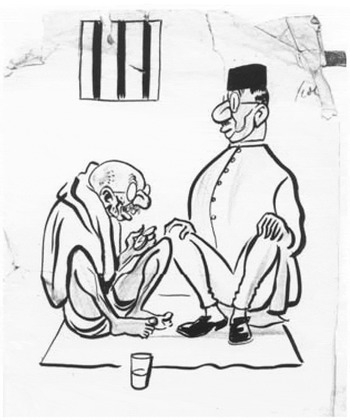
—“Its one o'clock—you might as well stop and have some lunch with me now.” Neb (Ronald Niebour), The Daily Mail (11 February 1943). Reproduced with the permission of the Centre for the Study of Cartoons and Caricature, University of Kent and Solo Syndication.

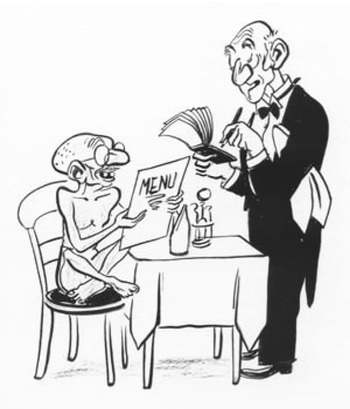
potency. Just one photograph of Gandhi in what could be interpreted as a hunger-induced pose appeared relating to either of the two fasts, on the front page of the Daily Express on the announcement of his intention to fast over the depressed classes issue. Of course, this picture could not possibly have been taken contemporaneously with the fast (it had not actually begun) and was in fact a photograph of Gandhi relaxing aboard the SS Rajputana during his passage to England for the Round Table Conference of 1931. However, the (captionless) image of his seminaked body, listlessly supine in a wicker chair with his spindly legs jutting out to the side, jarred with the accompanying story of “the most amazing ultimatum in political history.”Footnote 48 Otherwise, visual representations of Gandhi were limited to either a few small portrait images that failed to incorporate his emaciated body or cartoons that rendered it ridiculous (see figs. Footnote 1 and Footnote 2).
If the failure of the press to use archival images of Gandhi was an editorial decision, it would have been energetically supported by the government of India,
—“Just a moment sir—I'll have to get a fresh order pad.” Neb (Ronald Niebour), The Daily Mail (5 March 1943). Reproduced with the permission of the Centre for the Study of Cartoons and Caricature, University of Kent and Solo Syndication.

which was intensely aware of the dangers of allowing Gandhi to be seen suffering in their hands while in prison. To this end it had resolved to release Gandhi from detention for the duration of his 1943 fast (and had been happy to countenance releasing him to conduct his 1932 fast on his ashram), but the Mahatma, determined to keep the spotlight of publicity upon his incarceration and the colonial state, had refused release unless his demands were met in full. Great attention was therefore paid by colonial officials to controlling his environment in prison and publicizing those conditions to the press (while also ensuring that no photographs of a fasting Gandhi were available). In 1932 at Yeravda Gaol Gandhi was allowed exercise, his own diet (including luxury foodstuffs) and medics, correspondence and reading material, as well as facilities for spinning.Footnote 49 An indication of what the colonial regime perhaps feared can be seen in the Herald's screaming headline “Mr. Gandhi Sleeps in ‘Condemned’ Cell,” below which it was reported the rather more prosaic details of how exhaustion induced by the combined strains of the fast and negotiations with political representatives of the depressed classes had forced Gandhi to seek the quietude of the vacant cells for condemned prisoners in order to recuperate.Footnote 50 Richard Tottenham's note to provincial governors in January 1941, laying out measures to be taken in the event of a further fast by Gandhi underlined this concern with managing public opinion: “we have to admit,” he declared, “that the peculiar atmosphere surrounding this extraordinary individual and the importance attached, both here and abroad to his physical survival are determining factors in our policy.”Footnote 51
Tottenham's note was just one of a considerable number of papers generated by the government of India in their preparations for wartime fasts. No doubt to avoid similarly potentially damaging headlines, as early as December 1940 it had been decided to detain Gandhi in the Aga Khan's palace outside Poona rather than at Yeravda. A journalist and photographer had already been commissioned to compile a press release on Gandhi's potential residence, for, as Tottenham foresaw, “it may be most desirable for us to be able to describe the comfortable conditions in which he is living, especially for propaganda in America and other places abroad.”Footnote 52 Certainly, by 1943, when Gandhi undertook his famous fast to capacity in protest at the government of India's complete abnegation of all responsibility for the Quit India Movement, and to exert pressure upon moderate Indian politicians to take a more explicitly nationalist stance over the issue,Footnote 53 the official script had already been well prepared, a fact reflected in its reception by the British press.
While the Manchester Guardian and the News Chronicle urged a rapprochement between the two sides in order to avoid the debilitating effect of Gandhi's death upon Indo-British relations, the rest of the press were virulent in their condemnation of Gandhi's behavior at a time when Britain was fighting for the future of liberal democracy. The Daily Mail depicted Gandhi as a saboteur of the war effort, a dictator as reprehensible as those Britain found herself opposing, a trope around which they sought to rearticulate the justice of the colonial relationship between Britain and India:
The nation which refused to be intimidated by HITLER, MUSSOLINI, and TOJO was unlikely to surrender to GANDHI. The days of appeasement are over … the dark days of struggle for existence have shown us who are our true friends and who the false.
Had India reacted to the Japanese menace in 1942 in the same way as we reacted to the German in 1940, she would have shown herself worthy of complete self-government and equal status with all nations. In the hour of trial her leaders failed her.Footnote 54
The colonial government's press release documenting the grandeur, comfort, and extent of the rooms, furnishings, and gardens available to Gandhi, as well as the extensive medical care afforded to the Mahatma, served its purpose and proved a predictable source of ridicule.Footnote 55 Rather than being a life or death confrontation, Gandhi's actions became styled “The Luxury Fast.”Footnote 56 The Daily Mail was damning in its assessment of the whole affair at its termination, alleging Gandhi had “lost prestige” because the “general picture of a holy man fasting in lonely austerity does not apply in this case. Although the government of India offered to let him out for the period of the fast, Gandhi preferred to remain in the luxurious surroundings of the Aga Khan's palace.” For the Daily Telegraph Gandhi's “bluff” had been called. The “whole spectacle of the soi-disant ascetic sitting amid palatial luxury and availing himself of all the resources of modern medical science suggests not holiness but Hollywood.”Footnote 57 Visual evidence of Gandhi's travails may have been denied to a British audience, but the mental picture built up in its stead poured scorn and derision on his fast while the serious business of winning the war continued around him.
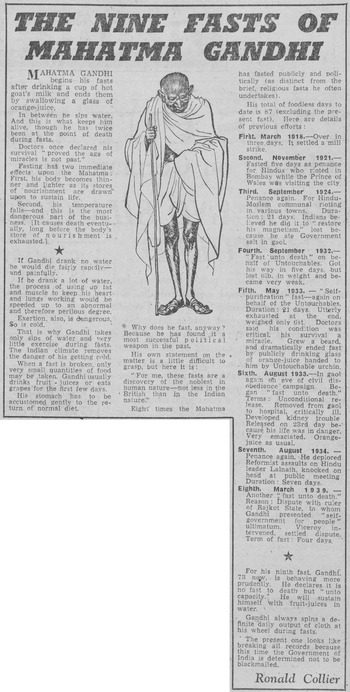
If the setting of the fast was used by the British press to denigrate Gandhi's actions, the rapidly developing contemporary interest in nutritional science, heightened by the everyday practice of rationing in wartime Britain, was enlisted to demystify it, providing scientific explanation of how the Mahatma could guide his body safely through nutritional barriers.Footnote 58 In India, the deeply skeptical Linlithgow took care to acquaint himself with the nature of Gandhi's metabolism by consulting the attendant doctors, satisfying himself that there was “no serious risk of his dying,”Footnote 59 and gratefully received correspondence on the mechanics of fasting from Sir Desmond Young, a provincial commissioner in the Punjab who had undertaken two fasts as part of a “Nature Cure” with only positive effects on his own health.Footnote 60 Similar analyses of Gandhi's behavior permeated Fleet Street's treatment of the fast. Whereas in 1932 the press had sought to render Gandhi's fast intelligible through its discussion of the origins and meanings of sitting dhurna, in 1943 a number of newspapers deployed nutritional science to elucidate its mechanics, not its meaning, in ways that shattered the semimystical image of the fasting Gandhi. Thus, in a feature entitled “The Nine Fasts of Mahatma Gandhi” published at the outset of the fast, the Daily Mail claimed that although “Doctors once declared his survival proved the age of miracles is not past,” it could reveal the critical nutritional techniques that had guided Gandhi through eight previous fasts, focusing upon the carefully regulated intake of water, minimal exercise, and the very gradual resumption of a normal diet after breaking fast. It detailed how Gandhi's careful intake of water and gentle exercise had kept him alive, whereas drinking too much or overexertion would have accelerated respiration to dangerous levels, burning off critical reserves of muscle and fat. The fall in Gandhi's body temperature was highlighted as the most critical aspect of the fast, threatening death long before malnutrition. Yet here the Indian climate, for so long held in imperial perceptions as exercising a degenerative, malign influence upon the peoples of the subcontinent, was identified as a key element in Gandhi's favor, effectively removing this danger from the equation. To break fast, the article revealed Gandhi's custom of imbibing sweetened fruit juices before slowly resuming a normal diet, in order to reaccustom his stomach to food (see fig. 3).Footnote 61
This use of nutritional science to demystify Gandhi's fast was also evident in the more sympathetic News Chronicle. There, Margaret Brady, a children's health expert, who the following year published Having a Baby Easily and Health for All—Wartime Recipes, used the correspondence columns to rehearse the controversial claims of her forthcoming books that fasting was a natural and nutritionally sound treatment for pregnant women with morning sickness or ailing children. In doing so, she lent legitimacy to those who continued to advocate the long medically discredited fasting cure, who, in turn, often looked to the examples of hunger strikes and fasts, Gandhi's among them, to demonstrate the art of the possible.Footnote 62 In her letter to the News Chronicle, Brady was therefore determined to dispel any mystique surrounding Gandhi's fast, arguing that “complete abstinence from all food for longer periods than 3 weeks, living just on water and fruit juices, is a normal part of some curative treatments … after the first day or two no great effort of self-denial or exercise of will-power is needed to continue fasting, for one has little desire for food.”Footnote 63 Here again the discourse of nutritional science not only helped show Gandhi's fasts to be governed by knowable, controllable, and predictable principles and processes, they also suggested it required no great willpower or sacrifice. There are no files to support the hypothesis that Brady was operating on behalf of the India Office in the manner described above, but it is nonetheless striking how closely her actions tally with the preferred modus operandi for countering Indian controversies in the British press.
Indeed, the coup de grace for the skeptical organs of the British press came with the revelation that Gandhi had imbibed lime juice sweetened with sugar on at least one occasion during the course of the fast. This was, they declared, proof positive of Gandhi's fraudulent, carefully calculated posturing. Even the Daily Express, which had initially joined the more liberal organs in voicing concern over
—Nine fasts. The Daily Mail (13 February 1943), p. 2. Reproduced with the permission of the British Library C4185-06.

earlier news of deterioration in Gandhi's condition and its possible effect on Indian opinion, reported this twist in the saga as rendering the nature of the protest suspect. Consuming a beverage with such high levels of vitamins and minerals, the Express remarked, would have marked the end of previous fasts.Footnote 64 The News Chronicle attempted to redress the balance, insisting that its hero was no “phoney,” as the fast was only to capacity rather than death as in previous campaigns. Gandhi, it pronounced, “has no intention of dying. He is rather `tight-rope walking' over the abyss of death. Every time he is about to fall he takes just sufficient … to restore his balance.”Footnote 65 However, the police agent monitoring the reactions to Gandhi's fast by surveillance of the vigorously pro-Gandhian India League's activities reported that Fleet Street's skepticism was shared by many others. Attendance at the League's meetings held during the fast had been unimpressive, ranging between fifty and three hundred, compared to the twenty-two hundred garnered (with Communist Party support) at a London meeting a month previously. The agent reported that while Gandhi's life had appeared in the balance, a government climb-down had been favored by concerned individuals and organizations, fearful of the potential chaos anticipated in the event of his death. The realization that the fast was merely “to capacity” had engendered a significant shift in opinion:
one high dignitary of the Church informed the India League, “it would have been ridiculous for the Government to have allowed themselves to have been deflected from a course they considered right just because an individual decided not to eat.” The average Western mind has, … proved quite incapable of appreciating the ethical niceties of a fast unto capacity for conscience’ sake, and tended to see the issue in terms of political blackmail. When it emerged that the fast was being maintained on judicious libations of sweetened lime juice (after all the normal nourishment for protracted fever cases), even those who regarded the blackmail as justified seem to have felt that it was not being conducted along sporting lines.Footnote 66
The News Chronicle's attention to such “ethical niceties” had thus been swept aside by a press temperamentally disposed to oppose the Mahatma, primed by a publicity-conscious and media-aware colonial regime, and armed with a new set of discourses that removed much of the wonder at the otherness of Indian politics and culture (even, it seems, with some of those ostensibly sympathetic to the Mahatma's cause).
There was a certain irony in this use of nutritional science to puncture the marvel that Gandhi and his supporters sought to engender around his capacity to fast. By the 1940s Britain's preeminence in the world of nutritional science had been achieved by the pioneering work of its nutritionists in the colonial laboratories of India and Africa.Footnote 67 In India, the Nutrition Research Laboratories at Coonor, established by its Director Robert McCarrison in 1918, used experimental rats to compare the diets of India's different regions and peoples in the quest to discover the ideal diet for racial health.Footnote 68 Although Gandhi praised McCarrison's work, seeing it as a counterpart to his own dietetic experiments, he was suspicious of the universalism of its claims. McCarrison's championing of milk and meat, his privileging of the manly mixed Sikh diet over those of the effeminate Bengali or the poor white Britisher (both of which generated enfeebled frames), especially irritated Gandhi who used the columns of Young India to chastise him for placing too “much emphasis on the necessity of animal food such as meat or milk” and claiming that the “unlimited capacity of the plant world to sustain man at his highest is a region yet unexplored by modern medical science.”Footnote 69 Although McCarrison gamely responded by detailing the wealth of research on the inadequacy of vegetarian diets, Gandhi argued that “the tremendous vested interests that have grown around the belief in animal food prevent the medical profession from approaching the question with complete detachment.” So compromised was nutritional science that it was the responsibility of “lay enthusiasts” like himself “to cut their way through a mountain of difficulties even at the risk of their lives to find the truth.”Footnote 70 In placing his own experiments with truth alongside those of the British nutritionists, attempting to reconcile the lessons of indigenous diets, Vedic texts, and modern nutrition, Gandhi arguably influenced a new cadre of Indian nutritionists at Coonor to lay claim to and reinscribe nutritional science as the basis for the formation of the public health policies of the new Indian nation after 1947.Footnote 71 Thus the nutritional science used in the British press to demystify Gandhi's fasts was not only partly a product of India but was seen by Gandhi to be intimately connected to his own regime of dietary experimentation and fasting. Yet, judging by the reception of his fasts in Britain, the attempt to produce a nationalist bio-politics that could be imagined as “Indian” and register within metropolitan political culture had ultimately failed.
The fact that only two of Gandhi's nine major fasts between 1915 and 1943 garnered any significant coverage may perhaps have been symptomatic of a decline in the level of news coverage of Indian and imperial affairs in the metropole at this time. Another factor may well have been sheer ennui with hunger strikes as a mode of political protest. By the decade that became known as “the hungry thirties” British audiences were not only well familiar with hunger strikes closer to home, but may have viewed them less sympathetically given the deprivations of many metropolitan diets. By 1943, as these privations were apparent to a rationed population more broadly, it was news of the starvation in occupied Europe, not significantly the unfolding catastrophic famine in Bengal, that filled the news columns of the British press.Footnote 72 More specifically, Gandhi's repeated recourse to fasting was by no means viewed positively by all his allies in the Indian arena, and his “success” in surviving fasts before 1943 may well have bred a degree of popular cynicism even without the encouragement of the press in pieces like the Daily Mail's “Nine Fasts” article, with its implicit evocation of a cat's nine lives. In this sense, Gandhi labored in the shadow of MacSwiney as a spectacle of suffering.
Most fundamentally, however, Gandhi's corporeal politics did not translate to a British public whose news of them was skillfully managed by government. The rapidly developing press may have shrunk the world, but Gandhi's semiotic register also contracted, a point insufficiently appreciated by those who assume his impact and influence was almost universal. Opportunities for Gandhi to carry his anticolonial message to the metropole were constricted by the thoroughness of press censorship and briefing by the imperial regime. Furthermore, the orientalism that posited Indian politics as antithetical to its British counterpart had retreated by 1943, certainly in relation to Gandhi and Indian nationalism, accompanied by the circulation of seemingly objective, scientific knowledge that exposed the mechanics of Gandhian bio-power. This exposure of the modernity of India's prime political figure is one of the ironies of the ultimate failure of his wartime fast.
This is not to suggest Gandhi's politics of hunger had no effect at all or was condemned to impotence outside the South Asia. As we have shown, the 1932 fast over the depressed classes issue ultimately garnered a measure of praise, even from that most unlikely of sources, the Daily Telegraph, and was instrumental in helping Gandhi win a significant political victory. The extensive precautions taken by the government of India and the India Office between 1940 and 1943 to condition press responses to any fasts certainly had the desired effect in Britain, but the response in America, where support for Gandhi and disapproval of the British Empire was less constrained, needs further investigation.Footnote 73 In India itself, the 1943 fast found sympathetic coverage in the nationalist leaning press despite government restrictions, and the unfolding drama affected not only the masses, but also Indian members of the Indian Civil Service so crucial to the operation of the increasingly overstretched wartime Raj.Footnote 74
There is one last twist to this tale, for ironically the dissolution of the formal bonds of Empire in 1947 saw the British press tacitly restore fasting to center stage of Gandhi's embodiment of the Indian nation. Gandhi's final (and arguably most successful) fast at Delhi in January 1948, undertaken against the continued communal hostilities wracking India, and the failure of the Indian government to pay a cash sum owing to Pakistan from the assets of the undivided India, was afforded the type of coverage studiously denied to the wartime hunger strike from both liberal and more nationalist sections of the British press.Footnote 75 The Guardian gave daily summaries of the Mahatma's health and hopeful reports of a political settlement as the week progressed. When news reached Britain of the termination of the fast, a lengthy editorial lauded it (and the Calcutta fast of the previous September) as being above the suspicions raised by detractors on previous occasions; Gandhi was “expressing what is best in all men and … creeds,” and on both occasions had been instrumental in preventing India's slide deeper into bloodshed. Any artifice in fasting was justified if it appealed to the “warm and emotional nature” of the Indian masses. If Gandhi had indeed “shocked” Indians and their political leaders into realizing how far they had traveled down “the road to disaster … India will have good cause to thank the courage and spiritual strength of this frail old man of seventy-eight who may be a politician among saints, but is no less a saint among politicians.”Footnote 76
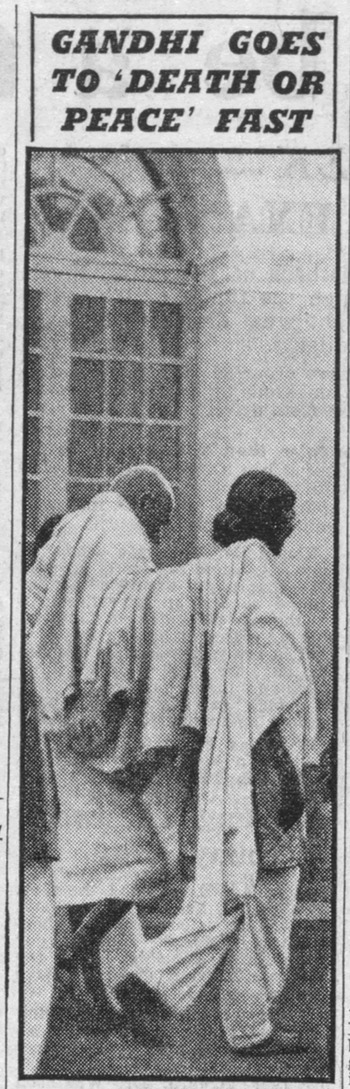
The Daily Mail similarly recorded the unfolding successes of Gandhi's final campaign, although the hostility of militant Sikh refugees was given prominent coverage as the fast commenced under the headline “‘Let Him Die’ Cries at Gandhi's Home.”Footnote 77 Most strikingly, however, a triptych of photographs in the 17 January issue united images of Gandhi's emaciated figure being guided into his residence by a concerned acolyte, the (empty) bed from which his fast was conducted, and concerned supporters offering their prayers at a meeting in India House, London, at the heart of empire (see fig. 4).Footnote 78 In the obituaries hastily constructed in the aftermath of Gandhi's assassination just two weeks later at the hands of a Hindu extremist, the Daily Mail and the Guardian differed in their ultimate interpretations of Gandhi's final fast. For the latter, the Calcutta and Delhi fasts were arguably his crowning glory in mobilizing and representing the nation, while the Mail explicitly linked the Delhi episode to his ultimate undoing, and suggested that his hunger politics was undertaken at the expense of, rather than on behalf of, some of India's hungry people: “The crisis was reached during Gandhi's fast of two weeks [previously]. Extremist Hindus and Sikhs, spearheaded by truculent refugees, felt that GANDHI, by fasting, was forcing them to withdraw their legitimate demands for minimum food and shelter in order to preserve his life.”Footnote 79
Yet the common thread uniting these divergent analyses of Gandhi's final fast, assassination, and political career was the elision of the prehistory of his hunger
—Gandhi goes to death or peace fast. The Daily Mail (17 January 1948), p. 1. Reproduced with the permission of the British Library C4185-05.

politics under imperial rule: the Daily Mail focused entirely upon the recent crisis, while the Guardian, in a far more comprehensive account of his life and career, nevertheless made the merest mention of the various 1930s fasts and ignored 1943 completely. Fasts and hunger strikes may have become successfully identified with Indian politics through Gandhi's actions, but they seemed to remain resolutely beyond the pale in an imperial context.