1 Introduction
If you were to look back at health-care systems in Northern European countries two decades ago, you would largely have found systems in which patients’ ability to choose where they received hospital treatment was limited. The referring doctor would decide where to send the patient, and most likely they would refer to the nearest hospital regardless of waiting times or service quality. More complicated cases might be referred to a specialist or tertiary hospitals, but on the basis of professional judgement rather than the patient's wishes. This has now changed in most Northern European countries. Patient choice has become a prominent policy issue. From a policy perspective this is interesting because while there are many purported benefits of choice, it also challenges traditional planning and cost control mechanisms in publicly funded health-care systems. From a theoretical perspective it is interesting to see how the concept of choice inspired by New Public Management (NPM) has been translated into practice in different national contexts.
According to some observers the NPM approach to the public sector reform has led to significant convergence in public policy reforms in recent decades (Hood, Reference Hood1991; Kettl, Reference Kettl2000). Other observers argue that although there has been a convergence on the rhetorical level, the situation is much more heterogeneous when looking at actual design, implementation and results of NPM policies across countries (Bouckaert and Pollitt, Reference Bouckaert and Pollitt2000; Pollitt, Reference Pollitt2002). National political and institutional contexts seem to create a significant degree of ‘path dependency’ (North, Reference North1990; Wilsford, Reference Wilsford1994; Pierson, Reference Pierson2000). While arguments for the instrumental value of choice are found among the proponents of NPM (McLaughlin et al., Reference McLaughlin, Osborne and Ferlie2002; Lynn, Reference Lynn2006), they are also prevalent in the ideas of regulated or managed competition (Enthoven, Reference Enthoven1978; Enthoven and Kronick, Reference Enthoven and Kronick1989). Although it has been realized that conditions for establishing ‘perfect markets’ are usually not present in health care (Arrow, Reference Arrow1963), it has been argued that there can still be benefits of using market-like mechanisms for delivery of public sector goods (Saltman and von Otter, Reference Saltman and von Otter1992; Le Grand, Reference Le Grand2007). It is argued that even if choice is only exercised by a minority of resourceful patients, the threat of exit creates contestability and the actions of this group can lead to improvements in responsiveness and quality across the system. When linked to economic incentives where funding either partially or fully follows the patient these effects will be more powerful (Le Grand, Reference Le Grand2007).
This paper contributes to a broader debate about whether there is convergence and divergence of health policy across industrialized countries (e.g. Blank and Burau, Reference Blank and Burau2010). Although there appears to be some convergence in the use of market mechanisms, on the other hand national context and institutional structures are expected to result in a divergence in design, implementation and probably also effects (Immergut, Reference Immergut1992).
We examine whether there has been convergence in choice policies across Northern Europe. Following C.P.'s suggestion we will distinguish between rhetorical (discursive) convergence, decision (design) convergence and implementation (operational) convergence (Pollitt, Reference Pollitt2002). An analysis of the impact of choice policies is beyond the scope of this paper.Footnote 1 Our research question is: Is the introduction of policies to strengthen choice in the four countries characterised by discursive, decision and operational convergence?
This paper compares the introduction of policies to promote or strengthen patient choice in four Northern European countries – Denmark, England, the Netherlands and Sweden. The selected countries include two decentralized tax-funded health systems (Denmark and Sweden), one centralized national health system (England) and one competitive system of mandatory health insurance (the Netherlands). The Netherlands has a public–private mix of health-care provision and insurance. Since 2006 health-care reforms in the Netherlands have introduced a system of regulated competition (Schäfer et al., Reference Schäfer, Kroneman, Boerma, van den Berg, Westert, Deville and van Ginneken2010) with compulsory membership of a competitive private insurance scheme (Van de Ven and Schut, Reference Van de Ven and Schut2008). Dutch citizens are therefore not only able to choose their health-care provider but their insurer as well. Choice of provider was possible previously, however, in almost all cases the referring doctor would decide where to send the patient, and most likely would choose the nearest hospital. Insurers are able to selectively contract with providers, though in practice most continue to offer freedom of choice.
The Danish, English and Swedish health-care systems are tax funded and provide universal coverage for all citizens. Governance of health care is decentralized to democratically elected councils at the regional level in Denmark and Sweden, while democratic accountability in England remains centralized at national level. In Denmark and Sweden patients were usually referred by their general practitioner (GP) to a hospital within the county. In England there was also the possibility for patients to be referred to any hospital in the National Health Service (NHS), but in practice most referrals were to a local hospital. It is also possible for patients to choose to be referred to private providers (practicing specialists and a few private hospitals) for many years, but they either have to pay fully or partially out-of-pocket. The focus in this paper is on the introduction of policies to promote patient choice that is available universally, which enables patients to choose from a broader range of hospitals (mostly not-for-profit in the Netherlands and mostly public in Denmark, Sweden and England) and where these choices are paid for by the insurer/public authority.
The selection of cases therefore consists of countries with differences in institutional set-up, but all with a common goal of increasing patient choice. Even this limited selection allows us to explore to what extent and in what ways convergence is taking place and to identify convergence or divergence across different institutional settings. Future research would ideally include additional country cases to increase the observations.
The paper focuses on choice of hospitals. To keep the analysis sufficiently simple for cross-country comparisons, we have chosen not to analyse other relevant forms of choice in health care such as choice of primary care provider, physician or treatment procedure within hospitals.
In the following sections we first describe the dimensions used in the analysis. After that we examine similarities and differences between the countries on these dimensions. We will conclude with some general observations and conclusions on divergence/convergence trends.
2 Research dimensions and data
In his discussion of public sector reform analysis, C. Pollitt distinguishes between discursive convergence, decisional convergence, operational convergence and results convergence to analyse and compare reforms in different countries. Following this lead we will focus our analysis on policy initiation (discursive convergence), policy decision and design (decisional convergence) and policy implementation (operational convergence) in the four countries. Due to the methodological issues mentioned above we will not analyse results convergence systematically.
Analysis of policy initiation is interesting, because it can illuminate the conditions for making institutional changes in health systems. Complex social systems are often considered relatively resistant to change, as there are strong forces keeping them on particular policy paths once established (Wilsford, Reference Wilsford1994; Pierson, Reference Pierson2000).
The second research question deals with policy decision and design. As noted by Pollitt we are more likely to find discursive convergence than decisional convergence. Once policies reach the decision phase they become subject to national political institutions and specific political configurations. This means that national political dynamics play a role in translating and specifying the policy. Different interests and interest groups will be active, and the policy is likely to be designed in a way that takes such specific interests and national needs and options into account. We will analyse such issues as our second step.
The third step of our analysis is to look at policy implementation and the specific operational design for choice policies. Many policy studies show that the proof of any policy is in how it is implemented and works on the ground (Pressman and Wildawsky, Reference Pressman and Wildawsky1973; Mazmanian and Sabatier, Reference Mazmanian and Sabatier1981; Lipsky, Reference Lipsky1983). Street level bureaucrats (health professionals), health service organizations and decentralized managers influence how a policy works in practice and the actual behaviour of the patients is obviously a crucial issue.
It is also clear that ‘choice’ may be a popular catchword for politicians, but that the actual practice of choice is influenced by many factors including the formal legal set-up, the economic incentives for patients and providers, the level of information available and the availability of true alternatives.
We address implementation aspects including whether patients have a legal right to choice, the scope of choice, whether any associated costs are met, inclusion of private providers, availability of information and the incentives for providers. We also consider the extent to which the implementation was phased.
The paper builds upon official policy documents, existing studies and information from key informants (the authors) in the four countries based on a standardized questionnaire (available on request).
3 Analysis of choice in four European health-care systems
3.1 The initiation of choice policies: discursive convergence?
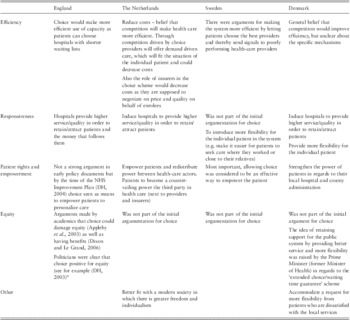
Looking across the four countries there appear to be many similarities in terms of official government rhetoric for introducing patient choice. Yet, there are also some important differences. The following table provides an overview of the main arguments for choice, and a brief indication of some of the mechanisms imagined to lead to fulfilment of the objectives in each country (Table 1).
Main arguments for introducing hospital choice in four countries

NHS = National Health Service.
Information on England: Greener et al. (Reference Greener, Mills, Powell and Doheny2006), Department of Health (DH, 2003) and Stevens (Reference Stevens2004). Denmark: Vrangbæk (Reference Vrangbæk1999, L118, 1990). Forslag til lov om det offentlige sundhedsvæsen. Information on the Netherlands: Trappenburg (Reference Trappenburg2008), Van de Bovenkamp (Reference Van de Bovenkamp2010), Grit et al. (Reference Grit, Van de Bovenkamp and Bal2008) and Van der Kraan (Reference Van der Kraan2006). Sweden: Winblad (Reference Winblad2008) and Winblad and Ringard (Reference Winblad and Ringard2009).
*Arguments included: (1) The programme extends choice beyond private payers and the well informed ‘affluent middle classes’ who already pushed their NHS General Practitioner to refer them to an alternative in the previous system. (2) Competition should lead poor performing providers to improve their care and so benefit patients from poor performance is concentrated in deprived areas, improvements in quality will benefit those living in these areas where poor performance is concentrated. (3) Choice should increase support for a publicly tax funded health-care system by stopping middle class patients’ flight from the NHS for the private sector.
In the Netherlands in the 1980s and 1990s the focus of policy discourse was patients’ rights, from 2000 onwards this shifted to a focus on the patient as a health-care consumer (Schäfer et al., Reference Schäfer, Kroneman, Boerma, van den Berg, Westert, Deville and van Ginneken2010). All countries used the rhetoric of patient empowerment in relation to policies to increase patient choice of hospital provider.
However, a general belief that choice will create competition, which in turn will induce providers to be more efficient was found in all countries though this was less marked in Denmark and Sweden. Responsiveness to patients was linked to the issue of waiting times in Denmark, Sweden and England. Choice was also seen as a means to improve convenience in Sweden, Denmark and the Netherlands.
It is interesting to note the role of equity in the English case. In the Nordic cases this was not part of the debate originally, or rather it figured on the negative side, as choice was seen as potentially endangering equity. The arguments were, that by introducing choice you would create a situation where the health system would adjust to the stronger and more vocal patient groups, while weaker and less mobile types of patients (e.g. elderly medical patients with co-morbidities) would tend to be ignored by the providers (see e.g. Fredriksson and Winblad Reference Fredriksson and Winblad2008).
Policy discourse on the impact of choice on equity has become more positive in the Danish case, where the liberal/conservative government has promoted an ‘extended choice’ scheme linked to a ‘waiting time guarantee’ since 2002. Similar to arguments in England, this is presented as a way to give all citizens access to private providers if waiting times exceed 1 month.
3.2. National political context
Patient choice policies have received broad political support with both centre-left and centre-right parties embracing the concept in the four countries. Even politicians who are against market mechanisms support values like freedom, patient empowerment, etc. In general, neither political parties nor interest organizations have emerged as strong opponents of choice in Denmark, Sweden or the Netherlands, while the British Medical Association is strongly opposed to the use of markets of health care in England. Major concerns in all countries have been based on practical issues such as GPs who are given extra burdens of supporting choice, and county administrations in Denmark and Sweden who initially feared that choice would lead to a problematic loss of planning capacity.
One area where there was opposition at least in Denmark and England is the extent to which patients can choose to be treated by private providers and still have their care paid by the public. The liberal/conservative government in Denmark introduced an ‘extended choice’ scheme in 2002 providing access to a list of private providers, if the expected waiting time for a patient exceeds 1 month. England has a similar list of private providers included in the choice scheme. In England the ability of patients to be treated ‘on the NHS’ by the private for profit sector has led to arguments about privatization.
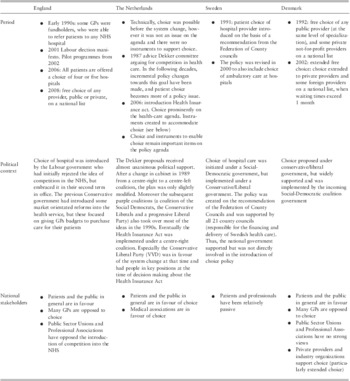
Policy was initiated earlier in Sweden and Denmark (early 1990s) than in England and the Netherlands, where although market reforms had been discussed and introduced in the 1980s/1990s a more focused and structured approach to supporting patient choice of provider only emerged in the last decade. The emphasis in England was on contracting arrangements and GP fundholding in the early 1990s. Patient choice was first introduced as a means to address waiting times from 2002 onwards, but later was introduced as key element of broader market reforms. In the Netherlands choice was part of a larger reform introducing regulated competition in health care. This reform was the result of a long incremental process (Helderman et al., Reference Helderman, Schut, Van der Grinten and Van de Ven2005). It was only in the later phase, that choice of provider (as opposed to insurer) became a prominent issue on the policy agenda. The following table summarizes the timing of introducing choice in the four countries (Table 2).
Timing and political context for introducing choice

GP = general practitioner; NHS = National Health Service.
Information for Netherlands: Helderman et al. (Reference Helderman, Schut, Van der Grinten and Van de Ven2005), Van der Grinten (Reference Van der Grinten2006), Borst (Reference Borst2001), Klink (Reference Klink2009a, Reference Klink2009b) and Schippers (Reference Schippers2011). Information for England: Secretaries of State for Health (1989), Dixon et al. (Reference Dixon, Robertson, Appleby, Burge, Devlin and Magee2010a), British Medical Association (2009) and Labour (2001). Sweden: Winblad and Ringard (Reference Winblad and Ringard2009). Denmark: Vrangbæk (Reference Vrangbæk1999) and Pedersen (Reference Pedersen2005).
We conclude that there is divergence in the timing of decisions to introduce policies to strengthen patient choice of hospital with two early adopters, Denmark and Sweden and two late adopters, the Netherlands and England. In all four countries the introduction of choice policies had broad political support.
Given the lack of organized opposition to choice at the political level it is unlikely to explain differences in the timing of decisions. Could the institutional arrangements within the health sectors explain this? Whereas Denmark and Sweden have traditionally been almost exclusively dominated by public providers and with a strong regional control of patient pathways, this has not been the case in the Netherlands (hospitals are private non-profit organizations) and England.
In the Netherlands choice was part of a much broader politically sensitive health-care reform. This reform was introduced in a system with coalition governments and a corporatist decision-making arena with many veto points. Moreover, the policy was implemented incrementally and the focus in the initial years was on developing choice of insurer (Helderman et al., Reference Helderman, Schut, Van der Grinten and Van de Ven2005). However, England was also a late adopter despite a parliamentary system in which the government can introduce reforms with little opposition or delay (at least prior to the current coalition government).
It seems more likely that the decisional divergence is due to when the window of opportunity opened in each country. When the issue of waiting times rose up the political agenda, policymakers saw patient choice as one of the solutions that were compatible with the overall political ideas. The inflexibility and increasing waiting times due to tight expenditure control in the 1980s led to a greater demand for more flexible and patient-centred approaches at this time in Denmark and Sweden (Saltman and von Otter, Reference Saltman and von Otter1992). In order to make better use of capacity, Sweden and Denmark needed a mechanism for increasing inter-county mobility of patients. Although waiting times were a growing issue during the 1990s it was the Labour government who came into office in 1997 that put this as their top priority for the NHS. The initial approach was setting targets, but by early 2000s the government was interested in the idea that patient choice could be used to make better use of under-used capacity across the system (and in the private sector). Despite social health insurance funding in the Netherlands, waiting times also became an issue around the same time as in England. In the Netherlands while choice of provider had been available, as a result of waiting times it became more structured, and as part of the market reforms, more ideologically important.
3.3. National differences in policy design: decisional convergence?
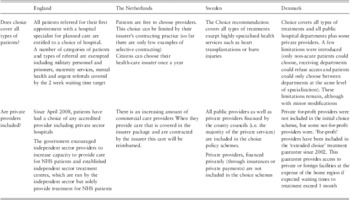
Design and implementation of choice policies is where we initially expected most divergence. Since choice does not happen by itself, conditions have to be created to make it happen in practice. In the following section we will focus on design decisions that were taken about the scope of choice, information and economic incentives (see Table 3).
Scope of choice in the four countries

NHS = National Health Service.
Information the Netherlands based on van de Bovenkamp et al. (Reference Van de Bovenkamp, Quartz, Weggelaar-Jansen and Bal2011) and Grit et al. (Reference Grit, Van de Bovenkamp and Bal2008). Denmark: Vrangbæk (Reference Vrangbæk1999) and Pedersen (Reference Pedersen2005). Ministry of Health. Information for England based on Dixon et al. (Reference Dixon, Robertson, Appleby, Burge, Devlin and Magee2010a).
Looking across the four countries we see that patient choice of hospital is in principle available for most patients. Due to capacity concerns at highly specialized departments these are not included in Denmark and Sweden. Some insurers in the Netherlands are experimenting with selective contracting on the basis of certain quality indicators (Bal and Zuiderent-Jerak, Reference Bal and Zuiderent-Jerak2011; Van de Bovenkamp et al., Reference Van de Bovenkamp, Quartz, Weggelaar-Jansen and Bal2011). Still, most insurers emphasize free choice as a selling point.
Private or commercial providers are included to some extent in all four countries. However, they are still marginal to the main public/private not-for-profit provision. There are different models for inclusion, but typically they need to be approved for a list or enter contracts with the public authority/insurer. This means that ‘entry’ to the market is controlled, and that the public authority/insurer can set requirements for quality standards, etc.
In England patient choice was expanded alongside a programme to expand the availability of capacity from the private sector in the form of independent sector treatment centres. In England the first Independent Sector Treatment Centres opened in 2003 and in all 25 fixed site centres and two chains of mobile units were opened following the first wave of procurement, a further 10 schemes involving multiple sites were procured in the second wave, nine of which had opened by June 2009 (Naylor and Gregory, Reference Naylor and Gregory2009).
Private providers are paid a fixed (mainly Diagnosis Related Group (DRG) based) price in Denmark, Sweden and England, while price competition is possible in the Netherlands for some treatments.
In Denmark and England there has been a heated debate on the rate of reimbursement for private providers. Currently rates for private providers in Denmark are slightly lower than for public providers as there are fewer obligations for education, research and acute care. In England arguments have both been made that private providers should be paid more than public providers, and vice versa. The inclusion of private providers has raised a more general issue – how to create a level playing field that takes the different operational requirements of the public and private providers into consideration. This is one of the areas where national level decisions are likely to have a significant impact on how choice develops in the future.
3.4. Information for choice
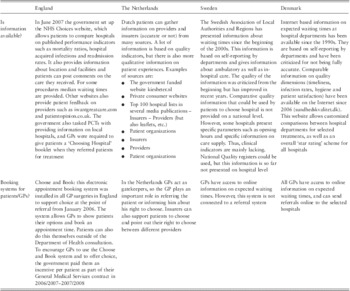
Another important design issue is whether choice is supported by availability of information for patients. Health care is characterized by significant information asymmetry between patients and providers, so choice is unlikely to be fully informed and based on a comprehensive rational assessment of service/quality. The availability of information about quality and service levels can help to alleviate some of the information asymmetry, but there are many issues regarding the methods and quality of data, the level of detail needed for patients and the interpretation of data. The following table illustrates some of the choices made in the four countries regarding information (Table 4).
Information and booking systems for choice policies in the four countries

PCT = primary care trusts; GP = general practitioner.
Information the Netherlands: Bal (Reference Bal2008), Grit et al. (Reference Grit, Van de Bovenkamp and Bal2008) and Schäfer et al. (Reference Schäfer, Kroneman, Boerma, van den Berg, Westert, Deville and van Ginneken2010). Denmark: Sundhedskvalitet.dk, Pedersen (Reference Pedersen2005).
England: DH (2010b) and Dixon et al. (Reference Dixon, Robertson and Baal2010b).
All four countries have established information systems covering both service information (waiting times, etc.) and some general quality information (e.g. infection rates, patient satisfaction, timeliness) (except Sweden). Denmark, England and partly Sweden have national public information systems, while the set-up in the Netherlands is more pluralistic. Detailed information on clinical quality is collected through clinical databases, and is to some extent available for patients (e.g. www.nip.dk), but there are significant concerns regarding patient interpretation of such data (Bal, Reference Bal2008).
In all four countries there is ongoing debate about the right type of information, and whether the information provided can actually help people in their choice process (Boyce et al., Reference Boyce, Dixon, Fasolo and Reutskaja2010; Dixon et al., Reference Dixon, Robertson and Baal2010b; Winblad and Andersson, Reference Winblad and Andersson2011). Research shows that patients experience a lot of difficulty in correctly assessing the quality information (Vrangbæk et al., Reference Vrangbæk, Stoop and Berg2005). A Dutch experimental study shows that although people say that they want a lot of information, they use a quite limited amount of information and mostly use it to check the choice they were already considering (Damman, Reference Damman2010).
3.5. Economic incentives
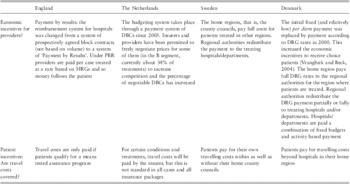
Another important issue for the actual operation of choice is the economic incentive structure for providers and patients. If patient and providers are stimulated financially to choose or to respond to choice, this will increase the likeliness that they will do so in practice (Table 5).
Economic incentives for providers and patients

PBR = payment by results; HRG =Health Resource Groups; DBC = diagnostic treatment combinations; DRG = Diagnosis Related Group.
The Netherlands based information, www.cvz.nl, www.nza.nl. Denmark: Vrangbæk and Beck (Reference Vrangbæk and Beck2004). Sweden: Winblad (Reference Winblad2008).
All four countries use some form of activity based payment scheme for hospitals. The payments are usually based on DRGs or similar classification schemes. Thus there are incentives for hospitals to attract patients to choose their health-care provider. There are differences in regards to the specific configuration of incentives at the hospital level. Regional authorities in Denmark and Sweden may choose to retain some or all of the payment at the regional level.
Patients generally have to pay some of the travel costs for selecting hospitals beyond the local area.
3.6. Legislation and implementation: operational convergence?
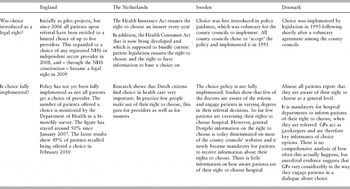
The third aspect of our framework is the implementation of the policy called operational convergence. In this section, we consider whether choice was introduced via formal legislation or softer regulatory measures such as guidance or agreements and the extent to which choice has actually been implemented, that is, whether the actors in the health-care systems are adhering to the new rules. The following table illustrates these issues (Table 6).
Legislation and implementation

NHS = National Health Service; GP = general practitioner.
Information – the Netherlands: Tweede Kamer (2006–2007 no.98), Grit et al. (Reference Grit, Van de Bovenkamp and Bal2008), Friele et al. (Reference Friele, Albada and Sluijs2006), Dorgelo et al. (Reference Dorgelo, Hekkink and Bakx2008) and Boonen et al. (Reference Boonen, Laske-Aldershof and Schut2009). Denmark: Pedersen (Reference Pedersen2005) and Vrangbæk (Reference Vrangbæk1999). Sweden: Fredriksson and Winblad (Reference Fredriksson and Winblad2008), Winblad (Reference Winblad2008) and Socialstyrelsen (2005). England: DH (2010b) and DH (2009a).
Three of the four countries have introduced choice via legislation as a general right for citizens. There are some limitations in the scope of choice options as described above, and in practice there are few, if any examples of court rulings based on choice legislation.
Implementation of choice is happening gradually. There are no comprehensive and comparable studies of this, but each of the countries have some statistical information, indicating that patients exercise their right to choose less frequently than assumed by many observers initially and despite the fact that citizens generally state that they feel choice is very important. However, the assessment of this is complicated by the fact that a patient attending their local hospital may have made a conscious choice to do so, and because interaction between GPs and patients is important and largely undocumented. This means that we do not know if choice is made by the GP or the patient in practice.
Awareness of the right to choose is relatively high in the Danish case. This indicates that as in England many patients know of choice and are satisfied with their right to choose, but relatively few patients actually want to travel far to receive treatment.
4 Discussion and conclusions
In order to investigate the question of divergence or convergence of health policies we developed a series of dimensions for analysing choice policies in the four countries. In the following sections we discuss the main findings related to each dimension. This is followed by a more general conclusion of divergence/convergence trends.
4.1 Policy initiation and decision context
We found some discursive divergence among the four countries at the time the policies were introduced although there has been convergence in later years and a clear decisional divergence in the timing of the introduction of the policies. It is interesting to note that despite the different institutional set-up in the Dutch case the rhetorical arguments were quite similar to those in England.
Choice policies were introduced earlier in Denmark (1993) and Sweden (1991) than in England (2002) and the Netherlands (2006), which had pursued market-oriented reforms for longer. Although patient choice was technically available in the latter two countries before, policy emphasizing the importance of choice and enabling choice were introduced later compared to Denmark and Sweden.
The emphasis in Denmark and Sweden (where the policy was introduced earlier) was on the intrinsic value of choice and was associated with patient rights and empowerment. In contrast in the Netherlands and England where choice was introduced later, the language of consumers was used and choice was seen as an instrumental policy to promote competition. It seems there has been some divergence with more recent policy discourse in Denmark focusing more on the market.
It could be argued that the two Nordic countries embarked on a type of NPM that was more heavily influenced by the historical concerns for patient rights and participation in decision processes (Kirkpatrick et al., Reference Kirkpatrick, Jespersen, Dent and Neogy2009). England's approach to NPM was focussed on contracting and market relations between institutional actors, in line with earlier ‘internal market’ reforms in the 1980s. The focus was less on promoting individual patient choice for its own sake but rather as an instrumental route to creating stronger competition between institutions. The institutional structures in the Netherlands have also promoted a focus on contract-based markets and choice of provider was seen as an important addition to choice of insurer. Historically, choice (either by patients or the referring GP) was more prevalent in the Netherlands and the United Kingdom, due to the more heterogeneous nature of the payment system (the Netherlands) and providers (both countries). In Sweden and Denmark the decentralized nature of health care where the county councils own the hospitals, meant there were traditionally more constraints on patient choice (and GP referrals) in these systems.
Choice reforms have become closely linked to performance issues and particularly the problem of waiting times. Denmark and Sweden have implemented ‘extended choice’ schemes that are specifically linked to waiting time guarantees, and that provide access to private or foreign hospital providers (Denmark only) when patients are facing waiting lists beyond a certain limit. England has similarly introduced rules for access to foreign treatment facilities and rights to be treated in private providers (funded by the NHS). Such explicit incorporation of foreign treatment options can also be seen as a way to formalize compliance with European Union level policies on cross-border choice (Martinsen and Blomquist, Reference Martinsen and Blomquist2009). In theoretical terms we conclude that choice may be part of a broader international spread of ideas related to empowerment of public sector ‘consumers’ and marketization of public services, but that the specific national policy paths have been important in influencing timing of the introduction of choice policies.
Choice has historically been seen as a liberal or right of centre policy arena, but in the past decade social democratic parties in these countries have embraced the notion of choice. Despite concerns about equity, they have used choice rhetorically to associate it with notions of empowerment, in part supported by patient organizations within countries. It has also been seen as a means of challenging the dominant interests of the profession and incumbent public providers as a means of driving efficiency within publicly funded systems. While there has been some professional opposition, this has not been sufficient to delay or change the policy intentions of governments but may have slowed its implementation.
The initial differences in the rhetoric around choice may in part reflect the timing. We see that later on there was greater convergence as the language of consumers and markets took greater hold in Sweden and Denmark. This convergence at the discursive or rhetorical level does not necessarily imply a similar convergence in design or operation of choice. Indeed we anticipated that national institutional differences and entrenched power relations in each country would influence how choice policy was designed and implemented.
4.2 Policy design and policy implementation
It appears from the four cases that there are some national differences in the design and implementation of choice policies. Denmark and Sweden initially chose a cautious design with limited economic incentives and relatively high influence for the decentralized authorities. This has changed gradually, as the systems have grown accustomed to choice, and it has been realized, that the number of choice patients is relatively limited. In England, choice of private provider was part of the early design of the policy with strong financial incentives for providers to compete for patients, whereas this was a later extension in Denmark. In the Netherlands where there has traditionally been a mixed economy of providers, the choice of private provider was never an issue explicitly addressed in the design of the policy.
Information has been made available in all countries, but there is a lot of debate on whether this information can be used by individual patients. Information is general, and is not necessarily tailored to the individual. Quality information is only available to some degree, and there is an ongoing debate over the quality of quality information, and the usefulness for patients. It is necessary to strike a balance between aggregating and simplifying data for patients, and maintaining sufficient sophistication and validity for the professional community. All four countries are struggling to find this balance.
In all four countries it appears that implementation is influenced by GP and related to the incentives faced by hospital providers. GPs play a central role as advisors for patient choice in all countries. Yet, it is not always a smooth process, as many GPs resent the extra work of collecting and comparing information, and thus tend to stick to minimal efforts, or focus on the cases where they perceive that choice may provide benefits. Diverging interests are also a possible danger inside hospitals. Managers are likely to be concerned about the possibilities for economic gain, while clinical staff tends to be more focused on maintaining good quality of care for the individual. Management might then push for strategies to maximize the number of patients, while clinical staff will see this as potentially endangering the quality.
There are a number of similarities across the four countries in the design of the economic incentives for hospital providers and the increasing availability of information to support patients. These have given rise to a number of common implementation issues, for example how to price services in the public and private sectors and how to present information on quality of care. There are some differences in the process of referral where this has been more highly structured in the Netherlands and England around the gatekeeping role of the GP.
The implementation process has been very lengthy in the Netherlands due to the institutional set-up favouring negotiated solutions, and with many veto points. Decision making is (was!) easier in England due to the majority governments, yet implementation of choice has been more gradual in the sense that there were pilots and these were then extended. However, the government did not wait for the results of pilots before extending choice.
4.3 Convergence or divergence?
From this analysis there seems to be convergence among these four countries in the overall policy rhetoric about the objectives associated with patient choice, embracing both concepts of empowerment (the intrinsic value) and market competition (the instrumental value). It appears that the institutional context and policy concerns such as waiting times have been important in affecting the timing of the introduction of choice policies and implementation but less so in the design of choice policies. Whether the effects of these choice policies are more heavily influenced by differences in design or institutional context requires further comparative analysis of the impacts of patient choice policies (beyond the scope of our paper). The specific design choices, for example, in regards to economic incentives, and the surrounding infrastructure, for example, in terms of availability of information, are likely to influence the way choice is operationalised and therefore how it affects hospital providers. How the institutional context and timing of implementation affect differences in how the choice policy works out in practice is an important area for further research.