Introduction
Thelotremoid lichens are a group of lichenized ascomycetes with crustose thalli that includes more than 1000 described species (Hale Reference Hale1981; Frisch et al. Reference Frisch, Kalb and Grube2006). The group was previously treated as the Thelotremataceae and is characterized by immersed-erumpent, rounded ascomata with unbranched to slightly branched paraphyses, mostly distoseptate ascospores, and mostly a trentepohlioid photobiont. The group has recently experienced major changes regarding its systematic and taxonomic concepts. Traditionally, Thelotremataceae was divided into large genera according to their spore septation and pigmentation following Müller Argoviensis (Reference Müller Argoviensis1887). Many workers have recognized this concept as artificial and consequently, Hale (Reference Hale1980) suggested a revised classification based on Salisbury's previous studies (Salisbury Reference Salisbury1972a,Reference Salisburyb, Reference Salisbury1978) that relied on the use of excipular characters, such as pigmentation of the exciple and the presence of lateral paraphyses. The resulting classification was too schematic and thus Frisch et al. (Reference Frisch, Kalb and Grube2006) provided a major revision of generic concepts in Thelotremataceae. They abandoned the traditional concepts and proposed a classification based on combinations of several morphological character complexes. Their proposed classification is largely followed here, with modifications as suggested by Mangold et al. (Reference Mangold, Elix and Lumbsch2009). Phylogenetic studies employing DNA sequence data revealed that the Thelotremataceae is not monophyletic, but that several thelotremoid clades are nested within Graphidaceae (Staiger et al. Reference Staiger, Kalb and Grube2006; Mangold et al. Reference Mangold, Martín, Lucking and Lumbsch2008). Consequently, the Thelotremataceae is now treated as a synonym of the latter family and taxa previously classified in Thelotremataceae are now referred to the informal group of thelotremoid lichens.
The centre of distribution of thelotremoid lichens is in tropical and subtropical regions. In fact, they represent one of the most important components of corticolous rainforest microlichen biotas (Santesson Reference Santesson1952; Sipman & Harris Reference Sipman, Harris, Lieth and Werger1989; Rivas Plata et al. Reference Rivas Plata, Lücking and Lumbsch2008). However, some genera, such as Chapsa and Thelotrema, extend into temperate regions (Purvis et al. Reference Purvis, Jørgensen and James1995). Other genera, such as Melanotopelia and Topeliopsis, occur in the tropics only at high altitudes and can be found in lower elevations in oceanic-temperate areas. These temperate thelotremoid taxa have recently received some attention. Purvis et al. (Reference Purvis, Jørgensen and James1995) revised the European taxa, Matsumoto (Reference Matsumoto2000) monographed Thelotrema s. lat. species in Japan, and the Tasmanian species of Chroodiscus and allied genera were treated by Kantvilas & Vězda (Reference Kantvilas and Vězda2000). Despite these recent publications, we became aware of several taxonomic problems in our studies on thelotremoid lichens regarding species in extratropical regions of the Southern Hemisphere. Consequently, we have studied material of thelotremoid lichens with a trentepohlioid photobiont from subantarctic regions. The study area refers to the Antarctic floral region according to Walter & Breckle (Reference Walter and Breckle1983). The Tasmanian species previously treated by (Kantvilas & Vězda Reference Kantvilas and Vězda2000) have already been studied by Mangold et al. (Reference Mangold, Elix and Lumbsch2009) and hence are not treated in detail here. In our studies we found three species that needed to be described as new and one species that needed to be transferred to another genus in order to follow the generic classification of Frisch et al. (Reference Frisch, Kalb and Grube2006). A total of 25 species is accepted here for the study area, a remarkable number for a group of lichens that is predominantly tropical in its distribution.
Material and Methods
Material from the following herbaria was examined for this study: ABL, AK, B, BCRU, BM, BRI, C, CANB, CANL, CHR, F, FH, G, GLAM, GZU, H, HO, LSU, MEL, MSC, NSW, NY, OTA, S, UPS, US and WELT. Sections of thalli and apothecia were cut using a razor blade and a freezing microtome, and examined in water and lactophenol cotton blue. Thin-layer chromatography was carried out using solvent system B' (Lumbsch Reference Lumbsch, Kranner, Beckett and Varma2002) and high-performance liquid chromatography according to Feige et al. (Reference Feige, Lumbsch, Huneck and Elix1993).
Key to the species of Thelotremataceae in subantarctic regions
1 Ascospores transversely septate ... 2
Ascospores muriform ... 9
2(1) Ascospores non- or rarely faintly-amyloid ... 3
Ascospores strongly amyloid ... 5
3(2) Ascomata regenerating, with layered margins, exciple apically carbonized ... ... Schizotrema zebrinum
Ascomata different, margin not layered but sometimes exfoliating, exciple hyaline to yellowish ... 4
4(3) Apothecia lepadinoid, margins not exfoliating ... Thelotrema suecicum
Apothecia chroodiscoid, with exfoliating margins ... Chapsa minor
5(2) Ascomata perithecioid when young, becoming urceolate, constricted at base ... 6
Ascomata lepadinoid, not perithecioid, not constricted at base ... 7
6(5) Ascospores up to 160 μm long; thallus K+ yellowish brown, containing stictic acid ... Topeliopsis patagonica
Ascospores up to 110 μm long; thallus K−, lacking secondary metabolites ... ... Topeliopsis subdenticulata
7(5) Thallus K−, lacking secondary metabolites ... Thelotrema subtile
Thallus K+ yellow turning red, containing salazinic acid ... 8
8(7) Ascospores 25 – 45 × 7 – 9 μm ... Thelotrema circumscriptum
Ascospores 50 – 80 × 8 – 12 μm ... Thelotrema hians
9(1) Ascospores brown, non-amyloid ... Thelotrema saxatile
Ascospores hyaline, rarely old spores brownish, amyloid or non-amyloid ... 10
10(9) Hamathecium with cone-shaped columella, lateral paraphyses absent ... 11
Hamathecium lacking a columella, lateral paraphyses present ... 12
11(10) Ascospores up to 300 μm long, with appendix-like ends; apothecia with more or less annulate pore ... Ocellularia bicuspidata
Ascospores up to 450 μm long, without appendices; apothecia lacking annulate pore ... Ocellularia profunda
12(10) Ascospores strongly amyloid ... 13
Ascospores non-amyloid or rarely faintly amyloid ... 18
13(12) Asci 1–2-spored ... 14
Asci 4–8-spored ... 17
14(13) Ascomata perithecioid when young, becoming urceolate, constricted at base, exciple fused ... 15
Ascomata peri- to apothecioid, not constricted at base, exciple apically free ... ... Thelotrema rugatulum
15(14) Ascomata with reddish brown base, ascospores 100–210 μm long, forming ascoconidia; thallus lacking secondary metabolites ... Topeliopsis muscigena
Ascomata with hyaline base; ascospores not forming ascoconidia; thallus containing the stictic acid chemosyndrome or lacking substances ... 16
16(15) Ascomata up to 0·8 mm diam.; ascospores 70 – 160 μm long, over bryophytes or rocks ... Topeliopsis azorica
Ascomata up to 2 mm in diam.; ascospores 100 – 200 μm long, on bark ... ... Topeliopsis novae-zelandiae
17(13) Ascomata chroodiscoid; thallus growing on Astelia leaves; containing the succinprotocetraric acid chemosyndrome ... Chapsa asteliae
Ascomata urceolate; thallus growing on bryophytes; lacking secondary metabolites ... Topeliopsis decorticans
18(12) Ascomatal margin entirely or apically carbonized ... 19
Ascomatal margin hyaline to yellowish ... 21
19(18) Ascomatal margin multi-layered, on bark or wood ... Schizotrema schizolomum
Ascomatal margin not layered, on bryophytes or soil ... 20
20(19) Ascospores 110–140 μm long; thallus containing salazinic, protocetraric and norstictic acids ... Melanotopelia blepharostoma
Ascospores 80–230 μm long; thallus containing the stictic acid chemosyndrome ... ... Melanotopelia rugosa
21(18) Ascomata chroodiscoid with recurved margins ... 22
Ascomata urceolate or lepadinoid, margins not recurved ... 23
22(21) Ascomatal margin not or sparsely layered; containing the stictic acid chemosyndrome ... Chapsa megalophthalma
Ascomatal margin multi-layered; containing the protocetraric acid chemosyndrome ... Chapsa lamellifera
23(21) Ascomata lepadinoid, not or weakly constricted at base; lacking secondary metabolites, on bark or rocks ... Thelotrema lepadinum
Ascomata urceolate, strongly constricted at base; containing the stictic acid chemosyndrome ... 24
24(23) Thallus restricted to surrounding of ascomata, growing on leaves; ascospores 50–108 μm long ... Topeliopsis athallina
Thallus larger, growing over bryophytes; ascospores 70–150 μm long ... ... Topeliopsis macrocarpa
The Species
Chapsa asteliae (Kantvilas & Vězda) Mangold
Flora of Australia 57: 653 (2009).—Chroodiscus asteliae Kantvilas & Vězda, Lichenologist 32: 328 (2000); type: Australia, Tasmania, Mt. Curly, Kantvilas & Jarman 38/85 (BM—isotype!).
(Fig. 1A & B)
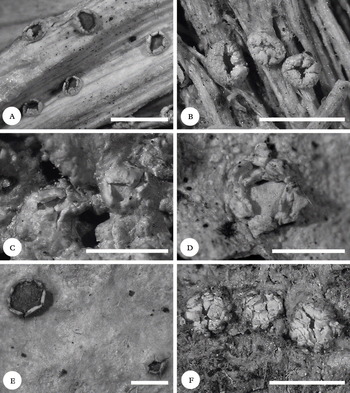
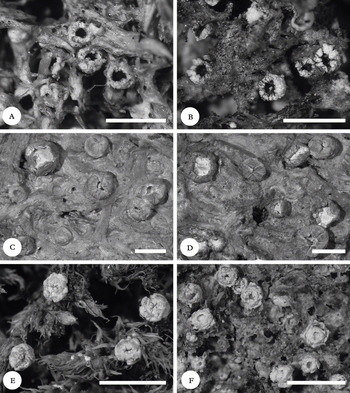
Habit of Chapsa species. A & B, C. asteliae [Harris 5415 (MSC)]; C & D, C. lamellifera [Streimann 51140 (CANB)]; E, C. megalophthalma [12 v 1993, Malcolm (CANB)]; F, C. minor (Harris 5586 [MSC]). Scales: A–F = 1 mm.

For a morphological description see Mangold et al. (Reference Mangold, Elix and Lumbsch2009).
Chemistry. Thallus K− to K+ yellowish brown, C−, PD+ orange-red; containing succinprotocetraric (major), protocetraric and fumarprotocetraric acids (traces).
Notes. Chapsa asteliae is characterized by a thin, corticate thallus and ascomata with layered margins and dark discs, and large, muriform, amyloid, and thick-walled ascospores, as well as the presence of succinprotocetraric acid. The species is similar to C. lamellifera and C. minor. The latter is readily distinguished by transversely septate ascospores. For differences to C. lamellifera see under that species.
Ecology and distribution. The species was described from Tasmania (Kantvilas & Vězda Reference Kantvilas and Vězda2000) and is recorded here from Campbell Island, New Zealand, for the first time. It is a rare species growing on dead leaves of Astelia in heathlands and peat bogs.
Specimens examined. New Zealand: Campbell Island: between Tucker and Camp Coves, Harris 4661 (MSC); W of Camp Cove, Harris 5415 (MSC).
Chapsa lamellifera (Kantvilas & Vězda) Mangold
Flora of Australia 57: 653 (2009).—Chroodiscus lamelliferus Kantvilas & Vězda, Lichenologist 32: 336 (2000); type: Australia, Tasmania, Ben Ridge, Kantvilas 105/81 (HO—holotype!).
(Fig. 1C & D)
For a morphological description see Mangold et al. (Reference Mangold, Elix and Lumbsch2009).
Chemistry. Thallus K+ yellowish, C−, PD+ reddish; containing protocetraric acid, fumarprotocetraric acid (major to minor), and succinprotocetraric acid (minor).
Notes. Chapsa lamellifera is readily identified by its large ascomata with a distinctly layered margin, muriform, hyaline, non-amyloid ascospores, and by the presence of the protocetraric acid chemosyndrome. The species is chemically similar to C. asteliae, which can be distinguished by smaller ascomata with greyish pruinose discs and narrower ascospores. Chapsa minor is also similar to C. lamellifera but readily distinguished by having transversely septate ascospores and by producing substances of the stictic acid chemosyndrome.
Ecology and distribution. The species is widely distributed in temperate Australasia, occurring in Tasmania, the South Island of New Zealand and subantarctic islands, where it grows on bark and wood, soil, debris or mosses. It occurs at altitudes ranging from sea level to 900 m in moist cool temperate rainforests.
Selected specimens examined. New Zealand: Auckland Island: above Ranui Cove, H. A. Imshaug 56201 (MSC); between head of Musgrave Inlet and Lake Hinemoa, H. Imshaug 56469 (MSC); head of N Harbour, H. A. Imshaug 57785 (MSC). Campbell Island: along road to old Tucker Station, R. C. Harris 4459, 4470 (MSC). South Island: Fiordland, Dusky Sound, D. J. Galloway (CHR-408259); Nelson, Denniston Plateau, 16 km E of Westport, H. Streimann 51140 (CANB); Westland, Croesus Track from end of Blackball Road, Polly (WELT-L6394). Stewart Island: Disappointment Cove, D. J. Galloway (CHR-378081).
Chapsa megalophthalma (Müll. Arg.) Mangold
Flora of Australia 57: 654 (2009).—Thelotrema megalophthalmum Müll. Arg., Flora 65: 500 (1882); type: Australia, Queensland, Toowoomba, Hartmann s.n. (BM—isotype!).—Chroodiscus megalophthalmus (Müll. Arg.) Vězda & Kantvilas in Vězda, Lich. Rar. Crit. Exsicc. 3: 2 (1992).
(Fig. 1 E)
For a morphological description see Mangold et al. (Reference Mangold, Elix and Lumbsch2009).
Chemistry. Thallus K+ yellowish becoming brown, C−, PD+ orange; containing stictic (major), constictic (major to minor), α-acetylhypoconstictic, cryptostictic, α-acetylconstictic, hyposalazinic and hypostictic acids (traces).
Notes. Chapsa megalophthalma is easily distinguished by its smooth, often distinct greenish thallus in contrast to large, regenerating ascomata with bright, off-white rimmed flesh-coloured discs that become overgrown by a covering tissue. Chapsa lamellifera and C. recurva (G. Salisb.) A. Frisch are similar species. Chapsa lamellifera differs in having multi-layered ascomatal margins and larger ascospores, and by the presence of protocetraric acid. Chapsa recurva differs by having distinctly pruinose discs, larger (up to 68 μm long) ascospores, and 2–4-spored asci.
Ecology and distribution. Chapsa megalophthalma grows on bark and siliceous rocks in shaded places in temperate rainforests. The species occurs in Australia (Mangold et al. Reference Mangold, Elix and Lumbsch2009) and New Zealand. The growth on smooth, siliceous rocks is rather unusual.
Selected specimens examined. New Zealand: South Island: Fjordland, Lake Thomson, mixed Nothofagus-broad leaf forest, 25 iv 2000, A. Knight (OTA-53630); Fjordland, Secretary Island, ii 1959, Murray (OTA-50158); Marlborough, Mt. Stokes track, W. Malcolm 763 (CHR); Nelson, Brook waterfalls, 12 v 1993, W. Malcolm (BM, CANB, GZU, H). North Island: Wellington, 17 v 1989, B. W. Hayward & G. C. Hayward (AK-212481); D'Urville Island, 4 i 1988, B. W. Hayward & G. C. Hayward (AK-212485).
Chapsa minor (Kantvilas & Vězda) Mangold
Flora of Australia 57: 654 (2009).—Chroodiscus minor Kantvilas & Vězda, Lichenologist 32: 341 (2000); type: Australia, Tasmania, Weindorfers Forest, Kantvilas 16/88 (HO—holotype!).
(Fig. 1F)
For a morphological description see Mangold et al. (Reference Mangold, Elix and Lumbsch2009).
Chemistry. Thallus K+ yellowish becoming brown, C−, PD+ orange; containing stictic, hypostictic (major to minor), constictic (minor to trace), and cryptostictic acids (traces).
Notes. A similar species is C. lamellifera, which has similar layered ascomata and contains stictic acid. It can, however, be readily distinguished by its larger, muriform ascospores.
Ecology and distribution. Chapsa minor is a rare species, collected from the bark of several trees in cool temperate rainforests and open Nothofagus forests. It occurs in western Tasmania and Victoria (Mangold et al. Reference Mangold, Elix and Lumbsch2009). The species is recorded here for the first time outside Australia. It also occurs in Campbell Island, the South Island of New Zealand and Patagonia (Messuti et al. Reference Messuti, Codesal, Mangold, Lücking and Lumbsch2010).
Specimens examined. New Zealand: Campbell Island: N slope of Filhol Peak, R. C. Harris 5586, 5598-B (MSC). South Island: Westland, Westland NP, Callery Gorge SE of Franz Joseph, R. C. Harris 6273 (MSC).
Melanotopelia blepharostoma Lumbsch & Divakar sp. nov
Mycobank no. MB 513052
Melanotopeliae rugosae similis sed ab hac specie ascosporis minoribus et acido salazinico et acido protocetrarico continens differt.
Typus: Falkland Islands, East Falklands, Stanley, UTM 21F VC 3270, 200 ft, mosaic of Empetrum heath and peat bogs, 30 January 1968, H. A. Imshaug 41444 (MSC—holotypus).
(Fig. 2A)
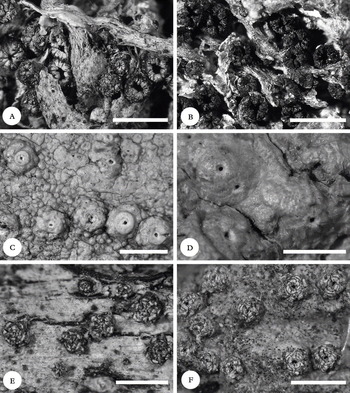
Habit of Melanotopelia, Ocellularia and Schizotrema species. A, M. blepharostoma (MSC-holotype); B. M. rugosa [Imshaug 52580 (MSC)]; C, O. bicuspidata (Knight (OTA-58820)]; D, O. profunda [Hale 66220 (US)]; E–F, S. schizolomum [Imshaug 56251 (MSC)]. Scales: A – F = 1 mm.

Thallus endo- to episubstratic, pale off-white to grey. Surface dull to slightly glabrous, smooth, continuous. True cortex continuous, formed by periclinal hyphae, up to c. 30 μm thick. Photobiont trentepohlioid; algal layer poorly developed, discontinuous, calcium oxalate crystals absent. Vegetative propagules not seen.
Ascomata conspicuous, up to c. 1 mm diam., roundish, perithecioid at first, becoming apothecioid with maturity, sessile, solitary to marginally slightly fused, distinctly emergent, subglobular to urceolate. Disc often becoming partly visible from the surface, whitish to pale brownish, epruinose, often distinctly cracked. Proper exciple not visible from the surface, pores small to gaping, star-shaped, pore margin entire to slightly split. Thalline rim in young ascomata whitish to pale greyish, entire, incurved. Proper exciple fused, hyaline internally, dark-brown to carbonized marginally, non-amyloid. Hymenium non-inspersed, moderately conglutinated; paraphyses straight, distinctly parallel, unbranched, with slightly thickened tips, lateral paraphyses present, conspicuous, not clearly separated from proper exciple, up to c. 50 μm long, columellar structures lacking. Epihymenium reddish or dark brown, granules or crystals absent. Asci 1(–3)-spored, tholus thick, thin when mature. Ascospores eumuriform, cell walls thin, endospore thin, sometimes with thin halo, hyaline to yellowish in decayed ascospores, non-amyloid, ellipsoid to irregular-fusiform with roundish ends, loci roundish to somewhat angular, predominantly irregular, 110–140 × 35–42 μm with multiple loci.
Chemistry. Thallus K+ yellowish becoming deep red, C−, PD+ orange; containing salazinic acid (major), norstictic acid (trace), and protocetraric acid (major).
Etymology. The name refers to the bryophyte genus Blepharostoma on which the new species was frequently collected.
Notes. This new species is characterized by eumuriform ascospores and the presence of salazinic and protocetraric acids. It is similar to M. rugosa, which, however, differs in having larger ascospores and in containing the stictic acid chemosyndrome. Another similar species is M. toensbergii Vězda & Kantvilas from the Pacific North-west of North America, which differs in having smaller apothecia and ascospores and lacking salazinic acid.
Ecology and distribution. The new species grows on bryophytes in heaths and peat bogs in Tierra del Fuego and the Falkland Islands.
Additional specimens examined. Argentina: Tierra del Fuego: Isla de los Estados, Bahia Capitan Canepa, H. A. Imshaug 52956 (MSC); Puerto Basil Hall, N of Puerto Abrigado, H. A. Imshaug & K. Ohlsson 51370 (CANB); Puerto Basil Hall, Punta Passalacqua Peninsula N of Puerto Abrigado, H. A. Imshaug 51370A (MSC); Puerto Cook/Puerto Vancouver, on ridge between the bays, H. A. Imshaug 51508 (MSC).—Chile: Aysen (Region XI): Puerto Island, H. A. Imshaug 43217 (MSC). Magallanes y la Antártica Chilena Region (Region XII): Brunswick Peninsula, Puerto cutre, H. A. Imshaug & R. C. Harris 39394 (MSC); Brunswick Peninsula, Puerto Cutter, on Monte Condor, H. A. Imshaug & R. C. Harris 39463 (AK, MSC); Brunswick Peninsula, Punta Arenas, E of Mina Loreto on S side of Rio de las Minas, H. A. Imshaug 38939 (MSC); Cove of I. Chatham, H. A. Imshaug 44330 (MSC); E of I. Juan., H. A. Imshaug 44238 (MSC); W side of I Grant, H. A. Imshaug 43697 (MSC).—Falkland Islands: East Falklands: Port William, H. A. Imshaug 41624 (MSC); Headwaters of Mullet Creek Stream, H. A. Imshaug 41461 (MSC); in stream valley NE of Sulivan House, H. A. Imshaug 42383 (MSC).
Melanotopelia rugosa (Kantvilas & Vězda) Lumbsch & Mangold
Lichenologist 40: 44 (2008).—Topeliopsis rugosa Kantvilas & Vězda, Lichenologist 32: 351 (2000); type: Australia, Tasmania, Reservoir Lakes, Kantvilas 177/86 (HO—holotype!).
(Fig. 2 B)
For a morphological description see Mangold et al. (Reference Mangold, Elix and Lumbsch2009).
Chemistry. Thallus K+ yellowish becoming brown, C−, PD+ orange; containing constictic, stictic (majors), and cryptostictic acids (minor).
Notes. Melantopelia rugosa is characterized by urceolate, dark ascomata with bright tips or pore margins, distinctly carbonized exciple; hyaline, eumuriform, large (up to 230 μm long) ascospores and by the presence of the stictic acid chemosyndrome. It is similar to M. toensbergii, which differs in having smaller ascomata with smaller pores, smaller ascospores (to 110 μm long), and containing protocetraric acid. The differences from M. blepharostoma are discussed under that taxon.
Ecology and distribution. It grows over bryophytes in subalpine moorland and bogs. The species occurs in Argentina, Australia, Chile, Falkland Island and New Zealand.
Specimens examined. Argentina: Tierra del Fuego: Isla de los Estados, Bahia Buen Suceso, H. A. Imshaug 50027, 50051 (MSC); Bahia Capitan Canepa, H. A. Imshaug 52879 (MSC); Bahia Crossley, headland at Bal. Tte., H. A. Imshaug 50734-B (MSC); Puerto Basil Hall, Punta Passalacqua Peninsula, N of Puerto Abrigado, H. A. Imshaug 51370-B, 51381-B (MSC); Puerto Celular, peak on N side of cove, H. A. Imshaug 52580 (MSC); Puerto Cook, H. A. Imshaug 51580 (MSC); Puerto San Juan, Punta Lasserre Peninsula, H. A. Imshaug 52022 (MSC).—Chile: Magallanes y la Antártica Chilena Region (Region XII): E of Pta Brown, Pto Charrua, H. A. Imshaug 43604 (MSC).—Falkland Islands: West Falklands: Mt. Adam, H. A. Imshaug 41096 (MSC); W of N Lake, H. A. Imshaug 41118 (MSC); Port Howard, Mt. Maria, H. A. Imshaug 41292 (MSC).—New Zealand: Auckland Island: S side of Laurie Harbour, H. A. Imshaug 57491 (MSC). Campbell Island: Head of Garden Cove toward Filhol Peak, R. C. Harris 5198, 5203B, 5224 (MSC); on spur between Tucker and Camp Groves, H. A. Imshaug 46222 (MSC).
Ocellularia bicuspidata (Müll. Arg.) Mangold, Elix & Lumbsch
Biblioth. Lichenol. 96: 129 (2007).—Thelotrema bicuspidatum Müll. Arg., Nuovo Giorn. Bot. Ital. 23: 395 (1891); type: Australia, Queensland, Sankey's Scrub (Brisbane), Bailey 631 (BRI-n. AQ721245!, US—isotypes!).
(Fig. 2C)
For a morphological description see Mangold et al. (Reference Mangold, Elix and Lumbsch2007, Reference Mangold, Elix and Lumbsch2009).
Chemistry. Thallus K+ yellowish, C−, PD+ yellow; containing psoromic (major), 2′-O-demethylpsoromic (minor to trace) and subpsoromic (trace) acids.
Notes. This species is distinguished by a dull, whitish-grey thallus, dark-rimed ascoma margin, large, eumuriform, amyloid ascospores with long appendix-like ends and by the presence of psoromic acid. Ocellularia grandis (Hale) Hale and O. subpraestans (Hale) Hale are similar, but they have ascospores with roundish tips and different chemistries: O. grandis contains the hypoprotocetraric acid and O. subpraestans the stictic acid chemosyndrome.
Ecology and distribution. Ocellularia bicuspidata is a species occurring on bark in warm-temperate to tropical rainforests. It occurs in Australia and New Zealand.
Specimens examined: New Zealand: South Island: Nelson, Abel Tasman NP., Lookout Rock Track, M. E. Hale 66218 (US); Wairoa, A. Knight (OTA 58820).
Ocellularia profunda (Stirt.) Mangold, Elix & Lumbsch
Biblioth. Lichenol. 96: 204 (2007).—Ascidium profundum Stirt., Trans. & Proc. Roy. Soc. Victoria 17: 70 (1881); type: Australia, Queensland, Brisbane, Bailey 131 (GLAM—holotype!).—Thelotrema profundum (Stirt.) Shirley, Proc. Roy. Soc. Queensland 6: 191 (1889).
(Fig. 2D)
For a morphological description see Mangold et al. (Reference Mangold, Elix and Lumbsch2007, Reference Mangold, Elix and Lumbsch2009).
Chemistry. Thallus K+ yellowish, C−, PD+ yellow; containing psoromic (major), 2′-O-demethylpsoromic (minor to trace) and subpsoromic (trace) acids.
Note. This species is readily distinguished by small, pored, sunken ascomata with a cone-shaped columella, large, eumuriform ascospores and by the presence of psoromic acid. It is similar to O. kalbii (Müll. Arg.) Mangold, Elix & Lumbsch, which has smaller ascospores and lacks secondary compounds.
Ecology and distribution. Ocellularia profunda is a corticolous species and is widespread in warm temperate to tropical rainforests, rarely wet sclerophyllous forest, along the east coast of Australia from Queensland to New South Wales (Mangold et al. Reference Mangold, Elix and Lumbsch2007, Reference Mangold, Elix and Lumbsch2009). It is here reported from New Zealand for the first time.
Specimens examined. New Zealand: South Island: Nelson, Abel Tasman National Park, Lookout Rock Track, M. E. Hale 66220, 66221, 66222 (US).
Schizotrema schizolomum (Müll. Arg.) Mangold & Lumbsch
Flora of Australia 57: 657 (2009).—Leptotrema schizoloma Müll. Arg., Nuov. Giorn. Botan. Ital. 21: 49 (1889); type: Argentina, Tierra del Fuego (“Fuegia”), Ushuaia, Beagle Channel, 1885, Spegazzini 101 [G—lectotype!, selected by Mangold et al. (Reference Mangold, Elix and Lumbsch2009)].
(Fig. 2E & F)
For a morphological description see Mangold et al. (Reference Mangold, Elix and Lumbsch2009).
Chemistry. Thallus K−, C−, PD− or thallus K+ yellow to deep red, C−, PD+ orange; containing salazinic acid or lacking secondary metabolites.
Notes. Schizotrema schizolomum is characterized by regenerating, distinctly layered and carbonized ascomata, and large, thin-walled, mainly non-amyloid, muriform ascospores. This species is similar to the tropical S. guadeloupensis (Hale) Mangold, which, however, has smaller ascospores (up to 70 μm long) and contains either stictic acid or ‘cinchonarum unknown’.
Ecology and distribution. The species grows on bark of various trees, especially Nothofagus spp. in cool-temperate rainforests of Tasmania, New Zealand, Argentina and also in Queensland (Australia).
Specimens examined. Argentina: Rio Negro: Puerto Blest, M. I. Messuti 4743 (BCRU).—New Zealand: Auckland Island: WNW of Chambres Inlet, H. A. Imshaug 56251 (MSC). Stewart Island: Port Pegasus, NW of Anchorage Island and SW of Tremulous Island, H. A. Imshaug 57824-B (MSC).
Schizotrema zebrinum Mangold
In A. Mangold, J.A. Elix & H.T. Lumbsch, Flora of Australia 57: 657 (2009); type: Australia, New South Wales, Mt. Warning NP., track from summit to parking lot, Mangold 19 e (CANB—holotype!; F, NSW—isotypes!).
For a morphological description see Mangold et al. (Reference Mangold, Elix and Lumbsch2009).
Chemistry. Thallus K+ yellowish to yellow, C−, P+ reddish to orange; containing constictic acid, conprotocetraric acid, stictic acid, protocetraric acid, fumarprotocetraric acid (all major to absent), hypoconstictic acid, hypostictic acid; virensic acid (all minor to absent).
Notes. Schizotrema zebrinum is characterized by transversely septate, non-amyloid, hyaline ascospores. The species has a variable chemistry: most of the specimens have either the stictic acid or the protocetraric acid chemosyndrome, while a few specimens produce both chemosyndromes. Schizotrema schizolomum is morphologically similar, but differs in containing salazinic acid or lacking secondary metabolites and in having muriform ascospores.
Ecology and distribution. Schizotrema zebrinum was collected from the bark of various trees in cool-temperate to warm-temperate and tropical montane rainforests. This is the first report from New Zealand; previously it was only known from Australia (Mangold et al. Reference Mangold, Elix and Lumbsch2009).
Specimens examined. New Zealand: North Island: Wellington, Orongorongo River Valley, 5·3 miles SE of Eastbourne, S. C. Tucker 19090 (LSU). South Island: Westland, Alexander Range, Camp Creek; M. Setzepfand 514.1 (CHR).
Thelotrema circumscriptum C. Knight
Trans. New Zealand Inst. 15: 349 (1883); type: New Zealand, 1883, C. Knight s.n., (WELT-hb. Knight 35A: 2—lectotype, selected by Galloway 1985: 573; G—isolectotype!).—Ocellularia circumscripta (C. Knight) Dodge, Nova Hedwigia 19: 489 (1970).
(Fig. 3A)
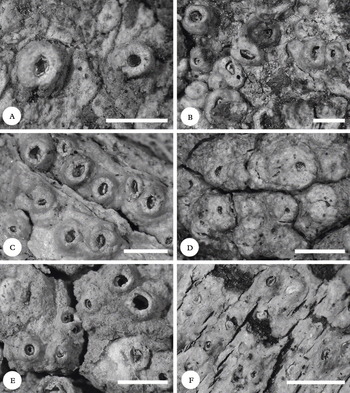
Habit of Thelotrema species. A, T. circumscriptum [Imshaug 57443 (MSC)]; B, T. hians [Buchanan 206 (BM)]; C, T. lepadinum [Harris 5304 (MSC)]; D, T. rugatulum [Polly (WELT-L6752)]; E, T. saxatile [Elix 26241 (CANB)]; F, T. subtile [Imshaug 39061 (MSC)]. Scales: A – F = 1 mm.

For a morphological description see Mangold et al. (Reference Mangold, Elix and Lumbsch2009).
Chemistry. Thallus K+ yellow becoming deep red, C−, PD+ orange; containing salazinic acid (major) and consalazinic acid (minor).
Notes. Thelotrema circumscriptum is distinguished by a thick, corticate thallus, emergent ascomata with free proper exciple, transversely septate, small, hyaline and amyloid ascospores, and by the presence of salazinic acid. It is similar to T. hians, which also contains salazinic acid. However, this taxon differs in having a thinner thallus, an apically more distinctly darkened exciple, and larger ascospores.
Ecology and distribution. Thelotrema circumscriptum grows on bark in cool-temperate to subtropical rainforests, often accompanied by T. lepadinum. It occurs in southern Argentina, Lord Howe Island, and New Zealand, where it has frequently been collected.
Specimens examined. Argentina: Neuquén: 5 km from Villa La Angostura, M. I. Messuti 4442 (BCRU).—New Zealand: Auckland Islands: between head of Smith Harbour and Norman Inlet, H. A. Imshaug 57245 (MSC); SW of Camps Cove, H. A. Imshaug 57443 (MSC). Ocean Island. D. S. Horning SA-485 (CHR-242358). South Island; Fiordland, Dusky Sound. 2 i 1900, D. J. Galloway s.n. (CHR-585904); Lake Rakatu, 11 iv 2002, T. Paul s.n. (CHR-584068), Nelson, Takaka Hill, W. Martin s.n. (CHR-585964); Otago, Abbots Hill, J. S. Thomson 1095 (CHR); Akatore Mouth, W. Martin 597 (CHR); Dunedin, Mihhiwaka, 29 viii 1953, W. Martin s.n. (CHR-585966), 29 viii 1954, W. Martin s.n. (CHR-585959); Flagstaff Hill, J. S. Thomson 1394 (CHR); Leith, Waitati Saddle, J. S. Thomson s.n. (CHR); Silver Peaks near Dunedin, H. H. Allan s.n. (CHR-587179, 585971, 587182). Southland, Greenhills, 4 i 1900, W. Martin s.n. (CHR-585891), 11 v 1905, W. Martin s.n. (CHR-585901), 3 i 1966, W. Martin s.n. (CHR-479333), 27 iii 1967, W. Martin s.n. (CHR-585888); Invercargill, W. Martin 1292 (CHR), 5 i 1900, D. J. Galloway s.n. (CHR-585963), 31 i 1900, W. Martin s.n. (CHR-585885), 2 iv 1954, W. Martin s.n. (CHR-585886), 24 xii 1956, W. Martin s.n. (CHR-585994), 24 xii 1965, W. Martin s.n. (CHR-585967, 585899), Invercargill, 16 x 1967, D. J. Galloway s.n. (CHR-585900), W. Martin s.n. (CHR-585893), 30 xii 1968, W. Martin s.n. (CHR-378912); Waikoau River, D. J. Galloway s.n. (CHR-378074, 585970, 585902); Westland, Greymouth, W. Martin 1354 (CHR); Haast, 18 v 1971, P. Child s.n. (CHR-445458); Taramakau River Catchment, 22 iii 2002, T. Paul s.n. (CHR-583540).
Thelotrema hians Stirt
Journ. Linn. Soc. London, Bot. 14: 465 (1875); type: New Zealand, nr. Wellington, Buchanan 141 pr. p. (GLAM—lectotype!, selected here).—Ocellularia hians (Stirt.) Müll. Arg., Bull. Herb. Boissier 2(1): 74 (1894).
(Fig. 3B)
Thallus epi- to hypophloedal, thin, up to c. 100 μm high, pale yellowish to greenish grey. Thallus dull to slightly shiny, smooth, slightly fissured, continuous and smooth to slightly verrucose. True cortex lacking, covered by an ±non-continuous protocortex up to c. 25 μm thick. Algal layer moderately well developed, ±continuous, calcium oxalate crystals rather sparse, moderately large, scattered. Vegetative propagules not seen.
Ascomata conspicuous, up to c. 800 μm diam., apothecioid, solitary to sometimes marginally fused, becoming emergent, roundish, predominantly hemispherical to flattened urceolate, with the same surface as the thallus. Pores small to wide, up to c. 300 μm diam., roundish, entire to split, proper exciple superficially apically to entirely distinguishable, free, often shrunken, apically bright, darker towards the base, predominantly incurved. Disc becoming visible, greyish with whitish pruina. Thalline rim margin thin to thick, predominantly entire, ±roundish, incurved, concolorous with thallus to more often reddish brown. Proper exciple becoming free, thick, hyaline on the inside to predominantly pale yellowish brown to darkish brown towards the tips, often moderately amyloid at the base. Hymenium up to c. 150 μm high, clear, conglutinated; paraphyses interwoven, unbranched, tips thickened, lateral paraphyses present, conspicuous, up to c. 30 μm long, columellar structures lacking. Epihymenium thin, with small greyish to hyaline, sometimes large greyish brownish granules. Asci 8-spored, tholus thick; ascospores transversely septate, with thick cell walls and endospore and thin halo, hyaline, amyloid, fusiform to clavate, ends narrowed-roundish to more rarely subacute, loci rather regular, predominantly roundish, subglobose to typically lentiform, end cells hemispherical to rarely cone-shaped, septa regular, 50–80 × 8–12 μm with 10–16 loci.
Pycnidia not seen.
Chemistry. Thallus K+ yellow becoming deep red, C−, PD+ orange; containing salazinic acid.
Notes. Thelotrema hians is characterized by a thin thallus, emergent ascomata with free proper exciple and transversely septate, amyloid, thick walled ascospores and by the presence of salazinic acid. Thelotrema circumscriptum is a similar species; for differences see under that taxon.
Ecology and distribution. So far only known from New Zealand, where it grows on bark.
Specimen examined. New Zealand: Locality not specified, J. Buchanan 206 (BM).
Thelotrema lepadinum (Ach.) Ach
Meth. Lich.: 132 (1803).—Lichen lepadinus Ach., Lich. Suec. Prodr.: 30 (1798); type: Sweden, Ostrogothia, Acharius s.n. (UPS-Ach.—lectotype, selected by Purvis et al. Reference Purvis, Jørgensen and James1995: 344).—Thelotrema flavescens Darb. in Nordenskjöld, Wiss. Ergebnisse Schwed. Südpolarexpedit. 1901–1903, 4(4): 6 (1912); type: Chile, Tierra del Fuego, Navarin Island, Skottsberg s.n., 4. March 1902 (S—holotype!).
For additional synonyms and a morphological description see Frisch et al. (Reference Frisch, Kalb and Grube2006) and Mangold et al. (Reference Mangold, Elix and Lumbsch2009).
(Fig. 3C)
Notes. This species is characterized by emergent, large ascomata with free, basally yellowish proper exciple and an entire, roundish thalline rim margin, muriform, hyaline, non- to faintly amyloid, thick walled ascospores and the absence of secondary compounds. Similar species include T. subtile and T. suecicum. They are, however, readily distinguished by smaller ascomata and transversely septate ascospores. Thelotrema adjectum Nyl. has similar ascospores but differs in its morphology.
Ecology and distribution. This is a common corticolous species that grows on bark in rainforests, heath shrubs and swamplands. It is a cosmopolitan species known from all continents except Antarctica (Frisch et al. Reference Frisch, Kalb and Grube2006; Mangold et al. Reference Mangold, Elix and Lumbsch2009). In the study area it is the most common thelotremoid species.
Selected specimens examined. Argentina: Chubut: Lago Puelo; M. I. Messuti 4432 (BCRU). Nequén: Brazo Norte del Lago Correntoso; M. I. Messuti 4576 (BCRU). Rio Negro: Brazo Tristeza, M. I. Messuti 4425 (BCRU). Tierra del Fuego: Bahia Primera, H. A. Imshaug & K. Ohlsson 52330 (UPS).—Chile: Araucania (Region IX): P. F. Cannon 31 (BM). Los Lagos (Region X): R. Santesson 4205, 4253, 4265, 6918 a (S). Magallanes y la Antártica Chilena Region (Region XII): P. Dusen 42 (S), 6 i 1981, K. Kalb (BM, H).—New Zealand: Auckland Island: Enderby Island, NW corner of Sandy Bay; low forest, 19 xii 1995, C. D. Meurk (CHR-543341). Campbell Island: 1 mile W of S Point, S side of Perseveance Harbour, R. C. Harris 5304 (CANB). North Island: N Auckland, Haruru Falls, J. A. Elix 8087 (CANB). Stewart Island: Disappointment Cove, 29 ix 1969, D. J. Galloway (CHR-378076); Glory Cove, 15 ii 1967, D. J. Galloway (CHR-378913).
Thelotrema rugatulum Nyl
Bull. Soc. Linn. Normand. 2(7): 168 (1873); type: Andaman Islands, 1867, Kurz 57 (H-Nyl. 22495—lectotype!, selected by Hale 1972 in hb.).
(Fig. 3D)
For a morphological description see Mangold et al. (Reference Mangold, Elix and Lumbsch2009).
Chemistry. Thallus K−, C−, PD−; lacking secondary compounds.
Notes. This species is distinguished by ascomata with an indistinctly free proper exciple, large, eumuriform, thin-walled, hyaline, ±amyloid ascospores and by the absence of secondary compounds. It is similar to T. conveniens Nyl., which has immersed to emergent ascomata with apically free exciple, and large, muriform ascospores.
Ecology and distribution. Thelotrema rugatulum grows on bark in temperate to tropical rainforests. It was previously known only from the Andaman Islands and Australia (Mangold et al. Reference Mangold, Elix and Lumbsch2009); this is the first record for New Zealand.
Specimen examined. New Zealand: South Island, Nelson: 15 km NW Collingwood, B. Polly (WELT – L6752).
Thelotrema saxatile Knight
Trans. Proc. New Zealand Inst. 8: 327 (1876); type: New Zealand, 1 ii 1882, C. Knight, (WELT-hb. Knight 36: 12—lectotype, selected by Galloway (1985); BM—isolectotype!).—Leptotrema saxatile (Knight) Müll. Arg., Bull. Soc. Bot. Belgique 31: 35 (1892).—Leptotrema monosporum var. saxatile (Knight) Müll. Arg., Bull. Herb. Boissier 2(1): 75 (1894).
(Fig. 3E)
For a morphological description see Mangold et al. (Reference Mangold, Elix and Lumbsch2009).
Chemistry. Thallus K−, C−, PD−; lacking secondary compounds.
Notes. This taxon is characterized by an often dark, free exciple, 1(–2)-spored asci with large, eumuriform, brown, non-amyloid ascospores and by the absence of secondary compounds. The distinction of T. saxatile and T. monosporum Nyl. has been discussed by Lumbsch et al. (Reference Lumbsch, Mangold, Martin and Elix2008) and Mangold et al. (Reference Mangold, Elix and Lumbsch2009). Another similar Thelotrema lacking secondary metabolites and having large, brown, muriform ascospores is T. conveniens, which can be readily distinguished by its distinctly amyloid ascospores.
Ecology and distribution. Thelotrema saxatile grows on bark in temperate to tropical rainforests. It occurs in Australia (Mangold et al. Reference Mangold, Elix and Lumbsch2009) and New Zealand.
Specimens examined. New Zealand: South Island: Canterbury, Banks Peninsula, Montgomery Reserve, J. A. Elix 26241 (CANB); Waihi Gorge, Mason 483c (OTA); locality not specified, Colenso 6227 (BM), C. Knight (BM, UPS).
Thelotrema subtile Tuck
Amer. J. Arts Sci., ser. 2, 25: 426 (1858); type: U.S.A., Vermont, Brattleboro, Frost 150 pr. p., 1851 [FH-Tuck.—lectotype!, selected by Mangold et al. (Reference Mangold, Elix and Lumbsch2009); NY—isolectotype!].—Ocellularia subtilis (Tuck.) Riddle, Mycologia 15: 79 (1923).
(Fig. 3F)
For a morphological description see Mangold et al. (Reference Mangold, Elix and Lumbsch2009).
Chemistry. Thallus K−, C−, PD−; lacking secondary compounds.
Notes. Thelotrema subtile is distinguished by a thin thallus, emergent, small apothecia with free proper exciple, small, transversely septate ascospores with a crenate surface and by the absence of secondary compounds. It is similar to T. pseudosubtile Mangold, which differs by its immersed to slightly raised ascomata with a less distinctly free proper exciple. Thelotrema defossum (Müll. Arg.) Mangold differs by having smaller ascospores (predominantly up to 30 μm with up to 11 loci).
Ecology and distribution. Thelotrema subtile grows on bark in cool-temperate rainforests and Nothofagus forests. It is a subcosmoplitan species (Frisch et al. Reference Frisch, Kalb and Grube2006; Mangold et al. Reference Mangold, Elix and Lumbsch2009).
Specimens examined. Argentina: Rìo Negro: Laguna Frias, 700 m from Puerto Blest, M. I. Messuti & I. N. de la Rosa 4692 (BCRU).—Chile: Magallanes y la Antártica Chilena Region (Region XII): Brunswick Peninsula, Seno Otway, Bahia Camden; H. A. Imshaug 39061 (MSC).—New Zealand: North Island: Auckland, Hunua Range, Wairoa Loop Track, 12 ix 2003, A. Knight (OTA-58820). South Island: Fjordland, Wet Jack Arm, 4 xi 2002, M. Renner (CHR-580998); Kauri Reserve, Cascades, 5 ii 1949, O. Selling (S); Wellington, 1874, S. Berggren (S).
Thelotrema suecicum (H. Magn.) P. James
Lichenologist 9: 186 (1977).—Ocellularia suecica H. Magn., Bot. Not. 1937: 125 (1937); type: Sweden, Bohuslän, 22 vi 1936, Magnusson (Lich. sel. scand. exs. 230) (BM—lectotype!, selected by James (Reference James1977); C, F—isolectotypes!).
(Fig. 4A)
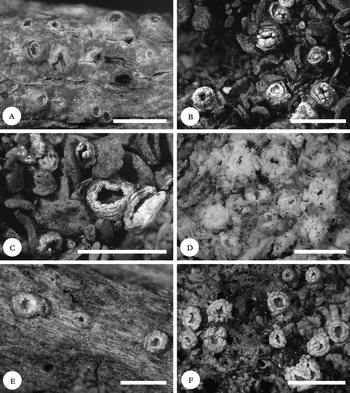
Habit of Thelotrema and Topeliopsis species. A, Thelotrema suecicum [Imshaug 45562 (MSC)]; B – F. Topeliopsis species; B & C, T. athallina (MSC–holotype); D, T. azorica [Messuti 4485 (BCRU)]; E, T. decorticans [Tibell 9975 (UPS)]; F, T. macrocarpa [Imshaug 52950 (MSC)]. Scales: A – F = 1 mm.

For a morphological description see Mangold et al. (Reference Mangold, Elix and Lumbsch2009).
Chemistry. Thallus K−, C−, PD−; lacking secondary compounds.
Notes. This taxon is characterized by a thin thallus, emergent, small apothecia with free proper exciple and hyaline, transversely septate, thick walled ascospores. Similar species are T. defossum and T. subtile. Thelotrema defossum can be distinguished by larger ascospores with regularly formed loci and thin septa. Thelotrema subtile has strongly amyloid ascospores, and less thickened cell walls that often show a crenate surface, larger loci and a brown pigmentation in older ascospores.
Ecology and distribution. The species grows on bark in cool-temperate rainforests. It is a subcosmopolitan species, recorded from Europe, North and South America (Purvis et al. Reference Purvis, Jørgensen and James1995), Australia (Mangold et al. Reference Mangold, Elix and Lumbsch2009), and is here recorded from New Zealand for the first time.
Specimens examined. Argentina: Neuquén: Puerto Blest, M. I. Messuti 4685 (BCRU); Parque Nacional Lanin, Secc Tromen, Rio Turbio, M. I. Messuti 206-P8, 4831 (BCRU); Villa La Angostura, M. I. Messuti 180-3 (BCRU), M. I. Messuti & I. N. de la Rosa 4491 (BCRU). Rìo Negro: Villa Tacul, Llao-Llao; M. I. Messuti 4595 (BCRU).—Chile: Magallanes y la Antártica Chilena Region (Region XII): B. San Nicolas, H. A. Imshaug 45562 (MSC); Brunswick Peninsula, Forest Reserve Magellanes, 6 km W of Punta Arenas, M. Wedin 1186 (UPS); Brunswick Peninsula, Puerto Cutter, H. A. Imshaug 39520-C (MSC); Isla Riesco, Mina Elena, R. Santesson 2054 (S); Pto Gallant, H. A. Imshaug 45093-B (MSC).—New Zealand: Campbell Island: Head of Garden Cove toward Filhol Peak, R. C. Harris 5206 (MSC); S base of Lyall ridge, across from Shoal Point, H. A. Imshaug 46069 (MSC); S side of Perseverance Harbour, 1 mi W of S point, R. C. Harris 5443 (MSC). South Island: Wellington, vii 1875, Berggren (S).
Topeliopsis athallina Lumbsch & Mangold, sp. nov
Mycobank no. MB 513053
Topeliopsis patagonicae similis sed thallis inconspicuis et ascis 1–2-sporis differt.
Typus: New Zealand, Campbell Island, Summit of Mt. Azimuth, H. A. Imshaug 46560 (MSC—holotypus).
(Fig. 4B & C)
Thallus endo- to episubstratic, pale brown, mostly reduced to the area surrounding the apothecia; surface dull, continuous. Thallus covered by a protocortex up to c. 20 μm thick. Algal layer discontinuous, poorly developed, calcium oxalate crystals lacking. Vegetative propagules not seen.
Ascomata conspicuous, up to c. 1 mm diam., roundish, perithecioid when young, becoming apothecioid with age, sessile, solitary to marginally slightly fused, emergent, subglobular when young, becoming urceolate. Disc usually not visible from surface, pale flesh-coloured, pruinose. Pores small to moderately wide, irregular to star-shaped with split pore margin in younger ascomata, in older ascomata often roundish with entire pore margin, proper exciple not visible from surface. Thalline rim margin coarsely cracked to slightly lacerate, thalline rim apically pruinose, whitish to off-white, incurved. Proper exciple fused, thick, hyaline internally, pale yellowish to greyish marginally, internal exciple distinctly amyloid. Hymenium non-inspersed, conglutinated; paraphyses straight, distinctly parallel, unbranched, with unthickened tips, lateral paraphyses conspicuous, not clearly separated from the proper exciple, up to c. 35 μm long, columellar structures absent. Epihymenium hyaline, without granules or crystals. Asci 1-2-spored, tholus thick in young asci, thin or not visible at maturity; ascospores eumuriform, cell walls thick, endospore thin to thick, hyaline to yellowish, non-amyloid, broadly ellipsoid, with roundish ends, loci large, angular to cuboid to irregular, transverse septa thin, distinct, regular to slightly irregular, 50–108 × 25–30 μm with numerous loci.
Chemistry. Thallus K+ yellowish becoming brown, C−, PD+ orange; containing stictic acid (major) and constictic acid (trace).
Etymology. Derived from thallinus (thalline), refering to the lack of a well-developed thallus.
Notes. The new species is readily distinguished by a thallus that is reduced to areas surrounding the ascomata, 1–2-spored asci with eumuriform ascospores, and the presence of the stictic acid chemosyndrome. A similar species is Chapsa asteliae, which is readily distinguished by the ascoma morphology with layered margins, amyloid ascospores, and the presence of succinprotocetraric acid. Topeliopsis patagonica is similar in containing the stictic acid chemosyndrome, but has 8-spored asci and larger, transversely septate ascospores.
Ecology and distribution. The new species is known only from two localities on the subantarctic islands, where it grows on leaves of higher plants on summits (above 500 m alt.) over cliffs and rocky outcrops.
Additional specimen examined. New Zealand: Auckland Island: Summit of peak just S of Mt. Easton, H. A. Imshaug 56640 (MSC).
Topeliopsis azorica (P. James & Purvis) Coppins & Aptroot
Lichenologist 40: 372 (2008).—Ramonia azorica P. James & Purvis, Arquipelago 11A: 11 (1993); type: Azores, Faial, 14 April 1992, Purvis & P. James s.n. (BM—isotype!).
(Fig. 4D)
For a morphological description see Mangold et al. (Reference Mangold, Elix and Lumbsch2009).
Chemistry. Thallus K−, C−, PD−; containing stictic acid (major), α-acetylconstictic (major or trace), hypoconstictic, hypostictic (minors or traces), cryptostictic and hyposalazinic acids (traces); or lacking secondary substances.
Notes. Topeliopsis azorica is characterized by large, hyaline, amyloid ascospores, and a short hymenium. Topeliopsis elixii Frisch & Kalb and T. muscigena are similar species. The latter can be distinguished by ascomata with reddish brown bases, larger ascospores that turn brownish with age and generate ascoconidia. Topeliopsis elixii contains the hypoconstictic chemosyndrome.
Ecology and distribution. In the study area it grows on bark in Nothofagus forests. Thus far the taxon is known from Australia, Argentina, Chile, the Azores, and Scotland.
Specimens examined. Argentina: Neuquén: Istmo de Quetrihue, M. I. Messuti & I. N. de la Rosa 4754 (BCRU). Tierra del Fuego: Sierra Alvear, Lago Escondido, M. I. Messuti 4485 (BCRU).—Chile: Magallanes y la Antártica Chilena Region (Region XII): Brunswick Peninsula, Rio Tres Brazos, H. A. Imshaug & K. Ohlsson 49677 (CANB, GZU, MSC, US); Punta Arenas, ii 1906, R. Thaxter (NY).
Topeliopsis decorticans (Müll. Arg.) Frisch & Kalb
Lichenologist 38: 44 (2006).—Thelotrema decorticans Müll. Arg., Bull. Herb. Boissier 1: 54 (1893); type: Black Spur, Vic, 1888, Wilson ‘514’ (G—lectotype!, NSW—isolectotype!).
Topeliopsis corticola Kalb, Mycotaxon 79: 322 (2001); type: Australia, New South Wales, Mt. Wilson, Blue Mnts. NP, K. & A. Kalb 20462 (CANB—holotype).
(Fig. 4E)
For a morphological description see Mangold et al. (Reference Mangold, Elix and Lumbsch2009).
Chemistry. Thallus K−, C−, PD−. No secondary compounds detectable by TLC.
Notes. This taxon is characterized by8-spored asci with muriform, hyaline, thick walled, amyloid ascospores and by the absenceof secondary metabolites. Other Topeliopsis species with muriform ascospores have distinctly larger ascospores and 1–2-spored asci.
Ecology and distribution. The species grows on epiphytic mosses, rarely on wood, bark or on siliceous rock in cool temperate rainforests. It was known only from Australia (Mangold et al. Reference Mangold, Elix and Lumbsch2009) and is recorded here for the first time from New Zealand.
Specimen examined. New Zealand: South Island: Westland, Arthur's Pass NP, 4 km N of Otira; L. Tibell 9975 (UPS).
Topeliopsis macrocarpa (C. W. Dodge) Mangold & Lumbsch
Flora of Australia 57: 659 (2009).—Thelotrema macrocarpum C. W. Dodge, Nova Hedwigia 19: 457 (1971); type: New Zealand, Auckland Islands, B. A. Fineran 1434b (CANU—holotype, not seen).
Chroodiscus australis Kantvilas & Vězda, Lichenologist 32: 331 (2000); type: Argentina, Isla de los Estados, H. Imshaug 51381A (HO—holotype!, MSC—isotype!).
(Fig. 4F)
Thallus thin, endo- to episubstratic, pale grey; surface dull, continuous, somewhat gelatinous and translucent when moist. Cortical structures absent. Algal layer discontinuous and poorly developed, calcium oxalate crystals lacking. Vegetative propagules not seen.
Ascomata conspicuous, up to c. 1·2 mm diam., roundish, perithecioid when young, becoming apothecioid, sessile, solitary to sometimes marginally fused, distinctly emergent, subglobose first, becoming (depressed-) urceolate. Disc orange-brown to olive-brown, concave, smooth, epruinose, mostly obscured by the exciple. Pores irregular to more often star-shaped to somewhat roundish, at first opening as ±regularly radiating cracks, in older ascomata with deeply split, dentate, and lobed pore margin, proper exciple visible from the surface, whitish to pale brown. Thalline rim coarsely lacerate, distinctly lobed, rarely somewhat eroded, off-white to pale brownish, whitish pruinose. Proper exciple fused, thick, pale yellowish, amyloid. Hypothecium pale yellowish to yellow, amyloid, medulla below hypothecium hyaline. Hymenium up to c. 200 μm high, non-inspersed, strongly conglutinated; paraphyses straight, unbranched, parallel to slightly interwoven, tips unthickened to slightly thickened, lateral paraphyses present, not clearly separated from exciple, conspicuous, up to c. 40 μm long, columellar structures absent. Epihymenium orange-brown to brownish in older stages, without granules. Asci 1-spored, tholus thick, thin when mature; ascospores eumuriform, cell walls and endospore thin, non-halonate, hyaline, amyloid, broadly ellipsoid to fusiform, transverse septae thin, 70–150 × 26–45 (–56) μm with multiple loci.
Chemistry. Thallus K+ yellow, C−, PD+ orange; containing stictic, cryptostictic acid (trace), peristictic acid (trace).
Notes. Topeliopsis macrocarpa is characterized by 1-spored asci with large, muriform, non-amyloid ascospores and by the presence of the stictic acid chemosyndrome. It is similar to T. tasmanica (Kantvilas & Vězda) Mangold, which was previously regarded as a subspecies of T. macrocarpa (Galloway Reference Galloway2001; Kantvilas & Vězda Reference Kantvilas and Vězda2000). However, T. tasmanica differs in having 2–4-spored asci with smaller (up to 100 μm long), non-amyloid ascospores. Further, the ascomata of T. tasmanica open more widely to expose the disc, while the discs in T. macrocarpa are usually obscured by the margin. The foliicolous T. athallina differs in having smaller ascomata and smaller ascospores.
Ecology and distribution. The species is widely distributed and common in southern South America and also occurs in Campbell Island and the South Island of New Zealand. It grows over peaty soil or mosses in heathlands or bogs.
Selected specimens examined. Argentina: Tierra del Fuego: Isla de los Estados, Bahia Buen Suceso, H. A. Imshaug 49988 (MSC); Bahia Capitan Canepa, H. A. Imshaug 52950 (MSC); Puerto Basil Hall, Punta Passalacqua Peninsula, N of Puerto Abrigado, H. A. Imshaug 51381 (MSC); Puerto Vancouver, head of inner bay, H. A. Imshaug 52135 (MSC); Isla Grande, Bahia Valentin, H. A. Imshaug 50324 (MSC).—Chile: Araucanìa (Region IX): Parque Nacional Conguillio, Los Paraguas, B. J. Coppins, D. J. Galloway, G. Guzman & P. W. James 5310 (BM). Los Lagos (Region X): Osorno, Refugio Antillanca, H. A. Imshaug 42923 (MSC); Parque Nacional Puyehue, Antillanca, B. J. Coppins, D. J. Galloway, G. Guzman & P. W. James 5095, 5326 (BM). Magallanes y la Antártica Chilena Region (Region XII): Isla Desolacion, Puerto Churruca, H. A. Imshaug 44796 (MSC).—New Zealand: Campbell Island: Mt. Lyall pyramid, H. A. Imshaug 46495-B (MSC); S slope of Mt. Hoeny above SE Harbour, H. A. Imshaug 47384 (MSC); W summit of Mt. Lyall, R. C. Harris 4787 (MSC). South Island: Southland, Sylvan Cove, Port Pegasus, D. J. Galloway (OTA-59746).—Falkland Islands: East Falklands: Mt. Usborne, H. A. Imshaug 39951 (MSC); Stanley, Goat Ridge, H. A. Imshaug 41496 (MSC); Stanley, Mt. Kent, H. A. Imshaug 40443 (MSC). West Falklands: Hill Cove, E French Peak, H. A. Imshaug 40996, 40999 (MSC); Port Howard, Mt. Maria, H. A. Imshaug 41284, 41285, 41295, 41360, 41361, 41362 (MSC).
Topeliopsis muscigena (Stizenb.) Kalb
Mycotaxon 79: 322 (2001).—Thelotrema muscigenum Stizenb., Jahresber. St. Gall. nat. wiss. Ges. 1888/89: 247 (1890); type: South Africa, Cape Province, August 1887, McOwan (H-Nyl.-22438—isotype!).
(Fig. 5A & B)
Habit of Topeliopsis species. A & B, T. muscigena [Harris 6329 (MSC)]; C & D, T. novae-zelandiae [Elix 7119b (CANB)]; E, T. patagonica (MSC–holotype); F, T. subdenticulata [Mayrhofer 8972 (GZU)]. Scales: A – F = 1 mm.

For a morphological description see Mangold et al. (Reference Mangold, Elix and Lumbsch2009).
Chemistry. Thallus K−, C−, PD−; lacking secondary substances.
Notes. Topeliopsis muscigena is distinguished by 1(–2)-spored asci with large, eumuriform, amyloid and hyaline ascospores that become pigmented with age and form ascoconidia in the final stages of their development, and by the lack of secondary metabolites. Another similar species that produces ascoconidia is T. elixii, which differs mainly by the presence of hypoconstictic and hyposalazinic acids.
Ecology and distribution. Topeliopsis muscigena grows on bryophytes, more rarely on wood or bark and over rocks in cool-temperate rainforests or (sub)alpine to coastal heath- or moorlands. It is known from southern Africa, Australia, India and New Zealand (Kantvilas & Vězda Reference Kantvilas and Vězda2000; Frisch et al. Reference Frisch, Kalb and Grube2006; Mangold et al. Reference Mangold, Elix and Lumbsch2009). This is the first record for Argentina.
Specimens examined. Argentina: Neuquén: Villa La Angostura, M. I. Messuti 4763 (BCRU); 6 km from Villa La Angostura, M. I. Messuti 4442 (BCRU). Rio Negro: Puerto Blest, M. I. Messuti, 4835 (BCRU).—New Zealand: Campbell Island: W of Camp Cove, R. C. Harris 5367 (MSC). North Island: Hunua Ra, Auckland, A. Knight (OTA-58054). South Island: Canterbury, Boyle River Lodge, ix 1981, F. J. Walker (BM, CANB, H); 9·5 km SSE of Arthur's Pass, Bealy Spur; L. Tibell 10095 (UPS); Westland Co., 8 miles W of Turiwhate; R. C. Harris 6329 (MSC).
Topeliopsis novae-zelandiae (Szatala) Lumbsch & Mangold comb. nov
Mycobank no. MB 513055
Thelotrema novae-zelandiae Szatala, Borbasia 1: 56 (1939); type: New Zealand, Gisbourne, near Lake Waikaremoana, 1932, J. Jablonszky T55 (BP—holotypus!).
(Fig. 5C & D)
Thallus epi- to hyposubstratic, pale yellowish grey to greyish green; surface shiny, smooth, continuous. True cortex continuous, up to c. 15 μm thick, consisting of periclinal hyphae. Algal layer poorly to well developed, discontinuous to continuous, calcium oxalate crystals not seen. Vegetative propagules not seen.
Ascomata conspicuous, up to c. 2 mm diam., roundish, perithecioid when young, becoming apothecioid with age, sessile, solitary to marginally slightly fused, distinctly emergent, subglobular. Disc visible from surface, flesh-coloured in younger ascomata, pale to dark brownish grey in older ascomata, pruinose. Pores small to moderately wide, irregular to star-shaped, pore margin split, proper exciple not visible from surface. Thalline rim margin coarsely cracked to slightly lacerate, thalline rim epruinose, whitish to off-white, incurved, base smooth, conspicuously pale brown. Proper exciple fused, thick, pale yellowish internally to hyaline marginally, apically sometimes dark brown, internal exciple and subhymenium distinctly amyloid. Hymenium non-inspersed, conglutinated; paraphyses straight, parallel, unbranched, with slightly thickened tips, lateral paraphyses present, inconspicuous, not clearly separated from proper exciple, up to c. 40 μm long, columellar structures absent. Epihymenium hyaline, without granules, with small crystals. Asci 1(–2)-spored, tholus thick. Ascospores eumuriform, cell walls in younger stages somewhat thickened, thin at maturity, endospore thin, with thin halo, hyaline to yellowish, strongly amyloid, cylindrical to roundish-fusiform with roundish to slightly roundish ends, loci predominantly roundish to slightly angular, transverse septa thin, distinct and ± regular, 100–200 × 25–52 μm with multiple loci.
Chemistry. Thallus K+ yellowish becoming brown, C−, PD+ orange; containing stictic acid (major), constictic, cryptostictic and α-acethylhypoconstictic acids (minors).
Notes. This species is characterized by large ascomata, a shiny thallus, 1(–2)-spored asci, eumuriform ascospores, and by the presence of the stictic acid chemosyndrome. The species is hardly confused with another species. Stictic acid is also present in Topeliopsis athallina, T. macrocarpa, and T. patagonica. The latter is readily distinguished by transversely septate ascospores, while T. athallina has smaller ascospores and smaller ascomata. Topeliopsis macrocarpa has smaller ascomata and smaller ascospores.
Ecology and distribution. The species occurs on bark and among bryophytes in temperate rainforests. The species occurs in New Zealand and has also been recorded from Sri Lanka (Hale Reference Hale1981).
Specimens examined. New Zealand: South Island: Canterbury, Banks Peninsula, Mt. Sinclair, J. A. Elix 7119b (CANB); Canterbury, Banks Peninsula, Otepatotu Scenic Reserve, J. A. Elix 26256 (CANB); Westland, Arthur's Pass NP, 4 km N of Otira; L. Tibell 9984 (UPS).
Topeliopsis patagonica Mangold & Lumbsch sp. nov
Mycobank no. MB 513054
Topeliopsis athallinae similis sed thallis griseis vel albo-griseis et ascis 8-sporis differt.
Typus: Chile, Prov. Magallanes, Isla Desolación, Imshaug & Ohlsson 44750 (MSC—holotypus).
(Fig. 5E)
Thallus endo- to episubstratic, pale grey to whitish grey or inconspicuous; surface dull, rough, continuous. Thallus covered by a discontinuous protocortex up to c. 30 μm thick. Algal layer discontinuous and poorly developed, calcium oxalate crystals usually abundant and of variable size, scattered or in clusters. Vegetative propagules not seen.
Ascomata conspicuous, up to c. 1 mm diam., roundish, peri- to apothecioid, sessile, predominantly solitary, emergent and subglobose to urceolate. Disc not visible from the surface. Pores small to moderately wide, usually ragged and irregular to star-shaped, pore margin distinctly split, incurved, proper exciple not visible from the surface, roundish to somewhat irregular, ±entire, incurved, pale brownish to reddish-brown. Thalline rim margin thick, with same colour and structure as rest of thalline rim, thalline rim lacerate, coarsely whitish pruinose to squamulose, often eroded, somewhat exfoliating with age and becoming slightly layered, off-white. Proper exciple predominantly fused, in eroded ascomata tips sometimes apically exposed, thick, hyaline to pale yellowish internally, pale orange to reddish brown marginally, usually distinctly amyloid towards the base and subhymenium. Hymenium non-inspersed, conglutinated; paraphyses unbranched, ± straight, parallel to slightly interwoven with unthickened, lateral paraphyses not clearly separated from exciple, inconspicuous, up to c. 45 μm long, columellar structures absent. Epihymenium hyaline, without granules or crystals. Asci 8-spored, tholus thick, thin when mature; ascospores transversely septate, cell walls thick, in younger ascospores distinctly halonate, hyaline, strongly amyloid, bacillar-fusiform to fusiform, with narrowed-rounded to subacute ends, loci angular, septae thin, regular, 90–160 × 20–26(–31) μm with 12–17 loci.
Chemistry. Thallus K+ yellowish becoming brown, C−, PD+ orange; containing stictic acid.
Etymology.The name refers to the distribution of the new species in Patagonia.
Notes. This new species is similar to T. subdenticulata and was included in the circumscription of that species by Frisch & Kalb (Reference Frisch and Kalb2006). It differs, however, in having larger ascospores and contains the stictic acid chemosyndrome and is therefore regarded as a distinct species here. A similar species is T. darlingtonii A. Frisch & Kalb, which, however, is readily distinguished by having smaller ascospores.
Ecology and distribution. It grows on bark and over bryophytes in cool-temperate rainforests or open Nothofagus forests and is currently known only from southern South America.
Specimens examined. Chile: Magallanes y la Antártica Chilena Region (Region XII): Brunswick Peninsula, Puerto Cutter, H. A. Imshaug 39400, 39430 (MSC); E shore of Pto Bueno, H. A. Imshaug 44552 (MSC); Head of Pto Bueno, H. A. Imshaug 44526-B (MSC); Isla Desolacion, Bahia Tuesday, H. A. Imshaug 44750 (MSC); Puerto Churruca, H. A. Imshaug 44785 (MSC, US).
Topeliopsis subdenticulata (Zahlbr.) A. Frisch & K. Kalb
Lichenologist 38: 44 (2006).—Ocellularia subdenticulata Zahlbr., in Skottsberg (ed.), The Natural History of Juan Fernandez and the Easter Island 2, Botany: 329 (1924); type: Chile, Juan Fernandez Islands, Masafuera, C. & I. Skottsberg s.n. (W—holotype).—Thelotrema subdenticulatum (Zahlbr.) Salisb., Lichenologist 5: 267 (1972).
Topeliopsis vezdae Kalb, Mycotaxon 79: 323 (2001); type: Australia, New South Wales, Styx River SF., Kalb & Williams 19199 (CANB—holotype!).
(Fig. 5 F)
For a morphological description see Mangold et al. (Reference Mangold, Elix and Lumbsch2009).
Chemistry. Thallus K−, C−, PD−; lacking secondary substances.
Notes. Topeliopsis subdenticulata is characterized by large, transversely septate, thick-walled, hyaline, amyloid ascospores and the lack of secondary metabolites. It is similar to T. darlingtonii, which is readily distinguished by smaller ascospores (up to 60 μm long, with up to 16 loci) and the presence of the stictic acid.
Ecology and distribution. This species occurs mainly on epiphytic mosses, rarely on bark and dead wood in cool temperate rainforests or wet sclerophyll forests. It occurs in South America, Australia and New Zealand.
Specimens examined. New Zealand: South Island: Canterbury, Arthur Pass NP, Waimakariri Valley, H. Mayrhofer & H. Hertel 8972 (GZU); Canterbury, Boyle River area, Lake Summer Forestry Park, J. Johnston & R. Elder 3417, 3440, 3441, 3442, 3443, 3445 (CANB); Otago, Tuapeka West, Knights Bush, A. Knight (OTA-59967). Stewart Island: Glory Cove, D. J. Galloway (CHR-378080).
We wish to thank Alan Fryday (East Lansing) for his support of this project. He invited HTL to study Thelotremataceae at MSU and was very helpful in all stages of this project. This study was supported by a NSF grant (DEB-0516116) to The Field Museum (PI: HTL, co-PI: RL), the Universidad Nacional del Comahue and CONICET (MIM) and the Spanish Ministry of Science and Innovation through a Ramon y Cajal grant (RYC02007-01576) to PKD.