1. Introduction
Marx lauded the English Factory Laws and said that he allotted a large space for them in Volume I of his Capital because he thought the Continent could learn from the English experience. Though no legislation could overcome the central contradictions of capitalism in his view, whether its development took ‘a form more brutal or humane’ depended on the counterpoise of the ‘right’ labor market institutions. Yet, workers had to be strong enough to compel capitalists to comply with the laws instituting them, especially when the state lacked the power or inclination to enforce them effectively. The paper highlights a previously unexamined aspect of Marx's discussion on the 19th century English Factory Acts, and points at its broader relevance for contemporary discussions about the role of institutions in a market economy.
Ever since Douglas North's seminal work and the rise of neo-institutional analysis more broadly, it has not been uncommon to think of institutions functioning as commitment devices, enabling the development of complex, arm's length transactions in economic development. In Greif's (Reference Greif2000) succinct formulation, complex exchanges are often a One-Sided Prisoner's Dilemma. Unless some institutional device enables the transacting parties – for instance, a buyer on credit – to commit ex-ante to not renege ex-post they will go unrealized despite their mutually beneficial potential. Fitting in this mold is also Oliver Williamson's pioneering work, among that of others, that explores the contractual hazard opportunistic behavior creates in bilateral exchange. The paper argues that the novelty of Marx's argument is in its unique approach to opportunism and collective action. His argument has three parts: (i) the free rider problem arising from capitalists' collective costs gives rise to an opportunism hazard, compounded by their stronger bargaining power in relation to workers. The hazard exists (ii) not just in scattered idiosyncratic market transactions, but in those that represent a class with systemic spillover effects, the changes in the balance of bargaining power in one transaction influencing what happens in the next. The strategic complementarities these create incentivize coordination among workers, which (iii) fulfils an enforcement function, providing the commitment device capitalists require to overcome opportunism. The logic of this is as follows: classes or groups need to coordinate to solve collective action problems, and can do so more effectively when they curb opportunistic self-seeking in their midst, which is better accomplished when a well-coordinated counterparty raises their cost of coordination failure. Thus, in Marx's argument, the early Factory Laws could first gain traction at a time of poor state enforcement as organized power of workers raised the capitalists' cost of coordination failure.
The paper's discussion on the broader relevance of Marx's argument for the role of institutions fits within the large literature on ‘self-enforcing contracts’ and on ‘private ordering’ under conditions of costly or non-existent third-party enforcement (Anderson and Hill, Reference Anderson and Hill2004; Clay, Reference Clay1997; Dixit, Reference Dixit2004, Reference Dixit2009; Greif, Reference Greif, Bates and Greif1998, Reference Greif2006). Much of this literature ignores any role for collective action, elite or class agency, with a few exceptions. One is North et al. (Reference Ward2009) where coalitions of elites precede state formation, and the few recent papers that build on this approach (Erturk, Reference Erturk2020; van Bavel et al., Reference van Bavel, Ansink and van Besouw2017) share a similar orientation with this paper. Another exception is Greif et al. (Reference Greif, Milgrom and Weingast1994) which considers the role of merchant guilds in historical context in which the long-distance traders' collective boycott threat helps a sovereign hosting them commit to respecting their property rights.Footnote 1 On the other hand, a large literature exists on English Factory Acts, addressing their social, legal, economic effects, and place in the industrial revolution (Allen, Reference Allen2009; Berg, Reference Berg2002; Blaug, Reference Blaug1958; Cooke-Taylor, Reference Cooke-Taylor1894; Hutchins and Harrison, Reference Hutchins and Harrison1903; Ward Reference Ward1970a, Reference Ward1970b), but work focusing specifically on Marx's discussion is thin. A couple of papers revisit Marx similar to this one to highlight the collective costs capitalists face arising from the too rapid pace of accumulation and overexploitation of workers. The Acts are seen to safeguard not only long-term growth and stability (Booth, Reference Booth1978a, Reference Booth1978b) but also address the threats to social reproduction due to the disruption of gender norms (Moos, Reference Moos2020). However, neither considers Marx's argument about the effect of organized labor on capitalist coordination as in both the state plays a central role in how capitalists exercise class agency.Footnote 2
The organization of the paper is as follows. Section 2 gives a brief overview of the English Factory Acts and Marx's argument. Section 3 discusses capitalists' free rider problem and the opportunism hazard it gives rise to. Section 4 uses basic game theory to make explicit Marx's argument on how organized labor could have made the Acts become self-enforcing, helping capitalists act in their enlightened self-interest. Section 5 reflects more broadly on the conception of collective action in Marx's argument, contrasting it with the conventional notion that associates it with collusion. The paper ends with a few concluding remarks.
2. English Factory Acts
During the early 19th century England, the dismal health and living conditions of working poor had become the hallmark of a mismanaged common pool resource. As the inflow of workers from rural labor reserves began to dry out continuing to externalize production costs threatened to harm capitalists collectively. It was in capitalists' common interest to better husband their work force by limiting the workday and curtailing child labor, but market competition made that inherently difficult. The ‘Factory Acts’, referring to a series of laws enacted from 1819 and on through the 19th century England, were thus the history of capitalists building institutional capacity to regulate industrial employment in their collective interest. However, the early Acts prior to 1833 were largely ineffective as they were poorly enforced and had limited scope (Bartrip and Fenn, Reference Bartrip and Fenn1983; Nardinelli, Reference Nardinelli1985). Opposing them as an infringement on ‘freedom of contract’, capitalists could widely ignore them with impunity (Blaug, Reference Blaug1958, Reference Blaug1985; Marvel, Reference Marvel1977). Even when the outnumbered factory inspectors (whom Marx praised for their professionalism) did their jobs well, magistrates – often factory owners themselves – were seldom impartial (Marx, Reference Marx1867: 288–289; Nardinelli, Reference Nardinelli1985: 429). It is also commonly agreed that the Acts gradually became generally accepted by mid-century. The Act of 1833, a turning point in retrospect, established a ‘factory inspectorate’ that oversaw compliance and gave inspectors magistrate power. This was also the period in which workers especially in the cotton mills were becoming better organized (Driver, Reference Driver1946, Ward, Reference Ward1962). Eventually, with improving political fortunes and widening social support, the 10-hour working day, first introduced in 1847, became part of the industrial landscape by the 1860s.
Marx's account, though less sanguine, agrees that poor enforcement impaired the Acts' effectiveness early on. In his view, the overall objective of the Acts was to ‘… curb the passion of capital for a limitless draining of labor power…’ to promote capitalists' collective interest (p. 239). ‘Just as in a machine the part of its value to be reproduced every day is greater the more rapidly the machine is worn out’, the unnatural extension of the working-day, thus, raised ‘the sum of the expenses for the reproduction of labor-power’ (p. 266). But, enforcement was a problem, since in his view ‘… [Parliament] was shrewd enough not to vote a penny for their carrying out’ (p. 278). Contrary to his interpretation, others have also argued that the Acts were basically a cartel device serving the sectional interests of large cotton-mill owners for whom a shorter working day was an opportunity to cut output and raise prices (Lawrence, Reference Lawrence1980; Marvel, Reference Marvel1977). According to this view, the shorter working day became possible only on account of capitalist support, not because they were acting on their enlightened self-interest or on humanitarian grounds but because they could so increase their profits.Footnote 3 While these arguments raise a valid question as to how the Acts could first gain traction, they ignore the capitalists' free rider problem altogether. The following discussion makes explicit Marx's argument on how organized labor could play an important role in capitalists' overcoming opportunism in their midst. It also explains why Marx thought it was in capitalists' interest not to hinder the organization of workers.Footnote 4
3. Capitalists' free rider problem and opportunism hazard
Ideological opposition to any labor market legislation, with a long history (Ely, Reference Ely1908), rests on the claim that low wages and poor working conditions would not be a problem if only the market were left alone.Footnote 5 Marx clearly had no such confidence in the market, yet he nonetheless made an inverse dynamic between wages and pace of accumulation a central theme in his General Law of Capitalist Accumulation. If indeed distributional shifts in favor of profits stimulate higher growth raising demand for workers, why would the workers' bargaining position not eventually improve along with their exit option, giving rise to better wages and working conditions? Whether workers are well organized or not appears to be the important issue in his argument.
Going all the way back to Adam Smith, authors other than Marx also have commonly emphasized the uniquely asymmetrical nature of the employment relationship.Footnote 6 The worker risks causing damage to his person in a way the capitalist does not since his labor power is inseparable from him. Holding out until he is fully compensated for this risk is seldom an option because labor power is perishable and cannot be stored.Footnote 7 Another argument is that a low wage trap thwarts any tendency toward any self-correction in wages and working conditions.Footnote 8 Because workers have to work more to secure their livelihood when wages dip below the living wage, the labor supply becomes flat and even downward slopping. Either way, workers' exit option remains depressed, making their low wages and bargaining power impervious to market competition and growth. But, that not only harmed workers' welfare but also caused capitalists to pay a collective price as well.
For the persistency of rock bottom wages, poor working conditions and child labor degraded the labor supply in the long run, hurting the capitalists collectively. A wage above the market rate in a wage trap is in capitalists' interest as in ‘efficiency wages’ – except, here, the benefit from the higher wage is collective. The collective nature of the gain creates in turn a free rider problem since the opportunistic self-interest of each capitalist is to disregard the deleterious long-term effect and take advantage of the depressed market wage and child labor while they can. The problem is fixable by imposing mutual constraints on behavior, but enforcement is an uphill battle when competition rewards those who are non-compliant. Thus, the legislation instituting a normal workday and curtailing child labor was hard to enforce in 19th century England even though it was mutually beneficial. The hazard was for long masked by the oversupply of labor, but it could not be ignored forever.Footnote 9
Capital that has such good reasons for denying the sufferings of the legions of workers that surround it, is in practice moved as much and as little by the sight of the coming degradation and final depopulation of the human race, as by the probable fall of the earth into the sun. In every stock-jobbing swindle everyone knows that some time or other the crash must come, but everyone hopes that it may fall on the head of his neighbor, after he himself has caught the shower of gold and placed it in safety. … [A]ll this does not, indeed, depend on the good or ill will of the individual capitalist. Free competition brings out the inherent laws of capitalist production, in the shape of external coercive laws having over every individual capitalist (p. 270).
4. Organized labor and capitalist class agency
A normal working day and other labor standards are hard to institute because competition puts capitalists in a Prisoner's Dilemma. They cannot commit to abiding by any restriction unless they are confident that others also will. A cooperative solution to their dilemma requires a commitment device in the form of an institutional fix, a uniform standard on a shorter working-day and a general curtailment of child labor. However, in early 19th century England, the state lacked the reputation for effective enforcement and the requisite relative autonomy from the ‘ruling classes’. According to Marx, organized labor functioned as yet another commitment device during this early period. With both the power and incentive to sanction non-compliant capitalists, the workers' threats of sanction lowered the expected benefit of non-compliance enabling capitalists to commit to acting in their long-term self-interest.Footnote 10 The following makes explicit the logic of Marx's argument.
Consider the familiar dyadic Prisoner's Dilemma payoff matrix below as a depiction of the competitive environment capitalists are in, where it is assumed that a > b > c > d. Cooperation here takes the form of capitalists complying with the Acts, while defection refers to non-compliance in one form of opportunistic act as another – of which, Marx gave numerous examples in Chapter 10 of Volume I of his Capital. The capitalists' dilemma is that mutual defection is the default Nash equilibrium since they cannot commit to comply before they can expect that others also will. It is assumed that all payoffs are common knowledge.

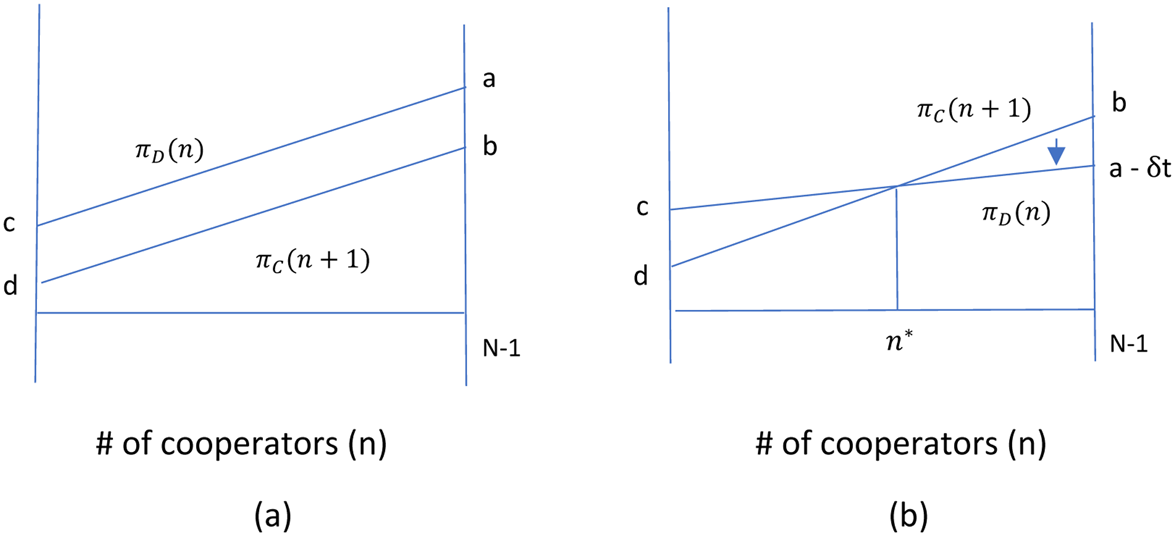
Based on the simplifying assumption that all capitalists are alike, an N-person extension in Figure 1 shows, respectively, the expected payoffs from compliance (cooperation) and non-compliance (defection), both as functions of the number (or ratio) of cooperators to defectors.
Workers, a game changer?

The n + 1st capitalist decides whether to cooperate or defect with n employers who have already complied based on the respective payoff of each strategy. Panel (a) shows that for all values of n, the cooperation payoff, π C(n + 1), lies below the defection payoff, π D(n), which means that defection always pays off more no matter how many cooperators there are. The sole Nash equilibrium then occurs when no one cooperates (n = 0). By contrast, in Panel (b), a threat of sanction t, carried out with probability δ, reduces the expected defection payoff to a 2 – δt, making the two payoffs equal at some critical threshold (n*). The cooperation payoff exceeds (falls short of) that of defection to its right (left). When the number of capitalists who comply exceed n*, mutual cooperation can be self-enforcing because cooperation is then expected to have a higher payoff. The lower is the threshold n*, the more likely self-enforcement becomes since then it takes fewer initial capitalists to comply before compliance becomes the preferred strategy.
The changes in cooperation and defection payoffs shift the value of n*. For instance, the greater is the threatened sanction (t) and the probability with which it is carried out (δ) the lower is the value of n*. That is, the greater is the fall in the expected defection payoff, the fewer are the initial cooperators required before the law can become potentially self-enforcing. Similarly, any improvement in the cooperation payoff has a similar effect.
The Acts' threats of sanction on defectors were initially lacking in credibility because capitalists would have reasonably expected a low enforcement probability. This implied a high value of n*, making defection the more attractive strategy than cooperation, provided most capitalists did not comply anyway. However, when workers became better organized, defecting capitalists had to worry about not only the diligent inspectors and infrequent impartial magistrates but also the potential retaliation from workers. They thus faced stronger threats with a higher probability of being carried out. Stylistically, the stronger credible threats from workers had the effect of lowering the slope of π D and thus the threshold value n*.
But, before they could collectively deter capitalists in defense of their rights, workers had to deal with their own intra-class competition. They faced a coordination problem of their own since the cost of organizing fell disproportionately on the initial group of organizers (Booth, Reference Booth1978b, Lichbach, Reference Lichbach1998), i.e. a worker's payoff of joining in the coalition was higher when other workers joined first. Thus, in the dyadic payoff matrix below, either worker's payoff is higher when the other has already joined: (β > δ).

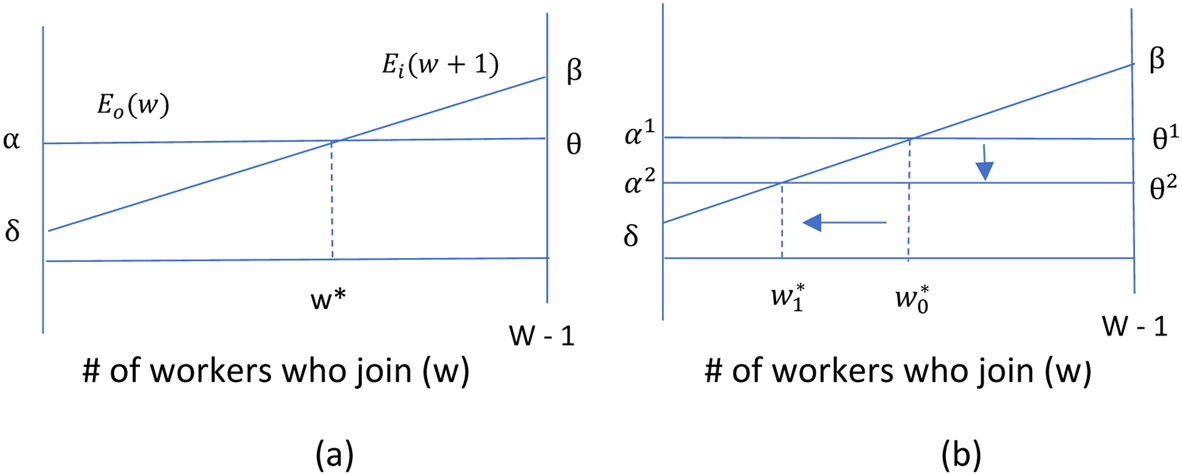
Panel (a) in Figure 2 depicts an N-person extension with homogenous workers, again with common knowledge payoffs. E i(w + 1) shows the w + 1st worker's expected payoff from joining in the coalition, which rises with the number of other workers who have already joined. E o(w) gives the expected payoff of staying out of the coalition, which is assumed for simplicity independent of the number of workers who are in the coalition (α = θ). Two stable Nash equilibria occur respectively at w = 0 and w = W; and a third unstable one at w = w*. When w < w* workers are trapped in a low bargaining power equilibrium as they are better off staying out, making it an uphill battle to organize. But when w > w*, the expected relative payoff of organizing is higher and can snowball. When coordination is the Nash equilibrium, workers can function as a commitment device for capitalists, transforming their Prisoner's Dilemma into an Assurance game – shown in panels (a) and (b) in Figure 1.
Workers' coordination problem.

The workers' chances of success in organizing depend on the threshold value w*. The lower (higher) the value of w*, it takes fewer (more) initial workers before the coalition promised a higher relative payoff. Marx thought that the ‘serpent of agonies’ the isolated worker suffered would only get worse over time, raising the expected relative benefit of organizing. This implied that E o(w) would shift down in panel (b) of Figure 2, depicting a fall in the expected payoff of staying out, which moves the threshold value w* to the left. Moreover, even when they were poorly enforced, the Acts' salience could still have worked as a focal point raising workers' expectations that more workers would want to organize.
While the foregoing discussion is helpful in clarifying Marx's argument, it also has some limitations. For instance, another part of his argument emphasized the sectoral differences among capitalists, which the simplifying assumption of homogenous workers and capitalists here ignores. In his view, the struggle for a normal working day triumphed first ‘in those great branches of industry which form the most characteristic creation of the modern mode of production’.Footnote 11 This is not surprising since in these sectors, the capitalists were more likely to have faced better organized workers, and also that a cooperative relationship with workers could have had a relatively higher payoff. A more complete formal treatment (not attempted here) would thus consider each sector separately and the cascade effects between them that would arise when success at organizing in one sector emboldens workers in the others. The essential theme however remains the same: as workers acquire a stronger deterrence capacity in one branch after another self-enforcement based on bi-lateral class agency becomes more likely throughout the economy.
Another implication Marx did not consider is also of interest – perhaps, more so today for us than his time. By all indications he thought the shift from isolation to coordination was a one-way street for workers. His general law of capitalist accumulation postulated that workers could successfully bargain for higher wages when growth picked up, raising the wage share, which implicitly assumed that they had permanently overcome the low bargaining power trap. However, a ‘reverse traverse’ to an uncoordinated equilibrium could also happen if forces strong enough coalesced to bring it about. A host of factors – ranging from changes in technology to rising competition from overseas workers that depressed the relative payoff of organizing – could shift down E i(w + 1) and move the unstable Nash equilibrium, w = w* far to the right in Figure 2, increasing the probability of a shift from the Nash equilibrium with coordination (w = W) to the one without (w = 0). Rising growth (and productivity) would again fail to raise workers' bargaining power, which implied that the wage share could just as well fall through cycles rather than fluctuating around some constant level – as in Goodwin's (Reference Goodwin and Feinstein1967) famous formulation of his general law.Footnote 12 Moreover, with weakened workers, the capitalists' opportunism hazard also returns resulting in a reverse movement from panel (b) to (a) in Figure 1, impairing their capacity to act in their enlightened self-interest when (and if) the state capacity to discipline is also eroded.Footnote 13
5. Collective action, spillover effects, and power balancing institutions
This section reflects briefly on the conception of collective action in Marx's argument and why it differs from the conventional view that associates it with collusion as in a cartel. In the latter, any gain from strategic coordination that accrues to organized groups, whether of firms, consumers, or workers, comes at the expense of the unorganized. For instance, labor unions inhibit market competition as a type of cartel, making their members better off at the expense of consumers and non-unionized workers. In Marx's argument, by contrast, organized workers not only help themselves but also the capitalists – and, presumably consumers as well. Because it lowers enforcement costs, strategic coordination by workers fosters ‘trade expansion’ and is thus market enabling rather than market inhibiting. The discrepancy between these two conceptions can be traced to their differences on two particular issues.
One issue is the potential enforcement function of strategic coordination by market participants. Costly or ineffective state enforcement is by now ubiquitous in much theorizing on incomplete contracts, interactive bargaining, and opportunistic behavior in ongoing transactions. But, what is perhaps not as common is the idea that strategic coordination by market participants can take on an enforcement function as in Marx's account where workers' collective threats function as a commitment device for the capitalists. Capitalists might benefit from organized labor in acting in their long-term interest, but they are also keen to prevent workers from using their power in ways that can harm them. When looked from this angle, the capital–labor exchange, the key representative transaction in capitalism Marx focused on, is one that is primarily enforced by bilateral class agency – what he called, class struggle. The argument however is broader than economic class as it also applies to other instances where transactional linkages incentivize coordination among similarly transacting others whose threat of collective action can then take on an enforcement function as for instance in the case of a consumer boycott.Footnote 14
The other issue is the endogeneity of spillover effects on bargaining costs. In the argument under consideration, trade expansion is incumbent on capitalists solving their opportunism problem, made possible by workers' capacity for strategic coordination, which is in turn incentivized by the structural complementarities that arise from the spillover effects of the very trade expansion itself. That is, the market exchange is – as in Lerner's (Reference Lerner1972) adage – a ‘solved political problem’ in the sense that strategic behavior on both sides keeps enforcement costs low, while at the same time it is the existence of transactional linkages giving rise to spillover effects that explains why the transacting parties' interest in strategic coordination overshadows their utility consideration.Footnote 15 In marked contrast, the traditional view of spillover effects holds that they arise exogenously from missing markets either because all property rights are not well-defined or because all contingencies cannot be foreseen as in the theory of ‘incomplete markets’. In either case, they are a second-order complication that can be conceptually stripped away by invoking the Coase Theorem that the affected parties could find schemes of mutual compensation if bargaining and other transaction costs did not exist. But, the Coase assumption ignores that bargaining costs might be constitutive of the exchange, which is plausibly the case when spillover effects are endogenous. If strategic coordination is incentivized because it can enhance bargaining power at low cost, coordination and bargaining costs are an integral part of the maximizing calculus that we presume brings about the exchange.
It is true that perfect third-party enforcement would obviate any enforcement function of collective action associated with the spillover effects of transactional linkages. For it is reasonable to think that the relative attraction of strategic coordination in lowering enforcement costs is lower (higher) the more (in)effective and (non-)neutral the state enforcement is. In situations where significant strategic complementarities exist, whether market participants think coordinated efforts can tilt third party enforcement in one's group or class interest also matters, unless they are deemed futile either because counter-group capacity to respond in kind is well-balanced or because state regulation is believed too resistant to capture (or, some mix of the two). True to the institutionalist insight, how well a market economy functions then depends on institutions that facilitate prior bargaining power balancing. For the capacity of competition to level the playing field might be impaired not by market collusion alone but also by the initial asymmetries in market participants' bargaining power when third party enforcement is not effective or neutral.
6. Conclusion
The paper highlights a previously unexamined aspect of Marx's discussion of the 19th century Factory Acts, which also has broader implications for the role of institutions in solving collective action problems in a market economy. In his argument, the capitalists' free rider problem arising from their collective costs creates an opportunism hazard, which is compounded by their superior bargaining power vis a vis the workers. However, the workers can make credible collective threats when they organize, which enables capitalists to commit to acting in their enlightened long-term self-interest. The paper makes explicit the dynamic between inter versus intra-group opportunism in Marx's discussion, showing how capitalists could develop class agency in addressing their collective costs without market collusion or state leadership. One general implication of his argument is that a market economy might work better when workers have the collective power to punish opportunistic behavior by capitalists, especially in those situations where the state's capacity or inclination to do so is low or eroded.