Between 1908 and 1958 Muslim entrepreneurs from Habsburg Sarajevo to Tsarist St. Petersburg and colonial Lahore to republican Beijing established their own self-proclaimed “Muslim” banks. With names like Muslimanska Centralna Banka and Muslim Orient Bank, these institutions triggered debates among a panoply of Muslim commentators about not only the legal identity of a Muslim bank in Islamic law, but also how to interpret the precise relationship between financial interest and usury in the Islamic foundational sources and the modern global economy. Rather than relying as today's “Islamic” banks do on complex financing methods that circumvent interest, these Muslim banks openly paid interest to depositors and charged interest on loans. Although since around 1960 a heterogeneous chorus of Muslim commentators have asserted that interest is unacceptable in any form, in the period studied here there were numerous legal rulings that Muslim entrepreneurs, customers, and jurists cited to justify the existence of Muslim-owned interest-based banks. It is telling that the ur-myth of today's Islamic finance industry does not point to any of these Muslim banks as a blueprint but rather to an interest-free bank opened at Mit Ghamr in Egypt in 1963, which is widely regarded as the first bona fide Islamic alternative to conventional interest-based banking.Footnote 1
The central task of this article is to explain how the earlier archetype of Muslim banks was eclipsed, although in no sense supplanted, by the later incarnation of the Islamic bank in the bid to establish a widely accepted form of banking among Muslim constituencies. Here Muslim bank refers to those Muslim-owned financial institutions created between 1908 and 1958 on the model of Western banks that openly endorsed interest transactions, whereas Islamic bank refers to those institutions founded after 1958 that rejected the paradigm of Western banking and had no nominal interest transactions listed in their books.Footnote 2 As argued here, three factors explain this process of displacement. First, the collapse of the Ottoman Empire brought an end to several institutional and legal precedents (based on a peculiarly Ottoman synthesis of kanun, shariʿa, and custom) in the Middle East that had accommodated and legitimized interest transactions among Muslims. Muslim entrepreneurs hoping to create Muslim banks in Egypt, Anatolia, and Bosnia in the first two decades of the 20th century pointed to these Ottoman precedents to justify interest transactions. As the empire passed from the scene, the institutions and legal precedents that had underpinned its unique fusion of Islamic commercial law and interest-based banking went with it. In turn, the reorganization in the 1920s of these former Muslim banks into new national entities (with “Muslim” erased from their titles) fostered conditions for post-Ottoman voices to offer alternative archetypes for Muslim banking.
The second factor explaining the transition from Muslim to Islamic banks was the rejection by a wide array of Muslim commentators of any effort either to encourage norms of interest-based banking among Muslim constituencies or to interpret the Islamic foundational sources as banning not interest but only usury. Far from being an exclusively Muslim phenomenon, these discussions paralleled arguments over interest and usury that had occurred in other parts of the world beginning in the late 19th century.Footnote 3 For all these analogs, at the heart of these quarrels was whether ribā (a word literally meaning increase, but often applied to interest on loans) in the Islamic foundational sources was equivalent to interest in the modern financial economy or merely a byword for usury. Nearly all Muslims saw usury or compound interest as reprehensible but disagreed over the degree to which modest rates of interest was acceptable.
The controversy stemmed from the fact that the vocabulary surrounding ribā was notoriously molten, and, once one historicizes the multiple meanings Muslims ascribed to the term, it becomes clear that as finance assumed greater prominence in the international economy from 1850 ribā took on novel meanings without precedent in the Islamic discursive tradition. Sunni Muslim commentators from this period onward regularly noted that the verses regarding ribā were, according to a famous report of the companion ʿUmar ibn al-Khattab, the last to be revealed to the Prophet Muhammad. Since the prophet had passed away before explaining it in full, unshakable interpretive ambiguities remained for the Muslim community.Footnote 4 Indeed, the concepts of ribā in the Qurʾan, hadith, and legal scholarship were but a fraction of a wider semantic field permeated by other Arabic synonyms such as fāʾida and manāfiʿ and other vernacular terms connoting interest, at once complementary and competing, such as sūd (Urdu), fāʾiẓ (Ottoman Turkish), and bunga (Indonesian), to name only a few. Beyond this, notions of ribā in the foundational sources possessed numerous subterranean layers of their own, as those Muslim scholars defending interest-based banks often pointed out to buttress their position.Footnote 5 In defining ribā simply as interest or usury historians have most likely not realized how, in employing this shorthand, they have waded into an ongoing polemical contest among Muslim writers and also effaced the potential incommensurability of a term that does not easily map onto modern notions of “rent on money.”
Even if debates over interest, usury, and the Islamic foundational sources had significant transnational dimensions stretching to Egypt and Indonesia, nowhere did this subject provoke more controversy than in colonial India, where by the late interwar period there was a growing conviction that the only authentically Muslim bank was an interest-free one. This diagnosis stemmed in large measure from the perception that Muslims were failing to create banks at a rate on par with non-Muslims in the subcontinent. In colonial India geographical and customary differences among Muslim mercantile communities, intra-Muslim legal polemics, the peripheral role of Muslim communities in the moneylending and banking professions, and colonial financial policies made the effort to mobilize legal and financial support for Muslim banks a process fraught with controversy. In addition to the problems of moral legitimacy, these institutions were undermined by the prohibitively expensive cost of capital throughout the region and the recurring failure of both indigenous and European banking institutions.Footnote 6
Lacking Ottoman institutional precedents that might legitimize interest-based banks, Indian Muslim commentators adopted one of the following positions: that interest was distinct from usury, which they understood as ribā (the Islamic modernist position); that one could accept interest, but only through various legal devices intended to bypass ribā while upholding the integrity of the ban (the traditionalist ʿulamaʾ view); that interest had to be avoided, except in moments of duress or in specific types of transactions (the typical modernist ʿulamaʾ argument); or that it had to be expunged entirely from the banking system (a neo-Salafi axiom).Footnote 7 Whatever the disparate religious views of the Muslim scholars, bankers, and customers who grappled with these problems, many had come to adopt the final position by mid-century. It is worth emphasizing that these actors did not accept the impermissibility of all types of interest because of neo-Salafi overtures, as many rejected the neo-Salafi vision of Islam.
Instead, an array of Indian Muslim writings from this period, especially those produced in the context of interwar all-India Muslim political mobilization, supply evidence of a rough consensus emerging that the only genuine form of Muslim banking was interest free. Currently existing forms of Muslim interest-based banking were deemed temporary expedients, even a vestige of colonial rule, that would be replaced in time by Islamic alternatives. These ideas gained added purchase as, upon the birth of Pakistan in 1947, the world's first self-declared Muslim nation–state supplied a unique paradigm for elaborating a novel “Islamic” economic framework.Footnote 8 Despite the fact that Pakistani commentators disagreed about the specifics of an Islamic economy, one aspect that most agreed upon was that it had to be interest free, for reasons explained below. In the midst of these transformations, some Muslim customers and entrepreneurs continued to defend the interest-usury distinction, but this became a progressively untenable position for Muslim scholars.
Here are the roots of the “maximalist” definition of ribā that Feisal Khan has identified in the debates between the Islamist Sayyid Abu al-A'la Mawdudi and Islamic modernist Fazlur Rahman in 1950s Pakistan.Footnote 9 This maximalist definition of ribā came to encapsulate all manner of interest on loans, bank deposits, and other transactions that some Muslim scholars—and by no means just modernists—had hitherto seen as distinct from the ribā banned in Islamic foundational sources. After 1947, a strange coalition of modernist bureaucrats, bankers, Islamists, and traditional ʿulamaʾ had come to agree that the presence of ribā in Pakistan's nascent banking system was intolerable. It would be another thirty years, however, before it was formally legislated out of existence. Ultimately, although Pakistan was undeniably an Islamic modernist project, even functionaries (like the first head of the State Bank of Pakistan) harbored similar views on the impermissibility of Muslim interest-based banking.Footnote 10
The third factor behind the ascent of Islamic finance and the eclipse of the Muslim interest-based banks was the rise of new religious and state actors during the interwar period who openly advocated the creation of a distinct form of Islamic economics. These ideas were most prominent in late colonial and postcolonial South Asia, but they drew strength from intellectual contests and political developments in Egypt and Saudi Arabia. Chief of these was the call for an institutional architecture that would enable a banking system free from the taint of ribā. Only in the postcolonial period, with the rise of the first formal banking institutions in Saudi Arabia and the Gulf, did this vision of interest-free Islamic banking acquire a concrete institutional expression. In Saudi Arabia especially, where there was a relative lack of formal banking institutions before the Second World War, largely conditioned by the regime's outright opposition to banks, there was demand for an interest-free Islamic banking alternative after 1950.
This is where the first two processes outlined above—the decline of Ottoman institutional precedents and the maximalist interpretation of interest and usury that was articulated most fulsomely in colonial India—converged with the third. In fact, if one looks past the short-lived and overestimated Mit Ghamr experiment, the first Islamic banks in the Middle East were in large measure the contrivance of South Asian Muslims, whether in the form of the Pakistani banking experts employed in regional finance ministries from the late 1940s or through the circulation of works by South Asian Muslim commentators on interest-free banking and Islamic economics. In the end, a feedback loop between the Middle East and South Asia created a new framework for the growth of Islamic banks starting in the 1960s, initiating a process in which earlier forms of Muslim interest-based banking were largely overshadowed.
Muslim Interest-Based Banking and the Study of Islamic Commercial Law
Any attempt to discuss Muslim banks as a precursor to Islamic banks must come to terms with the enormous literature on Islamic finance, which has become an intellectual industry in its own right. Despite the appearance of a few detractors eager to show that Muslim ethical norms can be fulfilled in the economic sphere without a hegemonic banking system that is functionally indistinct from conventional banks, the tone of most Islamic finance literature is affirmational.Footnote 11 Indeed, one might argue that the study of Islamic commercial law has been poorly served precisely because the Islamic finance literature casts such a large shadow over the field. As a point of illustration, in the recently published Oxford Handbook of Islamic Law, a work of exceptional scholarship, Anver Emon's first-rate study of contemporary Islamic finance industry is the only contribution to deal at any length with Islamic commercial law, but accords all discursive terrain to the Islamist ideological exponents of Islamic finance.Footnote 12 Even such critical voices as Abdullah Saeed, who has made significant contributions of his own to the historicization of Islamic discourses concerning interest and usury, have replicated this in another companion volume on Islamic law.Footnote 13 In short, although several excellent studies exist on 20th-century intellectual debates regarding ribā, there is neither a strong sense of how these confrontations played out against the backdrop of novel developments in Muslim banking, nor a recognition of just how many actors, whether in the guise of bankers, customers, or scholars, joined in the fray.Footnote 14
Attention to the historicity of Muslim banking in the early 20th century helps to better contextualize the three individuals often seen as the architects of a distinct field of Islamic economics—Sayyid Mawdudi, Sayyid Qutb, and Muhammad Baqir al-Sadr—and their vexed relations with the competing norms of Islamic commercial activity of their Muslim contemporaries and forebears.Footnote 15 In ceding these three figures the discursive heights, scholars have elevated their Manichean views of Islam and capitalism (particularly their uncompromising views on the legality of financial interest) to the apex of a supposed transhistorical Muslim perspective on interest-based banking. They also have ignored that these three scholars, in articulating a systematic vision of Islamic economics, actually repudiated much of the existing corpus of Islamic commercial law in favor of a purportedly more authentic blueprint for Muslim economic behavior, rooted in the Qurʾan and hadith. None of the Muslim entrepreneurs who set up the first Muslim banks, or even many of the legal scholars studied here, were advocating anything resembling Islamic economics until the later interwar period, and then only as a theoretical exercise.Footnote 16 For the many Muslim scholars, entrepreneurs, and customers who supported Muslim banks in their first global moment, these institutions were seen not only as commensurate with wider aspects of religious life but also as a springboard for the realization of religious aims in the economic sphere.
The later exponents of Islamic economics had little tolerance for those Muslim entrepreneurs who created Muslim interest-based banks at the beginning of the 20th century, whom they saw as capitulating to Western finance capital. Yet these entrepreneurs recognized that for Muslims to be economically competitive at the regional and global levels they had to develop financial institutions of their own. To be sure, many Muslim customers had opened up accounts at the range of exchange banks founded across the globe beginning in the mid-19th century. Muslim newspapers from Sarajevo to Delhi regularly carried advertisements for non-Muslim banks that openly touted their low-interest rates. Although one must acknowledge the complicity of European banks in colonial economic exploitation, it has to be admitted that banks offered far lower interest rates on loans than those available in the credit markets of urban bazaars and agricultural areas. Jared Rubin has convincingly argued that interest-rate levels were a key factor in the economic divergence of Europe and the Ottoman Empire, and a more recent study by Rubin and Timur Kuran demonstrates just how swiftly interest rates fell when modern banks were established in the Ottoman lands.Footnote 17 Muslim populations stood to gain enormously by embracing banking, and the Muslim entrepreneurs who created the first Muslim banks recognized this.
Despite the widespread use of European banks by Muslim communities between 1850 and 1900, the rise of Muslim banks led to acute legal problems that proved difficult to overcome. At first, Islamic legal attitudes regarding interest were not a roadblock; it was only with the ascent of Muslim interest-based banking that the question of interest's legality became controversial among large constituencies. The historical record is replete with instances of Muslims participating in interest transactions in previous centuries. Rather than attitudes to interest, one of the leading obstacles to the expansion of Muslim banking at the beginning of the century was the predominance of “inert capital” tied up in awqāf (pious endowments).Footnote 18 It is vital to recognize that many Muslim entrepreneurs, customers, and scholars across the Islamicate world regularly complained about poor awqāf management and lobbied for the formation of a central waqf committee that would permit not only easier supervision of these endowments but would free up their capital for more productive ends.Footnote 19 Predictably, many of the critics of awqāf administration were Islamic modernists enthusiastic for all types of reform, but they alone did not subscribe to programs of awqāf renovation.
Even if one acknowledges the prevalence of inert capital in awqāf, it must be underscored that, far more than the narrative of commercial crisis has hitherto recognized, Islamic law presented many institutional paths to the potential Muslim banker and his customers, as the best recent work shows.Footnote 20 As detailed here, not even traditionally trained Islamic legal scholars were univocal over the matter of interest-based banking; many were adamant that it was acceptable in some form. With that said, legal individualism and contradiction proved over time to be an acute problem, especially in South Asia, which likely left some Muslim constituents unclear about the legitimacy of these banks. All of this reinforces the imperative for attention to legal and geographical context. Islamic law in the Ottoman empire was very much unlike its counterpart in colonial India. Arguably, in a legal environment such as the Ottoman Empire, with its compact religious hierarchy, a fatwa permitting Muslim interest-based banking would carry greater weight than such a ruling penned in colonial India, where a plethora of new Muslim movements with irreconcilable institutions and doctrines vied with one another to be the mouthpiece of “true” Islam and the state was nominally uninvolved in religious affairs. In other words, the ruling of an Indian Muslim scholar permitting a Muslim to open up a bank account was never divorced from other debates about Islamic doctrine and practice.
On the contrary, any fatwa on banking was pulled into a rich polemical universe where it was interpreted alongside opinions on the permissibility of tomb worship or celebrating the prophet's birthday. How these various rulings sat in relation to one another might determine in turn which Muslim constituencies might be persuaded by a ruling on banking and which would reject it outright. Even though Indian Muslims kept abreast of legal developments in the Ottoman lands and might display an awareness of an Ottoman fatwa on banking, with no institutional lineage for that particular type of interest-based lending, and no state authorities to push the ruling through or infuse capital on occasion, there were distinct limitations on the circulation of Islamic legal rulings pertaining to banking, even within the Hanafi madhhab.
This raises the question of how to interpret Muslim commercial behavior in relation to fatwas. One can easily see a fatwa legitimizing a Muslim interest-based bank as euphemistic, a capitulation to preexisting economic realities determined by Western capitalism. This was most clearly advanced by the Marxist historian Maxime Rodinson forty years ago in his classic Islam and Capitalism, in which he asserted that legal opinions like the ones studied here “played an extremely secondary role in the economic process.” To assume otherwise, Rodinson continued, was to indulge
an idealistic conception of history—or, so as not to use so equivocal a term, a conception that assumes a dynamic contrary to that proposed by Marxism—we should expect that the Muslims, faithful in the main, with inevitable exceptions, to the prohibition laid down in their sacred writings, would feel free from it only after their religious leaders had so decided. Undoubtedly, however, it was in the contrary order that events occurred. … The fatwas in favour of lending at interest may sometimes (it is not certain) have accompanied the laws concerning the latter, but they never preceded or determined them. At best they represented a formality that was obtained without difficulty from accommodating theologians, to put in the clear with religious opinion rulers who had already decided to adopt a certain measure for reasons that were strictly economic and political. These documents passed unnoticed to such a degree that it is now very difficult to find any trace of them.Footnote 21
To be sure, there is some legitimacy to this argument, as interest-based banks had no place in Islamic law prior to the onset of European global financial hegemony in the 19th century, and all these rulings were in a sense ex post facto. Furthermore, the very fact that Muslims wrote with such frequency to religious scholars about working with banks is a clear indication that many Muslims were already utilizing banks and accepting interest, irrespective of legal qualms. “Fatwa-shopping,” whereby a Muslim petitioner solicited opinions from scholars until one received the answer one was seeking, was not uncommon. Finally, Rodinson's remarks serve as a reminder that the saga of Muslim banking is not strictly a narrative about Islamic law. Muslims abided by a wide range of commercial norms across Eurasia, and the various incarnations of the Muslim bank convey that the disparate economic environments and institutions fostered by colonial and semicolonial financial administrations inflected the profile of these entities as much as, if not more than, Islamic legal rulings.
That said, strict adherence to Rodinson's interpretation comes at a cost. To frame legal opinions as merely a concession to the preordained dictates of governmental or colonial authorities fails to account for the very real stresses and strains within the Islamic legal tradition over interest-based banking and conceals compelling distinctions in interpretation propagated by Muslim scholars, bankers, and customers. Differing legal opinions about interest-based banking had the potential to open certain institutional doors and close others. Attending to the tensions inherent in the Islamic rules governing interest transactions is the necessary context for understanding the controversies that accompanied the formation of the first Muslim banks.
Muslim Banks in the Late Ottoman World, 1912–1928
The transformation of the Islamic banking sector into a trillion-dollar industry since the 1970s has obscured the enthusiastic push for Muslim interest-based banks before 1914. Whatever the legal dissimilarities among the Muslim banks studied here, these institutions were all envisioned as engines of Muslim economic growth in the liberal financial climate that preceded the First World War. They were founded, moreover, as complements or alternatives to the range of exchange, cooperative, and agricultural banks set up from Bosnia to Java in this period and were readily utilized by Muslims for everything from Pan-Islamic remittances to obtaining credit and raising charitable subscriptions. In fact, Muslim banks were part of a global turn to community banking in the first decade of the 20th century. Like other contemporary community banking endeavors, such as African American banks in the United States or swadeshi banks in India, these Muslim banks were seen as furnishing services that other financial institutions such as trusts and charitable funds could not deliver: the decisive “money-multiplier effect” obtained through fractional-reserve lending that acts as an engine of wealth creation. But precisely like African American banks in the US, some Muslim banks also were haunted by a dearth of both intellectual legitimacy and capital inflow that flung them headlong into liquidation at an alarming rate.Footnote 22
The late Ottoman context offers an excellent window into how Muslim banks were envisioned as a necessary ingredient to uplifting the community, a corrective to Muslim economic underperformance, and a riposte to European financial control in the empire. Muslim entrepreneurs working in the formal territories of the empire (or its former appendages) had the benefit of a peculiarly Ottoman historical lineage whereby the provision of interest-bearing loans was long reconciled with Islamic law in institutional settings. In a classic piece on the cash waqf, Jon Mandaville demonstrated that the Ottoman judicial hierarchy of the 16th century found a means to assimilate interest lending into imperial frameworks of Islamic law.Footnote 23 Notwithstanding the fact that interest transactions certainly flourished in other Muslim empires, the cash waqf had no state-sanctioned institutional parallel in other contexts, including the Mughal Empire.Footnote 24 Despite this, as Kuran and others have argued, the cash waqf itself was not able to serve as a bridgehead for the creation of endogenous Muslim banks starting in the 19th century. Moreover, for all the prevalence of Muslim interest transactions in the Ottoman lands, Ottoman rulers chose not to remove interest bans altogether, as most European powers had done by the 16th century.Footnote 25
The cash waqf was typical of the “circumventions” or “ruses” (ḥīla/ḥīyāl) Islamic legal scholars across Eurasia had utilized well into the 20th century to provide a method for engaging in interest transactions while upholding the ribā ban. Too often these circumventions have been seen, as the translated word itself suggests, by academic scholars of Islamic law as a submission to extra-Islamic custom rather than a legitimate extension of Islamic law openly endorsed in many legal handbooks.Footnote 26 Such circumventions increasingly came under scrutiny at the beginning of the 20th century, as both “un-Islamic” custom and “blind imitation” of one madhhab were subjected to denunciation by a host of Muslim actors. All the same, even if Ottoman scholars at various moments voiced objections to any number of interest-based transactions and debated the precise meanings of ribā, these institutional and legal precedents remained steadfast until the empire's collapse.Footnote 27
Given the international circulation of Ottoman newspapers and the preeminence of the Ottoman judicial hierarchy in the Islamic world, Ottoman rulings on the subject of Muslim banks had a strong trans-imperial dimension, facilitating the birth of Muslim banks from Egypt to the Austro-Hungarian and Russian empires. A prime illustration of this occurred in 1913, when the Ottoman newspaper, Sebil al-Reşad, remarked with some curiosity that Bosnian Muslims in the Austro-Hungarian Empire had recently established a “Muslim bank” in Sarajevo.Footnote 28 From the moment Bosnia was occupied by the Habsburgs in 1878 until the full annexation of the region into the empire in 1908, Bosnian Muslims had experienced a decline in economic status. To stem the tide, there were episodic calls for the foundation of a Muslim bank beginning in the 1890s.Footnote 29 Although local Muslims were accustomed to using banks founded by other nationalities of the empire, the article in Sebil al-Reşad noted that “because [Muslims] could not compete with ‘Agrar-’ banks that carried out a wide array of transactions, an expedient was designed by Muslims for this problem.”Footnote 30
That expedient was nothing less than the foundation of the “Muslim Central Bank” (its official name was appropriately a Habsburg polyglot: Muslimanska Centralna Banka, or Die Moslimische Zentralbank), with a nominal capital of 10,000,000 crowns ($2,000,000 in 1912 US dollars), 3,000,000 crowns of which was paid up by the end of 1912 ($600,000 in 1912 US dollars). The bank's capital grew substantially over the years of the First World War and the collapse of the Austro-Hungarian empire itself.Footnote 31 The bank (which survived well into the early Yugoslav period before merging with the Croat Savings Bank to form the Union Bank) occupied itself with facilitating the restitution of Muslim land pawned to banks that charged usurious rates on loans. Many Muslim bankers in this epoch shared an understanding that the bank's low interest rates would combat the usurious rates that pushed Muslims deeper into debt. Put another way, although none of these Muslim banks made apologies for their interest transactions, their founders were committed to anti-usury campaigns and sought to restrain the extortionate rates of interest that were rife among unbanked Muslim populations who relied on moneylenders.
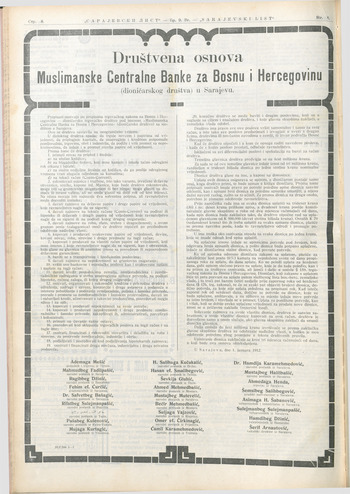
Operating as a joint-stock company based in Sarajevo, the bank's shareholders included the most prominent figures of the Bosnian Muslim community, many of whom held prominent administrative positions in the Austro-Hungarian bureaucracy in their capacity as national deputies (narodni poslanik; see Fig. 1 for newspaper advertisement and partial list of bank shareholders). Outside Sarajevo overtures were made to leading merchants and landowners within the Bosnian Muslim community. An article in Mostar's Pan-Islamic newspaper Biser, following an extensive attack on the parasitical influence of usurers (lihvarima), appealed to prosperous Muslims to buy shares “in this our joint bank.”Footnote 32 Support was forthcoming from Habsburg imperial officials as well. No less than General Oskar Potiorek, the governor of the province and Archduke Franz Ferdinand's fellow passenger on that fateful day in June 1914, as well as the finance minister Leon de Bilinski, encouraged the bank's creation. Potiorek and Bilinski hoped that the scheme would consolidate regional credit institutions and attract the support of Muslim landowners.Footnote 33 This deliberate governmental support was substantial and not something that many other Muslim banks, especially those in colonial India, could boast. After the outbreak of the First World War, the Muslimanska Centralna Banka repaid Austro-Hungarian patronage by selling the government's interest-bearing war bonds to local Muslims and contributing some 300,000 crowns to the war loan in November 1914.Footnote 34 But with all this cross-denominational support what made the bank a viable community institution that served Muslim needs?
An advertisement for Muslimanska Centralna Banka printed in Sarajevski List in 1912. From Gazi Husrev-Beg Library.

Initially the founders of the Muslim Central Bank, alive to the novelty of their undertaking, did not have a straightforward answer of their own; this despite the fact that their bank was not the first Muslim bank in Bosnia-Herzegovina. That accolade belonged to Tesanj's limited-liability Prva Muslimanska Kreditna Zadruga (First Muslim Credit Cooperative), a Muslim cooperative bank founded in 1906 with 500,000 crowns ($100,000 in contemporary US dollars), and the Prva Muslimanska Banka (First Muslim Bank), founded in Brcko in 1908 with a capital of K. 200,000 ($40,000 in contemporary US dollars).Footnote 35 These banks advertised widely in the Bosnian Muslim press—extolling the 5 percent interest they paid on savings accounts—and rapidly expanded with branches throughout the province.Footnote 36 The founders of the Muslimanska Central Banka, however, saw their institution as a cut above: it would be the only institution in the empire at which, as its own company report proclaimed, “Muslim capital will work for the benefit of the Muslims.”Footnote 37
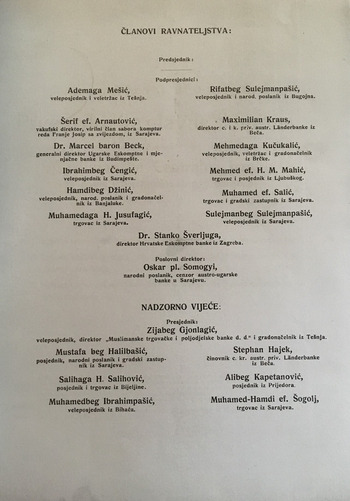
As that same report stressed, the bank experienced modest successes in its first year (see Fig. 2) and was aided by the close cooperation with other regional Muslim monetary institutions, including other Muslim banks. The majority of customers were Muslims, but the report also noted that “the monetary institutions of Croats and Serbs in Bosnia-Herzegovina, and a respectable number of non-Muslim clientele” also did business with the bank.Footnote 38 Before long provincial branches were set up, the first in Tuzla, with Bosanska Krupa soon to follow, and assistance was promised for agricultural cooperatives.Footnote 39 One of the shareholders, Ademaga Mešić, even attempted to set up a general Muslim bank in Switzerland.Footnote 40 This ability to mobilize support from the empire's other constituencies was a key factor in the bank's success.
Board of Directors included in Muslimanska Centralna Banka's First-Year Report. Note the important role of non-Muslim bankers like Oskar Somogyi. From Gazi Husrev-Beg Library.

Anxious perhaps to lend additional credibility to their enterprise, the shareholders of the Muslimanska Centralna Banka had applied to the Ottoman sheikh ül-Islam (the chief mufti of the empire) in 1910 requesting legal clarification (istīftāʾ) on the matter of “Islamic banks” and a fatwa legitimizing their institution. (This was some two years before the bank opened its doors). As recorded in the Istanbul-based newspaper Tearüf-i Muslimin, the brainchild of the itinerant Tatar Pan-Islamist Abd al-Reşid Ibrahim, the central contention for the petitioners and the sheikh ül-Islam was the permissibility of interest-based banking, which the paper identified as a principal impediment to the creation of autochthonous Muslim financial and economic institutions. The office of the sheikh ül-Islam responded to the query with the following:
The document was examined that was dispatched to the fatwa bureau. [It contained] the statement of a legal request that was sent to the office of the sheikh ül-Islam complete with the signature of Fakhr al-Din Demirović and dated 10 Shuval 1328. It comprises an appeal for a ruling that is adjoined to a legal permit for the foundation of an Islamic bank in Bosnia. The sublime sheikh ül-Islam decrees that amounts taken and given, as well as the deposits, loans, debts, and transactions at the aforementioned bank, and the increase in interest thereby obtained (by means of lending and borrowing) is legitimate and permissible in the event that there is a fictitious transfer of interest [devr-i şerʻī] undertaken in harmony with legal stipulations along one of the paths delineated by the doctors of divine law.Footnote 41
Here then was a 16th-century Ottoman legal ruling serving as an endorsement for a Muslim bank established in early 20th-century Habsburg Sarajevo. The editorial postscript following the sheikh ül-Islam's judgment stated that “it is generally known that Muslims, who have taken tiny steps in the world of commerce and the usurious and banking transactions, which today have assumed the form of custom and exchange, are forced to conform to its rules.”Footnote 42 The newspaper laid the blame for these “tiny steps” at the feet of religious scholars, and especially the Ottoman sheikh ül-Islam, who purportedly had impeded full Muslim involvement in the banking sector. For the editorial staff of Tearüf-i Muslimin, the ruling permitting the foundation of a Muslim bank was thus a watershed, as it was for Muslims in other parts of the Ottoman world.
What legal pretext justified the operation of Muslimanska Centralna Banka? As hinted above, devr-i şerʻī, the fictitious transfer of interest, was the justification underpinning the sheikh ül-Islam'sruling, but the fatwa also gave the bankers latitude to utilize any of the ruses laid out by the canonical schools of Islamic law. Devr-i şerʻī was itself a judicial expedient with an extended history in the financial life of the Ottoman Empire. Despite having analogous concepts in other traditions of Islamic law, it was unique to the Ottoman judicial environment, rather like istiǧlal (a fictitious mortgage sale that also acted as a vehicle for the transfer of interest), which, although present in classical Islamic law, took on entirely new meanings in the Ottoman context.Footnote 43Devr-i şerʻī may be thought of simply as an interest-bearing loan, in which a yearly addition was added automatically to the principal; although the addition was openly recognized, interest was never mentioned.Footnote 44 As Haim Gerber has stated, devr-i şerʻī was a singularly Ottoman symbiosis of kanun, shariʿa, and customary practice.Footnote 45 Until the end of empire, devr-i şerʻī was a hardly secretive ruse used to bypass legal restrictions on interest. It was ingrained in the official legal and financial framework of the Ottoman state.Footnote 46 Despite this, devr-i şerʻī, the cash waqf, and other rulings had not in themselves facilitated the formation of banks in the Ottoman Empire before the mid-19th century, but only supplied Muslims with a legal means to make use of them once they were created.
Before the First World War, the Muslimanska Centralna Banka gained considerable international attention, out of proportion to its small size, and the sheikh ül-Islam's ruling had some curious echoes. Revue du monde musulman heralded it as a moment of great import for the “future political economy of Islam.”Footnote 47 That same year a group of Ottoman Muslims in Adapazarı, including a Bosnian Muslim refugee, founded the Adapazarı İslam Bankası, which was rebranded the Türk Ticaret Bankası in 1928 after the word “Islam” in the title was expunged by a Kemalist government intent on removing overt religious references from public life.Footnote 48 Most compelling, however, was the attention the bank's activities garnered at the inaugural Egyptian Congress held at Heliopolis in 1912. There the Syrian Christian Yusuf Nahhas, in an extended lecture on Egypt's financial situation, cited the ruling as a pretext for the creation of homegrown national credit institutions. Against those who claimed that Islamic precepts banned interest-based banking, he stated:
Is it possible that this wise and beautiful religion should permit only borrowing at interest? Is it possible that this religion should wish to prevent the well-to-do Muslim from helping his Muslim brother … I do not consider myself competent to discuss the prescriptions of a religion which is not mine. But I believe the wise scholars of Islam, if they went to the bottom of things, could only say that the capitalist who receives a moderate interest for his capital does not infringe upon the prescriptions of his religion. Has not His Eminency [the sheikh ül-Islam] at the very centre of the Khilafate issued a fatwa authorizing the creation of a National Bank in Bosnia-Herzegovina? Could I supply a better proof in support of my argument[?]Footnote 49
For Nahhas, with the declaration of this fatwa by the Ottoman sheikh ul-Islam, any legal deterrent, real or imagined, for the foundation of banks by Muslims was finally removed, with the dictates of Islamic law itself supplying the vindication for the formation of home-grown financial bodies that lent at interest. Given the tendency among scholars to highlight Abduh's famous post office fatwa as the justification for later interest-based banking in Egypt, it is notable that Nahhas pointed to the Muslimanska Centralna Banka and the Ottoman fatwa as the true template for Muslim banking.Footnote 50
The Muslimanska Centralna Banka ruling, the bank's unmistakable success, and its international reputation make clear that the matter of institutionalized interest-based banking in the Ottoman Empire had more or less been settled to the satisfaction of many Ottoman ʿulamaʾ. Muslim bankers and customers in the empire and outside it looked to these legal rulings for legitimation of their own Muslim banks at the end of empire. The Muslim banks founded on the basis of Ottoman legal principles had extended afterlives as secular and national institutions in Yugoslavia and the Republic of Turkey. In their postimperial environments these banks maintained their devotion to Muslim economic betterment, even as they merged with secular entities. But merging with other banks meant that future appeals to Ottoman-era precedents like devr-i şerʻī were neither necessary nor relevant. In India, where there was no Ottoman lineage of devr-i şerʻī (that is to say, no institutionalized form of interest-based banking rooted in Islamic law and precolonial Muslim administrative precedent), the fate of the Muslim bank was a much more thorny affair.
Legal Debates and Muslim Banks in Colonial India, 1908–1947
The profusion of competing Indian Muslim religious orientations beginning in the 19th century makes the discussion of banking in colonial South Asia eminently more complex than consideration of the Ottoman Empire or Egypt.Footnote 51 As but one case in point, when the head of the fatwa department of one of India's leading reformist seminaries was asked in 1912 or 1913 if a mortgage company that recently opened in Austria-Hungary—perhaps one of the new Muslim companies established in Bosnia—was permissible for Muslims to use, the answer was a resounding no.Footnote 52 It would be a grave mistake, however, to assume that this single ruling was expressive of views held by Indian Muslims writ large, or even indicative of how all figures at this reformist seminary grappled with the institutional questions of modern capitalism. In truth, the Indian Muslim discourse around interest, usury, and the Islamic foundational sources was cacophonous, indicative of India's rich intra-Muslim rivalries. Any analysis of Muslim banking in the subcontinent must be sensitive to the intense competition that existed among various Indian Muslim commentators to “speak for Islam” over and against their rivals. Attention to Indian debates further reveals how banking itself now joined Sufi practices, tomb worship, and other controversial customary practices as a point of disputation among religious scholars of competing masalik (orientations). Added to this was the growing perception from the beginning of the century that there was a growing Hindu–Muslim wealth gap that had to be mitigated by the Muslim embrace of banking and that high rates of interest charged by “Hindu” moneylenders had driven Muslims into penury.
Beginning with the Balkan Wars (1912–13) and with added urgency from the Khilafat and Non-Cooperation movements (1919–24), many calls were made by Indian Muslims for the creation of Muslim banks and eschewal of European ones.Footnote 53 Nonetheless, the turn to Muslim community banking in the first decade of the 20th century was divisive, in part because of the dramatic underrepresentation of Indian Muslims in the finance sector when compared to the numbers of Hindus and Parsis.Footnote 54 But the turn to Muslim banking was not necessarily an exercise in communalism, because, as in Bosnia, Muslim banks in places like Punjab and Bengal were deeply enmeshed with other financial institutions run by non-Muslims and fostered cooperation with other Indian banks. What they lacked was the explicit state support enjoyed by the Muslimanska Centralna Banka, and many were founded, at least partially, as a counter to European financial control. After all, this era witnessed the creation of swadeshi (Indian-owned) banks across the country, whose advocates sought to break the monopoly of government banks and European exchange banks. There also were a host of new financial institutions that sprang up throughout the subcontinent, such as agricultural banks and cooperative societies, many of which were actively promoted by Muslim administrators.Footnote 55 These were envisioned as a means to reduce the power of local moneylenders, drive down the “usurious” rates of interest they blamed for Muslim economic decline, and “democratize” credit throughout small towns and rural areas.Footnote 56
Several notable Muslim organizations hitched themselves to the cooperative bandwagon, but as Muslims joined these banks their participation stirred up fraught debates about the relationships between interest, usury, and the Islamic foundational sources. The Muslim press in Punjab was heavily involved in the cooperative movement, believing that their low interest rates were the only alternative to “extortionate” rates of interest offered by moneylenders, with one editor even penning a work on “the morality of [Muslims] taking interest.”Footnote 57 The argument, constructed on the foundation of a diverse array of Islamic texts, was that God and the prophet inveighed against usury but not interest. Many other commentators disagreed vehemently with this interpretation. Sayyid Sulaiman Nadwi, a graduate of Nadwa al-ʿUlamaʾ (a prominent Muslim educational institution) and later leading proponent of Pakistan, left no scriptural stone unturned when he penned an article for al-Nadwa in 1909 titled “Interest and the Testaments of the Prophets.”Footnote 58 Leading the reader on a whirlwind tour of interest rulings beginning with the pagan Greeks and Romans, right through the scriptures of the Jews and the Christians who had eventually circumvented the dictates of holy law and rendered interest distinct from usury, Nadwi offered a grim cautionary tale: Muslims must not fall for such rhetorical tricks, otherwise they risked forfeiting divine privilege. The Christians and Jews had already violated holy writ by endorsing interest-based banking, and were Muslims to follow then disaster would ensue. As will be discussed below, Nadwi cited this article nearly thirty years later in his preface to one of the earliest systematic works on Islamic economics.
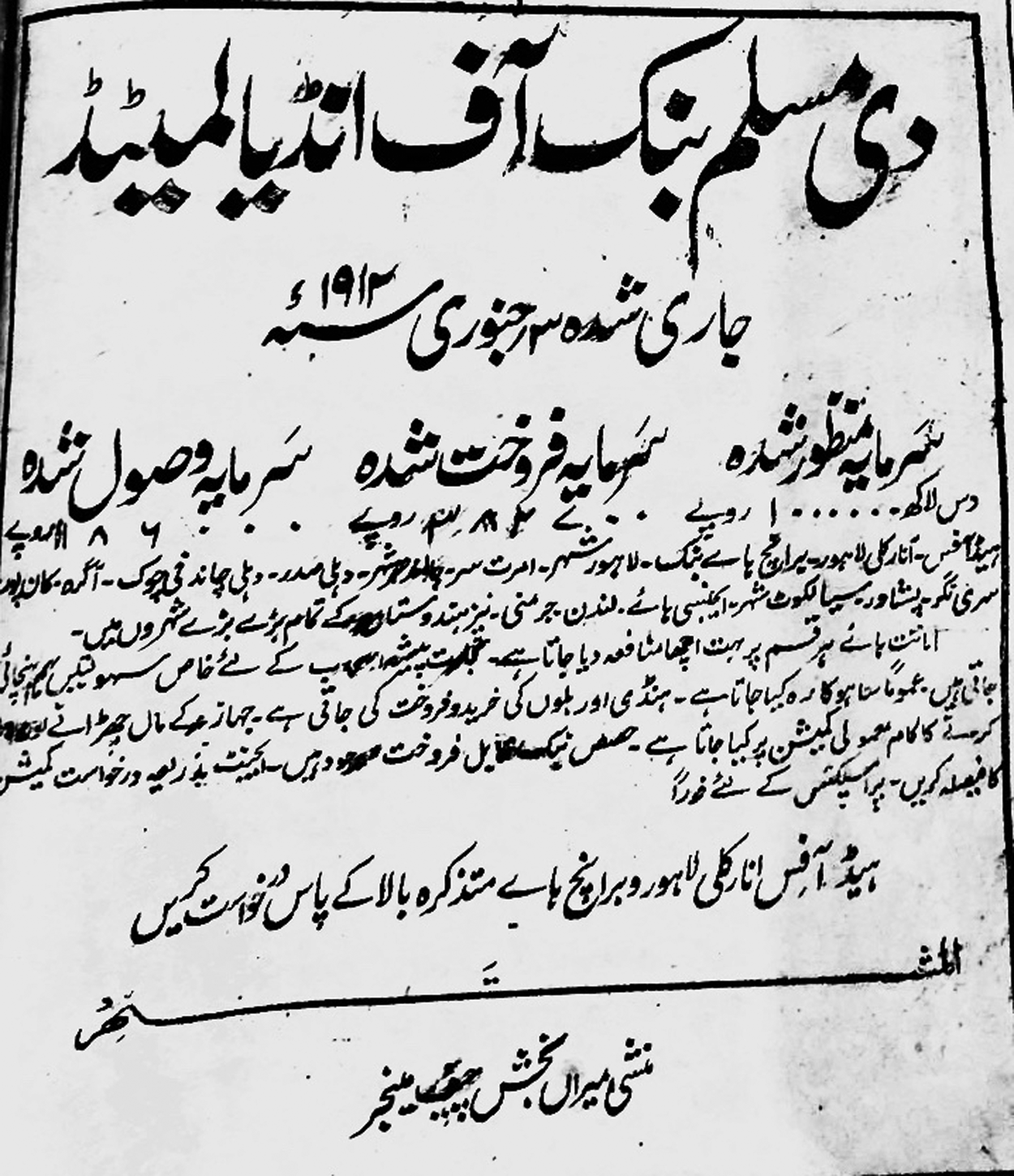
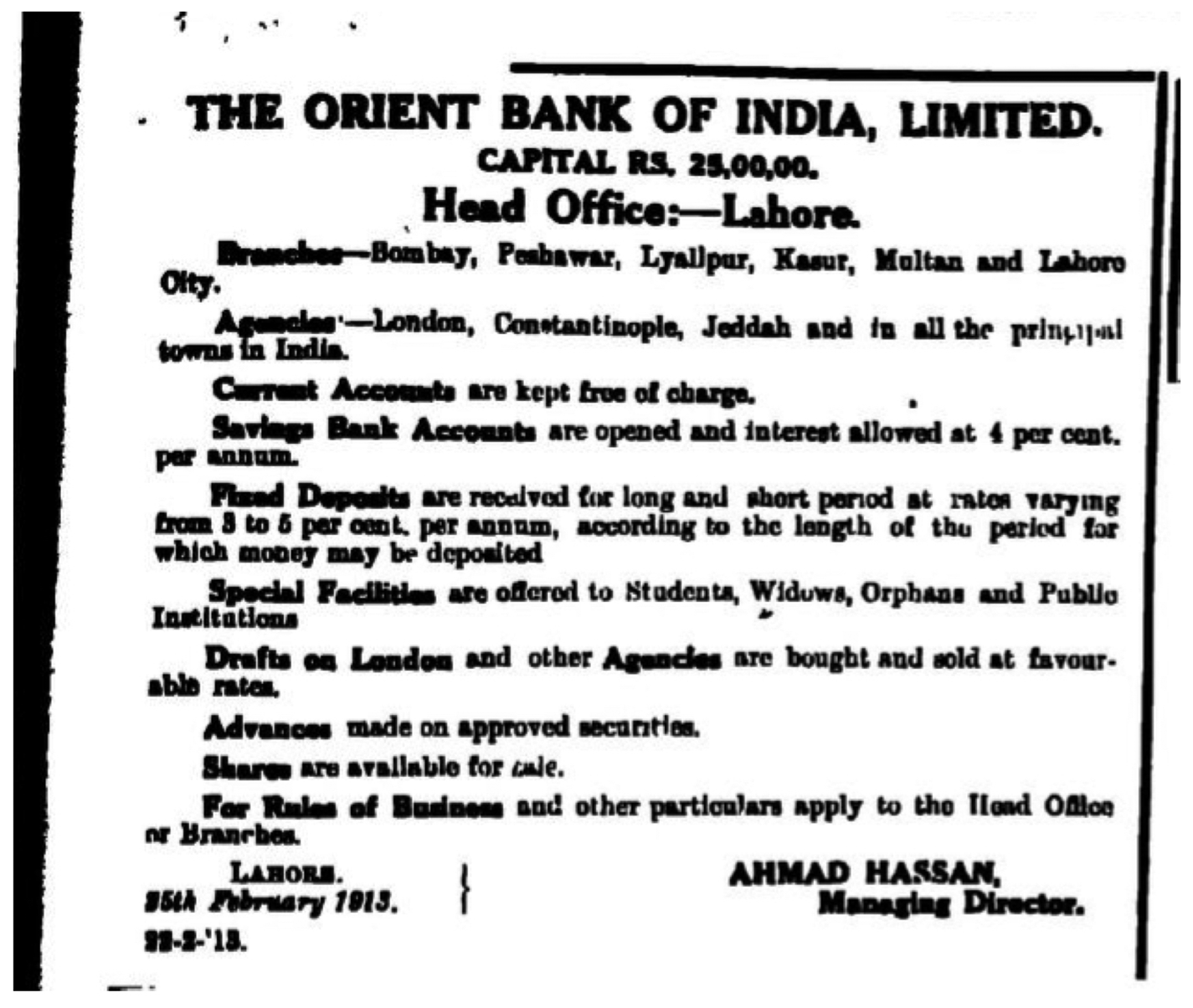
The same year that Nadwi penned his article, the Muslim Orient Bank opened in Lahore under the auspices of one Ahmad Hassan.Footnote 59 Although the bank was conceived as an Indian institution in the widest sense by both its founders and the vernacular press (rather than a purely Muslim one) and in fact employed Hindu managers in some of its branches, it also was regarded as a way for Muslims to mitigate the wealth gap between themselves and other Indian communities. The bank eventually founded branches in Bombay, Peshawar, Multan, Kasur, Lyallpur, and Gujrat, as well as agencies in London, Jeddah, and Istanbul, and it employed Hindus and Muslims of diverse sectarian affiliations.Footnote 60 As its regular advertisements in the Aligarh Muslim Gazette and other Urdu newspapers revealed, it charged interest on current accounts (accounts for general use) at 4 percent per annum (see Fig. 3 and Fig. 4).Footnote 61 For all this prodigious expansion, Hassan's bank went into temporary liquidation for the first time in 1916.Footnote 62
Advertisement for the Muslim Orient Bank in the Indian Muslim press trumpeting the bank's competitive interest rates. “The Muslim Bank of India Limited,” Inqilab.

Another advertisement for the competitive interest rates of the Muslim Orient Bank from the Indian Muslim press. The Aligarh Institute Gazette, 1913.

In contrast to the success of Bosnia's Muslimanska Centralna Banka, Hassan's bank did not have an auspicious record during the years of the First World War and after. Twelve years after the bank's opening, Sudmand, a Muslim newspaper dedicated to banking, published a gloomy annual breakdown of its balance sheet (see Table 1).
Muslim Orient Bank balance sheet. From “Muslim Bank (August 1925),” in Mazamin-i Sudmand, Tufail Ahmad Manglori (Badayun, India: Nizami Press, 1936): 103–4.

Note: In the Urdu text the 1917 amount appears to be written Rs. 1,100,000, but I believe this is a mistake in light of the other amounts listed. Therefore, I have interpreted it as Rs. 100,000. Several caveats are needed to best interpret this data. First, the original article makes no mention of whether these numbers are real or nominal values, so one must assume they are nominal (current). Second, the US values are only approximations. For simplicity's sake, pre-1917 values and 1917–22 values are calculated according to different exchange rates. From roughly 1898–1917 £1 was equal to Rs. 15. However, the First World War and its aftermath wreaked havoc on the exchange rate between the pound and rupee, with rates fluctuating from around Rs. 13.3 for £1 to Rs. 7.8 for £1. I have split the difference and made the exchange rate between 1917–22 Rs. 10.5 for £1. Once the exchange rate was stabilized after 1926 £1 was equal to Rs. 13.3. Again for reasons of simplicity, to calculate conversion from pounds to US dollars I have taken the $4.76 for £1 rate that persisted from 1914–19. Tirthankar Roy, Traditional Industry in the Economy of Colonial India (Cambridge, UK: Cambridge University Press, 1999), 165.
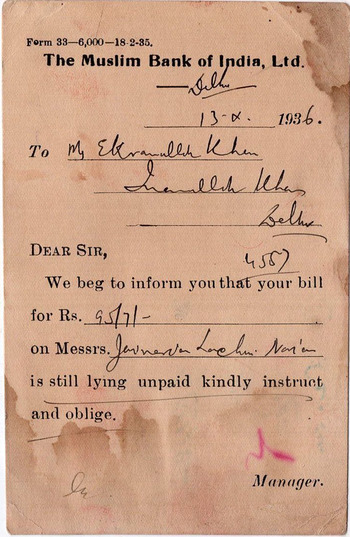
By 1925, the author mourned that the Central Bank of India -founded by a Parsi entrepreneur at the same time as the Muslim Bank of Lahore - had a capital (sarmāya) of 22 crore (Rs. 220,000,000; 1 crore = 10 million Rs; $99, 733, 333 in contemporary US values), an amount the writer calculated to be 345 times that of the Muslim Bank's capital of Rs. 638,000 ($289,226). In addition, many Hindus had opened banks throughout Punjab with crores of rupees to their names.Footnote 63 Over the next decade the Muslim Orient Bank went into liquidation and was resurrected several more times, managing to survive in some form until 1939, when it finally was shuttered by order of the courts (see Fig. 5).Footnote 64
A notice for an unpaid bill sent by the Muslim Bank of India, Ltd., to one of its customers. From author's personal collection.

Many explanations can be found for the bank's woes. As mentioned, it lacked the explicit state support enjoyed by its counterpart in Sarajevo. Second, bank failure was a recurring problem in colonial India, an epidemic that spared neither European nor Indian-owned institutions and was conditioned by informational asymmetries, the money market, and undercapitalized customers. Still, it must be acknowledged that one of the likely reasons for the bank's lackluster performance stemmed from its inability to obtain widespread moral legitimacy among Muslim constituencies in the region. To be sure, the ability of the bank's shareholders to repeatedly resurrect the institution after periods of liquidation serves as proof that support was forthcoming from certain quarters, both in terms of capital and fatwas. Around the time of the bank's foundation, Paisa Akhbar, one of Lahore's most venerable Urdu papers, posed the following two questions to a group of eighteen scholars led by Ahmad Ali Muhaddis:
1. Is a Muslim permitted to deposit money in a bank, without interest, for a certain period?
Response: This deposit is made in trust (amanat). The depositor may assume that the funds are used for purposes of usury and thus fear that he is committing a sin. But his primary aim was the security of his money and not interest. Thus he commits no sin in placing his money in a bank.
2. Can a Muslim legally send money from one place to another using hundis or checks by paying a commission?
Response: Yes, as this is a fee and not interest.Footnote 65
With such a ruling, any Muslim customer in Lahore could open an account at Hassan's bank. Nevertheless, if one looks at the writings of other contemporary Indian Muslim legal scholars one finds an array of opinions that differed dramatically from that given by Ahmad Ali Muhaddis. For example, in 1913 Ahmad Riza Khan, the head of the Barelwi movement and the most influential traditionalist Islamic religious scholar of the colonial period, was asked by two merchants whether Muslims were allowed to join a local “Muslim interest bank.” Not mincing his words, Khan replied that “the bank is totally haram and all its rules satanic. To become a member is also haram, as is to give and take interest.”Footnote 66 Yet that very same year he called on a separate occasion for Muslims to open up interest-free banks throughout the subcontinent, based upon a wide range of “ruses” present in Islamic law that allowed one to sidestep ribā.Footnote 67 In many ways, Khan's own legal arguments exhibited the contradictory views often put forward by the traditional legal scholars toward Muslim banking: either banks had to be avoided entirely because of the rulings on ribā, or a Muslim could mobilize various mechanisms within Islamic law to evade ribā and use the bank. Eventually, such ambiguity was rejected by the Islamist opponents of the traditional legal scholars, and later by the legal scholars themselves.
A more strident position came from one of Khan's foremost ideological opponents, Ashraf ʿAli Thanawi (d. 1944), a leading scholar and graduate of Deoband, who, when asked whether money deposited in a post office bank was haram, noted:
It should be verified whether the money deposited in the post-office as a money order is an amanat (trust) and the post-office is its ajir (servant), or whether it is a loan and the post-office is a borrower. It is evident that it is not exactly the same money which is sent. Also it is a rule that if the money thus deposited is lost by the post-office, the post-office pays daman (compensation). On the [basis] of these two factors, therefore, the nature of this transaction is not that one of a trust but that of a loan which is to be repaid at another place. The fee, therefore is part of the loan. Since the fee is deducted from the amount at the [time and] place of payment, it constitutes inequality in the payment of the loan. This is why it is prohibited.Footnote 68
Thanawi stuck to this position throughout his writings. His formidably titled treatise on interest and usury, Takhdhir al-Ikhwan ʻan al-Riba fi al-Hindustan (Warning to the Brothers on the Dangers of Ribā in India) ranks as among the most dramatic defenses of this position, buttressed as it was by references to hadith and Islamic legal literature.Footnote 69 Drawing from fiqh sources from the ninth to the 19th century, Thanawi responded that the majority of Indian Muslims had wrongfully concluded that the taking and giving of interest was permissible (halal and mubah). It was his expressed hope that through his replies to these questions and the intercession of God and the prophet Muslims might be saved from this spiritual confusion and its attendant economic infirmities.Footnote 70
As the ʿulamaʾ battled over their own interpretations, the 1920s also saw discursive controversies among Indian Muslim modernists, particularly regarding the relationship between interest and usury. The stakes of that debate were made plain in a pithy intervention by Khwaja Kamal al-Din, a prominent Ahmadi Muslim commentator, in a 1924 issue of the Islamic Review.Footnote 71 Kamal al-Din began his English-language article “Usury or Interest,” with a verse from Surat al-Imran: “O you who believe! Do not devour usury, making additions / again and again, and be careful of your duty to Allah / that you may be successful.”Footnote 72 This rendition of the verse was taken from Maulwi Muhammad Ali's recently completed English translation of the Qurʾan, which notably rendered ribā as usury and not interest.Footnote 73 Acknowledging the confusion in India over the issue, Kamal al-Din therefore asked, “Is usury identical with interest?” With reference to the post office savings banks and railway shares, he noted that “the shareholder, the depositor, and the person who entrusts his savings to the Post Office, are not making additions again and again.” Rather, depositing money was an act that permitted corporations and institutions to obtain a “recompense for the convenience they have afforded” to their clients. By contrast, a usurer was one who grew wealthy at the expense of his compatriot. Thus, banks, post offices, and company shareholders were not tainted by the charge of usury. Should the pious Muslim harbor any incertitude on the matter, he exhorted:
Then, it may be asked, why let the Bank or Post Office reap the benefit of these ill-gotten gains? Take them if you will, but devote them to charitable purposes. … The truth of the matter is, that the modern method of keeping money—in Banks and the Post Office—is one from which both the usurer (in this case the depositor) and the other party (Bank or Post Office or Company) derive mutual convenience, and the question of usury does not enter in. We are inclined to wonder that it ever should have done so.Footnote 74
Even so, given the controversial status of Ahmadi Islam in later decades, these interpretations were not likely to persuade members of other Indian Muslim orientations who saw Ahmadis as proponents of a heterodox form of Islam.
None of this was an exclusively Ahmadi position: many other Islamic modernists of Sunni persuasion made a similar argument for an interest-usury distinction. The Aligarh-educated native of Badayun, Sayyid Tufail Ahmed Manglori, published an Urdu tract in 1920 titled The Problem of Interest and the Future of the Muslims, in which he condemned Muslims for their wrongful belief that God and his prophet had condemned the taking of interest. (Manglori also founded Sudmand, mentioned previously, a paper dedicated to encouraging norms of interest-based banking among Muslims). The refusal of Muslims to take interest was, as Manglori saw it, not only religiously unacceptable but the key cause of Muslim penury. When Muslims did utilize banks, they made deposits without interest, and upon withdrawing their money they had to pay a debilitating indemnity. This was unconscionable for Manglori, and he delved deeply into the Islamic foundational sources, arguing that several suras of the Qurʾan legitimized commercial interest and the collection of minor interest on bank deposits.Footnote 75 Against those who invoked the injunction from Surat al-ʿImran that all ribā transactions are haram, he drew fine distinctions between ribā and rabah (profit).Footnote 76
For all his energetic emphasis on the imperative of creating Muslim banks, Manglori failed to gain support even among his fellow Islamic modernists at the Muhammadan Anglo-Oriental College, who rejected the idea of Muslim interest-based banking at the so-called Sudmand conference (a name that invoked Manglori's newspaper) held at Aligarh in 1927.Footnote 77 That the bastion of Islamic modernism in colonial India dismissed the notion of Muslim interest-banking and, by extension, the argument put forward by the institution's founder, Sir Sayyid Ahmad Khan, for an interest-usury distinction is perhaps the best indication of how the discursive terrain surrounding financial interest had shifted in favor of the maximalist position in colonial India.Footnote 78
From this point onward, Islamic scholars associated with the mainstream Indian nationalist movement represented by the Indian National Congress and organized under the rubric of the Jamiat-i ʿUlamaʾ-i Hind (Society of Indian Scholars) became proponents of banning all interest transactions and avoiding European banks, but also encouraged Muslims to accept the interest on their bank accounts, if only to prevent Christian and Hindu missionaries from using the funds for anti-Islamic activities.Footnote 79 According to this logic, accepting interest was a temporary concession to the realities of interreligious competition but was no long-term solution for Muslims. The growth of all-India Muslim political organizations guaranteed that the debate about interest, usury, and the Islamic foundational sources became more strenuous, as previously diffuse discussions were channeled into cohesive institutional settings.
This discussion demonstrates just how divisive the subject of interest, usury, and banking was for a variety of Indian Muslim commentators from the moment Muslim banks began to appear. Eager to supply solutions for Muslim economic woes and to close a perceived wealth gap between Muslims and Hindus, many Muslim entrepreneurs and scholars campaigned for Muslim constituencies to take up interest-based banking, which they argued was not polluted by ribā. Nevertheless, unlike in the Ottoman context, no central judicial hierarchy or universally recognized historical precedent rooted in Islamic law could be invoked by Indian Muslim entrepreneurs to legitimize the opening of banks. Prevailing rivalries among Muslim commentators in the subcontinent prevented the articulation of a collective defense of Muslim interest-based banking.
Still more, the undercapitalization and unbanked status of many Indian Muslims made the shift to organized banking onerous and constantly undermined the financial health of institutions like the Muslim Orient Bank. Despite the lower rates offered to customers by these Muslim banks, many Indian Muslims continued to pay “usurious” rates of interest on loans contracted with moneylenders. This likely made the entire model of interest-based banking unattractive for many Indian Muslims. By the late 1920s, the poor performance of Indian Muslim interest-based banking and the growing perception that many Indian Muslims were being thrown into penury by the high rates of interest charged by “Hindu” moneylenders helped to validate Muslim commentators anxious to eschew interest-based banking of all kinds. If Indian scholars like Manglori could appeal in the early 1920s to the authority of scholars in Egypt to draw a distinction between usury and interest, then by the late 1920s Egypt and India would provide the terrain for the consolidation of the maximalist position of ribā that has been a hallmark of the postcolonial epoch.
Cairo, Hyderabad, Riyadh and the Maximalist Feedback Loop, 1929–1958
The emerging maximalist interpretations of ribā were solidified by a series of debates and encounters between Egyptian, Indian, and later Saudi scholars, economists, and government officials between 1929 and 1958. It is worth emphasizing the obvious fact that these three regions were subjected to either direct British imperial rule or extensive British patronage. Colonial rule supplied the mechanisms for interaction and also the capitalist foil for articulation of these ideas. This constituted the feedback loop that transformed the nebulous calls for a new form of interest-free Islamic banking into an institutional possibility. In Egypt and India particularly, the rise of neo-Salafi movements contemptuous of traditional religious scholars and modernists alike contributed substantially to the elaboration of Islamic economics, the hallmark of which was the repudiation of all interest-based banking. Yet it was not neo-Salafis alone who subscribed to the maximalist interpretation of ribā. On the contrary, a range of Muslim jurists, economists, and scholars who might be broadly defined as Islamic modernist in outlook also agreed with this interpretation. This divide is surprising in part because the heads of the leading Muslim banks in Egypt as well as India and Pakistan in this epoch—Talat Harb (d. 1941, head of Bank Misr), Muhammad Habib (d. 1959, head of Habib Bank), Adamji Haji Dawud (d. 1948, head of the Muslim Commercial Bank)—all ran institutions that openly dealt in interest. However, in keeping with many Muslim entrepreneurs, these figures also spoke out regularly against the evils of usury.Footnote 80 Nonetheless, their close business ties to non-Muslims, coupled with the growing popularity of anti-capitalist nationalism and the eventual creation of Muslim-majority nation–states in the wake of decolonization, perhaps made their version of the Muslim bank unattractive to many actors in the early postcolonial era. Beyond this, since usury and interest were defined by a matter of degree and the yoke of usury was seen as the result of colonial machinations, it was foreseeable that they eventually became conflated.
Convergence at the maximalist interpretation in both Egypt and India was due in large measure to debates involving actors from both regions. It is best to examine the connection between Indian and Egyptian developments in the pages of al-Manar, with its enormous transnational readership. This magazine became in 1929–30 the forum for disputing the “Hyderabad fatwa” sent by Mufti ʿAbd al-Latif of Osmania University and Hyderabad's shariʿa court to three individuals: Muhammad Rashid Rida, al-Manar's editor from 1905–35; al-Azhar's rector, Muhammad Mustafa al-Maraghi; and the Egyptian grand mufti, Muhammad Bakhit al-Mutiʿi.Footnote 81 Muhammad Qasim Zaman, in an adroit examination of the istīftāʾ and its attendant fatwa, has demonstrated Rida, despite his implicit attack against ʿAbd al-Latif's pretensions to be a mujtahid, mostly agreed with him that loans at interest might be permissible.Footnote 82 For Zaman, this was “a remarkable position in view of the long history of financial interest in Islamic legal thought.”Footnote 83 However, this conclusion may be expressive of the tendency to consider Islamic theories of interest largely monochromatic throughout history and certainly overlooks many of the contradictory opinions advanced by the Muslim commentators examined here. It is rewarding to revisit the fatwa briefly, as in hindsight it represents a turning point at which madhhab-based defenses of interest on loans were deemed increasingly unpersuasive. When reading the Hyderabad fatwa, one needs to be sensitive, as Zaman himself was, to the methodological divisions separating Rida from ʿAbd al-Latif, particularly because the former condemned al-Latif's defense of the permissibility of interest-bearing loans by resorting to typical Hanafi ruses (ḥīla/ḥīyāl) and textual sources. To Rida, adherence to one madhhab was anathema both to the future progress of Islam and to the maintenance of past glories. Even if Rida ultimately agreed about the permissibility of interest-bearing loans, his influential call for the marginalization of much of the legal tradition when grappling with the question of ribā narrowed the discursive grounds by which interest transactions could be defended according to the Islamic tradition. In the decades after Rida's death in 1935, Egyptian figures as disparate as ʿAbd al-Razzaq Sanhuri and Sayyid Qutb would go even further and reject all forms of ribā, whereas in India the immediate respondents to Latif and his colleagues in Hyderabad came to the same conclusion as these influential Egyptian voices.Footnote 84
Rida prefaced the istīftāʾ from ʿAbd al-Latif with the statement that “The readers of al-Manar know that the problem of ribā is the greatest of Islamic civilizational problems, which has occupied the minds of rulers, heads of state, and ʿulamaʾ in this age.”Footnote 85 An occasion to revisit the issue had been provided by the government of Hyderabad and its shariʿa court, which had circulated a treatise on ribā in the major cities of the Islamic world and solicited the opinions of various ʿulamaʾ. After a long tour through centuries of jurisprudential sources, ʿAbd al-Latif's questions were:
1. Is the term ribā in the verse [Surat al-Baqara, 275] adumbrated [mujmal] or not? Specifically among the Hanafis, and more generally, what is the interpretation of the legislator? I mean in the Qurʾan and the authentic hadith.
2. What is said of the meaning of ribā in the Qurʾan and authentic hadith?
3. Is the designated contingent interest on loans the stipulated ribā or not?
4. If the contingent interest on loans is ribā, then what proof is there from the certified guides among the eminent ʿulamaʾ?Footnote 86
In the final analysis, ʿAbd al-Latif reckoned that neither the Qurʾan nor hadith established that interest on loans was ribā, and because qiyās, or analogical reasoning, had formed the basis of rulings that deemed loan interest ribā, the matter was still open, with appeals to juridical precedent largely unhelpful. He referenced the great Ottoman compendium of Hanafi fiqh, the Mecelle, to support the assertion that qiyas was subject to the vicissitudes of time and place and the work of Ibn ʿAbidin (d. 1836) to defend the claim that customary practice, even in financial matters, should be left in place to protect the Muslim community from hardship.Footnote 87 This was an example of the type of Ottoman judicial rulings that did circulate across the Hanafi legal landscape, but it is significant that ʿAbd al-Latif did not cite the precedent of devr-i i şer‛ī in his work, a reminder that this circulatory regime had its limitations. Toward the end of his treatise, ʿAbd al-Latif's appeal to necessity seems to have taken precedence over legal arguments, signaling a tone of expediency unlikely to sway many who saw ribā as inclusive of all interest transactions. “Anyone familiar with present circumstances and the experience of the people,” he wrote, “regard issuing a fatwa permitting it [taking interest from loans] as unavoidable since [interest is levied in] hiring to teach Qurʾan, reciting prayers, leading prayers, etc.”Footnote 88
This appeal to both madhhab-based defenses and compulsion cut little teeth with ʿAbd al-Latif's respondents. Although he praised ʿAbd al-Latif's credentials as a Hanafi, Rida stated that “despite the breadth of [ʿAbd al-Latif's] referencing tafsīr and hadith, [he cannot be considered a mujtahid or marjaʿ] in terms of the Qurʾan and Sunna.”Footnote 89 By contrast, Rida asserted that his own analysis was “not bound by any madhhab,” but, with its encyclopedic ambitions, eschewed taqlid (imitation). This supposedly permitted him to account for the nuances lost on ʿAbd al-Latif. As a case in point, when Rida criticized ʿAbd al-Latif's claim that the banned ribā referred only to an increase in sales he took the opportunity to castigate the Hyderabad mufti's knowledge of Arabic:
He says “and from the authentic hadith.” But what he means to say is “and not from the authentic hadith.” … For all his juristic capabilities, he is imprecise in the Arabic language. In this he resembles the ʿulamaʾ of non-Arab lands who study the legal sciences and the Arabic arts in translation, but they never study Arabic on its own.Footnote 90
This inadequate grasp of Arabic (a ridiculous charge), Rida averred, had further prevented the Hyderabad jurist from understanding that in Arabic a loan (qar ḍ) falls within the same semantic field as debt and therefore is considered ribā. These linguistic critiques were expressive of a wider problem: ʿAbd al-Latif had based his distinction of loans and debts not on Qurʾanic language but rather on classical jurisprudence, which had impaired the reasoning of “our brother the Indian Hanafi.”Footnote 91 An alternative understanding of ribā thus had to be mapped that looked only to the Qurʾan and Sunna and not to jurisprudence or customary practice for legitimacy. This was an attractive vision for many anti-madhhab Muslim commentators in both Egypt and India.
Given al-Manar's broad readership, Rida's call for a return to the core sources and rejection of the accretions spun out by the legal scholars to defend interest transactions likely carried considerable weight. The Hyderabad fatwa is consequential for many reasons, especially because in the years after its publication both Hyderabad and Cairo became the two principal sites where Muslim commentators delineated a maximalist interpretation of ribā. This assumed a rejection of the interpretive efforts by ʿAbd al-Latif and Rida, in their respective ways, to defend the permissibility of interest on loans.
In retrospect, Hyderabad was an unexpected incubator for the maximalist interpretation of ribā, and not only because ʿAbd al-Latif's treatise was endorsed by the princely state's shariʿa court. Levying interest on loans and deposits was standard practice in the nizam's territories and governmental institutions, something that the poet Muhammad Iqbal praised in a speech to the All-India Muslim League in 1930.Footnote 92 The maximalist interpretation thus implied a repudiation of this custom. Unexpected too is the fact that the maximalist definition was articulated most systematically in its late colonial form at the nizam's Urdu-medium university, Osmania, established in 1918.Footnote 93 There the theology and economics departments pioneered a new field of Islamic economics under the supervision of several influential figures.Footnote 94 Their writings, although brimming with contradiction, represented a rival economic vision to that of the ʿulamaʾ and modernists, but only acquired an institutional profile outside of Hyderabad after 1947.
Significantly, many of the figures at Osmania had fallen under the influence of Mawlana Mawdudi, the prominent neo-Salafi journalist, who lived in Hyderabad until 1938, at which time he relocated to Punjab. Unlike the Indian Muslim commentators surveyed in the previous section, Mawdudi's views on ribā were unambiguous. In the 1940s he published an extended study of the subject, positioning an interest-free Islamic economy as an alternative to both capitalism and communism.Footnote 95 A 1946 istīftāʾ printed in his newspaper, Tarjuman al-Qurʾan, serves as a concise illustration of his uncompromising position.Footnote 96 On this occasion, a petitioner sent Mawdudi an article by a Muslim scholar stating that the bans on ribā espoused by the traditional religious scholars had been the prime cause of economic decline among Muslims. Baffled by this statement, the petitioner asked Mawdudi whether there was any legal basis for the ban on interest, and whether Muslims who adhered to the ban were merely deceiving themselves with the belief that they would regain their forfeited capital after the Day of Judgment.
Mawdudi's reply began with an attempt to dispel the errors of the passage and reassure the petitioner: “The prohibition of ribā is affirmed explicitly in the definitive sources of the Qurʾan and Sunna and there is no room for ijtihād (independent legal interpretation) in it. Therefore, be assured that your reward is in the hereafter, whatever the sayings of these ʿulamaʾ.” Here, in one statement, was a rejection of both the modernist emphasis on reinterpreting divine injunctions regarding interest and the legal ruses endorsed by the traditional legal scholars. In the Manichean view of capitalism and Islam that was his métier, Mawdudi went on to assert that “if we were to eat ribā, then by what standpoint could we raise our voices against the regime of usury (al-niẓām al-rabawī) and the non-believers?” He ended by excoriating those scholars who sought to reform not simply Muslims but Islam itself through the door of tajaddud (modernization) rather than tajdīd (renewal).Footnote 97
What is most compelling is how Mawdudi's emphasis on the perils of tajaddud made its way into the writings of many Indian Muslim economists, none more so than Anwar Iqbal Qureshi, head of the economics department at Osmania University. Trained as an economist in Britain, Ireland, and India, Qureshi openly acknowledged Mawdudi's influence in the preface to his 1946 Islam and the Theory of Interest.Footnote 98 Mawdudi's mark is unmistakable throughout, as is that of Sayyid Sulaiman Nadwi, who penned the introduction. Nadwi had been a fierce opponent of Muslim participation in the cooperative credit movement thirty years before, and he used the introduction to Qureshi's book to settle old scores against those Muslims who he believed had perverted Islamic precepts by endorsing interest-based banking. Although Nadwi did not mention him explicitly, he condemned a certain individual who had established an association and newspaper dedicated to “promoting the custom of usury amongst Muslims,” a not-so-subtle jibe against Manglori, the former editor of Sudmand. The recent onset of the Great Depression and the success of the Bolshevik Revolution, Nadwi argued, had confirmed the evil effects of usury, the poverty of European economics, the triumph of Islamic economic thought, and the intellectual inadequacy of Islamic modernism.Footnote 99
In similar fashion, Qureshi lambasted “the false light of Western learning” and contrasted it with the exemplars offered by the Islamic developmental model.Footnote 100 Importantly, that dismissal of Western learning by no means prevented the ready invocation of Keynesian critiques of interest, precisely because Keynes had argued that the natural rate of interest in the economy was zero.Footnote 101 Qureshi and many other commentators would invoke Keynes repeatedly to bolster their argument that Islam was ahead of European economics in acknowledging this salient point about the laws of economics. Like Mawdudi, Qureshi castigated the modernists for their tajaddud, which he deemed a betrayal of core Islamic principles, further training his sights on those Muslims who had argued for an interest-usury distinction.Footnote 102
Both Qureshi and Mawdudi brought their ideas to Pakistan after 1947, but although a number of works on Islamic economics were published in that country during its first decade, these were entirely ignored, only to be reprinted in great numbers beginning in the 1970s.Footnote 103 That said, even if Pakistan was an Islamic-modernist contrivance, several figures associated with the Pakistani establishment openly spoke about establishing an “Islamic economy” and criticized the norms of Muslim interest-based banking. This is not entirely surprising; earlier sections of this article have demonstrated just how pervasive these ideas were among Islamic modernists in the years before partition. Among these modernists was Zahid Hussain, an Aligarh graduate and former minister of finance in pre-partition Hyderabad. In his role as the first head of the State Bank of Pakistan, Hussain spoke in his inaugural speech of the need to eliminate interest from the economy.Footnote 104 He and other Pakistani finance officials also sponsored several Islamic conferences in these years to promote economic links with the Middle East and foster ideas of Islamic economics.Footnote 105
Simultaneously, even as ideas of Islamic banking failed to gain immediate state endorsement within Pakistan itself, Mawdudi, Qureishi, and like-minded South Asian Muslim commentators and economists obtained considerable influence in the postwar Middle East. Mawdudi did so principally through the auspices of his students, with Sayyid Abu Hasan ʿAli Hasani Nadwi chief among these. While in the Middle East in the early 1950s, Nadwi had met Sayyid Qutb. The two collaborated on a number of works, and Nadwi introduced Qutb to the writings of Mawdudi, from whom Qutb borrowed the term jāhilīyya.Footnote 106 To be sure, Qutb had formulated many of his ideas before being exposed to the writings of Mawdudi and Nadwi, but his writings from the 1950s unmistakably exhibit that peculiar lexicon of neo-Salafism and anti-capitalism that was a hallmark of Mawdudi and his Indian and Pakistani devotees. Not long after their first meeting, Qutb wrote The Battle of Islam and Capitalism, a work expressive of the dalliance between Islamist and leftist critiques of the state that became popular in Egypt and Pakistan from this period.Footnote 107 His later commentary on the verses of the Qurʾan pertaining to ribā revealed that the problem of interest in the modern economy had been elevated to the centerpiece of the Islamist critique of capitalism.Footnote 108 Throughout that work, Mawdudi's interpretations of the verses on ribā were cited extensively, in fact more often than any other author.Footnote 109 Through such means, the late colonial South Asian debate on ribā gained ground in the postwar Middle East, in the most activist of neo-Salafi organizations no less, the Muslim Brotherhood. Within a few years, the short-lived “Islamic” bank set up by al-Najjar at Mit Ghamr in Egypt in 1963 was enthusiastically praised by Pakistani economists and religious scholars as an Islamic alternative to capitalism. Inspired by al-Najjar's example, one Pakistani author, with the help of Qureshi's Islam and the Theory of Interest, began to pinpoint sharika (joint partnership) and muḍāraba (silent partnership) as the cornerstones of a future Islamic economy.Footnote 110
Before this, however, Pakistani economists working as employees of various Bretton Woods institutions, such as the International Monetary Fund, began advocating for the growth of interest-free banking in the Middle East. The laboratory for these experiments was Saudi Arabia. The centrality of Saudi Arabia to the Islamic finance industry after 1958 is beyond the scope of the article, but the story of the transition from Muslim banks to Islamic banks would be incomplete without a discussion of what occurred in the 1950s. The year 1958 marked the moment when the ideas propounded by South Asian Muslim economists found the institutional backing and capital denied them in early postcolonial Pakistan. This institutional package was then exported to Pakistan in the 1970s.
From the time of the Saudi conquest of the peninsula in the mid-1920s, the Saudis had pushed back against the efforts of European, Indian, and Egyptian entrepreneurs to set up banks in the kingdom.Footnote 111 This was justified on the pretext that banks were an unambiguous violation of ribā. There were moments of equivocation: for example, the joint Saudi-Egyptian interest-based bank that King ʿAbd al-ʿAziz briefly agreed to in the 1930s.Footnote 112 Since the late 1920s major Saudi cities also became places where public lectures were delivered by figures like Muhammad Yunus ʿAbbadi on the dangers posed to society by ribā.Footnote 113 Throughout these years of rebuffing interest-based banks, the Saudi government did not articulate anything resembling a viable alternative to interest-based banking and there was nothing in the Saudi intellectual scene comparable to the rich debates among Indian Muslims. As a matter of fact, the Saudi government remained dependent on traditional money changers, two of whom founded the influential National Commercial Bank in 1953.Footnote 114 But starting in the early 1950s, as the government recognized that it needed to modernize its banking system, it began to cast about for foreign expertise that would permit it to erect a sophisticated banking network that also was harmonious with Islam. That expertise and the concomitant vision of interest-free Islamic economics was forthcoming from the coterie of Pakistani economists employed by the Saudi government from the early 1950s, all of whom had been inured in the assumptions about Muslim banking that were a vibrant aspect of Muslim intellectual thought in late colonial India.
These developments are best examined through the careers of Pakistani economists Anwar Iqbal Qureshi and Anwar ʿAli. Qureshi's route to the region, like that of other Pakistani economists of similar training and temperament, involved an initial stint at the State Bank of Pakistan, from where he pivoted to the International Monetary Fund (IMF) and the World Bank.Footnote 115 By the mid-1950s, Qureshi was employed by the Saudi Arabia Monetary Authority (SAMA), formed after the death of Ibn Saud in 1952. From the first, SAMA took on all the trappings of a government bank, the first of its kind in the country, and figures like Qureshi provided the much-needed technocratic expertise born of their academic training and practical experience in the financial institutions of British India and Pakistan.
The transformation of Saudi Arabia into a financial powerhouse starting in 1958 was largely the work of another Pakistani technocrat, Anwar ʿAli. A 1934 alumnus of Islamia College in Lahore, ʿAli had a career in the colonial financial bureaucracy before 1947. Sent as an officer by the IMF and World Bank from Pakistan to Jeddah in the 1950s, ʿAli headed the Saudi Arabian Monetary Authority from 1958 to 1974. As head of SAMA, he completely overhauled the political economy of Saudi Arabia, overseeing, among other reforms, the introduction of Saudi paper currency.Footnote 116 ʿAli found objections to interest-based banking among Saudi officials and religious scholars slightly quaint, and he advocated using the term commission (ʿamūla) to mask the interest transactions SAMA inevitably dealt with.Footnote 117 Still, before his death in 1974, ʿAli was a key player in negotiations for the creation of the Islamic Development Bank (IDB), which since 1975 has acted as one of the world's premier Islamic banks, with branches stretching across the Islamicate world. His Pakistani successors at SAMA continued to work for the agency and participated actively in IDB's genesis.Footnote 118 Within three years, these officials were in Islamabad assisting Pakistan's military dictator, Zia-ul-Haqq, in transforming the country's economy into a truly “Islamic” one, an economy in which interest was banned in all types of financial transactions.
When taken in full measure, one sees a process between 1930 and 1958 in which the model of Islamic finance first articulated in colonial South Asia was given institutional life in the postcolonial Middle East, where it became enmeshed with new political realities. This model was then exported as an institutional package to Pakistan in the late 1970s. These developments concisely portray how interactions between Muslim actors in South Asia and the Middle East amid the fall of the Ottoman Empire and the struggle to end colonialism produced unique institutional trajectories and intellectual debates that can only be seen when one pivots between the two regions. At decolonization, the pronouncements of individual Muslim actors on the subject of Muslim banking that had earlier been confined to Muslim social associations and journals were hashed out within state institutions. Pakistani state officials in particular were imbued with a vision of Islam as a socioeconomic system—itself the by-product of the Muslim intellectual landscape in interwar India—and recognized that a Muslim nation–state needed an economy suitable to its identity. Although the actual implementation of these ideas remained muted in Pakistan's early decades, geopolitical changes and intellectual connections with other parts of the Islamicate world beginning in the 1950s fostered the transplantation of these ideas to the Middle East and eventually to Pakistan in the late 1970s.
Conclusion
In its survey of how the age of “Muslim” interest-based banks gave way to a new epoch of “Islamic” banks, this article has shown that the transition was neither tensionless nor comprehensive. The end result was never predetermined, especially not by any supposed transhistorical Muslim opposition to interest. As shown here, the expansion of Muslim interest-based banking at the beginning of the 20th century provided a unique context for debating the exact meanings of ribā. Over time the term assumed maximalist dimensions. Before 1947, the key factors explaining this shift included the marginalization of Ottoman institutional forms of interest-based banking; the poor performance of Muslim interest-based banks in colonial India; condemnation of any distinction between usury and interest in the Islamic foundational sources by influential voices in India and Egypt; the rejection of the madhhab-based ruses that allowed for the bypassing of ribā; and the articulation of a distinct field of Islamic economics that at its core was anti-capitalist and anti-interest. These decades prepared the intellectual landscape for the dramatic economic and political changes in the Islamicate world after 1947.
From that year until 1958, the prime factors spurring this transition to Islamic finance were the foundation of Pakistan (where the perceived need for an Islamic economy prompted many to pinpoint “the regime of interest” as its elemental antithesis) and the construction of a formal banking system in Saudi Arabia under the auspices of Pakistani technocrats. The Saudi-Pakistan connection was momentous, because, although they were adamant from the beginning of their rule that no forms of interest-based banking were permissible (and thus rejected any Ottoman legacy in this regard), the Saudis did not put forward sophisticated intellectual alternatives to interest-based banking. Instead, Saudi Arabia furnished a laboratory of experimentation for those Pakistani economists and religious scholars who had grappled with the problem of Muslim interest-based banking from the late colonial period and desired, albeit unsuccessfully, to achieve an interest-free economy in Pakistan after 1947. In the postwar Middle East their expertise, combined with Saudi capital, fostered a new paradigm of Muslim interest-free banking.
It bears repeating that, despite their later importance to Islamic finance, neo-Salafis did not in any sense hold a monopoly on these views. After decades of disputes, a wide swath of Muslim bankers, customers, and scholars subscribed to the position that interest-based banking was not a viable option. Therefore Islamic finance, despite its critics, became an immensely attractive banking option for many Muslims. Those advocating that Muslims have nothing to do with interest-based banks met many stumbling blocks along the way, not least the tendency of select Muslim bank customers to make their own conclusions about the scope of ribā.Footnote 119 But for all of these individual exceptions, in the 1940s one discovers Muslim scholars, bankers, and customers alike embracing and popularizing the maximalist interpretation. Since then, on those rare occasions when a religious scholar has delivered a fatwa allowing Muslims to participate in interest transactions in one way or another, he faces the risk of alienating not only other Muslim scholars, but also the Muslim public, as happened to the chancellor of Deoband, Qari Muhammad Tayyib, when he issued a ruling to this effect while in South Africa in 1963.Footnote 120
When viewed in the broad expanse of the history examined here, it is plain that a multitude of rival forms of Muslim capitalism were articulated by Muslim entrepreneurs, jurists, and customers in the first half of the 20th century, none of which were ultimately reconcilable. Even if the Muslim banks of this period lacked the requisite social and monetary capital to spearhead a banking revolution of their own, their histories still point to the multivalent ways Muslims have sought to combine the institutions of global capitalism and competing interpretations of Islamic law. That transformation was never total, and the fact that Pakistan's Muslim Commercial Bank (founded in 1947) only opened an Islamic banking division in 2000 speaks to the ongoing stresses and strains that exist between earlier iterations of the Muslim bank and the more recent manifestation of Islamic banks. At the same time, the enormous growth of Islamic banks in Pakistan, Bosnia (with the substantial flow of Saudi capital and religious personnel into the country since the late 1990s), and many other majority Muslim countries suggests that Muslim-owned interest-based banks now suffer from an unwarranted authenticity deficit, even as Muslims across the globe continue to patronize conventional banks. The historical amnesia surrounding these Muslim interest-based banks and their rejection by the Islamic finance industry serve as reminders of the diverse institutional trajectories that have inflected Muslim economic life over the past century and the earnest intellectual contests these have engendered.
Acknowledgments
I would principally like to thank Joel Gordon and Sarwar Alam for their outstanding support over the past months. Readers and contributors to IJMES are very fortunate to have such a fine editorial team at the journal's helm. My gratitude also is extended to my three anonymous reviewers, who contributed more than their fair share to this piece. I dedicate this piece to them. Thanks as well to Nile Green and Roy Bar Sadeh for serving as inspiration throughout the writing of this article. Any mistakes are entirely of my own making.