Taqī al-Dīn Muḥammad b. Aḥmad al-Fāsī (d. AH 832/1429 CE),Footnote 1 Meccan scholar and Mālikī qāḍī (judge), occupies a central place in ninth-/fifteenth-century Middle Eastern historiography.Footnote 2 While several of his works on Meccan local history adhered to the model pioneered by al-Azraqī (d. 250/837) and al-Fākihī (d. after 272/885) for the Holy City, his biographical dictionary al-ʿIqd al-thamīn fī tārīkh al-balad al-amīn (The precious necklace of the safe country) notably closed the historiographical gap between the third/ninth and ninth/fifteenth centuries and reoriented Meccan history from sacred narratives to a record of mostly urban, social, and familial realities common to other metropolises of the Islamic domains. Until then, the symbolic value of Mecca had, as John Meloy noted, ‘obliterated any conception of it as an urban place where political, social, and economic actions were carried out’.Footnote 3 By the late medieval period, Mecca and the Hijaz were integrated into the normative framework of the tārīkh (historical writing) genre, as Hijazi historians, developing a so-called Hijazi school of history influenced by Syro-Egyptian models,Footnote 4 incorporated the region into broader historiographical currents.Footnote 5 This article, through a dual analytical framework, examines how al-Fāsī’s narratives described the rise of the Banū al-Fāsī within Mecca’s scholarly environment and shaped a meta-family of allied households, whose collective authority in the early ninth/fifteenth century shaped the city’s intellectual and institutional landscape. These processes, rooted in the author’s immediate milieu and his integration into the social and cultural networks of the Hijaz, Rasūlid Yemen (626–858/1229–1454), and the Cairo Sultanate (648–923/1250–1517), reflected broader patterns of local social consolidation and historiographical selectivity. The prominence of the Banū al-Fāsī, their integration into the elite, and the historiographical strategies deployed by Taqī al-Dīn thus invite a more detailed inquiry into the articulation, legitimation, and perpetuation of family narratives in late medieval Arabic sources.
During his lifetime, Taqī al-Dīn’s principal opus, the ʿIqd al-thamīn—a compendium of over 3,000 biographical entries spanning Islam’s origins to the early ninth/fifteenth century,Footnote 6 composed between 812/1410 and 830/1427Footnote 7—alongside his Shifāʾ al-gharam bi-akhbār al-balad al-ḥarām (The cure for longing through reports on Mecca, the Sacred City), attained wide dissemination.Footnote 8 Although the literary production of al-Fāsī, and the relations between his works, is complex and has yet to be fully grasped, his shorter historical treatises, including a mukhtaṣar (abridgement) of the Shifāʾ—the Tuḥfat al-kirām bi-akhbār al-bilād al-Ḥarām (A gift for the noble ones: reports on Mecca, the Sacred City)—and the Taḥṣīl al-marām min tārīkh al-balad al-Ḥarām (The attainment of the desired: from the history of Mecca, the Sacred City), a mukhtaṣar of the Tuḥfa, also achieved regional recognition.Footnote 9 Taqī al-Dīn himself boasted about the diffusion of the Tuḥfa, a claim corroborated by Najm al-Dīn ʿUmar Ibn Fahd, who noted its presence in ‘diyār Miṣr wa-l-Maghrib wa-l-Yaman wa-l-Hind’ (the lands of Egypt, the Maghrib, Yemen, and India), a distribution likely facilitated by Taqī al-Dīn’s own efforts at self-promotion.Footnote 10 These works are referenced across the major historiographical productions of the ninth-/fifteenth-century Arabic-speaking world, from Egypt and Syria to the Hijaz, Yemen, and the Maghrib.Footnote 11 By the mid ninth/fifteenth century, Taqī al-Dīn, designated as ‘qāḍī and historian of Mecca’, had emerged as the pre-eminent voice in Meccan historiography, his authority in the history of the Hijaz remaining uncontested.Footnote 12
I will examine the ʿIqd al-thamīn through two main perspectives. First, the work systematically elevates the Banū al-Fāsī’s status within Mecca’s scholarly hierarchy. By situating the Banū al-Fāsī family among the city’s long-standing elite and emphasising their contemporary prominence through strategically shaped biographical accounts, Taqī al-Dīn crafted a narrative of continuity and legitimacy. This discursive strategy, rooted in his immediate social milieu, reimagined the family’s integration into eighth-/fourteenth-century scholarly circles as both meaningful and historically entrenched. Second, the narratives covering the late seventh/thirteenth to early ninth/fifteenth centuries emerge as products of a tightly knit familial discourse. Taqī al-Dīn, the Banū al-Fāsī, and allied households, connected through marriage and kinship, constructed a meta-family of sorts, encompassing Mecca’s most influential scholarly lineages. These interlocking networks dominated the city’s judicial and intellectual institutions, their collective authority reflected in the text’s selective focus. Two conclusions follow. The ʿIqd al-thamīn’s treatment of the seventh-/thirteenth- to ninth-/fifteenth-century period does not constitute a comprehensive history of the Meccan scholarly environment. Instead, it likely privileged a circumscribed cohort of established households, refracting broader historical processes through the lens of familial, allied, and competitive interests. Concurrently, the text functioned as an instrument of social consolidation, documenting and accelerating the Banū al-Fāsī’s ascent within a reconfigured scholarly elite landscape. The work thus crystallised a distinct narrative of the Meccan social and intellectual hierarchies as they coalesced during Taqī al-Dīn’s lifetime and that of his father.
The prominence of Taqī al-Dīn and the Banū al-Fāsī in the religious and judicial spheres of early ninth-/fifteenth-century Mecca coincided with the Banū Qatāda’s efforts to assert political autonomy.Footnote 13 Their status as a leading Meccan household is attested by Najm al-Dīn ʿUmar Ibn Fahd’s (812–885/1409–1480) now-lost Tadhkirat al-nāsī bi-awlād ʿAbdallāh al-Fāsī (A reminder for the forgetful about the descendants of ʿAbdallāh al-Fāsī)—discussing the Banū al-Fāsī family historyFootnote 14—and is consistently reaffirmed in modern scholarship.Footnote 15 This convergence of textual production, familial standing, and institutional authority calls for more analysis of the ways in which Taqī al-Dīn articulated and situated his family’s narrative within the layered social, cultural, and political configurations of his time. To address these dynamics, the following section situates the Banū al-Fāsī within the broader landscape of Arabic historiographical production and interrogates the mechanisms by which their family narratives were anchored, legitimised, and perpetuated in the sources of the eighth/fourteenth to ninth/fifteenth centuries.
The Banū al-Fāsī family kin and Arabic historiographical narratives (eighth/fourteenth to ninth/fifteenth century)
While academic interest in Arabic historiography and the nature of families in the premodern period has increased in recent years,Footnote 16 when it comes to the study of the Hijaz from the seventh/thirteenth to the ninth/fifteenth centuries,Footnote 17 cases documenting the history of the families of Mecca appear to be a genre in themselves. Starting in 1983 with Ṣāliḥ Ma‘tūq’s work, many studies,Footnote 18 mostly written by Saudi academics, have since been dedicated to displaying and disentangling the internal dynamics of a small number of scholarly families in Mecca, including by designing their genealogical trees.Footnote 19 The recent study of Hanadi Abokadejah on three of these families illustrates this ongoing trend; the present article also participates in it.Footnote 20 This engagement with the late medieval history of Mecca and the Hijaz is mostly a consequence of the ninth-/fifteenth-century historiographical Hijazi corpus itself. Meccan historians from the ninth/fifteenth up to the eleventh/seventeenth century were indeed strongly concerned with shaping the history of the Holy City’s prominent scholarly families and their relations to their wider environment, a knowledge perhaps necessary to navigate the internal dynamics of the city.Footnote 21 Indeed, one is baffled by the sheer number of matrimonial and kinship ties mentioned in this historiographical literature, as well as by the insistence of authors to display them. This goes far beyond what is usually found in Arabic historical accounts of the Cairo Sultanate, and even more than in the eighth/fourteenth and ninth-/fifteenth-century Yemeni corpus, also very much concerned with family matrimonial ties and kinship filiations.Footnote 22 Such an assessment is especially true of Taqī al-Dīn al-Fāsī’s ʿIqd al-thamīn, which, in some respects, established the framework on which later Hijazi historians based their own works. Yet, while many of the modern studies dedicated to this scholarly environment usefully describe the internal dynamics of the prominent families of Mecca, they do not engage with the analytical consequences that went along with these distinct historiographical narratives, especially in terms of periodisation, social history, and historiographical representations and bias. The case of the Banū al-Fāsī may provide food for thought regarding the historiographical framework built through and around the social and symbolic construction of family ties and the social environment of authors as an influential factor regarding authorship.Footnote 23
By the mid ninth/fifteenth century, members of the Banū al-Fāsī family were considered prominent elites of Mecca, as illustrated by their numerous mentions in major contemporary works dealing with the aʿyān (notables) from this period and at least to the early tenth/sixteenth century.Footnote 24 In this family, Taqī al-Dīn al-Fāsī was the most famous character, as a result of his engagement with Meccan history and his position as chief qāḍī of the Mālikī school in Mecca for almost three decades. Yet, it is noteworthy that authors contemporary with Taqī al-Dīn and later ninth/fifteenth century historiographers apparently rarely engaged with the Banū al-Fāsī family as a group, and it is difficult to ascribe any clear categorisation to this extended group of family relatives. How should we consider the dozens of descendants of the Banū al-Fāsī family ancestor in Mecca, Abū ʿAbdallāh Muḥammad (d. 719/1319), given that they seldom appeared as a group per se, implying some form of cohesive social representation? This lack of specific denomination may be because of the family’s claim to descend from the Prophet Muḥammad through Ḥasan and his great-grandson Idrīs: it may have been implied that the Banū al-Fāsī family, through patrilineal descent, were members of the prophetic bayt (household), and a branch of the Ḥasanids, as Taqī al-Dīn explicitly mentions the Banū Abī Ṭālib al-Ḥasaniyyūn, a fairly common appellation.Footnote 25 To my knowledge, there are not many indications that allow us to single out the Banū al-Fāsī family members as an organised group. Beyond the reconstitution of their nasab (genealogy) in biographical notices, few cases allow for such an identification.Footnote 26 Najm al-Dīn ʿUmar Ibn Fahd mentioned the children of Taqī al-Dīn’s ancestor, ‘Awlād Abī ʿAbdallāh al-Fāsī’, in the title of a work (now lost), which he dedicated to the Banū al-Fāsī, in a rare piece of evidence to identify them as a distinct kinship group. Unfortunately, nothing further appears to be known about this work on the Banū al-Fāsī beyond the brief notice preserved by al-Sakhāwī in al-Ḍawʾ al-lāmiʿ, who recorded that Najm al-Dīn ʿUmar Ibn Fahd had composed a work devoted to the Awlād Abī ʿAbdallāh al-Fāsī, and described them as a bayt.Footnote 27 No manuscript or later quotations of the work appear to have survived. Nevertheless, the very fact that Ibn Fahd devoted a separate work to them is significant: it suggests that by the ninth/fifteenth century the Banū al-Fāsī were perceived as a sufficiently coherent and prominent family group in Mecca to warrant a dedicated genealogical or biographical treatment.
Al-Sakhāwī further explained that the nisba ‘al-Fāsī’ referred to ‘a city in the Maghrib’, adding that there is ‘in Mecca a group of them’ (bi-makka jamāʿat min hum).Footnote 28 Yet, although one might expect to find all sorts of people in Mecca who claim to be related to the city of Fez, al-Sakhāwī in fact lists only members of Taqī al-Dīn’s extended family (all regarded as ashrāf, descendants of the Prophet), including Taqī al-Dīn himself. In doing so, he appears to distinguish three branches: that of Taqī al-Dīn and his father; and two branches from his father’s cousins, ʿAbd al-Raḥmān b. Abī al-Khayr (d. 805/1403) and ʿAbd al-Laṭīf b. Abī al-Makārim (d. 772/1371), whose children held the office of qāḍī for the Ḥanbalī madhhab.Footnote 29
No other common term appears to single out the Banū al-Fāsī family members as a kinship group. Therefore, at the least, they were considered a bayt al-ʿilm (scholarly household) in the second half of the ninth/fifteenth century. Thus, authors from the Hijaz or writing from Mecca, while aware of the Banū al-Fāsī family ties, did not tend to identify them as a specific group able to yield a distinct influence or a common ability to act, nor do they seem to have been organised in some sort of family hierarchy that managed the family assets.
In the ʿIqd al-thamīn itself, the Banū al-Fāsī family are never mentioned by Taqī al-Dīn as an ahl (family group), as Banū al-Fāsī or Banū Abī ʿAbdallāh, nor are they designated by the term usra (family). In fact, Taqī al-Dīn seldom referred to other Hijazi households as family groups: the term ahl was used quite infrequently, with only one reference, for example, to the ahl al-Nuwayrī, yet a very prominent scholarly Meccan scholarly household by Taqī al-Dīn’s time.Footnote 30 The term bayt is referred to once with the meaning of kinship, regarding the al-Qasṭallānī, a prominent scholarly household of the Hijaz; in the context of Taqī al-Dīn’s mention of the mausoleum of the al-Qasṭallānī family, this was a clear marker of strong family ties.Footnote 31 Thus, explicit ties of kinship between family members were mostly emphasised through the idea of qarāba (proximity, kinship),Footnote 32 both about the Banū al-Fāsī and in relation to other households. Close family members from the matrilineal side of the Banū al-Fāsī family, bearing another nisba, such as members of the ʿAbd al-Muʿṭī, were also included in this designation.Footnote 33 But this denomination does not bring us a clear understanding of the perception of kinship shaped by the author, beyond the fact that, without doubt, al-Fāsī chose to shape distinct groups of discursive representations by mentioning family ties.
As such, while detailed family ties are a major feature of the biographical notices in the ʿIqd al-thamīn, this lack of explicit engagement with family groups raises even more questions regarding the capacity of organisation and solidarity of the Banū al-Fāsī or other scholarly households of Mecca.Footnote 34 With regard to the earlier rise of the Banū al-Fāsī family in the eighth/fourteenth century, were it not for Taqī al-Dīn’s insistence on mentioning, in his own works, the strong ties between his family relatives, and the genealogical and matrimonial relations linking them together, one may wonder if the Banū al-Fāsī may have appeared with such prominence in historiographical narratives of the Hijaz. Mentions of the Banū al-Fāsī are indeed almost non-existent before the ninth/fifteenth century; that is, before Taqī al-Dīn’s own display of his family in his works.
While the Banū al-Fāsī mainly followed the Mālikī madhhab,Footnote 35 they are not mentioned in a major work of Mālikī literature—the ninth-/fifteenth-century biographical dictionary of Mālikī scholars written by the scholar and Mālikī qāḍī of Medina Burhān al-Dīn Ibrāhīm Ibn Farḥūn (d. 799/1397), entitled al-Dībāj al-mudhhab fī maʿrifat aʿyān ʿulamā’ al-madhhab (The golden brocade on the eminent scholars of the Mālikī school). This may seem surprising as, on the one hand, Ibn Farḥūn’s interest in al-Dībāj covers most regions of the Arab worldFootnote 36 and includes scholars from the Hijaz up to Ibn Farḥūn’s own time.Footnote 37 On the other hand, most members of the Banū al-Fāsī family were Mālikī scholars, and from the eighth/fourteenth century onward several members of the Banū al-Fāsī, according to Taqī al-Dīn, also spent some time in Medina.Footnote 38 Thus, Abū ʿAbdallāh Muḥammad (d. 719/1319), the first ancestor of the Banū al-Fāsī family to settle in the Hijaz, went to study in the city, where his son Abū al-Makārim Aḥmad al-Fāsī (d. 753/1352) was born and Aḥmad’s brother, Abū al-Khayr Muḥammad (d. 747/1346), was buried.Footnote 39 Taqī al-Dīn al-Fāsī himself grew up in Medina and was well acquainted with the scholarly environment in the city where he followed the teachings of, among others, Ibrāhīm Ibn Farḥūn, the author of al-Dībāj.Footnote 40
Less concerned and aware of the Hijazi scholarly environment, but still a central work in which to frame that environment in the late eighth/fourteenth century, the Dhayl ṭabaqāt al-Ḥanābila (Supplement to the biographical classes of the Ḥanbalīs) by ʿAbd al-Raḥmān Ibn Rajab (d. 795/1393), a biographical dictionary dedicated to Ḥanbalī scholars up to Ibn Rajab’s own time, did not mention any members of the Banū al-Fāsī family branch that followed the Ḥanbalī madhhab, the lineage of Abū al-Makārim Aḥmad (d. 753/1352), the third son of Abū ʿAbdallāh al-Fāsī. Yet, by the end of the eighth/fourteenth century and the early ninth/fifteenth century, the Banū al-Fāsī family had risen to the top of the Ḥanbalī scholarly and judiciary environment in Mecca, where Sirāj al-Dīn ʿAbd al-Laṭīf b. Muḥammad (d. 853/1449) and his brother ʿAbd al-Qādīr (d. 827/1424) were appointed, respectively, chief qāḍī and nāʾib al-qaḍāʾ (deputy judge) for the Ḥanbalī madhhab in Mecca in the early ninth/fifteenth century.Footnote 41 This was the result of a multi-generational engagement in the Ḥanbalī scholarly environment of the city, as their uncle ʿAbd al-Laṭīf b. Abī al-Makārim (d. 772/1371) had already held the office of imām al-maqām for the Ḥanbalīs (imām of the prayer station of the Ḥanbalīs) in the Holy City from 759/1358 to his death.Footnote 42 It is unlikely that Ibn Rajab, writing from Damascus, was not aware of the scholarly environment in the Holy City, especially the Ḥanbalī one, all the more since he travelled to the city in his youth in 749/1348 and travelled back to Mecca during the hajj of 763/1362.Footnote 43 While Hijazi scholars do not feature pre-eminently in his work, Ibn Rajab does, in fact, mention several Ḥanbalī scholars from the Holy City, including two members of the Banū al-Āmidī, related in the second half of the eighth/fourteenth century to the Banū al-Fāsī.Footnote 44 Again, this may point to, among many factors, a source effect related to Ibn Rajab’s historiographical and ideological goals (yet to be studied), or it may simply indicate that the Banū al-Fāsī family’s scholarly production and influence among the Ḥanbalīs were considered negligible.
This historiographical absence is all the more visible given that, to my knowledge, no member of the Banū al-Fāsī family can be found in major Middle East Arabic historiographical works of the second half of the eighth/fourteenth century.Footnote 45 This raises questions regarding how the Banū al-Fāsī were regarded in the eighth/fourteenth century, the perceptions surrounding their origins and ascent within the Meccan milieu, and the manner in which their integration was systematically represented in historiographical accounts of the Middle Eastern scholarly environment during and after the era of Taqī al-Dīn.
Beyond the limited role of the Banū al-Fāsī family in the production, conservation, and transmission of legal or doctrinal knowledge, a plurality of reasons may partially explain this silence. Despite a strong presence in the Hijaz, Ḥanbalī and Mālikī schools of jurisprudence were only followed by a minority of scholars in the Near East during the eighth/fourteenth to ninth/fifteenth century.Footnote 46 Most ninth/fifteenth century historians of the Cairo and Rasūlid sultanates followed the Shāfiʿī and Ḥanafī schools.Footnote 47 They were more interested in introducing akhbār (historical reports) and people related to the Shāfiʿī and Ḥanafī environments, especially considering the porous nature of such identity and affiliation claims. Such distinctions had particularly significant consequences in the formation of Yemeni historiography, where Sunni authors—and the policies of the Rasūlid sultans—consistently highlighted and staged the prominence of Shāfiʿī scholars.Footnote 48 Scholars from the Hijaz were also less likely to appear in works produced outside the Hijazi environment, and in any case, Mecca was likely a rather small city in the early ninth/fifteenth century, except during the pilgrimage season. When compared with other major cities of the wider region, such as Cairo, Damascus, Aleppo, Taez, or Zabid, a smaller scholarly environment naturally led historians to mention fewer aʿyān in Egyptian, Syrian, and Yemeni historiographical works.
In any cases, the implications of such an absence are considerable for historiography, as the earliest major sources, strongly biased, to frame the position of the Banū al-Fāsī family in Mecca, remain the works of Taqī al-Dīn himself. When building on his grand historiographical project focused on the Holy City and its aʿyān, Taqī al-Dīn took it upon himself to display his own family’s merits and deeds: at least 36 members of his family are each the subject of a dedicated tarjama (biographical notice), while numerous additional notices concern relatives from other lineages, whether connected through the maternal affiliations of the Banū al-Fāsī or through matrimonial alliances, who are likewise incorporated into the ʿIqd al-thamīn.Footnote 49 By doing so, he laid down a normative narrative that had two long-term historiographical effects: it firmly anchored the Banū al-Fāsī in the historiographical landscape of the Middle East in the ninth/fifteenth and tenth/sixteenth centuries, and the accounts he wrote established a sort of literary precedent (sābiqa): to frame the role of the Banū al-Fāsī family as important players in the scholarly, legal, and social order of the Hijaz. This, in turn, reflected the role and integration of Meccan scholars in the wider Middle East. By the early ninth/fifteenth century, the very position of Taqī al-Dīn’s household (the Banū al-Fāsī family), which held the offices of both the Ḥanbalī and Mālikī qaḍīs in Mecca, may have required a strongly grounded story to spread to a wider audience, to explain, justify, and contextualise the swift rise of the family among the scholarly elites of the region, as displayed in Taqī al-Dīn’s narratives.
The first generation of the Banū al-Fāsī and Taqī al-Dīn al-Fāsī closest relatives (simplified genealogy).

Figure 1 Long description
The diagram is a simplified genealogical tree of Taqī al-Dīn al-Fāsī and the main branches of the Banū al-Fāsī family. It begins with Abū ʿAbd Allāh Muḥammad al-Fāsī, who died in 719/1319, at the top. His descendants are divided into several branches. On the left, Abū al-Makārim Aḥmad, who died in 753/1352, is married to Umm Hāniʾ bt. Muḥammad al-Ṭabarī and they belong to the Ḥanbalī branch of the al-Fāsī. Fāṭima, who died after 770/1368, is married to Yaʿqūb al-Kurānī. ʿAlī, who died in 769/1367, is married to Umm al-Khayr al-Larastānī, who died around 760/1358. Their children include Aḥmad, who died in 819/1416 and Muḥammad. Aḥmad is connected to Umm al-Ḥasan bt. Aḥmad bt. ʿAbd al-Muʿṭī. Taqī al-Dīn Muḥammad is married to Umm al-Ḥusayn Zaynab al-Nuwayrī and they have children including Umm al-Hudā and ʿAbd al-Laṭīf. On the right, Abū al-Khayr Muḥammad, who died in 747/1346, is married to Ṣafiyya bt. Muḥammad al-Abūṭījī. Umm al-Hudā Fāṭima, who died in 727/1326, is married to ʿAbd al-Muʾmin al-Dukkālī, who died in 741/1341. The diagram uses dashed lines to indicate direct filiation and solid lines for matrimonial ties.
The early rise of the Banū al-Fāsī family in Mecca
According to the author of the ʿIqd al-thamīn, the family’s past prior to their settling, first in Cairo and then in Mecca at the end of the seventh/thirteenth century, is almost unknown. The first member of the family known in narrative historiographical sources is Abū ʿAbdallāh Muḥammad al-Fāsī, the great-grandfather of Taqī al-Dīn and the eponymous family ancestor who first settled in Mecca in 686/1288.Footnote 50 Some detailed accounts about him appear in the ninth/fifteenth century; that is, when Taqī al-Dīn himself started to provide accounts about Abū ‘Abdallāh’s life and deeds. Prior to this figure, the family’s past is engulfed in shadows, and Taqī al-Dīn al-Fāsī, in the ʿIqd al-thamīn as well as, to my knowledge, in his other works, does not mention any family member before this ancestor.
While a few mentions related to the life of Abū ʿAbdallāh in the ʿIqd al-thamīn come from an oral tradition maintained in the Banū al-Fāsī family,Footnote 51 most references to him are in fact direct quotations from Abū ʿAbdallāh’s own written material and notes,Footnote 52 whose nature remains unclear. Allusions to such writings show that Taqī al-Dīn drew part of his material from his family and the Banū al-Fāsī family household archives. These documents, which are quoted numerous times in Taqī al-Dīn’s ʿIqd al-thamīn,Footnote 53 present his ancestor as a recurring figure of the text. They also allowed Taqī al-Dīn to base several narratives related to the seventh/thirteenth century and early eighth/fourteenth century on his great-grandfather’s direct testimony,Footnote 54 and this strengthened his own claims to historical truth. It also provided him the substance to comprehensively build, introduce, and frame the life and stature of his forebear Abū ʿAbdallāh as a most pious man and as a towering figure in the family memory of him.
Abū ʿAbdallāh Muḥammad: family origins and the shadow of saints
Born in a family claiming to belong to the ahl al-bayt (Prophet’s family) through Ḥasan b. ʿAlī,Footnote 55 the sharif Abū ʿAbdallāh Muḥammad (d. 719/1319) was said to have settled in Mecca after having first moved from Fas to Tunis, then the major cultural center in the Maghrib.Footnote 56 From there he went to Cairo, where he remained for some years, leaving no specific impression in the historiographical literature. The only mention associated with him in historiographical narratives is a short sentence reproduced by Taqī al-Dīn in the ʿIqd al-thamīn. This fragment can be found in the Tārīkh Miṣr (History of Egypt) of Quṭb al-Dīn al-Ḥalabī (d. 735/1335), a work that did not survive but which was partially copied by Ibn Khaṭīb al-Nāṣiriyya (d. 843/1440).Footnote 57 Alas, the sentence quoted by Taqī al-Dīn does not appear in the text preserved by Ibn Khaṭīb al-Nāṣiriyya, and we must depend on and trust the ʿIqd al-thamīn regarding the quotation of Quṭb al-Dīn al-Ḥalabī, who was said to have met Abū ʿAbdallāh: ‘He was a religious man, of righteousness and piety. I met him in Cairo [Miṣr] and Mecca. He made a duʿāʾ (supplication) for me (daʿā lī), and I benefited from his baraka (blessing) (antafaʿtu bi-barakatihi).’Footnote 58
In Cairo, Abū ʿAbdallāh trained with the traditionist and Egyptian Sufi figure Quṭb al-Dīn Muḥammad b. Aḥmad al-Qasṭallānī (d. 686/1287),Footnote 59 the only Egyptian master named by Taqī al-Dīn in Abū ʿAbdallāh’s biographical notice. The al-Qasṭallānī family was a major household (bayt) of Mecca in the eighth/fourteenth and ninth/fifteenth centuries, and had significant influence. This information likely resonated strongly with Taqī al-Fāsī’s audience, especially in Mecca.Footnote 60 It is thus no coincidence that the tarjama starts directly with this filiation and the mention of several works he studied, including the Jāmi‘ (Compendium) of al-Tirmidhī (d. 279/892), the ʿAwārif al-maʿārif (Benefits of intimate knowledge) of ʿUmar al-Suhrawardī (d. 632/1234) and al-Fuṣūl al-arbaʿa (Four chapters) on the sayings of Abū ʿAbd Allāh al-Qurashī (d. 599/1203) and Abū al-ʿAbbās Aḥmad al-Qasṭallānī (d. 633/1236)—Quṭb al-Dīn’s father—two figures associated with sainthood, the latter closely related to the Suhrawardiyya ṭarīqa (Sufi path).Footnote 61 This initial statement firmly anchored Abū ʿAbdallāh among the opponents of waḥdat al-wujūd (unity of being), as al-Quṭb al-Qasṭallānī was a strong critic of this doctrine, especially in the form of the absolute unity (al-waḥda al-muṭlaqa) put forward by Ibn Sabʿīn (d. 669/1271) and Balyānī.Footnote 62 In terms of the transmission of knowledge, in the ʿIqd al-thamīn Abū ʿAbdallāh was mainly referred to as a transmitter of the ʿAwārif al-maʿārif, and it is in this context that his introduction may also be understood.Footnote 63 Such pious names associated with his forefather were likely a subject of pride for Taqī al-Dīn. Beyond that, chronologically and essentially, so to speak, this presentation of his great-grandfather grounded the Banū al-Fāsī family’s opposition to the doctrines of waḥdat al-wujūd, and even more to al-waḥda al-muṭlaqa proposed by Ibn Sabʿīn and his later followers, who, their opposition believed, were ‘on the path of heresy and union with God’ (ʿalā ṭarīq al-ittiḥād wa-l-zandaqa). This statement by Shams al-Dīn al-Dhahabī (d. 748/1348) was picked up and endorsed by Taqī al-Dīn.Footnote 64 But this introduction also established a direct filiation between major figures of sainthood, the silsila (spiritual genealogy) of the Suhrawardiyya ṭarīqa, and the Banū al-Fāsī family, as evidenced by the continued transmission of the ʿAwārif al-maʿārif within the Banū al-Fāsī familyFootnote 65—a tradition in which Taqī al-Dīn himself participated through his own reading of the work.Footnote 66 Even more, through his proximity with figures associated to the walāya (sainthood), it contributed to Abū ʿAbdallāh’s aura of saintliness, strengthened by the rest of the tarjama.
After briefly mentioning his ancestor’s scholarly training in hadith and the legal sciences with members of the al-Ṭabarī family in Mecca, where he arrived in 686/1288,Footnote 67 indeed the bulk of Taqī al-Dīn’s biographical notice is tied to anecdotes grounded on Abū ʿAbdallāh’s own accounts, through oral or written transmission, which conjure great names from the scholarly and mystical environment of the Maghrib and Ifrīqiyya. Among them, particular emphasis was given to the teachings attributed to his putative master in Tunis, the walī Allāh (saint, ‘friend of God’) Muḥammad al-Marjanī (d. 699/1300), himself a direct disciple of Abū al-Ḥasan al-Shādhilī (d. 656/1258). Among the protagonists of this western Islamic region, Abū al-Ḥasan al-Shādhilī himselfFootnote 68 appears, along with stories of Abū Madyan (d. 594/1198) and statements by prominent scholars of the Maghrib (although these were likely unknown in the Hijaz).Footnote 69 Thereby great names associated with the rules of the Hafsids and the Marinids were summoned for the local Hijazi audience and that of the wider regional environment. Thus, Taqī al-Dīn inserted his family ancestors in the deeds, wonders, and wisdom of the west, and surrounded them with figures of sainthood whose reputation had spread throughout Cairo, Zabid, and Mecca. He thus fully played on his audience’s perceptions of Ifrīqiyya and al-Maghrib al-Aqṣā. Although he stopped short of calling his ancestor Abū ʿAbdallāh a walī Allāh, such piety and knowledge of saintly characters may have invited the audience to reach this conclusion, hinted at by Taqī al-Dīn himself. Indeed, he mentioned, through the words of Khalīl b. ʿAbd al-Raḥmān al-Mālikī al-Qasṭallānī (d. 760/1359),Footnote 70 one of the major scholarly and mystical figure of Mecca in his time, that ‘karāmāt (saintly miracles) were reported about [Abū ʿAbdallāh]’ (yudhkarū lahu karāmāt), thus he enveloped his ancestor even more closely to the proximity of the divine, as karāmāt is a ‘visible trace of sainthood’.Footnote 71 The shadow of sainthood surrounding the putative reputation of Taqī al-Dīn’s forefather offers an interesting parallel to the poor material condition in which his family apparently found itself in the early eighth/fourteenth century.
The social standing of the Banū al-Fāsī: establishing a status as aʿyān
The strong piety associated with Abū ʿAbdallāh, and his claim to be a sharif were certainly primary factors in the rise of the Banū al-Fāsī, according to Taqī al-Dīn, as the material and financial position of their ancestor was apparently not desirable. Indeed, it seems that his family, in the early eighth/fourteenth century, had a low economic standing, in contrast with the status of many members of the Banū al-Fāsī family in the ninth/fifteenth century, whose material wealth was substantial. As such, the accounts of the various generations of the Banū al-Fāsī family in Taqī al-Dīn’s history of Mecca also framed the story of their progressive material and institutional success. Taqī al-Dīn explicitly states that after his ancestor Abū ʿAbdallāh passed away in Cairo in 719/1319, the financial condition of the family was a cause for worry. According to an account mentioned as being passed on to Taqī al-Dīn orally by his relative ʿAbd al-Raḥmān b. Abī al-Khayr (d. 805/1403), his father’s cousin,Footnote 72 and thus part of the internal narrative of the Banū al-Fāsī family, only dreams—through what one may call a karāma (saintly miracle)—and the strong piety of Abū ʿAbdallāh, saved the family from its deteriorating economic situation, a proof of the divine favor granted to Abū ʿAbdallāh.
The sharif Abū ʿAbdallāh al-Fāsī entrusted his will to Abī ʿAbdallāh b. al-Ḥājj,Footnote 73 the author of al-Madkhal.Footnote 74 After the death of the sharif Abī ʿAbdallāh al-Fāsī, he met with a group of aʿyān, among them merchants and others (bi-jamāʿat min al-aʿyān, min al-tujjār wa-ghayrihim), and he asked them to arrange for the settlement of the sharif’s debt, as he had been poor (fī ʿamal dāʾira li-qāḍāʾ dayn al-sharīf li-annahu kāna faqīran).Footnote 75
Embarrassed to have to find a way to settle the sharif’s debts, Ibn al-Ḥājj saw ʿAbū ʿAbdallāh in dreams, asking him to sell his properties, which initially made no sense to Ibn al-Ḥājj, as Abū ʿAbdallāh did not own much. Yet, after four times in which the same dream occurred, he finally conceded to the request of the dead man and sold his goods to the highest bidder. Such was the piety of Abū ʿAbdallāh that prices rose swiftly: an earthenware teapot (ibrīqahu al-fakhār) sold for 300 dirhams, and the sharif’s prayer beads (sabḥatahu) for 1,000 dirhams. The debts were settled, and his heirs received 180 dirhams.Footnote 76
According to this narrative, the ancestor of the Banū al-Fāsī family was indeed poor, or had become indebted, and his children did not inherit large sums and properties from their father. The specific mention that traders were part of the gathering that followed the sharif’s death may imply that Abū ʿAbdallāh was at some point involved in (rather unsuccessful) trade activities in the Red Sea. That would also explain his journeys back and forth between the Hijaz and Egypt, and his relations in Alexandria and Cairo, where he passed through, although Taqī al-Dīn states that his last travel there was due to health issues.Footnote 77
The matrimonial ties of Abū ʿAbdallāh also underline his low economic standing in the Meccan environment: prestigious alliances were not concluded with other Meccan families during Abū ʿAbdallāh’s lifetime. While Taqī al-Dīn al-Fāsī provides us with a considerable amount of information regarding the matrimonial ties of his family, as recorded in the ʿIqd al-thamīn, he barely mentions the wives of Abū ʿAbdallāh. Only one is mentioned succinctly and without any name: the mother of Abū al-Khayr Muḥammad al-Fāsī (d. 747/1346), who was the sister of a certain al-Ḥasan b. Muḥammad al-Ḥasanī, a scholar with a minor background in hadith, who had no specific reputation and is only mentioned once in the ʿIqd al-thamīn. Like Abū ʿAbdallāh, he too claimed to be a sharif from the Ḥasanid branch, a social marker fundamental to understanding the matrimonial strategies of the ashrāf in the Hijaz.Footnote 78 This may be why only this wife of Abū ʿAbdallāh was mentioned by al-Fāsī, as she may have been the only one with some social standing. Al-Ḥasan b. Muḥammad’s social position was indeed strong enough that another daughter married into the prestigious al-Ṭabarī family, who belonged to the Ḥusaynid branch of the Prophet’s family. It is thus likely that the Banū al-Fāsī’s claim to belong to the ahl al-bayt, was recognised in Mecca. The Banū al-Fāsī family, along with the al-Ṭabarī family, may have seen in this alliance with the family of al-Ḥasan b. Muḥammad al-Ḥasanī an opportunity to strengthen their relations to the Prophet’s lineage. Yet, the very brief tarjama of al-Ḥasan b. Muḥammad in the ʿIqd al-thamīn also points to his rather low standing in scholarly terms. I have not found any mention of other wives of Abū ʿAbdallāh, including the name or information about the great-grandmother of Taqī al-Dīn himself. Considering that later successful matrimonial alliances took place between the Banū al-Fāsī and prominent Meccan households, as we see below, this silence may emphasise, again, the low social background of Abū ʿAbdallāh, and that of Taqī al-Dīn’s own maternal ancestor. This element, combined with the unexceptional training of Abū ʿAbdallāh in religious sciences, the lack of wealth or influence in the judiciary and scholarly environment of Mecca or the Hijaz, may explain of Taqī al-Dīn’s efforts to paint his forefather as a man of singular piety, who lived in the shadow of holiness, and was respected by prominent scholars and men of knowledge. Through him, the display of the Banū al-Fāsī family and their rise as major brokers in the judiciary and scholarly landscape of the Holy City can be framed as the direct consequence of a virtuous and attentive upbringing, as indeed Abū ʿAbdallāh was presented as playing a direct role in his children’s education, especially his eldest son Abū al-Makārim Aḥmad.Footnote 79 As illustrated in the case of Abū ʿAbdallāh al-Fāsī, evidence found in Taqī al-Fāsī’s ʿIqd al-thamīn highlights that the Banū al-Fāsī were, relatively, newcomers among the Meccan families of aʿyān. However, firmly supported by a narrative anchoring his ancestor in the Egyptian and Meccan scholarly environment, Taqī al-Dīn could more easily frame the skills, abilities, and deeds of the Banū al-Fāsī family, which allowed their lineages to successfully integrate into the narrow circle of the Meccan scholarly elites over the course of the eighth/fourteenth century.
The institutional rise of the Banū al-Fāsī
The three sons of Abū ʿAbdallāh Muḥammad, namely Muḥammad (d. 747/1346), Aḥmad (d. 753/1352), and ʿAlī (d. 769/1367), had stronger scholarly backgrounds than their father did; they were all, at some point, engaged in the transmission of scholarly knowledge, although they did not seem to have institutional teaching positions, either in Mecca or Egypt. Yet, they were quite familiar with the Egyptian environment, in Cairo, where Aḥmad was buried in al-Qarāfa, near his father,Footnote 80 but also in Alexandria.Footnote 81 This may be related to the activities of their father, but it is plausible to think that they were also personally engaged in trade. The importance of the Banū al-Fāsī in Egypt cannot be overstated, as their early rise seems to have been tied to their relations to prominent Egyptian figures, as illustrated in the case of Taqī al-Dīn’s grandfather ʿAlī (d. 769/1367): he was granted 100,000 dirhams for his service as a teacher by the great Cairene merchant Badr al-Dīn al-Kharrūbī (d. 762/1361),Footnote 82 one of the kārimisFootnote 83 who was wealthy thanks to his sugar refineries,Footnote 84 and left a considerable wealth.Footnote 85 ʿAlī’s links with known merchants, like his sister-in-law’s husband, ʿAbd al-ʿAzīz Ibn al-Īṣbaʿ (d. 760/1359),Footnote 86 and ʿAbd al-ʿAzīz al-ʿAjamī (d. 764/1363), with whom he maintained ‘relations of mutual affections and wordly dealings’ (tawād wa-mukhālaṭa fī l-dunyā),Footnote 87 strongly suggests that he himself may have been involved in trade. He also had important connections to the Egyptian scholarly environment, and it is worth considering the continuous relations of the early al-Fāsī family members with Cairene scholars, as ʿAlī’s swift promotion in the Meccan legal and administrative religious landscape was directly related to his standing in Cairo: before the year 740/1339–1340, he was appointed by the Shāfiʿī chief qāḍī of Egypt, ʿIzz al-Dīn Ibn Jamāʿa (d. 767/1366), to supervise the affairs of the two ḥarams of Medina and Mecca.
The qāḍī al-quḍāt [Ibn Jamāʿa] used to rely on him for questions related to the Ḥaram in Mecca (fī umūr al-Ḥaram bi-Makka), and entrusted [ʿAlī] with the oversight of matters that fell under his jurisdiction within the two Ḥarams (wa-fuwwiḍa ilayhi mā lahu al-naẓar fīhi bi-l-Ḥaramayn), and he was appointed to the direct administration of the Ḥaram (wuliyyā mubāshirat al-ḥaram),Footnote 88 before [the year] 740. Shaykh Khalīl al-Mālikī, imām al-maqām, held him in high esteem. And he carried out on behalf of shaykh KhalīlFootnote 89 1,000 expiatory oaths (akhraja ʿan al-shaykh Khalīl alf kaffārat yamīn), which had been stipulated in his will but left unfulfilled by his executors.Footnote 90
Although the exact contour of ʿAlī’s functions in the two ḥarams is not well defined,Footnote 91 as emphasised by Taqī al-Dīn himself, his father did not have to go through the various career steps that eventually led him to a central, if apparently subaltern, legal and administrative position in the institution of the Ḥaram al-Sharīf: he was directly appointed to it by the chief Shāfʿī qāḍī of Egypt. This direct appointment emphasised the strong support the Banū al-Fāsī had garnered in Cairo during the early decades of the eighth/fourteenth century. It also likely put him in close professional relations with major figures of the Meccan scholarly environment, as the overseer of the Ḥarām (mubāshirat al-Ḥarām), which seems to have implied that he worked in the Ḥaram al-Sharīf under the direct leadership of at least one of the four imām al-maqām, in this case the Mālikī imam.Footnote 92 This situation meant that Taqī al-Dīn al-Fāsī’s branch of the family was a rising group among the top Meccan scholarly elites around the mid eighth/fourteenth century. This is also implied by al-Fāsī’s other statements concerning his close family entourage: one of his father's cousins, ʿAbd al-Laṭīf (d. 772/1371),Footnote 93 was appointed imam of the Ḥanbalī maqām (prayer station) after the death of Jamāl al-Dīn Muḥammad al-Āmidī, in 759/1357–1358.Footnote 94 Another cousin of his father, ʿAbd al-Raḥmān, was appointed to a position in the Ḥaram al-Sharīf: al-Fāsī mentions him as the shaykh of the Mālikī school (shaykh al-Mālikiyya bi-makka) and al-Sakhāwī refers to him as shaykh al-Ḥaram,Footnote 95 an office to which his son Muḥammad (d. 806/1404) succeeded.Footnote 96 This position or title perhaps referred to the head of teaching in the Ḥarām al-Sharīf, for which ʿAbd al-Raḥmān was apparently renowned.Footnote 97 At a time when there was still only one qāḍī in Mecca,Footnote 98 Taqī al-Dīn’s father, Aḥmad (d. 819/1416), was also able to secure the position of naʾīb (deputy judge) under the supervision of three quḍāt (judges), and with them he dealt with various legal matters. He was then appointed to the mubāshirat al-Ḥarām and inherited his father’s position in 771/1369–1370.Footnote 99
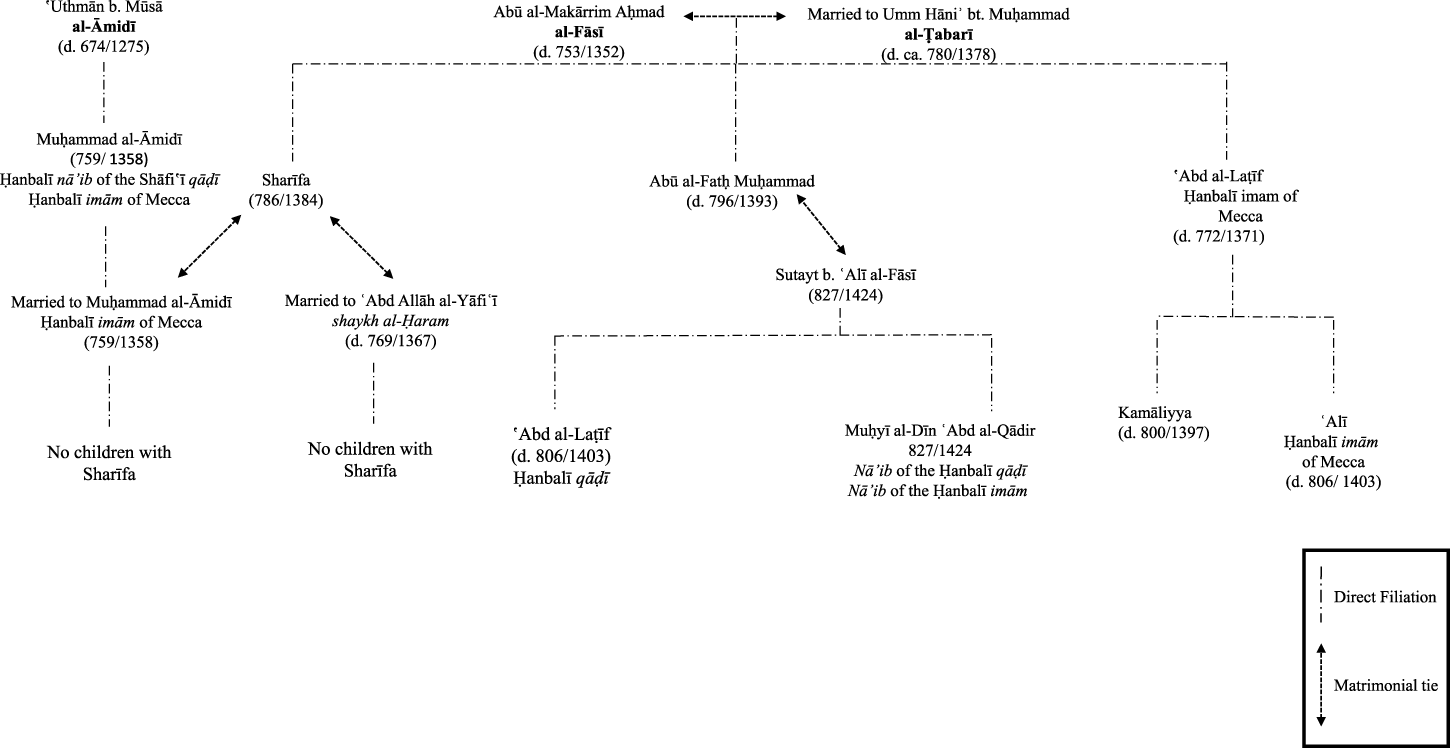
The Ḥanbalī branch of the Banū al-Fāsī and its matrimonial connection with the Banū al-Āmidī.

Figure 2 Long description
The diagram maps the Ḥanbalī branch of the Banū al-Fāsī family through its lines of filiation and matrimonial alliances. Near the top, ʿUthmān b. Mūsā al-Āmidī (d. 674/1275) is linked to Abū al-Makārim Aḥmad al-Fāsī (d. 753/1352), who married Umm Hānī bt. Muḥammad al-Ṭabarī (d. ca. 780/1378). The genealogy then extends to Muḥammad al-Āmidī (d. 759/1358), a Ḥanbalī deputy of the Shāfiʿī judge and imam of Mecca, and to Sharīfa (d. 786/1384), who married Muḥammad al-Āmidī and ʿAbd Allāh al-Yāfiʿī (d. 769/1367), without issue. Other figures represented include Abū Muḥammad (d. 796/1393) and Sutayta bt. ʿAlī al-Fāsī, from whom the genealogy proceeds to Muḥyī al-Dīn ʿAbd al-Qādir (d. 827/1424), a deputy of the Ḥanbalī judge. On the right, ʿAbd al-Laṭīf, imam of Mecca (d. 772/1371), is connected to Kamāliyya (d. 800/1397) and ʿAlī, imam of Mecca (d. 806/1403). Dashed lines indicate filiation, while solid lines indicate matrimonial ties, as specified in the legend in the lower-right corner.
As we can see from Taqī al-Dīn’s grandfather’s appointment around the mid 740s/1340s and the overall quick rise of several members of the Banū al-Fāsī from this period onward, the emergence of the name al-Fāsī as a heavyweight in the Meccan scholarly environment is quite discernable. It likely culminated in the early ninth/fifteenth century with Taqī al-Dīn’s appointment to the newly created position of chief judge of the Mālikī school in Mecca; this confirms that in three generations they had reached the highest institutional judiciary and scholarly standing in the Holy City. This new situation of prominent members of the Banū al-Fāsī is all the more significant when considering the matrimonial strategies of the family.
The Banū al-Fāsī and their family ties: framing their integration among the Meccan aʿyān
A closer look at the members of the Banū al-Fāsī family and their matrimonial ties suggests that they became fully part of the urban elite of the city during the second half of the eighth/fourteenth century.Footnote 100 Two matrimonial strategies can be identified within the family. On the one hand, the Banū al-Fāsī maintained strong intra-family endogamic matrimonial ties, through all the eighth–ninth/fourteenth–fifteenth centuries. While endogamy was common to many families during this period in the Middle East and in the Hijaz,Footnote 101 it seems that the Banū al-Fāsī family presented a peculiar configuration, with a higher number of intra-family marriages than other families in Mecca, as illustrated by K. Otsuya’s quantitative census of several Meccan families.Footnote 102 This was likely due to their status as recognised members of the ahl al-bayt, as ashrāf families were often interested in preserving the baraka of the Prophet’s family. The discrepancy of the quantitative data of intra-family marriages of the Banū al-Fāsī assessed in K. Otsuya’s article on the marriages of the Meccan elites should also be put in this context.
On the other hand, the Banū al-Fāsī actively sought marriages with other Meccan households, with two periods quite broadly identifiable. The first period, running from the end of the seventh/thirteenth century to roughly the mid eighth/fourteenth century, underlines that in the first two generations—that of the ancestor Abū ʿAbdallāh and his children—the Banū al-Fāsī contracted marriages both with lesser-known families connected to the scholarly milieu and with two households of ashrāf, including one marriage with a woman from the prominent Ḥusaynid family of the Banū al-Ṭabarī. The link of the Banū al-Fāsī with the prophetic lineage was thus a factor into their matrimonial alliances and likely facilitated their integration among the scholarly elites of Mecca—despite their initial material status—as the pool of scholarly families claiming prophetic descent seems in the early eighth/fourteenth century to have been very small. The marriage of Abū al-Makārim al-Fāsī, brother of Taqī al-Dīn’s grandfather ʿAlī, to Umm Hānī al-Ṭabarī—at a time when the Banū al-Ṭabarī were at the height of their influence—likely consolidated the family’s status early on, conferring significant social capital and perhaps reflecting a better material situation progressively acquired by the Banū al-Fāsī after the death of Abū ʿAbdallāh. However, the remaining alliances of the family predominantly involved daughters of scholars who were not distinguished by material wealth, social standing, or scholarly renown, and most of the sons of Abū ʿAbdallāh were associated with little-known families of scholars, with no link to the judiciary and scholarly institutions of the city. By this measure, as well as the occupational patterns of the first two generations of the Banū al-Fāsī and their networks, it seems quite clear that the family was not yet part of the elite of the city, despite being on the rise.
This stands in contrast to the situation observed in the following two generations of the Banū al-Fāsī—namely, the generation of Taqī al-Dīn al-Fāsī’s father, Taqī al-Dīn himself, and their immediate relatives. Members of the family, both men and women, started to mingle with other prominent scholarly households with a decisive influence in Mecca (see Tables 1 and 2). During this period, the leading families of Mecca’s scholarly elite increasingly appear as marital partners of the Banū al-Fāsī. From around the mid eighth/fourteenth to the early ninth/fifteenth century, the Banū al-Fāsī thus became connected through marriage to at least seven of the city’s most significant scholarly households.
Matrimonial relations of the Banū al-Fāsī with other families (first and second generation)

Table 1 Long description
Matrimonial connections for the first-generation group Banū Muḥammad b. Kāmil al-Ḥasanī are listed as ties to six named families. The families shown are Banū al-Dukkālī, Banū al-Larāstanī, Banū al-Abūtijī, Banū al-Fāsī, Banū al-Ṭabarī, and Banū al-Kurānī. All entries are presented as a simple list without counts, dates, or direction of marriage. Because no frequencies or additional attributes are provided, the list indicates which families are connected but not how often or through whom.
Matrimonial relations of the Banū al-Fāsī with other families (third and fourth generation, up to al-Taqī)

Table 2 Long description
Family names associated with matrimonial relations involving Banū al-Fāsī are listed. The entries include Banū al-Dukkālī, Banū ʿAbd al-Muʿṭī, Banū al-Nuwayrī, Banū al-Ṭabarī, Banū Qatāda, Banū al-Yāfiʿī, Banū al-Āmidī, Banū al-Marjānī, and Banū Ẓuhayra, alongside the Banū al-Fāsī themselves. No counts, dates, directions of marriage ties, or generational breakdown are provided in the data shown. Because the table contains only names, it supports identifying which families are involved but does not indicate frequency, strength, or chronology of the relationships.
The Banū al-Fāsī maintained marital ties with the Banū al-Ṭabarī, who, even though their influence in Meccan scholarly circles declined somewhat in the latter half of the eighth/fourteenth century, continued to be regarded as one of the city’s most esteemed lineages in terms of learning, influence, and scholarly authority.Footnote 103 Alongside these two families, other notable names—the Banū al-Nuwayrī,Footnote 104 the Banū al-Marjānī,Footnote 105 the Banū Ẓuhayra,Footnote 106 the Banū al-ĀmidīFootnote 107—stood out as leading figures within Mecca’s judiciary, scholarly, and religious institutions, with the quite noteworthy exception of the Banū al-Qasṭallānī and the Banū al-Sujazī.Footnote 108 Simultaneously, the Banū al-Fāsī also established marital alliances with the Banū al-Yāfiʿī, whose most prominent representative in Mecca was ʿAbdallāh al-Yāfiʿī (d. 769/1367), a distinguished Sufi authority and saintly figure in the Holy City. These patterns of intermarriage reached a new level by Taqī al-Dīn al-Fāsī’s time, when the Banū al-Fāsī began marrying into the emiral family, the Banū Qatāda, further consolidating their social and political standing.Footnote 109
As such, the Banū al-Fāsī sought alliances and intermarried with households that held the greatest scholarly prestige and influence: families who occupied the principal institutional roles within Mecca’s religious and judicial spheres. These social considerations regarding the entanglement of the Meccan scholarly environment at the end of the eighth/fourteenth century and the early ninth/fifteenth century have a marked influence on how we interpret the configuration of the Meccan scholarly landscape, the position of the Banū al-Fāsī during Taqī al-Dīn’s era, and the character of the ʿIqd al-thamīn itself.
The Meccan elites in the early ninth/fifteenth century: a new social reality?
The ties of the Banū al-Fāsī within the Meccan environment at the end of the eighth/fourteenth and in the early ninth/fifteenth century illustrate members of the Banū al-Fāsī and the households related to them held, although not continuously, the following offices: the khuṭba (ritual sermon) of the Ḥaram (the most political and profitable position in the scholarly environment of Mecca),Footnote 110 held by Taqī al-Dīn’s maternal grandfather, uncle, and cousin;Footnote 111 the niẓāra (superintendence) of the Ḥaram al-Sharīf; the qaḍāʾ (judgeship) for the four main Sunni madhāhib (schools of jurisprudence); the imamate of the four maqāmāt for the Sunni schools in the Ḥaram; the ḥisba (market supervision); and positions in major teaching institutions such as the prestigious madāris built by the Rasūlids, al-Manṣūriyya, al-Mujāhidiyya, and al-Afḍaliyya.Footnote 112 These positions included substantial remunerations as did the supervision and control over the awqāf (pious endowments) linked to them. Indeed, the testimonies of the material wealth of these families attest that it was often considerable.Footnote 113 As such, the Banū al-Fāsī had become strongly connected to a group of scholars that sat at the top of the institutional Meccan environment and enjoyed significant positions of power and influence in the city and likely the wider region of the Hijaz.
These numerous matrimonial relations among a small group of families, over at least two generations, tightly linked these households and effectively created one group whose members were all related (to one or two degrees) in terms of kinship. This is, at least, the depiction Taqī al-Dīn proposes in the ʿIqd al-thamīn. This historiographical representation is strengthened by the author’s detailed information on these very matrimonial ties, with biographical notices of men and women from Mecca that include long entries with details of household ties, most of all the Banū al-Fāsī’s ties to other prominent households with whom they shared some kinship. This is exemplified by the notice of Fāṭima al-Nuwayrī:
Fāṭima bt. Abī al-Faḍl Muḥammad […] al-Nuwayrī […]. Her mother [was] Umm al-Ḥusayn the daughter of the qāḍī Shihāb al-Dīn al-Ṭabarī. Her husband was her paternal cousin Bahāʾ al-Dīn ʿAbd al-Raḥmān […] al-Nuwayrī, and she had children with him, among whom were Najm al-Dīn Muḥammad and Umm Kamāl. She died in 794 [1391–1392] in Mecca […]. And she is my mother’s sister, through their father.Footnote 114
Such precision regarding the family ties of scholarly elites are quite ordinary in the ʿIqd al-thamīn regarding the ninth-/fifteenth-century elite households of the Holy City. In the wider context of Middle East Arabic historiographical production in the late medieval period, this amount of precise detail for such a great number of people is exceptional. To my knowledge, around the same period Yemeni historiography or the historiographical literary production of the Cairo Sultanate is far from this level of precision, except in rare cases,Footnote 115 and for a much narrower group of people. These narratives undoubtedly attest to al-Fāsī’s insistence and interest in identifying and connecting members of this small group who occupied the top echelons in the judiciary, scholarly, and religious institutions of Mecca, including members of his own kin in the Banū al-Fāsī lineage. In that regard, the great scholarly households of Mecca Taqī al-Dīn identified and staged by Taqī al-Dīn can be perceived as one extended kinship group, a blood-related urban community, or, for practical purposes, a meta-family, in the sense of an entangled web of relationships between a circumscribed group of several families all related over two generations at least, and all of whom maintained continuous matrimonial strategies within this group. Not all, but a meaningful part of the power plays, competitions, and rivalries of these households can also be said to have happened in the context of this large (but barely understood) kinship, an intra-familial social production whose boundaries were delimited by a small number of households and clients. This perspective is in line, I believe, with Taqī al-Dīn’s display of not only the Banū al-Fāsī but also of other prominent households of the group tied to the Banū al-Fāsī, as illustrated by the work of Abokadejah and the quantitative study of Otsuya.Footnote 116 Thus, Taqī al-Dīn gave great consideration to matrilineal kinship, such as for the author’s own maternal branch, the Banū al-Nuwayrī, who were related to the Banū al-Ṭabarī, the Banū al-Yāfiʿī, and the Banū Ẓuhayra. By the time of Taqī al-Dīn’s writings, the intermarriages had made the elite scholarly environment of Mecca a complex mosaic of more or less loose ties that nonetheless evolved mostly in a recurrent and narrow loop, a situation that remained as such for most of the ninth/fifteenth century.
This ongoing process of increasing kinship and marital ties among a select group of scholarly families reveals transformations that took place in the elite Meccan social landscape. As these alliances multiplied, some prominent Meccan households of the seventh/thirteenth and eighth/fourteenth centuries seem to have been demoted and lost their prerogatives. The case of the Banū al-Sujazī, who lost the office of Ḥanafī imams at the end of the eighth/fourteenth century, after having held this office for several generations, exemplifies this process.Footnote 117 Other families were either incorporated through maternal lineages and matrimonial ties into other families or bonds with related families were created that led to informal favors and institutional reproduction. Such is the case of the Banū al-Āmidī, whose ancestor Muwaffaq al-Dīn ʿUthmān al-Āmidī (d. 674/1275), his son Muḥammad (d. 731/1331), and his grandson Jamāl al-Dīn Muḥammad (d. 759/1357–1358) were imams, successively, of the Ḥaram al-Sharīf for the Ḥanbalī school for 24, 57, and 29 years, respectively.Footnote 118 Beyond these three figures, the name of the Banū al-Āmidī seems to fade from the narratives of the ʿIqd al-thamīn, perhaps because ʿAbd al-Laṭīf b. Aḥmad al-Fāsī took over the office of imam al-Ḥaram after them. While this may suggest a successful bid from ʿAbd al-Laṭīf a-Fāsī in a competitive environment, in fact he had strong ties to the Banū al-Āmidī, as Jamāl al-Dīn Muḥammad al-Āmidī had married ʿAbd al-Laṭīf’s sister.Footnote 119 In the absence of a male successor, explicitly mentioned by Taqī al-Dīn al-Fāsī,Footnote 120 with the skills to perform the function of the imam, upon the death of his brother-in-law, ʿAbd al-Laṭīf b. Aḥmad al-Fāsī may have been the closest relative with the background and influence to hold such an office, backed by the Banū al-Āmidī themselves.
From a social perspective, by the early ninth/fifteenth century these growing ties between a small group of households with a high cultural and material capital led them to adopt more circumscribed matrimonial strategies, and we can see an increasing number of alliances within the same households. As a result, access to the upper echelons of the Meccan scholarly elite became increasingly restricted, with the pool of families competing for the most prestigious positions diminishing. Yet, this consolidation was never absolute: rare case of scholars successfully rising despite being exogenous to this group still subsisted, and interventions by the rulers of Cairo or the emirs of Mecca could override such relative exclusivity. The appointment of Aḥmad al-Ṣāghānī as Ḥanafī qāḍī by direct order of Sultan al-Nāṣir Faraj (r. 801–815/1399–1412) exemplifies the capacity of the Cairo authorities to circumvent established networks.Footnote 121 But the number of newcomers in the top Meccan scholarly elites seems to have consequently dwindled in the ninth/fifteenth century, a phenomenon that is quite visible in contemporary historiographical narratives, at least if we follow Taqī al-Dīn’s ʿIqd al-thamīn or its continuation (dhayl) written by Najm al-Dīn ʿUmar Ibn Fahd (812–885/1409–1480), al-Durr al-kamīn. It is thus no coincidence that later in the ninth/fifteenth century, Najm al-Dīn ʿUmar Ibn Fahd decided to dedicate six works on what he deemed the six most important buyūt al-ʿilm (scholarly households) of Mecca.Footnote 122 He was, in effect, designating the limited circle of families that, over the course of the eighth/fourteenth and ninth/fifteenth centuries, had consolidated and retained control over the most lucrative and prestigious positions within the scholarly and judicial institutions of the Holy City. He was attesting to the social landscape of his own times and conveying its historical process toward power, wealth, and influence, as much as scholarly knowledge, transmission, and reputation. To the five families Najm al-Dīn ʿUmar Ibn Fahd identified as the most notable of the Holy City, including the Banū al-Fāsī, he added his own, the Banū Fahd, a historiographical coup de maître that remains to be studied. To do this, he had to rely heavily on the ʿIqd al-thamīn of Taqī al-Dīn al-Fāsī, the first author to have displayed this transformation and frame this process with such minutia, skill, and vision. By elevating the status of Taqī al-Dīn al-Fāsī, he thus in turn elevated the status of the members of the Banū Fahd mentioned in the ʿIqd al-thamīn.
From a historiographical perspective, such a social landscape so closely related to Taqī al-Dīn al-Fāsī also had significant consequences. With regard to characters from the mid eighth/fourteenth to the early ninth/fifteenth centuries, Taqī al-Dīn was effectively talking in large part about his own kinship, related to him in the first, second, and third degrees. His uncles, aunts, their cousins, his own cousins, from both the paternal and maternal lines, formed an important bulk of his narratives, about which it is difficult, despite differences in nasab and nisbas, to entirely dissociate members of various households, and question the material and social organisation of family groups and the growing relevance of matrilineal lines in the plague-stricken period of the second half of the eighth/fourteenth to the mid ninth/fifteenth century. In this regard, the case of the Banū al-Dukkālī is paradigmatic, as men of the Banū al-Dukkālī married women of the Banū al-Fāsī family each generation between the early eighth/fourteenth and the early ninth/fifteenth century.Footnote 123 ʿAbd al-Muʾmin al-Dukkālī (d. 741/1341)Footnote 124 married the daughter of Abū ʿAbdallāh al-Fāsī; thus, this lineage was directly related to the ancestor of the Banū al-Fāsī. Furthermore, their continuous relations in the course of the eighth/fourteenth and ninth/fifteenth centuries suggest that these families were almost indistinguishable.Footnote 125
With regard to Taqī al-Dīn’s environment, he was writing about people he knew, with whom he may have grown up, played with as a child, and met at wedding parties and gatherings, both informal and formal. He also likely grew up hearing stories about them, and continued to do so when writing the ʿIqd al-thamīn. This last element is indeed fundamental to understanding the process through which Taqī al-Dīn wrote his biographical dictionary, as in fact his own kinship, along with members of households related to the Banū al-Fāsī, were important sources for the ʿIqd al-thamīn—although not, by far, the only onesFootnote 126—at least for biographical notices regarding characters from the late seventh/thirteenth century to the early ninth/fifteenth century. This, we may argue, transforms our perception of the nature of the ʿIqd al-thamīn. While this text was undoubtedly a major work on the history of Mecca, dealing with a vast number of its most famous figures, its aʿyān and the prominent and mujāwirūn (resident scholars), it also introduced distinct scholarly circles who were active from the end of the seventh/thirteenth to the early ninth/fifteenth century. This information appeared according to the discourses of prominent scholarly figures of the city from these same families, thereby shaping the memory of their rise precisely during this period, as emphasised by other well-documented cases such as that of the Banū Ẓuhayra and the Banū al-Nuwayrī.Footnote 127 That is, these families slowly started to appear, progressively coalesced, and eventually emerged to seemingly embody the institutional elite of the early ninth/fifteenth century Meccan scholarly environment. Theirs was a narrative display that nonetheless did not dissimulate the process by which they intermingled with older Meccan scholarly households, even experiencing fierce competition and direct political interventions from the Rasūlids, the sultans of Cairo, the Cairene scholarly elites, and the Banū Qatāda.
Conclusion
To conclude, Taqī al-Dīn’s widespread inclusion of the Banū al-Fāsī and other closely related families as one of the main elements of the ʿIqd al-thamīn is a clear illustration that family was first and foremost a verbal, narrative, and symbolic construction, and that family discourses, in many regards, participated in a social and political ideology framing and designating specific ‘valued configurations of social relationships’.Footnote 128 This article emphasises that, on the one hand, Taqī a-Dīn’s narratives of his own family show the considerable attention he dedicated to frame it in the best possible light. His kin progressively rose in the eighth/fourteenth century and the early decades of the ninth/fifteenth century in the elite scholarly environment of Mecca, when members of the Banū al-Fāsī achieved a significant level of prestige, influence, and institutional power. This rise was relatively close to the time of al-Fāsī’s writing; indeed, before he wrote the ʿIqd al-thamīn, few mentions of the Banū al-Fāsī can be found anywhere. The akhbār of the ʿIqd al-thamīn anchored this family narrative deep in the framework of subsequent ninth-/fifteenth-century Arabic historiographical writing, especially that of the Hijaz. The position held by the Banū al-Fāsī in the time of Taqī al-Dīn was due in large part to the ability of some family members to introduce themselves into the framework of the scholarly, religious, and judiciary institutions of the Holy Cities. They maintained important contacts in Cairo and Alexandria, and above all were successful in their matrimonial strategies in relation to other established or rising families. These successful scholarly families, for their part, could build on the Banū al-Fāsī’s sought-after status of ashrāf. The presentation of the Banū al-Fāsī as members of the Meccan scholarly elite must then be situated within the broader social and institutional context of Mecca from the late seventh/thirteenth to the early ninth/fifteenth century and considered alongside the political and social transformations that accompanied these shifts in the city’s scholarly milieu, including the successful progressive insertion of several new families at the top of the Meccan family environment.
On the other hand, the present study has underlined the way Taqī al-Dīn’s account of his family’s integration into the Meccan’s aʿyān demonstrates the progressive formation of an interconnected group of scholarly families related through matrimonial alliances, which emerged mostly in the course of the eighth/fourteenth century. By the early ninth/fifteenth century, the Meccan scholarly environment was transformed. According to historiographical accounts, it would appear to be hardly recognisable compared to the mid seventh/thirteenth century, at least to the social actors and families that were responsible for and at the head of the scholarly, judiciary, and religious institutional Meccan landscape. A very narrow set of families—most of them unknown before the eighth/fourteenth centuries—with close local and regional political ties had come to lead the entire institutional Meccan framework, and the social reproduction of this group would continue deep into the ninth/fifteenth century. Taqī al-Dīn al-Fāsī, for all intents and purposes, may also be seen as the spokesperson of this group and its members. The ʿIqd al-thamīn, while also reaching far beyond this narrow social scope, was nonetheless a powerful account of their rise, their standing, and their interests. As such, it best embodied a new social status quo in Mecca, as perhaps the first and likely the main work recording and shaping the memory of this group. When and in what circumstances this precise group came to be, how it was delimited, and how we can understand this transformation in relation to the changing Hijazi political landscape of the seventh/thirteenth to the ninth/fifteenth centuries, are topics I hope to address in a forthcoming article.
Acknowledgements
I am very grateful to Dr Élise Franssen and Professor Frédéric Bauden for their valuable comments and suggestions. This research was carried out with the support of the Fonds de la Recherche Scientifique—FNRS (F.R.S.-FNRS), through my position as chercheur mandataire at Liège University (2021–2024).
Conflicts of interest
None.