

Underpinning the development of the Australian Curriculum (AC) was the desire to achieve a world-class national curriculum centred on improving both quality and equity within Australian schooling (Australian Curriculum, Assessment and Reporting Authority [ACARA], 2012c). A founding proposition was the belief that all students can learn and that individual needs must be recognised in the design and delivery of effective learning experiences. Despite this broad aim, there has been continued criticism of the AC from educators (ACARA, 2012a) and educational associations (Australian Association of Special Education [AASE], n.d.), highlighting its lack of detail, clarity, and inclusiveness, particularly as it applies to students with disabilities (SWD) and other special educational needs. To inform an inclusive curriculum that lives up to its stated intention, it is important to understand how educators of SWD interpret and apply the AC framework in their daily work. In this paper, we report on selected findings from a larger national survey of educators, which asked about their experiences using the AC in their planning and teaching for SWD. Although the broader study also focused on educators’ professional learning experiences and needs, this paper is specifically concerned with educators’ experiences of designing learning and assessment tasks and their perceptions of the value of the AC framework for SWD in special education settings.
Towards a Curriculum for all Students
The development of a curriculum for all students is not only an inclusive aspiration, but also a legal requirement under the federal Disability Discrimination Act (Commonwealth of Australia, 1992) and associated Disability Standards for Education (Commonwealth of Australia, 2006), which stipulate that ‘. . . students with disabilities [have] the right to participate in educational courses or programs that are designed to develop their skills, knowledge and understanding, including relevant supplementary programs, on the same basis as students without disabilities’ (Commonwealth of Australia, 2006, p. 23). This statement acknowledges that ‘relevant supplementary programs’ often comprise part of a student's curriculum (Commonwealth of Australia, 2006, p. 23). The question of the relationship between the ‘official’ curriculum and the learning needs of SWD is one that has taxed educators around the world (Duke, Reference Duke2009; Snell & Brown, Reference Snell and Brown2011), and is particularly pertinent for students with extensive support needs (ESN; Ryndak, Jackson, & White, Reference Ryndak, Jackson and White2013) whose individual, needs-based programs may be significantly altered from the ‘“common” curriculum mandated for the vast majority of students’ (Lyons & Arthur-Kelly, Reference Lyons and Arthur-Kelly2014, p. 449). Debate continues between those who maintain that SWD require a separate curriculum that caters for their specific needs and those who maintain that the learning needs of SWD can and should be incorporated in the mainstream curriculum. The Australian Curriculum, Assessment and Reporting Authority (ACARA) has opted for the latter approach, making it clear that the national curriculum is based on the key value of ‘educational inclusion for all’ (ACARA, 2012d, p. 5).
The AC is a standards-based framework designed to support equity and accountability, but this requires positive engagement by educators given they are the conduit between the intended and enacted curriculum. Previous draft materials, such as Progressing to Foundation (ACARA, 2012b), proved popular with some educators as they provided specific content for students considered to be at what was termed a pre-intentional stage of development — those very students whose curriculum needs are currently seen as poorly addressed (Australian Government Department of Education and Training, 2014). ACARA relinquished this approach, however, instead directing teachers to utilise the AC's three dimensions (learning areas, general capabilities, and cross-curriculum priorities) to address diverse student needs.
Educators are more likely to actively use curriculum if they believe it is relevant to the students they teach (Nolet & McLaughlin, Reference Nolet and McLaughlin2000). Although used inconsistently in Australian schools (Dempsey, Reference Dempsey2012), for many special educators the individualised education program (IEP) presents an opportunity to personalise curriculum, including supplementation of standard curriculum frameworks. Educators’ histories in the use of specialised curricula also influence their choice and engagement with new curriculum (Duke, Reference Duke2009). These factors are of significance in mapping Australian special educators’ engagement with and implementation of the AC for SWD.
Emerging Perspectives on the AC and SWD
At this early stage of its implementation, there is little research on the application and impact of the AC framework, including for SWD. However, international perspectives on the education of SWD and special educational needs within a system-wide curriculum framework are informative in framing the challenge for Australian special educators (Ahlgrim-Delzell, Knight, Jimenez, & Agnello, Reference Ahlgrim-Delzell, Knight, Jimenez and Agnello2009; Council for the Curriculum, Examinations and Assessment, 2011; Howell & Nolet, Reference Howell and Nolet2000). In addition, the Australian special education literature has historically been concerned with the extent to which a general curriculum, assessment, and reporting framework can and should be applied inclusively to the education of SWD, even in the absence of a formalised national approach.
In 2006, an Australian national study of published curriculum materials found that although education systems theoretically include SWD through broad, inclusive statements of responsibility for all learners, the documents reflected a tangible sense in which SWD and other special educational needs were expected to fit the general curriculum, with the ‘typical’ student considered the starting point for comparison (Australian Special Education Principals Association [ASEPA], n.d.). The ASEPA study also highlighted considerable inconsistency between states and education jurisdictions in their approaches to the inclusion of students with special needs in curriculum, and a lack of resources and advice for educators about how to use mandated curriculum documents to design authentically inclusive learning experiences for SWD (ASEPA, n.d.). Although a drive for nationally consistent language and definitions was considered desirable, the authors recommended that the push for a high-quality, inclusive curriculum should be grounded in discussions of a broader vision and national leadership for excellence in the education of SWD.
In addition to curriculum, discussions of the tension between standardised top-down approaches and individualised bottom-up approaches have focused on assessment and reporting. In the context of the National Assessment Plan: Literacy and Numeracy (NAPLAN) tests, researchers have drawn attention to relatively low rates of participation in standardised tests of SWD (Dempsey & Conway, Reference Dempsey and Conway2005), failure to incorporate principles of accessibility into assessment design (Elliott, Davies, & Kettler, Reference Elliott, Davies and Kettler2012), and inconsistent use of testing accommodations for SWD between jurisdictions (Carson & Walker, Reference Carson, Walker and Askell-Williams2015). These inconsistencies and poor participation rates of SWD in standardised assessments reflect a challenge to equity and inclusion (Cumming & Dickson, Reference Cumming and Dickson2013) and have been linked to a lack of accountability at the systems level for the education of SWD (Dempsey & Davies, Reference Dempsey and Davies2013). Assessment and reporting are clearly entwined with considerations of curriculum. Within the AC framework, the assessment of SWD exclusively against the general capabilities (in isolation from learning area content) has been criticised as an approach that further marginalises SWD from the ideal of an accessible, inclusive curriculum framework (Carson & Walker, Reference Carson, Walker and Askell-Williams2015).
In 2012, ACARA published a thematic overview of the literature in curriculum, assessment, and reporting for students with special educational needs and disability. The review noted a lack of coherence between curriculum, assessment, and reporting in many national settings. There was ongoing concern about the disparity between inclusive policy and the daily practice of education for SWD: a tension for educators between designing curriculum and learning experiences driven by common standards and grounding learning on the needs of the individual student. It was noted that in Australia the classroom teacher is responsible for adjusting, modifying, and differentiating curriculum for SWD, whatever their professional preparation, competence, and support (ACARA, 2012d). In comparison with countries such as England, the review pointed to a lack of targeted Australian research on curriculum, assessment, and reporting for SWD. Guided by themes from the ACARA scoping exercise, Garner and Forbes (Reference Garner and Forbes2015) interviewed 16 educators and leaders with special education experience in Australia (eight participants), England, and Wales about their views on curriculum, assessment, and reporting provisions for SWD. Experienced practitioners in both contexts favoured a holistic, accessible curriculum and assessment framework in which provisions for SWD are part of a continuum of provisions for all students. They highlighted key synergies between mainstream and special education, even while they reflected a prevalent view in both the Australian and international literature of the tension between meeting system-level policy and accountability requirements and grounding learning experiences in students’ individual needs.
Although not specific to SWD, research has begun to focus on teachers’ work within the AC framework. Most notably, a series of related studies has investigated teachers’ planning practices in relation to the AC in English and Mathematics (Gerrard et al., Reference Gerrard, Albright, Clarke, Clarke, Farrell, Freebody and Sullivan2013). Through surveys and focus groups, researchers found considerable diversity in mathematics teachers’ practices of selecting content and designing learning and assessment tasks. They noted that curriculum planning was a complex decision-making process incorporating multiple resources and sources of information (Sullivan, Clarke, Clarke, Farrell, & Gerrard, Reference Sullivan, Clarke, Clarke, Farrell and Gerrard2013). The surveys included a small number of items that enabled teachers to indicate their use of assessment data to plan differentiated learning experiences. However, planning for SWD was not explicitly investigated through the surveys and was notably absent from the discussion of designing learning and assessment experiences in the context of this large-scale, multi-site research.
On a much smaller scale, Price (Reference Price2015) conducted a case study project with two teachers of SWD implementing the AC, with a specific focus on the literacy general capability. Participants identified challenges in using the AC to plan for SWD, including the ‘step by step literacy continuum with limited links to disability’ (Price, Reference Price2015, p. 29). However, this study was limited to an exploration of the literacy general capability and focused primarily on the relationship to broader concepts of human capabilities as a framework for education. This leaves considerable scope to research teachers’ day-to-day work with the AC in selecting and organising content, setting learning goals, and designing learning and assessment tasks for SWDs. There is a particular gap in the research on curriculum planning by Australian teachers in special education settings, including special schools, and a need to examine the national landscape.
Gerrard et al. (Reference Gerrard, Albright, Clarke, Clarke, Farrell, Freebody and Sullivan2013) suggested that ‘the Australian Curriculum offers a unique research opportunity, providing substantial scope for the examination of the changing systems and school-level practices entailed in large-scale curriculum reform’ (p. 60). Both Australian and international researchers highlight the complexity of effectively addressing the individual needs of SWD in the context of mandated general curriculum, assessment, and reporting frameworks. However, there is an absence of research investigating how Australian special educators navigate this tension between top-down and bottom-up approaches in their day-to-day work of planning, teaching, and assessing learning for SWD.
Research Questions
This study highlights how special educators currently interpret, apply, and supplement different aspects of the AC framework, including how they might include supplementary materials to make learning relevant and meaningful for SWD. It addresses a research gap in terms of how educators teach to the curriculum in order to meet diverse needs and complements ACARA's consultation processes and the Australian Government's review, which have sought to identify and clarify the curriculum needs of today's teaching profession. Through a national online survey, this research addresses the following questions:
1. How do educators in special education settings engage with the AC framework in developing learning objectives, planning learning experiences, selecting resources, assessing learning, and reporting outcomes for SWD?
2. How, and to what extent, do educators in special education settings supplement the AC framework with additional frameworks, programs, and/or resources?
Method
Participants
Participants included 151 educators (124 female, 27 male) from special education settings in Australia. Settings ranged in size, with the majority having an enrolment of less than 100 (58.94%), followed by 100 to 200 (21.85%), and more than 300 (19.20%). Ninety percent of participants were from four states: South Australia (28%), Victoria (20%), New South Wales (16.67%), and Western Australia (25.33%). A further 10% were from Queensland (5.33%), the Northern Territory (1.33%), Tasmania (0.67%), and the Australian Capital Territory (2.67%). Approximately 68% of participants were located in metropolitan areas, 31% in rural or regional locations, and a further 1.34% of participant locations were considered remote.
Across settings and year levels, a number of different roles were represented, including directors and/or principals (19.21%), assistant principals (11.26%), special education coordinators/lead teachers (19.21%), classroom teachers (45.03%), and other roles such as school support officer/teacher aide, music specialist, or noninstruction-time teacher (10.60%).
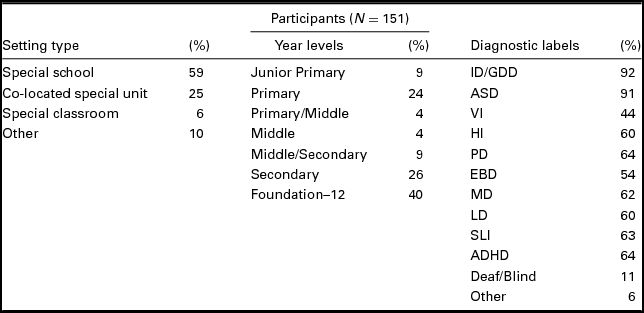
Participants’ qualifications varied with 38.41% holding a Bachelor of Education, 19.21% holding a Graduate Diploma of Teaching, and 9.93% holding a Master of Education degree. In regard to specialist qualifications, 19.87% held a Bachelor of Special Education (or equivalent), 16.56% held a Graduate Diploma of Special Education, 11.92% held a Graduate Certificate with a Special Education focus, 0.66% held a TAFE Certificate in Disability (or equivalent), 21.85% held a Master of Education degree with a Special Education focus, while 1.32% held a Doctorate with a Special Education focus. A small number of participants reported having no current special education qualification (5.30%). It is noteworthy that approximately half the participants reported having more than one type of teacher education qualification. In addition, participants varied in the number of years spent specifically teaching in the field of special education, with 14% of the sample having between 0 and 2 years of experience, 34% between 2 and 9 years of experience, and 51.33% having more than 10 years of experience. Further participant and reported student diagnostic details are presented in Table 1.
Participant Educational Settings and Student Disability Diagnostic Label

Note. Participants may have selected multiple categories. ID/GDD = intellectual disability/global developmental delay; ASD = autism spectrum disorder; VI = vision impairment; HI = hearing impairment; PD = physical disability; EBD = emotional/behavioural disorder; MD = multiple disabilities; LD = learning disability; SLI = speech/language impairment; ADHD = attention-deficit/hyperactivity disorder.
Procedure
In this study, we employed an anonymous online survey design. The RISE Australian Curriculum Survey was designed specifically for this study and was initially pilot tested with special educators. Following pilot testing, 24 ethics applications were approved, to address various state and local jurisdiction requirements. The survey was then distributed to principals and directors of all known special education schools and units throughout government, Catholic, and independent sectors across Australia's six states and two territories via an email containing an electronic link to the survey. Principals and directors were asked to share the survey with their staff. An invitation to participate in the survey was also promoted via the AASE website and at a local special education conference in 2015.
Materials
The survey contained 37 questions across four key sections: (1) demographic information, (2) use of the AC for SWD, (3) supplementation of the AC for SWD, and (4) professional learning and support. Section four of the survey regarding professional learning and support was discussed in Part 2 of the study (McMillan et al., Reference McMillan, Carson, Walker, Noble, Jarvis and Bissaker2018). Survey questions took the form of multiple-choice and Likert-type scale responses in addition to a series of open-ended questions to support detailed and elaborated responses. The survey took approximately 30 minutes to complete. A selection of survey question examples can be found in the Appendix.
Ethics
This research was approved by the Flinders University Social and Behavioural Research Ethics Committee and all state and local education jurisdictions who participated. Informed consent was required prior to participant access to the online survey.
Results
A mixed-methods approach was employed whereby descriptive statistics were used to quantify data as percentages and frequencies for Yes-No or Likert-type scale questions, whereas responses to open-ended survey items were analysed qualitatively using the constant comparative method (CCM; Maykut & Morehouse, Reference Maykut and Morehouse1994). The CCM is a variant of grounded theory (Glaser & Strauss, Reference Glaser and Strauss1967), which applies a nomination frequency to themes emerging from a dataset. Outcomes from this mixed-methods approach are presented below.
Engagement With the AC Framework to Support Teaching and Learning for SWD
Survey data were analysed to evaluate how educators of SWD engage with the AC framework when (a) developing learning objectives, (b) planning learning experiences, (c) assessing learning, and (d) reporting on student outcomes.
Developing learning objectives for SWD
The AC requires educators in the first instance to consult curriculum information at each student's age-equivalent year level and then make adjustments either up or down the year levels in order to develop appropriate learning objectives. Participants in this study were asked to indicate which levels of the AC they used to develop learning objectives for their students. Approximately 74% of participants drew from curriculum information more than three years below their students’ year level, 31% used information that was 2–3 years below year level, 22% used information that was 1–2 years below year level, 21% used information that matched the students’ year level, whereas only 5% were guided by curriculum information that was above year level. Approximately 9% of participants indicated that they did not use the AC for developing learning objectives, and qualitative feedback suggested that they found it irrelevant or unsuitable for their students: ‘My students can barely unzip their bags and go to the toilet independently — I use the [Australian] curriculum to the absolute minimum to keep the bosses quiet as it is completely irrelevant to my students!’
Using the CCM approach, several themes emerged, with the strongest being that educators develop learning objectives from the AC by adjusting up and down the year levels of the curriculum (i.e., this theme accounted for 43% of open-ended responses). Three different approaches identified were (a) identifying the content of learning areas that matched students’ year level, and then adjusting to lower year levels as appropriate to each student's academic functioning to develop learning objectives (e.g., ‘[I] work from the year level for my students then work top down until I find an appropriate achievable objective for the majority of my students’); (b) assessing students’ level of functioning and then approaching the level of the AC that matches this ability (e.g., ‘I assess the students and determine what they need to learn. I then scan the curriculum to determine the year level and objectives that best fit with their needs’); and (c) utilising the general capabilities as the focus for developing learning objectives (e.g., ‘I go back through the capabilities until I find the general capabilities that can be achieved by the students’). Additional themes included the use of local curriculum frameworks to support the development of learning objectives (12%; e.g., state-specific curriculum resources such as AusVELS in Victoria and the NSW Life Skills Curriculum) and use of the AC achievement standards and/or general capabilities to develop individual learning plans (11%).
Overall, the results did not reflect a consistent approach to the development of learning objectives for SWD within the AC framework. Rather, educators used a range of approaches including moving up and down age-equivalent content descriptions, drawing from the general capabilities and achievement standards, considering students’ IEP goals and drawing from local curriculum guidelines. Although some of these approaches involved beginning with the AC framework, others took the approach of beginning with objectives that were relevant to the student and then aligning these with the AC framework.
Planning learning experiences for SWD
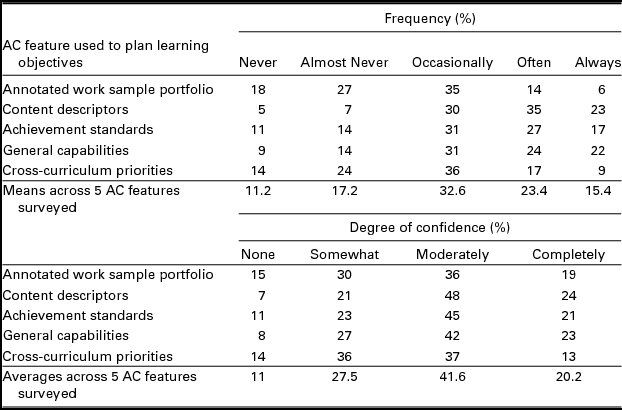
Participants were invited to indicate their use and degree of confidence in using the AC to plan learning experiences for their SWD. Specifically, the use of five key features of the AC were surveyed: (a) annotated work samples/portfolios, (b) content descriptors, (c) achievement standards, (d) general capabilities, and (e) cross-curriculum priorities. Almost one third of participants reported either never or almost never (28.4%) consulting one of the five AC features to plan learning experiences for SWD. A further third indicated that they did this occasionally (32.6%), and approximately 39% of participants noted that they did this often to always (38.8%). The AC features most often used to plan learning experiences for SWD included the content descriptors (23%), general capabilities (22%), and achievement standards (17%). Of note, a large majority of participants indicated that they were not completely confident in how to use the AC to plan learning experiences for SWD (79.8%). Participants indicated greatest confidence in using content descriptors (24%) and general capabilities (24%) to support their planning practices and were least confident in the use of annotated work samples (15%) and the cross-curriculum priorities (14%). Table 2 presents the results of this analysis.
Degree of Confidence in Using the Australian Curriculum (AC) to Plan Learning Experiences for Students With Disabilities

Analysis of open-ended comments identified several key themes in relation to how educators use the AC to plan learning experiences. The predominant theme (38%) was the use of the AC content descriptors or achievement standards to inform the design of learning experiences tailored to each student's needs and goals, as well as indicating an age-appropriate starting point (e.g., ‘I use the content descriptors to set differentiated goals for each student — same topic/theme but different expectations for students’). Others reported using the AC to develop learning experiences in specific learning areas (19%), for example, ‘targeting spelling and reading objectives’ or ‘literacy and maths’. Further, the use of local education system curriculum planning resources was also a source for planning learning experiences (13%). Similar to the development of learning objectives, the data indicated that educators use the AC in various ways to plan tailored learning experiences for SWD, and that they have varying levels of confidence in applying different components of the AC framework in their planning.
Assessing progress for SWD
Participants were asked to indicate which methods of assessment they employed to measure progress of SWD in relation to the achievement standards of the AC. The majority of participants reported using informal observation (97.22%), formal or direct observations (80.56%), permanent products (e.g., work samples; 80.56%), checklists (74.31%), and professional judgement (70.83%). Approximately half of the participants used discussion with students (56.94%), portfolios (54.17%), or curriculum-based (criterion-referenced) assessment (45.14%). Approximately one third of participants employed standardised (norm-referenced) assessment (34.03%), tests or quizzes (31.25%), or student self-assessment (27.08%). Few participants used peer assessment (13.89%), and even fewer participants used the NAPLAN data (6.94%). Using teacher-created tools was reported by 12.5% of participants. For example, one educator commented, ‘I have to create my own data sheets/recording system based on my students’ ILP goals’.
Assessment and reporting outcomes for SWD
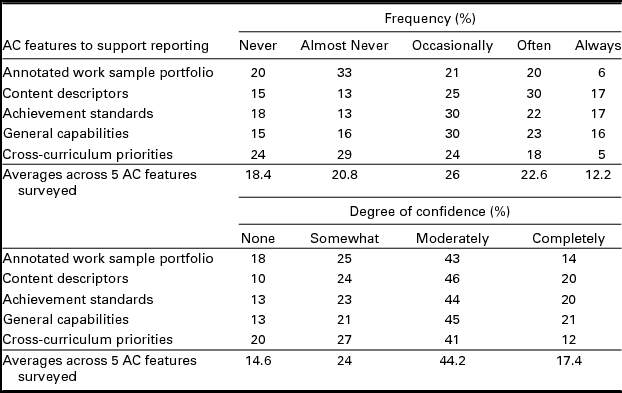
Participants were asked to indicate their use and degree of confidence in using the AC to assess and report on student learning outcomes. The majority of participants occasionally consulted the AC to support their assessment and reporting practices for SWD (26%), with approximately 23% doing this often and only 12% doing this always. A large percentage never to almost never consult the AC (39.2%) to support assessment and reporting. A majority of participants felt moderately comfortable using the AC for assessment and reporting purposes (44.2%), and a smaller percentage felt completely confident (17.4%). Importantly, only 24% and 14.6% of participants felt somewhat confident or reported no confidence, respectively, in using the AC to support assessment and reporting for SWD. Percentage of use and degree of confidence in using the AC's annotated work sample portfolios, content descriptors, achievement standards, general capabilities, and/or cross-curriculum priorities to support assessment and reporting practices are profiled in Table 3.
Degree of Confidence in Using the Australian Curriculum (AC) to Assess and Report on Learning Outcomes for Students With Disabilities
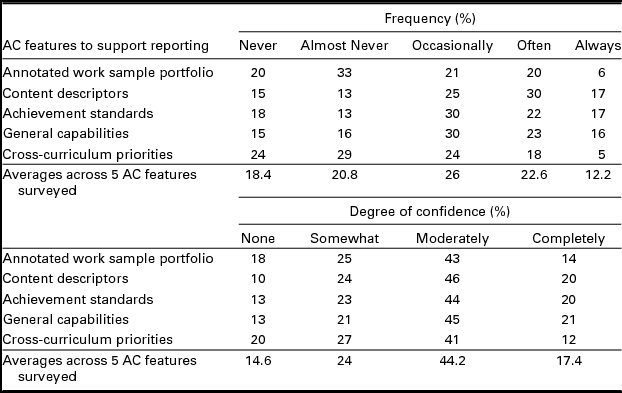
Qualitative analysis of comments indicated that the majority of participants assessed and reported on their students’ IEP goals as opposed to the AC achievement standards (11%). The second most prevalent theme was the use of nonspecific or unclear comments, including ‘participation and completion of work’ or ‘use as guidelines’, which were difficult to interpret in terms of specific practices (13%). These, in combination with the number of participants indicating no use of the AC for assessment and reporting (6%), suggest that at least 30% of participants do not use the AC as the primary basis for their assessment and reporting for SWD.
Supplementing the AC to support teaching and learning for SWD
Participants were asked to indicate which specific resources, frameworks, or programs, if any, they use to supplement the AC for SWD, and to indicate the value of those resources for supporting their teaching practice. Approximately 50% of participants indicated that they use the Early Years Learning Framework (EYLF; Australian Government Department of Education and Training, 2009). Approximately one third of participants used the P Scales (Ndaji & Tymms, Reference Ndaji and Tymms2012) and/or Intensive Interaction (Hewett, Firth, & Barber, Reference Hewett, Firth, Barber and Harrison2012). Progressing to Foundation (draft materials; as cited in ACARA, 2012b) was used by approximately 25% of participants. Fewer participants supplemented with the Social Skills Improvement System (Elliott & Gresham, Reference Elliott and Gresham2008; 17%), the Mobility Opportunities Via Education/Experience (MOVE) program (Move International, 2018; 15%), Conductive Education (Cottam & Sutton, Reference Cottam and Sutton1986; 14%), the Expanded Core Curriculum (Hatlen, Reference Hatlen1996; 13%), and the Syracuse Community-Referenced Curriculum Guide (Ford et al., Reference Ford, Schnorr, Meyer, Davern, Black and Dempsey1989; 1%).
Of note, the majority of participants also reported supplementing their use of the AC with resources, frameworks, or programs not stated in the survey. These ‘other’ sources included the use of AusVELS (Victorian Curriculum and Assessment Authority, 2017), Abilities Based Learning and Education Support (ABLES; Victoria State Government Department of Education and Training, 2018), NSW Life Skills Curriculum, and autism spectrum disorder programs. Further, the majority of participants indicated that the use of these ‘other’ sources (87%) were either valuable or very valuable forms of supplementation to the AC. Almost two thirds of participants found supplementation with the EYLF (60%) and/or Intensive Interaction (60%) valuable or very valuable. Supplementation with the P Scales (55%), the MOVE program (58%), and/or the Social Skills Improvement System (45%) were considered valuable to very valuable by participants. Use of the Syracuse Community-Referenced Curriculum Guide (54%), the Expanded Core Curriculum (32%), and Conductive Education (29%) were noted among participants as sources with the least supplementation value.
Qualitative analysis using the CCM demonstrated that a large number of participants used supplementary programs or adaptations in addition to the AC, supporting the quantitative results. For example, educators commented on the use of supplementary programs such as the Progressing to Foundation draft, and P Scales, in addition to the creation of their own materials or adaptations they employed to ensure age appropriateness (e.g., ‘My students don't want to be treated like they are babies so age appropriate is necessary, but at each student's level’.).
Overall, it was clear that participants relied heavily on resources beyond the AC framework to support their students’ learning, and that many found these supplementary resources invaluable across all areas of curriculum and assessment. In some cases, educators appeared to use supplementary materials as primary sources for their planning and then ‘retrofit’ their plans into the AC framework. In other cases, the supplementary sources mentioned were local materials based on the AC framework specifically designed to help teachers translate the AC into daily planning, teaching, and assessment practices for SWD.
Discussion
We investigated how educators of SWD in special education settings engaged with the AC. Educators reported inconsistent confidence and use of the AC for planning, assessment, and reporting the learning outcomes of SWD. They confirmed experience of tension between planning, teaching, and assessment of individual personalised learning and use of the systems-based standardised AC framework. Such perceptions and reflections aid to inform future policy, practice, and professional learning efforts, leading to a common and unified approach that holds education systems accountable for addressing the diverse learning needs of SWD, including those with ESN.
Engagement With the AC
Our first research question examined how educators in special education settings engaged with the AC when developing learning objectives, planning learning experiences, selecting resources, assessing learning outcomes, and reporting on outcomes for SWD. The findings demonstrated variable confidence and use of the AC for SWD. When developing learning objectives and planning learning experiences, educators reported varied approaches. They reported starting at the children's year level and moving up or down the age-equivalent curriculum, focusing on the general capabilities, scanning the curriculum for student interest, focusing on students’ IEP objectives, supplementing the AC with other resources, and some largely used other resources as the primary source and retrofitted to the AC.
Consistent with previous international and national research (ASEPA, n.d.), this study highlighted the significant and ongoing challenges educators encounter when using a mandated curriculum for SWD. Although it is acknowledged that a significant initiative as ambitious as the AC inevitably takes time to embed and implement (Garner & Forbes, Reference Garner and Forbes2015), the results of this study have demonstrated extensive work ahead to foster further and consistent adoption of the AC in practice for SWD. A complex national initiative of the scale of the AC is prone to inconsistency between the planned curriculum and that which is enacted in practice (Gerrard et al., Reference Gerrard, Albright, Clarke, Clarke, Farrell, Freebody and Sullivan2013), resulting in implementation that often differs from that envisaged in policy (Ball, Reference Ball2012); in the case of the AC, ‘inclusion for all’.
Importantly, approximately 80% of participants reported that they were not completely confident in how to use the AC to plan learning experiences for SWD. Self-confidence in professional practice is considered important for underpinning effective and sustainable educational practice (Fackler & Malmberg, Reference Fackler and Malmberg2016). Therefore, developing teacher confidence in the use of the AC is central to its continued adoption and establishment as a viable national framework to plan, assess, and report on the learning outcomes for SWD.
Investigating use of the AC for assessment and reporting of outcomes for SWD was a key aim of the study. Such a focus has been recommended in previous research demonstrating the lack of accessibility and accountability for the learning and participation of SWD in assessment and reporting (Garner & Forbes, Reference Garner and Forbes2015). Indeed, 40% of participants indicated that they never to almost never used the AC to inform their assessment and reporting for SWD, thereby questioning the relevance of the AC for some educators when reporting the achievement of SWD.
Supplementation of the AC Framework
The second research question we evaluated was how educators supplemented the AC with additional frameworks, resources, and/or programs for SWD. Qualitative and quantitative data analysis demonstrated that up to 84% of participants used the AC with adaptations (e.g., technology, 38%) or used alternatives to the AC (e.g., EYLF, 32%; ABLES, 14%) to support the planning and delivery of learning for SWD. These data indicate inconsistency in productive use of the AC for all SWD, as well as uncertainty of the relevance of the AC as a framework for planning learning content for SWD. Historically, states and territories have relied upon locally based curricula in Australia, resulting in unique educational practices and content tied to respective states and jurisdictions. The findings from this research demonstrated that, to some extent, this has continued. For instance, the F–10 Curriculum by the Victorian Curriculum and Assessment Authority (2017) claims that it ‘incorporates the AC’ but at same time ‘reflects Victorian standards and priorities’ and incorporates the Towards Foundation A–D levels for SWD as a precursor to the F–10 Curriculum (Victorian Curriculum and Assessment Authority, 2017). Further, the Victorian State Government provides educators with ABLES (Victoria State Government Department of Education and Training, 2018), a program of curricular, assessment, and reporting resources intended to support educators of SWD. Given that a substantial proportion of special educators reported using state-based or supplemental curricular materials, consistent application, accessibility, and relevancy of the national curriculum, as perceived by special educators for all SWD, may be questionable.
‘Previously the individual traditions of, and legislative requirements for, curriculum development in the States and Territories had contributed to limited national collaboration’ (Gerrard et al., Reference Gerrard, Albright, Clarke, Clarke, Farrell, Freebody and Sullivan2013, p. 61). This research indicates that a substantial minority of participants are principally relying upon a local or individual interpretation and using alternative resources for key aspects of educational planning. This demonstrates that local traditions and individual experience, to some extent, remain as drivers of the enacted curriculum and/or the perception by educators that the AC does not meet the education needs of all SWD resulting in partial adoption in practice. Without systems-based accountability for reporting learning outcomes for SWD, low levels of participation in assessment and reporting against the AC can be expected to persist.
Limitations and Future Directions
It is important to interpret the results of this study in light of its design limitations. The geographic distribution of study respondents to the national survey was not representative of the demographic composition and localities of special educators in Australia. Although researchers sought permission for distribution across all states and jurisdictions, authorisation and uptake were major barriers to participant recruitment. It should also be acknowledged that there may be differences in the experiences and opinions of educators across different settings. Although we have presented general findings based on the responses of educators in inclusive and specialist settings, the scope of the paper and the breakdown of participants by setting type did not allow for meaningful comparisons between educators of SWD who may be working as the sole special education practitioner (such as those in a special class in a mainstream school) and those working in a team of special education staff in a more specialised setting (special school or unit). This research was intended to be exploratory in nature, thereby limiting the generalisation of results to all special educators; the purpose was to investigate potential areas for future research and the implications and opportunities for current practice. Such opportunities may include prioritising professional learning initiatives to develop educator knowledge and skill in addressing the inconsistencies and opposing tensions between systems and person-centred curricular approaches. A practical perspective from educators may shed light on how policy and resulting initiatives may be informed by the reality of enacted practices, suggesting ways forward for improved uptake based on the types of resources, supports, and learnings valued by educators.
Conclusion
Interpretation and application of a complex national initiative such as the AC by teachers requires complex decision-making in practice (Sullivan et al., Reference Sullivan, Clarke, Clarke, Farrell and Gerrard2013), particularly when accessibility and relevancy are questioned by a substantial minority of special educators. Educators described varied and inconsistent practices when planning and programming personalised learning for SWD, relying upon state-recommended, familiar, or dated practices rather than embracing the inclusive intentions of the AC. Accessibility for students with ESN continues to be an area of contention as educators grapple with the relevancy of age-equivalent curriculum, particularly for reporting against achievement standards. Without consensus on a consistent approach to the use of the AC, inclusive of individual needs-based personalised learning, the lack of accountability for the learning outcomes of SWD will persist as a source of contention.
Educators clearly voiced their desire for further guidance and professional learning as they continue to struggle with programming for individual personalised needs against national standards-based curriculum. An additional component of this research investigated educators’ valued professional learning in the implementation of the AC for SWD. Part 2 of this research reported on educators’ suggested professional learning to promote confidence and adoption of the AC for SWD (McMillan et al., Reference McMillan, Carson, Walker, Noble, Jarvis and Bissaker2018).
Acknowledgement
This research was supported by the Australian Association of Special Education (AASE) through the AASE Research Award.
Appendix
The Research in Special Education (RISE) Australian Curriculum Survey: Example Questions
Q27. In relation to your students’ year level/chronological age, what levels of the Australian Curriculum do you draw on when developing learning objectives? Please select relevant box(es).
- More than 3 years below year level/chronological age
- 2–3 years below
- 1–2 years below
- At year level/chronological age
- Above year level/chronological age
- I do not use the Australian Curriculum for developing learning objectives
Q34. Indicate your level of use and degree of confidence in using the Australian Curriculum in the following ways to assess and report on outcomes:
- Use the annotated work sample portfolio to establish learning objectives
- Use the content descriptors to assess and report
- Use the achievement standards to assess and report
- Use the general capabilities to assess and report
- Use the cross-curriculum priorities to assess and report
Note: Participants indicated their degree of confidence on a scale of no confidence to completely confident and indicated their frequency of use on a scale of never to always.
Q41. Indicate which specific resources, frameworks, or programs you use to supplement the Australian Curriculum for students with disabilities. Check the box(es) that apply.
- Early Years Learning Framework
- P Scales
- The Syracuse Community-Referenced Curriculum Guide
- Social Skills Improvement System
- MOVE Program
- Conductive Education
- Intensive Interaction
- Progressing to Foundation draft materials
- Expanded Core Curriculum
- Other (please specify)
Note: Participants indicated if they used or did not use the resource, and then indicated how valuable the resource was on a scale of not valuable to very valuable.