



The western conifer seed bug, Leptoglossus occidentalis Heidemann (Hemiptera: Coreidae), is widely distributed within its natural range west of the Rocky Mountains in North America, where it feeds on the seeds of conifer hosts, especially Douglas-fir (Pseudotsuga menziesii (Mirbel) Franco) (Pinaceae) and both native and introduced pine (Pinus spp.) (Pinaceae). Nymphs and adults feed on developing and mature cones by inserting their stylets through cone scales and penetrating individual seeds, injecting salivary enzymes, and sucking out the resulting contents. Feeding damage results in seed loss and conelet abortion (Bates et al. Reference Bates, Strong and Borden2002). In British Columbia, Canada, large populations of western conifer seed bugs may cause severe damage to seed crops in Douglas-fir and pine; for example, seed losses as high as 83% in lodgepole pine (Pinus contorta Douglas) seed orchards have been reported (Forest Genetics Council of British Columbia, n.d.; Strong Reference Strong2015). Bates and Borden (Reference Bates and Borden2005) estimated that a hypothetical density of one L. occidentalis per lodgepole pine tree will result in an expected seed loss of approximately 310 seeds.
The invasive range of the western conifer seed bug now continues into eastern North America (McPherson et al. Reference McPherson, Packauskas, Taylor and O’Brien1990) and Europe. It was first found in northern Italy in 1999 (Tescari Reference Tescari2001), from where it spread rapidly throughout Europe in less than 15 years (Lesieur et al. Reference Lesieur, Lombaert, Guillemaud, Courtial, Strong, Roques and Auger-Rozenberg2019). There it impacts, among other species, the stone pine (Pinus pinea Linnaeus), which is used for pine nut production. In Italy, pine nut production declined by approximately 95% after the insect’s introduction (Roversi et al. Reference Roversi, Strong, Caleca, Maltese, Sabbatini Peverieri and Marianelli2011). The western conifer seed bug has also invaded South America (e.g., Faúndez et al. Reference Faúndez, Rocca and Villablanca2018; Kun and Masciocchi Reference Kun and Masciocchi2019), Asia (e.g., Ishikawa and Kikuhara Reference Ishikawa and Kikuhara2009), and Africa (e.g., Ben Jamâa et al. Reference Ben Jamâa, Mejri, Naves and Sousa2013).
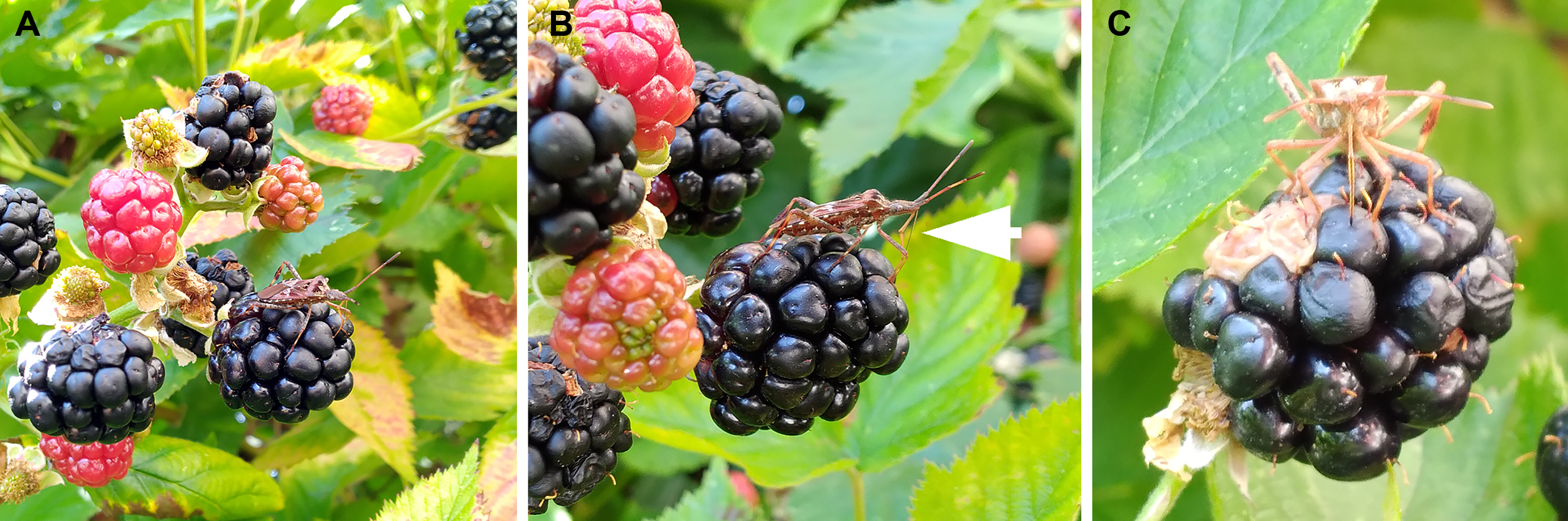
On 12 August 2023, western conifer seed bug adults were observed perching on the ripe fruit of two cultivated thornless Rubus fruticosus Linnaeus (Rosaceae) vines (Fig. 1) in Langford, British Columbia. The three-year-old vines were planted in a single row occupying a length of 4 m within a suburban yard with a southwest-facing aspect and full sun exposure. The berry vines were located approximately 170 m from a mature Pseudotsuga menziesii forest. Western conifer seed bugs were found concurrently with a notable population of conchuela stink bugs, Chlorochroa ligata Say (Heteroptera: Pentatomidae), which had caused moderate damage to the blackberry fruit and were subjected to control efforts including hand picking and spraying with a solution of dish detergent and water. Observations were repeatedly made of western conifer seed bugs feeding on fruit, with their proboscis inserted between or through individual drupelets (Fig. 1). Drupelets that were fed on became discoloured (pink to pale) and collapsed. The population on both vines was estimated to be at least 200 individuals. Continuous observations were made until the older canes bearing fruit were pruned and disposed of on 23 September 2023. Casual surveys of wild Rubus armeniacus Focke and cultivated Rubus spp. within 500 m of the observed western conifer seed bugs did not yield any other detections. Western conifer seed bugs were also not observed on the grapes of a cultivated Vitis vine planted within 1 m of the blackberry vines.
Leptoglossus occidentalis adults feeding on fruit of Rubus fruticosus: A, an adult perched on a ripe berry; B, arrow highlights the proboscis inserted into a drupelet; and C, the proboscis is inserted into a drupelet, and an adjacent pale, collapsed drupelet shows feeding damage.
Thirty-six adults were collected and stored in vials containing 70% ethanol. Species identification was confirmed by morphology and by amplifying and sequencing the mitochondrial cytochrome c oxidase subunit 1 gene (CO1). Two specimens were submitted to the National Identification Service (Agriculture and Agri-Food Canada, Ottawa, Ontario, Canada) and subsequently confirmed as L. occidentalis and then deposited into the Pacific Forestry Centre Arthropod Reference Collection, Victoria, British Columbia (PFC-2024-00013, PFC-2024-00014). Total genomic DNA was extracted from a fresh specimen using a Qiagen DNeasy® Blood and Tissue Kit (Qiagen, Hilden, Germany) following the manufacturer’s protocol, with the modification that grinding the specimen was replaced with piercing the abdomen with a sterilised scalpel. The specimen was kept in the extraction buffer until after the incubation and preserved in 70% ethanol. The partial CO1 sequence was amplified and sequenced using the primer pair LepF1 and LepR1 (Hebert et al. Reference Hebert, Penton, Burns, Janzen and Hallwachs2004). Polymerase chain reaction was conducted in a total volume of 25 µL containing 12.5 µmol of each primer, 4 µg BSA, 5 µmol dNTPs mix, 0.2 µL AccuStart II Taq DNA Polymerase (Quantabio, Beverly, California, United States of America), 60 µmol MgCl2, 2.5 µL 10X PCR Buffer II, 4.1 µL water, and 16 ng of template DNA. The thermocycler conditions were 94 °C for 2 minutes, then five cycles of 94 °C for 40 seconds, 45 °C for 40 seconds, and 72 °C for 1 minute, followed by 35 cycles each of 94 °C for 40 seconds, 51 °C for 40 seconds, and 72 °C for 1 minute, with a final extension at 72 °C for 5 minutes. Polymerase chain reaction product was verified by gel electrophoresis and submitted to the SANGER sequencing platform at Centre de recherche du CHU de Québec–Université Laval (Québec City, Québec, Canada) for sequencing using the BigDye Terminator sequencing kit, version 3.1 (Applied Biosystems, Foster City, California) and analysed with the ABI 3730xl Data Analyzer (Applied Biosystems). The resulting sequences were assembled and manually checked using Geneious Prime, version 2020.2.5 (https://www.geneious.com). Based on a BLASTn query with the National Center for Biotechnology Information GenBank, our CO1 sequence shared a 99.39–99.85% similarity with available L. occidentalis sequences – for example, identities = 657/658 (99%) with no (0) gaps (L. occidentalis 21_BHS_05, OP686468.1). The CO1 sequence was deposited into GenBank (accession number PP301970).
To our knowledge, there are no published reports of L. occidentalis feeding on Rubus or other Rosaceae hosts. Leptoglossus occidentalis appears to preferentially feed on conifer seeds of Pseudotsuga menziesii and Pinus species within its home range, but it is also reported on a broad range of conifers, including Abies (Pinaceae), Calocedrus (Cupressaceae), Cedrus (Pinaceae), Cupressus (Cupressaceae), Juniperus (Cupressaceae), Larix (Pinaceae), Picea (Pinaceae), and Tsuga (Pinaceae) (Barta Reference Barta2009; Lindelöw and Bergsten Reference Lindelöw and Bergsten2012; Grozea and Muntean Reference Grozea and Muntean2019), and it is even described as a pest of pistachio seeds, Pistacia vera Linnaeus (Anacardiaceae) (Rice et al. Reference Rice, Uyemoto, Ogawa and Pemberton1985; Uyemoto et al. Reference Uyemoto, Ogawa, Rice, Teranishi, Bostock and Pemberton1986). The western conifer seed bug has been reported to create holes with its stylets in a variety of natural and nonnatural substrates, including cross-linked polyethylene (PEX) plumbing pipes (Bates Reference Bates2005), plastic Petri dishes and Tygon tubing, needles of Pinus monticola Douglas ex D. Don and P. contorta (both Pinaceae), and the frothy spittle mass of the cone spittlebug, Aphrophora canadensis Walley (Hemiptera: Aphrophoridae) (W. Strong, unpublished data).
Leptoglossus occidentalis was clearly observed feeding on Rubus fruit over a period of approximately six weeks, but it is not known whether it can complete its life cycle on this host or if this was a rare opportunistic behaviour. We were unable to visually ascertain whether the insects were feeding on seeds, the liquid contents of the mesocarp, or the receptacle. In the future, damage to berries should be studied more thoroughly to elucidate feeding behaviour, which presumably involves seeds but may include berry juice, as our observations were made during a period of severe drought that may have limited water availability. Western conifer seed bugs produce an aggregation pheromone, which may explain why the observed insects occurred in such a localised area and not on nearby Rubus or other potential host fruit plants (Blatt and Borden Reference Blatt and Borden1996; Millar et al. Reference Millar, Zou, Hall, Halloran, Pajares and Ponce-Herrero2022). This first observation of L. occidentalis feeding on a rosaceous host suggests that the western conifer seed bug has the potential to act as an agricultural pest, thus expanding its phytosanitary significance.
Acknowledgements
The authors thank M.D. Schwartz (National Identification Service, Agriculture and Agri-Food Canada, Ottawa, Ontario, Canada) for confirming the morphological identification of our L. occidentalis specimens.
Competing interests
The authors declare that they have no competing interests.



