Introduction
The Caloplaca cerina group is treated here as a monophyletic group of species around C. cerina (Hedw.) Th. Fr. It is morphologically characterized by a crustose thallus, which is dark grey to white, devoid of anthraquinones but containing the grey pigment Sedifolia-grey (K+ violet in section). The apothecia can be classified as lecanorine with yellow to orange discs containing non-chlorinated anthraquinones, even though there is a strongly reduced true exciple containing anthraquinones in all species. The thalline exciple is distinct, persistent and in shades of grey, devoid of anthraquinones and with a conspicuous cortex in the lower part. The ascospores are c. 10–16 µm long, c. 6–9 µm wide and have a septum c. 4–7 µm thick; the conidia are bacilliform, 3–4 µm long and c. 1 µm wide.
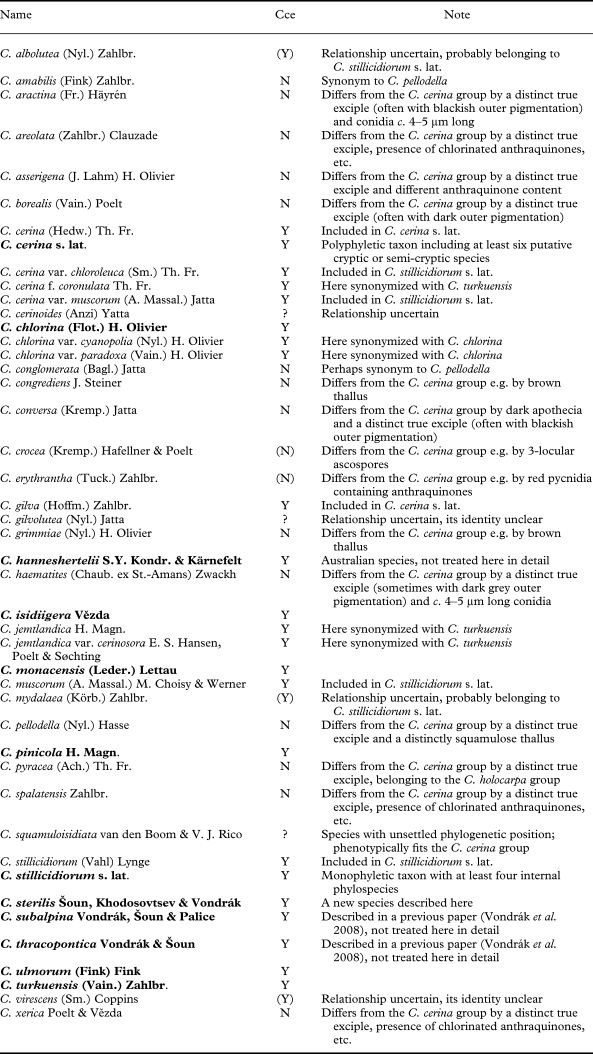
List of species that belong to or have formerly been included in the Caloplaca cerina group by Clauzade & Roux (Reference Clauzade and Roux1985) and Wetmore (Reference Wetmore2007). Only the infraspecific names of C. cerina with examined type material are listed. Cce – affiliation to the C. cerina monophyletic group according our ITS-sequence data; when brackets are used, the placement is based on phenotype characters only. Names representing accepted species within the C. cerina monophyletic group are in bold
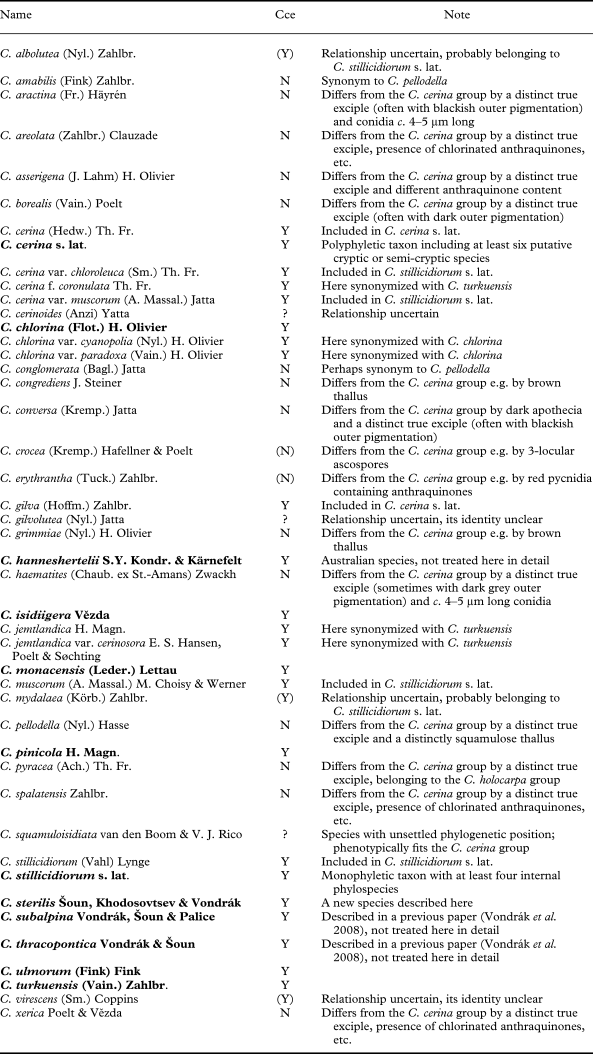
The large morphological variation within the group (e.g. in type of vegetative diaspores, disc colour, presence of pruina, size of apothecia) has resulted in many specific and infraspecific names described from all over the world (Table 1). Caloplaca cerina itself is an important species to understand as it is the type for the genus Caloplaca.
The group name has usually been applied in a broader morphological sense (Clauzade & Roux Reference Clauzade and Roux1985; Hansen et al. Reference Hansen, Poelt and Søchting1987; Wetmore Reference Wetmore1996, Reference Wetmore1997, Reference Wetmore2004, Reference Wetmore2007a), but our unpublished molecular data and phenotype evaluation show that some species commonly placed in this group belong elsewhere (Table 1) and they are not treated in detail here. The first data about the phylogeny of the group was published by Vondrák et al. (Reference Vondrák, Šoun, Hrouzek, Říha, Kubásek, Palice and Søchting2008), who described two new species, C. subalpina Vondrák, Šoun & Palice and C. thracopontica Vondrák & Šoun. The present study deals with the phylogeny of the entire group in Europe and also, to some extent, North America and western parts of Asia.
Material and Methods
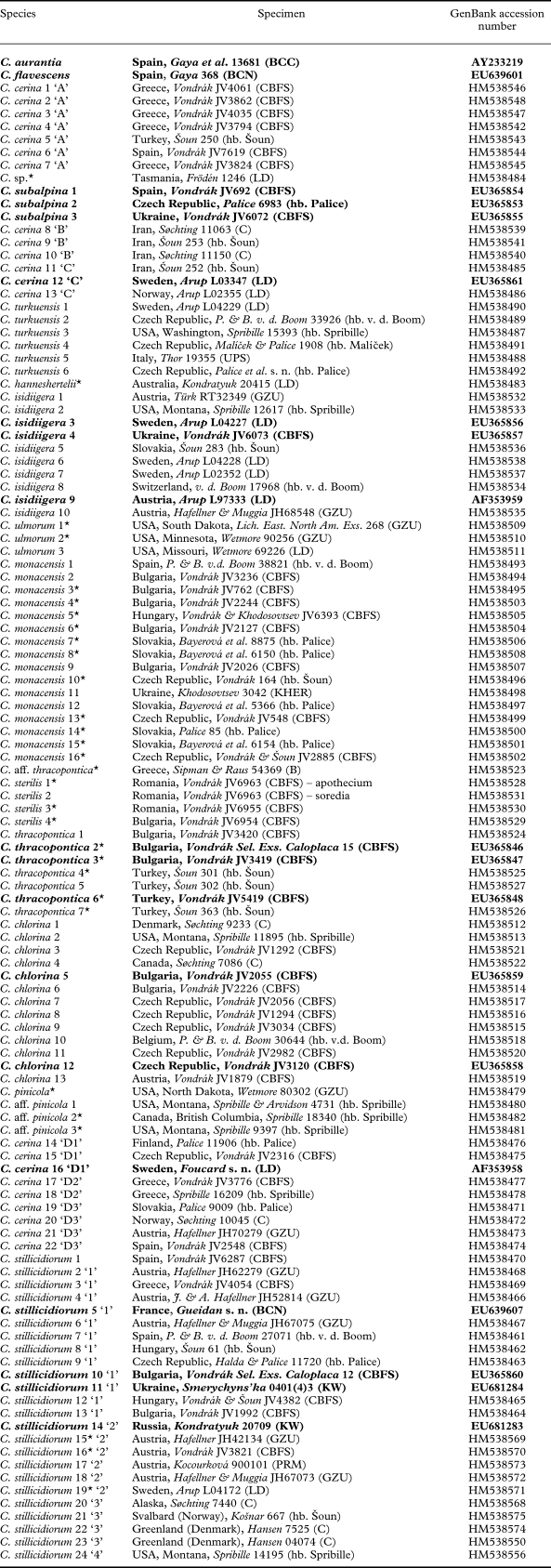
Our study is mainly based on material from the temperate zone of Europe, North America and Asia. Samples from ASU, B, BM, C, CBFS, GZU, H, KHER, LD, MIN, PRM, TUR, UPS and the private herbaria of P. van den Boom, J. Malíček, Z. Palice, T. Spribille and the first author have been used. Morphological data were taken only from sequenced specimens listed in Table 2. The specimens were examined with light microscopy. Anatomical features were measured on hand-cut sections or squash preparations mounted in water. Morphological characters were measured on dry material using a dissecting microscope (×45). Measurements are recorded as (min.–) x ± SD (–max.), where x = mean value, SD = standard deviation and min./max. = extremes. The total number of measurements (n) is given in brackets. Only the ascospores with well-developed septa (loculi connected by a thin and distinct cytoplasmatic channel) were measured.
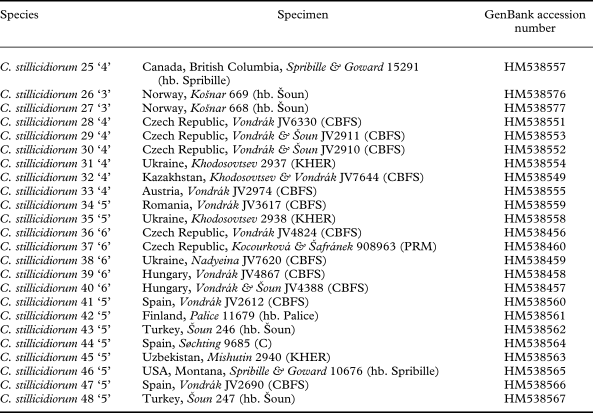
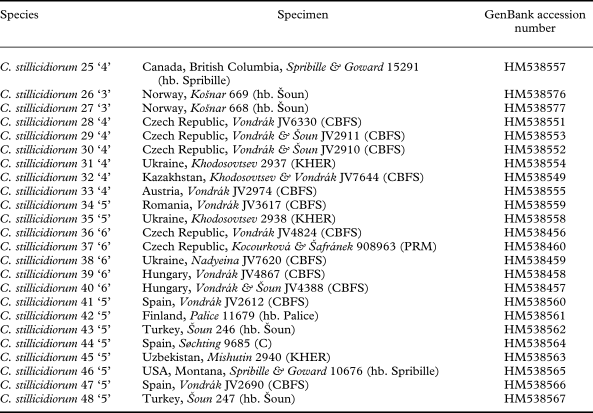
Voucher specimens and GenBank accession numbers of the ITS sequences used in the phylogenetic analysis. Specimens in bold were already at hand and the remainder were newly produced in this study
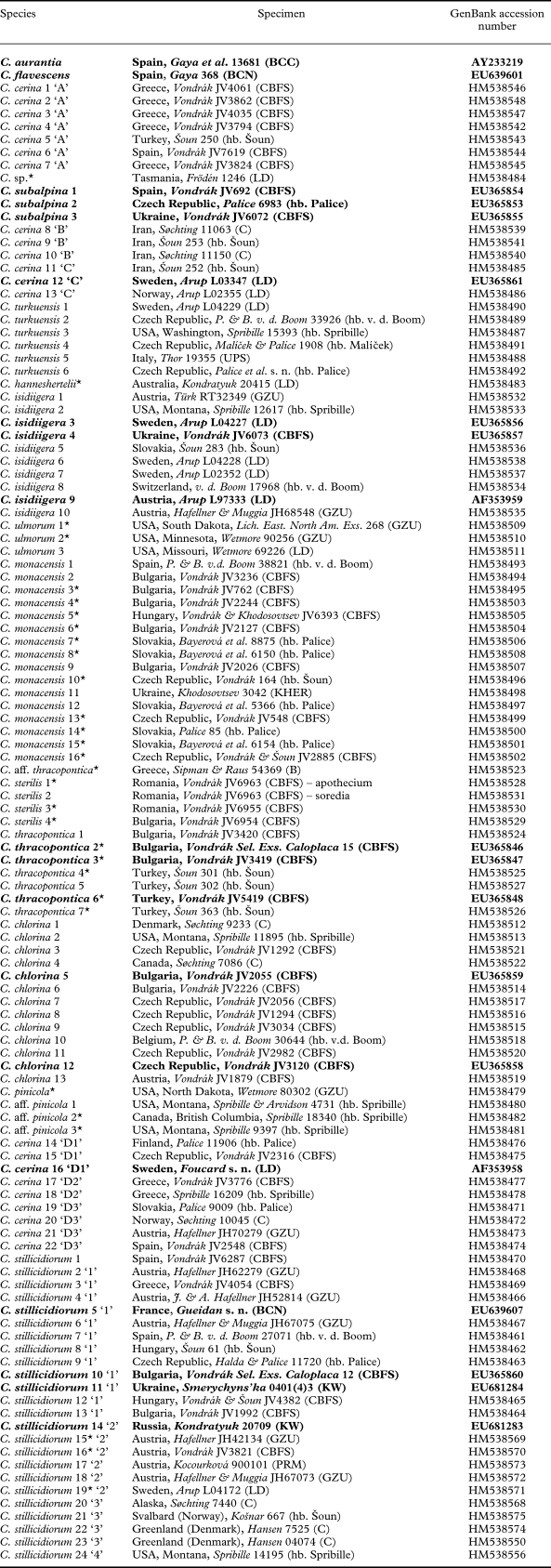
* Sequences have an intron 218 bases long in the 18S region
Anthraquinone contents (% concentrations) of selected species of the Caloplaca cerina group
Molecular markers, DNA extraction, PCR amplification and sequencing
Initially, we tried to use two loci, mtSSU and nrITS, for molecular analysis. However, the former proved to be too conserved for our study, thus we continued only with the ITS gene, which has suitable variability. Direct PCR was used for PCR-amplification of the ITS regions including the 5.8S gene of the nuclear rDNA following Arup (Reference Arup2006). Primers for amplification were ITS1F (Gardes & Bruns Reference Gardes and Bruns1993) and ITS4 (White et al. Reference White, Bruns, Lee, Taylor, Innis, Gelfand, Sninsky and White1990). PCR cycling parameters followed Ekman (Reference Ekman2001). Products were cleaned using JETquick PCR purification Spin Kit (Genomed). Both complementary strands were sequenced either by Macrogen Inc., Korea or by the Laboratory of Genomics, Biology Centre of the Academy of Sciences of the Czech Republic.
Sequence alignment and phylogenetic analyses
One hundred and twenty two newly obtained ITS sequences were included in the phylogenetic analysis along with seventeen sequences of the Caloplaca cerina group available from GenBank (Table 2). Sequences of Caloplaca aurantia (AY233219) and C. flavescens (EU639601) from GenBank were selected as an outgroup. Sequences were aligned using MAFFT 6 (on-line version in the Q-INS-i mode; see Katoh et al. Reference Katoh, Kuma, Toh and Miyata2002) and manually cut to eliminate the unalignable ends, the intron and ambiguously aligned regions of ITS1 and ITS2. The final alignment included 596 positions. Bayesian phylogenetic analysis was carried out using the programme MrBayes 3.1.1 (Ronquist & Huelsenbeck Reference Ronquist and Huelsenbeck2003). The General Time Reversible substitution model (Rodriguez et al. Reference Rodriguez, Oliver, Marin and Medina1990) with estimation of invariant sites and assuming a gamma distribution with four categories (GTR+I+G) was used for likelihood calculations. The optimal nucleotide substitution model was found with the program MrModeltest v2.3 (Nylander Reference Nylander2004) using the Akaike Information Criterion and the hierarchical likelihood ratio test (Posada & Crandall Reference Posada and Crandall1998). The MCMC analysis was run for ten million generations, performed in two runs, each with four chains starting from a random tree and using the default temperature of 0·2. Every 100th tree was sampled, and the first 30% of the trees were discarded as burn-in.
Chemistry
Lichen substances in the apothecia were extracted in 150 µl of acetone at room temperature. The extract was subjected to high-performance liquid chromatographic analysis (HPLC). Reverse phase column (C18, 5 µm, Lichrocart 250-4) was eluted with MeOH/30%MeOH+1%H3PO4 for 77 min and the absorbance at 270 nm was recorded (for details see Søchting Reference Søchting1997). The compounds were determined on the basis of their retention times and absorption spectra. Acetone insoluble pigments were examined according to Meyer & Printzen (Reference Meyer and Printzen2000).
Results
Phylogeny
The final alignment of 596 nucleotides had 134 variable positions. The following species had an insertion 218 bases long in the 18S region: C. stillicidiorum (only ecotype 2), C. pinicola, C. aff. pinicola, C. monacensis (except van den Boom 38821 and CBFS JV3236), C. ulmorum, C. thracopontica, C. aff. thracopontica, C. sterilis, C. hanneshertelii and C. sp. (Frödén 1246, LD). The insertion was not included in the analysis.
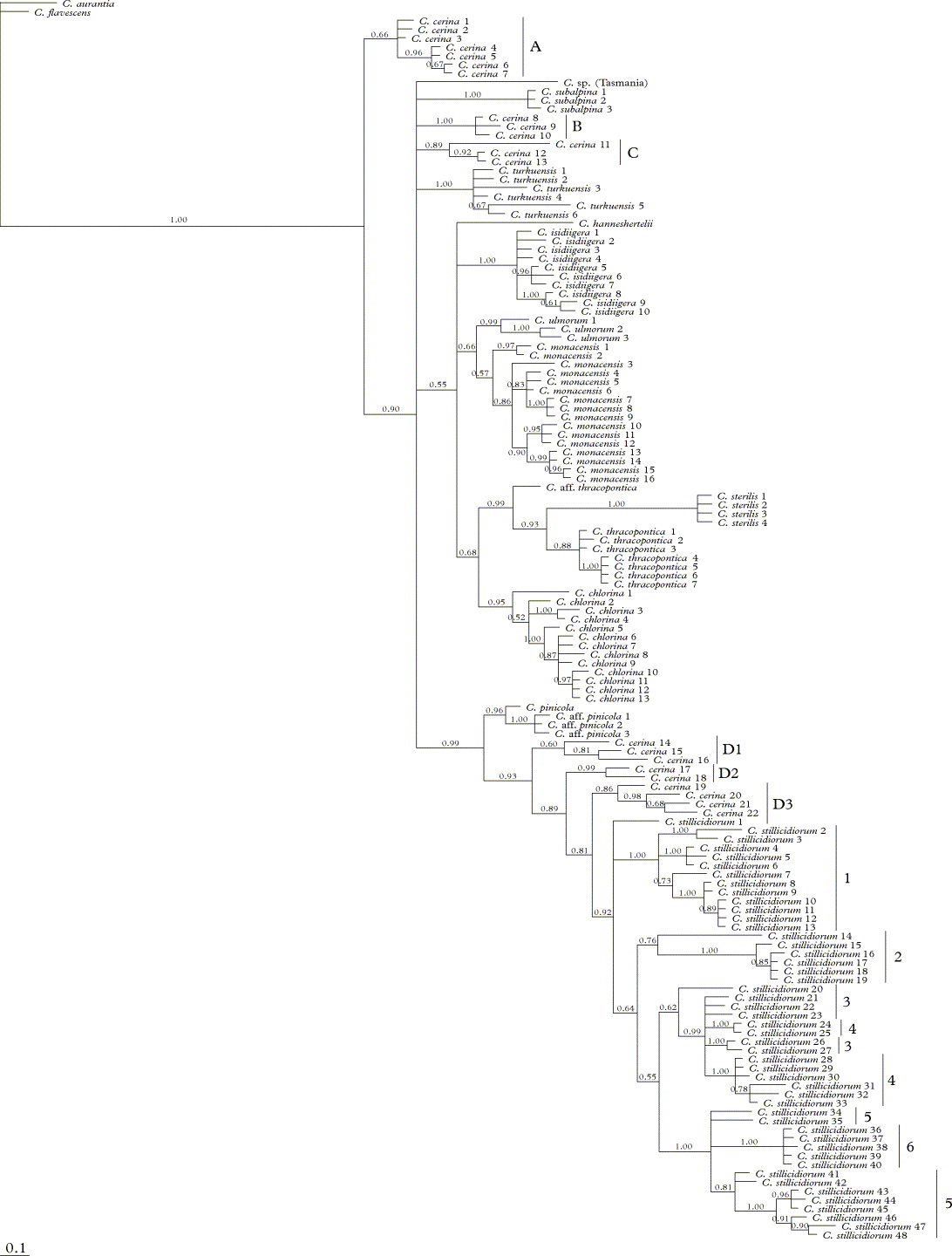
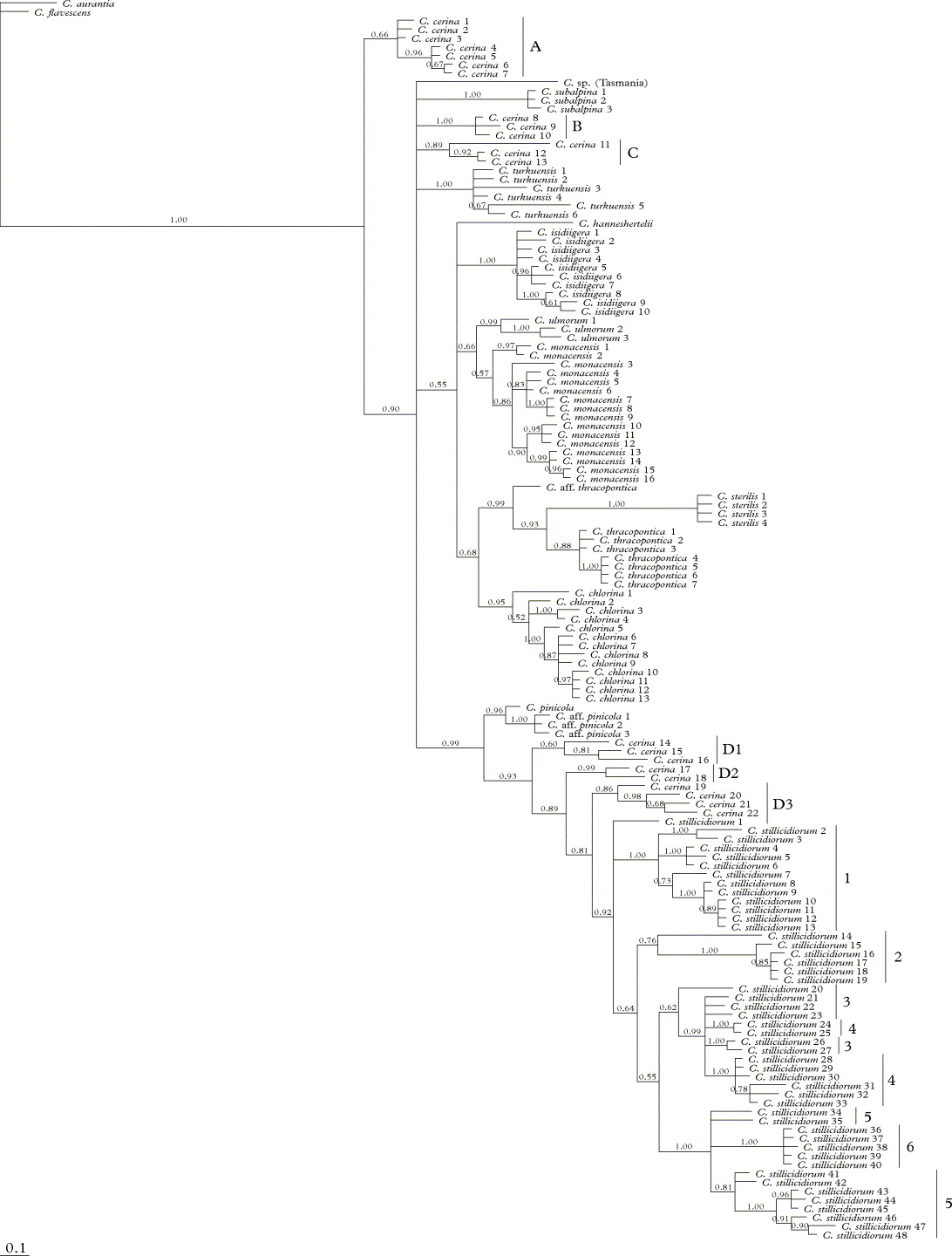
The phylogenetic tree, based on the Bayesian inference analysis is presented in Fig. 1 along with the posterior probabilities for the nodes. The species C. isidiigera, C. sterilis, C. subalpina, C. turkuensis and C. ulmorum form well-supported clades (PP > 0·95) in the cladogram. The species C. chlorina, C. monacensis and C. thracopontica are not so well supported. Caloplaca cerina s. lat. is a polyphyletic taxon with six lineages, possibly cryptic or semi-cryptic species. Caloplaca stillicidiorum s. lat. is a monophyletic taxon (PP = 0·92) forming the crown group of the tree. This clade is internally diverged into three major lineages (ecotype 1, ecotype 2, ecotype 3–4, ecotype 5–6), possibly representing several semi-cryptic species. The only available sequence of C. pinicola has a sister relationship to three similar sequences of North American sorediate C. cerina-like specimens which probably represent an unknown species (see the note under C. pinicola). The only sequence of C. aff. thracopontica from the Mediterranean region is close to the C. thracopontica clade but possibly not conspecific with it. One available sequence of the Australian C. hanneshertelii and one sequence of an undescribed species from Tasmania confirmed their affinities to the C. cerina group.
Bayesian consensus phylogeny of the Caloplaca cerina group inferred from nrDNA ITS sequences. Node support values are Bayesian posterior probabilities.
Chemistry
The anthraquinone content of all species analyzed from the C. cerina group is uniform (Table 3) and corresponds with chemosyndrome A (Søchting Reference Søchting1997). Sedifolia-grey, a pigment insoluble in acetone, is present in the cortex of the thallus, the thalline margin and in the vegetative diaspores, except the soredia of C. sterilis, of all studied species from the group (C+, K+, N+ pinkish violet/violet/sordid violet in section).
Key to fertile species known to belong to the Caloplaca cerina group. Sterile specimens can be confused with various species outside the group or even outside the genus Caloplaca
1 Ascospore septum relatively thin, 1·5–4·0 µm; thallus dark grey; soredia often present; North America ... C. pinicola
Ascospore septum wider, 4·0–7·0 µm ... 2
2(1) Thallus without any vegetative diaspores ... 3
Thallus with vegetative diaspores (lobules, isidia, granules, soredia/blastidia) ... 4
3(2) On trees and shrubs ... C. cerina s. lat.
On mosses, plant debris, wood, bark of exposed roots, dwarf-bushes and rarely on rocks ... C. stillicidiorum s. lat.
4(2) Thallus with lobules, isidia or granules (usually > 50 µm diam.) ... 5
Thallus with soredia/blastidia (usually up to 50 µm diam.) ... 9
5(4) Thallus surface with pustules and lobules, 100–400 µm wide or rarely without any
vegetative diaspores; saxicolous, maritime ... C. thracopontica
Thallus with isidia or granules ... 6
6(5) Thallus with isidia; apothecia absent or present ... 7
Thallus with granules on margins of areoles or completely granulose; granules (53–) 96 ± 27 (–163) µm diam.; usually richly fertile ... 8
7(6) Thallus areolate covered by small globose to shortly vertically elongated isidia, (25–) 66 ± 20 (–140) µm wide ... C. isidiigera
Thallus with branched coralloid isidia and erect lobules ... C. squamuloisidiata
(species with unsettled phylogenetic position)
8(6) Thallus areolate with marginal granules, rarely predominantly granular; corticolous; North America ... C. ulmorum
Thallus nearly to completely granulose; corticolous, rarely saxicolous; Europe, Asia ... C. monacensis
9(4) Soralia crater-like, Australia ... C. hanneshertelii
Soralia different ... 10
10(9) Areoles at thallus margin forming squamules, (0·16–) 0·58 ± 0·32 (–2·04) mm wide; thallus, at least in marginal parts, white-pruinose ... C. subalpina
Thallus without marginal squamules ... 11
11(10) Thallus with white-pruinose delicate areoles, (0·05–) 0·16 ± 66 (–0·30) mm wide, soralia (sordid) grey-green to pale green soralia ... C. sterilis
Thallus without pruina; soralia darker, usually with grey or blue tinge ... 12
12(11) Areoles usually relatively large, up to 1·2 mm wide; soredia/blastidia (15–) 33 ± 7 (–53) µm diam.; apothecia common, apothecial margin not sorediate; saxicolous or on nutrient-rich tree bases ... C. chlorina
Thallus with very small areoles up to 0·2 mm wide; areoles usually very soon entirely sorediate; soredia smaller (15–) 22 ± 3 (–30) µm diam.; apothecial margin often sorediate, at least in part, however some specimens completely without sorediate margin; corticolous, lignicolous ... C. turkuensis
(morphologically resembles another phylogenetically distant undescribed Caloplaca species, differing in soralia and apothecia with an endophloeic origin, not developing from areoles, the true exciple usually more apparent and the thalline margin not so stout)
The Species
Caloplaca cerina s. lat
Including Caloplaca cerina (Hedw.) Th. Fr. s. str., C. gilva (Hoffm.) Zahlbr., C. cerina var. azaleae (Vain.) Zahlbr., C. cerina var. circumponens (Nyl.) Boist., C. cerina var. subfuscescens (Nyl.) Blomb., C. cerina f. chrysaspis (Ach.) Th. Fr., C. cerina f. corni Britzelm.
This is a polyphyletic taxon split into six different clades scattered within the cladogram, comprising corticolous specimens lacking vegetative diaspores. Three of the clades, D1, D2 and D3, are very closely related and seem to have similar distribution and ecology; they are here treated together (group D). We keep all the lineages unnamed, without nomenclatural status, because we failed to find sufficient morphological characters to separate them. Brief summaries of the characteristics of each of the molecularly based groups are presented here:
A: on bark of Cupressus, Olea, Pistacia, and Platanus in the Mediterranean region (Greece, Spain, Turkey). Thallus as in clade B but tends to be darker; apothecia yellow to orange-yellow, strongly pruinose on disc and inner part of margin, to 1·1 mm diam.; ascospores (12–) 13·8 ± 1·1 (–16) × (5–) 6·4 ± 0·7 (–8) µm; septum (5–) 5·9 ± 0·7 (–7) µm wide (n = 60).
B: on bark of deciduous trees in northern Iran. Thallus crustose, thick, pale grey to beige, sometimes whitish; apothecia orange-yellow to deep orange, disc sometimes slightly pruinose when young, to 0·9 mm in diam.; ascospores (14–) 14·8 ± 0·8 (–17) × (7–) 8·3 ± 1·1 (–11) µm; septum (4–) 5 ± 0·5 (–6) µm wide (n = 20).
C: on bark of Salix in Scandinavia (Norway, Sweden) and on Fraxinus in Hyrcanian forest in Iran. Thallus and apothecia similar to the type D but smaller; apothecia orange-yellow, not pruinose, to 0·8 mm diam.; ascospores (10–) 12·6 ± 2 (–17) × (5–) 6·8 ± 1 (–9) µm; septum (3–) 4·1 ± 1 (–6) µm wide (n = 30).
D1, D2 and D3: on bark of Acer, Juglans, Populus, Prunus, Sambucus throughout Europe (Austria, Czech Republic, Finland, Greece, Norway, Slovakia, Spain). Thallus crustose, pale to dark grey, sometimes warted, thick or thin; apothecia orange-yellow to orange, rarely pruinose, to 1·6 mm diam.; ascospores (11–) 14·6 ± 1·7 (–20) × (6–) 7·9 ± 0·9 (–10) µm; septum (5–) 6·7 ± 1·2 (–10) µm wide (n = 90).
The holotype of C. cerina (Hedw.) Th. Fr. is the illustration in Hedwig (Reference Hedwig1788: 62, tab. 21, f. B). Wetmore (Reference Wetmore2007a) designated an epitype (MIN!) and several isoepitypes (ASU, COLO, MIN, US) using the exsiccate Lichenotheca Fenn. 116 (Finland, Ostrobottnia Borealis: Simo, insula Kumurainen, leg. Räsänen). The type illustration is difficult to assign to any of the clades described above. The epitype probably belongs to clade C because of its relatively small apothecia (to 1 mm diam.) and small spores (11–13 ×7–8 µm, septum 5–5·6 µm). However, a placement in the other Scandinavian clades, D1 or D3, is also possible.
Caloplaca chlorina (Flot.) H. Olivier
Mém. Soc. natl. Sci. nat. et math. Cherbourg 37: 122 (1909).—Zeora cerina α* [var.] chlorina Flot., Jahresber. Schlesisch. Gesellsch. für vaterl. Kultur 27: 126 (1849); type: Callopisma cerinum a** chlorinum, Körb. Lichenes Selecti Germanici Exsiccati no. 128 (1857), ad saxa granitica circa “Drachenburg” prope Hirschbergam Silesiae, Körber [O—neotype designated by Wetmore (Reference Wetmore1997), L, M!, MIN, S!—isoneotypes].
Caloplaca chlorina var. cyanopolia (Nyl.) H. Olivier, Mém. Soc. natl. Sci. nat. math. Cherbourg 37: 123 (1909).—Lecanora cerina f. cyanopolia Nyl., Notiser ur Sällsk. pro Fauna et Flora Fennica Förhandlingar 8: 128 (1866); type: Russia: Republic of Karelia, Sortavala, 1863, Kullhem [H-NYL 29770!—lectotype designated by Kärnefelt (Reference Kärnefelt1990)].
Caloplaca chlorina var. paradoxa (Vain.) H. Olivier, Mém. Soc. natl. Sci. nat. math. Cherbourg 37: 123 (1909).—Lecanora cerina var. cyanopolia *[f.] paradoxa Vain., Meddel. Societas pro Fauna et Flora Fennica 3: 55 (1878); type: Karelia australis, Wiipuri, Monrepos [Russia, Leningrad Oblast, Vyborg], 1875, Lang (TUR-V 07552!).
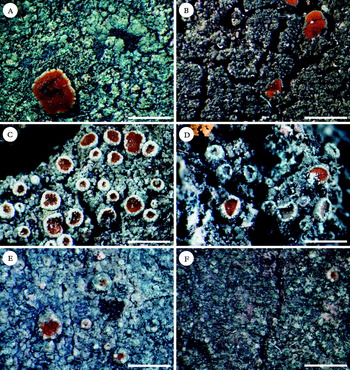
(Fig. 2A)
Caloplaca species. A, C. chlorina (CBFS JV2055); B, C. isidiigera (Šoun 283); C, C. monacensis (v. d. Boom 38821); D, C. monacensis Arnold Lich. Monacenses exs. 1896 no. 422, note apothecial discs without normal yellow-orange colour (BP—isotype); E. & F, C. turkuensis (CBFS JV2921). Scales: A–F = 1 mm.

Thallus areolate, up to several cm wide, non-pruinose, up to 0·27 (–0·53) mm thick, always sorediate/blastidiate; sometimes also with tiny isidiate outgrowths especially at margins of older areoles; areoles flat to convex, up to 1·2 mm wide; colour variable, sordid white, pale grey, brownish grey, dark grey to almost black, usually with bluish tinge; soralia and blastidia pale to dark grey, with bluish tinge, rarely greenish grey, arising from margins of areoles, sometimes spreading over the whole areole; soredia/blastidia (15–) 33 ± 7 (–53) µm diam. (n = 100); soredia sometimes forming consoredia; prothallus sometimes present, thin and black; cortex up to 10 (–30) µm thick, paraplectenchymatous.
Apothecia lecanorine, abundant to absent, up to 1·5 mm diam., sessile, non-pruinose; disc flat to slightly convex, pale to dark orange; true exciple indistinct, very thin, up to 15 µm thick, prosoplectenchymatous; thalline exciple of thallus colour, raised above disc when young, somewhat reduced in old apothecia, 60–90 µm thick; epihymenium orange, with inspersed granules; hymenium 50–85 µm thick, hyaline; hypothecium (55–) 80–110 µm thick, hyaline; paraphyses simple to branched, 2 µm broad with upper cells wider, 3–5 µm thick; asci 8-spored, 35–59 × 10–18 µm (n = 50); ascospores polarilocular, ellipsoid, (10·0–) 12·4 ± 0·9 (–15·0) × (5·0–) 6·6 ± 0·6 (–8·0) µm; septum (4·0–) 4·7 ± 0·5 (–6·0) µm wide (n = 100); ratio of septum width/spore length (0·3–) 0·4 ± 0·04 (–0·5).
Pycnidia rare to scattered, immersed, distinct by elevated darker ostiole; conidia bacilliform, 3–4 × 1 µm.
Habitat and distribution. This species grows from lowlands to mountains on basic or nutrient enriched siliceous (e.g. gneiss, slate, granite) and limestone rocks both in natural and anthropogenic habitats, especially on old stone walls, pebbles in railroads, bricks, roofing-tiles and mortar. It is occasionally found on bark of broad-leaved trees (e.g. Acer, Fraxinus, Juglans, Ulmus) on trunk bases. It seems to prefer humid or shaded sites and substrata near the ground. Probably it is quite frequent throughout Europe but often overlooked or confused with similar taxa. There are confirmed records from Austria, Belgium, Bulgaria, Czech Republic, Denmark, Germany, Ireland, Netherlands, Norway, Portugal, Romania, Russia, Slovakia, Sweden, Ukraine and the United Kingdom. The world distribution (see Fletcher & Laundon Reference Fletcher, Laundon, Smith, Aptroot, Coppins, Fletcher, Gilbert, James and Wolseley2009) needs revision but three records from North America are confirmed.
Remarks. The name C. chlorina has often been used in a broad sense for saxicolous and corticolous specimens of the C. cerina group with any vegetative diaspores. Wetmore (Reference Wetmore1997) selected a neotype for C. chlorina and stated that the isidiate C. isidiigera is a synonym. However, according to our results, C. chlorina s. str. is always characterized by the presence of soredia/blastidia. Only some morphotypes of C. chlorina, usually overgrown or grazing affected thalli, possessing various isidia-like secondary outgrowths and consoredia, can resemble C. isidiigera. Sterile specimens can be confused with some unrelated species, for example C. soralifera Vondrák & Hrouzek.
Selected specimens examined. Austria: Lower Austria: Wolfsthal, castle ruins Pottenburg, Vondrák JV1879 (CBFS). Carinthia: Gailtaler Alpen, Hermagor, Weibriach, van den Boom 16234 (hb. v. d. Boom). Burgenland: Bernsteiner Gebirge, Bernstein, Hafellner & Maurer JH31242 (GZU).—Belgium: Luxembourg: Martelange, Witry, van den Boom & van den Boom 30644 (hb. v. d. Boom).—Bulgaria: Haskovo: Eastern Rodopi Mts, Malko Gradishte, Vondrák JV2226 (CBFS); Madzharovo, Vondrák JV2055 (CBFS).—Canada: British Columbia: Wells Gray Educ. and Res. Centre, Søchting 7086 (C). Newfoundland: Waghorne (BM).—Czech Republic: Central Bohemian Reg.: Rakovník, castle ruins Týřov, Vondrák JV2982, JV2764 (CBFS). South Bohemian Reg.: Písek, castle Zvíkov, Vondrák JV3034, (CBFS). Zlín Reg.: Kroměříž, castle Buchlov, Vondrák JV1294 (CBFS). Liberec Reg.: Jizerské hory Mts, Jizerka, Kocourková & Kocourek 907659 (PRM). Karlovy Vary Reg.: Karlovy Vary, Andělská Hora, Vondrák JV1103 (CBFS). Plzeň Reg.: Konstantinovy Lázně, castle ruins Krasíkov, Vondrák JV2294 (CBFS). Vysočina Reg.: Nové Město na Moravě, Kuťák 762037 (PRM). Moravian-Silesian Reg.: Hrubý Jeseník Mts, Mt Vysoká hole, Vondrák JV1932 (CBFS). South Moravian Reg.: Kyjov, Milotice, Vondrák JV1373 (CBFS).—Denmark: Bornholm: Hammershus, Larsen & Vondrák JV4714 (CBFS).—Germany: Baden- Württemberg: Heidelberg (M).—Ireland: Connemara: Lough Feagh and Lough Muck, Larbalestier 23 (BM).—Netherlands: North Holland: Naarden-Vesting, van den Boom 15417 (hb. v. d. Boom). North Brabant: Werkendam, Woudrichem, van den Boom 12545 (hb. v. d. Boom).—Norway: Aust-Agder: Grimstad, Tønsberg 13551 (BM).—Portugal: Trás-os-Montes: Bragança, Zeive, van den Boom 19357 (hb. v. d. Boom).—Romania: Arad: Arad, Nǎdlac, Vondrák JV2222 (CBFS).—Slovakia: Trenčín Reg.: Považský Inovec Mts, Tematín, Halda & Palice 10186 (hb. Palice). Bratislava Reg.: Bratislava, Mt Devínská kobyla, Vondrák JV1822 (CBFS).—Sweden: Värmland: Frykerud, Arup L03566 (LD). Skåne: Maltesholm, Hessikahuset, Arup L08033 (LD).—Ukraine: Crimea: Karadag Mts, Mt Svyataya, Vondrák 290 (hb. Šoun).—Great Britain: Scotland: Dumfries, Drumlanrig Castle, James (BM); Banff, Mountblairy, James (BM); Mid Ebudes, Ballyhaugh, James (BM). Wales: Monmouthshire, Abergavenny, James (BM).—USA: Montana: Lincoln Co., W of Libby, Spribille 11895 (hb. Spribille).
Exsiccata examined. Finland: Finland Proper Reg.: Kakskerta, Lich. Fenn. Exs. no. 234 [as Placodium gilvum var. chlorina].—Russia: Karelia: Kurkiyeki, Lich. Fenn. Exs. no. 85 [as Placodium gilvum var. chlorina] (BM).—Sweden: Närke: Mellösa, Arnold: Lich. Exs. no. 1550a [as Callopisma cerinum f. chlorinum] (BM).
Caloplaca hanneshertelii S.Y. Kondr. & Kärnefelt
Bibliotheca Lichenologica 88: 262 (2004); type: Australia, Victoria, NW of Swan Hill, 22 km W of Nyah West, on shrubs along the road, c. 50 m alt., 35°10′61″S, 143°09′14″E, growing together with Xanthoria filsonii, 15 January 1999, Kärnefelt 992101 (LD—holotype).
This Australian corticolous species is characterized by crater-like soralia with dark-bluish soredia erupting from pustule-like outgrowths at whitish grey areoles. Apothecia are small, 0·2–0·5 mm diam. Caloplaca ahtii Søchting, C. obscurella (J. Lahm) Th. Fr. and C. ulcerosa Coppins & P. James have similar type of soralia but their apothecia differ. For detailed description of this species see Kärnefelt & Kondratyuk (Reference Kärnefelt and Kondratyuk2004).
Caloplaca isidiigera Vězda
Folia Geobot. Phytotax. Bohemoslov. 13: 417 (1978); type: Caloplaca isidiigera, Vězda Lich. Sel. Exs. no. 1494, Czechoslovakia, Eu-Carpaticum, Tatra Minor, in monte Velký bok, c. 1550 m s. m., ad saxa calcarea, September 1974, Vězda (PRA-V—holotype; PRM!, BM!—isotypes).
(Fig. 2B)
Thallus areolate, up to several cm wide, non-pruinose, up to 0·4 (–0·8) mm thick, isidiate; areoles convex when very young, later flat, up to 2·1 mm wide; colour varies from sordid pale grey, dark grey to black, usually with bluish tinge; lower part of very thick areoles often stained purple-black (in section); isidia initially arising mainly from margins of areoles, but soon covering whole surface of areoles, globose to shortly elongated or flattened, concolorous with the areoles; (25–) 66 ± 20 (–140) µm diam. (n = 82); prothallus usually present, thin and black; cortex up to 20 µm thick, paraplectenchymatous.
Apothecia lecanorine, abundant to absent, up to 1·3 mm diam., sessile, non-pruinose; disc flat to slightly convex, pale to dark orange; true exciple indistinct, very thin, up to 10 µm thick, prosoplectenchymatous; thalline exciple of thallus colour, raised above disc when young, somewhat reduced in old apothecia, sometimes crenulate to isidiate, 65–110 µm thick; epihymenium orange, with inspersed granules; hymenium 55–85 µm thick, hyaline; hypothecium 60–110 µm thick, hyaline; paraphyses simple to branched, 2 µm broad with upper cells wider, 3–5 µm thick; asci 8-spored, 38–55 × 9–15 µm (n = 24); ascospores polarilocular, ellipsoid, (10·0–) 12·4 ± 1·4 (–15·0) × (5·0–) 6·5 ± 0·9 (–8·0) µm; septum (3·0–) 4·6 ± 0·7 (–6·0) µm wide (n = 48); ratio of septum width/spore length (0·3–) 0·4 ± 0·05 (–0·5).
Pycnidia rarely seen, immersed; conidia bacilliform, 3 × 1 µm.
Habitat and distribution. The species seems to grow only in subalpine and alpine habitats on natural limestone, dolomite or calciferous slate and base-rich sandstone rocks. Confirmed records are from the Alps (Austria, Germany, Italy and Switzerland), Carpathians (Slovakia, Ukraine) and Scandinavia (Sweden). One record is confirmed from North America.
Remarks. This species is characterized by the presence of isidia and the type specimens are clearly isidiate. However, Wetmore (Reference Wetmore1996) considered these structures seen in the isotypes as lobules and van den Boom & Rico (Reference van den Boom and Rico2006) regarded them as granules or microsquamules. This has caused many misinterpretations and the name has, for example, been applied to the corticolous C. monacensis. Sterile specimens might be confused with unrelated C. xerica Poelt & Vězda, but it differs in growing on base-rich siliceous rocks in xerothermic habitats.
Nomenclatural note. Caloplaca isidiigera was synonymized by Wetmore (Reference Wetmore1997) with C. chlorina, and thereafter not accepted as a separate species. This study clearly shows that both taxa are separate species (for more details see the note under C. chlorina).
Selected specimens examined. Austria: Styria: Ennstaler Alpen, Reichenstein-Massiv, Hafellner, Muggia & Hafellner JH68548 (GZU); Schladminger Tauern, Ursprungalm, Türk RT32349 (GZU); Gurktaler Alpen, Turrach, Hafellner JH61513 (GZU); Steirisches Randgebirge, Grazer Bergland, Mixnitz, Hafellner JH64492 (GZU); Nördliche Kalkalpen, Hochschwab-Gruppe, Trenchtling, Hafellner & Hafellner JH62455 (GZU); Mürzsteger Alpen, Schneealpe, Mayrhofer & Bilovitz 17752 (GZU); Wölzer Tauern, Lachtal, Mayrhofer & Sterner 13973 (GZU); Stubalpe, Wölkerkogel, Wilfling & Unger AW2315 (GZU); Niedere Tauern, Gumpeneck, Hafellner & Wilfling AW1728 (GZU); Eisenerzer Alpen, Reiting-Massiv, Hafellner & Hafellner JH43577 (GZU). Carinthia: Karnische Alpen, Schloßhüttensattel, Poelt IN52-84 (GZU). Tyrol: N. P. Hohe Tauern, Kals, Hafellner JH47074 (GZU).—Germany: Bavaria: Berchtesgaden N. P., Türk & Wunder (M).—Italy: Trentino-Alto Adige: Merano, NP Stilfser Joch, van den Boom 10756 (hb. v. d. Boom).—Slovakia: Žilina Reg.: Nízke Tatry Mts, Mt Veľký bok, Šoun 283 (hb. Šoun).—Sweden: Lule Lappmark: Padjelanta national park, Allak, Arup L04227 (LD). Torne Lappmark: Torneträsk, Bessisjohka, Arup L04228 (LD). Pite Lappmark: Arjeplog par., Mt Skärrim, Arup L03570 (LD). Härjedalen: NE of Ramundberget, Mt Stor-Mittåkläppen, Arup L02352 (LD).—Switzerland: Berner Oberland: Brienz, Chüemad, van den Boom 17968 (hb. v. d. Boom). Valais: Val de Moiry, Fêta d'Août de Chateaupré, van den Boom 10108 (hb. v. d. Boom).—Ukraine: Zakarpatska oblast: Svidovets Mts, Vondrák JV6073 (CBFS).—USA: Montana: Lincoln Co., Whitefish Range, Mt Marston, Spribille 12617 (hb. Spribille).
Exsiccata examined. Ukraine: Zakarpatska oblast: Svidovets Mts, Vondrák: Sel. Exs. of Caloplaca no. 42 (CBFS).
Caloplaca monacensis (Leder.) Lettau
Hedwigia 52: 240 (1912).—Pyrenodesmia monacensis Leder., Bericht. Bayr. Botan. Gesellsch. 4: 26 (1896); type: Pyrenodesmia monacensis, Arnold Lich. Monacenses Exs. 1896 no. 422, an alten Strassenpappeln nicht weit vom Warthof bei Giesing, München, März 1896, Lederer [M (M-0023624)!—lectotype designated here, BP!, BM!, M (M-0053460)!—isolectotypes].
(Figs 2C & D)
Thallus predominantly to entirely granular, scarcely with distinct areoles, especially around apothecia, scattered to continuous, thin to thick, non-pruinose, (sordid) pale to dark grey; granules (53–) 96 ± 27 (–163) µm diam. (n = 99). Sometimes very minutely tomentose with inconspicuous hairs 4–10 × 2–3 µm formed by projecting hyphae (visible in section), particulary on granules; prothallus not seen.
Apothecia lecanorine, abundant to rare, up to 1·2 mm diam., sessile, distinct, sometimes pruinose; disc flat to slightly convex, yellow-orange to orange, sometimes pruinose, especially when young; true exciple indistinct, very thin, up to 20 µm thick, prosoplectenchymatous; thalline exciple of thallus colour and often whitish pruinose, raised above the disc when young, somewhat reduced in old apothecia, 55–110 µm thick; epihymenium orange, with inspersed granules; hymenium (65–) 85–102 µm thick, hyaline; hypothecium (45–) 75–90 µm thick, hyaline; paraphyses simple to branched, 2 µm broad with upper cells wider, 4–6 µm diam.; asci 8-spored, 40–67 × 10–22 µm (n = 48); ascospores polarilocular, ellipsoid, (11·0–) 13·4 ± 1·3 (–16.0) × (5·0–) 6·5 ± 0·7 (–8·0) µm, septum (3·0–) 4·9 ± 0·7 (–7·0) µm wide (n = 100), ratio of septum width/spore length (0·2–) 0·4 ± 0·05 (–0·5).
Pycnidia rare to scattered, immersed, made distinct by elevated darker ostiole; conidia bacilliform, 3–4 × 1 µm.
Habitat and distribution. This species grows on bark of wayside trees, solitary trees in pastures and in other types of agricultural landscapes and in open deciduous or mixed forests. It has been recorded on a variety of broad-leaved trees such as Acer, Fagus, Fraxinus, Juglans, Ostrya, Pistacia, Populus, Pyrus, Quercus, Salix, Tilia, Ulmus, but it is also rarely found on bark of shrubs and rotten wooden fences. Once it was found growing on shaded cherty limestone in Bükk Mts, Hungary (Vondrák et al. Reference Vondrák, Šoun, Redchenko, Lőkös and Khodosovtsev2009b). Probably it is widely distributed from the lowlands to medium altitudes in the mountains throughout temperate and Mediterranean Europe and western Asia, but its collection has been mistaken for C. cerina. We have confirmed it from Austria, Bulgaria, the Czech Republic, Germany, Greece, Hungary, Italy, Russia, Slovakia, Slovenia, Spain, Sweden, Turkey, Ukraine and the United Kingdom.
Remarks. Caloplaca monacensis is characterized by its granular thallus and usually pruinose apothecia. The North American C. ulmorum, a closely related taxon, is very similar, but it usually has a more developed areolate thallus with granules at the thallus margins.
Nomenclatural note. The name C. monacensis was never widely used; it was adopted by Lettau (Reference Lettau1912), Migula (Reference Migula and Thomé-Migula1929), Zahlbruckner (Reference Zahlbruckner1931) and Poelt (Reference Poelt1969) without any new records. The reason is that the apothecia in the exsiccate (syntype) are mostly brownish and only rarely with the normal yellow-orange colour (see Fig. 2D). Therefore it was originally described in the genus Pyrenodesmia. In all other aspects the specimens in the exsiccate are morphologically completely consistent with recent collections of the species.
Selected specimens examined. Austria: Styria: Schladminger Tauern, Schladming, Kocourková 900419 (PRM). Lower Austria: Mitterbach am Erlaufsee, Neuhaus, Poelt IN10-84 (GZU). Carinthia: Koralpe, Oberauerling, Maurer 1131 (GZU); Görtschitztal, Lölling Graben, Hafellner JH14855 (GZU). Burgenland: Mittelburgenland, Bernstein, Maurer 356 (GZU). Salzburg, Kondratyuk 2936 (KHER).—Bulgaria: Kardzhali: Eastern Rodopi Mts, Ptichar, Vondrák JV2026 (CBFS). Burgas: Strandzha Mts, Gramatikovo, Vondrák JV3236 (CBFS).—Czech Republic: South Moravian Reg.: Pavlovské vrchy hills, Soutěska, Vondrák 164 (hb. Šoun). Vysočina Reg.: Nové Město na Moravě, Kuťák 697020 (PRM). Central Bohemian Reg.: BR Křivoklátsko, Týřov, Palice 9151 (hb. Palice).—Greece: Crete: Orosira Dikti Mts, Ano Viannos, Vondrák JV3768 (CBFS).—Hungary: Borsod-Abaúj-Zemplén: Bükk Mts, Látó-kövek, Vondrák & Khodosovtsev JV6393 (CBFS).—Italy: Trentino-Alto Adige: Val Venosta, Glorenza, Hafellner 61270 (GZU).—Russia: Orenburg: Buzuluk distr., Nat. park “Buzulukskiy bor”, Zapovednoye, Vondrák JV7336 (CBFS).—Slovakia: Banská Bystrica Reg.: Muránska planina Mts, Mt Šiance, Bayerová, Halda & Palice 5366, 8875 (hb. Palice).—Slovenia: Cerknica: Rakek, Prügger, Suppan, Mayrhofer & Batič SN059.8/1 (GZU).—Spain: Extremadura: SW of Cáceres, van den Boom & van den Boom 38821 (hb. v. d. Boom).—Sweden: Uppland: Norrsunda par., Rosenberg, Nordin 2081 (UPS).—Turkey: Eastern Anatolia Reg.: Lake Van, Yassıca, Vondrák JV6514 (CBFS).—Ukraine: Crimea: Czernigiv, Khodosovtsev 3042 (KHER).—Great Britain: England: Colchester, Crombie 380 (BM).
Exsiccata examined. Austria: Lower Austria: Rosenau, Mt Sonntagberg, Krypt. Exs. no. 252 [as C. cerina var. ehrharti] (PRM, BM).—Bulgaria: Haskovo: Rhodope Mts, Rabovo, Vondrák Sel. Exs. Caloplaca. no. 11 [as C. virescens] (CBFS).—Czech Republic: Central Bohemian Reg.: Benešov u Prahy, Hodětice, Vězda: Lich. Sel. Exs. no. 2469 [as C. cerina var. cyanolepra] (BM).—Germany: Baden-Württemberg: Constance, Rabenhorst: Lich. Eur. no. 697 [as Placodium cerinum var. ehrharti] (BM).—Italy: Veneto: Vicenza, Trevisan: Lichenotheca veneta no. 183 [as C. cerina var. ehrhartii] (BM).—Slovakia: Žilina Reg.: Nízké Tatry Mts, Lich. Slovak. Exs. no. 227 [as C. cerina] (BM).
Caloplaca pinicola H. Magn
Bot. Not. 1953(2): 188 (1953); type: USA, Arizona, [Coconino Co.] Grand Canyon National Park, Coconino Plateau, August 1926, E. & G. Du Rietz (S!—holotype; UPS!—isotype selected by Wetmore Reference Wetmore2004 as superfluous lectotype).
Taxonomic note. Detailed descriptions are given in Wetmore (Reference Wetmore2004, Reference Wetmore2007a, b). According to specimens of C. pinicola seen from ASU, GZU and MIN, the species seems fairly variable in thallus morphology, especially in the number and characteristics of the soralia. The uniting character is a relatively thin spore septum (3·0–4·0 µm and never up to 5·5 µm). Unfortunately, the type specimen has a poorly developed thallus. The species needs further study.
There is one closely related species, also from North America, here provisionally called C. aff. pinicola (Fig. 1), but it differs in having larger ascospores with thicker septa.
Nomenclatural note. The holotype of C. pinicola was identified by Magnusson himself in S; on the label is written in Magnusson's handwriting “Caloplaca pinicola H. Magn. n. sp.” and “Typus!”. Wetmore's lectotypification (Wetmore Reference Wetmore2004) is superfluous.
Selected specimens examined. USA: Arizona: Coconino Co., Grand Canyon Nat. Park, Nash 10513 (GZU); Gila Co., Flowing Springs, Nash 39318 (MIN); Pima Co., Saguaro Nat. Mon., Wetmore 54893 (MIN). Colorado: San Juan Co., Mesa Verde Nat. Park, Nash 18141 (ASU); Rio Grande Co., South Fork, Wetmore 17214 (MIN). New Mexico: Catron Co., San Francisco Mts, Nash 22562 (ASU); San Juan Co., Marsh & Rankert 419, 448 (ASU); Union Co., Capulin Mt. Nat. Mon., Wetmore 17433 (MIN). North Dakota: McKenzie Co., T. Roosevelt Nat. Park, Warford City, Wetmore 80071 (MIN); Billings Co., T. Roosevelt Nat. Park, Medora, Wetmore 45047 (MIN), 80302 (GZU).
Caloplaca sterilis Šoun, Khodosovtsev, Vondrák sp. nov
Thallus areolatus albido-pruinosum, areolae soraliis marginalibus; soredia viridi-grisea, pigmentis anthraquinoneis et Sedifolia-grisea in thallo et soraliis nullis; apothecia lecanorina (Caloplaca cerinae-typus).
Typus: Ukraine, AR Crimea, Chornomorskiy district, village Olenevka, cape Tarchankut, coast of Black Sea, on twigs of Artemisia lerchiana, 45°20′61·7″N, 32°30′47·6″E, alt. 15 m, 4 May 2010, A. Khodosovtsev (KHER—holotypus; KHER, CBFS —isotypi).
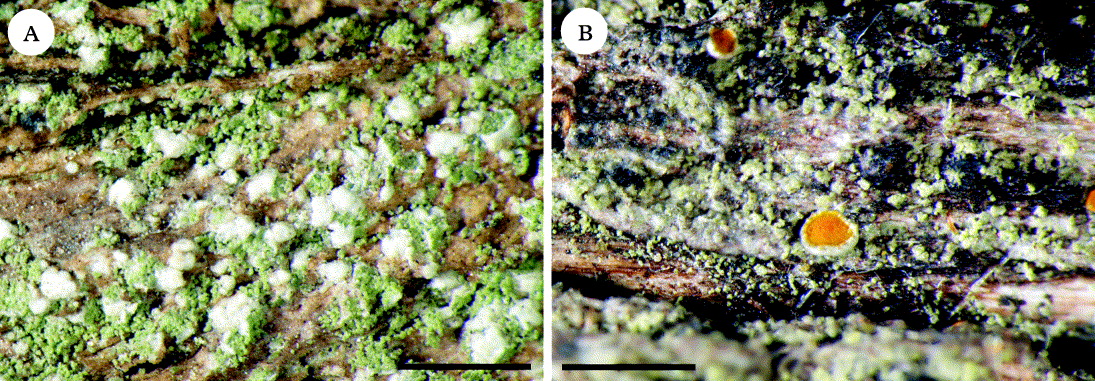
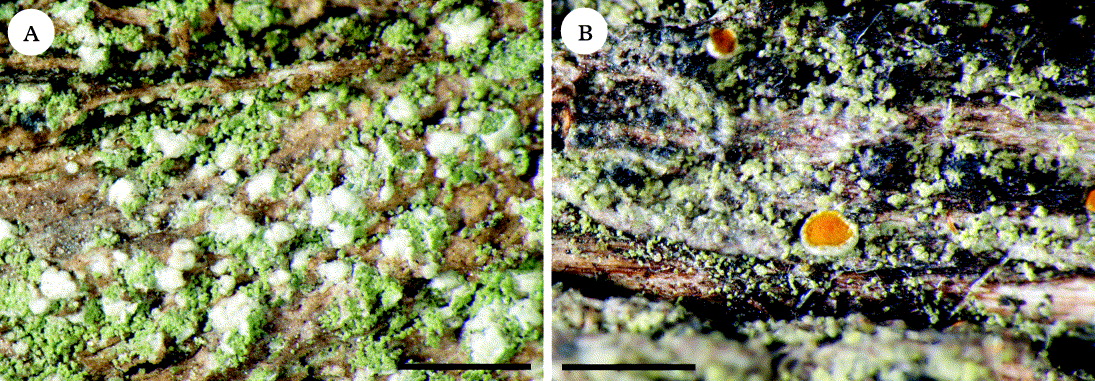
(Fig. 3A & B)
Caloplaca sterilis. A, specimen with white pruinose areoles from steppe (CBFS JV6962); B, fertile specimen without pruina from coastal sand dunes (CBFS JV7421). Scales: A & B = 1mm.
Thallus of scattered areoles/squamules to thin, inconspicuous, grey-green, often white pruinose, sorediate; areoles or squamules (50–) 157 ± 66 (–300) µm wide (n = 22), slightly convex, (50–) 85 ± 22 (–130) µm thick (n = 20); cortex alveolate (sensu Vondrák et al. Reference Vondrák, Šoun, Redchenko, Lőkös and Khodosovtsev2009a) 8–12 µm thick, loosely paraplectenchymatous with crystals dissolving in N; algal layer thick, reaching lower thallus surface; medulla not always conspicuous, formed by loose prosoplectenchymatous tissue; photobiont trebouxioid; soralia developed on the areole margins or rarely punctiform on thallus surface, greenish or greenish grey, (80–) 145 ± 44 (–250) µm in size (n = 20); sterile thalli sometimes forming continuous greenish sorediate crusts; soredia (15–) 24 ± 6 (–35) µm diam. (n = 30), sometimes forming consoredia (50–) 70 ± 15 (–100) (n = 20), K−; prothallus not seen.
Apothecia lecanorine, very rare, (0·2–) 0·3 ± 0·1 (–0·6) mm diam. (n = 29), constricted at the base; disc flat to slightly convex, yellow-orange to orange, sometimes pruinose, especially when young, K+ purple; true exciple indistinct or very rarely visible in section as 2–3 rows of radiate hyphae; thalline exciple whitish pruinose, sometimes sorediate, raised above disc, (50–) 87 ± 42 (–200) µm thick (n = 20); cortex of thalline exciple well-developed, (12–) 23 ± 9 (–40) µm thick (n = 21), paraplectenchymatous; cells (2·5–) 3·1 ± 0·5 (–4·3) µm thick (n = 20); epihymenium orange, granular inspersed; hymenium 65–75 µm tall, hyaline; hypothecium 50–75 µm thick, hyaline; paraphyses simple to branched, 2·0–2·5 µm wide with upper cells widened to (2·8–) 3·4 ± 0·4 (4·3) µm (n = 20); asci 8-spored, (33–) 40·5 ± 3·2 (–46) × (10–) 13 ± 2·4 (–20) µm (n = 20); ascospores polarilocular, wide ellipsoid, rarely subglobose, (7·5–) 10·4 ± 2·0 (–16.0) × (7·5–) 7·9 ± 1·0 (–11·3) µm (n = 32), septum (2·3–) 4·7 ± 1·1 (–7·0) µm wide (n = 32), ratio of septum width/spore length (0·25–) 0·5 ± 0·1 (–0·5).
Pycnidia immersed, inconspicuous; conidia bacilliform, c. 3 × 1 µm.
Etymology. The name reflects the often sterile state of this species.
Habitat and distribution. Caloplaca sterilis grows on basal parts of woody plant stems (Artemisia, Halocnemum, Thymus), plant debris and dead wood in steppe and sand dune habitats in the Black Sea region. It is an inconspicuous but common species in steppe landscapes and in coastal habitats on sand dunes in SE Europe. Associated species are Caloplaca raesaenenii Bredkina (= C. thuringiaca Søchting & Stordeur), C. phlogina (Ach.) Flagey, C. skii ad int., Lecania cyrtella (Ach.) Th. Fr., Lecanora hagenii (Ach.) Ach., Physcia adscendens (Fr.) H. Olivier, Rinodina pityrea Ropin & H. Mayrhofer and Xanthoria parietina (L.) Beltr. Hitherto known from Bulgaria, Romania, SW Russia and Ukraine.
Two old specimens from old palings from Cherry Hinton near Cambridge (UK) deposited in BM (Larbalestier Lichen-Herb. no. 167, sub Lecanora cerina var. dispersa Larbal., 9/1879; Ibid., sub Lecanora cerina var. cyanolepra), seem to be identical to this species. However, molecular data is needed to confirm the identity of British material.
Remarks. The species is characterized by commonly white-pruinose minute squamules/areoles with contrasting pale greyish green to greenish soredia in punctiform, marginal or diffuse soralia. However, our specimens from coastal sand dunes lack pruina and their thalli do not contrast with soralia. The colour of soredia is unique within the C. cerina group as they do not contain Sedifolia-grey. The species is easily overlooked and hardly identifiable when completely sorediate and sterile.
Specimens examined. Bulgaria: Burgas Prov.: Burgas, Sozopol, sand dunes near seashore c. 5·5 km S of town, on stems of Artemisia, 2007, Vondrák JV6954, JV7421, JV7624 (CBFS).—Romania: Tulcea Co.: Babadag, limestone outcrops 250 m SE of Enisala castle ruin, on old dead wood in steppe, 2007, Vondrák JV6955 (CBFS); coast c. 5·5 km E of Sinoie, on stems of steppe shrubs, 2007, Vondrák in JV6616 (CBFS); Razim Lake, Popina Island, on dead twig of shrub, 2007, Vondrák JV6963 (CBFS).—Russia: Krasnodar krai: Taman Peninsula, steppe near road E of Primorskiy, on shrub twig, 2007, Vondrák & Šoun JV7386 (CBFS).—Ukraine: Kherson Reg.: Belozerskiy district, vill. Sofievka, Sofievska balka, on Artemisia twigs, 2009, Gavrilenko & Khodosovtsev JV6962 (CBFS), Vondrák JV7100 (CBFS, KHER); vill. Kirove, steppe slope, 11 m alt., N46°53′92.8″ E32°50′54.9″, 24 iv 2010, Khodosovtsev (KHER); Beryslavskiy district, village Novokairy, Kamenska balka valley, steppe slope with limestone outcrops, on twigs of Thymus dimorphus, alt. 20 m, 1 iv 2009, Khodosovtsev (KHER); Golopristansky district, Black Sea reserve, Tendrivs'ka kosa island, sand littoral dunes, on plant debris of Artemisia, 30 iv 2009, Khodosovtsev (KHER); Gornostaivskiy district, vill. Kairy, Kairska balka, steppe slopes, on plant debris, 21 iii 2010, Khodosovtsev (KHER); Verhnerogacheskiy district, vill. Ushkalka, cliff to Kahovskoye artificial sea, on plant debris, 27 iii 2010, Khodosovtsev (KHER); Novotroitskiy district, 4 km S of vill. Drushelyubovka, cape Kutara, on coast of Sivash lake, N46°08′64.0″ E34°02′76.5″, 25 iv 2010, Khodosovtsev (KHER). AR Crimea: Leninskiy district, Arabatskaya strelka peninsula, Valok, sand littoral dunes, on Thymus, 10 viii 2009, Khodosovtsev (KHER); Krasnoperekopsk, Nadezdino, at small shallow gulf S of village, on stems of Halocnemum strobilaceum, 8 vi 2006, Vondrák in JV5164 (CBFS); Pervomaiskiy district, upland Sary-Bash, 5 km SW from vill. Vypasne, near road H05, 71 m alt., N45°35′37.9″ E33°51′49.8″, 28 iv 2010, Khodosovtsev (KHER).
Caloplaca stillicidiorum s. lat
Including Caloplaca stillicidiorum (Vahl) Lynge, C. cerina var. chloroleuca (Sm.) Th. Fr., C. cerina var. muscorum (A. Massal.) Jatta, C. cerina (Hedw.) Th. Fr. p.p., & C. muscorum (A. Massal.) M. Choisy & Werner.
This taxon comprises Caloplaca cerina-like lichens growing on or near the ground on various substrata such as bryophytes, plant debris, wood, bark of exposed roots and chamaephytes, rarely rocks. Such specimens form a monophyletic group in the cladogram. The molecular topology shows basically four monophyletic groups. These groups may be only partly interpreted on the basis of their morphology and ecology. Six provisional ‘ecotypes’, more or less reflecting the phylogeny (Fig. 1), are distinguished here but they are not always separable by morphology. Characteristics of the ecotypes based on sequenced material are briefly presented here.
1. On bryophytes and plant debris, in uplands and mountains on limestone inAustria, Bulgaria, Czech Republic, France, Greece, Hungary, Spain and Ukraine; apothecia to 1·1 mm diam.; apothecial margin strongly white pruinose, disc sordid yellow-orange, sordid yellow-green to sordid grey-brown, pruinose or rarely not; thallus consisting of small white pruinose areoles; ascospores (12–) 16·0 ±1·8 (–19) × (6–) 8·7 ± 1·0 (–11) µm, septum (5–) 7·1 ± 1·1 (–9) µm wide (n = 59). The type of Lichen chloroleucus Sm. (BM!—holotype) and the epitype of Lichen stillicidiorum Vahl (FH!—isoepitype) selected by Wetmore (Reference Wetmore2007a) probably belong to this ecotype. However, the holotype illustration of Lichen stillicidiorum in Vahl (Reference Vahl1792: 6, tab. 1063, f. 2) may belong elsewhere.
2. On plant debris (e.g. Saxifraga) and moss, in alpine calcareous habitats in Austria, Russia and Sweden; apothecia to 1·2 mm diam.; apothecial margin dark grey, white pruinose; disc (sordid) yellow to orange, pruinose or not; thallus invisible; ascospores (13–) 15·2 ± 1·4 (–19) × (6–) 7·7 ± 0·8 (–10) µm, septum (5–) 6·3 ± 0·9 (–8) µm wide (n = 43).
3. On plant debris and moss, in artic areas in Alaska, Greenland, Norway and Svalbard; apothecia to 1·3 mm diam.; apothecial margin dark grey, white pruinose or not, disc yellow-orange to orange, not pruinose; thallus invisible; ascospores (12–) 14·7 ±1·2 (–17) × (7–) 8·1 ± 0·7 (–9) µm, septum (5–) 5·7 ± 0·7 (–7) µm wide (n = 39).
4. On plant debris, exposed wood of roots, and rock in calcareous xerothermic habitats in Canada, Czech Republic, Kazakhstan, Ukraine and USA and on wooden fences in mountains in Austria; apothecia to 1·5 mm diam.; apothecial margin pale to dark grey, white pruinose or not, disc yellow-orange to orange, pruinose or not; thallus invisible or formed by white pruinose tiny areoles; ascospores (12–) 14·4 ± 0·9 (–16) × (5–) 7·7 ± 0·6 (–9) µm, septum (4–) 4·9 ± 0·5 (–6) µm wide (n = 58).
5. On acrocarpous mosses (esp. Grimmia), on basic siliceous and conglomerate rocks in Finland, Romania, Spain, Turkey, Ukraine, USA and Uzbekistan; apothecia to 1·6 mm diam.; apothecial margin pale to dark grey, white pruinose; disc yellow-orange to dull orange, pruinose or not; thallus thin to thick crustose or formed by well-developed small lobules; ascospores (11–) 14·8 ± 1·6 (–19) × (6–) 8·7 ± 1·3 (–11) µm, septum (4–) 5·2 ± 0·6 (–7) µm wide (n = 69).
6. On bark of chamaephytes (especially Thymus) and exposed roots, in steppe-like habitats on limestone in the Czech Republic, Hungary and Ukraine; apothecia to 0·9 mm diam.; apothecial margin pale to medium grey, white pruinose or not; disc yellow to yellow-orange, pruinose or not; thallus invisible or formed by smallareoles; ascospores (10–) 12·8 ± 1·2 (–16) × (6–) 7·1 ± 0·7 (–8) µm, septum (4–) 4·8 ± 0·4 (–5) µm wide (n = 39).
Burgaz et al. (Reference Burgaz, Arenal, González and Esteve-Raventós1999) dealt with samples of C. cerina on Dryas octopetala from the Pyrenees with extremely wide septa, 7–9 µm, more than half of the length of the ascospore. Such wide septa have not been observed in the material studied here and in future attention should be given to those samples.
Caloplaca subalpina Vondrák, Šoun & Palice
Lichenologist 40: 378 (2008); type: Ukraine, Eastern Carpathians, Svidovets Mts, glacial cirque in NE slope below Mt Bliznitsa, alt. c. 1500 m, 48° 14′ 21″ N, 24° 14′ E, on lime-rich schist outcrop, beneath overhang, in subalpine belt, 29 June 2007, Vondrák CBFS JV6072 (CBFS!—holotype; GZU, L—isotypes).
This saxicolous species grows on well-lit rocks beneath overhangs and is known from several localities throughout the mountains in Europe. Apothecia are rarely developed on the white-pruinose areolate thallus which merges into squamules at margins. The soralia are dark grey, arising from margins of areoles. For a detailed description see Vondrák et al. (Reference Vondrák, Šoun, Hrouzek, Říha, Kubásek, Palice and Søchting2008).
Caloplaca thracopontica Vondrák & Šoun
Lichenologist 40: 381 (2008); type: Turkey, Black Sea coast, Sinop, coastal rocks on NE coast of peninsula, alt. c. 100 m, 42° 01′ 57·81″ N, 35° 11′ 34·42″ E, on coastal volcanic rock, 21 April 2007, Vondrák CBFS JV5419 (CBFS!—holotype; GZU, hb. M. Seaward—isotypes).
This is a maritime saxicolous species that grows on hard siliceous outcrops in the Black Sea region, where it is locally common. It is characterized by the presence of lobules and pustules on the thallus. On the Mediterranean coasts there is a similar, but possibly different species, hitherto not well known (see Results). For a detailed description see Vondrák et al. (Reference Vondrák, Šoun, Hrouzek, Říha, Kubásek, Palice and Søchting2008).
Caloplaca turkuensis (Vain.) Zahlbr
Cat. Lich. Univ. 8: 589 (1931) [as ‘turkensis’].—Placodium turkuense Vain., Ann. Soc. zool.-bot. Fenn. Vanamo 9: 320 (1929); type: Ab. Turku, Vartiovuori, 2 Oct. 1927, Vainio 35118 (TUR-V 35374!—holotype).
Caloplaca jemtlandica H. Magn., Bot. Notiser 1945: 304 (1945); type: Sweden, Jämtland, Undersåker, 30 vi 1912, Malme (S!—holotype, UPS!—isotype).
Caloplaca jemtlandica var. cerinosora E. S. Hansen, Poelt & Søchting, Meddelelser om Grønland, Bioscience 25: 33 (1987); type: Grönland, Disko, Lyngmark, untere Hänge des Lyngmarksfjeld N Godhavn, an Salix, 27 vii 1983, Poelt & Ullrich (GZU!—holotype).
Caloplaca cerina f. coronulata Th. Fr., Lichenogr. Scandinavica I: 175 (1871).—Lecanora cerina f. coronulata Nyl., Notiser ur Sällsk. pro Fauna et Flora Fennica Förhandlingar 8: 128 (1866); type: Lapponia orientalis. Knäsä [Russia, Murmansk Oblast, Knyazhaya Guba], 1861, Fellman (H!—lectotype designated here).
(Figs 2E & F)
Thallus with very small areoles, sorediate, up to several cm wide, non-pruinose, up to 0·13 (–0·3) mm thick; areoles sordid white to pale (sordid) grey, initially convex but later flat, up to 0·2 mm wide, usually very soon entirely sorediate. Soralia pale to dark grey or greenish grey, with bluish tinge, whitish or greenish inside (seen when external soredia are detached), arising from upper surface or margins of areoles, scattered to confluent, slightly convex; soredia (15–) 22 ± 3 (–30) µm diam. (n = 95); prothallus sometimes present, very thin, grey to black; cortex up to 10 (–20) µm thick, paraplectenchymatous.
Apothecia lecanorine, abundant to absent, up to 0·8 mm diam., sessile; disc flat to slightly convex, yellow-orange, rarely pruinose; true exciple indistinct, up to 15 µm thick, prosoplectenchymatous; thalline exciple grey to white, rarely pruinose, raised above the disc when young, somewhat reduced in old apothecia, 50–85 µm thick, sometimes becoming sorediate; epihymenium orange, with inspersed granules; hymenium 55–100 µm thick, hyaline; hypothecium 55–110 µm thick, hyaline, sometimes oil-inspersed; paraphyses simple to branched, 2 µm broad with upper cells wider, 3–5 µm diam.; asci 8-spored, 38–54 × 10–17 µm (n = 19); ascospores polarilocular, ellipsoid, (10·0–) 12·1 ± 1·1 (–15·0) × (6·0–) 6·9 ± 0·8 (–9·0) µm, septum (3·0–) 4·3 ± 0·7 (–6·0) µm wide (n = 58), ratio of septum width/spore length (0·2–) 0·4 ± 0·05 (–0·5).
Pycnidia sometimes present, immersed, distinct by elevated darker ostiole; conidia bacilliform, 3–4 × 1 µm.
Habitat and distribution. This species grows on bark of broad-leaved trees (Acer, Alnus, Betula, Fraxinus, Malus, Populus, Sorbus, Ulmus) and rarely of conifers (Picea). Also found on wood of spruce stumps and wooden fences. It occurs from lowlands to mountains in deciduous and mixed forests or on wayside trees. The specimen from Greenland (C. jemtlandica var. cerinosora) grew on a twig of Salix glauca. Probably, this species is widespread throughout Europe and North America, but it has not previously been recognized. Hitherto recorded from Austria, Czech Republic, Finland, Greenland, Norway, Russia, Slovakia, Sweden, United Kingdom and the USA.
Remarks. This species is characterized by the often sorediate apothecial margins, slightly convex, punctiform to confluent blue-grey soralia, minute or often absent areoles. However, specimens without sorediate apothecial margins and with persistent corticated areoles with delimited soralia are common and can be confused with small thalli of C. chlorina, but the latter usually has larger soredia. Sterile specimens can be confused with Rinodina colobina (Ach.) Th. Fr. or Rinodina pityrea Ropin & H. Mayrhofer.
During the phylogenetic analyses a taxon similar to C. turkuensis was discovered, but several ITS sequences showed that it belonged outside of the C. cerina group (not included in the cladogram in Fig. 1). These specimens from Sweden are morphologically distinguished from C. turkuensis by soralia and apothecia with an endophloeic origin, not developing from areoles, the true exciple is usually more apparent and by the thalline margin being not so stout. This is probably an unknown species which needs further study. The types of C. turkuensis and the here synonymized C. jemtlandica incl. var. cerinosora and C. cerina f. coronulata are mostly old and were not included in the molecular analysis. However, morphologically they seem to correspond with our material molecularly confirmed to belong to the C. cerina group.
Nomenclatural note. Specimens of this species have been commonly misidentified as various species, i.e., C. virescens, C. chlorina or C. cerina. However, the names Caloplaca jemtlandica (including var. cerinosora) and Caloplaca turkuensis have been applied to different forms of the same species, but the latter name is the oldest and has therefore priority over the younger ones.
Caloplaca turkuensis has probably been used only for the type collection, which has a fairly well-developed, thick, sorediate thallus and abundant apothecia, with completely sorediate margins; it is congruent in phenotype with specimens used for obtaining the molecular data.
Caloplaca jemtlandica is also a little known taxon. Surprisingly, the type specimens are sorediate, contrary to the description in the original paper, although both thallus and apothecial margin are not so sorediate as in the type of C. turkuensis. The specimen labelled as isotype in S is not conspecific with holotype in S and isotype in UPS, but at the moment it is not possible to determine where it belongs.
Caloplaca jemtlandica var. cerinosora is another poorly known taxon, described and hitherto known only from one twig of Salix glauca from Greenland. The type specimen is a poorly developed specimen of C. turkuensis.
Caloplaca cerina f. coronulata is a form with distinctly sorediate thallus and apothecial margin clearly conspecific with C. turkuensis.
Selected specimens examined. Austria: Vorarlberg: Verwall-Gruppe, Nenzigast-Tal, Poelt IN85-86 (GZU). Styria: Schladming, Aich, Vondrák JV7251 (CBFS).—Czech Republic: Central Bohemian Reg.: Příbram, Lešetice, Malíček et al. 1258 (hb. Malíček). Plzeň Reg.: Šumava Mts, Modrava, Mt Medvěd, Liška JV2921 (CBFS). South Bohemian Reg.: Šumava Mts, České Žleby, Palice, Dětinský, Horáková & Liška (hb. Palice). Moravian-Silesian Reg.: Beskydy Mts, Staré Hamry, Salajka, Malíček & Palice 1908 (hb. Malíček).—Finland: Uusimaa: Karjalohja, Maila, Laurila (H). Tavastia Proper: Tammela, Mustiala, Räsänen (H).—Norway: Oslo, Tønsberg 9926 (BM). Buskerud: Sigdal, Prestfoss, Tønsberg 13312 (BM). Oppland: Vang, Lykkja, Søchting (BM).—Russia: Orenburg: Buzuluk distr., Nat. park “Buzulukskiy bor”, Zapovednoye, Vondrák JV7429 (CBFS).—Slovakia: Prešov Reg.: E Carpathians, N.P. Nízké Poloniny, Mt Pľaša, Palice & Šárová 9302 (PRA).—Sweden: Torne Lappmark: Jukkasjärvi par., Torneträsk, Arup L04229 (LD). Gotland: Atlingbo par., Lillo Atlings, Sundin & Thor 57 (UPS).—United Kingdom: Scotland: Elgin, Ballindalloch Castle, James (BM).—USA: Washington: Pend Oreille Co., Selkirk Mts, Lower Granite Falls, Spribille 15393 (hb. Spribille).
Caloplaca ulmorum (Fink) Fink
Lichen Fl. U. S. 358 (1935).—Placodium cerinum var. ulmorum Fink, Contr. U. S. Nat. Herb. 14: 215 (1910); type: USA, Kansas, Rooks County, on Juniperus virginiana, 7 xi 1893, E. Bartholomew (MICH 00062622!—lectotype designated by Wetmore Reference Wetmore2007a; MICH 00067693!—isolectotype).
Thallus areolate to predominantly granular, up to 0·16 (–0·3) mm thick; areoles flat to slightly convex, scattered to continuous, non-pruinose, beige, beige-grey to pale greenish grey, up to 0·8 mm wide; granules (50–) 107 ± 32 (–200) µm diam. (n = 90); cortex up to 25 (–40) µm thick, paraplectenchymatous, sometimes made very minutely tomentose by inconspicuous hairs 4–10 ×2–3 µm formed by projecting hyphae (visible in section), particulary on granules; prothallus not seen.
Apothecia lecanorine, usually abundant, up to 1·3 mm diam., sessile, distinct, usually pruinose; disc flat to slightly convex, yellow to yellow-orange, usually pruinose; true exciple indistinct, very thin, up to 10 µm thick, prosoplectenchymatous; thalline exciple of thallus colour, usually white pruinose, raised above disc when young, somewhat reduced in old apothecia, 75–120 µm thick; epihymenium orange, with inspersed granules; hymenium 80–100 µm thick, hyaline; hypothecium 50–140 µm thick, hyaline; paraphyses simple to branched, 2 µm broad with upper cells wider, 3–6 µm thick; asci 8-spored, 42–70 × 10–18 µm (n = 45); ascospores polarilocular, ellipsoid, (11·0–) 13·6 ± 1·4 (–18·0) × (6·0–) 6·9 ± 0·8 (–9·0) µm; septum (4·0–) 5·6 ± 0·9 (–8·0) µm wide (n = 90); ratio of septum width/spore length (0·3–) 0·4 ± 0·05 (–0·5).
Pycnidia rare to abundant, immersed, distinct by elevated darker ostiole; conidia bacilliform, 3–4 × 1 µm.
Habitat and distribution. Caloplaca ulmorum is an exclusively North American species usually growing on bark of broad-leaved trees, mainly Ulmus but also on, for example, Acer and Quercus. Nevertheless, the type collection is from bark of Juniperus virginiana. The complete distribution is not known.
Remarks. The species is characterized by a usually well-developed areolate thallus with marginal granules. Poorly developed thalli consisting of only granules are morphologically hard to separate from C. monacensis. A good illustration may be found in Wetmore (Reference Wetmore2007a: 805).
Nomenclatural note. Wetmore (Reference Wetmore2007a) synonymized this name with C. cerina but we have shown that it represents a separate species.
Selected specimens examined. USA: Minnesota: Hennepin Co., Minneapolis, Wayzata Big Woods, Wetmore 90256 (GZU), ibid., Wolsfeld Woods, Trana 9973 (GZU); Olmsted Co., Oronoco, Wetmore 24185 (GZU). Missouri: Newton Co., Joplin, George Washington Carver Nat. Mon., Wetmore 69226 (LD). South Dakota: McCook Co., Lake Vermillion St. Rec. Area, Wetmore 93154 (MIN). Wisconsin: Bayfield Co., Rainbow Lake Wilderness, Bellevue Lake, Wetmore 70829 (GZU).
Exsiccata examined. Canada: Ontario: Ontario Co., Beaverton, Lich. Can. Exs. no. 157 (GZU).—USA: South Dakota: Grant Co., Marvin, Blue Cloud Benedictine Abbey, Lich. E. N. Am. Exs. no. 265 [as Caloplaca cerina] (GZU). Wisconsin, Iowa Co., Barneveld, Lich. Wiscon. Exs. no. 107 (GZU).
Taxa with uncertain affinities
Caloplaca virescens (Sm.) Coppins seems to be morphologically and ecologically close to C. monacensis, but differs in its well-developed, areolate, rarely fertile thallus with a thick layer of small granules (45–70 µm diam.). Unfortunately, no fresh material was available for sequencing. Four very old specimens, including the part of the holotype (see Laundon Reference Laundon1992), and only one more recent specimen (1973) have been found in BM. This species needs further study.
The little used name C. albolutea (Nyl.) Zahlbr. (type: Supra muscos pulvinatos in Lapponia orientali eam in insulis Maris Albi, legit G. Selin, H-NYL!—lectotype designated here) and perhaps C. mydalaea (Körb.) Zahlbr. (type: UPS—“fragment. specimin. original.”!) probably belong to C. stillicidiorum s. lat. but both type specimens are too exiguous.
Discussion
Our results show again, what has already been proved many times; the phenotype-based traditional taxonomy has been influenced by choosing incorrect diagnostic characters or by the incorrect interpretation of the characters. For example, in the British lichen flora, Fletcher & Laundon (Reference Fletcher, Laundon, Smith, Aptroot, Coppins, Fletcher, Gilbert, James and Wolseley2009) list three species of the Caloplaca cerina group: a sorediate “C. virescens”, an isidiate “C. chlorina” and “C. cerina” without vegetative diaspores. This is a very practical simplification, but the situation is much more complex. As we have shown, sorediate and isidiate species and species without vegetative diaspores occur repeatedly within the phylogenetic tree, and very similar species are often not closely related. Based on our data, we cannot say which thallus characters are plesiomorphic and which are derived, but convergent evolution is evident here in phenotypes even with or without vegetative diaspores. Similar patterns have been observed in the phylogeny of the C. citrina group (Arup Reference Arup2006, Vondrák et al. Reference Vondrák, Šoun, Redchenko, Lőkös and Khodosovtsev2009a) and the C. ferruginea group (Arup & Åkelius Reference Arup and Åkelius2009).
Our molecular analysis corroborates the sometimes underestimated role of the precise type of vegetative diaspores as a crucial phenotypic character in this complex. For instance, presence of soredia (or blastidia) vs. isidia clearly separate the formerly often unrecognized C. chlorina and C. isidiigera. Undoubtedly, other important phenotype characters are substratum specificity and geographical distribution. This is shown in a provisional taxonomy of C. cerina s. lat. and C. stillicidiorum s. lat., where vegetative diaspores are absent, and only a little data on ecology and distribution are available. Both groups are formed of several phylogenetic lineages, polyphyletic in C. cerina s. lat. and monophyletic in C. stillicidiorum s. lat., which may be called cryptic species or semi-cryptic species, if they have at least some phenotypic tendencies (Vondrák et al. Reference Vondrák, Šoun, Redchenko, Lőkös and Khodosovtsev2009a).
Grube & Kroken (Reference Grube and Kroken2000) recommended that a phylogenetic species should be congruent with at least one phenotypic character when a single locus such as ITS is used. Crespo & Pérez-Ortega (Reference Crespo and Pérez-Ortega2009) suggested for recognition of cryptic species that molecular analysis should be based on more than one independent genetic region, in order to detect recombination events among lineages. We are so far not able to fulfill these conditions in the two species complexes. Several loci, more extensive sampling to avoid present sampling bias and/or more advanced phenotype appraisal should be used to separate some putative cryptic species within these tentative aggregate names.
We are grateful to Z. Palice, P. van den Boom, T. Spribille, J. P. Halda, J. Malíček and to the following herbaria and their curators: B (H. Sipman), C (E. S. Hansen), FH (M. Schmull), GZU (W. Obermayer), ASU (T. H. Nash III), BM (H. Thüs), H (L. Myllys), M (A. Beck), MIN (I. Schmitt), PRM (J. Kocourková), TUR (S. Huhtinen), UPS (A. Nordin) for loaning us their herbarium material. J. Košnar kindly collected some fresh material during his field trip to Norway and Svalbard. O. Redchenko kindly made some sequences. M. Herbstová (University of South Bohemia), L. Knudsen and A. Løth (University of Copenhagen) kindly helped JŠ in the molecular laboratories. Our work was financially supported by the Grant Agency of the Academy of Sciences of the Czech Republic (KJB 601410701) and Ministry of Education of the Czech Republic grant no. MSM 6007665801. The work in Copenhagen was supported by a grant from the European Commission's (FP 6) Integrated Infrastructure Initiative programme SYNTHESYS (DK-TAF 2664 and 4724).