

To understand electoral administration we must look beyond the rules and focus on the electoral institutions themselves.Footnote 1 This article takes as its focus electoral commissions in Australia, both at the national and sub-national (state and territory) levels. It explores the structure, management and institutional design of commissions in Australia and unpacks how these institutions operate within the Australian political landscape and where they differ from some Asian comparators. Part 1 looks at the structure of Australian electoral commissions and how they maintain professionalism and structural independence. Part 2 seeks to better understand Australian electoral institutions, through an examination of their agility in the face of administrative and political challenges as well as in times of crisis. Finally, Part 3 employs a neo-institutionalist lens to focus on the internal and external dynamics that assist or hinder the operation of commissions in Australia and the lessons for how legitimacy and institutional trust can be created, maintained and harmed by electoral agencies.
Australian Electoral Commissions: Structure, Functions, Independence
Structure and Origins
The Australian Federation is home to nine electoral commissions. The Australian Electoral Commission (AEC) is the best known and is responsible for conducting federal (or national) elections. In addition, there are electoral commissions in all six states and two territories, each in charge of running elections in their respective jurisdictions. Each commission is led by an electoral commissioner, who is typically supported by a small group of senior electoral officials and larger number of staff employed as public servants. The AEC is the largest such body with around 800 staff.
All nine commissions are established by legislation and exist as statutory bodies. This distinguishes Australian commissions from the constitutionally entrenched bodies discussed elsewhere in this special issue – see contributions by BhatFootnote 2 (India) and SamararatneFootnote 3 (Sri Lanka) – and puts them at odds with recent trends in the design of electoral management bodies.Footnote 4 It has been argued that entrenchment enhances the independence of electoral authorities and enables them to play a more muscular role in safeguarding electoral democracy.Footnote 5 These arguments have never had much purchase in Australia. This is due partly to the fact that elections have been run fairly and with integrity for over a century without any resort to constitutional protections.Footnote 6 The commissions enjoy the trust of politicians and the community, and partisan interference with electoral administration is rare. Against this background it is difficult to argue that constitutional entrenchment would improve electoral democracy in Australia. Instead, the Australian experience demonstrates that, given the right conditions, statutory electoral commissions can act independently and impartially. It challenges assumptions that constitutional entrenchment is an optimal design feature for electoral management bodies.
Electoral commissions are relatively recent creations in Australia. The first such commission, the AEC, was established in 1984; states and territories gradually followed, with New South Wales (2006) and South Australia (2009) the last to adopt such bodies.Footnote 7 Prior to that the running of elections was mostly the responsibility of officials working within government departments. That arrangement served Australia well: electoral officials built and maintained a robust culture of independence, and allegations of ministerial interference were infrequent.Footnote 8 When steps were finally taken to put electoral administration on a statutory footing, it was in the spirit of making modest improvements to existing arrangements rather than upending them.Footnote 9 The AEC, for instance, was effectively ‘a renamed and slightly reconfigured version of an organisation which had been in place for 82 years’.Footnote 10 All the same, the new arrangements brought some important changes: electoral officials were better shielded from ministerial direction, and the Commission was put in a position to deal directly with Parliament rather than have its voice filtered through the executive government.Footnote 11
The relatively sedate origins of Australian electoral commissions distinguish them from some of their counterparts in the Asian region. In some nations, such as Indonesia and Sri Lanka, electoral management bodies have been established following periods of unrest and have been designed to protect against the very real prospect of partisan manipulation of the electoral process.Footnote 12 None of this rings true in Australia: there was no crisis or rupture that prompted lawmakers to better insulate electoral administration from political influence, nor was there any specific concern with the integrity of elections being run by public servants within government departments.
Functions
Each commission discharges broadly similar functions. First and foremost is the conduct of elections and referendums. These are managed centrally within each jurisdiction; national elections, for instance, are run by the AEC without direct involvement from its state and territory counterparts.Footnote 13 Compulsory voting, which applies in all parliamentary elections in Australia, profoundly shapes the work of commissions in delivering elections. It places an onus on the commissions to make voting a relatively easy experience for electors irrespective of their circumstances. Among the measures employed to enhance access to the vote are early voting, postal voting, internet voting (in NSW and WA, for select voters), and mobile polling booths.
Other key responsibilities for electoral commissions include enrolment of voters, maintenance of the electoral roll, support of redistributions (redrawing of electoral boundaries), registration of political parties, conduct of public education programs, and the provision of advice to Parliament and government. Some commissions also administer financial disclosure and electoral funding schemes. Australian commissions have limited ability to make their own rules. For the most part their work involves administering highly prescriptive laws that allow minimal scope for the exercise of discretion.Footnote 14
Independence and Accountability
The independence of electoral management bodies from both government and political parties is essential to free and fair elections.Footnote 15 In Australia the law enshrines the institutional independence of electoral commissions in at least four ways. First, each commission is established as a statutory body and, as such, a government must mobilise parliamentary majorities should it wish to abolish a commission or alter its powers. Second, the commission membership is non-partisan. Four commissions take the form of three-member bodies, typically comprising a Chairperson (often a serving or retired judge), the Electoral Commissioner and a non-judicial appointee.Footnote 16 Four other commissions are structured so that the Electoral Commissioner serves as the only member,Footnote 17 while one is established as a department of state.Footnote 18 In addition, all jurisdictions except the Commonwealth have rules that prevent persons with current or recent political affiliations from being appointed to the position of Electoral Commissioner.
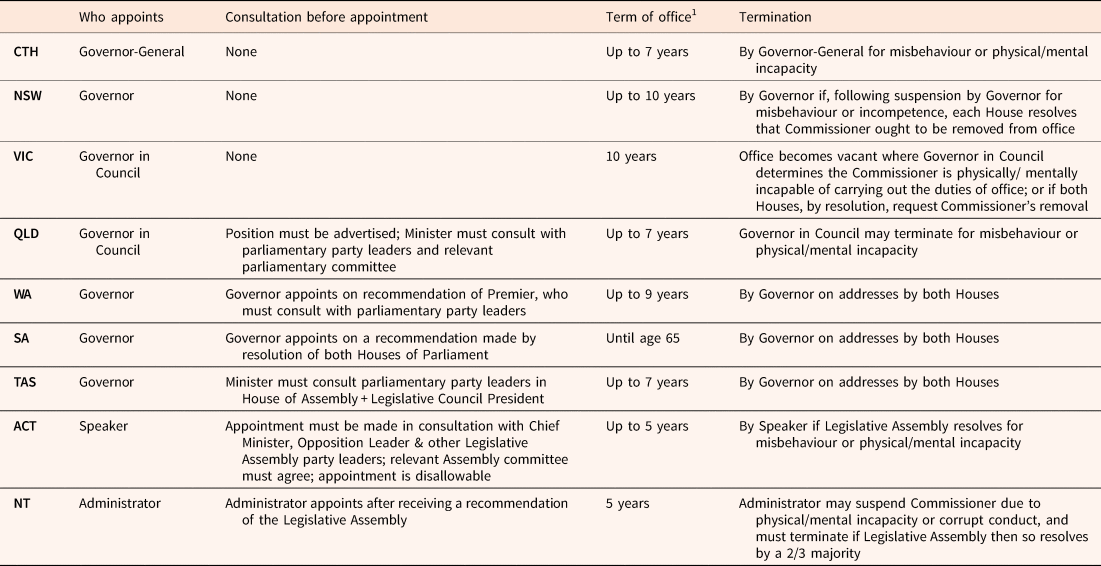
Third, the law establishes an appointments process and security of tenure for the position of electoral commissioner (see summary table in Appendix). In the three largest jurisdictions the appointment is at the discretion of the executive government, whereas elsewhere the government must either receive a recommendation from the legislature (SA, NT) or consult with party leaders and/or the relevant parliamentary committee (QLD, WA, TAS, ACT). These consultation requirements were introduced to help guard against suspected political leanings in appointees and to encourage cross-party support for commissioner appointments.Footnote 19 Once commissioners are appointed, the law protects them – to a greater or lesser degree – by providing for a term of office of reasonable duration and protection against termination. Across Australian jurisdictions the appointment terms range from 5 to 10 years, with commissioners eligible for reappointment at least once. The exception is South Australia, which guarantees tenure to age 65. Electoral commissioners may be removed from office on various grounds, the most common being misbehaviour and physical or mental incapacity, although the laws in three jurisdictions (WA, SA and TAS) are silent on the available grounds. The Commonwealth and Victoria stand apart for authorising the executive government to terminate an electoral commissioner without the involvement of the parliament.
Fourth, the law helps to protect the independence of electoral commissions by circumscribing government influence. Under express statutory provisions in their respective jurisdictions, the electoral commissions in New South Wales, Victoria and Tasmania exercise their functions free from ministerial direction or control,Footnote 20 while the AEC does the same except on a limited set of matters.Footnote 21 In some other jurisdictions, such as South Australia, Western Australia and the ACT, independence from ministerial direction is a matter of convention.Footnote 22
A culture of independence is also considered important within electoral management bodies.Footnote 23 This feature, also known as decisional independence, refers to an agency's capacity to bring a ‘personal independence of mind’ to decisions such that they are made ‘free from improper influence’.Footnote 24 Australian electoral commissions have long prided themselves on such a culture. Hughes, for example, has remarked on the reputation for decisional independence enjoyed by federal electoral officials in the decades prior to establishment of the AEC.Footnote 25
Another important consideration in assessing an electoral commission's independence is its degree of financial autonomy. Under an independent model, a commission ‘has and manages its own budget independently of day-to-day government control’.Footnote 26 This is not the case for Australian electoral commissions, which depend on governments for their budgetary allocations. The commissions typically negotiate their funding with their parent department or with their finance or treasury department in the course of annual government budget processes.Footnote 27 Commission funding is therefore vulnerable to both government-wide reductions (such as efficiency dividends) and to targeted cuts. There is also potential for departmental interference with commission budgets.Footnote 28 The ACT process is the most transparent: the Speaker consults the electoral commissioner on funding requirements and makes a recommendation to the Treasurer, and the Treasurer must provide reasons to the Legislative Assembly should she present an appropriation that is less than the recommended amount.Footnote 29
The flipside of independence is accountability. The electoral commissions are accountable primarily to their respective parliaments. Some commissions report directly to the parliament: the VEC, for instance, is required to provide to each House a report on the conduct of each election within 12 months.Footnote 30 Other commissions provide election, annual and other reports to the Minister, who is then obliged to table them in parliament.Footnote 31 The AEC, NSWEC and VEC are regular participants in inquiries conducted by joint standing committees on electoral matters, which examine the conduct of elections and electoral policy generally. They make detailed submissions and answer questions about their performance. The commissions are also directly accountable to the public, including through social media; the AEC Twitter account, for example, attracts questions and criticisms throughout the electoral cycle but especially in the lead-up to an election.
Antipodean Challenges to Legitimacy & Functionality
Australian commissions are typically appraised as highly functional, independent and free of allegations of subornation. The effectiveness of the electoral commissions, however, is tested each time electoral writs are issued and ‘depend for their success on a complex web of administrative structures, systems and arrangements’.Footnote 32 This section highlights instances where commissions in Australia have navigated operational obstacles, whether they be administrative, political or a particular moment of crisis. Australian electoral commissions, unlike some of their counterparts in the Asian region, operate in a stable political environment with established democratic norms, and typically are not faced with major threats to electoral integrity such as widespread vote-buying or, as occurred recently in Myanmar, attempts to overthrow election results. But the challenges faced by the commissions are nonetheless real, and their reputations for independence, impartiality and competence rise or fall on how effectively they respond to them. Taken together, these case studies provide a window into the operation of elections in Australia and the institutions that manage them.
Administrative Electoral Challenges
For Australian Commissions some of the prime challenges they face are administrative. Most crucially, in ensuring democratic stability through keeping elections fair, orderly, and prompt in the return of electoral results. All of their processes are directed by meticulous electoral legislation and regulations which govern the administration of elections and political partiesFootnote 33 and which significantly curtail any discretion on the Commissions’ part.Footnote 34 Compliance with voting requirements is in turn monitored by practices such as internal policies, scrutineers at polling booths, parliamentary committees and avenues for judicial review.
Without large scale e-voting, logistical challenges such as long queues can become a real headaches for Commissions.Footnote 35 The Report by the Commonwealth Joint Standing Committee on Electoral Matters into the 2016 election found there had been a notable drop in satisfaction with increased polling booth wait times on polling day compared with early voting venues, partly attributable to senate voting changes, boundary changes, higher numbers of voters and the complications brought by a double dissolution election.Footnote 36 It also found that wait times were a particular problem for some electors such as those with a disability and for whom limited parking was also found to be an obstacle to in-person voting.Footnote 37 Such issues are not only experienced federally – state commissions have also come under fire for long voting lines outside polling centres.Footnote 38
The AEC responded to these challenges by indicating what measures it was putting in place, such as increased automation and staff training, but also acknowledging the need for appropriate resourcing for technological improvements and staffing challenges as well as legislative innovation.Footnote 39 It also proceeded to commission technical researchers from Deakin University to assist with its management of crowds at polling boothsFootnote 40 with this work designed to improve ‘the reputation of the polling process’.Footnote 41 For Commissions facing such challenges, the approach is typically to acknowledge failings while recognising the magnitude of the task presented by an election in terms of temporary staff, quantities of paper and very tight time periods. The shift to the option of voting early has eased some issues while presenting new ones particularly in terms of sourcing venues, managing uncertain numbers of early voters and increased staffing costs.Footnote 42 Along with the need for legislative reform,Footnote 43 Commissions see the need for re-designing funding models in light of the significant undertaking of mounting a modern-day electoral event.Footnote 44
Another administrative pressure point stems from the demand for electoral results to be provided by Commissions extremely promptly to facilitate the transition from one parliamentary term to the next.Footnote 45 The AEC has recognised that such delay, when combined with ‘media speculation about the reason for the delay’ can ‘undermine faith in the result and the reputation of Australia's electoral system’. Footnote 46 Commissions tend to emphasize the legislative and technical limitations they face in this regard, particularly when there are inevitable delays associated with awaiting postal and declaration votes being returned or determinations of the Senate voting quota.
Administrative difficulties have only been compounded by COVID-19. The pandemic has brought unprecedented obstacles to almost every area of life and elections are no exception.Footnote 47 Recent elections in the Northern Territory, the Australian Capital Territory and Queensland, as well as State and Federal by-elections, all tested the administrative capacity of Commissions to manage elections in the face of significant restrictions and potential public health risks.Footnote 48 This has required Commissions to increase postal voting and pre-poll voting capacityFootnote 49 as well as put in place appropriate social distancing at booths.Footnote 50 It has presented innumerable challenges for Commissions, particularly when the existing legislative frameworks were not designed with the challenge of a pandemic in mind.
Political Challenges
The work of electoral commissions is, by its nature, bound up in politics. The conduct of elections is a ‘high stakes’ affair in that election results determine the future allocation of public power, not to mention the political fortunes of individual candidates. The actions and decisions of commissions will, from time to time, disappoint or even anger political actors, who may level accusations of bias against electoral officials. In such an arena it is not feasible for commissions to be ‘above politics’ – the navigation of politically sensitive matters, and occasionally controversies, is inherent to their work.Footnote 51 The more realistic approach for commissions is to accept that they are in the ‘political game’ but to make efforts to act impartially and with integrity.Footnote 52 The challenges involved are demonstrated by the commissions’ work in three areas: financial disclosure and electoral funding, misleading political communications, and law reform.
Financial disclosure and electoral funding
There is significant variation in both the laws that regulate political finance in Australia, and the roles that electoral commissions play in administering those laws.Footnote 53 The Commonwealth has a relatively laissez faire regime while the states, with the exception of Tasmania, have adopted stricter requirements. Disclosure rules are the most common feature: these typically require political parties to lodge, with the respective commission, annual and/or election returns that show the details of donations that exceed the statutory threshold. Most commissions also administer rules on public funding (although not in Tasmania or the Northern Territory). In the three eastern states the commissions oversee limits on donations and expenditure.
The potential for tensions between electoral commissions and political parties in this area is most acute with respect to compliance. Robust enforcement of disclosure and other obligations can strain a commission's relationship with political parties; on the other hand, laxity can endanger a commission's reputation for impartiality and integrity. For the most part this tension is in the background, as stakeholders seek to observe the rules and commissions work to promote compliance through education and consultation. But when serious cases of non-compliance arise, how do commissions respond?
The NSW Electoral Commission has faced numerous such instances and stands out for its relatively aggressive pursuit of breaches of political finance laws. In 2016, for instance, the Commission found that the NSW Liberal Party had failed to disclose the identity of major donors in the period 2010–2011. The relevant contributions exceeded $690,000 and included donations from prohibited donors and donations in excess of the cap. In response the Commission acted in line with its obligations under the Election Funding, Expenditure and Disclosures Act 1981 (NSW):Footnote 54 it withheld $4.4 million in public funding from the Party until it received – some months later – a full and proper disclosure of donations for the relevant period, at which point it returned the withheld funds less the value of the unlawful donations (a sum of approximately $600,000).Footnote 55 Orr wrote that the incident showed a willingness on the part of the NSWEC to serve as both an administrator and a regulator, concluding that ‘in pursuing this matter, and using clean public funding as leverage to an outcome where parties will think twice about resorting to formalities of trust law to hide donations, the NSWEC is to be congratulated’.Footnote 56
By contrast, the AEC's administration of the federal disclosure scheme was recently the subject of a critical report from the Commonwealth Auditor-General. The report assessed the Commission's management of the disclosure scheme as only ‘partially effective’.Footnote 57 It found that ‘[n]ot all required returns have been obtained, there is limited analysis of the returns that are obtained and evidence that some returns are incomplete’ and that ‘[t]he number of compliance reviews, and the resources allocated to them, have declined considerably over time’.Footnote 58 In response, the AEC issued a statement saying that it disagreed with the findings and that the Commission had ‘not detected systemic issues, wilful or large-scale noncompliance with the legislation’. It also defended its use of education and consultation in relation to stakeholders, arguing against a more aggressive approach to enforcement ‘as prosecutorial action for amendments and other administrative mistakes would be disproportionate’.Footnote 59
The different responses of the NSWEC and AEC draws attention to their distinct legal frameworks. Electoral law in NSW imposes stronger limits on donations and expenditure,Footnote 60 prescribes higher penalties, and grants the NSWEC more extensive enforcement powers.Footnote 61 By contrast, federal political finance laws have been described as ‘lackadaisical’Footnote 62 and it has been suggested that inadequate investigative powers and resources render the AEC unable to take strong action when parties prove unwilling to comply with disclosure rules.Footnote 63 Moreover, while the AEC can refer the most serious cases to the police for investigation, prosecutions are extremely rare, slow moving and penalties are small.
Misleading political communications
Another politically sensitive area in which electoral commissions are involved is the administration of rules about political communications. The AEC, for instance, can take various actions – ranging from issuing of a warning to making a referral to police – where it identifies material that lacks adequate authorisation or ‘is likely to mislead or deceive an elector in relation to the casting of their vote’.Footnote 64 Most such matters are resolved out of the public eye, with a warning usually sufficient to secure compliance. Occasionally, however, a commission can be called upon to resolve a dispute about electoral material that raises new questions of statutory interpretation and impacts the major parties. How do commissions navigate situations like these?
A case study of sorts is provided by an incident on polling day at the 2019 federal election. The AEC was asked to remove Liberal Party corflutes (signs) from polling places in two Sydney electorates on the grounds that they breached legal rules on the display of ‘misleading’ content. These signs bore AEC colours (purple and white), were in many instances displayed adjacent to AEC banners, and told voters in Mandarin that the ‘correct’ way to vote was to record a first preference for the Liberal Party.Footnote 65 The AEC refused to remove the signs. Placing reliance on the High Court decision in Evans v Crichton-Browne,Footnote 66 the AEC reasoned that if the corflutes were misleading, it was in relation to the choice of a candidate and not ‘in relation to the casting of a vote’.Footnote 67 A few months later, in the course of determining petitions challenging the election results in both seats, a unanimous decision of the Court of Disputed Returns (which is a special jurisdiction of the High Court) found the opposite.Footnote 68 The Court ruled that the corflutes were ‘plainly misleading or deceptive’ in the sense that they purported to be a message from the AEC and that, so understood, they implied that the way to cast a valid vote was to vote for the Liberal Party.Footnote 69
Two aspects of the AEC response to the signs are noteworthy. First, faced with a novel set of circumstances, the Commission adopted a cautious reading of previous judicial authority on what amounts to ‘misleading and deceptive’ material. Its view remains that there was ‘no legislative basis’ for a Commission to remove the corflutes in 2019 and that it was the Court of Disputed Returns ruling that ‘provided precedent on the use of AEC branding’ under section 329 of the Commonwealth Electoral Act 1918.Footnote 70 Second, the AEC not only joined the disputed returns case as a respondent (as is its right) but took a firm position, arguing that the case lacked merit and should be dismissed.Footnote 71 This sits in tension with the Commission's usual role in litigation as a ‘friend of the court’ that provides expert evidence about electoral administration and addresses questions of statutory construction.Footnote 72 And the case was perhaps a missed opportunity for the AEC to advocate an interpretation of the law that would better protect its brand. As the Court recognised: ‘The AEC occupies an independent place and role under the Act of some importance. Its independence should not be appropriated or undermined by trickery’.Footnote 73
Law Reform
Another area in which electoral commissions must be sensitive to their relationships with political actors is law reform. Australian commissions play an active role in debates about electoral law reform, drawing on their technical expertise to offer assessments about policy ideas and to make their own suggestions for change and innovation. In some jurisdictions this role is fostered through cross-party parliamentary committees on electoral matters which conduct election reviews and convene special inquiries on pressing issues. Always in the background, however, is the question as to what constitutes the legitimate role of an electoral commission in the law reform process. Should commissions confine their suggestions to technical issues, as opposed to policy issues, and where exactly is the line between the two? Should they steer clear of matters that are, or could be, the subject of partisan disagreement? The scope for political tension arises where political parties and electoral authorities have differing views on these matters. Commissions need to be alert to the risk of ‘offending those who hold political power’.Footnote 74
The introduction of automatic enrolment for federal elections provides an example of these tensions coming to the surface. The AEC had investigated ‘direct enrolment’ (as it is known at the federal level) as a means of addressing a decline in enrolment and, before any party views were known, came out in support of it. Later, the Labor government took steps to enact the change but the opposition Liberal Party opposed it as a threat to the integrity of the electoral roll. In a sharp exchange at a 2011 committee hearing, Liberal senator Scott Ryan accused the AEC of going outside its remit by making suggestions on ‘policy’ issues as opposed to ‘technical’ issues; he viewed the introduction of direct enrolment as ‘rightly a policy decision for the Parliament of Australia’.Footnote 75 Ryan elaborated:
I personally think that, by recommending a change to the law that is highly contentious, you are actually crossing the line from a recommendation about your view of the integrity of the system to recommending a substantive change in the law.Footnote 76
The Electoral Commissioner, Ed Killesteyn, defended the AEC by noting that enrolment was one of its core concerns under the Commonwealth Electoral Act, and that it had recommended direct enrolment as one of a suite of tools to arrest the drop in enrolment. Killesteyn asserted that his role before the committee was ‘to provide information, guidance and recommendations … about issues associated with the administration of the [A]ct’.Footnote 77 Killesteyn also rejected claims that the AEC's independence had been dented: ‘because in some way our views align now with various political parties, that does not mean that we are not independent’.Footnote 78
At other times, political dynamics have facilitated a broad and active reform role for electoral commissions. In the 1980s the AEC was a ‘leader in innovation’ as it worked to implement the many changes instituted by a reform-minded government.Footnote 79 Over the past decade the NSWEC has taken a lead role, in conjunction with the state parliament's electoral matters committee, in the introduction of automatic enrolment, the development of internet voting and a wholesale review of the state's electoral law statutes.Footnote 80
The AEC has in recent years taken a cautious approach to law reform. This can partly be traced back to the lost ballots fiasco (discussed further below). It diminished the Commission's capacity to engage in law reform debates, with new commissioner Tom Rogers understandably focused on restoring political and public confidence in the work of the AEC. Perhaps more significantly, the lost ballots incident diminished the standing of the Commission among parliamentarians and in the eyes of the Liberal-National government. In navigating this political dynamic the AEC has played an active role in law reform debates but has been careful to confine itself to more technical issues. It has, for instance, been assertive in making the case for changes to election machinery and the modernization of its internal systems.Footnote 81 At the same time, it has steered clear of contentious policy matters. On political finance, for instance, the Commission has said that the task of reconciling divergent views is ‘a matter for Parliament’ and has avoided offering advice on ‘best practice’ as it ‘may create the impression that the AEC has entered into partisan debate’.Footnote 82 On the rise of early voting, it has deferred to legislators on the policy dimensions: ‘the AEC doesn't set the length of the pre-poll voting period and does not have an opinion on how long this should be—that's a matter for parliament’.Footnote 83
Commissions in Crisis
Trust in electoral commissions is pivotal to the legitimacy of the electoral process. It can be tested by critical electoral irregularities or errors, like that which transpired in the 2013 Federal Election. When a tight margin prompted a challenge to the Western Australian half-Senate election, it emerged that 1370 ballot papers from across the Forrest and Pearce divisions were unable to be found.Footnote 84 Described by the Joint Standing Committee on Electoral Matters (JSCEM) as the ‘greatest failure in the history of the Australian Electoral Commission’,Footnote 85 the papers’ disappearance resulted in the Court of Disputed Returns finding that a new Senate election was required in Western Australia with the first count being declared void.Footnote 86 This was the first time in Australia's electoral history that a half-Senate election in a State had to be repeated.Footnote 87 It put immense pressure on the AEC to avoid a re-occurrence.
An electoral mishap, even one as rare as the 2013 ballot paper loss, has the potential to undermine the public's perception of an institution's integrity and legitimacy. The AEC sought to counter this risk through a range of crisis management strategies. First, Mick Keelty AO, was commissionedFootnote 88 to undertake an independent inquiry into the incident with the benefit of the AEC's resources but separately from it.Footnote 89 The Keelty Report stressed that trust was the ‘glue…hold[ing] the system together’ and that the misplacement of the ballots was a blip in the AEC's ‘enviable reputation’ (and internationally sought-after knowledge) for streamlined and ordered electoral management.Footnote 90 It, however, noted that with the WA Senate ballot, for a host of reasons, ‘the AEC failed to meet its own high standards and damaged its reputation with the community and Parliament’.Footnote 91 It was also highlighted that without the call for a recount of the papers, the misplacement would probably not have come to light.Footnote 92
Second, the Australian Electoral Commissioner, Ed Killesteyn, fronted the media to be open about the failure acknowledging:
the gravity of the situation is not lost on me. Nearly 1400 Western Australian electors have had their Senate vote disenfranchised and I apologise unreservedly to all those electors. We're left with a nagging and almost irreconcilable doubt about the outcome of the Western Australian Senate election. Of course this is very damaging to the reputation of the AEC which has been earned over many decades of dedicated service to the Australian community….The AEC is a good organisation and I hope the Australian community continues to believe in it but it can be better and we will look at Keelty's report and make sure our procedures are made even tighter than they are…Footnote 93
Third, resignations followed. Both Commissioner Killesteyn and the Australian Electoral Officer for Western Australia, Peter Kramer, stood down. The Special Minister of State, Senator Ronaldson, announced that ‘[e]vents in Western Australia mean that the Australian Electoral Commission must regain the confidence of the community. The government will in due course announce a new electoral commissioner who will be charged with the restoration of that confidence.’Footnote 94
The case studies presented above show that Australian commissions encounter a range of challenges, from major crises that threaten their reputations (as occurred with the lost ballots episode), to administering and enforcing laws in a ‘high stakes’ political environment, to more prosaic matters such as meeting voters’ expectations around queuing at polling places. In the next section we take a step back to examine some of the factors that have contributed to the commissions’ resilience in the face of the challenges.
Appraising Australian Electoral Commissions – Lessons For Engineering Success And Legitimacy
In this final part we explore what institutional factors have helped or hindered Australian electoral commissions in their organisational efforts and ability to ride out crises or political and administrative hiccups. It adopts a neo-institutionalist perspective to ask how legitimacy and institutional trust is created, maintained and lost by electoral agencies in the Australian context. We explore this question across three dimensions: structural and legislative factors, strategic factors, and relational factors.
Neo-institutionalism, whichever its strand, concentrates on the dynamic nature of institutions and their capacity for streamlining their actions depending on their values, goals, environment and actors.Footnote 95 It identifies institutions as being ‘defended by insiders and validated by outsiders’ and the impact this has on their operations and development.Footnote 96 To hold the public's faith institutions must not only meet their assigned expectations but must do this in line with shared values and practices.Footnote 97 Falls from grace can detract from an institution's legitimacy quotient and the community's ability to buy-in to its assurances.Footnote 98 However, the way that institutions respond to challenges is not necessarily linear and must often reconcile competing demands.Footnote 99
Such approaches are pertinent in the electoral context. Electoral commission performance is measured against clear values of independence, integrity, efficiency and innovation. Commissions face the difficulty of remaining agile, progressive and streamlined often without significant funding increases to support modernisation or growth. This requires Commissioners to weigh up priorities while also communicating their changing organisational needs to government stakeholders.
Structural and Legislative Factors
The legal framework that governs Australia's electoral commissions helps to explain their resilience. The commissions’ statutory basis is particularly noteworthy given the international trend towards constitutional entrenchment. They have demonstrated a high degree of independence, functionality and legitimacy without being formally constitutionalised. The success of this institutional arrangement partly reflects high levels of public confidence; partisan attempts to weaken the commissions would likely face community resistance. It also reflects a century-old culture of independence among electoral officials, in turn fostered by institutional protections such as judicial chairpersons and the absence of political party representation.Footnote 100 Also crucial is the detailed nature of statutory regulation. Australian electoral legislation is highly prescriptive, minimising the scope for commissions to exercise discretion (while leaving room for innovation through legislative amendment). This helps to protect the commissions from accusations of bias and helps fuel public confidence in commission impartiality and capacity.
The protection afforded by the statutory regimes is apparent in the case studies discussed in Part 2. With the crisis of the missing WA ballots there was initially criticism of the Australian Electoral Commissioner for officially declaring the result on the basis of a count that excluded the lost ballots. In response, Commissioner Killesteyn emphasised that he had no choice as the Commonwealth Electoral Act 1918 (Cth) required the writs to be returned.Footnote 101 It was therefore not a personal or political choice but a statutory requirement. Similarly, we see commissions citing legislative justifications for their actions (or inactions) in response to the misleading corflutes episode and the political finance activities of political parties.
Strategic Factors
The co-dependence of trust and functionality influence all aspects of commissions’ operations and communications.Footnote 102 A key trend that has emerged with recent elections is commissions actively shaping the conversation of elections, particularly to highlight the magnitude of the challenge presented by an election in terms of the sheer quantity of people and paper amidst highly condensed timeframes, limited resources and countless temporary staff.Footnote 103 The utility of this messaging is that when errors occur, they can be identified as rare blips in an otherwise smooth operation. As Langford et al note, they are also less likely to be interpreted as politically contrived.Footnote 104 This was particularly evident in the 2013 federal ballot loss of 1370 votes but also in less dramatic instances like criticisms of long queues at polling booths. Similarly, the AEC has used smaller mishaps, such as errors in the count in the federals seat of Indi and Fairfax,Footnote 105 to point to the efficiencies and integrity of the Commission in identifying early the rare errors that occur and promptly fixing them. As the Australian Electoral Commissioner noted after the 2019 federal election:
Pleasingly, all participants in that process, including parties and candidates, generally abide by the rules and contribute to ensuring the success and integrity of the Australian electoral process. Of course, given the scale of the election that doesn't mean Australian elections are perfect. I'm pretty sure there's never been a perfect election from the very first elections in Ancient Greece through to modern times. It would be statistically impossible for such a vast, national, complex, hugely contested and essentially manual process involving all eligible adult Australians and some 90,000 temporary staff to be without error.Footnote 106
Commissions are somewhat dependent on parliaments for electoral reform and innovation. This can, in turn, be used as a defence in the face of media or political criticism. Extraordinary mishaps like the WA ballot disappearance are not necessarily due entirely to legislative gaps. However, criticism of the AEC for losing ballots, which may have been avoided by reforms such as electronic voting, can be batted away as a task for parliament when electoral legislative reform is not the province of electoral regulators.
Relational Factors
External relationships and interactions are pivotal in the way commissions in Australia manage the challenges they face. Our case studies suggest that relations with outside stakeholders can serve to support, protect or constrain the commissions in how they go about their work.
Parliamentary joint standing committees can play a key supportive role. They might do this by communicating budgetary or reform imperatives after an election, or in promoting the difficult work that a commission undertakes.Footnote 107 Joint Standing Committee electoral findings appraising each election can draw attention to challenges in administration, and so assist Commissions to make their case for legislative reform or augmented budgets in a way that is more objectively cast.
With the lost ballots fiasco in WA, both the Keelty inquiry and the High Court (sitting as the Court of Disputed Returns) provided an external check on AEC operations, resulting or contributing to a number of organisational changes.Footnote 108 These changes provided an opportunity for the Commission to reinforce its institutional goals and begin to repair reputational damage. Ironically, such a dramatic exemplification of what can happen when things go wrong and the expense such errors can attract, may assist political parties and other stakeholders to better appreciate the complexity of electoral management and the importance of proper resourcing. With COVID-19 the widespread external appreciation of the potential public health risks of the pandemic have made it easier for Commissions to meet the steep challenge of conducting elections during a pandemic. That external appreciation has paved the way for partnerships with other government institutions (such as health authorities) and adequate resourcing to prophylactically ensure the safety of the electoral process. The AEC's focus on reducing polling place queuing times also demonstrates its responsiveness to external opinion.
Relationships with political parties can present a particular source of tension for independent electoral agencies keen to avoid perceptions of regulatory capture. Here we see the potential for external relations to constrain commission behaviour. This dynamic was evident in Commissioner Killesteyn's response to criticism of the AEC recommending direct enrolment reforms when there was a partisan stance on the issue. Typically, in law reform contexts, such as with political financing, we see commissions adopting a technical focus to avoid more contentious terrain. This approach helps to reinforce a commission's reputation for independence and impartiality while propagating public confidence and trust.
Conclusion
Australian electoral commissions have a reputation for independence, administrative effectiveness and integrity. They challenge the assumption that constitutional entrenchment is the superlative form of electoral design for a democratic state. As statutory bodies, Australian commissions have shown institutional resilience in the face of political and administrative complexity as well as in times of crisis. The case studies in this paper show that Australian electoral agencies confront a range of challenges typical to agencies around the world, even if they take on their own local form. They include administering elections in a partisan environment, operating without financial independence, facing intense scrutiny from political elites and the public, managing the increasing complexity of elections, and responding to unexpected crises. We have argued that Australian commissions have remained resilient in the face of all of this due to a mix of structural/legislative, strategic and relational factors. Institutional and cultural independence, combined with an administrative agility and a sensitivity to maintaining productive relationships with political parties and the general public, have been key in enabling the commissions to meet these diverse challenges.
Electoral Commissioners in Australia: Appointment process, terms, and termination

Author Biography
Paul Kildea, Senior Lecturer, Faculty of Law & Justice, University of New South Wales.
Sarah Murray, Professor of Law, University of Western Australia Law School.