


Introduction
In today’s dynamic public health landscape, prompt detection and response to emerging infectious diseases is an urgent priority. The timely dissemination of precise and actionable information to the frontline health care personnel (HCP) is particularly vital during an outbreak. Public health authorities, such as the Centers for Disease Control and Prevention (CDC), tribal public health, and state and local health departments, routinely communicate significant and actionable information to clinicians.
However, the current system of information delivery is not consistently directed to the frontline HCP and is often not accessible at the right time or at the time of decision-making. These public health communications may reach clinicians many days or weeks before they encounter a patient for whom the alerted details are relevant, decreasing the likelihood that the clinician will recall and act upon advisory content and direction. Consequently, frontline HCP often lack real-time knowledge about different outbreaks and may be unable to readily find the latest guidance needed to effectively recognize and manage potentially exposed or infected patients.Reference Billings, Ching and Gkofa 1 –Reference Broom, Broom and Bowden 4
Vital information about novel or other serious infectious threats comes from numerous, disparate sources spanning official public health advisories, preliminary medical literature, informal online discussion forums, and mainstream news media reports,Reference Rollett, Collins and Tamimy 5 –Reference Tsao, Chen and Tisseverasinghe 8 some of which may not be accurate, leading to what has been described as an Infodemic.Reference Borges do Nascimento, Pizarro and Almeida 9 –Reference Simon and Camargo 11 The vast volume and disjointed nature of these data streams make it increasingly difficult for busy clinicians and frontline HCP to stay updated with the most recent developments. This challenge is compounded by the evolving nature of outbreaks, in which details about an emerging pathogen’s symptoms, transmission routes, risk factors for infection, diagnostic tests, and treatment protocols often change, leading to frequent revisions and updates.
Clinical decision support (CDS) offers one potential means of closing this gap by integrating rapidly changing public health guidance directly into the HCP’s workflow. CDS tools embedded in electronic health records (EHRs) can surface the latest outbreak-specific recommendations at the point of care, such as prompting HCPs to obtain relevant travel or exposure histories, suggesting appropriate diagnostic tests, highlighting infection prevention measures, or displaying current treatment protocols. By doing so, CDS can reduce reliance on recall and ensure that decision-making reflects the most up-to-date guidance available.
We acknowledge the potential value of advisories, like the Health Alert Network (HAN) issued by CDC, to serve as a primary source of rapid, actionable, accurate information in the current infodemic setting. These advisories have the potential to offer authoritative information about emerging infectious threats. However, the current format of these communications is static and not designed for EHR processing or interpretation, limiting their effectiveness as input for practical CDS applications. It is important to contextualize this limitation within the scope and purpose of the CDC HAN, which was originally designed to disseminate urgent public health information in a traditional format rather than to serve as a source of computable data, that is, structured, standardized information that can be electronically exchanged and processed by health informatics systems.
Methods
The primary aim is to evaluate the comprehensiveness of the information provided in the advisories based on a minimum dataset necessary to produce effective CDS for HCP. We performed an in-depth analysis of the HAN advisories as a source for computable data to drive actionable CDS that can provide timely information, at the point of care, to support patient care decisions. This analysis was based on the CDS prototype, an early, interactive model of a CDS system that demonstrates how data and alerts would function within clinical workflows.
CDS Prototyping
We developed a CDS use case centered on an emergency room triage nurse, focusing on scenarios where the system aids in managing patients with potential high-impact pathogens (HIP). We define HIP as pathogens that can be transmitted between individuals in the health care environment, require specific interventions to contain, and are not routinely managed—all of which may cause the care of a patient with a suspected HIP to disrupt normal care routines. Based on the use case, we mapped the information flow within the CDS system, identifying key points in the clinical workflow where the system interacts with users and determining how data should be structured and retrieved for optimal functionality.
Using this framework, we built interactive prototypes designed for nurses, emphasizing the identification and presentation of critical information for effective decision-making. This alert prioritizes the delivery of potential exposure information, adhering to the Vital Sign ZeroReference Koenig 12 concept. This concept prioritizes the assessment of infectious disease risk before standard vital signs are measured, by focusing on the travel history and potential infectious disease exposure immediately upon patient interaction.
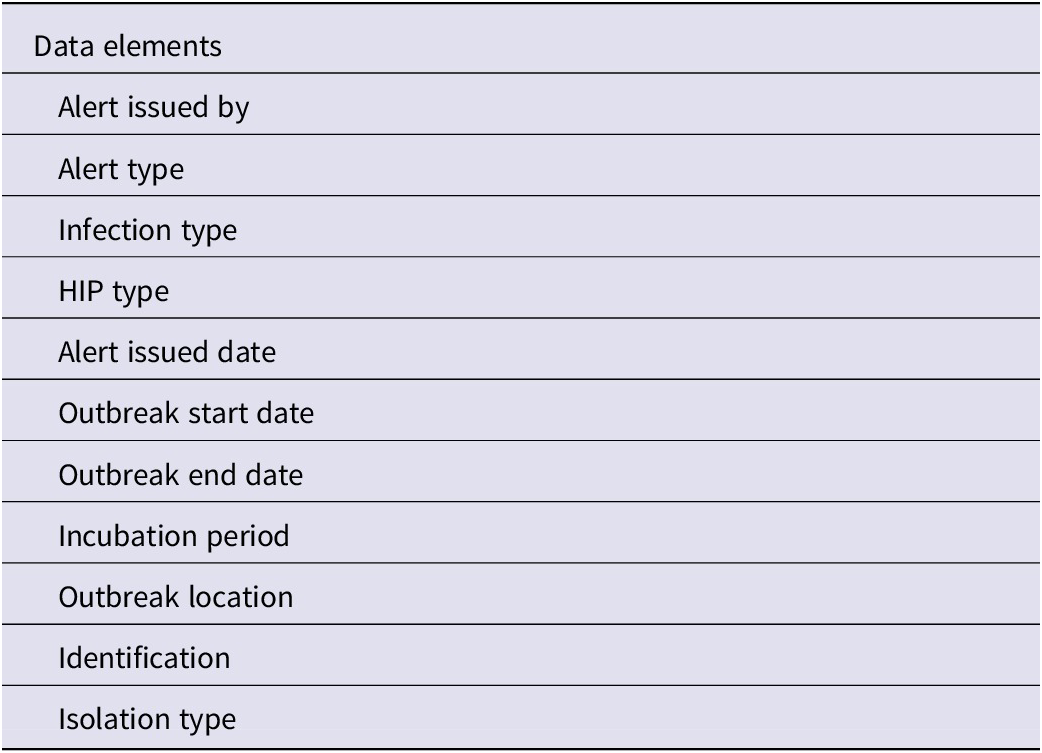
The CDS prototype was further used to define the essential computable dataset required for an effective CDS system. This is the minimum set of structured, standardized data elements required for an effective CDS system. These elements include key information such as the type of pathogen, the start and end dates and geographic location of the outbreak, and the specific signs and symptoms of the infection (Table 1). For the latter, the focus was on common symptoms, including fever, cough, rash, and bleeding, associated with three categories of HIP—acute respiratory tract infection, viral hemorrhagic fever, and fever and rash—that pose significant public health threats. The dataset also included isolation recommendations for patients or staff to prevent further spread of the infection, and the method of transmission and incubation period of the pathogen for determining the period of infectiousness and guiding infection prevention measures. To ensure accuracy and relevance, these computable data elements underwent validation by infectious disease and infection prevention experts at one organization Yale New Haven Health (YNHH).
Data elements

Table 1. Long description
The table consists of a single column with the header Data elements. The rows below list the following specific data points in descending order.
* Alert issued by
* Alert type
* Infection type
* H I P type
* Alert issued date
* Outbreak start date
* Outbreak end date
* Incubation period
* Outbreak location
* Identification
* Isolation type
A footer note defines the initialism H I P as High-impact pathogen.
HIP, High-impact pathogen.
Data Collection
Publicly available CDC HAN advisories from May 25, 2018 to September 5, 2023 were abstracted from the CDC website. 13 A systematic approach was employed to download all available advisories. The advisories were searched and downloaded using a Python™ script that automated the process of accessing each advisory, extracted the relevant text, and saved it to a structured format for subsequent analysis. The script was designed to capture all available advisories to ensure a comprehensive dataset during this time period.
Review and Annotation of All HAN Advisories
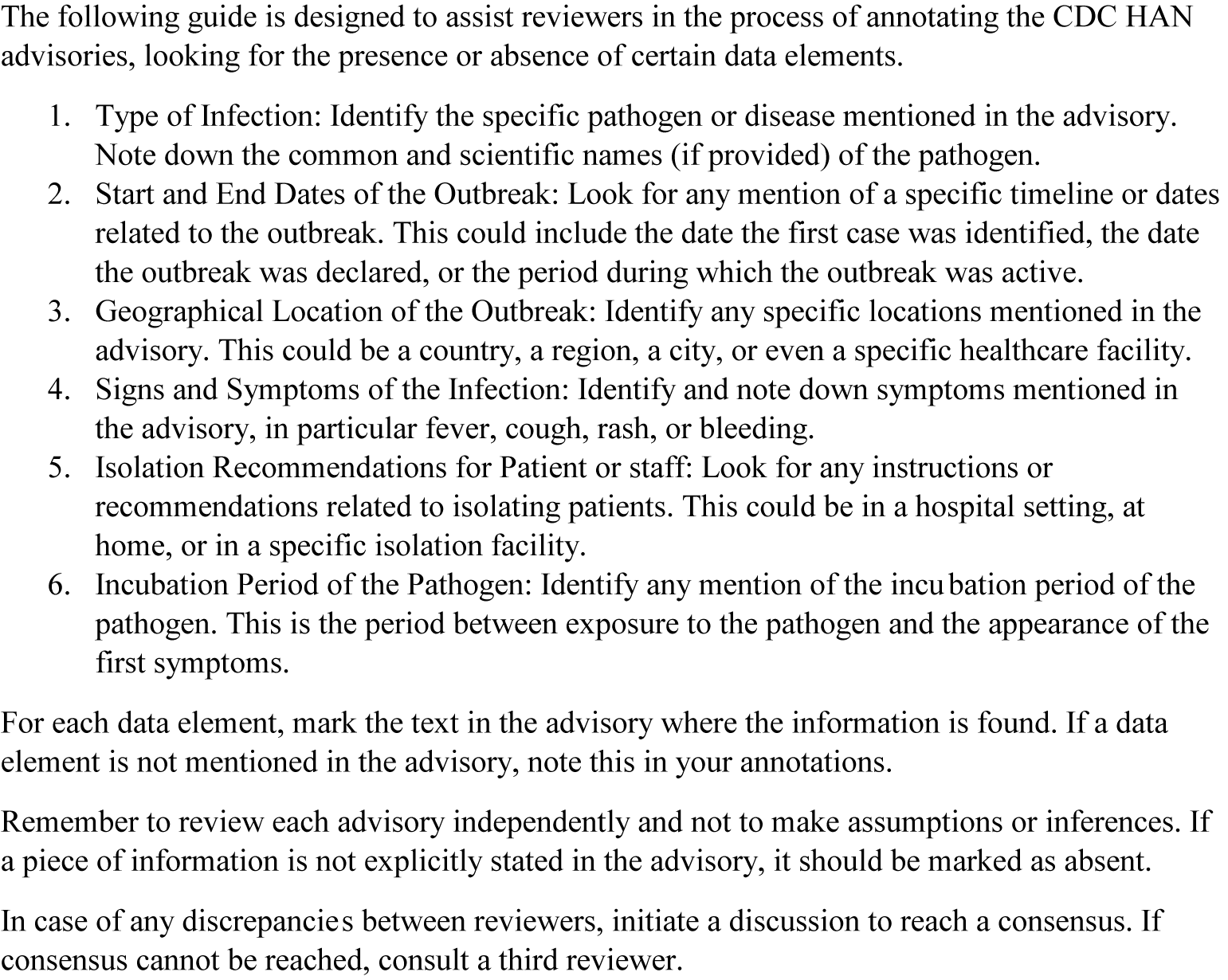
Two trained reviewers (HP and NK) independently reviewed each HAN advisory and annotated the text for the presence or absence of these data elements. The reviewers used a standardized annotation guide (Figure 1) to ensure consistency and accuracy in the annotation process. The guide provided specific criteria for each data element to minimize subjective interpretation. Any discrepancies between the reviewers’ annotations were resolved through discussion until a consensus was reached. In cases where consensus could not be reached, a third reviewer was consulted (RM).
Annotation guide for reviewing HAN advisories.

Figure 1. Long description
The document begins with an introductory sentence stating the guide is for reviewing C D C H A N advisories for specific data elements.
A numbered list follows with six points:
1. Type of Infection: Identify pathogen or disease names.
2. Start and End Dates of the Outbreak: Identify timelines or specific dates.
3. Geographical Location of the Outbreak: Identify countries, regions, cities, or facilities.
4. Signs and Symptoms of the Infection: Note symptoms like fever, cough, rash, or bleeding.
5. Isolation Recommendations for Patient or staff: Look for instructions for hospital, home, or facility isolation.
6. Incubation Period of the Pathogen: Identify the time between exposure and first symptoms.
Below the list, instructions specify to mark where information is found or note if it is absent. It emphasizes reviewing advisories independently without making inferences. The final paragraph states that discrepancies between reviewers should be resolved through discussion to reach a consensus, or by consulting a third reviewer if consensus is not reached.
Qualitative Analysis
Following the initial study period (i.e., dataset familiarization and initial codebook development), the analytic workflow moved to iterative expansion and formalization of communication- and operational-focused codes. In December 2023, a communications code group was added (e.g., Notify; Disseminate; Contact), and subsequent phases introduced more granular operational categories (e.g., Clinician Recommendations, Public Health Recommendations, Testing) and manual link coding to capture isolation guidance and resource metadata. The taxonomy shifted accordingly from detection and reporting-centered tags (Identify; Reports/Reporting; Travel; PUI) toward actionable, point-of-care elements (Isolation; Prevention; Vaccine; Therapeutics; Test-to-Treat access), while symptom and clinical-variable codes (Fever; Cough; Short of Breath; Diarrhea; Rash; Incubation period) remained central and were supplemented by context and action codes (Notify; Contact; Communicate), enabling clearer separation of message content from delivery mechanism and supporting operational use in clinical workflows.
Results
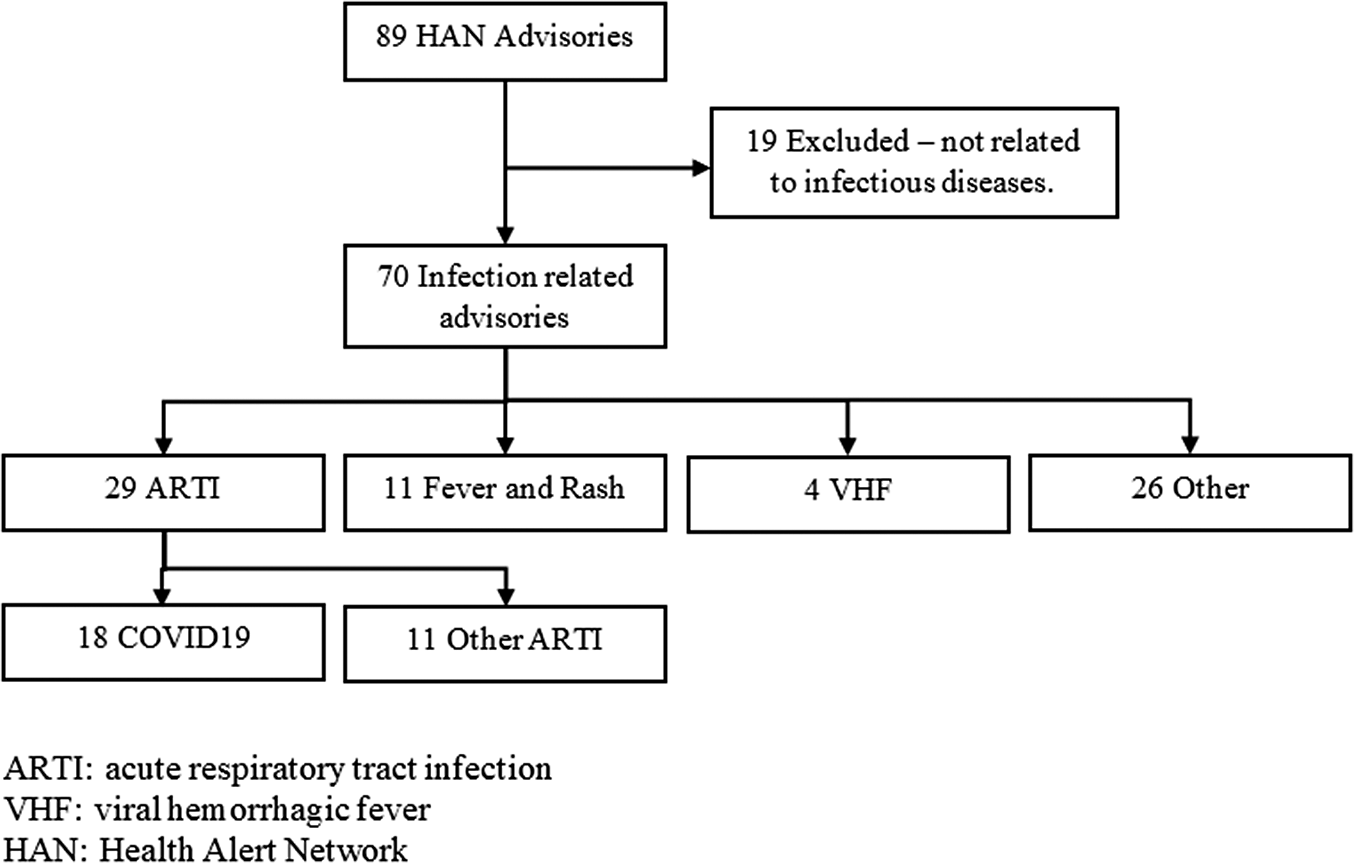
A total of 89 HAN advisories, communicated between May 25, 2018 and September 5, 2023, were abstracted from the CDC website (Table 2). Of these advisories, 70 were related to infectious pathogens, with 50 specifically addressing 13 high-consequence organisms. High-consequence pathogens are defined by the CDC as pathogens that are a threat to global and domestic security. 14 Other advisories unrelated to microbial pathogens (19), including those related to wildfire health hazards, synthetic opioids, and vaping, were excluded from the analysis (Figure 2). In our analysis of the advisories, we found that 18 (25%) out of the total 70 HAN advisories related to infection were explicitly related to COVID-19.
Summary of HCID and COVID-19 information found in HAN advisories

Table 2. Long description
A table with 7 columns and 9 rows. The columns are: Category (unlabeled), A R T I (29), Fever and rash (11), V H F (4), H C I D (50), COVID-19 (18), and All I D (70).
Row 1, Outbreak start date: A R T I 13 (45 percent), Fever and rash 6 (55 percent), V H F 3 (75 percent), H C I D 23 (46 percent), COVID-19 8 (44 percent), All I D 33 (47 percent).
Row 2, Outbreak end date: A R T I 0 (0 percent), Fever and rash 0 (0 percent), V H F 0 (0 percent), H C I D 0 (0 percent), COVID-19 N/A, All I D 0 (0 percent).
Row 3, Location country: A R T I 20 (69 percent), Fever and rash 10 (91 percent), V H F 4 (100 percent), H C I D 35 (70 percent), COVID-19 11 (61 percent), All I D 53 (76 percent).
Row 4, Location state/region: A R T I 7 (24 percent), Fever and rash 7 (64 percent), V H F 3 (75 percent), H C I D 21 (42 percent), COVID-19 3 (17 percent), All I D 31 (44 percent).
Row 5, Location city: A R T I 1 (3 percent), Fever and rash 1 (9 percent), V H F 0 (0 percent), H C I D 2 (4 percent), COVID-19 1 (6 percent), All I D 4 (6 percent).
Row 6, Isolation: A R T I 4 (14 percent), Fever and rash 3 (27 percent), V H F 0 (0 percent), H C I D 6 (12 percent), COVID-19 2 (11 percent), All I D 8 (11 percent).
Row 7, Incubation period: A R T I 1 (3 percent), Fever and rash 5 (46 percent), V H F 2 (50 percent), H C I D 10 (20 percent), COVID-19 0 (0 percent), All I D 15 (21 percent).
Row 8, Symptoms: A R T I 9 (31 percent), Fever and rash 9 (82 percent), V H F 4 (100 percent), H C I D 28 (56 percent), COVID-19 5 (28 percent), All I D 37 (53 percent).
ARTI, Acute respiratory tract infection; HCID, high consequence infectious diseases; VHF, viral hemorrhagic fever; ID, infectious diseases.
Inclusion and exclusion diagram.

Figure 2. Long description
The flowchart begins at the top with a box labeled 89 H A N Advisories.
An arrow points down to a second box, but a side arrow branches right to a box labeled 19 Excluded - not related to infectious diseases.
The main downward path leads to a box labeled 70 Infection related advisories.
From this box, the flow splits into four horizontal branches:
* 29 A R T I
* 11 Fever and Rash
* 4 V H F
* 26 Other
The 29 A R T I box further branches down into two final categories:
* 18 COVID19
* 11 Other A R T I
Below the diagram, a legend defines the initialisms:
A R T I: acute respiratory tract infection
V H F: viral hemorrhagic fever
H A N: Health Alert Network
For the 70 advisories concerning infectious pathogens, 47% had a noted start date, but none indicated an end date for the advisory. At least one clinical symptom was mentioned in 53% (37) of these advisories, and recommended isolation precautions were described in 11% (8). The examination of isolation precautions across various groups revealed a variation from 0% for viral hemorrhagic fever to 27% for the fever and rash group. HAN advisories specific to high-consequence infectious diseases (12%) and COVID-19 (11%) were both found to have a low frequency for the inclusion of isolation recommendations.
A notable aspect of the first 5 COVID-19 advisories, in chronological order, was the rapidly changing and evolving nature of the novel coronavirus. For example, beginning with an advisory issued on January 8, 2020, and continuing through March 8, 2020, 4 subsequent advisories “superseded” the guidance and recommendations provided in CDC’s previous HAN advisory.
There was also evident uncertainty surrounding the pathogen in these early advisories. One advisory stated, “Although the transmission dynamics have yet to be determined, CDC currently recommends a cautious approach to patients under investigation for 2019-nCoV.” Another advisory also highlighted that the “CDC clinical criteria for 2019-nCoV PUIs have been developed based on available information about this novel virus, as well as what is known about SARS and MERS.” However, they also acknowledged that these criteria were subject to change as additional information became available.
Limitations
This study has 2 limitations that should be noted. First, the data for this study was collected solely from the CDC’s HAN advisories over a limited period. This could lead to a selection bias, as the data does not include advisories from other health agencies or organizations. Therefore, the findings may not be applicable to documents from other organizations.
In addition, the use of a Python™ script for text data extraction may lead to errors or omissions in the data extracted from the downloaded HAN advisories. While automation can improve efficiency, it may also overlook important contextual information or nuances in the formatting.
Discussion
Many public health notification sources exist today, including the World Health Organization (WHO), CDC, state and local public health authorities, and news media outlets. The CDC’s HAN advisories are a highly regarded source of information. HAN advisories have served an important function in distributing authoritative, pre-processed information to subscribers. Given the various sources of information for infectious outbreaks, we were interested in assessing whether the CDC HAN can serve as a source for computable data to drive actionable CDS for frontline HCP. Lurio et al.Reference Lurio, Morrison and Pichardo 15 implemented a process in which HAN messages prompted the manual creation of CDS alerts. However, to our knowledge, no prior study has systematically analyzed HAN or other advisories for their computability, that is, their ability to be structured and processed electronically, or their potential role in CDS integration.
Our analysis indicates that the current content of HAN advisories is not conducive to automating a computable solution. Many HAN advisories lacked crucial details, such as isolation recommendations (11%), pathogen incubation periods (21%), outbreak start dates (47%), and symptoms (53%). While these advisories often contained links to CDC websites containing this missing information, accessing this data required navigating away from the HAN website, presenting difficulty for an automated solution. This finding is consistent with prior literatureReference Michaels 16 that highlights the broader problem of repurposing unstructured information into standard, computable knowledge for CDS applications.
Based on current information found in HAN advisories, one would need assumptions and more complex suppositions to generate actionable recommendations via a CDS. For example, one significant oversight evident across all HAN advisories was the absence of an outbreak end date. In the context of public health incidents, the absence of an outbreak end date sustains a state of perpetual alertness among clinicians and health care staff, potentially desensitizing them to critical alerts and diminishing the effectiveness of the alert system. Prior research on alert fatigue in clinical informatics has demonstrated that non-specific or persistent alerts reduce responsiveness to truly urgent recommendations, suggesting that the same risks may apply to outbreak communications.Reference Ancker, Edwards and Nosal 17
The declaration of an “outbreak end date” carries significant political, social, and economic implications, influencing public perception, government response, and resource allocation.Reference Charters and Heitman 18 However, for the purposes of CDS, this definition should be operationalized more narrowly. Within a CDS framework, the “outbreak end date” should mark the point at which HCPs can safely stand down from heightened alert status, signaling that continuous outbreak-specific vigilance is no longer required.
We propose defining an “alert end date,” distinct from the broader public health declaration, as the system cue for returning CDS functions and provider notifications to their baseline or “normal” operational state. This approach acknowledges that epidemics often follow complex, cyclical patterns with potential for resurgence, while ensuring that the CDS system remains both responsive during outbreaks and appropriately de-escalated when immediate risk subsides.
Addressing this gap by providing “alert end date” in HAN advisory updates could significantly alleviate alert fatigue and enhance the overall effectiveness of public health communication efforts.
Furthermore, only 11% of the advisories mentioned recommended isolation precautions, with significant variation across different pathogen groups. This indicates a need for the CDS system to standardize the presentation of isolation protocols based on limited information available in the HAN advisories.
One approach to addressing the sparseness of computable datasets derived from HAN advisories is to supplement them with pathogen-specific information stored within a local database, such as the duration of the incubation period, isolation protocols, and symptoms and signs of infection. In this hybrid model, HAN advisories provide timely, authoritative alerts about emerging threats, and locally maintained datasets supply detailed, context-specific information necessary for an effective clinical response. While this approach helps overcome the limitations of sparse HAN data, it introduces challenges such as dependence on open CDS architectures to query local data sources, risks of data inconsistency across institutions, and added liability concerns related to locally maintained knowledge bases.Reference Kuperman, Reichley and Bailey 19
Conclusions
Ultimately, the ideal CDS system would be capable of identifying and transforming public health statements from any credible source into computable data, which can then be presented to clinicians at the most useful time and requiring a minimum or no manual human governance.
Given the urgency and dynamic nature of the current public health landscape, as observed during the COVID-19 pandemic, there is an immediate need for a robust, unified, and responsive system to deliver timely and precise information to frontline HCPs. The existing system, marked by disjointed data streams, inconsistent updates, and inconsistent content, hinders the swift dissemination of critical guidance necessary for the safe management of emerging infectious diseases and HIP threats by clinicians and HCP.Reference Billings, Ching and Gkofa 1 –Reference Broom, Broom and Bowden 4 The information about novel or high impact infectious threats originates from multiple diverse sources,Reference Broom, Broom and Bowden 4 –Reference Tornberg, Moezinia and Wei 7 which are published at varied intervals and speeds. This fragmented nature of information delivery, coupled with the vast volume of data, poses a significant challenge for busy clinicians and HCPs striving to stay updated with the most recent developments. As a result, our health care systems are inadequately prepared to tackle emerging epidemics. Therefore, there is a pressing need to address this issue and devise a solution that ensures the efficient and timely delivery of vital actionable information to frontline HCPs.
However, this scenario also presents a unique opportunity. By leveraging existing technology, we can reduce inconsistencies and streamline the process, thereby enhancing the efficiency and efficacy of information dissemination.
The rapidly evolving nature of emerging diseases underscores the need for an adaptable CDS alert system. Such a system should be capable of incorporating frequent updates, ensuring that clinicians receive the most current and actionable information.
In addition, the HAN advisories, in their current state, could benefit from standardization of data content and formatting, as well as improvements to methods used to communicate these advisories. The lack of direct delivery of public health advisories to the EHR and processing of their message in a computable format, which can be presented to clinicians at a relevant time, is the missing link. Direct delivery of essential computable data to local EHR CDS has the potential to transform the current communication system into a more agile and reliable tool for frontline HCP.
In light of our findings, we propose the following enhancements to the HAN advisories outlined in Table 3. Alternatively, public health communications could contain these data elements as metadata independent of the communications’ narrative text.
Proposed enhancements to the HAN advisories

Table 3. Long description
The table consists of nine numbered rows, each containing a specific recommendation for improving Health Alert Network (H A N) advisories.
1. Outbreak start date.
2. Outbreak end date.
3. Alert end date.
4. Signs and symptoms associated with the infection.
5. Incubation period.
6. Isolation precaution recommendations.
7. Outbreak location based on a taxonomy for region: country, state, region, city.
8. Reference links to previous advisories on the same outbreak.
9. Application Programming Interface (A P I) for C D S / E H R systems to link to this information directly into user workflow.
Future Work
An integrated public health and health care response is critical in response to the global health care response.Reference Wong, Houry and Cohen 20 Especially with emerging conditions, international travel, and the speed of discovery. Continued efforts are needed to close the gap between reputable information sources and its presentation to the frontline professionals to ensure that accurate and timely information is disseminated to those directly managing patient care. Enhancing the content and format of public health advisories will make them easily understood and readily computable. Further work is needed to automate the computation of CDS from these public health advisories to minimize delays and missed opportunities in the management of high-impact infections and conditions. Standard terminologies should be used to document symptoms in the EHR, create decision support logic, and deliver to the EHR using current CDS standards and data models.
Acknowledgments
HIPSTER Team Collaborators
Yale New Haven Health System: Eileen Blake, MPH; Jamie Trumpler, MBA; Noelle Frye, MA; Elin Nilsen; Hyung Paek, MD; Michael Boyce, PhD; Cheryl Mayeran, MPH; Tony Polcaro, CTS; Antonietta Hallet; Lindsey Greene-Upshaw.
Emory University: Nitu Kashyap, MD.
Yale School of Medicine: Richard Martinello, MD; Scott Roberts, MD; Thomas Murray, MD, PhD; David Peaper, MD, PhD; Leigh Evans, MD; Kim Hieftje, PhD; Asher Marks, MD; Veronica Weser, PhD; Erin Truesdell, PhD; Abigail Crocker, RN.
Yale School of Public Health: Windy Tanner, MSPH, PhD.
Yale School of Engineering and Applied Science: Jordan Peccia, PhD; Lucien Dieter, PhD Student; Hannah Healy, PhD.
HealthTAMCycle3, PLLC: Trini Mathew, MD, MPH.
Author contributions
HP, NK, NF, RM conceptualized, analyzed, and interpreted the CDC HAN data. HP, NK, NF, RM, TM, SR, JET, TM were major contributors in writing, reviewing, and editing the manuscript. All authors read and approved the final manuscript.
Funding statement
This publication is supported by the Centers for Disease Control and Prevention of the U.S. Department of Health and Human Services (HHS) as part of a financial assistance award totaling $3,014,045.50, with 100% funded by CDC/HHS. The contents are those of the author(s) and do not necessarily represent the official views of, or an endorsement by, CDC/HHS or the U.S. Government.
Competing interests
HP, NK, TM, SR, JET, and RM report no conflict of interest relevant to this article.
TAM reports relationships with GE Healthcare and Google LLC that include equity or stocks.



 Open access

