1. Introduction
Interfacial interactions play an essential part in day-to-day life and in industry, which not only shape the perception and cognition method of the environment but also dictate the engagement manner with surroundings. For robotic systems, the ability to interact effectively with environments and targets is the cornerstone of their utility and functionality. The interdependence of the interfacial forces including adhesion and friction establishes a complex yet crucial dynamic that requires precise optimization to achieve enhanced robotic performance. As robots perform more complex tasks in all kinds of environments, there comes a higher demand for improved interface interactions for the sake of attachment, motion, and manipulation. The development of advanced control algorithms has made a significant stride in this direction, allowing robots to exert precise force and motion control. Nevertheless, it does not represent the end of the process. The enhancement and regulation of interface interactions themselves are of equal, if not greater, importance. It has the potential to transform the very design and deployment of robots. Relying on enhanced controllable interfacial interactions, tasks that are difficult to achieve with mechanism design and control are expected to be accomplished at low design and control costs, such as flexible and stable movement of complex terrain, handling of large mass and large area objects using compact actuators, and non-destructive handling of fragile objects and even tissue. The control of interface adhesion and friction focuses on the switch ratio, speed, precision, and consumption. It requires a holistic approach that involves a deep understanding of the materials and dynamics of the interface. Bionics gives a feasible scheme to achieve this goal.
Creatures in nature have developed delicate topological structures and smart control strategies during long-term evolution. By intelligently exploiting possible physical and chemical interactions between contact interfaces, creatures can resist the detach trend caused by self-weight or other factors, achieving permanent or reversible adhesion to support their life activities such as parasitism, locomotion, and predation under different conditions [Reference Gorb1]. As demonstrated in Figure 1, compared with organisms such as mussels and barnacles, which can permanently attach to the target surface basically by chemical methods, there are temporarily attached organisms, exhibiting highly adaptable and controllable adhesion mechanisms.
Creatures owning permanent or reversible adhesion capability in different environments.

Geckos have excellent crawling abilities to lift their mass with just one finger and can move quickly on vertical walls and upside-down ceilings, owing to the delicate hierarchical setae structure of their feet enabling them to take advantage of powerful van der Waals interactions [Reference Arzt, Gorb and Spolenak2–Reference Cobos and Higham6]. Tree frogs have been shown to use a microstructural array of their feet to achieve strong adhesion in wet environments through capillary actions [Reference Emerson and Diehl7–Reference Federle, Barnes, Baumgartner, Drechsler and Smith9]. Flies and ants utilize both capillary forces and van der Waals interactions to adhere, exhibiting the coexistence mechanism of wet and dry adhesion [Reference Langer, Ruppersberg and Gorb10, Reference Peng, Wang and Chen11]. Octopuses, squids, and starfishes have a large number of suckers, achieving controllable attachment mainly through negative pressure despite differences in the structure of the suckers [Reference Smith12–Reference Tramacere, Pugno, Kuba and Mazzolai16]. Snails effectively use both capillary adhesion and suction mechanisms to attach to and move on the surface [Reference Kim, Kim and Kim17]. Beetles can attach to rough surfaces by mechanical interlocking and are virtually unconstrained by wet and dry environments [Reference Dai, Gorb and Schwarz18]. It is controllable adhesion facilitates their ability to adhere to, manipulate, capture, and traverse various surfaces across diverse environments, necessitating reliable adhesive strength, high-speed switch between attachment and detachment states, and the stability and durability of these functions.
Figure 2 displays four typical biological prototypes with controllable adhesion ability and their attachment system structures, whose attachment mechanism includes van der Waals interaction, capillary force, suction force, and mechanical interlocking. These bio-adhesion systems have inspired research on bio-inspired adhesion and its regulatory mechanism in surface interface mechanics, contact theory, materials science, mechanical design, and other disciplines. After decades of development, biomimetic controllable adhesion structures, materials, and systems have been developed, showing the advantages of low preload, high strength, reusable, easy control, etc., compared with the traditional attachment form. At the same time, it is expected to realize the attachment or grasp of special-shaped and non-cooperative target targets in complex environments such as high and low temperature, low pressure and even vacuum, and radiation. showing a wide range of potential applications represented by dexterous grasping [Reference Jiang, Hawkes, Fuller, Estrada, Suresh, Abcouwer, Han, Wang, Ploch, Parness and Cutkosky19–Reference Wang, Sun, Fan, Xiao and Zhu23], flexible locomotion [Reference Li, Ahmed, Sameoto and Menon24–Reference Li, Wang, Zhang, Song, Wang, Tan, Zhao, Wang, Sun, Yang, Liu, Chen, Xu, Nguyen, Kovac and Wen27], and reversible patches [Reference Kwak, Jeong and Suh28–Reference Ruan, Li, Xu and Chen32]. The typical biomimetic adhesion structures include Mushroom fiber [Reference del Campo, Greiner and Arzt33–Reference Aksak, Sahin and Sitti37], hexagonal fiber [Reference Chen, Zhang, Zhang, Zhang and Han38–Reference Xie, Li, Dai, Huang and Wang41], sucker [Reference Baik, Kim, Lee, Lee and Pang42–Reference Zhu, Cao, Chen, Wang, Shi, Xiao, Lei, Liu, Song and Xue44], and spine structure [Reference Asbeck, Kim, Cutkosky, Provancher and Lanzetta45–Reference Wang, Jiang and Cutkosky47]. Strategies such as array strategy [Reference Hu, Wang, Tian, Huang, Wang, Chen, Gao, Li, Chen, Zheng and Shao21, Reference Jiang, Wang and Cutkosky46, Reference Wang, Shi, Huang, Yao, Xie, Huang, Gu, Ma, Zhang and Chen48], asymmetric design [Reference Jin, Cremaldi, Erickson, Tian, Israelachvili and Pesika49–Reference Wang, He and Shen52], hierarchical structure [Reference Murphy, Kim and Sitti53, Reference Zhang, Chen, Guo, Wang, Jiang, Zhang, Ma, Luo and Jiang54], gradient stiffness [Reference Wang, Shi, Huang, Yao, Xie, Huang, Gu, Ma, Zhang and Chen48, Reference Liu, Tan, Meng, Yang, Shi, Wang, Li, Nie, Liu and Xue55–Reference Liu, Meng, Tan, Shi, Zhu, Xiao and Xue57], and external field control [Reference Sun, Tang, Wang, Guo, Lv and Yang58–Reference Kortman, Sakes, Endo and Breedveld65] are used to improve adhesion strength and controllability.
Typical biological controllable adhesion systems and mechanisms. Biological prototypes including gecko [Reference Autumn and Hansen66], tree frog [Reference Zhang, Chen, Guo, Wang, Jiang, Zhang, Ma, Luo and Jiang54], octopus [Reference Tramacere, Kovalev, Kleinteich, Gorb and Mazzolai15], and beetles [Reference Liu, Sun, Wu and Mei67].

Indeed, many review articles have been published on bioinspired controllable adhesion. For instance, some reviews have focused on the mechanisms and designs of controllable adhesion based on single [Reference Niewiarowski, Stark and Dhinojwala68–Reference van Veggel, Wiertlewski, Doubrovski, Kooijman, Shahabi, Mazzolai and Scharff74] or multiple [Reference Gorb1, Reference van den Boogaart, Langowski and Amador75, Reference Qin, Zhang, Tan, Yang, Wang, Zhang, Wang and Liu76] bioinspired prototypes. Others have categorized the discussions according to the structural characteristics of bioinspired adhesion [Reference Brodoceanu, Bauer, Kroner, Arzt and Kraus77, Reference O’Rorke, Steele and Taylor78]. Tan et al. [Reference Tan, Wong, Ong, Leow, Wong, Boo, Goh and Loh79] organized their review on polymeric reversible adhesion primarily around the logic of regulation methods. Additionally, some reviews approach bioinspired adhesion from the perspective of applications in bioelectronics, robotics, and medical devices [Reference Li, Yin and Tian80–Reference Xu, Zi and Ding84]. These articles provide various frameworks for understanding the technology itself and its developmental trajectory, reflecting the broad prospects and potential applications of this technology. In this paper, the mechanisms and theoretical models of various biological controllable adhesion systems suitable for different environments and surfaces are summarized. Then the design criteria, optimization method, and preparation technology of the artificial adhesion structures based on van der Waals interaction, capillary force, negative pressure, and mechanical interlocking mechanisms are reviewed. Starting from the perspective of surface and interface interactions, these technologies can enhance and regulate interfacial adhesion and friction on both smooth and rough surfaces in environments including vacuum, dry, moist, and liquid environments. In particular, the adhesion/load ratio and the switch ratio of adhesive materials and structures are highlighted to evaluate the adhesion ability and controllability of various designs. Focusing on two critical functions of robotics, i.e. motion and manipulation, the article discusses the application forms of bioinspired adhesion technologies and summarizes their performance, aiming to provide a plentiful reference for further performance enhancement of robotic systems.
2. Mechanisms of bio-inspired controllable adhesion
2.1. Controllable adhesion based on van der Waals force
Organisms such as geckos and spiders are equipped with hierarchical setae that serve for attachment and locomotion. The hierarchical splitting varies the stiffnesses of the structures made of the same material at different levels, facilitating the formation and maintenance of the real contact with the target surface, and thus harnessing van der Waals interactions to achieve adhesion. JKR model (Figure 3a) was applied to describe the interaction between the terminal ends of setae and their counterpart surfaces, thus giving that the pull-off force can be described as:
(a) JKR model. (b) Kendall peeling model. (c) Peel-zone model considering both adhesion and friction [Reference Tian, Pesika, Zeng, Rosenberg, Zhao, McGuiggan, Autumn and Israelachvili85], (d) Splitting theory: heavier animals exhibit finer adhesion structures [Reference Arzt, Gorb and Spolenak2], (e) Numerical model considering the interfacial adhesion and the micro-fibrillar structures [Reference Zhou, Pesika, Zeng, Wan, Zhang, Meng, Wen and Tian86].

 \begin{equation}F_{\rm JKR}=-\frac{3}{2}\pi R\end{equation}
where
 $R$
is the radius of the contact unit and
 $\gamma$
is the interfacial adhesion energy per unit area [Reference Autumn, Sitti, Liang, Peattie, Hansen, Sponberg, Kenny, Fearing, Israelachvili and Full87, Reference Johnson, Kendall and Roberts88]. Simplifying the terminal thin plate shape of the setae, the calculated adhesion force for a single thin plate is approximately 20 nN, which is within the same order of magnitude as the experimental values [Reference Autumn, Niewiarowski and Puthoff89, Reference Huber, Gorb, Spolenak and Arzt90]. However, this model gives the adhesion force solely dependent on the surface energy and the geometric characteristics of the contact unit, which contradicts the strong adhesion and easy detachment characteristics of gecko setae.
Considering the spatula structure at the end of the setae, the Kendall peeling model (Figure 3b) was utilized to describe the peeling of the thin plates:
 \begin{equation}F_{\rm peel}\approx \frac{\gamma b}{1-cos\theta }\end{equation}
where γ is the interfacial adhesion energy per unit area, b is the width of the plate, and θ is the peeling angle [Reference Johnson, Kendall and Roberts88, Reference Autumn, Niewiarowski and Puthoff89]. Under this model, the adhesion force decreases as the peeling angle increases.
Tian et al. [Reference Tian, Pesika, Zeng, Rosenberg, Zhao, McGuiggan, Autumn and Israelachvili85] focused on the impact of the peeling area and established a model based on the tape peeling model (Figure 3c) by force balance, giving the pull-off forces along normal and lateral directions as:
 \begin{align}\begin{cases} F_{n}(\theta )=0.5F_{f}sin2\theta +F_{\rm vdW}sin^{2}\theta \\ F_{L}(\theta )=F_{f}cos^{2}\theta +0.5F_{\rm vdW}sin2\theta \end{cases}\end{align}
By altering the peeling angle to change the length of the peeling zone, the adhesion and friction forces can change by more than three orders of magnitude at a high speed.
As shown in Figure 3d, the contact splitting theory elucidates the relationship between the structural dimensions and the body weight of organisms that utilize setae systems for attachment [Reference Arzt, Gorb and Spolenak2]. When split up into
 $n$
subcontacts, the adhesion increases to the
 $\sqrt{n}$
times the original value, probably due to directly enlarged contact area, better conformability to rough surfaces, and crack arresting that improves the tolerance of the contact defects [Reference Arzt, Gorb and Spolenak2, Reference Chung and Chaudhury3, Reference Autumn, Sitti, Liang, Peattie, Hansen, Sponberg, Kenny, Fearing, Israelachvili and Full87, Reference Peressadko and Gorb91–Reference Jagota and Bennison94]. Further research has been carried out to describe the adhesion and peeling behavior of the adhesive surfaces with fiber array, which guides the design and performance optimization of fibrillar adhesives [Reference Zhou, Pesika, Zeng, Wan, Zhang, Meng, Wen and Tian86, Reference Li, Pesika, Li, Li, Li, Bai, Meng and Tian95].
(a) Stefan adhesion model of two flat rigid plates fully immersed in a fluid [Reference Endlein and Barnes96]. (b) Capillarity model of two flat, rigid surfaces separated by a small volume of fluid [Reference Endlein and Barnes96]. (c) Single-level and double-level liquid self-splitting [Reference Zhang, Chen, Guo, Wang, Jiang, Zhang, Ma, Luo and Jiang54]. (d) Boundary-friction-enhanced self-sucking effect [Reference Zhang, Chen, Guo, Wang, Jiang, Zhang, Ma, Luo and Jiang54]. (e) Crack propagation during pull-off [Reference Persson97].

2.2. Controllable adhesion based on capillary force
The toe pads of tree frogs possess densely arranged polygonal microscale protrusions and channels [Reference Emerson and Diehl7, Reference Noble and Jaeckle98, Reference Welsch, Storch and Fuchs99]. Quadrangular, pentagonal, irregular hexagonal, regular hexagonal, and heptagonal epithelial cells can be found on the toe pads of tree frogs [Reference Chen, Zhang, Zhang, Zhang and Han38]. With the development of microscopic visualization technology, nanoscale structures have also been seen on the microscale protrusions [Reference Barnes100, Reference Guo, Zhang, Wang, Liang, Liu, Jiang, Jiang and Chen101]. The adhesion mechanism of tree frogs has been discussed and refined in the long term. Contrary to geckos and other organisms that adhere to surfaces through van der Waals interactions, tree frogs typically exhibit adhesion in humid environments containing liquid at the interface, where the van der Waals force is significantly reduced. Considering the wet environments and the mucus secretion, it was widely believed that tree frogs achieve wet adhesion through the combined action of viscous force and interfacial tension, which is consistent with experimental results at the time, including observations of meniscus around the toe pad’s contact area with substrates, velocity-related properties of the shear forces of the toe pad, as well as the reduction in adhesive forces when the toe pad fully immersed in water [Reference Emerson and Diehl7, Reference Hanna and Barnes8, Reference Green102, Reference Barnes103]. Consider two rigid plates fully submersed in a fluid as shown in Figure 4a. The process of separating the plates makes the fluid flow into the gap, with the viscous force being quantifiable by the following expression:
 \begin{equation}F_{V}=-\frac{dh}{dt}\cdot \frac{3\pi \eta r^{4}}{2h^{3}}\end{equation}
where
 $h$
is the distance between the two plates,
 $t$
is the time needed to separate the two plates,
 $\eta$
is the viscosity of the liquid, and
 $r$
is the radius of the plates [Reference Endlein and Barnes96].
Another main component of wet adhesion consists of Laplace force (
 $F_{L}$
) and tensile force (
 $F_{T}$
) of the meniscus. As shown in Figure 4b, considering two rigid plates separated by a thin layer of fluid:
 \begin{align}F_{L}&=\pi r^{2}\gamma \left[r^{-1}-\left(cos\theta _{1}+cos\theta _{2}\right)h^{-1}\right]\end{align}
 \begin{align}F_{T}&=-2\mathit{\pi }\mathit{r}\mathit{\gamma }sin\theta \end{align}
where
 $\theta _{1}$
and
 $\theta _{2}$
are the contact angles of the liquid with the plates [Reference Endlein and Barnes96]. The capillary forces significantly increase when the height of the interfacial liquid bridge is low, which is consistent with the behavior of tree frogs enhancing adhesion to wet surfaces by squeezing out excess water [Reference Endlein and Barnes96, Reference Persson97].
Federle et al. [Reference Federle, Barnes, Baumgartner, Drechsler and Smith9] measured the thickness of the fluid layer between the pad and the substrate, the viscosity of the toe pad mucus, and the static and dynamic shear stress generated by single toe pads, indicating that the shear adhesion of frog toe pads may primarily result from the boundary friction of the toe pad epidermis on the substrate. Persson [Reference Persson97] highlighted the key role of fluid channels in tree frog adhesion, including enhancing contact area through reduced bending elasticity, acting as a liquid reservoir for rapid adhesion to rough substrates, and facilitating fluid squeeze-out during detachment. Through hierarchical self-splitting (Figure 4c), the liquid is uniformly distributed on the pillars during movement, a self-sucking effect (Figure 4d) appears automatically with the cavity rims to form a Nanometer-thick liquid film, and the interfacial contact stress shifting effect increases the liquid film area as well as the stability of the nano-liquid bridges, leading to strong and stable boundary friction.
Similar to gecko adhesion, the tree frogs utilize the peeling method to easily detach from the surfaces [Reference Hanna and Barnes8, Reference Persson97], and the Kendall peel model can used to describe the detachment behavior:
 \begin{equation}\frac{P^{2}}{2Eh}+P\left(1-cos\alpha \right)-{\unicode[Arial]{x0394}} \gamma =0\end{equation}
where
 $P$
is the peel strength which is calculated by peel force divided by width,
 $E$
is Young’s modulus,
 $h$
is the thickness,
 $\alpha$
is the peeling angle, and
 ${\unicode[Arial]{x0394}} \gamma$
is adhesive energy [Reference Endlein, Ji, Samuel, Yao, Wang, Barnes, Federle, Kappl and Dai104].
2.3. Controllable adhesion based on suction force
The attachment of organisms with suction cup structures is primarily achieved by applying suction forces. During attachment, the suction cup first makes contact with the target surface, expels the liquid within the chamber, and forms a seal. The volume of the suction chamber is increased to reduce the pressure inside the chamber thereby creating a pressure differential with the external pressure, which provides a suction force through negative pressure. The magnitude of the suction force can be described as:
 \begin{equation}F_{{\rm suction}}=\left(p_{o}-p_{i}\right)\cdot A\end{equation}
where
 $p_{o}$
is the pressure of the external environment,
 $p_{i}$
is the pressure inside the suction cup, and
 $A$
represents the effective contact area between the suction cup and the targeted surface. Detachment can be achieved by actively breaking the seal [Reference Tramacere, Pugno, Kuba and Mazzolai16, Reference Ehrlich and Ehrlich105, Reference Xi, Ye, Cong and Sundaramanickam106].
The principle of negative pressure-based adhesion can be realized in both atmospheric and aquatic environments. In the atmosphere, the negative pressure differential is constrained by the atmospheric pressure and reaches a maximum of about 101 kPa. While in water, the pressure differential can be further increased as the water pressure increases. When the pressure in the chamber is reduced to the lowest sustainable pressure, or cavitation thresholds, cavitation of water will occur and limit the further increase of pressure difference. At sea level, pressure differentials are limited to the same range of 100∼200 kPa due to cavitation regardless of their morphology [Reference Smith12, Reference Kier and Smith13, Reference Smith107].
Different organisms have various suction cup morphologies to adhere through hybrid mechanisms more than realizing and maintaining the pressure differential. Octopus has flexible muscular suction cups called sessile suckers and decreases the pressure of the enclosed water by the movement of the musculature of the wall of the cup [Reference Smith107]. As shown in Figure 2, protuberance structures covered with hair-like structures can be found in the acetabular roof [Reference Tramacere, Beccai, Kuba, Gozzi, Bifone, Mazzolai and Laudet14–Reference Tramacere, Pugno, Kuba and Mazzolai16, Reference Tramacere, Appel, Mazzolai and Gorb108]. During the attachment process, the protuberance contacts with the upper surface of the side wall of the orifice and then forms two compartments within the sucker. Capillary force drains the residual liquid towards the upper chamber, and the hairy structures lead to adhesion in the contact interface (Figure 5a). Therefore, the sucker can achieve extremely low pressure in the lower chamber and maintain attachment without extra energy consumption owing to the balanced restoring elastic force and the adhesion force [Reference Tramacere, Beccai, Kuba, Gozzi, Bifone, Mazzolai and Laudet14–Reference Tramacere, Pugno, Kuba and Mazzolai16, Reference Baik, Kim, Park, Lee, Ho Bhang and Pang109]. Grooves or wrinkles can be found on the exterior rim, which increases the contact area during attachment, allows low pressure generated in the chamber to be transmitted to almost the entire interface, and permits residual water out of the contact area [Reference Tramacere, Beccai, Kuba, Gozzi, Bifone, Mazzolai and Laudet14, Reference Tramacere, Kovalev, Kleinteich, Gorb and Mazzolai15, Reference Baik, Lee, Kim, Min and Pang31]. Creatures including cuttlefish and squid are equipped with stalked suckers consisting of a rigid cylinder, a muscular piston, and a stalk connecting the piston to the tentacles. The pressure inside the sealed chamber can be reduced by pulling on the stalk. It is suggested that the stalked suckers may be capable of producing larger pressure differentials than sessile suckers [Reference Ehrlich and Ehrlich105, Reference Smith107, Reference Omura and Ikeda110]. The abalone abdominal foot surface is covered with a large number of fibers. The adhesion of the abalone is mainly provided by the suction of the local part of the foot (Figure 5b), while the van der Walls force also plays a great role [Reference Xi, Ye, Cong and Sundaramanickam106]. The pedal foot of the snail is supposed to be composed of suction cups of different scales and fibers on the surface, and mucus is secreted among the contact interface. The large-scale suction cups can form local sealing and sucking, while the small-scale suction cups contribute to the formation of pedal waves and propel the body to move [Reference Kim, Kim and Kim17, Reference Li, Peng, Ma, Song and Liu111].
(a) Working progress of octopus sucker attachment [Reference Tramacere, Pugno, Kuba and Mazzolai16], (b) Adhesion method of abalone abdominal foot with irregular surfaces [Reference Xi, Ye, Cong and Sundaramanickam106].

2.4. Controllable adhesion based on mechanical interlocking
The previously mentioned surfaces have a limited adaptation to roughness and generally perform better on smooth surfaces. In contrast, spines and claw structures can facilitate adhesion on various irregular rough surfaces through mechanical interlocking and can be divided into two types: penetrative and nonpenetrative interlocking [Reference Gorb1, Reference Roderick, Cutkosky and Lentink112, Reference Liu, Huang, Zhang, Chen, Yu, Meng, Bao, Ming, Huang, Hashimoto and Takanishi113].
Considering the case where the strength of the target surface material is much lower than that of the claw structure, the claw can penetrate the target surface to achieve locking. Research on the attachment mechanisms of penetrative claws began in the medical field on the penetration mechanisms of biological tissues [Reference Kataoka, Washio, Chinzei, Mizuhara, Simone and Okamura114–Reference Mahvash and Dupont116]. The penetration behavior can be divided into the elastic stage and the penetration stage, as demonstrated in Figure 6a. In the elastic stage, the surface of the soft tissue remains intact, and the penetration behavior can be simplified as the contact between a conical body and an elastic half-space. In the penetration stage, the process can be considered as the cutting of the soft tissue by the conical body. The penetration resistance can be described as the sum of cutting force, elastic force, and friction force, and the magnitude is related to the target material, penetration speed, and penetration depth [Reference Mahvash and Dupont116, Reference Popov, Hess and Popov117].
(a) Process of a spine penetrating elastic material. (b) Rough peak contact model [Reference Dai, Gorb and Schwarz18]. (c) Surface normal vector angle model.

In the nonpenetrative interlocking process, the spines and claws interact with the rough peaks to provide normal and shear adhesion. Dai et al. [Reference Dai, Gorb and Schwarz18] proposed a sphere-sphere rough peak contact friction interlocking model to describe the crawling process of insect claws on rough surfaces (Figure 6b). This model considers the interlocking between the claw tip and the rough surface as frictional interlocking between two spheres with radii
 $r$
and
 $R$
, the force analysis results in
 \begin{equation}\frac{F}{W}=\frac{1+ftan\,\, \alpha }{\mathit{\tan } \alpha -f}\end{equation}
where
 $F$
is the tangential force,
 $W$
is the normal load,
 $f$
is the friction coefficient, and
 $\alpha$
is an angle decided by
 $r$
,
 $R$
, and the protruding height of the roughness peak
 $h$
.
 $F/W$
is defined as the load ratio to describe the adhesion capability and is greater with smaller r, larger
 $R$
,
 $h$
, and
 $f$
.
Asbeck et al. [Reference Asbeck, Kim, Cutkosky, Provancher and Lanzetta45] proposed the surface normal vector angle model. As shown in Figure 6c, considering the tip of the spine as a sphere with a radius
 $r$
, the sweep curve can be obtained by letting the tip slide on the rough wall. Define the angle between the normal vector of the curve and the direction of the normal force as
 \begin{equation}\phi =\arccos \frac{\vec {n}\cdot \vec {F}}{\left| \vec {n}\right| \left| \vec {F}\right| }-\frac{\pi }{2}\end{equation}
Then the mechanical interlocking condition can be described as
 \begin{equation}\phi \gt \phi _{c}=\arctan \frac{F}{W}-\arctan f_{s}\end{equation}
demonstrating that the smaller the radius of the tip and the larger the friction coefficient, the easier the mechanical interlocking can occur.
3. Bio-inspired controllable adhesives
3.1. Dry adhesives
Dry adhesives adhere to the targeted surfaces via van der Waals interaction characterized by its short-range nature [Reference Israelachvili118, Reference Israelachvili, Maeda, Rosenberg and Akbulut119]. Under ideal contact conditions, the apparent contact area is the real contact area, thus leading to adhesion strength estimated based on van der Waals force reaching more than 104 MPa, which is much higher than the observed adhesion strength at present [Reference Popov120]. One of the direct reasons for this result is that the real surface roughness reduces the proportion of the real contact area to the apparent contact area [Reference Popov120–Reference Persson, Albohr, Creton and Peveri122]. Inspired by the splitting structures of the organisms, fibrillar dry adhesives have been designed and fabricated, performing reversible adhesion on real surfaces [Reference King, Bartlett, Gilman, Irschick and Crosby123, Reference Hu, Tian, Gao, Wan, Wang, Xu, Wang, Shao and Zheng124]. However, excessive splitting may lead to a reduction in fiber strength and durability [Reference Barreau, Hensel, Guimard, Ghatak, McMeeking and Arzt125–Reference Greiner, Spolenak and Arzt128]. The strength of excessive split fibers is probably unable to meet actual demands and results in fiber breakage, especially when the artificial materials used to form the adhesives are not comparable to the biomaterials. The overly low stiffness may cause bending, buckling, or bundling. Also, defects may be formed during the preparation of the extremely delicate structures, which may act as initial cracks, leading to easier failure of the interface or structure.
For fibers with higher subdivision scales, such as nanoscale fibers, the stress concentration at flaws is no longer valid for nanomaterial design, and the contact end shape has little impact on its adhesion strength [Reference Gao, Ji, Jäger, Arzt and Fratzl129]. Therefore, the carbon nanotube fiber array without fine regulation of the end shape can exhibit strong adhesion properties at the MPa level [Reference Qu, Dai, Stone, Xia and Wang130]. However, most of the microstructural features of the biomimetic fibrillar adhesive surface prepared by flexible materials have characteristic sizes in the order of microns, thus the local stress concentration among the contact interface has a great influence on the adhesion strength.
Cylindrical fiber array is one of the most basic structure designs for dry adhesive. Considering the process of axial separation between a single micron-scale cylindrical fiber and the target surface, obvious stress concentration occurs at the edge of the contact interface, resulting in most of the fibers expanding through the edge cracks and peeling off [Reference Carbone, Pierro and Gorb131]. Comparing various biological adhesive systems, Gorb et al. [Reference Gorb and Varenberg132] found the mushroom-shaped geometry of contact elements. As shown in Figure 7b the mushroom-shaped fibers with expanded ends can effectively eliminate the stress concentration at the edge of the contact area, inhibit the peeling mechanism of edge crack propagation, and thus increase the adhesion strength of the fiber [Reference Carbone, Pierro and Gorb131, Reference Heepe, Carbone, Pierro, Kovalev and Gorb133]. Reasonable design of geometric parameters is necessary for achieving uniform stress distribution [Reference Carbone, Pierro and Gorb131]. Compared to other shapes, fibers with rounded enlarged terminals exhibit the best adhesion strength [Reference del Campo, Greiner and Arzt33]. The adhesive properties of mushroom-shaped fiber can be further optimized by selecting the concerned parameters and comparing the interface stress under each parameter condition [Reference Heepe, Gorb and Clarke34–Reference Aksak, Sahin and Sitti37].
Instead of human intuition, machine learning methods further extend the scope and flexibility of fiber geometry optimization (Figure 7c) [Reference Dayan, Son, Aghakhani, Wu, Demir and Sitti134, Reference Son, Liimatainen and Sitti135]. Son et al. [Reference Son, Liimatainen and Sitti135] proposed a computational design method to optimize the normal adhesion strength of the mushroom-shaped fiber. Using the third-order Bessel curve to describe the fiber contour, the algorithm provides design parameters to the simulator by controlling the Bayesian optimizer, and the simulator returns the predicted normal adhesion force through mechanical simulation based on the finite element method. The optimal adhesive design outperformed previously proposed designs by as much as 77% in normal adhesion strength on smooth surfaces. Dayan et al. [Reference Dayan, Son, Aghakhani, Wu, Demir and Sitti134] used a similar method to optimize the shear adhesion strength of the fiber, giving optimized designs with higher shear forces than the standard shapes in all studied cases.
To further improve the adaptability and load-bearing capacity of dry adhesive surfaces, low stiffness is required during the contact process to achieve real contact, while high stiffness in the bearing state is conducive to reducing the deformation of the material under load so that the structure can maintain its shape under load, preventing the interface adhesion strength from being weakened by the additional bending strain energy caused by the deformation of the fiber structure, and suppressing the macroscopic peeling behavior [Reference Barreau, Hensel, Guimard, Ghatak, McMeeking and Arzt125, Reference Peisker, Michels and Gorb136].
The stiffness design can be approached from both the structure and the material perspective (Figure 7d--e). The hierarchical structure is a primary feature of the dry adhesion system in nature, which is effective in adjusting the structural stiffness across orders of magnitude [Reference Peisker, Michels and Gorb136, Reference Perez Goodwyn, Peressadko, Schwarz, Kastner and Gorb137]. The spring model has been employed to elucidate the interaction between single-, double-, and triple-layer adhesive structures and rough surfaces, demonstrating the influence of hierarchical structures on adaptability enhancement, and pointing out that the stiffness and number of springs are crucial factors influencing adhesion [Reference Bhushan, Peressadko and Kim138, Reference Kim and Bhushan139]. The experimental results indicate that the biomimetic dry adhesives with hierarchical structures exhibit enhanced adhesion on both smooth and rough surfaces, although greater preload may be required to facilitate contact with roughness [Reference Hu, Wang, Tian, Huang, Wang, Chen, Gao, Li, Chen, Zheng and Shao21, Reference Murphy, Kim and Sitti53, Reference Brodoceanu, Bauer, Kroner, Arzt and Kraus77, Reference Jeong, Lee, Kim, Moon and Suh140–Reference Shen, Cheng, Peng and Chen146].
Modifying the modulus of the material can effectively achieve flexible contact and rigid load-bearing. Two typical designs are formed, namely gradient stiffness structures and core-shell structures, comprising soft material at the terminal or outer of the fiber and hard material at the root or inner. The gradient stiffness of the fiber structure can be achieved by adding particles to the soft base material and using field gradient or centrifugation operation to create a particle concentration gradient distribution [Reference Wang, Shi, Huang, Yao, Xie, Huang, Gu, Ma, Zhang and Chen48, Reference Liu, Tan, Meng, Yang, Shi, Wang, Li, Nie, Liu and Xue55, Reference Wang56]. Adding softer material via subsequent processing such as dipping and secondary curing based on the prepared simple fibers can enhance the flexibility of the contact terminal to conform to rough surfaces [Reference Drotlef, Amjadi, Yunusa and Sitti30, Reference Fischer, Arzt and Hensel147, Reference Minsky and Turner148]. The core-shell structure can be generated by softening the exterior of the fiber using a material that is sensitive to humidity [Reference Tan, Luo, Wang, Shi, Lei, Steinhart, Kovalev, Gorb, Turner and Xue149], or directly grown by the method of electrically driven multilayer material growth [Reference Tian, Wang, Zhang, Jiang, Liu, Li, Wang, Chen and Shao150].
(a) Typical designs of gecko-inspired dry adhesives [Reference Jin, Cremaldi, Erickson, Tian, Israelachvili and Pesika49–Reference Pang, Kim, Wu, Wang, Yu and Sitti51, Reference Geim, Dubonos, Grigorieva, Novoselov, Zhukov and Shapoval151–Reference Wang, Liu and Xie153]. (b) The contact end affects the stress distribution at the interface [Reference Carbone, Pierro and Gorb131]. (c) Machine learning-based optimization of dry adhesive geometry [Reference Dayan, Son, Aghakhani, Wu, Demir and Sitti134]. (d) Hierarchical dry adhesive [Reference Murphy, Kim and Sitti53]. (e) Typical stiffness design of dry adhesive [Reference Tian, Wang, Zhang, Jiang, Liu, Li, Wang, Chen and Shao150].

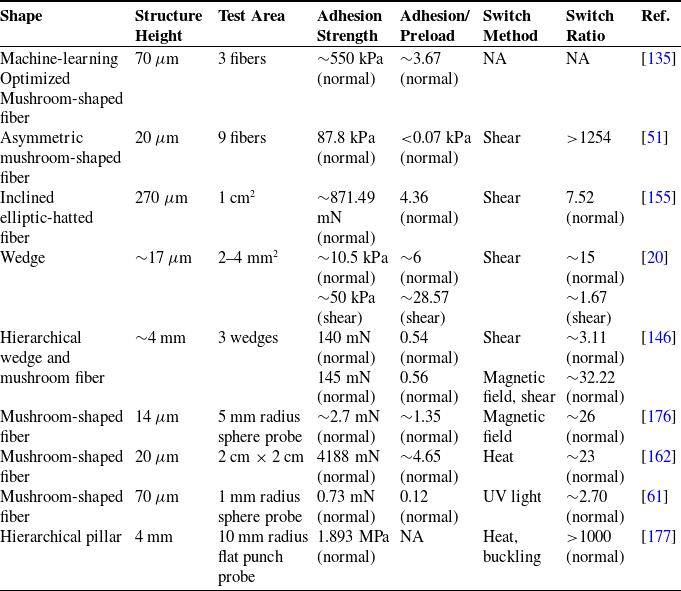
The asymmetric design can facilitate the anisotropic dry adhesion and enhance controllability. For adhesives with fibrillar array structures, typical asymmetrical designs include inclined fibers [Reference Jin, Cremaldi, Erickson, Tian, Israelachvili and Pesika49, Reference Wang, Li, Tian, Hu, Tian, Shao and Ding50, Reference Shi, Cheng and Cheng154–Reference Hwang, Yi, Choi and Jeong156], asymmetric contact ends [Reference Jin, Cremaldi, Erickson, Tian, Israelachvili and Pesika49, Reference Wang, Li, Tian, Hu, Tian, Shao and Ding50, Reference Seo, Lee, Kim, Ko, Lee and Lee157], and local support [Reference Pang, Kim, Wu, Wang, Yu and Sitti51] designs. Micro wedge array that mimics the spatula structure of the terminal of the gecko setae is another representative type of anisotropic dry adhesive. Distinguished by the compliant deformation capacity under shear movement at a specific angle, the wedge-shaped array can give a large adhesion-to-preload ratio as well as an anisotropy ratio [Reference Tao, Gao, Lu, Liu, Li, Tong, Pesika, Meng and Tian20, Reference Wang, Liu and Xie153, Reference Liu, Zhou, Pan, Li and Li158–Reference Suresh, Kerst, Cutkosky and Hawkes161]. External fields such as electricity [Reference Sun, Tang, Wang, Guo, Lv and Yang58–Reference Tian, Liu, Shao, Li, Li and Chen60], light [Reference Kizilkan, Strueben, Staubitz and Gorb61], heat [Reference Kim, Yeom, Ro, Na, Jung and Ko62–Reference Zhang, Tian, Liu, Wang, Wu, Li, Wang, Chen and Shao64, Reference Li, Tian, Shao, Liu, Wang and Zhang162], pressure [Reference Kortman, Sakes, Endo and Breedveld65, Reference Frey, Haque, Tutika, Krotz, Lee, Haverkamp, Markvicka and Bartlett163–Reference Sun, Chen, Li, Li, Li, Meng and Tian165], and magnetism [Reference Shi, Yang, Li, Guo and Zhao166–Reference Wang, Luo, Linghu and Song168], or external forces such as shearing [Reference Jiang, Hawkes, Fuller, Estrada, Suresh, Abcouwer, Han, Wang, Ploch, Parness and Cutkosky19–Reference Hu, Wang, Tian, Huang, Wang, Chen, Gao, Li, Chen, Zheng and Shao21, Reference Dadkhah, Zhao, Wettels and Spenko169, Reference Pang, Mak, Tse, Yu and Wang170], peeling [Reference Li, Li, Li, Meng and Tian171–Reference Nagahama, Nakao and Sugano174], and structural instability [Reference Purtov, Frensemeier and Kroner175] can realize rapid control between adhesion and detachment, as illustrated in Figure 8. Among force-regulated situations, the peeling method is widely applied to isotropic surfaces, while the peeling method is widely applied to anisotropic surfaces. Table I quantitatively summarizes the adhesion properties of gecko-inspired dry adhesives, including their adhesion strength and controllability.
Dry adhesion control methods.

Adhesion ability of van der Waals force-based dry adhesives.

The fabrication methods of biomimetic dry adhesives can be divided into two types: molding methods and direct forming methods. The shaping of the mold is the core of the molding process. Common mold preparation processes include lithography [Reference Wang, Li, Tian, Hu, Tian, Shao and Ding50, Reference Barreau, Hensel, Guimard, Ghatak, McMeeking and Arzt125, Reference Rong, Zhou, Chen, Robertson, Federle, Hofmann, Steiner and Goldberg‐Oppenheimer142, Reference Yuan, Wang, Li and Wu178, Reference Wang, Hu, Shao and Ding179], etching [Reference Wang56, Reference Yi, Hwang, Sung, Lee, Kim, Kang, Bae and Jeong152, Reference Seo, Lee, Kim, Ko, Lee and Lee157, Reference Yuan, Wang, Li and Wu178, Reference He, Xu, Yu, Huo, Wang, Chen, Sun, Yin, Du, Li and Dai180], precision machining [Reference Tao, Gao, Lu, Liu, Li, Tong, Pesika, Meng and Tian20, Reference Hwang, Yi, Choi and Jeong156, Reference Zhou, Ruan, Che, Li, Chen and Jiang160, Reference Kerst, Suresh and Cutkosky181], etc. Through specifically designed schemes, complex structures such as undercut structures for the formation of the mushroom-shaped fibers can be formed on the surface uniformly. Hierarchical structures can be formed through multi-step molding [Reference Raut, Baji, Hariri, Parveen, Soh, Low and Wood145, Reference Shen, Cheng, Peng and Chen146]. For more complex irregularly shaped fibers, bottom-up fabrication methods including two-photon polymerization lithography [Reference Pang, Kim, Wu, Wang, Yu and Sitti51, Reference Son, Liimatainen and Sitti135, Reference Busche, Starke, Knickmeier and Dietzel155] and 3D printing [Reference Shi, Cheng and Cheng154, Reference Gwon, Park, Hong, Park, Han, Kang and Koh159] are utilized for prototyping. However, the demolding process may lead to the destruction of the delicate structures, while the disappearing mold method for tiny structures limits the cost and efficiency of adhesive production. Directly printing adhesive structures with flexible materials can prepare complex structures [Reference Dayan, Son, Aghakhani, Wu, Demir and Sitti134, Reference Dayan, Chun, Krishna‐Subbaiah, Drotlef, Akolpoglu and Sitti182]. Carbon nanotubes with a high aspect ratio can be grown by chemical vapor deposition [Reference Qu, Dai, Stone, Xia and Wang130, Reference Rong, Zhou, Chen, Robertson, Federle, Hofmann, Steiner and Goldberg‐Oppenheimer142, Reference Xu, Du, Ganguli, Roy and Dai183]. The electrohydrodynamic growing method is effective for fabricating well-defined mushroom-shaped arrays with or without core-shell design [Reference Tian, Wang, Zhang, Jiang, Liu, Li, Wang, Chen and Shao150, Reference Hu, Shao, Tian, Li and Jiang184, Reference Hu, Tian, Li, Shao, Ding, Liu and An185].
3.2. Wet adhesives based on capillary force
The polygon array structures are typical wet adhesion structures inspired by tree frogs. Chen et al. [Reference Chen, Zhang, Zhang, Zhang and Han38] compared the adhesion performance of adhesive surfaces with seven various patterns. The results showed that the hexagonal pillar pattern exhibits strong and stable friction on soft tissue. The liquid movement among channels and contact interfaces was assumed to be the main influence factor of friction performance. By draining the liquid through channels, flushing onto the contact areas can be avoided, thus inhibiting liquid lubrication and strengthening the friction.
The influence of structural geometry and distribution characteristics of the hexagonal array on the adhesion properties have been studied. Wet adhesive force tests between the artificial pads and sandpaper slices with different average surface roughness at various preloads have been carried out, whose results pointed out that the wet adhesive force increased significantly by the microstructures and preloads when the microcosmic profile height of the substrates is near or less than the width of microchannels in the biomimetic adhesive pads [Reference Wang, He and Shen52]. Drotlef et al. [Reference Drotlef, Stepien, Kappl, Barnes, Butt and del Campo39] tested the wet adhesion properties of hexagonal fiber arrays with flat, T-shaped, and concave ends, and the results showed that the shape of the contact ends had little influence on the wet adhesion properties, reflecting the difference in the design of fiber structures between the tree-frog-inspired capillary-based wet adhesives and the gecko-inspired van-der-Waals-based dry adhesives. Iturri et al. [Reference Iturri, Xue, Kappl, García‐Fernández, Barnes, Butt and del Campo40] addressed that the elongated hexagonal patterns showed higher friction forces than regular patterned or non-structured surfaces under wet conditions, as shown in Figure 9c, mainly caused by high pillar deformability and high edge density of the pattern in the sliding direction. However, the aspect ratio of the pillar should be designed considering the material stiffness to avoid clustering. Chen et al. [Reference Chen, Zhang, Zhang, Zhang and Han38] tested the friction of the adhesives with various hexagonal shapes and aspect ratios in different shear directions (Figure 9a and b). The shape of the hexagons significantly influenced the direction dependence of the adhesives. It was also addressed that the elasticity of the material and the aspect ratio of the hexagonal pillars must be properly matched, but mainly for liquid flow considerations. Xie et al. [Reference Xie, Li, Dai, Huang and Wang41] pointed out that compound parameters such as width-to-length, height-to-length, and height-to-width had more significant influences on friction performance than single parameters alone. The micro-nano hierarchical structures of the tree frog toe pads with nanocavities existing on the top of the second-level pillars (Figure 9d) form a two-level self-splitting effect to uniformly distribute liquid on the pillars, and a self-sucking effect with the cavity rims generating thinner Nanometer-thick liquid film, improving the interface friction over 3.5 times as compared with a smooth surface [Reference Zhang, Chen, Guo, Wang, Jiang, Zhang, Ma, Luo and Jiang54]. The design criteria are proposed based on the liquid volume on the pillars and in the channels [Reference Zhang, Chen, Guo, Wang, Jiang, Zhang, Ma, Luo and Jiang54]. Nonuniform pillar arrays with inclined and gradient in height and length (Figure 9e) are found to perform strong boundary wet friction without external normal force and excellent controllability [Reference Zhang, Guo, Wang, Liang, Zhou, Liu, Zhang and Chen186].
(a) Effect of geometry on wet adhesion [Reference Chen, Zhang, Zhang, Zhang and Han38]. (b-c) Effect of loading direction on wet adhesion [Reference Chen, Zhang, Zhang, Zhang and Han38, Reference Iturri, Xue, Kappl, García‐Fernández, Barnes, Butt and del Campo40]. (d) Performance of the hierarchical wet adhesive during frog-like-crawling step [Reference Zhang, Chen, Guo, Wang, Jiang, Zhang, Ma, Luo and Jiang54]. (e) Wet adhesive with inclined gradient pillars surface [Reference Zhang, Guo, Wang, Liang, Zhou, Liu, Zhang and Chen186]. (f-h) Gradient stiffness design and adhesion performance of wet adhesive [Reference Liu, Meng, Tan, Shi, Zhu, Xiao and Xue57].

Barnes et al. [Reference Barnes, Goodwyn, Nokhbatolfoghahai and Gorb187] tested the stiffness of Litoria caerulea toe pads by micro-indentation and found that the stiffness was distributed in gradient, where the outer layer had the largest stiffness, inspiring the gradient stiffness design of wet adhesives. The fiber gradient stiffness achieved by adjusting the distribution density of enhanced particles can increase the maximum stress during separation while maintaining the flexible adaptation, thus achieving adhesion strength and durability enhancement (Figure 9f-h) [Reference Liu, Meng, Tan, Shi, Zhu, Xiao and Xue57]. Based on the idea of stress distribution, the design of fiber reinforcement is proposed, which also effectively improves the adhesion and friction capabilities of the adhesives [Reference Xue, Sanz, Luo, Turner, Wang, Tan, Zhang, Du, Steinhart, Mijangos, Guttmann, Kappl and del Campo188, Reference Shi, Tan, Liu, Meng, Zhu and Xue189].
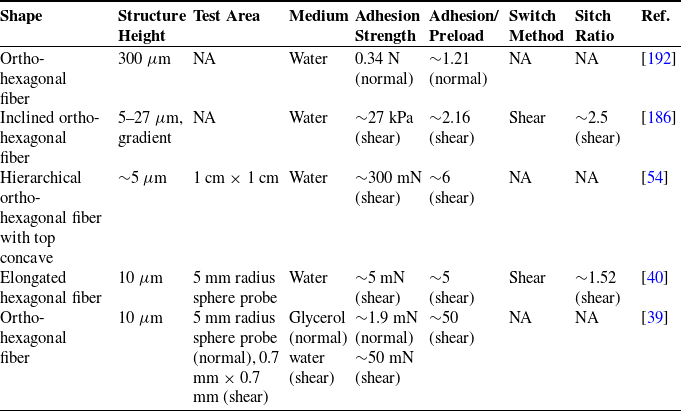
The typical preparation methods of wet adhesives are similar to those of dry adhesives due to similar characteristics of fibrillar array patterns, including molding methods [Reference Ruan, Li, Xu and Chen32, Reference Chen, Zhang, Zhang, Zhang and Han38–Reference Xie, Li, Dai, Huang and Wang41, Reference Wang, He and Shen52, Reference Zhang, Chen, Guo, Wang, Jiang, Zhang, Ma, Luo and Jiang54, Reference Liu, Meng, Tan, Shi, Zhu, Xiao and Xue57, Reference Zhang, Guo, Wang, Liang, Zhou, Liu, Zhang and Chen186, Reference Xue, Sanz, Luo, Turner, Wang, Tan, Zhang, Du, Steinhart, Mijangos, Guttmann, Kappl and del Campo188–Reference Chun, Kim, Kim and Pang191] and direct forming methods [Reference Shiratori, Sakamoto, Kanazawa, Suzuki, Takahashi and Aoyagi192]. The mold can be fabricated through lithography [Reference Chen, Zhang, Zhang, Zhang and Han38–Reference Xie, Li, Dai, Huang and Wang41, Reference Wang, He and Shen52, Reference Meng, Liu, Shi, Tan, Yang, Wang, Shi, Kappl, Lei, Liu and Xue190], etching [Reference Chun, Kim, Kim and Pang191], and additive manufacturing methods [Reference Ruan, Li, Xu and Chen32]. In addition to traditional materials such as PDMS and PU, new materials such as hydrogels are used for the preparation of wet adhesives to improve adhesion capability as well as biocompatibility [Reference Ruan, Li, Xu and Chen32, Reference Meng, Liu, Shi, Tan, Yang, Wang, Shi, Kappl, Lei, Liu and Xue190]. Complex structures with hierarchical or stiffness gradient designs can be formed by specifically designed methods and perform enhanced properties. Hierarchical structures [Reference Zhang, Chen, Guo, Wang, Jiang, Zhang, Ma, Luo and Jiang54, Reference Zhang, Guo, Wang, Liang, Zhou, Liu, Zhang and Chen186] and fiber-reinforced pillars [Reference Xue, Sanz, Luo, Turner, Wang, Tan, Zhang, Du, Steinhart, Mijangos, Guttmann, Kappl and del Campo188, Reference Shi, Tan, Liu, Meng, Zhu and Xue189] have been formed by groups of delicate lithography, etching, and molding processes. For the gradient stiffness designs, the distribution of the enhanced particles can be adjusted by centrifugation during the molding process, realizing a 2.3-times dry adhesion and a 5.6-times wet adhesion as compared to the unenhanced sample [Reference Liu, Meng, Tan, Shi, Zhu, Xiao and Xue57]. Table II quantitatively summarizes the adhesion properties of capillary force-based wet adhesives.
Adhesion ability of capillary force-based wet adhesives.

3.3. Suckers
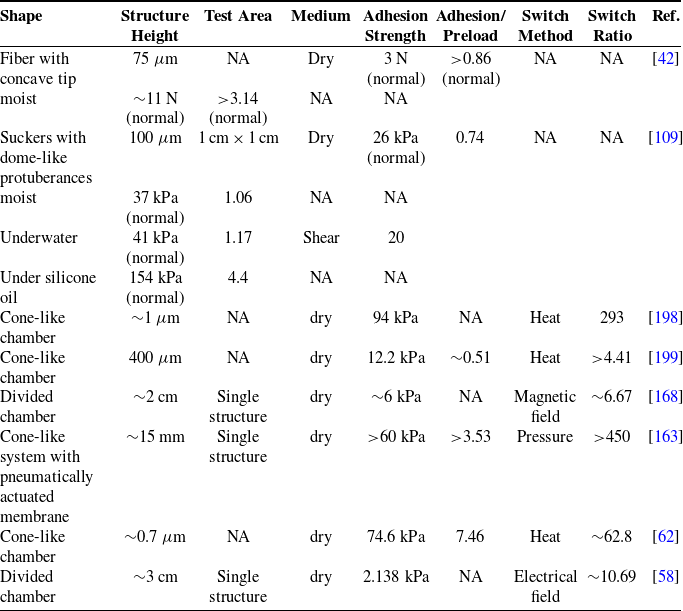
The suckers can adhere to surfaces with a certain range of roughness under both dry, moist, and underwater situations [Reference Baik, Kim, Lee, Lee and Pang42, Reference Eroğlu and Parmak43, Reference Chen and Yang193]. The adhesion strength is mainly related to the difference between internal and external pressure and the effective contact area. Controllable attachment can be effectively achieved by using external force or external field to actively change the pressure or sealing state of the sucker chamber. Table III quantitatively summarizes the adhesion properties of suction-based adhesives.
Adhesion ability of suction-based adhesives.

Fibers with concave-shaped tops can achieve negative pressure adhesion under proper normal load [Reference Baik, Kim, Lee, Lee and Pang42–Reference Zhu, Cao, Chen, Wang, Shi, Xiao, Lei, Liu, Song and Xue44]. The shape of the inner chamber significantly affects adhesion properties by changing the contact formation and maintenance processes [Reference Eroğlu and Parmak43, Reference Zhu, Cao, Chen, Wang, Shi, Xiao, Lei, Liu, Song and Xue44, Reference Li, Hu, Liu, Tian, Li, Luo, Zhou and Lu194], an example is given in Figure 10a. The dome-like protuberances inside the suckers of the octopus are verified to be essential for generating a cohesive force among liquid molecules without energy consumption and inspire a series of biomimetic sucker designs [Reference Baik, Kim, Park, Lee, Ho Bhang and Pang109, Reference Chun, Kim, Baik, Lee, Lee, Bhang and Pang195]. Baik et al. [Reference Baik, Kim, Park, Lee, Ho Bhang and Pang109] proposed a model to describe the low energy consumption self-locking strong adhesion of octopus suckers and confirm the relative effects by confocal fluorescence microscopy (Figure 10b). During the loading process, the volume of the chamber gradually decreases, minimizing the number of liquid molecules inside the orifice. The elastic chamber is squeezed until the dome-like microstructure and the adjacent sidewalls are in contact dividing the initial chamber into the upper and the lower chambers, leading to capillary action within. After removing the external load, the cohesive forces of the liquid molecules close the upper chamber and induce an extremely low pressure in the lower chamber, achieving stable high adhesion.
(a) Differently shaped micro-suckers and simulated interfacial stress distributions [Reference Zhu, Cao, Chen, Wang, Shi, Xiao, Lei, Liu, Song and Xue44], (b) Octopus-inspired long-lasting sucker design and mechanism of action [Reference Baik, Kim, Park, Lee, Ho Bhang and Pang109]. (c-e) Suckers with patterned lips [Reference Baik, Lee, Kim, Min and Pang31, Reference Hwang, Lee, Kim, Yang and Pang196, Reference Hernandez, Sandoval, Yuen and Wood197].

The outstretched lip structure can enhance the adhesion by strengthening the sealing. Specific patterns on the exterior rim of the suckers (examples as Figure 10c-e) exhibit multi-function including flowing residual water out of the contact area thus enhancing the surface interaction, maximizing the contact area under pressure, and enhancing the conformability during bending [Reference Baik, Lee, Kim, Min and Pang31, Reference Hwang, Lee, Kim, Yang and Pang196, Reference Hernandez, Sandoval, Yuen and Wood197]. By adjusting material stiffness, the lip can be softened thus enhancing conformability and sealing capability [Reference Baik, Lee, Kim, Min and Pang31, Reference Lee, Kang, Kim, Kim and Pang200]. Baik et al. [Reference Baik, Lee, Kim, Min and Pang31] combine octopus-inspired micro suckers with a soft wrinkled layer via pre-stretching (Figure 10c), UV/ozone exposure, and selective transfer process. The peel-off energy of the optimized patches on heart and liver tissue reached over 10 times of the original patches.
Under the condition of a certain internal and external pressure difference, reducing the size of the sucker may not significantly improve the adhesion strength. However, for bigger suckers, interface defects are more likely to occur in the process of forming contact and maintaining pressure difference, which easily leads to the failure of adsorption. From this perspective, the subdivision of the sucker structure may improve the adhesion of the sucker by improving the adaptability to interface defects [Reference Kim, Coutinho, Park and Rodrigue22, Reference Li, Wang, Zhang, Song, Wang, Tan, Zhao, Wang, Sun, Yang, Liu, Chen, Xu, Nguyen, Kovac and Wen27].
3.4. Spines
For a single spine, the radius of the tip should be as small as possible to increase the number of effective locks according to theoretical models of mechanical interlocking attachment mentioned in Figure 6, while a limit exists to ensure the strength of the spine. For any given spine, there are various attachment points distributed randomly across the rough surface [Reference Jiang, Wang and Cutkosky46]. To maximize attachment strength and stability, the interlocking pad must make the spines interlock with as many attachment points as possible.
Array designs, as shown in Figure 11a, increase the number of spines to increase the number of effective locks, thus raising the maximum gripping strength, and probabilistically reduce the average interlocking distance [Reference Jiang, Wang and Cutkosky46, Reference Chen, Miller, Winston, Schneider, Bylard and Pavone201, Reference Wang, Jiang, Myung Huh, Sun, Ruotolo, Miller, Roderick, Stuart and Cutkosky202] to improve the stability of locks. A one-dimensional array provides more effective locks perpendicular to the gripping direction. A two-dimensional array, based on one-dimensional array, adds more effective locks along the gripping direction and probabilistically reduces the average interlocking distance.
Typical spine designs for controllable adhesion.

The unidirectional array mainly draws inspiration from the foot structures of humans and felid animals such as tigers and cats. Consisting of spines arranged in a single direction, it can provide significant tangential force with a relatively small normal preload, making it effectively suitable for attachment to vertical or inclined surfaces [Reference Liu, Huang, Zhang, Chen, Yu, Meng, Bao, Ming, Huang, Hashimoto and Takanishi113, Reference Wang, Jiang, Myung Huh, Sun, Ruotolo, Miller, Roderick, Stuart and Cutkosky202].
The opposing array consists of two arrays with opposite inclined directions. The primary bionic model for the opposing array structure is the beetle, which utilizes the principle of opposing self-locking to allow the attachment claws to interlock with rough surfaces. This opposing self-locking enables it to bear not only shear force but also substantial normal force, expanding the applicability of the attachment claws to a broader range of applications, such as ceiling attachment and microgravity attachment [Reference Nagaoka, Minote, Maruya, Shirai, Yoshida, Hakamada, Sawada and Kubota203].
Circumferential arrays create multiple sets of non-parallel opposing pairs of constraints, which can provide sheer force in any direction so that the stability of the design is significantly improved while the force in any certain direction is smaller as a result of the sheer force resolution. In addition, the circumferential arrays perform better with curved surfaces with significant waviness, as Figure 11a shows [Reference Parness, Frost, Thatte, King, Witkoe, Nevarez, Garrett, Aghazarian and Kennedy204–Reference Li, Chen, Li, Hou, Zhao, Meng and Tian206].
Flexible designs aim to improve the effectiveness of locking, requiring flexibility in both tangential and normal directions, which mainly draw inspiration from animal muscles and are built upon underactuated systems. For the array design that consists of many independent spins, flexible structures are indispensable to guarantee that most of the spins can interlock with their attachment points. Tangential flexibility is used to overcome the randomness in the distribution of attachment points, allowing the spines to align properly with various points on the surface. Normal flexibility helps the spines adapt to the uneven topography of rough surfaces, enabling better conformance to surface contours and improving overall interlocking performance. The demanded flexibility can be achieved and optimized by designing flexible structures and utilizing elastic materials and components [Reference Asbeck, Kim, Cutkosky, Provancher and Lanzetta45, Reference Wang, Jiang and Cutkosky47]. Flexible structures are usually designed like “” or “” as Figure 11b shows [Reference Wang, Jiang, Myung Huh, Sun, Ruotolo, Miller, Roderick, Stuart and Cutkosky202, Reference Nagaoka, Minote, Maruya, Shirai, Yoshida, Hakamada, Sawada and Kubota203], which can deform in two directions, to gain both tangential and normal flexibility. The elastic components, such as springs or rubbers, are usually placed at a certain angle to a horizontal plane and in pairs to achieve similar flexibility [Reference Wang, Jiang and Cutkosky47]. It should also be noted that there is still a balance between flexible adaptation and bearing capacity, which needs comprehensive consideration to guarantee structural strength and adhesion strength at the same time.
4. Applications of bio-inspired controllable adhesion in robotics
4.1. Gripping and manipulation
In the robot system, the end effector directly interacts with the object, and its grasp and operation performance directly affect the efficiency and reliability of its task execution. Traditional grippers usually grasp targets by wrapping or friction. The former is challenging to realize the grasping of large-sized objects, whereas the latter typically needs to apply a relatively large normal force to generate sufficient friction for grasping, which may potentially result in damage to the target object. The use of biomimetic reversible adhesives can essentially improve the capability of the grippers, not only augmenting the strength of the interface interaction, enabling small grippers to grasp relatively large mass and large volume objects, but also enhancing the properties of dexterity and controllability (Figure 12).
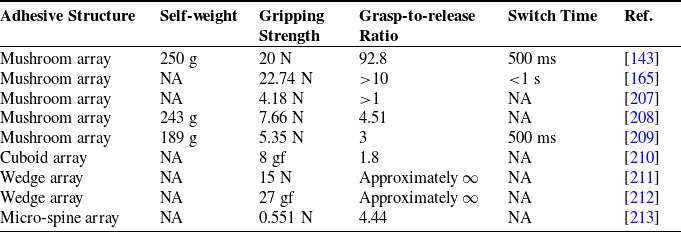
Through enhancing interfacial interactions via bio-inspired controllable adhesives, it is possible to handle large objects with compact small grippers. Typical performance parameters are summarized in Table IV. Due to the lack of uniform specification for demonstration of grasping ability, some parameters are estimated according to the articles. Chen et al. [Reference Chen, Sun, Li, Li, Li, Meng and Tian164] combined gecko-inspired dry adhesive and particle jamming stiffness modulation, achieving an impressive gripping performance with smooth objects with various shapes from plane to irregular surface weighing over 2 kg, with a load-to-weight ratio of approximately 8. The adhesion-to-detachment ratio is 92.8, the switch time is remarkably fast at just 0.5 s, and the minimal power consumption is only 4.404 W.
Bio-inspired controllable adhesion enhanced gripping and manipulation. (a) Ref. [Reference Tao, Gao, Lu, Liu, Li, Tong, Pesika, Meng and Tian20]. (b) Ref. [Reference Wu, Deng, Jian, Yang, Shao, Zhou, Xiao, Ma, Zhou, Wang and Li215]. (c) Ref. [Reference Jiang, Hawkes, Fuller, Estrada, Suresh, Abcouwer, Han, Wang, Ploch, Parness and Cutkosky19]. (d) Ref. [Reference Chen, Sun, Li, Li, Li, Meng and Tian164]. (e) Ref. [Reference Hu, Wang, Tian, Huang, Wang, Chen, Gao, Li, Chen, Zheng and Shao21].

Parameters and capability of grippers utilizing bio-inspired adhesion.

The corresponding grippers have different application scenarios according to the characteristics of different adhesives. The gecko dry adhesives can provide controllable strong adhesion in vacuum environments since the adhesion is based on van der Waals interactions, exhibiting potential for space grasping and docking [Reference Jiang, Hawkes, Fuller, Estrada, Suresh, Abcouwer, Han, Wang, Ploch, Parness and Cutkosky19, Reference Ben-Larbi, Hensel, Atzeni, Arzt and Stoll214]. For large-size and large-mass targets, the core problem to be solved is the adaptive fit and uniform bearing among the adhesion area, to avoid the initial formation and propagation of cracks at the interface. For underwater scenarios, the attachment ability of the suckers may be further enhanced by the increase in water pressure, breaking the limit of atmospheric pressure.
Due to controllable strong adhesion and easy detachment, grippers with bio-inspired adhesives are specially designed to operate fragile parts such as silicon wafers [Reference Tao, Gao, Lu, Liu, Li, Tong, Pesika, Meng and Tian20, Reference Baik, Kim, Park, Lee, Ho Bhang and Pang109] and even biological tissue [Reference Chen, Zhang, Zhang, Zhang and Han38, Reference Chen and Yang193, Reference Wu, Deng, Jian, Yang, Shao, Zhou, Xiao, Ma, Zhou, Wang and Li215]. The gripper utilizing tree-frog-inspired wet adhesives can provide considerable friction and adhesion enhancement without large pre-pressure, effectively reducing tissue damage compared to traditional surgical grippers [Reference Chen, Zhang, Zhang, Zhang and Han38]. Similarly, the grippers based on suction disks have application potential in atmospheric, moisture, and underwater environments. With superior flexibility and adaptability, grippers with suction can be designed to grasp tissues or organs firmly and nondestructively [Reference Chen and Yang193, Reference Wu, Deng, Jian, Yang, Shao, Zhou, Xiao, Ma, Zhou, Wang and Li215].
The combination of sensing and manipulation is another trend in robotics grasping. Due to the flexible film properties, biomimetic adhesive materials are particularly suitable for integration with flexible sensing to provide tactile functions. Chen et al. [Reference Chen, Zhang, Wu, Zhang, Chu and Cui216] introduced an intrinsic adhesion state sensing methodology. The complex micro-scale contact issues can be transformed into relatively simple mechanical measurements based on the shear and adhesion performance of the inclined anisotropic adhesive structure. Kim et al. [Reference Kim, Je, Hart and Kim217] fabricated flexible three-dimensional (3D) surface electrodes that are mechanically compliant and electrically conductive, providing multifunctional ability to switch and sense the contact force via capacitive sensing. Through the combination of sensing and interface force enhancement, the grasping power, adaptability, and processing ability of fragile objects of the robot system are significantly improved [Reference Chen, Wu, Zhang, Zhang, Chu and Cui212, Reference Krahn, Liu, Sadeghi and Menon218].
4.2. Motion and attachment
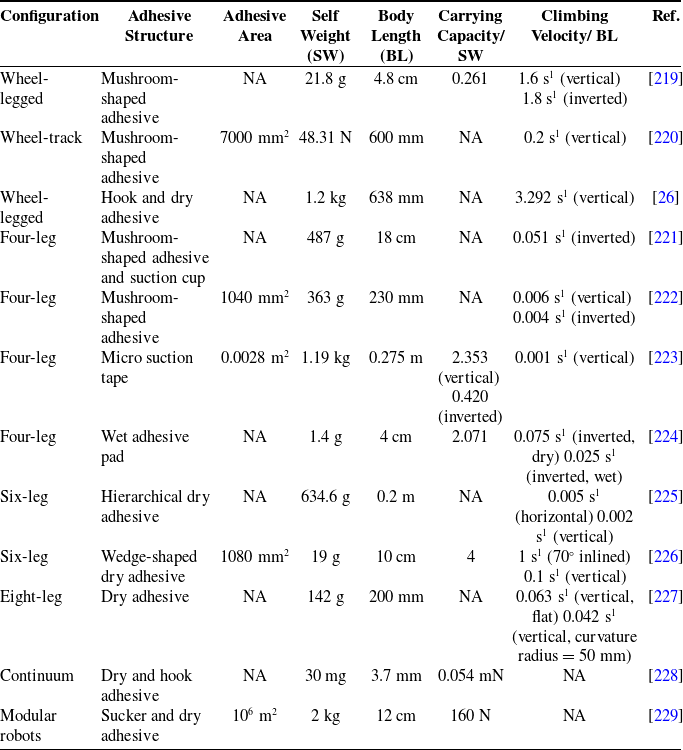
Motion and attachment are the basis for many unmanned operations. The utilization of biomimetic adhesion materials and structures can increase strength and controllability of interfacial interactions between the robots and the targets, enabling horizontal, vertical, and even ceiling wall crawling on various surfaces with low preload requirements, low energy costs, and good flexibility. Typical designs are illustrated in Figure 13, and some key parameters of climbing robots integrated with bio-inspired adhesion are listed in Table V.
The locomotion modes can be classified into four groups: wheel, track, leg, and continuum. The wheeled and tracked robots usually demonstrate higher mobile efficiency and their movement ability can be significantly enhanced by integrating biomimetic dry adhesive surfaces [Reference Krahn, Liu, Sadeghi and Menon218–Reference Li, Sun, Chen, Zhang, Wang and Wu220, Reference Dharmawan, Xavier, Hariri, Soh, Baji, Bouffanais, Foong, Low and Wood230] or spine structures [Reference Liu, Sun, Cao, Wu, Xu, Han, Wen, Shen, Chen, Xu, Yu and Ji26], suitable for climbing on smooth and rough surfaces, respectively. Owing to the continuous rolling form of motion, such robots usually exhibit higher velocity. Wheeled and tracked robots combined with negative pressure suckers have already been applied in various cleaning and detection tasks [Reference Okada, Yamanaka and Kondo231–Reference Lei233].
Bio-inspired controllable adhesion enhanced motion and attachment. (a) Ref. [Reference Ko, Yi and Jeong222]. (b) Ref. [Reference Wang, Li, Zhao, Zhang and Wen234]. (c) Ref. [Reference Parness, Frost, Thatte, King, Witkoe, Nevarez, Garrett, Aghazarian and Kennedy204]. (d) Ref. [Reference Wu, Dong, Kim, Wang and Sitti228]. (e) Ref. [Reference Zhao, Luo, Tu, Meng and Lam229].

Parameters and capability of climbing robots utilizing bio-inspired adhesion.

Compared to wheeled and tracked robots, the multi-legged structure and discrete control enable the legged robots to navigate defects or obstacles. Even when one leg or some legs fail to adhere, the remaining legs can still hold the robot on the surface. Utilizing biomimetic adhesives, four-legged [Reference Ko, Yi and Jeong222, Reference Chen, Doshi and Wood224, Reference Kim, Spenko, Trujillo, Heyneman, Mattoli and Cutkosky235, Reference Sangbae Kim, Spenko, Trujillo, Heyneman, Santos and Cutkosky236], six-legged [Reference Li, Ahmed, Sameoto and Menon24, Reference Henrey, Ahmed, Boscariol, Shannon and Menon225, Reference Birkmeyer, Gillies and Fearing226, Reference Birkmeyer, Gillies and Fearing237], and eight-legged [Reference Liu and Seo25, Reference Liu, Kim and Seo227] climbing robots have been widely studied, achieving crawling on smooth surfaces at different angles in dry and moist environments, according to the applied adhesives. The foot of the wall-climbing robot can be designed with flexibility, incorporating flexible material as a support layer of the adhesive material. This optimizes the interface contact and load bearing while reducing the impact of the actuator and improving the wall-climbing ability [Reference Ko, Yi and Jeong222, Reference Li, Bai, Li, Li, Li, Lu, Ma, Meng and Tian238]. By mimicking the mobile strategy of organisms, the gait planning, body structure design, and control framework of the robots can be further optimized, aiming at improving crawling speed and stability [Reference Wang, Weng, Wang, Wang, Wang, Dai and Jusufi221, Reference Wu, Dong, Kim, Wang and Sitti228, Reference Haomachai, Dai and Manoonpong239]. The parameters and capability of some typical climbing robots are summarized in Table IV. To better evaluate the climbing ability of the robot, the ratio of carrying capacity to self-weight and the ratio of crawling speed to body length are calculated. Compared with the carrying capacity of their biological prototypes, which is many times their weight, and the movement distance per second, which is many times their body length, the performance of the biomimetic climbing robots still needs further improvement.
Continuum robots are characterized by their exceptional compliance and flexibility, which enables them to navigate unstructured and complex terrain while excelling at entering tight spaces. By combining the biomimetic adhesion, the motion ability of the continuum robot can be further improved. Wu et al. [Reference Wu, Dong, Kim, Wang and Sitti228] reported a soft-bodied robot that can achieve controllable adhesion to climb 3D soft and wet surfaces including porcine tissues with its unique footpad design combining mushroom-shaped dry adhesives and micro-spines and paves the way for minimally invasive medicine applications.
In recent years, modular robots have become a research hotspot because of their high scalability and diversified functions and forms. Biomimetic controllable adhesion can be used as an effective assembly form to realize mutual locking and controllable disengagement between robot modules. Zhao et al. [Reference Zhao, Luo, Tu, Meng and Lam229] presented a robotic swarm system inspired by snails, whose “strong mode” employs a vacuum sucker with directional polymer stalks for robust and ensures secure connections in unstructured environments.
5. Conclusions and outlook
Through prolonged evolution, some organisms have developed sophisticated structures and ingenious control strategies that harness diverse mechanisms to achieve robust and controllable interfacial interactions, thereby attaining superior locomotion and manipulation capabilities. This biological intelligence has inspired the advancement of bio-inspired controllable adhesion technologies, offering vital insights for advancing robotic motion and operational performance. This review elaborates on the realization of bionic reversible adhesion and introduces various adhesion mechanisms represented by gecko, tree frog, octopus, and beetle, corresponding to van der Waals interaction, capillary action, negative pressure action, and mechanical locking mechanism, respectively. The latest progress in the design and preparation of biomimetic attachment structures and materials is summarized, and the optimization methods to improve the adhesion strength, controllability, and adaptability under different mechanisms are discussed. The typical applications of biomimetic attachment materials and structures for different environments and target surface characteristics are summarized. By combining interfacial interaction design with mechanism design, capabilities including manipulation and locomotion of the robotic systems can be effectively enhanced.
Despite the long-term development, bio-inspired adhesion technology has formed preliminary application ability but still features a large space for optimization. Its application form in the field of robotics also requires further development.
-
(1) The comprehensive ability of biomimetic attachment materials is still inferior to that of their corresponding biological prototypes. By adopting new designs, materials, and technologies, it is expected to comprehensively improve the interface adhesion strength, surface topography adaptability, adhesion/detachment controllability, and reuse durability. In combination with machine learning and other advanced methods, the exploration of the adhesion structure design can be extended to a wider range to achieve performance optimization with higher efficiency. In terms of material properties, current artificial materials exhibit limitations in replicating the superior properties (e.g., strength, self-cleaning, and self-healing), while frequently requiring compromising processability for performance enhancement. This inherent trade-off poses significant challenges in advancing adhesion performance, thereby emphasizing the optimization of material intrinsic characteristics. Moreover, adhesion designs with multiple mechanisms are expected to achieve strong and controllable adhesion of multiple modes for complex applications and environments.
-
(2) The intelligence of biomimetic attachment materials needs to be further studied and utilized. The sensing and execution can be integrated into the biomimetic attachment material based on comprehensive understanding of the dynamic response of materials to external fields such as force, heat, light, electricity, and magnetism, achieving the unity of biomimetic touch, interaction, and control. This integration enables programmable interfacial modulation and may fundamentally improve operational precision and mobility while maintaining minimized control cost, energy consumption, and simplified mechanical structure.
-
(3) The application maturity of biomimetic attachment technology needs to be improved. The mass and low-cost preparation method of high-performance adhesion materials should be studied to provide the material basis for large-scale applications. The corresponding adhesion mechanism should be designed for different adhesion materials to realize the transformation of strong interface adhesion to high carrying capacity. When expanding the application area, the possibility of local defects existing increases, and the stress concentration deteriorates, which attaches specific importance to simultaneous surface conformation and load redistribution. By imitating the smart operation mode of natural organisms, control methods that are delicate, flexible, and match the interfacial interaction mechanisms may be developed.
Author contribution
Tianhui Sun conducted the review and wrote the first draft; Yunxiao Liu revised and edited the manuscript; and Yu Tian provided advice, supervision, and funding acquisition.
Financial support
This work was supported by the National Natural Science Foundation of China under Grant U2141248.
Competing interests
The authors declare no conflicts of interest exist.
Ethical approval
Not applicable.