Introduction
The financialization of everyday life has received considerable attention from academics over the last decade (Beggs et al., Reference Beggs, Bryan and Rafferty2014; Deville, Reference Deville2015; Langley, Reference Langley2008). This research has played an important role in understanding how financialization and neoliberal fiscal austerity policies together impact on people’s everyday life (Joseph, Reference Joseph2014; Hacker and O’Leary, Reference Hacker and O’Leary2012). In the UK, there is evidence of increasing financial precarity as a direct result of the risk shift from the state to individuals via insecure employment and unstable incomes (Shildrick et al., Reference Shildrick, McDonald, Webster and Garthwaite2012; Standing, Reference Standing2011). The growth of credit has been normalized by society as a safety net in place of the welfare state (Soederberg, Reference Soederberg2013; van der Zwan, Reference Van Der Zwan2014). In this journal, Rowlingson et al. (Reference Rowlingson, Appleyard and Gardner2016) and Marston and Shevellar (Reference Marston and Shevellar2014) have highlighted how access to subprime credit in the UK and Australia has provided an important lifeline to people experiencing poverty and enabled them to smooth incomes and meet basic needs such as living expenses.
However, within the financialization literature, research on the lived experience of everyday financial practices at the financial fringe is limited. Less is known about those at the UK financial fringe marginalized by mainstream and subprime forms of credit. Financial exclusion from mainstream finance (for example, through bank branch closure and credit scoring) and financial inclusion (for example, via access to subprime credit) have both been studied extensively in the UK, US and Australia (French et al., Reference French, Leyshon and Signoretta2008; Marshall, Reference Marshall2004; Marston and Shevellar, Reference Marston and Shevellar2014; Leyshon et al. Reference Leyshon, Burton, Knights, Alferoff and Signoretta2004; Rowlingson, MacKay and Overton, Reference Rowlingson, MacKay and Overton2019; Servon, Reference Servon2017). In the UK, the introduction of payday loan regulation, known as High-Cost, Short-Term Credit [HCSTC], has meant that there is a significant group of people that are now excluded from both mainstream and subprime sources of credit. This dual exclusion is because the HCSTC regulation sought to protect vulnerable borrowers from unaffordable credit and overindebtedness. Payday loan borrowers were using credit as a way of managing on low and moderate incomes with little or no alternatives for them to borrow. This incongruence at the centre of HCSTC regulation raises an important question of the ways in which this group of former payday borrowers now access credit, if at all. In order to answer this question, it is, therefore, important to understand the lived experience of these individuals to examine how they manage their financial situations and assess the impact of the HCSTC regulation on financially marginalized individuals.
More specifically, this paper explores the lived experience of being denied subprime, payday loan credit and the subsequent practices that declined applicants engage in. We define the lived experience as the ‘shared typical’ behaviours and experiences of payday loan borrowers (McIntosh and Wright, Reference McIntosh and Wright2019:460). This approach is valuable as it enables us to examine financial subjects experiencing the changes in regulatory policy and the impact of these policies on their lives (McIntosh and Wright, Reference McIntosh and Wright2019). We define a declined applicant as someone who had previously accessed a payday loan and has subsequently been declined credit from a payday lender. We examine the impact of the HCSTC regulation on sixty-four financially marginalized individuals in the UK that are now unable to access payday loans. We make two theoretical and empirical contributions. First, we identify the range of socioeconomic strategies that individuals employ in order to manage their finances to create a typology of financial subjectivity at the financial fringe and argue that the financially marginalized are active, rational financial subjects. Second, we demonstrate that the temporal and precarious nature of financial inclusion has a significant impact on people’s everyday lived experience of financialization. The structure of the paper is as follows: part two explores the financialization of everyday life and the financial strategies of people with precarious incomes, subprime credit and financial subjectivity literature. In the third part, we outline our research methodology. Part four examines the findings and part five is the discussion. Part six concludes the paper.
The financialization of everyday life and subprime credit
Research on the financialization of everyday life has explored the increasingly significant role of finance within individual lives. Financialization has shifted greater financial responsibilities and risks to individuals alongside welfare state reforms. To ensure that individuals are financially secure, active engagement with financial services are encouraged through transforming ‘welfare subjects’ into financial subjects (Langley, Reference Langley2008; Rowlingson et al., Reference Rowlingson, Appleyard and Gardner2016:530). The literature on the financialization of everyday life has shown it to have had an uneven impact on individuals and their ability to engage with financial services.
Financial exclusion is defined as a spectrum of people that lack access to or are marginalized by mainstream financial services rather than a simple binary of being included or excluded. Financial exclusion is where mainstream financial institutions are unwilling to risk serving individuals with a thin or poor credit history leaving many people excluded from accessing affordable sources of credit. This group of people at the financial fringes of the mainstream are pushed towards the subprime economy to meet their financial needs (Aitken, Reference Aitken2006; Karger, Reference Karger2005; Sherraden et al., Reference Sherraden, McBride and Beverly2010; Rowlingson et al., Reference Rowlingson, Appleyard and Gardner2016). Therefore understanding the role of credit at the financial fringe is an important area of research as it plays a significant role for those that can be excluded from both mainstream and subprime financial institutions.
Credit at the financial fringe
Financially precarious individuals that are on the lowest incomes, underemployed or unemployed are vulnerable and at greatest risk of being pushed to the financial fringe as they are most reliant on credit to smooth income flows and are paying the poverty premium for such credit (Davies et al., Reference Davies, Finney and Hartfree2016; Soederberg, Reference Soederberg2013; Standing, Reference Standing2011). Areas of high deprivation are likely to have ‘credit deserts’ defined as a lack of affordable credit options, dominated by subprime, high-cost credit providers (Hilhorst and Jones, Reference Hilhorst and Jones2019:4). The financial fringe is a heterogeneous concept linked to financial exclusion, as part of a geographical process and an individual concept attached to the ability to access affordable credit as well as other financial products and services (Aitken, Reference Aitken2006; Marshall, Reference Marshall2004). In the US, payday lending is synonymous with the financial fringe and targeted at people excluded from mainstream financial services in low income areas (Servon, Reference Servon2017). Whilst payday lending is prohibited in some US states, it is argued that greater consistency is needed to protect consumers from lenders that find loopholes to serve them, such as operating in higher densities along the state border where lending is permitted (Graves, Reference Graves2003; Ramirez and Harger, Reference Ramirez and Harger2020).
The UK payday lending industry filled a gap for people considered to be financially precarious and/or living in a credit desert. The payday loan market grew from an estimated £100 million worth of loans made in 2004 to over £2.5 billion in 2013 (Lane and Rodrigues, Reference Lane and Rodrigues2015). The number of loans taken out more than doubled from 2009 to 2013 to reach 10 million loans, taken out by 1.6 million customers across 400 companies (FCA, 2014; Social Market Foundation, 2016). This growth has been combined with exceptionally high profits for many payday lenders.
Before HCSTC regulation was introduced in 2015, the average value of a payday loan taken out was £270 for 30 days (Office of Fair Trading, 2013). The cost of a payday loan could be between £15-£35 per £100 borrowed for 30 days, equating to between 448 percent and 3,752 percent annual percentage rate (APR) (Office of Fair Trading, 2013). In 2014, the FCA introduced the first in a series of new rules for payday lenders. Lending responsibly through checking borrower information and affordability became central to these initial regulatory changes. The key regulatory reform to payday loans was introduced in 2015: a cap on the initial cost of credit at 0.8 percent per day; default fees were limited to a maximum of £15 and a 100 percent repayment cap (FCA, 2014). This meant that borrowers would never have to repay more than double the amount borrowed. The decision to regulate HCSTC impacted on flows of credit to individuals as the consumer credit markets shifted to this new regime and it was predicted that 160,000 people (or 11 percent of payday borrowers) would no longer be able to access this form of credit (FCA, 2014). Regulation has therefore created a barrier for some of the most financially vulnerable to access credit. Whilst these measures were designed to protect consumers from financial harm, it excluded a significant number of consumers from accessing payday loans, pushing them further towards the financial fringe.
The key impact of the FCA’s HCSTC regulation has been to normalise fringe finance and reshape personal lending markets (Rowlingson et al., Reference Rowlingson, Appleyard and Gardner2016; Appleyard et al., Reference Appleyard, Rowlingson and Gardner2016). Whilst credit availability has decreased for consumers, consumer detriment is considered to have decreased. Financial regulation therefore aims to control financial markets and protect consumers from financial harm. HCSTC regulation has influenced how HCSTC lenders operate and the extent to which consumers can be financialized.
Post-regulation, payday lenders have changed their operations to meet the regulation. Since 2014, almost half of firms have exited the market either through withdrawing, not applying for authorisation or going into liquidation (Stepchange, 2016). Major lenders, such as Wonga, entered into administration as a consequence of the cost of compensating former borrowers for irresponsible lending practices (Collinson and Jones, Reference Collinson and Jones2018). One example of the growth and decline of payday lending is DFC Global Corp, a US company and a subsidiary of Dollar Financial UK Limited and owner of The Money Shop in the UK. In 2009, the Money Shop recorded 273 stores and 64 franchises across the UK and in 2011 acquired PayDay UK, one of the UK’s biggest online payday lending outlets. In August 2018, The Money Shop stopped issuing short-term loans and announced that 200 stores would close, indicating that irresponsible lending practices pre-HCSTC regulation were catching up with the lenders (Hayward, Reference Hayward2018).
The payday loan market has reduced dramatically since the introduction of the HCSTC regulation. Between 2017-2018, 5.4 million payday loans were made worth £1.3 billion (FCA, 2019). This has almost halved the size of the market, from the peak of 10.3 million payday loans worth £2.5 billion in 2013 (FCA, 2017a). In 2017, the average payday loan borrower had a below average income of £20,400 (compared to a UK average of £26,370) and had a declining credit profile (FCA, 2018).
The FCA’s (2017b:5) quantitative research suggests that as a result of the regulation, payday loan borrowers that are now excluded from HCSTC have not experienced a negative impact:
‘The majority (63 percent) of consumers turned down for HCSTC products since the cap was introduced believe that they are better off as a result. We have not seen … consumers increasing their use of other high-cost credit products after failing to get a HCSTC loan. We also found no evidence that consumers who have been turned down for HCSTC are more likely to have subsequently used illegal money lenders’
The lower cost of borrowing and regulatory changes have resulted in reduced default rates (FCA, 2017b). These FCA (2017b) statistics justify the role of regulatory policy and implementation.
However, in Australia, payday lending remains a significant issue despite regulation of the payday loans in 2010 and its revision in 2013. Under the current Australian regulation, small, unsecured loans (known as a small-amount credit contract or SACC) under AUD $2000) under 15 days are illegal. These loans are the equivalent of payday loans and can be borrowed for at least 16 days and up to a year. There are responsible lending guidelines and lenders are permitted to charge an establishment fee (up to 20% of the loan) as well as a monthly fee (up to 4% of the loan amount) (Queensland Law Handbook, 2019). However, critics argue that this equates to 400 percent per annum which is still too high and further regulation is needed to prevent consumer harm (Consumer Action Law Centre, 2020). This evidence from Australian regulation and the UK’s FCA quantitative survey suggests that exploring the lived experience of the declined payday applicant enables us to examine the practices and challenges of managing finances in a changing financial landscape more closely.
Financial subjects
Individual financial subjects are key to understanding the financialization of everyday life as they are considered to play an important role in participating and shaping the economy and their identity through the purchasing of financial products and services (Langley, Reference Langley2008; Martin, Reference Martin2002). Neoliberal discourses have assumed that everyone is able to actively participate in the financial system. For example, wealthy, middle class financial subjects have been characterized as neoliberal, rational, self-disciplined, calculative and responsible subjects that take an active role in everyday saving and borrowing (Martin, Reference Martin2002). Financial subjects are taking on greater financial responsibility and are being pushed to become more entrepreneurial in their approach to managing their finances for their long-term security through purchasing mortgages, pensions and insurance (Hall, Reference Hall2016; Langley Reference Langley2008; Rowlingson et al., Reference Rowlingson, Appleyard and Gardner2016). Lai (Reference Lai2017) and Hall (Reference Hall2016) have shown that financial subjects have a more complex set of financial subjectivities than simply being either active or passive within the financial system. People that are financially marginalised are likely to have different, yet carefully considered, socioeconomic practices to manage their money but notions of financial subjectivity need further examination to unpack this concept.
The concept of ‘household strategies’ (or coping strategies) has merit in contextualising active, economic practices from the ground up within an uncertain economic environment (Wallace, Reference Wallace2002). These everyday financial practices of life on a low income are characterised as financial strategies to make ends meet. This is particularly acute when an individual or household has unexpected expenses. Financial strategies include: reducing outgoings, protect or stabilise incomes, and the use of assets or resources (Dagdeviren and Donoghue, Reference Dagdeviren and Donoghue2019) – through, for example, juggling expenses and negotiating, working more or selling things, reducing the cost of debt, using savings or using unsecured credit (Sherraden et al., Reference Sherraden, McBride and Beverly2010). The growing use of credit reflects the responsibilisation of financial subjects for their welfare and that incomes are often insufficient to sustain a household.
A significant debate has developed around financial subjects and the financialization of everyday life between individuals, their role and interactions with the market to shape products (Deville, Reference Deville2015). This emerging body of research suggests that:
‘as a result of the growing interconnectedness of finance and everyday life, households and individuals became identified as simultaneously the victims and the architects of the credit crisis’ (Hall, Reference Hall2016:308)
Exploring the range of socioeconomic practices associated with financial subjects at the financial fringe diversifies the types of people and households we research under the remit of work on the financialization of everyday life. Capturing the context and nuances of the financially marginalised within the financialization of everyday life is important because:
‘ Everyday financial practices are relational and emotional, shaped by responsibilities, dependencies, reciprocities, negotiations, memories and aspirations, to make up the lived experience of finance.’ (Hall, Reference Hall2016:327)
The lived experience captures the complex notions of financial subjectivity and shows how this influences financialization at the financial fringe.
This paper adds nuance to current understandings of how financialization is operating at the financial fringe in the UK by exploring the experiences and socio-economic practices of financial subjects at the financial fringe in the UK. To our knowledge, there is no qualitative research on the experience of those denied payday loan credit in the UK or elsewhere. Whilst research has examined the financial fringe through: economic strategies (Dagdeviren and Donoghue, Reference Dagdeviren and Donoghue2019; Sherraden et al., Reference Sherraden, McBride and Beverly2010; Wallace, Reference Wallace2002) and high-cost credit use (including payday loans) to show how payday loans can provide ‘temporary moments of relief’ within the precarity of everyday life (Anderson et al. Reference Anderson, Langley, Ash and Gordon2020:427), borrowers’ sense of responsibility in taking action to access a high-cost loan as a ‘last resort’ to resolve one financial issue and the ‘lonely individualisation’ of payday users that are experiencing financial difficulty in repaying the debt (Anderson et al, Reference Anderson, Langley, Ash and Gordon2020:427-428; Rowlingson et al., Reference Rowlingson, Appleyard and Gardner2016). Research on the financialization of everyday life suggests greater understanding is needed of how financial subjects navigate their finances at the financial fringe:
‘The performance of the subject position of the responsible and entrepreneurial borrower is necessarily partial and incomplete, and is especially problematic for those on low incomes. Representations of borrowers as disconnected figures that are disembedded from all other social relations cannot be maintained. For example, the flexible, downsized, mobile and contracted-out worker who necessarily encounters uncertainties over employment contracts, hours, pay and conditions is very poorly placed to perform the financial self-discipline of the responsible borrower’ (Langley, Reference Langley2008:143-144)
Langley (Reference Langley2008) suggests that the financially marginalised are not necessarily disengaged from the financial system. Instead, the growth of high-cost credit is a democratic response to the demand by an increasingly financially excluded section of the community as a way of managing welfare reform and insecure labour markets in the UK and elsewhere (Marston and Shevellar, Reference Marston and Shevellar2014; Stenning, Reference Stenning2020).
Methodology
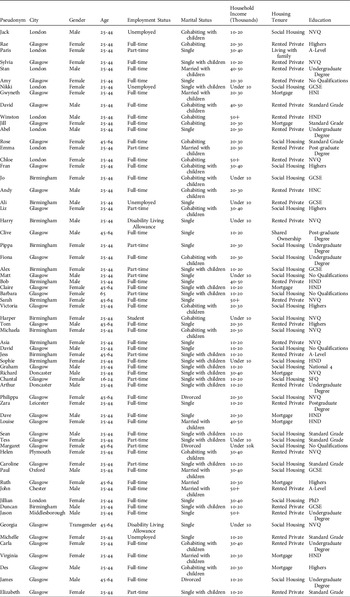
The aim of this paper is to explore the lived experience of being denied subprime, payday loan credit and the subsequent practices that declined applicants engage in. The fieldwork received ethical approval by Coventry University and was conducted between July 2017 and February 2018. We completed 64 in-depth, semi-structured qualitative interviews with declined payday loan borrowers. The interviews explored: participants’ ability to gain access to a payday loan before and after the price cap, what stricter guidelines for responsible lending have meant for consumers and their perceptions of financial wellbeing. Our interview locations centred on payday loan ‘hotspots’ of Birmingham and London in England, and Glasgow in Scotland (See Table 1 for demographic data; Aitken, Reference Aitken2014; Hilhorst and Jones, Reference Hilhorst and Jones2019; Partington, 2017; Stepchange, 2013).
Participant Profiles

(Source: own research)
For the first phase of research in England, participants were recruited through advertising the project in email newsletters and social media via: the Financial Health Exchange (a network of over 400 organisations including financial inclusion service delivery organisations and practitioners); Stepchange (the debt advice charity); and Street UK (an alternative lender). For the second phase of the research in Scotland, an external marketing company recruited participants using a screening questionnaire. We ensured that we had a mix of participants (in terms of age, gender and income) and arranged for sixty face-to-face interviews to take place in local community venues or a cafe. Four interviews were undertaken via telephone. The sample was not intended to be representative of UK payday borrowers but capture a deeper insight into the lived experience of payday borrowers to explore the commonalities between borrowers to develop ‘shared typical’ examples.
The average interview was twenty-five minutes. We transcribed the interviews in full and the transcripts produced four hundred pages of data. We first analysed the data by identifying initial key themes from a selection of transcripts as a team. Second, we undertook a more focused thematic analysis of the interview material using NVivo to organise the data and to identify core and subthemes (Ritchie et al., Reference Ritchie, Lewis, McNaughton Nicholls and Ormston2013). Third, we looked for patterns and connections between the codes. All participants were given pseudonyms to protect their identity and ensure anonymity.
The participants’ demographic was similar to those involved in previous studies focusing on the consumers of HCSTC prior to the new regulation (FCA, 2018). The borrowers who participated reflect a socioeconomic profile which generally positions them as socially marginalised, in low paid and insecure work, at risk of financial exclusion and living in poverty (Flaherty and Banks, Reference Flaherty and Banks2013; Rowlingson et al., Reference Rowlingson, Appleyard and Gardner2016). The majority were in full-time employment highlighting the financial precarity of those experiencing in-work poverty (Standing, Reference Standing2011). Participants were generally female, aged between 25-44 years old, employed full-time, single or living alone in rented (private or social) housing, over half had dependent children and were educated to HND level or equivalent (for participant demographics see Table 1). Almost 50 percent of participants were living on a low income, defined as a household earning less than £20,000 per annum (39 out of 64 participants) (National Statistics, 2018).
Findings: The lived experience of declined payday applicants
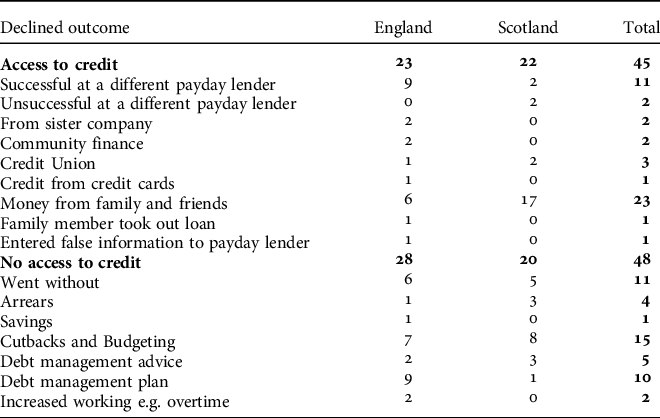
In this section, we examine the lived experience through the range of socioeconomic strategies that people take to explore the impacts of being declined a payday loan. We have created a typology which enables us to identify the types of financial subjectivities at the financial fringe (Table 2).
Declined applicant actions

(Source: own research)
Declined applicant actions
From our findings, we have identified sixteen actions that a declined applicant carried out after being declined a payday loan (see Table 2). We found that participants took a series of different actions after being declined that can be categorised in two ways: access to formal or informal credit products, or no access to credit; and people took different strategies to manage their finances.
We found that thirty-seven people took forty-six different actions to seek access to other sources of credit in response to being declined (Table 2). Twenty-seven people took forty-eight different actions towards other strategies that did not involve seeking credit (such as increasing their working hours). This is similar to findings from other research on financial strategies in the UK and elsewhere (Dagdeviren and Donoghue, Reference Dagdeviren and Donoghue2019; Sherraden et al., Reference Sherraden, McBride and Beverly2010). Of those that sought credit from other sources, family and friends are included within the credit seeking category as this is a type of informal lending. Our research found the number resorting to family and friends to be higher than the forty percent identified by the FCA (2017b). After being declined, the most likely outcome was to access credit from friends and family (taken by twenty-three of the sixty-four declined applicants) followed by applying for some kind of formal credit product. For example, eleven people sought and were successful in accessing a payday loan from another company after being declined a payday loan first. Two people were unsuccessful in their attempts, while another two were successful with a sister company of their original payday lender. Three borrowed from a credit union, one used credit cards, and two others used a community finance provider. One person borrowed money from a family member who took out a bank loan on their behalf. Another person entered false information to access a payday loan. We discuss the typical lived experiences in further detail below.
The calculative borrower: Payday loans from another lender
After being declined, eleven (out of sixty-four) participants reported re-applying for a loan with another HCSTC lender online or on the high street (See Table 2). One person even changed their information to fraudulently access a payday loan. Participants commented that a hierarchy of lenders exists so that they initially applied to companies that had marketed themselves widely then moved to those that were less well known and which had less stringent checks. For example, in two cases, online payday loan companies declined applicants, but then referred them to their sister lender:
‘Because [payday lender] didn’t approve me. They said to go to our sister company [another payday lender].’ (Bob, Birmingham)
This highlights the uneven impact that HCSTC regulation is having on lenders in practice and that the declined applicant status can be temporary and is dependent on space (which lender) and time (in the borrower’s income cycle). This demonstrates the difference in lenders’ assessments of creditworthiness and interpretation of the HCSTC regulation. The ways in which payday lenders have organised their operations (where different lenders operate under a group umbrella) suggests that their assessment process is designed to segment applicants depending on their credit score and match them to lenders that are likely to offer them credit. This referral process ensures that they can capture the marketplace and retain customers that are likely to go to competitors if declined. The implication of this is that payday lenders are adjusting their operations to the HCSTC regulation in a competitive market. Moreover, this research demonstrates that financial exclusion is a temporal process shaped by different lenders at the financial fringe. In addition, we suggest as a result of the HCSTC regulation that there is a growing spectrum of payday lenders at the financial fringe categorised by the risk they are willing to take on the borrower’s ability to repay and in terms of their responsible lending practices.
The fact that, even after being declined, people were calculative – in that they still sought credit as a solution to resolve their financial issues – raises a number of key points around their financial subjectivity. First, people were actively taking responsibility for their financial situation and seeking a solution. Second, they were prepared to take the risk of taking on debt to manage often financially precarious situations and prioritise their role as a responsible borrower to pay bills on time. Third, whilst taking on high-cost credit may seem an irrational choice, it was often the lender of last resort where participants considered that they had no other option. Some even quoted that a payday loan would be cheaper than using a mainstream bank overdraft. Seeking a cheaper form of credit would appear to be a more rational solution in the short-term; however, being further declined for credit may have a negative impact on their ability to access credit in the long term. These findings subvert existing notions of financial subjects at the financial fringe as detached and irrational – by demonstrating that they are active and calculative in seeking solutions.
The austere borrower: informal borrowing
When declined from accessing a payday loan, some participants borrowed from family members and, in one instance, used a family member’s ability to access lower interest financial products, such as a bank loan for the declined applicant. Family therefore play a significant role in providing financial and other support during austere times.
Accessing money from family and friends was not always a positive experience for some interviewees, with some expressing that they would rather have been able to access a form of regulated credit rather than expose their financial difficulties to others close to them due to the affective nature of money. This typical example of informal borrowing highlights the number of issues with this:
‘I ended up having to borrow off my mum. Yeah, I know …Oh honestly, I hate doing it, I absolutely hate doing it, but yeah, I ended up having to go to her…. Just because it makes you feel as if, like it’s my problem, do you know what I mean, it’s not hers, it’s mine, so I’m an adult now I should be able to deal with these kind of things myself. I just don’t like it. Like she doesn’t grudge it or nothing like that, she does get me it if I needed, but I’d rather not, it’s just pride really’ (Elizabeth, Glasgow)
Borrowing from family and friends is not without challenges. A number of participants noted that their financial situation caused them anxiety and stress. Whilst some participants in this situation wanted to preserve their self-esteem, some participants did not ask for help or discuss any financial problems with family members due to feelings of shame and guilt:
‘Well obviously it’s really difficult to ask people, whoever it is, close family for money because there’s a lot of stigma attached to that [laughter] and if you can sort of do it yourself then sometimes that seems like the better option’. (Jill, Glasgow)
The changes to HCSTC regulation and austerity may have forced some people to share their financial situation and families, rather than payday loans, have taken on the role of lender of last resort for many people at the financial fringe. This is despite many families having finite resources themselves (Dagdeviren and Donoghue, Reference Dagdeviren and Donoghue2019).
The alternative borrower: Affordable access to credit
The research revealed five cases in which borrowers used alternative, affordable and responsible finance, such as from a Credit Union or Community Development Finance Institution (CDFI), after being declined for a payday loan. In the UK, these alternative finance providers are responsible lenders that are designed to support financially excluded people that can afford to repay a loan. In this way, affordable, alternative financial products provide an opportunity to access credit at fair rates of interest. This signals to us that, despite being declined, people still sought access to credit. For example, there are few borrowing options for those on a low income or with impaired credit histories. The decision to seek credit was preferable for declined applicants rather than managing in other ways. For example, many respondents reported:
‘The immediate effect is just pure stress of what are we going to do now and then trying to figure out what you can do because you know full well the bank are not going to touch you’ (Pippa, Birmingham)
Overwhelmingly, participants were unaware of fair, ethical alternatives.
The self-disciplined borrower: No-access to credit
Further actions participants undertook after being declined a payday loan were making ‘cutbacks’, sacrifices and ‘budgeting’ their income, which often took great self-discipline (see Table 2 for no-access to credit options). Making such savings, however, is not an easy task for those on low and insecure incomes who often used credit to meet essential needs such as rent, food or utilities. Participants spoke about having to ‘go without’ after being declined a payday loan. This might mean not being able to pay household bills and enter arrears, buy a present or an item needed by a child, or something that might not be essential but was desired. For example, Stan shared how family and friends provide non-financial support:
‘I couldn’t get a tumble dryer, so obviously I have had to rely on my parents and family and friends to help me drying my children’s clothes because obviously I’ve got 3 children, so not being able to dry the clothes without anything to dry it with, so just relying on my family and friends at the moment until I can afford, either I can get someone to give me a loan to get one or whether I can save up and go and get myself one’. (Stan, London)
Some participants demonstrated greater financial awareness about making a decision that was appropriate for them. For example, they noted that being turned down for a loan gave them the opportunity to reconsider their finances such as through a ‘debt management plan’. Ali described being turned down for a loan as a wake-up call to reconsider his financial situation:
‘I haven’t been able to get the loans, I’ve learnt to budget a lot easier. If I was able to get the loans, I think I’d be in a lot more trouble than what I’m in now, kind of thing, but yes, it’s helped. It’s helped.’ (Ali, Birmingham)
This typical example of no-access to credit shows that the HCSTC regulation can prevent consumers from becoming over-indebted or to seek debt advice but also act as so-called ‘rational’ financial subjects to find a better solution to their situation and only borrow responsibly.
Discussion
As our findings show, UK HCSTC regulation has shifted the financial fringe further away from those at the financial margins making it harder to access regulated subprime credit, particularly for those that live in deprived areas or credit deserts. Within the context of UK welfare reform, austerity, insecure employment and incomes, the need for credit remains. Through examining the lived experience of declined payday loan applicants, we have shown that individuals employ a range of socioeconomic strategies to manage their finances in the absence of payday loans. In so doing, we argue that the financially marginalized are active, calculative and responsible financial subjects making difficult decisions in a financially ‘constrained choice’ environment, whether to pay bills through using high-cost credit or enter arrears and the broader implications of this action such as eviction and homelessness (Marston and Shevellar, Reference Marston and Shevellar2014). We argue that marginalized financial subjects are likely to have been conditioned through broader welfare policy reforms to perform particular subjectivities such as responsibility/agency (McIntosh and Wright, Reference McIntosh and Wright2019).
These findings show that the socioeconomic practices and subprime credit consumption provide important and realistic understandings of life at the financial fringe (Hall, Reference Hall2016). Moreover, this evidence subverts existing notions of subprime financial practices as irrational and irresponsible as:
‘everyday experiences of finance do not map so easily onto assumptions in policy-making about individuals as active, entrepreneurial financial subjects; they do not conform to policy makers’ expectations of calculative and rational financial subjectivities, regarding how people perceive, relate to and use finance in their everyday lives.’ (Hall, Reference Hall2016:327)
We suggest that subprime financial subjects can be rational and self-disciplined but this may not be within the same context of policymakers notions of subjectivity who assume that individuals have stable, secure incomes with sufficient means to save and have savings to draw upon for financial shocks. Through this understanding of the lived experience of financial subjects, we can contextualise these practices within austerity and the broader financial system (Lai, Reference Lai2017; Langley, Reference Langley2008).
The significant role of the household in supporting each other concurs with Hall (Reference Hall2016) particularly with little or no alternatives in a time of austerity. We suggest that informal borrowing is a common and important feature of individuals managing financial marginalization (Dagdeviren and Donoghue, Reference Dagdeviren and Donoghue2019; Shildrick et al., Reference Shildrick, McDonald, Webster and Garthwaite2012). Rowlingson et al. (Reference Rowlingson, Appleyard and Gardner2016) found that, prior to the HCSTC regulation being introduced, payday borrowers wanted to manage their situation independently without being a burden on their families. Hall (Reference Hall2016) also found that borrowing from family could complicate relationships and put people in challenging situations. The role of family and friends may be due to changing credit markets as a result of HCSTC regulation but is more likely to be a long-standing feature of the informal economy – particularly for those on low incomes – and thus warrants further attention.
Alternative and informal lending is rarely considered within the financialization of everyday life literature in the UK context, particularly the emotional aspect of financial decision-making (Hall, Reference Hall2016). Borrowing between family and friends was a major finding in our research and this often took place within a ‘mixed economy of credit’ whereby borrowers would borrow from a regulated source alongside informal borrowing (Marston and Shevellar, Reference Marston and Shevellar2014:155). A minority of participants used alternative, affordable and responsible forms of credit from a Credit Union or CDFI. Those people now excluded from payday loans could be defined as ‘entrepreneurial or thrifty’ financial subjects employing various coping strategies to get by but these were often unsustainable long-term such as selling household items or being fed by family or friends (Hall, Reference Hall2016: 317). Yet when considered together, informal and alternative credit practices are, albeit in small ways, challenging financialization and reshaping the financial fringe when mainstream and high-cost credit flows are limited.
We argue that HCSTC regulation has been used to normalize and shift payday lending further towards the mainstream financial sector in the financialization process. The lived experience of HCSTC regulation has meant that it is now more difficult for people at the financial fringe to access credit, increasing the number of people at the financial fringe and moving them further away from the financial mainstream.
Conclusions
This paper has conceptualized the financialization of everyday life through examining the socioeconomic practices of financial subjects at the financial fringes of the economy to show the range of strategies individuals employ to manage their finances. As such, we argue that the financially marginalized are active financial subjects albeit in a ‘constrained choice’ environment (Marston and Shevellar, Reference Marston and Shevellar2014). We have explored how financialization is an evolving process shaped by and dependent on credit markets, lenders and regulators creating active financial subjects to extract value through ‘precarious-inclusion’, government austerity and insecure labour markets (Appleyard et al., Reference Appleyard, Rowlingson and Gardner2016:311).
Examining the lived experience of declined payday applicants through understanding how they navigate the changing regulatory landscape and manage their finances at the fringes of the financial system makes two key theoretical and empirical contributions. First, drawing on the socioeconomic practices of financial subjects at the financial fringe allows us to ground the lived experience of financialization of everyday life to challenge the existing notions of financial subjectivity of those on a low and/or insecure income as irrational and detached. We argue that they are embedded within the financial margins of the financial system, rather than being detached. Our findings also highlight that these financial subjects are active, calculative, rational borrowers within their individual context. In addition, we have highlighted examples of where the welfare state ‘safety net’ has left individuals to take on greater financial responsibility. As a result, we argue that individual financial subjects at the financial fringe can exhibit the financial discipline of a responsible borrower, taking an active, entrepreneurial approach to managing their finances. However, this is not necessarily the type of entrepreneurial financial subjectivity sought by policymakers that advocate saving to reduce financial shocks and increase financial wellbeing. The paper makes a policy contribution by demonstrating that access to low or no cost credit for those excluded from HCSTC is essential to minimize the impact of HCSTC regulation. Second, our research shows how affordability assessments determine who can access credit and who is excluded according to one particular lender in a particular space and time highlighting the temporality of financial inclusion and the nature of ‘precarious inclusion’ at the financial fringe (Appleyard et al., Reference Appleyard, Rowlingson and Gardner2016:311). This also impacts the extent to which individuals are financialized.
The paper continues the call for a theoretical reconsideration of financialization of everyday life, displaying the merit in adopting a lived experience approach: to overcome binary understandings of decision making that fail to accurately represent people’s financial lives (Hall, Reference Hall2016; McIntosh and Wright, Reference McIntosh and Wright2019). This approach also highlights the wider role that regulation, lenders and communities play in reconfiguring the financial fringe and financialization of everyday life. We suggest that undertaking such in-depth qualitative research enables ‘hidden’ financial processes, practices and outcomes of financialization to be explored in order to advance conceptualizations of the financialization of everyday life. In an era of financial precarity and government austerity, we welcome further research on the lived experience of credit consumption including informal lending, alternative and mainstream finance to explore this increasingly significant market for those at the financial margins and how individuals both experience and challenge financialization.
Acknowledgements
The authors would like to thank the participants for sharing their lived experience for the research and the Barrow Cadbury Trust and Carnegie UK Trust for funding this research. We would also like to thank the two anonymous reviewers and editors for their constructive feedback during the review process.
Competing interests
The authors declare none.