




Introduction
New Democracy (Nea Dimokratia/ND) entered 2025 in an unexpectedly difficult position. Two crises shaped the political dynamic. The Tempi protests produced the most visible civic mobilisation in a generation, while the scandal at Payment and Control Agency for Guidance and Guarantee Community Aid (OPEKEPE) – the paying agency for Common Agricultural Policy subsidies supervised by the Ministry of Rural Development and Food – produced the most damaging evidence of governance failure. The Cabinet reshuffle of 14 March brought in Kyriakos Pierrakakis as Finance Minister and was framed by Mitsotakis as a pivot toward renewal and action. Pierrakakis was subsequently elected President of the Eurogroup, the first Greek to hold the post – though this success was quickly overshadowed by further political turbulence.
The political landscape remained fragmented. Polls consistently placed the cost of living, institutional crisis, and corruption as citizens’ top concerns. By year-end, ND led Panhellenic Socialist Movement–Movement for Change (Panellinio Sosialistiko Kinima-Kinima Allagis/PASOK-KINAL) by some 15 percentage points but remained below the one-party-government threshold – giving rise to a potential ‘ungovernability’ scenario ahead of the next elections. In a December Metron Analysis poll, 62 per cent of respondents expressed a desire for political change (Metron Analysis 2025), yet the opposition proved unable to capitalise in ways that would generate a viable alternative.
The economy performed well by headline indicators – 2.1 per cent GDP growth, declining unemployment, and a general government surplus of 1.7 per cent of GDP (European Commission 2026). Yet none of these achievements translated into improved poll standings for the government.
Election report
No national legislative elections took place in 2025
The year’s major event was the indirect presidential election in anticipation of the expiry of President Katerina Sakellaropoulou’s term on 13 March. In January, Prime Minister Mitsotakis nominated Konstantinos Tasoulas, a veteran ND politician who was elected three times as President of the Parliament from 2019 to 2025. Following Tasoulas’s nomination, the Parliament elected Nikitas Kaklamanis as the new President of the Parliament on 22 January with 247 votes in favour – a broad coalition of support that included MPs from various opposition parties.
Turning back to the election of a new President of the Republic, four rounds of voting were required. In the first round, the ND-backed Tasoulas received 160 votes against the 200 required. PASOK-KINAL’s proposed candidate, economist and former minister Tassos Giannitsis, received 34 votes; the Coalition of the Radical Left’s (Synaspismos tis Rizospastikis Aristeras/SYRIZA) candidate, former minister Louka Katseli, received 40 votes; while Victory’s (NIKI) candidate Konstantinos Kyriakou received 14. The second round again required 200 votes and the third 180. In the fourth and final round, the required majority was 151. Tasoulas secured 160 votes and was elected President of the Republic. He was inaugurated on 13 March. The New Left (Nea Aristera/NEAR) supported Katseli in the first three rounds but abstained from the final one, with its leader Alexis Charitsis citing the government’s disrespect for the rule of law.
Cabinet report
On 6 February, Deputy Minister for Climate Crisis and Civil Protection Christos Triantopoulos resigned ahead of the establishment of a preliminary inquiry committee into allegations that he had overseen the premature clearance of the Tempi crash site.
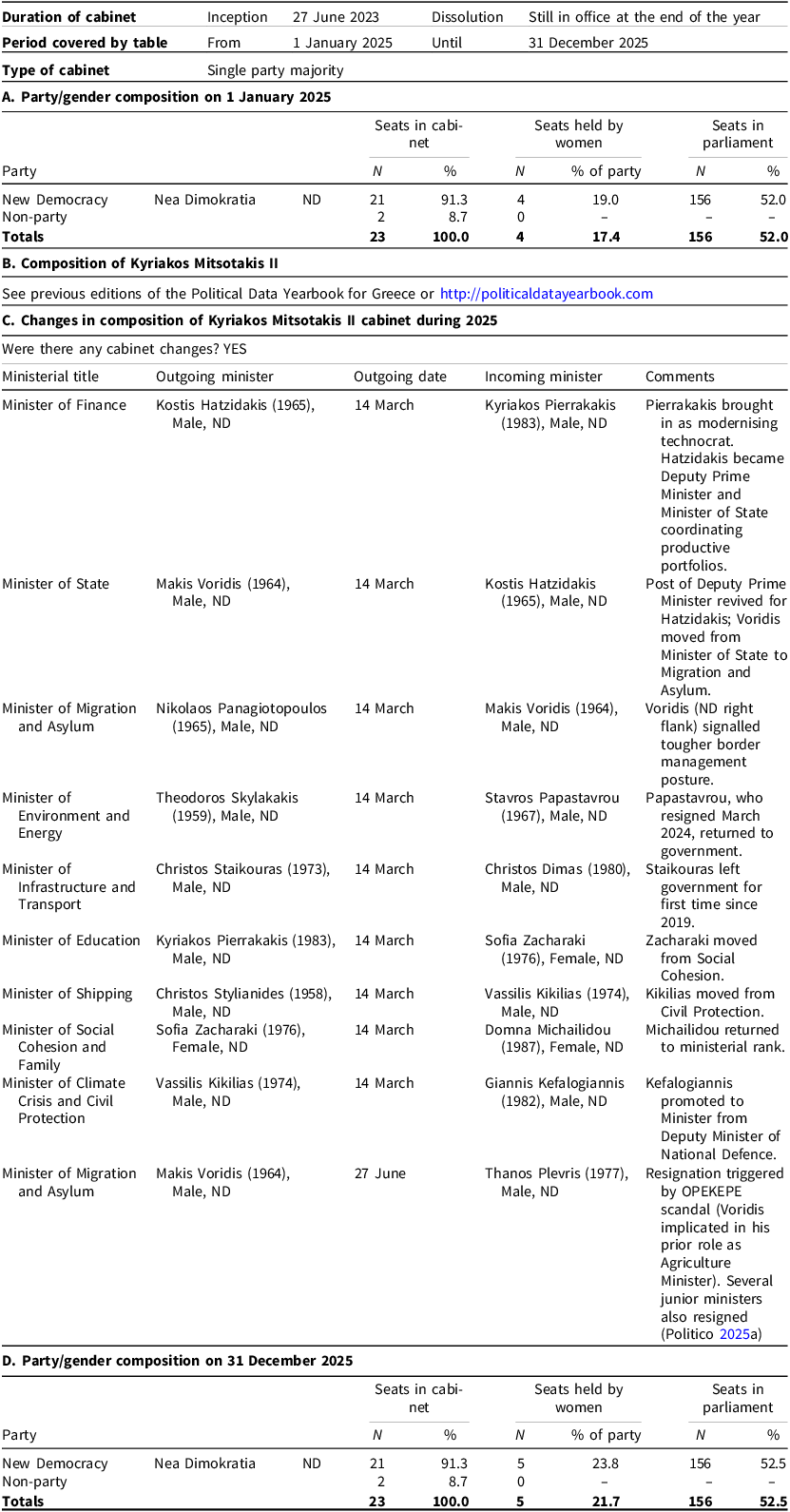
But the most significant political event of the first quarter was the sweeping Cabinet reshuffle of 14 March – the sixth of the Mitsotakis era (see Table 1). Framed as renewal and action with the slogan ‘Faster, Bolder’, it replaced the Finance Minister and restructured several portfolios. Former Finance Minister Kostis Hatzidakis moved to the revived Vice Presidency coordinating productive portfolios and was replaced by Kyriakos Pierrakakis – who had served in the past as Minister of Digital Governance and Education; Akis Skertsos coordinated institutional and social portfolios. Makis Voridis was appointed Minister of Migration; Stavros Papastavrou returned to government as Minister of Environment and Energy; Vassilis Kikilias moved to Shipping; and Christos Dimas took over Infrastructure and Transport. Sofia Zacharaki moved from Social Cohesion and Family to Education. Four ministers left the government altogether: Christos Staikouras at Infrastructure and Transport, Nikos Panagiotopoulos at Migration, Theodoros Skylakakis at Environment and Energy, and Christos Stylianides at Shipping, alongside a larger group of deputy ministers. The reshuffle also reduced the overall presence of women in government, from fifteen to twelve, concentrated in social-policy portfolios such as Education, Labour, Social Cohesion and Family, Culture, and Tourism, with women appearing in the core executive ministries only at deputy level (Marmara Reference Marmara2025). At ministerial rank, however, the number of women rose from four to five with the appointment of Domna Michailidou to Social Cohesion and Family (see Table 1). The Justice Minister was not replaced, attracting opposition criticism. The attempted reset was dented almost immediately when the newly appointed Deputy Development Minister, Aristos Doxiadis, stepped down less than 48 hours after taking office. Opposition parties had criticised his past involvement with a now defunct company that had twice been convicted of unfair competitive practices and indebted to suppliers and to the state in unpaid taxes. Doxiadis wrote in his resignation announcement that he was stepping down to spare the government a ‘witch hunt’ (Kathimerini 2025).
Cabinet composition of Kyriakos Mitsotakis II in Greece in 2025

Table 1. Long description
The table provides detailed information about the composition of Kyriakos Mitsotakis II cabinet in Greece in 2025. It includes the duration of the cabinet’s period, party/gender composition on January 1, 2025, and changes in the cabinet during 2025. The table is divided into several sections: A. Party/gender composition on 1 January 2025, B. Composition of Kyriakos Mitsotakis II, C. Changes in composition of Kyriakos Mitsotakis II cabinet during 2025, and D. Party/gender composition on 31 December 2025. The table lists the party, seats in cabinet, seats held by women, and seats in parliament for each party. It also details the outgoing and incoming ministers, their titles, and comments on the changes. The table highlights the significant political event of the first quarter, which was the sweeping Cabinet reshuffle of 14 March 2025.
Source: Greek Government (https://government.gov.gr/kivernisi/); authors’ compilation.
The reshuffled government also sought to shift attention back to economic considerations, with Labour Minister Niki Kerameus announcing an increase in the minimum wage from 830 to 880 euros from April, presented as an intermediate step towards the government’s pledge of 950 euros by 2027.
The OPEKEPE agricultural subsidies scandal – which broke in May (see Parliament report section) – forced a further round of ministerial changes. Voridis resigned as Migration Minister, along with Deputy Minister of Foreign Affairs Tasos Chatzivasileiou, Deputy Minister of Rural Development and Food Dionysis Stamenitis, Deputy Minister of Digital Governance Christos Boukoros, and Secretary-General of Rural Development and Food Giorgos Stratakos. Thanos Plevris was sworn in as Voridis’s successor at Migration and Asylum on 30 June. These departures constituted an unplanned mid-year reshaping of the Cabinet, compounding the political fallout from the scandal.
Parliament report
Two preliminary inquiry committees were established over Tempi, a parliamentary investigative committee was established over OPEKEPE, an all-night session on 30 July produced a constitutional controversy, Parliament’s composition fell to 297 members, and a former Prime Minister resigned his seat. Let us unpack these developments.
The opposition continued pressuring the government over the handling of the 2023 Tempi railway tragedy. PASOK-KINAL tabled a motion supported by SYRIZA, NEAR, Course of Freedom (Plefsi Eleftherias/PE), and nine independent MPs. The three-day debate concluded on 7 March with the government surviving 157–136 – a narrower majority than in March 2024 (159–141). Seven MPs were absent, including all remaining Spartans (Spartiates) MPs and former Prime Minister Samaras. Parliament also established two preliminary inquiry committees over Tempi, the first on Triantopoulos and the second on former Transport Minister Kostas Karamanlis (see Issues in national politics).
The OPEKEPE scandal – concerning the systematic abuse of EU agricultural subsidies through allegedly false declarations of pastures, livestock and crops – escalated in May, when the European Public Prosecutor’s Office (EPPO) conducted searches in Athens and Crete and subsequently compiled a dossier that was formally transmitted to the Greek Parliament. The case was further aggravated by Commission Implementing Decision (EU) 2025/1147 of 11 June, which excluded nearly €415 million in Greek expenditure from EU financing. The largest portion of this exclusion consisted of a horizontal 5 per cent penalty – totalling around €392 million – applied directly to the country’s farm-subsidy allocation (European Commission 2025). The political fallout was severe, costing Voridis – who had held the Agriculture portfolio during the period covered by the dossier – and four other officials their posts (see Cabinet report).
The OPEKEPE parliamentary track was more turbulent. A parliamentary investigative committee was established on 29 July with 166 votes in favour. One day later, on 30 July, an all-night plenary session debated the opposition’s proposals for a preliminary inquiry against former Agriculture Ministers Voridis and Avgenakis. The session descended into a parliamentary crisis. Government benches were largely empty as ND deliberated between abstention and outright opposition. The entire opposition then walked out in protest and the vote proceeded with a handful of government MPs present and the remainder submitting proxy votes. The opposition accused the government of a ‘parliamentary coup’ and violation of the Constitution. Former PASOK President and Deputy Prime Minister Evangelos Venizelos publicly condemned the procedure. The government insisted no validity issue arose. All the proposals were ultimately rejected, though the government emerged from the episode politically damaged having narrowly avoided a larger internal rupture.
The investigative committee began work in September, with dozens of witnesses examined. The government framed it as a transparency exercise, while the opposition characterised it as a ‘PR show’. The pressure intensified on 2 October, when EPPO chief prosecutor Laura Kövesi gave a press conference in Athens where she described OPEKEPE as ‘the acronym for corruption, nepotism and clientelism’ (Stamouli Reference Stamouli2025), dismissed the investigations to date as ‘at best superficial’, and identified Article 86 of the Constitution – which reserves the indictment of ministers to Parliament – as the basic obstacle to both the OPEKEPE and the Tempi probes, urging its amendment. Her intervention converted a domestic accountability dispute into a European rule-of-law issue. The case remained active into the autumn. On 13 October the European Anti-Fraud Office carried out an unannounced on-the-spot check at OPEKEPE’s Athens offices, reviewing payments across 2014–2025, on 22 October a police operation conducted within the EPPO-led investigation resulted in 37 arrests across northern Greece, Attica and Crete for systematic subsidy fraud dating back to at least 2018. The estimated damage to the EU budget exceeded €19.6 million and 13 suspects were remanded in custody (EPPO 2025). On 30 October the Financial Police seized the 2025 application files, reinforcing expectations that further revelations could follow (To Vima 2025a, 2025b). The two colourfully nicknamed protagonists of the affair – Giorgos Xylouris (known as ‘Frapés’, i.e., iced coffee) and Andreas Stratakis (‘Hasapis’, the butcher) – turned the proceedings viral on social media. Xylouris declined to appear, invoking his right to silence and submitting a written memorandum instead, a refusal the government majority chose not to override. Stratakis testified on 20 November and denied any involvement. PASOK MP Milena Apostolaki distinguished herself through her methodical cross-examination.
Several significant pieces of legislation passed during the year. A January domestic violence bill (157 for, 135 against) stiffened penalties, added cyber-stalking as an offence, and aligned Greek law with EU directives on gender-based motives (Stamatoukou Reference Stamatoukou2025). A labour bill by Minister Kerameus permitting 13-hour daily working periods under certain conditions passed in October amid two nationwide strikes and intense opposition from SYRIZA, the Communist Party of Greece (Kommounistiko Komma Ellados/KKE), NEAR, and trade unions. The government presented the measure as voluntary and covered by overtime protections, but its critics argued that it substantively eroded the eight-hour day and could become coercive in practice. The labour agenda closed on a more consensual note. On 26 November the government and all six national social partners, among them the General Confederation of Greek Workers (GSEE) and the employers’ Hellenic Federation of Enterprises, concluded a collective bargaining agreement, thereby reinstating the pre-memorandum regime and removing the last bailout-era restrictions on collective bargaining (To Vima 2025c). Whereas the government presented the accord as the restoration of pre-crisis labour rights, the opposition dismissed it as ‘too little, too late’, pointing to the absence of arbitration and to the newly legislated 13-hour day.
An amendment passed on 21 October concerning the Monument to the Unknown Soldier which transferred responsibility for its maintenance to the Ministry of Defence, while leaving public-order responsibilities with the Ministry of Citizen Protection, and introduced penalties for demonstrations, encampments or installations near the monument. The amendment, adopted by 159 votes in favour to 134 against, was widely interpreted as a response to the 23-day hunger strike by Tempi victim’s father Panos Ruci and exposed visible discomfort within the government (see Issues in national politics section).
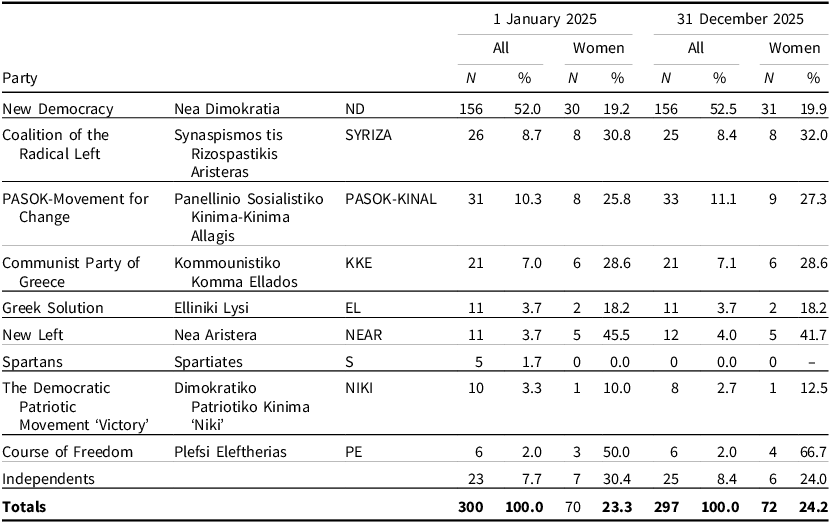
Volatility was high among certain parliamentary groups (see Table 2). PASOK-KINAL grew from 31 to 33 seats as Rania Thraskia and Petros Pappas, both elected with SYRIZA, joined its parliamentary group in February and March respectively, while NIKI lost Nikos Papadopoulos, expelled in May and Nikos Vrettos, expelled in September over the OPEKEPE affair. On 10 June the Electoral Court (Eklogodikeio) stripped three Spartiates MPs of their seats for deceiving voters, holding that the seats could neither be redistributed nor refilled. The Parliament therefore sat at 297 members for the remainder of the term, for the first time in the post-1974 period, and the Spartiates parliamentary group was dissolved for falling below the threshold. Under the Parliament’s rules, a parliamentary group requires at least ten MPs, or five, provided the party received over 3 per cent of the vote and stood candidates in at least two-thirds of constituencies (Hellenic Parliament 2025). The absolute majority threshold in the Parliament remained at 151.
Party and gender composition of parliament (Vouli) in Greece in 2025

Table 2. Long description
A table showing the party and gender composition of parliament in Greece on 1 January 2025 and 31 December 2025. The table has 12 rows and 10 columns. Column headers are: Party, 1 January 2025 All N, 1 January 2025 All %, 1 January 2025 Women N, 1 January 2025 Women %, 31 December 2025 All N, 31 December 2025 All %, 31 December 2025 Women N, 31 December 2025 Women %. Row 1: New Democracy, 156, 52.0, 30, 19.2, 156, 52.5, 31, 19.9. Row 2: Coalition of the Radical Left, 26, 8.7, 8, 30.8, 25, 8.4, 8, 32.0. Row 3: Aristeras, 31, 10.3, 8, 25.8, 33, 11.1, 9, 27.3. Row 4: Panhellenic Socialist Movement for Change, 21, 7.0, 6, 28.6, 21, 7.1, 6, 28.6. Row 5: Communist Party of Greece, 11, 3.7, 2, 18.2, 11, 3.7, 2, 18.2. Row 6: Greek Solution, 11, 3.7, 5, 45.5, 12, 4.0, 5, 41.7. Row 7: Spartiates, 5, 1.7, 0, 0.0, 0, 0.0, 0, 0.0. Row 8: The Democratic Patriotic Movement Victory, 10, 3.3, 1, 10.0, 8, 2.7, 1, 12.5. Row 9: Course of Freedom, 6, 2.0, 3, 50.0, 6, 2.0, 4, 66.7. Row 10: Independents, 23, 7.7, 7, 30.4, 25, 8.4, 6, 24.0. Row 11: Totals, 300, 100.0, 70, 23.3, 297, 100.0, 72, 24.2.
Note: The two new women MPs are Stella Arampatzi (ND), who took Apostolos Vesyropoulos’s seat after his passing in August, and Elli Roussou (PE), who replaced Diamantis Karanastasis following his resignation in November.
Source: Hellenic Parliament (2025); Mylonas (Reference Mylonas2025).
When former Prime Minister Tsipras resigned his parliamentary seat on 6 October (see Political party report), the seat passed to Thodoris Dritsas as first runner-up. But with Dritsas having joined NEAR, the seat was added to that group’s tally rather than SYRIZA.
ND MP Dimitris Kyriazidis was expelled from the parliamentary group in March after heckling Zoe Konstantopoulou during her speech, telling her to ‘have a child’. The condemnation was unanimous, though ND reinstated him in October.
Konstantopoulou (PE) was widely described in the press as the parliamentary personality of the year – omnipresent in proceedings, confrontational, and partly the catalyst for a revision of Parliament’s rules of procedure adopted in October (see Institutional change report).
Political party report
ND remained the dominant force but governed under societal pressure. The configuration of extreme multipartyism with one dominant party that emerged from the 2023 elections persisted throughout the year (Rori Reference Rori2025). Opinion polls, however, showed support stagnating at around 28–30 per cent throughout the year, well below the party’s 2023 election result. By December, one poll placed ND’s estimated vote share at 28.7 per cent, some 15 points ahead of PASOK, but still several points below the range that would plausibly deliver a single-party majority government under the reinforced proportional system’s sliding-scale bonus (see Rori Reference Rori2025: 1494).
Internally, Mitsotakis managed factions by balancing right-wing figures (e.g., Voridis, Georgiadis) with centrist technocrats (e.g., Pierrakakis, Chrisochoidis), though the OPEKEPE resignations disrupted this equilibrium. Several signs of persistent, albeit mild, backbench dissent continued during the year. In September, a group of eight ND backbenchers submitted a collective parliamentary question to Labour Minister Kerameus on pension inequities for former agricultural fund (OGA) widows. Internal party cohesion was further tested at the end of October, when the announced suspension of 204 branches of the Hellenic Post provoked the sharpest backbench revolt of the year: a four-hour teleconference of some 80 ND MPs, most vocally those from rural constituencies, was followed by the resignation of the company’s CEO on 4 November. What had been designed as a routine cost-cutting exercise became a symbol of the state’s withdrawal from the periphery, emboldening the same backbenchers who had been pressing the government on electricity prices and foreclosures. In November, a group of eleven ND backbenchers submitted a collective question on electricity prices, reflecting recurrent internal dissent.
The year’s fiscal showcase was the tax-reform package announced at the Thessaloniki International Fair in September (see Issues in national politics). Mitsotakis framed the announcements along two horizons: measures taking effect in 2026, and a set of reforms projected to 2030 that he presented as transcending electoral cycles and requiring broader consensus (Nellas Reference Nellas2025). Separately, on 11 December Pierrakakis was elected to lead the Eurogroup, succeeding Paschal Donohoe for a two-and-a-half-year term – though the achievement was quickly overshadowed by the farmers’ protests and their roadblocks across the country. Former PASOK minister Andreas Loverdos officially joined ND, described by the governing party as evidence of the party’s ‘bilateral broadening’. Finally, the cohesion of the ND voting bloc could be undermined by a potential Samaras party (Mylonas Reference Mylonas2025: 263–264).
PASOK-KINAL, under Nikos Androulakis, failed to benefit in the polls from the scale of ND’s difficulties and SYRIZA’s collapse. In fact, the average gap in opinion polls between ND and PASOK actually widened during the year – from approximately 13 percentage points in January (ND 30 per cent, PASOK 17 per cent) to 15 percentage points by December (ND 29 per cent, PASOK 14 per cent; Politico 2025b; Moschonas Reference Moschonas2026). PASOK’s most visible interventions were leading the no-confidence motion and the role of MP Milena Apostolaki in the OPEKEPE investigative committee. In terms of collaboration with other parties, Androulakis remained cautious about proposals for a joint list with SYRIZA.
The Tempi victims’ association leader Maria Karystianou – who had become a prominent public figure – was reportedly oriented toward founding her own political party, which, if realised, could draw votes from parties across the spectrum, since her public profile was not clearly identified with any established political camp.
SYRIZA, under Sokratis Famellos, continued its post-implosion struggle, with its estimated vote share falling to approximately 5 per cent by December – a dramatic collapse from its already low 2024 European Parliament result of 14.9 per cent. The pivotal development for SYRIZA was Alexis Tsipras’s resignation from his parliamentary seat on 6 October, after 16 consecutive years in the Parliament. His resignation statement cited a Parliament ‘democratically stripped’ of its constitutional role. The first edition of his memoir Ithaca, published on 24 November, sold out within hours of publication. At its presentation at the Pallas theatre on 3 December – attended by 19 of SYRIZA’s 25 MPs (including its leader Sokratis Famellos) and NEAR president Charitsis – Tsipras criticised the left’s fragmented ‘who’s first in the village’ mentality and characterised the overall picture as one of ‘shards and self-interest’. These events were widely read as the prelude to a new party. The SYRIZA-origin parties collectively (SYRIZA, NEAR, PE, Movement for Democracy/Kinima Dimokratias, and MeRA25) continued to aggregate around 23–24 per cent in the opinion polls – not a negligible electoral pool.
KKE remained stable at around 8–10 per cent in vote estimates, maintaining its distance from other formations. Course of Freedom (PE), led by Zoe Konstantopoulou, gained substantial visibility through the Tempi protests and parliamentary confrontation – polling briefly as high as 10–12.5 per cent in opinion polls by the end of the year, up from the 3.4 per cent it received in the 2024 European Parliament elections. Greek Solution (Elliniki Lysi/EL), led by Kyriakos Velopoulos, polled at approximately 11.7 per cent, vying with PE for third place. Voice of Reason–Afroditi Latinopoulou (Foni Logikis/FL) polled at approximately 4–5 per cent and Spartiates continued to disintegrate following the court-ordered removal of three of its MPs and the dissolution of its parliamentary group.
Institutional change report
No changes were made to the electoral law. The reinforced proportional representation system with a graded seat bonus remained in place.
Kaklamanis’s election as President of the Parliament (see Election report) brought changes to parliamentary procedure. New rules were voted on 30 October and implemented from November, introducing automatic time limits – the ‘cutter’ – on ministerial and party leader speeches, redistributing speaking time to backbenchers. Kaklamanis announced a wider rules review for spring 2026.
Issues in national politics
From late January to mid-March, the Santorini–Cyclades region experienced unprecedented seismic activity. Over 11,700 tremors were recorded between 26 January and early February alone, with the strongest reaching approximately 5.3 on the Richter scale and many exceeding 4.0. The government declared a state of emergency for the region from early February. Thousands of residents and workers evacuated the island; schools closed; local businesses suffered severe losses as tourists cancelled bookings and the start of the tourist season was pushed back. Seismic activity began subsiding in late February, and authorities moved to plan the reactivation of tourism and the return of residents.
The 2025 fire season ranked among the five worst of the last two decades, with 47,828 hectares burned – a 39 per cent increase over the 2006–2024 average (WWF Greece/FLAME Group 2025). A record heatwave exceeding 45°C, prolonged drought, and strong winds drove major fires in Chios, Patra, East Attica, Zakynthos, and Preveza-Epirus. One person died, over 60 were injured, and restoration costs exceeded €165 million. Six of the ten largest fires were attributed to the electricity transmission network.
The second anniversary of the Tempi train crash (28 February 2025) produced large protest marches. Demonstrations were held across more than 420 gathering points in Greece and over 100 abroad. The GSEE, Greece’s peak trade union confederation, and ADEDY (Supreme Administration of Civil Servants’ Trade Unions), the confederation of public sector employees, organised a nationwide general strike. Parliament established two successive preliminary inquiry committees: the first on Triantopoulos which drew support well beyond the governmental majority (4 March, 277 votes), and the second on former Transport Minister Kostas Karamanlis which rested solely on it (19 June, 154 votes). Regardless, both votes ended with the former ministers requesting self-referral to a judicial council, limiting Parliament to a referral role.
A decisive legal development shaped the political dynamic: the judiciary ultimately decided not to bring charges relating to the alleged illegal flammable cargo on the freight train, effectively foreclosing one of the two main narratives about the cause of the fireball. The Prosecutor General’s investigation (launched 7 April) against those publicly advocating the ‘illegal cargo’ theory was itself highly controversial. According to polling data, the two ‘sides’ on Tempi had stabilised by late February at approximately 70–30 against the government’s version (Malkoutzis Reference Malkoutzis2025), placing a ceiling on ND’s poll recovery.
A parallel dramatic episode involved Panos Ruci, father of a 22-year-old victim, who conducted a 23-day hunger strike outside the Parliament in Syntagma Square demanding the exhumation of his son’s remains for toxicological examinations. The authorities initially insisted this was impossible without delaying the trial; yet after 23 days, they reversed course without explanation. Defence Minister Dendias expressed support for Ruci’s demand from the parliamentary floor, reinforcing his reputation for independence.
The delays in OPEKEPE subsidy payments led to wider agricultural mobilisation. The organisation itself did not survive the scandal: its absorption into the Independent Authority for Public Revenue (AADE), announced in late May, was legislated in December (Law 5264/2025), with AADE assuming the paying-agency role from 1 January 2026 under a hybrid system for 2025 and a fully digital one thereafter. Whereas the transfer was presented as a guarantee of transparency, the transition itself delayed disbursements: the first payments arrived at the end of November, a month behind schedule, following the Commission’s green light of 19 November, with Deputy Prime Minister Hatzidakis conceding that failure to meet EU requirements could entail fines or the partial or total suspension of subsidies (Protothema 2025). The remedy thus temporarily fed the grievance it was meant to cure. From late November, thousands of farmers and livestock farmers blockaded the national road network with tractors – 59 roadblocks at its peak, alongside 45 regional rallies on the day of the budget vote (16 December). Their demands combined the release of the delayed subsidies with requests for lower fuel and energy costs, higher compensation from the agricultural insurance organisation (Hellenic Agricultural Insurance Organization/ELGA), and general income support. Mitsotakis acknowledged the grievances and called for dialogue, but the protesters – backed by broad public sympathy – remained at their blockades pending concrete commitments. On budget day, the wider general strike by ADEDY, teachers’ federations, and municipal workers’ unions demonstrated the breadth of social discontent. The budget passed, nonetheless.
The Tempi and OPEKEPE controversies fed into broader scrutiny of Greece’s international standing on rule-of-law indicators (Human Rights Watch 2025) and a deterioration in its standing on democracy indicators. V-Dem’s Democracy Report again flagged Greece as among the top autocratisers (Nord et al. Reference Nord, Altman, Angiolillo, Fernandes, Good God and Lindberg2025, Reference Nord, Altman, Fernandes, Good God and Lindberg2026). Press freedom indices placed Greece near the bottom of EU rankings (Reporters Without Borders 2025). Critics accused the government about blurring the line between judicial and executive power. Moreover, the tax authority’s (AADE) inspection of the offices of the Tempi Victims’ Association, conducted while OPEKEPE investigations were ongoing, generated accusations that regulatory tools were being deployed as political weapons against government critics.
Against the turbulent political backdrop, the economy performed well by headline indicators. The overall general government balance reached a surplus of 1.7 per cent of GDP. Public debt fell to 146.1 per cent of GDP – close to the levels recorded in 2010 when Greece received its first bailout – though it remained the highest ratio in the European Union (Eurostat 2026). The Athens Stock Exchange was upgraded to developed-market status by FTSE Russell, with the change to take effect from September 2026. DEPA and Aktor concluded a 20-year Liquefied Natural Gas (LNG) supply contract with US firm Venture Global for gas to flow primarily to Ukraine and Eastern Europe, positioning Greece as the EU’s entry point for American LNG (Atlantic Council 2025). The autumn also revived hydrocarbon exploration. On 23 October the Chevron-HelleniQ Energy consortium was designated as the preferred investor for four offshore blocks south of the Peloponnese and Crete, and on 6 November ExxonMobil acquired a 60 per cent stake in Ionian Block 2, west of Corfu, alongside Energean and HelleniQ, with exploratory offshore drilling expected in late 2026 or early 2027. These agreements were accompanied by a US-Greece Economic Security Declaration and the activation of the ‘Vertical Corridor’ for gas transit towards Ukraine (HELLENiQ ENERGY 2025).
In April, after confirmation of a stronger-than-projected fiscal outturn, the government announced a €1.1 billion package comprising €600 million in targeted support for renters and pensioners and an additional €500 million for the public investment budget, seeking to shift the agenda back to economic management after the Tempi crisis. The headline domestic initiative was the €1.6 billion tax-reform package (Law 5246/2025), effective from January 2026: zero-rate income tax for under-25s on income up to €20,000, reduced rates across brackets, and real estate tax revisions. The package was explicitly designed around the demographic question, with tax relief increasing with each dependent child and large families facing a zero rate on the €10,000–20,000 income bracket. The demographic issue was by then well established in the public debate: ELSTAT put the resident population at 10.37 million on 1 January 2025, with deaths exceeding births by 57,564 over the preceding year and the shortfall offset only by net migration (ELSTAT 2025). Births fell further over the course of the year, 4.2 per cent below 2024 (ELSTAT 2026). None of these measures translated into opinion poll gains for the government. Housing affordability remained a significant political issue as apartment prices continued to rise and short-term rentals constrained the long-term rental market in Athens and Thessaloniki. PASOK-KINAL pressed for rent controls.
A February bill on amateur and professional sport eased parts of the stadium-security regime introduced in 2024, abolishing the minister’s power to bar individual away-fan travel, adjusting police spot-checks on ticket holders and giving clubs access to camera identifications of offending supporters. Voluntary military service for women was also advanced, with applications for the first cohort to open in June 2026. A significant reform of inheritance law – the first in 80 years – was completed, with a committee proposing 13 major revisions to forced heirship, spousal inheritance rights, and estate management, which were submitted to Justice Minister Floridis.
Migration remained the field in which domestic and external policy most directly intersected. Flows continued, with NGOs documenting alleged pushbacks. The Ministry of Migration advanced Talent Visa and Tech Visa schemes. Greece–Turkey relations stalled after Turkey’s arrest of Istanbul Mayor Imamoglu in March triggered the postponement of the bilateral summit; a September New York meeting was cancelled at the last minute by the Turkish side. Greece–Israel–Cyprus trilateral security talks drew Turkish condemnation. In April, PM Mitsotakis and Defence Minister Nikos Dendias presented a twelve-year, €25 billion defence procurement programme (2025–2036), linking military modernisation to Greece’s changing security environment and to the government’s appeal to conservative voters. Greece continued its F-35 procurement and Ukraine support, with the Alexandroupoli port sustaining its NATO logistical role.
Data availability statement
The data for this article can be found at the PDY Interactive website: http://politicaldatayearbook.com.
Competing interests
The authors declare none.
Artificial intelligence disclosure
The authors used Gemini (Google) to search for and verify factual details of events reported in this article, and Claude (Anthropic) for editorial assistance (reviewing the draft for internal inconsistencies, repetition, and citation problems; standardising reference formatting; and proposing English-language sources in place of Greek-language ones). All substantive content, analysis, and interpretation are the authors’ own. The authors verified every source, figure, and claim and take full responsibility for the accuracy and integrity of the final text.

 Open access

