




No CrossRef data available.
Article contents
Processing efficiency and directed forgetting in bipolar disorder
Published online by Cambridge University Press: 16 December 2005
Abstract
We hypothesized that patients with bipolar disorder would demonstrate verbal recognition performance deficits consistent with processing efficiency theory, a theory about how emotional states modulate performance by interfering with working memory resources or increasing cognitive arousal/effort. We predicted that (1) a manic group (n = 26) would demonstrate slow reaction time (RT) and low accuracy, (2) a euthymic group (n = 23) would demonstrate slow RT to maintain high accuracy; and (3) a healthy comparison group (n = 25) would demonstrate fast RT and high accuracy. The groups were administered symptom-rating scales and compared on a computerized, trial-by-trial, directed forgetting in recognition task. This task requires participants to comply with an overt instruction to forget irrelevant studied words, and it places a relatively high demand on working memory. The manic group was impaired on directed-forgetting sensitivity; however, when RT was statistically controlled, the groups demonstrated similar directed-forgetting effects. These findings are consistent with processing efficiency theory. They suggest that bipolar patients perform directed forgetting in recognition by increasing effortful control at encoding at the expense of processing efficiency, although acute mania reduces the capacity for control, thereby impairing recognition performance. Problems with processing efficiency are viewed as trait characteristics of bipolar disorder that may be overlooked by traditional error-based assessments. (JINS, 2005, 11, 871–880.)
Keywords
Information
- Type
- Research Article
- Information
- Journal of the International Neuropsychological Society , Volume 11 , Issue 7 , November 2005 , pp. 871 - 880
- Copyright
- © 2005 The International Neuropsychological Society
INTRODUCTION
Mounting evidence suggests that bipolar disorder is characterized by performance deficits in a number of specific cognitive domains (Bearden et al., 2001; Quraishi & Frangou, 2002, for reviews), including prominent deficits in verbal declarative memory (Altshuler et al., 2004; Basso et al., 2002; Clark et al., 2001; Deckersbach et al., 2004; Fleck et al., 2003; Krabbendam et al., 2000; Martinez-Aran et al., 2004; van Gorp et al., 1998, 1999). Verbal memory deficits can lead to clinically significant impairment in everyday functioning (Goodwin & Jamison, 1990), leading some researchers to describe verbal memory as a “core deficit” of bipolar disorder (Martinez-Aran et al., 2004; Quraishi & Frangou, 2002). However, not all aspects of verbal memory performance are affected equally in bipolar patients.
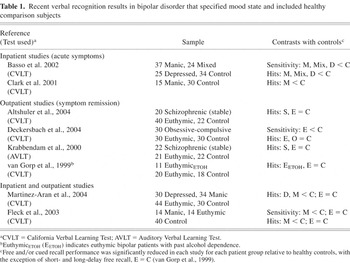
Recall is significantly impaired in both manic and euthymic patients relative to healthy comparison subjects, although recognition deficits are generally restricted to mania (Fleck et al., 2003; Martinez-Aran et al., 2004). As seen in Table 1, two recent inpatient studies of acutely ill patients in various mood states demonstrate significantly decreased recognition performance relative to healthy comparison subjects. In contrast, outpatient studies indicate that euthymic patients perform similarly to healthy comparison subjects on recognition measures, with the exception of the sensitivity measure in the Deckersbach et al. (2004) study. Two studies of acute inpatients relative to remitted outpatients further confirm findings of decreased recognition performance during acute mood states, but not during euthymia (see Table 1). These findings suggest that recognition performance may be primarily influenced by mood rather than representing a core deficit of bipolar disorder that persists in the absence of abnormal mood episodes. Therefore, it is important to better understand the impact of mood on recognition performance.
Recent verbal recognition results in bipolar disorder that specified mood state and included healthy comparison subjects

Processing efficiency theory (Eysenck & Calvo, 1992) was developed to account for the influence of mood on performance. Although it was originally formulated as a theory of anxiety, we believe it can be extended to account for the influence of any heightened mood state, including mania, on performance. According to processing efficiency theory, heightened anxiety (or other mood states by extension) reduces the overall processing capacity of working memory available to perform cognitive tasks and increases the on-task effort or strategy requirements to achieve adequate performance. The crucial distinction in this theory is that between performance effectiveness and processing efficiency. The effectiveness of cognitive processing with abnormal mood, for instance recognition performance during mania, is limited by the resources available to working memory. In the context of heightened mood, competition in working memory for limited resources available to process mood and memory concurrently would be expected to influence processing efficiency more than performance effectiveness (Eysenck & Calvo, 1992). That is, an individual may be able to achieve an adequate performance, but at the expense of processing efficiency. Supervisory control mechanisms of the prefrontal cortex, if available, may provide additional processing resources in the form of increased strategy use or effort (Norman & Shallice, 1986).
Performance effectiveness is defined by a cognitive outcome measure, usually an accuracy measure, while processing efficiency is defined by performance effectiveness in relation to measures of mental effort such as reaction time (RT). Unfortunately, processing efficiency deficits are often overlooked in the literature on psychiatric disorders, due to an overreliance on accuracy measures of performance effectiveness. In the case of recognition, reported accuracy measures have included hit rates and perceptual sensitivity (the ability to discriminate between targets and nontargets; e.g., d′, A′; See Table 1), to the exclusion of processing efficiency indices of effort and strategy use. These processing efficiency indices of response tendencies include response bias (either a liberal or conservative response tendency; e.g., β′′) trading accuracy for speed (an avoidance strategy indicating poor effort or impulsivity), and trading speed for accuracy (an index of decreased processing efficiency indicating good effort).
For the present study, we examined recognition processing efficiency in the context of a verbal directed-forgetting paradigm (Basden et al., 1993; Fleck et al., 2001; MacLeod, 1989) in manic and euthymic patients with bipolar disorder and in a comparison group of healthy participants. Directed forgetting is used to examine the ability to comply with an overt instruction to forget irrelevant or unimportant information. In the item-by-item variant of directed forgetting, words (or pictures) are presented one at a time and followed by a cue either to remember or forget that word. This stimulus presentation ensures that both “remember” and “forget” cued words are initially encoded prior to memory testing. Directed forgetting is demonstrated by poorer memory performance for forget-cued (F-cued) relative to remember-cued (R-cued) words on a memory test for both word types. This effect has been reliably demonstrated for a variety of explicit memory tests including recognition (Basden et al., 1993; Fleck et al., 2001; MacLeod, 1989, 1999).
The recollection of irrelevant F-cued words requires considerably more cognitive effort than that of relevant R-cued words, due to lower attentional demand and less focused rehearsal in working memory (MacLeod, 1998), making directed forgetting a good test of processing efficiency theory. In practice, however, any task involving working memory that incorporates both accuracy and RT measures could be used to assess processing efficiency (see Fleck et al., 2005 for a processing efficiency account of sustained attention in the current sample of patients with bipolar disorder), provided the task requires sufficient effort to elicit a processing decrement. Indeed, previous research shows that as task demands increase, the magnitude of attentional impairment increases disproportionately for patients with major affective disorders relative to control subjects (Cohen et al., 2001). The paradigm of directed forgetting in recognition was chosen for the present study because recognition has been well-studied in bipolar disorder, and directed forgetting provides increased difficulty and allows a direct comparison of the selective encoding of relevant (R-cued words) and irrelevant (F-cued words) information from working memory to long-term verbal memory.
Our goal was to examine whether recognition deficits involve an inability to selectively encode only relevant information to long-term memory (Hasher & Zacks, 1988). Clinical evidence suggests that psychopathology may induce a hypersensitivity to irrelevant information, possibly through disinhibition, that increases depth of processing by overrehearsal in working memory for instance. Our primary hypothesis was that bipolar patients would exert more effort on a recognition task as indicated by a primary deficit in processing efficiency. During mania, we also expected an increased presence in the working memory system of irrelevant information (i.e., by impaired selective encoding), ameliorating the standard directed-forgetting effect for recognition (see “Methods” for further description of this effect). We made the following directional hypotheses for each study group's yes/no recognition performance: (a) the manic group would demonstrate impaired processing efficiency and performance effectiveness (e.g., both RT slowing and accuracy deficits); (b) the euthymic group would demonstrate impaired processing efficiency and intact performance effectiveness (e.g., RT slowing to maintain accuracy); and (c) the healthy comparison group would demonstrate intact processing efficiency and performance effectiveness (e.g., no RT slowing and high accuracy). If these hypotheses were supported, the results would be consistent with processing efficiency theory.
METHODS
Participants and Materials
Twenty-six inpatients with a current DSM-IV diagnosis of bipolar I disorder, manic or mixed with psychotic features, and 23 euthymic outpatients with a current DSM-IV diagnosis of bipolar I disorder in full remission (no significant signs or symptoms of the disturbance during the past 2 months), most recent episode manic or mixed, were recruited from the inpatient psychiatry units at the University of Cincinnati Medical Center or the Cincinnati First-Episode Mania Study, respectively. Diagnoses were made with the Structured Clinical Interview for DSM-IV Axis I Disorders (SCID-I/P; First et al., 1997) by an experienced clinician (κ ≥ 0.90 with S.M.S.). Patients were excluded by a history of major medical, developmental, or neurological disorders as determined by the SCID-I/P and clinical evaluations. Those who met criteria for a substance use disorder were included if they were in sustained full remission (i.e., full criteria for dependence had not been met for 12 months or longer) and had not used substances during the week prior to testing. At the time of testing, seven euthymic and two manic patients were unmedicated while the remainder received some combination of atypical antipsychotic medications, lithium, valproate, carbamazepine, or clonazapam.
Upon hospital admission for manic inpatients or a scheduled research appointment for euthymic outpatients, symptom ratings were obtained by administering the Young Mania Rating Scale (YMRS; Young et al., 1978), Hamilton Depression Rating Scale (HDRS; Hamilton, 1960), and the Scale for the Assessment of Positive Symptoms (SAPS; Andreasen, 1984). A SAPS total score was determined by summing the global items for each subscale. Euthymia was characterized by HDRS total scores < 10, YMRS total score < 10, and SAPS global scores < 2. All ratings were performed by an experienced rater who had established acceptable interrater reliability (ICC ≥ 0.70 for all YMRS items, HDRS items, and SAPS global scores).
Twenty-eight healthy volunteers were recruited from the same catchment area as the patients. Healthy volunteers were excluded by the same criteria used for patients and by a history of psychiatric disorders as determined by the SCID-I/P and initial evaluation. The subject sample, both patient and healthy comparison participants, has been described previously for a study of sustained attention (Fleck et al., 2005); however, the current study includes data for one additional manic patient. After complete description of the study to the participants, written informed consent was obtained. This study was approved by the University of Cincinnati Institutional Review Board.
Computer Apparatus and Procedures
An IBM laptop computer was used to present stimuli for the yes/no recognition memory test. Each inpatient was tested on a psychiatry unit in a private exam room. Euthymic outpatients and healthy volunteers were tested individually in the medical school in a private office. Initially, participants were administered a continuous performance task that lasted approximately 15 minutes. These results have been reported previously (Fleck et al., 2005). The participants were then instructed that they would be shown a list of words, some followed by a prompt to remember and others followed by a prompt to forget. They were informed that they would subsequently be asked to recollect remember-cued (R-cued) words but not forget-cued (F-cued) words. Each trial consisted of a word presented at the center of the screen for 2 seconds, followed immediately by a remember (RRRRRR) or forget (FFFFFF) cue lasting 3 seconds. Two buffer words were added to the beginning and end of the study list to reduce the effect of word order. The buffers were always R-cued words, and with this exception, all study-list stimuli were presented in a different random order to each participant. There were 36 study words. At the conclusion of the study list, participants performed a lexical decision task for approximately 10 min before a recognition memory test was administered.
Yes/no recognition is a cued test of memory that requires deliberate recollection of the study list and measures explicit memory. Each of 62 words (16 R-cued words, 16 F-cued words, and 30 new words) was presented successively at the center of the screen in a different random order for each participant. The participants were instructed to decide whether each word was on the original study list, regardless of the initial instruction cue associated with each word. They were also instructed to respond with a key press as quickly and accurately as possible.
Directed forgetting in recognition is demonstrated when R-cued words are recognized more accurately than F-cued words. This performance difference is thought to reflect preferential encoding of R-cued words to long-term memory during study list learning (Woodward & Bjork, 1971). Three measures were of interest:
- Perceptual sensitivity (A′) was used to index the ability to discriminate targets (R- or F-cued words) from nontargets (distractor words). A′ is an appropriate measure when only one point in receiver operating characteristic (ROC) space is obtained. It provides an average between minimum and maximum performance and is analogous to the signal detection index d′.
- Response bias (β′′) was used to index a liberal versus conservative response tendency. β′′ is often paired with A′ and is analogous to the signal detection index β.
- Hit reaction time (Hit RT) was used to index psychomotor processing speed on correct trials.
Generally, A′ can be viewed as a measure of processing effectiveness while β′′ and Hit RT are measures of processing efficiency (e.g., motivation, effort, and speed). Hit and false alarm rates were used to calculate the nonparametric indices of A′ and β′′ used in the analyses (Grier, 1971), where x = probability of a false alarm and y = probability of a hit:

Statistical Analyses
All statistical analyses were performed using SPSS Version 11.0.1 (SPSS Inc., Chicago). Comparisons among the three groups were made for demographic, clinical, and rating scale variables. Chi-square analyses were used to test for differences in the distribution of sex, race, and current medication treatment. Each of the other comparisons was made using a one-way analysis of variance (ANOVA) and followed up with the Tukey honestly significant difference procedure (Tukey HSD) as appropriate.
Pearson bivariate correlations were then conducted between factors on which the groups differed significantly and the performance variables of interest. Additional within-group correlations between A′ and Hit RT were conducted to examine whether or not speed/accuracy tradeoffs existed in the data set.
To examine directed-forgetting performance in recognition, 3 (Group: control, euthymic, manic) × 2 (Stimulus Type: R-cued words, F-cued words) mixed ANOVAs were conducted on the A′, β′′, and Hit RT measures, including measures of effect size (partial eta squared, ηp2). For each significant effect or interaction identified by the omnibus test, mean comparisons were made with follow-up t-tests using the Bonferroni correction. Planned comparisons of the directed-forgetting effect within each group were examined using dependent samples t-tests regardless of the ANOVA outcome. An additional post-hoc analysis of covariance (ANCOVA) was conducted, with hit RT for R- and F-cued words as the covariates, to statistically control for the influence of RT on recognition accuracy. To further examine medication effects, post-hoc t-tests were conducted on the A′, β′′, and Hit RT measures between patients who were either receiving or not receiving medications in general and antipsychotic medications specifically.
RESULTS
Participant Characteristics
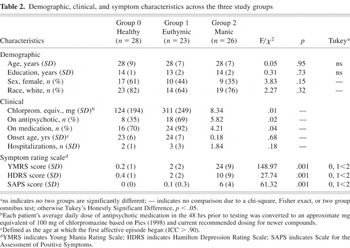
As seen in Table 2, the groups were well matched on relevant demographic and clinical characteristics including age, years of formal education, sex, race, age at illness onset, and number of psychiatric hospitalizations. As expected, patients in the manic group received significantly higher mean doses of antipsychotic medication [Chlorpromazine equivalents; F = 8.34, df = 1, 47, p < 0.01], were more likely to receive at least one antipsychotic medication [number on medication χ2 = 5.82, df = 1, p < .05], and were more likely to receive at least one psychotropic medication [number on medication; χ2 = 4.21, df = 1, p < .05] than those in the euthymic group. The manic group also had more elevated ratings on scales of mania [YMRS; F = 148.97, df = 2, 76, p < 0.001], depression [HDRS; F = 27.74, df = 2, 76, p < 0.001], and positive psychotic symptoms [SAPS; F = 61.32, df = 2, 76, p < 0.001] relative to both euthymic and healthy comparison groups.
Demographic, clinical, and symptom characteristics across the three study groups

There were no statistically significant correlations between chlorpromazine equivalent scores and R- and F-cued word performance (A′, β′′, Hit RT) [r = −.16 to .22, p > .05] or between symptom rating scale scores (HDRS, YMRS, SAPS) and performance [r = −.24 to .24, p > .05] in the combined patient sample (n = 49), suggesting that medication did not affect the main analyses substantially. Consistent with a typical speed/accuracy relationship, the R- and F-cued word Hit RT/A′ correlations were not significant and generally negative in all three groups [r = −.38 to .19, p > .05], indicating good effort and a lack of strong speed/accuracy tradeoffs.
Directed Forgetting in Recognition
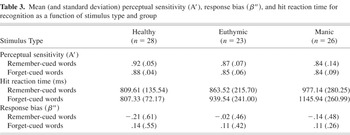
As seen in Table 3 and Figure 1a, participants generally had higher sensitivity scores (better discrimination between targets and distractors) for remember-cued words than for forget-cued words. Moreover, the healthy comparison group demonstrated greater overall sensitivity than the patient groups. These observations were confirmed by a mixed ANOVA yielding significant main effects of Stimulus Type [F(1,74) = 8.38, p < .01, ηp2 = .10] and Group [F(2,74) = 4.85, p < .05, ηp2 = .12]. The Stimulus Type × Group interaction did not reach statistical significance [F(2,74) = 1.21, p = .30, ηp2 = .03]. Pairwise group comparisons using the Bonferroni correction indicated that the healthy group demonstrated significantly better sensitivity than the manic group (p < .01), but was statistically similar in sensitivity to the euthymic group (p = .15). Moreover, there was no difference in performance between the manic and euthymic groups in overall sensitivity (p = .99). Planned comparisons of directed-forgetting effects within groups indicated that both the healthy and euthymic groups demonstrated a significant directed-forgetting effect; that is, greater sensitivity to R-cued words than to F-cued words [t(27) = 3.86, p < .001 and t(22) = 2.17, p < .05, respectively].
Mean (and standard deviation) perceptual sensitivity (A′), response bias (β′′), and hit reaction time for recognition as a function of stimulus type and group


Group comparison of (a) mean recognition sensitivity (A′), and (b) mean hit reaction time (ms) to remember- and forget-cued words in ANOVA.
As demonstrated in Table 3 and Figure 1b, a complementary performance pattern occurred for hit RT. Participants were generally faster at responding to remember-cued than to forget-cued words. Moreover, the healthy comparison group responded more rapidly than the patient groups overall. These observations were confirmed by a mixed ANOVA that yielded significant main effects of Stimulus Type [F(1,74) = 12.54, p < .001, ηp2 = .15] and Group [F(2,74) = 12.65, p < .001, ηp2 = .26]. However, in the analysis of Hit RT, these effects were qualified by a significant Stimulus Type × Group interaction [F(2,74) = 4.95, p < .01, ηp2 = .12]. Pairwise group comparisons indicated that both the healthy and euthymic groups were significantly faster than the manic group (p < .001 and .01, respectively). The healthy and euthymic groups responded with statistically similar latencies (p = .24). Planned comparisons of within group directed-forgetting effects indicated that both the manic and euthymic groups demonstrated a significant effect; that is, faster responses to R-cued words relative to F-cued words [t(25) = 3.07, p < .01 and t(22) = 2.21, p < .05, respectively], whereas this effect was not significant for the healthy comparison group.
A mixed ANOVA of response bias only yielded only a significant main effect of Stimulus Type [F(1,74) = 22.44, p < .001, ηp2 = .23]. Participants had a significantly lower response bias to R-cued (M = −0.13, SD = 0.53) than F-cued words (M = 0.12, SD = 0.43), indicating more liberal responding on remember-cued words relative to more conservative responding on forget-cued words. The groups did not differ in response bias and there was no Stimulus Type × Group interaction [F(2,74) = 0.26, p = .77, ηp2 = .01 and F(2,74) = 1.53, p = .22, ηp2 = .04, respectively] (See Table 3).
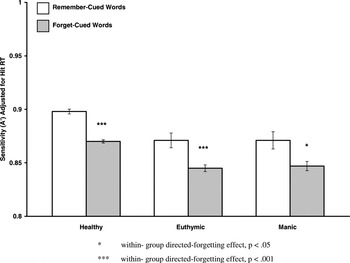
In light of the complementary patterns of performance for sensitivity and hit RT, we conducted a post-hoc analysis to control for the influence of information processing speed on perceptual sensitivity. As demonstrated in Figure 2, when hit RT for R- and F-cued words was statistically controlled, participants in each group were more sensitive to R-cued than to F-cued words, but the groups responded with statistically equivalent levels of overall sensitivity. These observation were confirmed in a mixed ANCOVA that yielded a significant main effect of Stimulus Type [F(1,72) = 4.84, p < .05, ηp2 = .06]. Neither the main effect of Group nor the Stimulus Type × Group interaction was significant in this run [F(2,72) = 0.95, p = .39, ηp2 = .03 and F(2,72) = 0.02, p = .98, ηp2 = .001, respectively]. However, hit RT for F-cued words had a significant between-subjects covariate effect on the model [F(1,72) = 8.18, p < .01, ηp2 = .10]. The planned comparisons of directed-forgetting effects yielded significant effects for the healthy, euthymic, and manic groups [t(27) = 38.22, p < .001; t(22) = 6.82, p < .001; t(25) = 2.02, p < .05, respectively].

Group comparison of mean recognition sensitivity (A′) to remember- and forget-cued words with remember- and forget-cued hit reaction time (msec) as covariates in ANCOVA.
To further examine possible medication influences, we compared the performance of patients who either were receiving or were not receiving medications in general (any combination of antipsychotic, antidepressant, and mood stabilizing medication) and those who either were receiving or were not receiving antipsychotic medications (any combination of conventional and atypical antipsychotic). There were no group differences on any of the performance measures of interest due to receiving medications [p = .26 (F-cued word RT) to .99 (R-cued word β′′)] or antipsychotics [p = .29 (F-cued word RT) to .93 (R-cued word β′′)].
DISCUSSION
The current study was conducted to examine processing efficiency differences between bipolar manic, bipolar euthymic, and healthy comparison participants using a directed forgetting in recognition paradigm. The sensitivity analysis indicated that overall recognition effectiveness (R- and F-cued word sensitivity combined) and directed-forgetting effectiveness (R-cued word superiority over F-cued words) were impaired in the manic group. The finding of impaired recognition during an acute mood episode of bipolar disorder is consistent with previous reports (Basso et al., 2002; Clark et al., 2001; Fleck et al., 2003; Martinez-Aran et al., 2004).
The RT analysis of recognition processing efficiency yielded a mirror image of the sensitivity results and included a significant Stimulus Type × Group interaction. The interaction represents a distinction in the speed at which the groups selectively processed R- and F-cued words. Taken together, the sensitivity and Hit RT results are consistent with our hypotheses and processing efficiency theory (Eysenck & Calvo, 1992). The healthy group was significantly more sensitive to R- than F-cued words (good performance effectiveness), without responding differently to each word type in terms of speed (good processing efficiency). The euthymic group also demonstrated good performance effectiveness, but was significantly slower at processing F-cued than R-cued words (poor processing efficiency). Finally, the manic group was similarly sensitive to R- and F-cued words (poor performance effectiveness) and slower to F-cued than R-cued words (poor processing efficiency).
Although the influence of medications on RT cannot be completely ruled out, it was not likely responsible for the directed-forgetting effects, as there were no significant relationships between performance measures and chlorpromazine equivalence scores. Moreover, there were no statistically significant mean differences on the performance measures of interest when patients receiving medications or not receiving medications were compared directly. If medication induced psychomotor slowing was the only factor accounting for RT effects in the patient groups, we would expect equivalent RT reductions for both R- and F-cued words, which was not the case. Rather, differential R- and F-cued word RT likely represents a processing efficiency distinction. Of course, overall RT slowing in the manic group might indicate a mild medication effect despite the lack of a statistically significant medication/performance relationship.
When information processing speed was held constant to examine performance effectiveness in the absence of processing efficiency differences, manic patients not only recognized previously presented verbal information as accurately as both euthymic and healthy participants, but also demonstrated intact selective encoding processes as indicated by a significant directed-forgetting effect. These findings are consistent with the notion that both manic and euthymic patients are capable of accurate overall recognition and selective encoding to long-term memory if processing efficiency is equated. Bipolar patients may be less able to selectively encode relevant (R-cued words) and irrelevant information (F-cued words) as instructed, consistent with mood-state related deficits in working memory storage or capacity, rather than having a stable verbal recognition memory deficit per se. Instead, verbal memory impairment may be secondary to a core deficit of processing efficiency in bipolar disorder, as has also been described for sustained attention (Fleck et al., 2005). The lack of response tendency differences (response bias) or significant speed/accuracy tradeoffs in the patient groups that might indicate an avoidance strategy (fast RT and low accuracy) or poor effort (slow RT and low accuracy) provide further support for a processing efficiency explanation of the current data. This interpretation is consistent with recent findings by Kieseppä et al. (2005) who reported that bipolar twins, but not nonbipolar co-twins, were impaired relative to controls on a comprehensive memory and verbal learning battery. Information processing speed had a significant effect on most memory and verbal learning tests. However, after adjusting test performance for processing speed, group differences between bipolar twins and controls were ameliorated in areas of working memory span, memory encoding, and learning efficiency, but remained significant on most recall measures (Kieseppä et al., 2005).
Poor inhibitory control is a common explanation for cognitive deficits in bipolar disorder (Murphy et al., 1999). Processing efficiency theory might also be used to make certain distinctions about the type of inhibitory control deficit involved. Harnishfeger (1995) defines inhibition as “an active suppression process, such as the removal of task-irrelevant information from working memory” (pp. 188–189). Decreased directed-forgetting accuracy (i.e., decreased sensitivity) is consistent with disinhibition based on the inability to actively suppress F-cued words in working memory (poor attention suppression; Zacks & Hasher, 1994). However, in the light of the accuracy correction when RT was controlled, poor attention suppression of task-irrelevant, F-cued information seems too simplistic an explanation. A more accurate representation of the deficit may involve an inability to resist interference from endogenous (e.g., racing thoughts) and exogenous sources (e.g., distractibility) related to mania, which decrease processing capacity. Just as secondary task interference has been shown to negatively impact primary task performance in healthy subjects tested in the laboratory (e.g., Baddeley & Hitch, 1974), manic patients must resist interference from intrusive feelings that compete for working memory resources on day-to-day tasks. An inability to resist mood-related interference could, in turn, affect task-related inhibitory processes (e.g., attention suppression) that would appear to represent the source of the inhibitory deficit in bipolar disorder. The implication of being able to better distinguish inhibitory constructs based on processing efficiency theory is clinically important. Inhibitory deficits characterized by an inability to resist interference (i.e., a processing deficiency) would be predicted to benefit from cognitive/behavioral techniques or medications that increase processing capacity (e.g., by focusing attention, slowing performance, increasing effort, or removing competing influences).
As with any clinical investigation, this study has several limitations that need to be considered. First, a longitudinal design assessing the same individuals in both euthymic and manic mood states would provide a better test of the stated hypotheses. Second, the scope of the study was restricted to recognition based on previously identified verbal memory deficit in patients with bipolar disorder. The extent to which these findings can be extended to other cognitive domains, or are related to task difficulty, will need to be determined. Third, co-occurring Axis I disorders, with the exception of past substance-use disorders, were a cause for exclusion from this study. This practice may limit the ability to generalize these findings to the broader population of patients with bipolar disorder. Fourth, because directed forgetting is rarely applied to clinical samples, standard relationships between performance and related factors not addressed in the current study, such as stimulus relevance, novelty, and attention, are unclear. Finally, with the present design it is difficult to determine whether symptom severity level or mood state better account for the findings. Future studies might incorporate patients with a full range of symptom severities to examine this issue.
Despite these limitations, the results suggest that verbal encoding for recognition is not a core deficit of bipolar disorder, but the result of a processing efficiency deficit. Consistent with processing efficiency theory, when supervisory control mechanisms (Norman & Shallice, 1986) are relatively intact during euthymia, the bipolar patients increased effort (Eysenck & Calvo, 1992), thereby decreasing processing efficiency (speed) to increase performance effectiveness (accuracy). By examining and controlling for measures such as effort, strategy use, and speed, researchers may get a more accurate picture of state- and trait-related deficits in bipolar disorder. Based on a processing-efficiency approach, we would argue that verbal-recognition deficits represent mood-state related decreases in processing efficiency rather than impaired selective encoding per se. Note that this interpretation is inconsistent with that of researchers who have proposed that verbal memory, as well as sustained attention, is a trait-related deficit based on traditional accuracy measures (Martinez-Aran et al., 2004; Quraishi & Frangou, 2002). However, by a more stringent processing efficiency approach, only deficits that stand up to corrections for effort and strategy use, either by statistical control or methodological control of speed/accuracy operating characteristics during both acute mood states and periods of symptom remission, can be considered core deficits.
Future studies with bipolar patients might assess processing efficiency in recall. Retrieval processes of recall are subserved by subcortical structures to a greater extent than encoding processes (Nuyen et al., 2005), possibly opening them up to the negative influence of subcortical structural abnormalities identified in neuroimaging studies (see Strakowski et al., 1999). Functional imaging results from our site indicate that supervisory mechanisms of prefrontal cortex are overactivated in euthymia relative to healthy comparison participants to maintain similar cognitive performance (Strakowski et al., 2004). This activation may indicate increased effort to compensate for subcortical abnormalities and be negatively related to processing efficiency. Future studies might benefit by utilizing chronometric tests within functional imaging paradigms to further identify and characterize processing efficiency deficits in bipolar and other psychiatric disorders.
ACKNOWLEDGMENTS
This work was supported in part by National Institute of Mental Health grants MH12883 (D. Fleck) and MH58170 (S. Strakowski).
References
REFERENCES
Altshuler, L.L.,
Ventura, J.,
van Gorp, W.G.,
Green, M.F.,
Theberge, D.C., &
Mintz, J.
(2004).
Neurocognitive function in clinically stable men with bipolar I
disorder or schizophrenia and normal control subjects.
Biological Psychiatry,
56,
560–569.Google Scholar
Andreasen, N.C.
(1984).
Scale for the assessment of positive symptoms (SAPS).
Iowa City:
The University of Iowa.
Baddeley, A.D. &
Hitch, G.
(1974).
Working memory. In
G.H. Bower (Ed.),
The Psychology of Learning and Motivation
(Vol. 8, pp.
47–89).
New York:
Academic Press.
Basden, B.H.,
Basden, D.R., &
Gargano, G.J.
(1993).
Directed forgetting in implicit and explicit memory tests: A
comparison of methods.
Journal of Experimental Psychology: Learning, Memory, and
Cognition,
19,
603–616.Google Scholar
Basso, M.R.,
Lowry, N.,
Neel, J.,
Purdie, R., &
Bornstein, R.A.
(2002).
Neuropsychological impairment among manic, depressed, and
mixed-episode inpatients with bipolar disorder.
Neuropsychology,
16,
84–91.Google Scholar
Bearden, C.E.,
Hoffman, K.M., &
Cannon, T.D.
(2001).
The neuropsychology and neuroanatomy of bipolar affective disorder:
A critical review.
Bipolar Disorders,
3,
106–150.Google Scholar
Clark, L.,
Iversen, S.D., &
Goodwin, G.M.
(2001).
A neuropsychological investigation of prefrontal cortex involvement
in acute mania.
American Journal of Psychiatry,
158,
1605–1611.Google Scholar
Cohen, R.,
Lohr, I.,
Paul, R., &
Boland, R.
(2001).
Impairments of attention and effort among patients with major
affective disorders.
Journal of Neuropsychiatry and Clinical Neurosciences,
13,
385–395.Google Scholar
Deckersbach, T.,
Savage, C.R.,
Reilly-Harrington, N.,
Clark, L.,
Sachs, G., &
Rauch, S.L.
(2004).
Episodic memory impairment in bipolar disorder and
obsessive-compulsive disorder: the role of memory strategies.
Bipolar Disorders,
6,
233–244.Google Scholar
Eysenck, M.W. &
Calvo, M.G.
(1992).
Anxiety and performance: The processing efficiency theory.
Cognition and Emotion,
6,
409–434.Google Scholar
First, M.G.,
Spitzer, R.L.,
Gibbon, M., &
Williams, J.B.W.
(1997).
Structured clinical interview for DSM-IV Axis I
disorders—patient edition (SCID–I/P).
New York:
Biometrics Research Department, New York State Psychiatric
Institute.
Fleck, D.E.,
Berch, D.B.,
Shear, P.K., &
Strakowski, S.M.
(2001).
Directed forgetting in explicit and implicit memory: The role of
encoding and retrieval mechanisms.
Psychological Record,
51,
207–221.Google Scholar
Fleck, D.E.,
Shear, P.K., &
Strakowski, S.M.
(2005).
Processing efficiency and sustained attention in bipolar
disorder.
Journal of the International Neuropsychological Society,
11,
49–57.Google Scholar
Fleck, D.E.,
Shear, P.K.,
Zimmerman, M.E.,
Getz, G.E.,
Corey, K.B.,
Jak, A.,
Lebowitz, B.K., &
Strakowski, S.M.
(2003).
Verbal memory in mania: Effects of clinical state and task
requirements.
Bipolar Disorders,
5,
375–380.Google Scholar
Goodwin, F.K. &
Jamison, K.R.
(1990).
Manic-depressive illness.
New York:
Oxford University Press.
Grier, J.B.
(1971).
Nonparametric indexes for sensitivity and bias.
Psychological Bulletin,
75,
424–429.Google Scholar
Hamilton, M.
(1960).
A rating scale for depression.
Journal of Neurology, Neurosurgery, and Psychiatry,
23,
56–61.Google Scholar
Harnishfeger, K.K.
(1995).
The development of cognitive inhibition: Theories, definitions, and
research evidence. In
F.N. Dempster &
C.J. Brainerd (Eds.),
Interference and Inhibition in Cognition (pp.
175–204).
San Diego:
Academic Press.
Hasher, L. &
Zacks, R.T.
(1988).
Working memory, comprehension, and aging: A review and a new
view. In
G.H. Bower (Ed.),
The Psychology of Learning and Motivation
(Vol. 22, pp.
193–225).
San Diego:
Academic Press.
Kieseppä, T.,
Tuulio-Henriksson, A.,
Haukka, J.,
van Erp, T.,
Glahn, D.,
Cannon, T.D.,
Partonen, T.,
Kaprio, J., &
Lönnqvist, J.
(2005).
Memory and verbal learning functions in twins with bipolar-I
disorder, and the role of information-processing speed.
Psychological Medicine,
35,
205–215.Google Scholar
Krabbendam, L.,
Honig, A.,
Wiersma, J.,
Vuurman, E.F.P.M.,
Hofman, P.A.M.,
Derix, M.M.A.,
Nolen, W.A., &
Jolles, J.
(2000).
Cognitive dysfunction and white matter lesions in patients with
bipolar disorder in remission.
Acta Psychiatrica Scandinavica,
101,
274–280.Google Scholar
MacLeod, C.M.
(1989).
Directed forgetting affects both direct and indirect tests of
memory.
Journal of Experimental Psychology: Learning, Memory, and
Cognition,
15,
13–21.Google Scholar
MacLeod, C.M.
(1998).
Directed forgetting. In
J.M. Golding &
C.M. MacLeod (Eds.),
Intentional Forgetting: Interdisciplinary Approaches (pp.
1–57).
Mahwah, NJ:
Lawrence Erlbaum.
MacLeod, C.M.
(1999).
The item and list methods of directed forgetting: Test differences
and the role of demand characteristics.
Psychonomic Bulletin and Review,
6,
123–129.Google Scholar
Martinez-Aran, A.,
Vieta, E.,
Reinares, M.,
Colom, F.,
Torrent, C.,
Sanchez-Moreno, J.,
Benabarre, A.,
Goikolea, J.M.,
Comes, M., &
Salamero, M.
(2004).
Cognitive function across manic or hypomanic, depressed, and
euthymic states in bipolar disorder.
American Journal of Psychiatry,
161,
262–270.Google Scholar
Murphy, F.,
Sahakian, B.,
Rubinsztein, J.,
Michael, A.,
Rogers, R.,
Robbins, T., &
Paykel, E.
(1999).
Emotional bias and inhibitory control processes in mania and
depression.
Psychological Medicine,
29,
1307–1321.Google Scholar
Norman, D.A. &
Shallice, T.
(1986).
Attention to action: Willed and automatic control of
behavior. In
R.J. Davidson,
G.E. Schwartz, &
D. Shapiro (Eds.),
Consciousness and Self-Regulation
(Vol. 4, pp.
1–18).
New York:
Plenum Press.
Nuyen, J.,
Sitskoorn, M.M.,
Cahn, W., &
Kahn, R.
(2005).
Verbal memory in first-episode schizophrenia: Heterogeneity in
performance?
Journal of the International Neuropsychological Society,
11,
152–162.Google Scholar
Pies, R.W.
(1998).
Handbook of essential psychopharmacology.
Washington, DC:
American Psychiatric Press.
Quraishi, S. &
Frangou, S.
(2002).
Neuropsychology of bipolar disorder: A review.
Journal of Affective Disorders,
72,
209–226.Google Scholar
Strakowski, S.M.,
Adler, C.M.,
Holland, S.K.,
Mills, N.P., &
DelBello, M.P.
(2004).
A Preliminary FMRI study of sustained attention in euthymic,
unmedicated bipolar disorder.
Neuropsychopharmacology,
29,
1734–1740.Google Scholar
Strakowski, S.M.,
DelBello, M.P.,
Sax, K.W.,
Zimmerman, M.E.,
Shear, P.K.,
Hawkins, J.M., &
Larson, E.R.
(1999).
Brain magnetic resonance imaging of structural abnormalities in
bipolar disorder.
Archives of General Psychiatry,
56,
254–260.Google Scholar
van Gorp, W.G.,
Altshuler, L.,
Theberge, D.C., &
Mintz, J.
(1999).
Declarative and procedural memory in bipolar disorder.
Biological Psychiatry,
46,
525–531.Google Scholar
van Gorp, W.G.,
Altshuler, L.,
Theberge, D.C.,
Wilkins, J., &
Dixin, W.
(1998).
Cognitive impairment in euthymic bipolar patients with and without
prior alcohol dependence.
Archives of General Psychiatry,
55,
41–46.Google Scholar
Woodward, A.E. &
Bjork, R.A.
(1971).
Forgetting and remembering in free recall: Intentional and
unintentional.
Journal of Experimental Psychology,
89,
109–116.Google Scholar
Young, R.C.,
Biggs, J.T.,
Ziegler, V.E., &
Meyer, D.A.
(1978).
A rating scale for mania: Reliability, validity, and
sensitivity.
British Journal of Psychiatry,
133,
429–435.Google Scholar
Zacks, R.T. &
Hasher, L.
(1994).
Directed ignoring: Inhibitory regulation of working memory.
In
D. Dagenbach &
T.H. Carr (Eds.),
Inhibitory processes in attention, memory, and language (pp.
241–264).
San Diego:
Academic Press.
Recent verbal recognition results in bipolar disorder that specified mood state and included healthy comparison subjects
Demographic, clinical, and symptom characteristics across the three study groups
Mean (and standard deviation) perceptual sensitivity (A′), response bias (β′′), and hit reaction time for recognition as a function of stimulus type and group

Group comparison of (a) mean recognition sensitivity (A′), and (b) mean hit reaction time (ms) to remember- and forget-cued words in ANOVA.
Group comparison of mean recognition sensitivity (A′) to remember- and forget-cued words with remember- and forget-cued hit reaction time (msec) as covariates in ANCOVA.
 You have
Access
- 7
- Cited by